R. Gomathi (Correspondence)
[email protected]
+
1Sugarcane Breeding Institute (ICAR), Coimbatore-641007, Tamil Nadu
Abstract: An experiment was conducted with the objective of standardizing temperature conditions for screening thermotolerance in sugarcane variety Co 86032 under in vivo and in vitro conditions. Lethal temperature condition for settlings (in vivo) and callus (in vitro) were identified by subjecting the 30 days old settling and callus 7 temperatures condition (39, 41, 43, 45, 47, 48 and 49 ºC) with four time durations (5, 10, 15 and 20 hrs). Temperature conditions at 48ºC with 20 h and 48 ºC with 15 h of heat stress treatment were identified as critical temperature condition for settlings and callus respectively. To determine the optimum induction temperature conditions (sub lethal temperature) for settlings, the variety Co 86032 was exposed to gradual increase in temperature from 38, 40, 42 to 44 ºC with two time durations (10 and 15 h), followed by lethal temperature (48 ºC with 10 h). The optimum induction temperature condition for developing thermo tolerance in settlings was worked out to be 40 ºC with 10 h stress treatment. Similarly, the optimum induction temperature condition for calli for develop thermo tolerance was worked out as 42ºC with 10 h. Adaptive response of Co 86032 by heat acclimation was investigated under in-vivo and in-vitro conditions through temperature induction response technique. It was found that induced settlings and calli for thermotolerance recorded higher soluble protein, proline, glycine betaine, total phenols, POX activity and SOD activity than non-induced.
Keywords: Sugarcane, temperature induction response (TIR) technique, in vivo, in vitro, thermotolerance, ROS scavenging enzymes, osmolytes
INTRODCUTION
It has been observed that on many occasions a relevant physiological trait could not to be related to stress tolerance in known tolerant genotypes/species, mainly because expression of this trait was examined by directly subjecting plants to severe stress. Earlier reports suggest that genetic variability could not be visualized when plants were directly exposed to severe stress. (Uma et al. 1995). Several studies have shown that an acclimated plant survives when exposed to a temperature that would be lethal to a non-acclimated plant. This phenomenon is the major aspect of acclimation response termed as acquired thermo tolerance. This involves expression of diverse stress-responsive genes to maintain metabolic homeostasis during stress or to be able to re-establish, subsequent to the stress period (Hong et al. 2003). The major principle in induction (acclimation) response technique is to initially expose seedlings/plants to a less severe temperature before these are challenged with severe temperature and subsequent recovery. The seedling survival and recovery growth is considered as criteria to arrive at optimum acclimation stress levels. Thus, relevance of a physiological and biochemical trait for thermo tolerance can best be studied by pre exposure of
seedlings or plants to a sub lethal acclimation temperature. Many of the earlier work have proved that the genetic variability occurs when the plant is exposed to sub lethal induction (Srikanthbabu et al.
2002).
As thermo tolerance is a multigenic trait emphasis needs to be on relevant approaches to assess the genetic variability in basal and acquired tolerance. This is in fact the major aspect in crop improvement programmes. Temperature induction response (TIR), a high throughput approach has been utilized for screening of thermo tolerance in many of the crops viz., pea, pearl millet, cotton, finger millet, sunflower, capsicum, ground nut and soybean etc (Senthil-Kumar et al. 2003, Gopalakrishna 2001, Uma et al. 1995). Thermotolerance might be acquired by heat acclimation, which can occur through exposure to a non-lethal heat treatment (Levitt 1980; Chen et al. 1982; Gong et al. 1997, 1998; Hatice and Atilla 2003). The processes involved in temperature acclimation are initiated by the perception of temperature signals and transduction of these signals into biochemical processes that finally lead to the development of heat tolerance (Sangwan and Dhindsa 2002, Xu et al.
http://www.ijSciences.com
Volume 3 - March 2014 (3)
6
of metabolism and gene expression at hightemperatures (Vierling, 1991), which enables plants to minimize heat injury. Heat acclimation also involves a considerable reorganization of thylakoid membrane, including adaptive changes of lipid composition (Larkindale and Huang 2004). Sugarcane requires optimum temperature (32-33ºC) for growth, productivity and yield expression, and it is known to tolerate temperatures approaching 40°C, while high temperature around 45°C is detrimental to sugarcane growth (Wahid et al.2007). Heat stress greatly changes the physiological and biochemical phenomena of sugarcane leading to growth and yield suppression. Sugarcane grown under high temperature exhibited smaller internodes and early drying of leaves with increased tillering with reduced biomass. Very little is known, about the defense mechanism in sugarcane against high temperatures stress. Hence, a suitable technique for screening high temperature-tolerant sugarcane germplasm and cultivars is required in order to stabilize yield in the current and future warmer climate conditions. MATERIALS AND METHODS
Determination of lethal and sub-lethal temperature condition for settlings (in vivo)
Experiment I: To identify lethal (critical) temperature condition for bud chip raised settlings. Thirty days old settling (40 settlings) of Co 86032 were subjected to 7 temperature levels (39, 41, 43, 45, 47, 48 and 49 ºC) with four time durations (5, 10, 15 and 20 h) in BOD incubator (Table 1). The settlings maintained at 30 to 32 °C (normal temperature) throughout the experimental period were taken as controls. On completion of stress treatment, settlings were kept for incubation for 3 days at 32 °C and then the settling survival percent was worked out to identify the challenging temperature condition. Temperature at which 100% settling mortality occurred was considered as challenging temperature.
% survival of settlings = No. settlings survived at the end of recovery/ X 100
Total no. of settlings
Experiment II: To identify the sub lethal temperature conditions for bud chip raised settlings, settlings of Co 86032 were exposed to gradual increase in temperature (38, 40, 42 and 44 ºC) and time durations (10 and 15 h) followed by lethal temperature (48 ºC with 20 h).The settlings which are maintained at 30 °C (normal temperature) throughout the experimental period were taken as controls. The induction temperature treatment at which maximum percentage survival of the settlings was observed after exposing to the identified challenging temperature was considered as the optimum induction temperature. Percent growth of settlings was calculated as follow:
% in settling growth = (RG induced- RG non induced) /control growth) X 100
* RG= relative growth
Determination of lethal and sub-lethal temperature condition for callus (in vitro)
Experiment I:To identify lethal (critical) temperature condition for calli, the calli of Co 86032 developed through in vitro method were subjected to seven temperature condition (36, 38, 40, 42, 44, 46 and 48 ºC) and four time durations (5, 10, 15 and 20 h). On completion of stress treatment, callus was kept for incubation at normal temperature (± 24 ºC) for 24 hours. The calli which were maintained at normal temperature throughout the experimental period were taken as controls. At the end of recovery period cell viability test (TTC assay) was done to work out the callus survival percent. The temperature at which 100% callus mortality occurred was considered as challenging temperature.
Survival % of callus = (No. callus survived at the end of recovery/ Total no. of callus) X 100
Experiment II ( Sub-lethal Temperature): During the induction treatment, callus of Co 86032 was exposed to gradual increase in temperature (38, 40, 42 and 44 ºC) for two time durations (10 and 15 h) followed by lethal temperature (48 ºC with 15 h). The calli which were maintained at ± 24 °C (normal temperature) throughout the experimental period were taken as absolute controls. On completion of temperature treatment, calli were allowed to recover for 24 h at room temperature (±24°C and 60 percent RH). The induction temperature treatment at which maximum percentage survival of the calli was observed after exposing to the defined challenging temperature was considered as the optimum induction temperature. Percent survival growth in callus was calculated as follows:
% in callus growth = (RG induced- RG non induced) /control growth) X 100
* RG= relative growth
Physiological and biochemical assays: The variety Co 86032 was subjected to the identified lethal and sub lethal temperature conditions (both in vivo and in vitro) and the metabolic and cellular responses for thermotolerance were investigated. For in vivo
http://www.ijSciences.com
Volume 3 - March 2014 (3)
7
protein, proline, glycine- betaine, soluble sugars, totalphenols, APX, POX and SOD activity, percent membrane injury, lipid peroxidation, identification of temperature induced proteins by SDS-PAGE, isozyme pattern of POX and SOD were assayed. Free proline was determined from the frozen fresh leaf powder extracted with sulphosalicylic acid, as described by Bates et al. (1973). Glycine-betaine was determined using the method of Grieve and Grattan (1983). Soluble sugars quantified by the method of Yoshida et al. (1976). Protein was estimated by the method as described by Lowry et al. (1951). Peroxidase activity was assessed following the oxidation of o-dianisidine by following the method of Malik and Singh (1980). SOD activity was determined by using Nitro Blue Tetrazolium (NBT) salt as described by BeauChamp and Fridovich (1971) and expressed as enzyme units g-1 protein min -1
. Lipid peroxidation was measured by estimating thiobarbituric acid reactive compounds (Heath and Packer 1968). Percent membrane injury protocol was modified from Leopold et al. (1981) and Tripathy et al. (2000). Electrophoresis of protein was carried out through native and SDS-PAGE (Laemmli 1970). The isoenzyme pattern of Peroxidase was estimated by staining gels through Benzidine following the method of Nadonly and Sequeiria (1980). SOD was estimated and analyzed by the method of Beauchamp and Fridovich, (1971)
Statistical analysis: The experiments were conducted twice and all the determinations were made in triplicate. Data from both the experiments was pooled to perform statistical analysis using COSTAT software. LSD values were determined and Tukey’s test (Steel et al. 1996) was used to ascertain the significance of temperature treatments and time points.
RESULTS AND DISSCUSION
Lethal and sub-lethal temperature condition for settlings (in vivo): Settling of variety Co 86032 were exposed to different challenging temperatures and after recovery for 3 days at normal temperature,
settling growth and mortality was assessed (Table 1).Results indicated that percentage of settling survival decreased corresponding with increase in temperature and duration of heat stress. Temperature condition at 48 ºC with 20 h of heat stress treatment showed 0% settling survival over untreated control and hence it was identified as critical temperature condition for sugarcane settlings. Similar critical temperature has been reported in rice, sunflowers, ragi, maize, pea, pearl millet and sorghum (Senthil-Kumar et al. 2003; Srikanthbabu et al. 2002; Hahn and Li 1990; Pareek et al. 1997; Ashraf and Hafeez, 2004). At the end of the recovery period the temperature treatment at which 90% mortality of the seedlings occurred was taken as the challenging temperature in order to assess the genetic variability for seedling survival. The temperature treatment at which 50% reduction in seedling growth occurred was considered as the challenging temperature to assess differences in recovery growth (Senthil-Kumar
et al. 2003).
Settlings exposed to the gradual induction temperature of 38, 40, 42 and 44 ºC with two different time duration of 10 and 15 h each prior to the challenging temperature exhibited higher settling survival and recovery growth compared to those exposed to other induction treatments and the non-induced settlings. At 48ºC with 10 h stress treatment 100 % mortality was seen. The optimum induction temperature condition for developing thermo tolerance in bud chip settlings was worked out as 40 ºC with 10 h stress treatment (Fig.1). Such a response has also been observed in species like groundnut, sunflower, pea, soybean and tomato in spite of intrinsic variation for their high temperature tolerance. Similar protocol for identification of lethal temperature was reported in sunflower, ragi, pea, rice, pearl millet and sorghum. (Senthil-Kumar et al. 2003; Hahn and Li 1990, Srikanthbabu et al. 2002, Pareek et al. 1997, Howarth et al.1997). The identified lethal temperature conditions will be utilized for working out optimum induction temperature conditions for settlings through TIR.
Table: 1. Treatment details for working out critical temperature (lethal temperature) in 30 days old bud chip settlings
Number of treatments
Details treatment Survival % of settlings
To Normal temperature (± 34 ºC) 100
T1D1 39 ºC + 5 h+ 3 days normal temperature 100
T1D2 39 ºC + 10 h+ 3 days normal temperature 100
T1D3 39 ºC + 15 h+ 3 days normal temperature 100
T1D4 39 ºC + 20 h+ 3 days normal temperature 100
http://www.ijSciences.com
Volume 3 - March 2014 (3)
8
T2D1 41 ºC + 5 h+ 3 days normal temperature 100
T2D2 41 ºC + 10 h+ 3 days normal temperature 100
T2D3 41 ºC + 15 h+ 3 days normal temperature 100
T2D4 41 ºC + 20 h+ 3 days normal temperature 100
To Normal temperature(± 34 ºC) 100
T3D1 43 ºC + 5 h+ 3 days normal temperature 100
T3D2 43 ºC + 10 h+ 3 days normal temperature 100
T3D3 43 ºC + 15 h+ 3 days normal temperature 100
T3D4 43 ºC + 20 h+ 3 days normal temperature 100
To Normal temperature(± 34 ºC) 100
T4D1 45 ºC + 5 h+ 3 days normal temperature 100
T4D2 45 ºC + 10 h+ 3 days normal temperature 100
T4D3 45 ºC + 15 h+ 3 days normal temperature 50.0
T4D4 45 ºC + 20 h+ 3 days normal temperature 45.0
To Normal temperature(± 34 ºC) 100
T5D1 47 ºC + 5 h+ 3 days normal temperature 100
T5D2 47ºC + 10 h+ 3 days normal temperature 45.0
T5D3 47ºC + 15 h+ 3 days normal temperature 40.0
T5D4 47ºC + 20 h+ 3 days normal temperature 40.0
To Normal temperature(± 34 ºC) 100
T6D1 48 ºC + 5 h+ 3 days normal temperature 100
T6D2 48ºC + 10 h+ 3 days normal temperature 25.0
T6D3 48ºC + 15 h+ 3 days normal temperature 20.0
T6D4 48ºC + 20 h+ 3 days normal temperature 0.0
To Normal temperature(± 34 ºC) 100
T7D1 49 ºC + 5 h+ 3 days normal temperature 100
T7D2 49ºC + 10 h+ 3 days normal temperature 0.0
T7D3 49ºC + 15 h+ 3 days normal temperature 0.0
T7D4 49ºC + 20 h+ 3 days normal temperature 0.0
Lethal and sub-lethal temperature condition for calli (in vitro): Results indicated that percentage of cell viability decreased corresponding with increase in temperature and duration. Stress treatment combination of 48 ºC with 15 h duration showed 100% cell mortality over untreated control, hence it was identified as critical temperature condition for screening thermotolerance in sugarcane calli (Table 2).
The induction treatment which showed least percent reduction in recovery growth was considered as optimum induction temperature. The optimum induction temperature conditions for calli for developing thermotolerance in calli were worked out to be as 42ºC with 10 hrs stress time. In this study the induction temperature treated sugarcane calli, when challenged with severe temperature showed higher recovery growth compared to calli, which were directly exposed to severe temperature. The identified lethal temperature conditions will be utilized for working out optimum induction temperature conditions for calli through TIR. Callus induction technique has been successfully employed in number
of crops for thermotolerance. Liang et al. (2007) screened temperature tolerant somatic clones in sweet corn through in vitro callus induction. Induction and acquisition of thermo tolerance has been studied in
Gerbara through callus induction (Nelson et al.
http://www.ijSciences.com
Volume 3 - March 2014 (3)
9
Table: 2. Treatment details for working out critical (lethal temp) temp under in vitro condition.Number of treatments
Details treatment Survival % of settlings
To Normal temperature (±24 ºC) 100
T1D1 36 ºC + 5 h+ 24h normal temperature 100
T1D2 36ºC + 10 h+ 24h normal temperature 100
T1D3 36 C + 15 h+ 24h normal temperature 100
T1D4 36 ºC + 20 h+ 24h normal temperature 100
To Normal temperature(±24 ºC) 100
T2D1 38 ºC + 5 h+ 24h normal temperature 100
T2D2 38 ºC + 10 h+ 24h normal temperature 100
T2D3 38 ºC + 15 h+ 24h normal temperature 100
T2D4 38 ºC + 20 h+ 24h normal temperature 100
To Normal temperature(±24 ºC) 100
T3D1 40 ºC + 5 h+ 24h normal temperature 100
T3D2 40 ºC + 10 h+ 24h normal temperature 100
T3D3 40 ºC + 15 h+ 24h normal temperature 100
T3D4 40 ºC + 20 h+ 24h normal temperature 100
To Normal temperature(±24 ºC) 100
T4D1 42 ºC + 5 h+ 24h normal temperature 100
T4D2 42 ºC + 10 h+ 24h normal temperature 60.0
T4D3 42 ºC + 15 h+ 24h normal temperature 55.0
T4D4 42 ºC + 20 h+ 24h normal temperature 45.0
To Normal temperature(±24 ºC) 43.0
T5D1 44 ºC + 5 h+ 24h normal temperature 100
T5D2 44ºC + 10 h+ 24h normal temperature 55.0
T5D3 44ºC + 15 h+ 24h normal temperature 50.0
T5D4 44ºC + 20 h+ 24h normal temperature 40.0
To Normal temperature(±24 ºC) 35.0
T6D1 46 ºC + 5 h+ 24h normal temperature 100
T6D2 46ºC + 10 h+ 24h normal temperature 45.0
T6D3 46ºC + 15 h+ 24h normal temperature 35.0
T6D4 46ºC + 20 h+ 24h normal temperature 30.0
To Normal temperature(±24 ºC) 25.0
T7D1 48 ºC + 5 h+ 24h normal temperature 100
T7D2 48ºC + 10 h+ 24h normal temperature 15.0
T7D3 48ºC + 15 h+ 24h normal temperature 0
T7D4 48ºC + 20 h+ 24h normal temperature 0
Physiological and biochemical response of
sugarcane settlings and calli for acquired tolerance:
Adaptive response of settling and calli by heat acclimation were estimated in terms of soluble protein, total sugars, total phenolics, proline, glycine-betaine and ROS scavenging enzymes activities (SOD, POX and APX) and isozyme pattern (SOD and POX). In the present study, a significant reduction in soluble protein was observed in both settlings (11.06%) and calli (10.60%) under heat
http://www.ijSciences.com
Volume 3 - March 2014 (3)
10
subjected to temperature stress. The increase ordecrease in levels of proteins depends on the plant species and organ studied as well as the severity of stress.Settlings and calli, which were acclimatized by sub-lethal temperature showed higher total phenolics content of 125.1 and 142.5 µg g-1 respectively compared to non-induced (60.0 and 82.51 µg g-1) and control (50.4 and 62.4 µg g-1) (Fig.1B). Similar pattern of accumulation of total phenolics under heat stress has been reported to be accompanied with increased phenylalanine ammona lyase (PAL) and decreased peroxidase and polyphenol oxidase activities (Taiz and Zeiger 2006). Since the metabolism of phenolics takes place in the cytosol, it is believed that soluble phenolics themselves are the scavengers of ROS (Moyer et al. 2002). The role of phenolics has been recently reappraised as proficiently from oxidative stress rather than protection from herbivores. Available data show that phenolics accumulate under a range of environmental stresses, including temperature extremes and salinity (Wahid and Ghazanfar 2006).
In settlings, proline content increased up to 125.5 µg g-1fr. wt. at 40°C with 10 h stress treatment (induced), while in calli it reached up to 148.0 µg g -1
fr. wt. The accumulation of proline was high in induced settlings (68.6% over control) and calli (55.9% over control) compared to non induced settlings (37.6% over control) and calli (34.6% over control) (Fig.2A). Accumulation of large quantities of free proline (up to 200% increase) has been reported in plants subjected to heat and drought stresses and was suggested to be used as an index for screening sugarcane genotypes for abiotic stress tolerance (Wahid and Close 2007; Gomathi et al. 2011). Glycine-betaine (GB) plays an important role as a compatible solute in plants under various stresses, such as salinity or high temperature. Capacity to synthesize GB under stress conditions differs from species to species (Ashraf and Foolad 2007). Data on glycine-betaine content indicated that the induced settlings have higher GB accumulation (34.50 µg g-1 with 41.50% increase over control) than non-induced settlings (15.50 µg g-1) with 25.80% increase over control. Induced calli also showed higher GB level of 40.5 µg g-1 with 29.6% increase over control compared to non- induced calli (28.50 µg g-1) (Fig. 2B). Similar increase has been reported in rice (Sakamoto and Murata 2002) and sugarcane upon heat acclimation (Wahid and Close 2007). Data on total sugar content indicated that the temperature acclimated settlings and calli recorded higher values of 44.5 and 50.2 mg g-1 compared to non- acclimated settlings and calli (22.40 and 24.5 mg g-1) respectively (Fig.2C). Significant increase in total sugars upon heat stress treatment indicated that heat stress could contribute or induce a significant
defense response resulting in better regulation ability in both sugarcane seedlings and calli under stress situation as reported by Yuan et al. (2011) in sugarcane. Similar accumulation of total sugars has been reported in sugarcane shoots, which had greater implications for heat tolerance (Wahid and Close 2007). In the present study, greater accumulation of total sugars, free proline and glycine-betaine was evident in both sugarcane settlings and calli due to temperature acclimation treatment. Among the osmolytes, free proline showed steep and prolonged accumulation only under acclimated conditions followed by glycine-betaine and soluble sugars. Production of both the free proline and glycine-betaine has been noted in various plant species under different stresses (Wang et al. 2003, Wahid and Shabbir 2005, Wahid and Close 2007). These osmolytes are believed to maintain cell water balance, membrane stability and buffer cellular redox potential. In sunflower Kumar et al. (1999) have shown that protein synthesis was maintained significantly higher in the acclimated settlings and calli compared to non-acclimated settlings and calli on being exposed to severe stress. Burke (1998) reported that the chlorophyll stability was more in acclimated wheat plants and sorghum (Howarth et al.1997). In addition, the acclimation treatment resulted in maintenance of higher cell viability (Kumar et al. 1999).
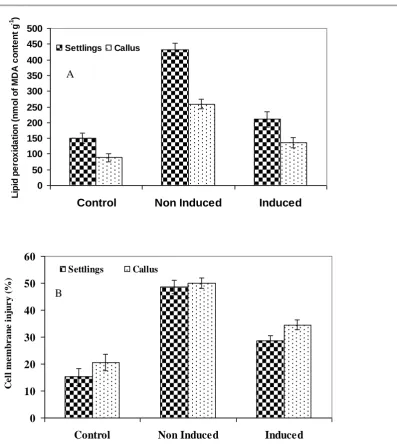
Exposure to high temperature caused a significant increase in lipid peroxidation (MDA content) and cell membrane injury (%), however acclimatized settling and calli recorded lower cell membrane damage. Acclimated settlings and calli showed comparatively less cell membrane leakage of 28.50 and 34.50 % respectively than non- induced (48.5 and 50.0% respectively) and control (15.2 and 20.5% for settlings and calli respectively) (Fig. 3A). Results suggest that, the increase in cell membrane leakage % is due to heat induced increase in MDA content as a result of higher peroxidation of membrane lipids. However, acclimated settlings and calli are showed lower lipid peroxidation and cell membrane damage compared to control and non - induced tissues. The changes in MDA content and EL revealed that heat acclimation could contribute to stability of sugarcane settlings and calli from the membrane injury and indicated that sugarcane could endure heat stress (Fig.3B). It is well known that ROS-induced peroxidation of membrane lipid is a reflection of stress induced damage at the cellular level (Jain et al. 2001; Xu et al. 2006).
http://www.ijSciences.com
Volume 3 - March 2014 (3)
11
antioxidant enzymes increased significantly due toheat stress in both the settlings and calli, higher activity was observed in heat acclimated settlings and calli, which then declined gradually at temperature condition of 44○C. APX is one of the most important antioxidant enzymes of plants that detoxify H2O2 using ascorbate for reduction. In the present study, heat stress showed two fold increases in APX activity over control both in sugarcane settlings and calli. However, acclimated settlings showed higher APX activity of 40.1 units g-1 min-1 with 99.0% over control, while non induced recorded 28.50 units g-1 min-1 with 39.8% over control. Similar increase in APX activity upon heat acclimation was noticed in calli (Fig. 4A), suggesting that the ascorbate– glutathione cycle played a crucial role in mitigating the accumulation of H2O2 in sugarcane settlings and calli upon heat stress treatment. This is in agreement with the results in Lilium and Freesia seedlings (Yin
et al. 2008, Yuan et al. 2011).
Previous studies have shown that POX activity increased during exposure to heat stress in bean (Ye
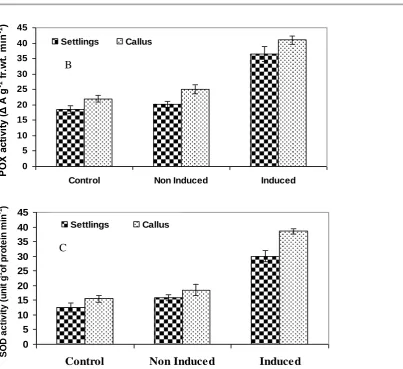
et al. 2000), maize (Scandalios et al. 2000) and grass (Jiang and Huang 2001). Our results also showed that heat acclimation could contribute to a significant increase in POX both in calli and settlings and maintained a high level even under lethal temperature. Acclimated settlings and calli recorded higher POX activity of 36.50 and 41.0 ΔA g-1 fr.wt min-1 respectively compared to non- induced (20.10 and 25.10 ΔA g-1
fr.wtmin-1 respectively) suggesting that the calli and settlings that are pretreated with sub-lethal temperature (acclimated) have an adaptation mechanism (increase in POX) when exposed to lethal temperature (Fig. 4B). Among the antioxidants, SOD is an essential component of defense mechanism in plants under environmental adversity. A reduction in the activity of SOD under heat stress and its rapid increase following re watering was reported in Kentucky blue grass (Zhaolong and Bingru 2004). In the present study heat acclimation led to significant increase in SOD activity in both settlings and calli. In settlings, a much higher activity of SOD was noticed in acclimated (30.0 units g-1 fr.wt.min-1) compared to non- induced (15.75 units g-1 min-1) and control (12.5 units g-1 fr.wt. min-1), respectively (Fig. 4C). Simialr to settlings, calli also showed higher SOD activity (38.50 units g-1 fr.wt.min-1)compared to non- induced (18.50 units g-1 fr.wt.min-1) and control (15.50 units g -1
fr.wt.min-1) , which suggested to a stronger ability to scavenge ROS as reported Xu et al. (2006), Wahid and Close (2007) and Yuan et al. (2011).
Enhanced activity of antioxidant enzymes may increases heat tolerance by detoxification of the heavy load of ROS, which in turn provides protection. In this regard it is suggested that use of
stress signaling molecules may enhance the antioxidant capacity of cells and produce thermotolerance (Sairam and Tyagi 2004). An apparent increase in POX and CAT during exposure to heat stress has been reported in several crops (Jiang and Huang 2001). Temperature induced over expression in the POX isoform were noticed only in heat acclimated settlings and calli at 40°C and 42°C, respectively (Plate.1a&1b). Results of isoforms pattern of SOD indicated (Plate 2a & b) that different forms of isozymes (high and low molecular weights) were noticed in all the samples. However, these isoforms were over expressed under acclimation temperature of 40°C (settlings) and 42°C (calli). Higher degree of expression of these isoforms (POX & SOD) in and their activity lead to protection of cells from oxidative damage suggesting that as an adaptation. One of the primary responses of plants exposed to high temperature is enhanced synthesis of reactive oxygen species (ROS) (Sung et al. 2003). Several studies (Srikanthbabu 2004, Larkindale et al. 2005a and 2005b) demonstrated that upon acclimation, generation of free radicals is significantly less.
Plants have developed many strategies to tolerate stress that include expression of some novel proteins (Wang et al. 2003). Formation of additional protein bands of different molecular weights (90, 70 and 27 kDa) were observed upon heat acclimation, particularly at 40ºC in settlings and 42ºC in calli (Plate 3a and b). Similar expression of Hsps upon heat stress was recently reported Sanjam et al.
(2010). One of the most widely studied aspects of thermotolerance is the enhanced expression of heat shock proteins (Hsps). Synthesis and localization of a few Hsps have been shown to trigger several physiological and biochemical processes (Cushman and Bohnert 2000) such as the maintenance of membrane integrity and chaperoning proteins. The expression of Hsps is primarily regulated by the heat dependent activation of the heat shock transcription factors (HSFs) (Scharf et al. 1998). There is convincing evidence to show that the stress-responsive proteins and genes are predominantly expressed duringthe sub-lethal induction stress that would bring the required changes in the plant metabolism necessary for withstanding the subsequent severe stress (Lindquist and Craig 1988). The major role of Hsp70 is to protect heat-labile proteins from denaturation. Under normal conditions, Hsp70 facilitate folding of newly synthesized proteins, preventing undesirable interactions. Developmentally regulated Hsp70 genes have been described in Arabidopsis (Wu et al. 1988). In
http://www.ijSciences.com
Volume 3 - March 2014 (3)
12
inducible protein (Hsp 90, Hsp70) and dehydrins (27kDa) in induced settlings and calli play an important role in cell protection from heat stress damage. From the present study, temperature conditions of 42 ºC with 10 h of stress treatment and 48 ºC with 20h of stress treatment were identified as sub- lethal and lethal temperature conditions for screening thermotolerant calli (in vitro condition) and 40 ºC with 10h and 48 ºC with 15h were identified as sub- lethal and lethal temperature conditions for screening thermotolerance in settlings (in vivo condition). The results showed that in vivo method was more effective in terms of time and cost than the in vitro
method of screening for thermotolerance. Response
of cultivar Co 86032 for high temperature stress was studied through temperature induction response (TIR) technique in settlings and callus. Results indicated that, acclimated settlings recorded higher soluble protein, proline, glycine betaine, total phenols, POX, APX and SOD activities than non-acclimated settlings and calli, which indicated stability under stress treatment.
Acknowledgement: I thank the Director, Sugarcane Breeding Institute, Coimbatore and Head, Division of Crop Production for providing facilities and support for carrying out the research work in successful manner.
0 20 40 60 80 100 120 140 160
Control Non induced Induced
So
lu
b
le
p
ro
te
in
c
o
n
te
n
t
(m
g
g
-1 )
Settlings Callus
0 20 40 60 80 100 120 140 160
Control Non Induced Induced
T
o
ta
l
p
h
e
n
o
li
c
s
c
o
n
te
n
t
(µ
g
g
-1 fr
.w
t.
)
Settlings Callus
Fig.1. Effect of heat acclimation on soluble protein (A) and total phenolics (B) of sugarcane settlings and calli upon heat stress. Error bars represent the standard error (S.E.) of mean (n = 4).
A
http://www.ijSciences.com
Volume 3 - March 2014 (3)
13
0 20 40 60 80 100 120 140 160 180
Control Non Induce d Induce d
P
ro
li
ne
c
on
te
nt
(µ
g
g
-1 )
Settlings Callus
0 5 10 15 20 25 30 35 40 45
Control Non Induce d Induce d
G
ly
ci
n
e
b
eta
in
e
co
n
te
n
t
(µ
g
g
-1
)
Settlings Callus
0 10 20 30 40 50 60
Control Non Induced Induced
S
ol
u
b
le
s
u
ga
rs
(
m
g
g
-1
)
S ettlings Callus
Fig.2. Effect of heat acclimation on proline content (A), glycine-betaine (B) and soluble sugars (C) of sugarcane settlings and calli upon heat stress. Error bars represent the standard error (S.E.) of mean (n = 4).
A
B
http://www.ijSciences.com
Volume 3 - March 2014 (3)
14
050 100 150 200 250 300 350 400 450 500
Control Non Induced Induced
Lipid pe
rox
ida
tion (
nm
ol of
M
D
A
c
ont
e
nt
g
-1 )
Settlings Callus
0 10 20 30 40 50 60
Control Non Induced Induced
C
e
ll
m
e
m
b
r
a
n
e
i
n
ju
r
y
(
%)
Settlings Callus
Fig. 3. Effect of heat acclimation on lipid peroxidation (A) and cell membrane leakage (B) of sugarcane settlings and calli upon heat stress. Error bars represent the standard error (S.E.) of mean (n = 4).
0 5 10 15 20 25 30 35 40 45
Control Non Induced Induced
A
P
X
a
c
ti
v
it
y
(
u
n
it
g
-1 m
in
-1 ) Settlings Callus
Optimization of Temperature Conditions for Screening Thermotolerance in Sugarcane through Temperature Induction Response (TIR) Technique
http://www.ijSciences.com
Volume 3 - March 2014 (3)
15
05 10 15 20 25 30 35 40 45
Control Non Induced Induced
P
O
X
a
ct
iv
it
y
(Δ
A
g
-1 f
r.
w
t.
m
in
-1 )
Settlings Callus
0 5 10 15 20 25 30 35 40 45
Control Non Induce d Induce d
SO
D
a
c
ti
v
ity
(u
n
it
g
-1 o
f
p
ro
te
in
m
in
-1 )
Settlings Callus
Fig. 4. Effect of heat acclimation on APX activity (A), POX activity (B) and SOD activity (C) of sugarcane settlings and calli upon heat stress. Error bars represent the standard error (S.E.) of mean (n = 4).
Plate1a: POX isoforms (a) from settlings of Co 86032: L1, L2 & L3= Control, L4= Induced, L5= Non induced
Plate1b: POX isoforms (a) from calli of Co 86032: L1= Control, L2= Induced, L3 = Non induced
LI L2 L3 L4 L5 LI L2 L3
http://www.ijSciences.com
Volume 3 - March 2014 (3)
16
References1) Ashraf, M., & Foolad, M.R. (2007). Roles of glycine betaine
and proline in improving plant abiotic stress resistance.
Environmental and Experimental Botany 59: 206–216.
2) Ashraf, M., & Hafeez, M. (2004). Thermotolerance of pearl
millet and maize at early growth stages: growth and nutrient
relations. Biol. Plant. 48:81–86.
3) Bates, I.S., Waldren, R.P.,& Teare, I.D. (1973). Rapid
determination of free proline for water stress studies. Plant
and Soil 39: 205-207.
4) Beauchamp, C., & Fridovich, I., (1971). Superoxide
dismutase: improved assays and an assay applicable to
acrylamide gels. Anal. Biochem .44(1): 276–287.
5) Burke, J.J. (1998). Characterization of acquired
thermotolerance in soyabean seedlings. Plant Physiol.
Biochem. 36: 601 – 7.
6) Chen, T.H.H., Shen, Z.Y. & Lee, P.H. (1982). Adaptability
of crop plants to high temperature stress. Crop Science. 22:
719–725.
7) Cushman, J.C. & Bohnert, H.J. (2000). Genomic approaches
to plant stress tolerance. Current Opinion in Plant Biol.
3:117–124.
8) Gomathi, R., Vasantha, S., Hemaprabha, G., Alarmelu, S., &
Shanthi, R.M. (2011). Evaluation of elite sugarcane clones
L1 L2 L3 L1 L2 L3 L4 L5
Plate 2a: SOD isoforms (a) from
settlings of Co 86032: L1=
induced, L2= non induced, L3= Control
Plate 2b: SOD isoforms (a) from calli of Co 86032: L1= Control, L2= blank, L3&L4= induced, L5 = Non induced
132kD
97kD
43kD
29kD
Plate 3b: SDS protein profile (a) for calli of Co 86032: M= Marker L1= Control, L2= Non Induced, L3= Induced
L1 L2 L3 M
Plate 3a: SDS protein profile (a) for settlings of Co 86032: M= Marker L1= Control, L2= Induced, L3= Non induced
M L1 L2 L3
132kD
97kD
43kD
http://www.ijSciences.com
Volume 3 - March 2014 (3)
17
for drought tolerance. Jl. Sugar Res.1: 55–62.
9) Gong, M., Chen, S.N., Song, Y.Q., & Li, Z.G. (1997). Effect
of calcium and calmodulin on intrinsic heat tolerance in
relation to antioxidant systems in maize seedlings. Aust. Jl
Pl. Physiol. 24: 371–379.
10) Gong, M., Knight, M.R., & Trewavas, A.J. (1998).
Heat-shock induced changes of intracellular Ca2? level in tobacco
seedlings in relation to thermotolerance. Plant Physiol. 116:
429–437.
11) Gopalakrishna, R. (2001). Cloning and characterization of
moisture stress responsive genes from stress-tolerant
groundnut (Arachis hypogaea L.). PhD Dissertation
submitted in University of Agricultural Sciences, Bangalore.
12) Grieve, C.M., & Grattan, S.R. (1983). Rapid assay for
determination of water soluble quaternary ammonium
compounds. Plant and Soil. 70: 303–307.
13) Hahn, G.M., & Li, G.C. (1990). Thermo-tolerance,
thermo-resistance and thermo-sensitization. In: Morimoto R.I., Tissieres A. and Georgopoulos, C. (edits). Stress proteins in biology and medicine. p. 79–100, Cold Spring Harbor, New York.
14) Hatice, G., & Atilla, E. (2003). Some physiological changes
in strawberry plants under heat stress. Jl. Horti. Sci. and
Biotech. 78: 894–898.
15) Heath, R.L., & Packer, L. (1968). Photoperoxidation in
isolated chloroplasts. Arch. Biochem. Biophy.125: 189–198.
16) Hong, S.W., Lee, U., & Vierling, E. (2003). Arabidopsis hot
mutants define multiple functions required for
acclimation to high temperatures. Plant Physiol. 132:757–67.
17) Howarth, C.J., Pollock, C.J., & Peacock, J.M. (1997).
Development of laboratory – based methods for assessing
seedling thermotolerance in pearl millet. New Phytol. 137: 129
– 39.
18) Jain, M., Mathur, G., Koul, S., & Sarin, N.B. (2001).
Ameliorative effects of proline on salt stress induced lipid
peroxidation in cell lines of groundnut (Arachis hypogea L).
Plant Cell Rep.20: 463-468.
19) Jiang, Y.W., & Huang, B.G. (2001). Effects of calcium on
antioxidant activities and water relations associated with heat
tolerance in two cool-season grasses. J. Exp. Bot. 52:341–
349.
20) Kumar, G., Krishnaprasad, B.T., Savitha, M.,
Gopalakrishna, R., Mukhopadhyay, K. Ramamohan, G., & Udaya Kumar, M. (1999). Enhanced expression of heat shock proteins in thermotolerant lines of sunflower and their progenies selected on the basis of temperature induction
response (TIR). Theoretical and Applied Genetics. 99:
359-367.
21) Laemmli, U.K. (1970). Cleavage of structure proteins during
the assembly of the head of bacteriophage T4. Nature. 227:
680-685.
22) Larkindale, J., & Huang, B. (2004). Thermotolerance and
antioxidant systems in Agrostis stolonifera: involvement of
salicylic acid, abscisic acid, calcium, hydrogen peroxide, and
ethylene. Jl of Plant Physiol.161: 405–413.
23) Larkindale, J., Hall, J.D., Knight, M.R., & Vierling, E.
(2005a). Heat stress phenotypes of Arabidopsis mutants
implicate multiple signaling pathways in the acquisition of
thermotolerance. Plant Physiol. 138:882–97.
24) Larkindale, J., Mishkind, M,. & Vierling, E. (2005b). Plant
responses to high temperature, In: Jenks M. A. and Hasegawa P. M. (edits). Plant abiotic stress. p:71-95. Oxford: Blackwell Scientific Publications. London, UK.
25) Leopold, A.C., Musgrave, M.E., & Williams, K.M. (1981).
Solute leakage resulting from leaf desiccation. Plant Physiol.
68:1222–1225.
26) Levitt, J. (1980). Responses of plants to environmental
stresses. Chilling, Freezing and High Temperature Stresses. Vol. 1. Academic Press.. pg. 1-.449.
27) Liang, Y., Sun, W., Zhu, Y.G., & Christie, P. (2007).
Mechanisms of silicon-mediated alleviation of abiotic
stresses in higher plants: A review. Environ. Pollut. 147:
422–428.
28) L
indquist, S.L., & Craig, E. (1988). The heat shock proteins.
Annu. Rev. Genet. 22: 631–637.
29) Lowry, O.H., Rosebrough, N.J., Farr, A.L., & Randall, R.J.
(1951). J. Biol. Chem.193- 265.
30) Malik, C.P., & Singh, M.B.(1980). Plant Enzymology and
Histo-enzymology. Kalyani Publishers , New Delhi.
31) Moyer, R.A., Hummer, K.E., Finn, C.E., Frei, B.,&
Wrolstad, R.E. (2002). Anthocyanins, phenolics, and antioxidant capacity in diverse small fruits: vaccinium,
Rubus, and Ribes. J. Agri. Food Chem. 50: 519–525.
32) Nadonly, L., & Sequeiria, L. (1980). Increase in peroxidase
activities are not directly involved in induced resistance in
tobacco. Physiol. Plant Pathol.16: 1-8.
33) Nelson, V., Adger, J., & Brown. (2008). Adaptation to
Environmental Change: Contributions of a Resilience Framework. Valerie Nelson, Richard Lamboll and Adele Arendse (Edits). In. Climate Change Adaptation, Adaptive Capacity and Development Discussion Paper, UK.
34) Pareek, A., Singla, S.L., & Grover, A. (1997). Short term
salinity and high temperature stress associated ultra-
structural alterations in young leaf cell of Oryza sativa L.
Ann. Bot. 80:629–39.
35) Sairam, R.K., & Tyagi, A. (2004). Physiology and molecular
biology of salinity stress tolerance in plants. Curr. Sci. 86:
407-421.
36) Sakamoto, A. & Murata, N. (2002). The role of glycine
betaine in the protection of plants from stress: clues from
transgenic plants. Plant Cell Environ. 25: 163–171.
37) Sangwan, V., & Dhindsa, R.S. (2002). In vivo and in vitro
activation of temperature-responsive plant map kinases.
FEBS Letters. 531: 561–564.
38) Sanjam MJ, Tucic B., & Matic, G. (2010). Differential
expression of Heat Shock proteins Hsp70 and Hsp90 in
vegetative and reproductive tissues of Iris pumila. Acta
Physiol. Planta. 33: 233–240.
39) Scandalios, J, G., Acevedo, A., & Ruzsa, S. (2000). Catalase
gene expression in response to chronic high temperature
stress in maize. Plant Sci. 156: 103–110.
40) Scharf, K.D., Heider, H., Hohfeld, I., Lyck, R., Schmidt, E,
& Nover, L. (1998). The tomato Hsf system: HsfA2 needs interaction with HsfA1 for efficient nuclear import and may
be localized in cytoplasmic heat stress granules. Mol.
Cellular Biol.18: 2240–2251.
41) Senthil-Kumar, M., Srikanthbabu, V., Mohan Raju, B.,
Ganeshkumar,N., Shivaprakash, N., & Udayakumar, M. (2003). Screening of inbred lines to develop a thermotolerant sunflower hybrid using the temperature induction response (TIR) technique: a novel approach by exploiting residual
variability. J. Exp. Bot. 54(392): 2569-2578.
42) Srikanthbabu, V., Ganesh Kumar, Krishnaprasad, B.T.,
Gopalakrishna, R.,Savitha, M., & Udaya Kumar. M. (2002).
Identification of pea genotypes with enhanced thermo tolerance using temperature induction response (TIR)
technique. J.Pl. Physiol. 59:535–545.
43) Srikanthbabu, V. (2004). Identification of thermotolerant
lines from the mutated population of groundnut (Arachis
hypogea L.) based on the temperature induction response and expression of HSFs and HSPs. Ph.D Dissertation submitted to the University of Agricultural Sciences, Bangalore – 65.
44) Steel, R.G.D., Torrie, J.H., & Dickey, D.A. (1996). Principles
and procedures of statistics: a biometrical approach, 3rd ed. NewYork: McGraw Hill.
45) Sung, D.Y., Kaplan, F., Lee, K.J., & Guy, C.L. (2003).
Acquired tolerance to temperature extremes. Trends Plant
Sci. 8: 179–87.
46) Taiz, L., & E. Zeiger (2006). Plant Physiology.
Massachusetts: Sinauer Associates Inc. Publishers.1-410.
47) Tripathy, J.N., Zhang, J., Robin, S., Nguyen, T.T., &
Nguyen, H.T. (2000). QTLs for cell membrane stability
mapped in rice (Oryza sativa L.) under drought stress.
Theoretical and Applied Genetics.100: 1197–1202.
48) Uma, S., Prasad, T.G., & Udayakumar, M. (1995). Genetic
http://www.ijSciences.com
Volume 3 - March 2014 (3)
18
in response to polyethylene glycol and salt stress in Finger
millet. Ann. Bot. 76:43–9.
49) Vierling, E. (1991). The role of heat shock proteins in plants.
Ann. Rev. Pl. Physiol. and Pl. Mol. Biol. 42:579–620.
50) Wahid, A., & Ghazanfar, A. (2006). Possible involvement of
some secondary metabolites in salt tolerance of sugarcane. J. Pl. Physiol. 163: 723–730.
51) Wahid, A., & Shabbir, A. (2005). Induction of heat stress
tolerance in Barely seedlings by pre sowing seed treatment with glycine betaine. Pl. Growth Regul. 46: 133–141.
52) Wahid, A., Gelani, S., Ashraf, M., & Foolad, M.R. (2007).
Heat tolerance in plants: An overview. Environ. Exp. Bot. 61. 199–223.
53) Wahid, A., & Close, T.J. (2007). Expression of dehydrins
under heat stress and their relationship with water relations of
sugarcane leaves. Biol. Plant. 51:104–109.
54) Wang, W., Vinocur, B., & Altman, A. (2003). Plant
responses to drought, salinity and extreme temperatures:
towards genetic engineering for stress tolerance. Planta.
218:1–14.
55) Wu, C.H., Caspar, T., Browse, J., Lindquist, S., &
Somerville, C. (1988). Characterization of an hsp70 cognate
gene family in Arabidopsis. Plant Physiol. 88: 731–740.
56) Xu, S., Li, J., Zhang, X., Wei, H., & Cui, L. (2006). Effects
of heat acclimation pretreatment on changes of membrane lipid peroxidation, antioxidant metabolites, and ultrastructure of chloroplasts in two cool-season turf grass species under
heat stress. Environ. Exp. Bot. 56: 274–285.
57) Ye, L.A., Gao, H.Y., & Zou, Q. (2000). Responses of
antioxidant system and xanthophylls cycle in Phaseolus
vulgaris to combined stress of high irradiance and high
temperature. Photosynthesis. 38: 205–210.
58) Yin, H., Chen, Q.M., & Yi, M.F. (2008). Effects of
short-term heat stress on oxidative damage and responses of
antioxidant system in Lilium longiflorum. Pl. Growth Regul.
54: 45–54.
59) Yoshida, S., Forno, D.A., Cock, J.H., & Gomaz, K.U. (1976).
Laboratory Manual for Physiological Studies of Rice. IRRI, Los Baños.
60) Yuan, Y., Qian, H., Yu, Y., Lian, F., & Tang, D. (2011).
Thermotolerance and antioxidant response induced by heat
acclimation in Freesia seedlings. Acta Physiol. Plant. 33:
1001–1009.
61) Zhaolong, W. & Bingru, H. (2004). Physiological recovery of
Kentucky bluegrass from simulation drought and leaf