http://ijessr.com Page 19 PREPARING A HIGH TECH ACTIVE LEARNING CLASSROOM: EXPERIENCED
INSERVICE ENGLISH TEACHERS’ PERCEPTION AND PRACTICE
Hilda Rakerda, Nur Arifah Drajati and Ngadiso Universitas Sebelas Maret, Surakarta, Central Java, Indonesia
ABSTRACT
Active learning is one of the most important strategies leading the students to master the 21st century learning skills. It raises the learners’ own initiatives and responsibilities for their own progress to be critical, creative thinking, collaboration and communication skills (4Cs) in particular. With the rapid changes in technology, the use of ICT prepares an active learning environment that is more interesting and effective for both teachers and student. How teachers perceive and choose the right application/technology implemented in the class influence the students’ learning outcome and qualities. This study aims to investigate how EFL teachers who currently continue their teaching education (TE) in master degree experience, perceive and promote active learning in their school. This study used qualitative method focused on case study to describe the EFL teachers’ perception and practice of active learning enhanced technology. The study involved 10 female EFL teachers who was continuing their TE to master degree at one of the university in Indonesia. They teach in different level of education which are Senior High School, Junior High School and Primary School. The data were taken from classroom observation, questionnaire and interview. The findings of this study showed that all of the respondents had practiced the high technology active learning strategies during their TE and perceived active learning positively. EFL teachers who teach in Senior and Junior High School had implemented the high tech active learning strategies but EFL teacher in primary school had only implemented the active learning strategies without using any technology device or technology application. This study showed the pivotal part of good perception and practice about active learning for teacher during their TE that influence the way they implement it in their school to fulfill the demand of 21st century learning era.
KEYWORDS: Active learning, teachers’ perception, teachers’ practice
1. INTRODUCTION
http://ijessr.com Page 20 As education's main goal in 21st century learning skills is to allow learners to develop critical, creative thinking, collaboration and communication skill (4Cs), teachers should find teaching methods that transmit student participation and interaction (Bedir, 2019; Melatu and Bezabih, 2018). Active participation in the learning process take the students as the owners, generators of new knowledge (Sahin-Taskin 2017), and facilitate them to think about what they are doing (Bonwell and Eison, 2003). The students learn more when they actively engage in the classroom (Chickering and Gamson, 1987). This view implies that much of the learning responsibility lies with the students themselves and embraces the importance of cognitive processes of higher order thinking (e.g. analysis, synthesis and evaluation), as highlighted in Bloom's taxonomy (1956).
The shifts in the work environment that technology adds are affecting how people learn and how much knowledge they need to know (Nicol et all, 2017). These necessitate the use of technological advances. In addition, some find that technology integration in the classroom is necessary given that most students rely on and use high technology outside the classroom (Isaías et al., 2015; Mutekwe, 2015). This has inspired educators to use social media in the classroom such as twitter (e.g. Prestridge, 2014) or audio files created by students (e.g. Bollinger and Armier, 2013) in the classroom. Ghavifekr and Rosdy (2015) established technology-based teaching and learning is more effective than conventional classrooms because the use of ICT tools can create a more engaging and productive active learning experience for both teachers and students.
Active learning has been considered effective in higher education disciplines compared to conventional teacher-centered approaches since a more active, student-centered approach influences how students learn, but it also requires teachers to change their perceptions and practices (Prince 2004).The importance of teacher education in developing productive learning environments has been noted by researchers (Mentiş Taş, 2005; Niemi, 2002). Niemi (2002) spoke about the opportunities student teachers have during their teaching education (TE) to practice and implement active learning. Williams (2008) suggested that innovative and exemplary practice should be used in teacher education programs to encourage the use of active learning because teachers teach the way they were taught (Britzman, 2003; Parsons, 2005). It implies that teacher education should supply the professional developments skill needed by the student teacher which requires the key elements such as content focus, active learning, coherence, duration and collective participation (Dekker-Groen, Schaaf, and Stokking, 2013). Kunter et al (2013) also found that successful TE programs provide student teachers with opportunities to be both active learners and knowledge constructors. Student teachers need to learn to make informed choices by integration theory and practice. The needs for teachers to be literate and have good skills in implementing pedagogy and knowledge in using ICT to improve their teaching method and approach are desired to promote effective learning as well as to meet the demand of the 21st century teaching skills (Ghavifekr and Rosdy, 2015).
http://ijessr.com Page 21 Simmie, and Kennedy, 2014). To generate the rich epistemic discourse needed for an intellectually productive classroom, teachers need to fully understand the difference between activity and active learning (Ford and Wargo 2012).Active learning project (Stern and Huber, 1997) revealed that teachers who wanted to tutor their pupils to become active learners need to learn how to be a good facilitators, who gave more responsibility to students. They need to learn democratic; negotiated more with students about aims, methods and control of learning, knowing new teaching methods, which consisted of more independent learning, more collaborative arrangements, more open tasks and projects that enabled students to collaborate with each other. The position of a teacher was no longer in front of the classroom or in the center of the classroom, but he / she was a circulating expert, learning with students and trying to give his / her students as much space as possible. To promote active learning, the teacher should be know how to be a tutor and how to lead the class into the active learning classroom. These scenarios of teachers’ work create new demands on teacher education as the teachers’ role is the key role in making any of the new policy to be implemented efficiently and successfully in the class.
http://ijessr.com Page 22 increase, resulting in pressure on lecturers to change their teaching in ways that also impact their current professional identity.
In view of these dynamic obstacles, some teachers may be resistant to implementing changes to include more active learning. For the teacher both in service and pre-service teacher, the understanding or value of active learning is essential. When teachers do not seem to be convinced of the usefulness of active learning methods during their professional career, it is difficult to see how this method of learning is implementing in their daily teaching. Such research reports on many aspects of the teacher's experience and practice of active learning both for in service and pre-service teachers, but none of them goes further to explore the practice and perception of active learning from the perspective of experienced in-service teacher who is continuing their TE to master degree. This research investigates the perception and practice active learning of experienced in-service teachers who currently continue their TE in master degree.
2. METHOD
This study used qualitative method focused on case study as this study emphasized on describing the experienced in-service teachers’ perception and practice of active learning. Yin (2018) emphasized that case study is an empirical inquiry that investigates a contemporary phenomenon within its real-life context, especially when the boundaries between phenomenon and context are not visible. In this case, the emphasis was on the understanding deeply about the experienced in-service teachers’ perception and practice of high tech active learning in the 21st century learning. Thus, the data was taken from questionnaire, interview and classroom observation in the university level. The case where the experience EFL teachers’ perceive and practice the active learning method was a uniqueness case and become the main reason for the study. These teachers’ were continuing their teaching education (TE) in master degree to develop their professionalism in teaching. The feature brings the researcher's high sense of curiosity to know how active learning was practiced, what was the teacher’s perception about it and how they implemented it in their classroom.
http://ijessr.com Page 23 teachers’ perspectives deeper. The entire data has been systematically categorized in the data condensation process. The classification was based on the coded lexical and themes to reflect any mandatory information relevant to the problem of the research. The appropriately grouped theme-based data was presented in the conceptual table with respect to the data display. Finally, this study's conclusions have been extensively discussed.
The steps of analyzing data are figured as follows:
Interactive Model of Data Analysis (Miles, Huberman, & Saldana, 2014)
3. FINDING AND DISCUSSION
Active learning experiences. The active learning questionnaire was spread to the experienced in-service teachers after the researcher conduct the classroom observation to their class. The experienced in-service teachers were come from English department from different class in the university. Based on the observation conducted, it found that they did active learning during their study. With this regard, T1 and T2 acknowledge that they did active learning enhance technology during their study in TE.
T1 : “ I did schoolgy in my class. The lecturer asked us to download schoology in our
mobile phone since the material and what will we do announced in it. Before we get in the class, we had to read the material attached in it. In the class, we discussed the material and did the assignment in group. We did poster presentation also”.
T2 : “ The lecturer give us some topic of presentation and we chose the topic we
interested in. Then, we made a paper about the topic, presented it using power point and discuss the topic in the class. We made the video also for that.”
All of the respondents agreed that they did active learning even though some of them did not realize it was the active learning activities before. It was because some of the lecturers did not implicitly acknowledge what they were doing in the class was based on active learning method.
T3 : “ I did the presentation, group discussion in the class, field trip, making video but I
http://ijessr.com Page 24 Based on the observation to all classes in the English department and the interviews done, all of the lecturers did active learning method in the class but because there was no special material or course specialize discuss about active learning, the student teachers did not realize that they had done active learning. Some of them realize it was active learning due to the topic they were chosen for they final assignment.
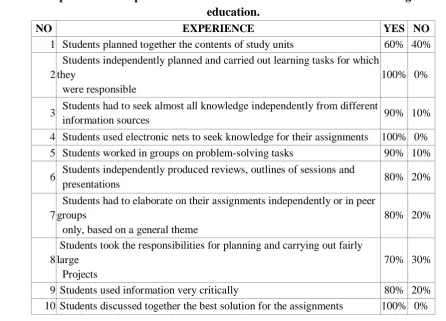
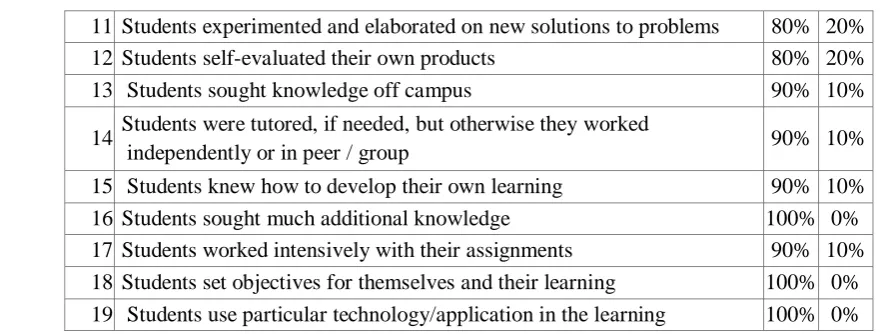
The questionnaire spread was covered the main qualities of active learning processes (see Table 1) adapted from questionnaire developed by Niemi and Kohonen (2002) specialized for student teacher in teaching education (TE). For knowing the experience of using active learning enhanced technology, the researcher added one question about the utilizing of technology in their learning process. The questionnaire could be seen in the table 1.
From the table 1, it can be seed that all of the student teachers had independently planned and carried out learning tasks for which they were responsible, used electronic nets to seek knowledge for their assignments, discussed together the best solution for the assignments, sought much additional knowledge, set objectives for themselves and their learning, and use particular technology/application in the learning.
Table 1. Experiences of experienced in service EFL teachers with active learning in teacher education.
NO EXPERIENCE YES NO
1 Students planned together the contents of study units 60% 40%
2
Students independently planned and carried out learning tasks for which they
were responsible
100% 0%
3 Students had to seek almost all knowledge independently from different
information sources 90% 10%
4 Students used electronic nets to seek knowledge for their assignments 100% 0%
5 Students worked in groups on problem-solving tasks 90% 10%
6 Students independently produced reviews, outlines of sessions and
presentations 80% 20%
7
Students had to elaborate on their assignments independently or in peer groups
only, based on a general theme
80% 20%
8
Students took the responsibilities for planning and carrying out fairly large
Projects
70% 30%
9 Students used information very critically 80% 20%
http://ijessr.com Page 25
11 Students experimented and elaborated on new solutions to problems 80% 20%
12 Students self-evaluated their own products 80% 20%
13 Students sought knowledge off campus 90% 10%
14 Students were tutored, if needed, but otherwise they worked
independently or in peer / group 90% 10%
15 Students knew how to develop their own learning 90% 10%
16 Students sought much additional knowledge 100% 0%
17 Students worked intensively with their assignments 90% 10%
18 Students set objectives for themselves and their learning 100% 0%
19 Students use particular technology/application in the learning 100% 0%
Since the student teachers come from different level of academic year, not all of them had experience of planning together the contents of study units with the teacher educator. It can be seen form the table 1, only 60% of the experienced in-service ELT teachers experience it and only 70% of them had took the responsibilities for planning and carrying out fairly large projects. Therefore, most of them had to seek almost all knowledge independently from different information sources, worked in groups on problem-solving tasks, independently produced reviews, outlines of sessions and presentations, had to elaborate on their assignments independently or in peer groups only based on a general theme, used information very critically, experimented and elaborated on new solutions to problems, self-evaluated their own products, sought knowledge off campus, worked independently or in peer / group, and knew how to develop their own learning.
All the least according to these data had experiences the active learning practice in their study at TE. These statements in the questionnaire give complementary definitions of active learning that the student teacher had during their study in TE. Niemi (2002) differed the statements into two theoretically interesting which were called independence and responsibility in Learning (with statement 1–8) and meta-cognitive strategies (with statement 9–18). Data in table 1 assert that most of the student teacher have their independence and responsibility in their learning and also they have meta-cognitive strategies in implementing active learning. It is in line with the research done by Nicol et All (2017) indicated that active learning instructions keep students responsible for their own learning initiatives and responsibilities, managing learning at their own pace, and engaging with peers (team-based) in the process of creating information for themselves.
http://ijessr.com Page 26 Bollinger and Armier, 2013) in the classroom and is necessary given to the students (Isaías et al., 2015; Mutekwe, 2015).
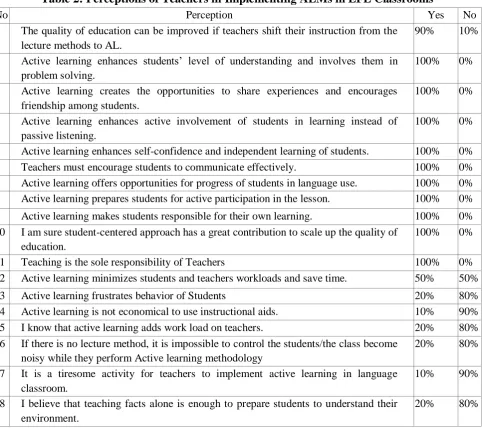
Student teachers’ perception of active learning. As shown in table 2, the items are related to assumptions about active learning, advantages of active learning and the student teachers view about active learning. The items in table 2 could be seen below.
Table 2: Perceptions of Teachers in Implementing ALMs in EFL Classrooms
No Perception Yes No
1 The quality of education can be improved if teachers shift their instruction from the
lecture methods to AL.
90% 10%
2 Active learning enhances students’ level of understanding and involves them in
problem solving.
100% 0%
3 Active learning creates the opportunities to share experiences and encourages
friendship among students.
100% 0%
4 Active learning enhances active involvement of students in learning instead of
passive listening.
100% 0%
5 Active learning enhances self-confidence and independent learning of students. 100% 0%
6 Teachers must encourage students to communicate effectively. 100% 0%
7 Active learning offers opportunities for progress of students in language use. 100% 0%
8 Active learning prepares students for active participation in the lesson. 100% 0%
9 Active learning makes students responsible for their own learning. 100% 0%
10 I am sure student-centered approach has a great contribution to scale up the quality of
education.
100% 0%
11 Teaching is the sole responsibility of Teachers 100% 0%
12 Active learning minimizes students and teachers workloads and save time. 50% 50%
13 Active learning frustrates behavior of Students 20% 80%
14 Active learning is not economical to use instructional aids. 10% 90%
15 I know that active learning adds work load on teachers. 20% 80%
16 If there is no lecture method, it is impossible to control the students/the class become
noisy while they perform Active learning methodology
20% 80%
17 It is a tiresome activity for teachers to implement active learning in language
classroom.
10% 90%
18 I believe that teaching facts alone is enough to prepare students to understand their environment.
20% 80%
http://ijessr.com Page 27 presented in item 2 up to 11. All of them agreed if active learning enhances students’ level of understanding and involves the students in problem solving; active learning creates the opportunities to share experiences and encourages friendship among students; active learning enhances active involvement of students in learning instead of passive listening; active learning enhances self-confidence and independent learning of students; teachers must encourage students to communicate effectively; active learning offers opportunities for progress of students in language use; active learning prepares students for active participation in the lesson; active learning makes students responsible for their own learning; student-centered approach has a great contribution to scale up the quality of education; teaching is the sole responsibility of teacher.
The interesting data found from item 12 which was showed that 50% of the teacher disagreed that active learning minimizes students and teachers workloads and save time. This means that some students teacher perceived active learning as a method that was not save the time. T3 acknowledge that applying active learning method sometime made her lost to give some materials to the students because applying active learning made the students be more active and noisy than before so she had to calm down the class and lead the students to focus on the assignment intensively. She need to learn how to manage the class so the active learning method could be implemented effectively. It support the idea offered by Ghavifekr and Rosdy (2015) that training and professional development must be provided for teachers as the teachers’ role is the key role in making any of the new policy to be implemented efficiently and successfully in the class. Therefore, most of them perceive active learning positively as in displayed in table 2 that most of the students teachers did not agree that active learning as frustrates behavior of students, not economical to use instructional aids, adds work load on teachers, impossible to control the students/the class become noisy while they perform active learning methodology, a tiresome activity for teachers to implement active learning in language classroom, and teaching facts alone is enough to prepare students to understand their environment. Experienced in-service teachers in the study reported by Gredy, Simmie, and Kennedy (2014) agreed that the need for active learning pedagogy during their teacher continuing education which would enable them to understand and enact active learning in their teaching repertoire.
Teaching using active learning. To assess the extent to which active learning has been implementing in ELT classroom, all students teachers reacted through the questionnaire as can be seen in table 3 and to find deeply information about the kind of activity done, the interviews were conducted.
Table 3. Teachers’ use of active learning in EFL Classrooms
Activity Person Percentage
http://ijessr.com Page 28
Problem solving method 7 70%
Role-playing 9 90%
Group Discussion /syndicate 10 100%
Brain storming 9 90%
Peer Teaching 7 70%
Cooperative learning 9 90%
Group work 9 90%
Demonstration 9 90%
Student independent work by giving homework/ assignments 8 80%
Inquiry method 7 70%
Case study 4 40%
Discovery method 2 20%
Educational visits/field trip 6 60%
Using Particular Technology integrated with Active Learning Activity 8 80%
As presented in table 3, all of the teachers in the school practice group discussion /syndicate. Almost of them use lecture/explanation, problem solving method, role-playing, brain storming, peer teaching, cooperative learning, group work, demonstration, student independent work by giving homework/assignments, inquiry method, case study, and educational visits/field trip. They rare to use discovery method which was showed from the table 3 that only 2 teachers had used it in the class. Almost of them using particular technology when they apply active learning in the class. From the interview, it was found that, those who teach English in primary school only apply active learning activity without integrating particular technology in it. It was because the primary students in their school did not bring high technology device such as smart phone or personal computer (PC) in their school. Moreover, their school facilitation such as computer was only used for special occasion not for teaching and learning in the class. It is opposite with the Junior and Senior High School students that bring their technology device such as mobile phone or PC in their school because their school policy allowed the students to use their phone or any technology device in the classroom. As suggested by Ghavifekr and Rosdy (2015) that the school policy should be adjusted to 21st century learning demanded which allows advanced technology and communication devices used by the students wherever they were either at school or home to promote effective learning.
http://ijessr.com Page 29 perception of active learning. They agreed that practice and understand more about active learning pedagogy during TE will enable them to understand and enact active learning in their teaching repertoire. It is in line with Yurdabakan (2012) who claimed that teachers’ positive perception towards active learning should be knowledge based and they should have all the details and principles of active learning for effective implementation. Supported by several research results which are demonstrated that there is a strong relationship between the perception of teachers of active learning and their attempt to implement it (Ghavifekr and Rosdy, 2015; Gredy, Simmie, and Kennedy, 2014; Nicol et al, 2017).
4. CONCLUSION
The main purpose of this study was to assess the perception and practices of EFL teachers in implementing active learning during their TE and how they promote it in their school. All the subjects of this study were 10 English teachers who were teaching from Primary School, Junior High School and Senior High School and also continuing their teaching education in master degree at one of the university in Indonesia. The data were gathered using classroom observations in TE, questionnaires, and interviews. The questionnaires were administered to all respondents. All respondents returned the questionnaire. The classroom observation was conducted in the TE in English department at different class and academic year. The interview was also conducted with three of the respondents. The data obtained through questionnaires were analyzed in percentages and based on the analysis of the data, the following findings were obtained. The analysis of the data indicates that most of the teachers involved in this study had practice active learning during their TE, perceive active learning positively and have applied it in their classroom. In addition, the participants viewed that active learning plays an important role in developing higher order thinking skill. Furthermore, they believe that to practice it, they must get special training and support from the teacher education and the school which they teach. Moreover, the analysis of the data disclosed that the extent of the practices of active learning in the schools was found to be high since all of the teacher applied more than one active learning technique in their class. The respondents stated that they are conducting active learning in their classes, leading to the conclusion that the active learning activities are suitable for their class. Since the teacher practice active learning in TE, they also learn how to implement active learning effectively to their class. It is important to carry the teacher the practice of active learning because the teacher involve themselves in the lesson, so they are aware of the importance the methodology such as active learning.
5. REFERENCES
Aderie, A. (2015). Assessing teachers’ practices of active learning in English classes: The case of Gohatsion Secondary School, North Shoa Zone, in Oromiyan Region (M.A Thesis). Haramaya University, Ethiopia.
http://ijessr.com Page 30 Biggs, J. (1988). The role of metacognition in enhancing learning. Australian Journal of Education, 32, 127–138.
Bloom, B. (1956). Taxonomy of Educational Objectives. Book 1: Cognitive Domain. New York: Longman.
Bollinger, D. U., & Armier D.D. (2013) Active learning in the online environment: The integration of student generated audio files. Active Learning in Higher Education 14(3): 201–11.
Bandura, A. (1986). Social Foundations of Thought and Action: A Social Cognitive Theory. Prentice-Hall Series in Social Learning Theory. Englewood Cliffffs, NJ: Prentice-Hall.
Bonwell, C., & Eison, A. (2003). Active learning: Creating excitement in the classroom. Rhen: Grips.
Borg, S and Busaidi, S. Al. (2012). teachers beliefs and practices regarding learner autonomy . ELT journal 66 (3) : 283-292
Britzman, D. (2003). Practice makes practice. A critical study of learning to teach. Albany: State of New York Press.
Dewey, J. (1933). How We Think. Boston, MA: D. C. Heath.
Chickering, A.W., & Gamson, Z.F. (1987). Seven principles for good practice in undergraduate education. AAHE Bulletin 39(7): 3–7.
Dekker-Groen, Agaath M., Marieke, F. Van Der Schaaf, & Karel, M. Stokking. (2013). “A Teacher Competence Development Programme for Supporting Students’ Reflection Skills.” Teachers and Teaching 19 (2): 150–171.
Feryok, A. (2008). “The Impact of TESOL on Maths and Science Teachers.” ELT Journal 62 (2): 123–130.
Ford, M. J., & Wargo, B. M. (2012). “Dialogic Framing of Scientific Content for Conceptual and Epistemic Understanding.” Science Education 96 (3): 369–391.
Ghavifekr, S. & Rosdy, W.A.W. (2015). Teaching and learning with technology: Effectiveness of ICT integration in schools. International Journal of Research in Education and Science (IJRES), 1(2), 175-191.
Grady, O’ Audrey., Simmie,, Geraldine Mooney,. & Kennedy, Therese. (2014). Why change to active learning? Pre-service and in-service science teachers’ perceptions. European Journal of Teacher Education (37) no. 1, 35–50
Hall, L. A. (2005). “Teachers and Content Area Reading: Attitudes, Beliefs and Change.” Teaching and Teacher Education 21 (4): 403–414.
Haworth, P. (2004). “Developing Praxis for a Few Non-English Speaking Background Students in the Class.” PhD diss., Massey University.
Isaías P, Spector JM, Ifenthaler D, et al. (2015). E-learning systems, environments and approaches: Theory and implementation. In: Isaías P, Spector JM, Ifenthaler D, et al. (eds) E-learning Systems, Environments and Approaches. Berlin: Springer, pp. 1–7.
http://ijessr.com Page 31 Mentiş Taş, A. (2005). Öğretmen eğitiminde aktif öğrenme. Gazi Üniversitesi Kırşehir Eğitim Fakültesi Dergisi, 6(2), 177–184.
Miller, J. L., Wilson, Miller, K. , J., & Enomoto, K. (2016). Humorous materials to enhance active learning, Higher Education Research & Development
Miles, M.B., Huberman, A.M, & Saldana, J. (2014). Qualitative Data Analysis: A Methods Sourcebook 3rd ed. USA: Sage Publications.
Mulatu, M. & Bezabih, W. (2018). Perceptions And Practices Of Efl Teachers In Implementing Active Learning In English Classes: The Case Of Three Selected Secondary Schools In Dawro Zone, Snnprs, Ethiopia. International Journal Of Education, 10(2), 88-94. Upi Press.
Mutekwe, E. (2015) Higher education and the social media technology: A dilemma unfolding in institutions of higher learning. Journal of Education and Human Development 4(3): 119–33.
Nespor, J. (1987). “The Role of Beliefs in the Practice of Teaching.” Journal of Curriculum Studies 19 (4): 317–328.
Nguyen, H. B., & Nguyen, T. A. (2017). “English for Specific Purposes (ESP): Perceptions of Students and Teachers of Learning Needs at a Vietnamese School.” International Journal of Advanced Research 5 (4): 793–803.
Niemi, H. (2002). Active learning - a cultural change needed in teacher education and schools. Teaching and Teacher Education, 18, 763-780
Nicol, Adelheid AM., Owens Soo, M., Coze ,Stéphanie SCL Le., MacIntyre, Allister,. & Eastwood, Christina. (2017). Comparison of high-technology active learning and low-technology active learning classrooms. Active Learning in Higher Education 1–13.
Sahin-Taskin, C. (2017). “Effffects of Active Learning Environments Supported with Self- and Peer Assessment on Pre-Service Teachers’ Pedagogical and Self-Efficacy Beliefs.” Asia-Pacific Journal of Teacher Education 45 (1): 1–20.
Stern, D., & Huber, G. L. (Eds.), (1997). Active learning for students and teachers. Reports from eight countries. OECD. Frankfurt am Main: Peter Lang.
Pham, H. A., & Ta, B. T. (2016). “Developing a Theoretical Framework for ESP Teacher Training in Vietnam.” The Asian ESP Journal 12 (1): 66–84.
Pajares, M. F. (1992). Teachers’ beliefs and educational research: Cleaning up a messy construct. Review of Educational Research, 62(3), 307–332.
Parsons, L. (2005). Bullied teacher bullied student: How to recognise the bullying culture in your school and what to do about it. Ontario: Pembrook Press.
Prince, M. (2004). “Does Active Learning Work? A Review of the Research.” Journal of Engineering Education 93 (3): 223–231.
Richards, J. C., P. B. Gallo, & Renandya, W. A. (2001). “Exploring Teachers’ Beliefs and the Processes of Change.” PAC Journal 1 (1): 41–58.
http://ijessr.com Page 32 Yurdabakan, I. (2012).The effects of active learning on foreign language self-concept and reading comprehension achievement. International Journal on New Trends in Education and Their Implications, 3(4), 43-48.