
D E B A T E
Open Access
Clarifying the distinction between case
series and cohort studies in systematic
reviews of comparative studies: potential
impact on body of evidence and workload
Tim Mathes
*and Dawid Pieper
Abstract
Distinguishing cohort studies from case series is difficult.
We propose a conceptualization of cohort studies in systematic reviews of comparative studies. The main aim of this conceptualization is to clarify the distinction between cohort studies and case series. We discuss the potential impact of the proposed conceptualization on the body of evidence and workload.
All studies with exposure-based sampling gather multiple exposures (with at least two different exposures or levels of exposure) and enable calculation of relative risks that should be considered cohort studies in systematic reviews, including non-randomized studies. The term“enables/can”means that a predefined analytic comparison is not a prerequisite (i.e., the absolute risks per group and/or a risk ratio are provided). Instead, all studies for which sufficient data are available for reanalysis to compare different exposures (e.g., sufficient data in the publication) are classified as cohort studies.
There are possibly large numbers of studies without a comparison for the exposure of interest but that do provide the necessary data to calculate effect measures for a comparison. Consequently, more studies could be included in a systematic review. Therefore, on the one hand, the outlined approach can increase the confidence in effect estimates and the strengths of conclusions. On the other hand, the workload would increase (e.g., additional data extraction and risk of bias assessment, as well as reanalyses).
Background
Systematic reviews that include non-randomized studies often consider different observational study designs [1]. However, the distinction between different non-randomized study designs is difficult. One key design feature to classify observational study designs is to distin-guish comparative from non-comparative studies [2, 3]. The lack of a comparison group is of particular import-ance for distinguishing cohort studies from case series be-cause in many definitions, they share a main design feature of having a follow-up period examining the ex-posed individuals over time [2, 3]. The only difference be-tween cohort studies and case series in many definitions is
that cohort studies compare different groups (i.e., examine the association between exposure and outcome), while case series are uncontrolled [3–5]. Table 1 shows an ex-ample definition [3]. The problem with this definition is that vague terms, such as comparison and examination of association, might be interpreted as an analytic compari-son of at least two exposures (i.e., interventions, risk fac-tors or prognostic facfac-tors).
For example, imagine a study of 20 consecutive pa-tients with a certain disease that can be treated in two different ways. A study that divides the 20 pa-tients into two groups according to the treatment re-ceived and compares the outcomes of these groups (e.g., provides aggregated absolute risks per group or a risk ratio) would be probably classified as a cohort study (the example used in the following sections is * Correspondence:[email protected]
Institute for Research in Operative Medicine, Chair of Surgical Research, Faculty of Health, School of Medicine, Witten/Herdecke University, Ostmerheimer Str. 200, 51109 Cologne, Germany
denoted “study 1”). A sample of this study type is il-lustrated in Fig. 1 and Table 2.
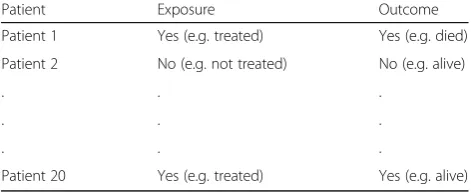
In contrast, a publication that describes the interventions received and outcomes for each patient/case separately would probably be classified as a case series (the example in the following sections is denoted“study 2”). An example of this study type is illustrated in Fig. 2 and Table 3. In the medical literature, the data on exposure and outcomes are usually provided in either running text or spreadsheet for-mats [6–21]. A good example is the study by Wong et al. [10]. In this study, information on placental invasion (ex-posure) and blood loss (outcome) is separately provided for 40 pregnant women in a table. The study by Cheng et al. is an example of a study providing information in the running text (i.e., anticoagulation management [exposure] and re-covery [outcome] for paediatric stroke) [6].
These examples illustrate that distinguishing between cohort studies and case series is difficult. Vague defini-tions are probably the reason for the common confusion between study designs. A recent study found that ap-proximately 72% of cohort studies are mislabelled as case series [22]. Many systematic reviews of non-randomized studies included cohort studies but excluded case series (see examples in [23–28]). Therefore, the un-clear distinction between case series and cohort studies can result in inconsistent study selection and unjustified exclusions from a systematic review. The risk of mis-classification is particularly high because study authors also often mislabel their study or studies are not classi-fied by their authors at all (see examples in [6–21]).
Objective
We propose a conceptualization of cohort studies in sys-tematic reviews of comparative studies. The main objective
of this conceptualization is to clarify the distinction be-tween cohort studies and case series in systematic reviews, including non-randomized comparative studies. We discuss the potential impact of the proposed conceptualization on the body of evidence and workload.
Clarifying the distinction between case series and cohort studies (the solution)
In the following report, we propose a conceptualization for cohort studies and case series (e.g., sampling) for system-atic reviews, including comparative non-randomized stud-ies. Our proposal is based on a recent conceptualization of cohort studies and case series by Dekkers et al. [29]. The main feature of this conceptualization is that it is exclu-sively based on inherent design features and is not affected by the analysis.
Cohort studies of one exposure/one group
Dekkers et al. [29] defined cohort studies with one expos-ure as studies with exposexpos-ure-based sampling that enable calculating absolute effects measures for a risk of out-come. This definition means that“the absence of a control group in an exposure-based study does not define a case series” [29]. The definition of cohort studies according to Dekkers et al. [29] is summarized in Table 4.
Table 1Example definitions of cohort studies and case series [2]
Cohort study
A study in which a defined group of people (the cohort) is followed over time, toexamineassociations between different interventions received and subsequent outcomes.
Case series
Observations are made on a series of individuals, usually all receiving the same intervention, before and after an intervention but with no control group.
Fig. 1Cohort study (vague definition) Fig. 2Case series (vague definition)
Table 2Possible presentation of a study with a preexisting exposure based comparison (cohort study not requiring a reanalysis)
Group 1 Group 2 Effect
Absolute risk for outcome (e.g. mortality rate) in all exposed (e.g. treated) patients
Absolute risk for outcome (e.g. mortality rate) in all unexposed (e.g. not treated) patients
Cohort studies of multiple exposures/more than one group
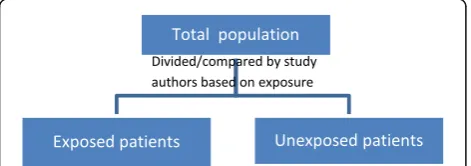
This idea can be easily extended to studies with more than one exposure. In this case, all studies with exposure-based sampling gathering multiple exposures (i.e., at least two different exposures, manifestations of exposures or levels of exposures) can be considered as (comparative) cohort studies (Fig. 3). The sampling is based on exposure, and there are different groups. Con-sequently, relative risks can be calculated [29]. The term “enables/can”implies that a predefined analytic compari-son is not a prerequisite but that all studies with suffi-cient data to enable a reanalysis (e.g., in the publication, study reports, and supplementary material) would be classified as cohort studies.
In short, all studies that enable calculation of a relative risk to quantify a difference in outcomes between differ-ent groups should be considered cohort studies.
Case series
According to Dekkers et al. [29], the sampling of a case series is either based on exposure and outcome (e.g., all patients are treated and have an adverse event) or case series include patients with a certain outcome regardless of exposure (see Fig. 4). Consequently, no absolute risk and also no relative effect measures for an outcome can be calculated in a case series. Note that sampling in a case series does not need to be consecutive. Consecu-tiveness would increase the quality of the case series, but a non-consecutive series is also a case series [29].
In short, for a case series, there are no absolute risks, and also, no risk ratios can be calculated. Con-sequently, a case series cannot be comparative. The definition of a case series by Dekkers et al. [29] is summarized in Table 4.
It is noteworthy that the conceptualization also en-sures a clear distinction of case series from other study designs that apply outcome-based sampling. Case series, case-control studies (including case-time-control), and self-controlled case-control designs (e.g., case-crossover) all have outcome-based sampling in common [29].
Case series have no control at all because only patients with a certain manifestation of outcomes are sampled (e.g., individuals with a disease or deceased individuals). In contrast, all case-control designs as well as self-controlled case-control designs have a control group. In case-control studies, the control group constitutes indi-viduals with another manifestation of the outcome (e.g., healthy individuals or survivors). This outcome can be considered as two case series (i.e., case group and no case group).
Self-controlled case-control studies are characterized by an intra-individual comparison (each individual is their own control) [30]. Information is also sampled when patients are not exposed. Therefore, case-control designs as well as self-controlled case-control studies en-able the calculation of risk ratios. This approach is not possible for a case series.
Illustrating example
Above, we illustrated that by using a vague definition, the classification of a study design might be influ-enced by the preparation and analysis of the study data. The proposed conceptualization is exclusively based on the inherent design features (e.g., sampling, exposure). After considering the example studies again using the proposed conceptualization, all studies would be classified as cohort studies because the rela-tive risk can be calculated. This outcome becomes clear looking at Table 2 and Table 3. If the patients in Table 3 are rearranged according the exposure and the data are reanalysed (i.e., calculation of absolute risk per group and relative risks to compare groups), Table 3 can be converted into Table 2 (and also, Fig. 2 can be converted to Fig. 3). In the study by Wong et al. [10], the mean blood loss in the group with pla-cental invasion and in the group without plapla-cental in-vasion can be calculated and compared (e.g., relative risk with 95% confidence limits). In this study, the data on gestational age are also provided in the table. Therefore, it is even possible to adjust the results for gestational age (e.g., using a logistic regression). Table 4Summary of the distinction proposed by Dekkers et al. [28]
Cohort study: Patients are sampled on the basis of exposure. The occurrence of outcomes is assessed during a specified follow-up period.
Case series:Patients with a particular disease or disease-related outcome are sampled. Case series exist in 2 types:
1. Samplingis based on a specific outcome and presence of a specific exposure.
2. Selectionis based only on a specific outcome, and data are collected on previous exposures. Cases are reported regardless of whether they have specific exposures. This type of case series can be seen as the case group from a case–control study .
Table 3Possible presentation of study without a preexisting exposure based comparison (cohort study requiring a reanalysis)
Patient Exposure Outcome
Patient 1 Yes (e.g. treated) Yes (e.g. died)
Patient 2 No (e.g. not treated) No (e.g. alive)
. . .
. . .
. . .
Discussion (the impact) Influence on the body of evidence
The proposed conceptualization is exclusively based on inherent study design features; therefore, there is less room for misinterpretation compared to existing con-ceptualizations because analysis features, presentation of data and labelling of the study are not determined. Thus, the conceptualization ensures consistent study selection for systematic reviews.
The prerequisite of an analytical comparison in the publication can lead to the unjustified exclusion of rele-vant studies from a systematic review. Study 1 would likely be included, and Study 2 would be excluded from the systematic review. The only differences between Study 1 and Study 2 are the analysis and preparation of data. If the data source (e.g., chart review) and the re-analysis (calculation of effect measures and statistical tests) to compare the intervention and control group in Study 2 are performed exactly with the same approach as the existing analysis in Study 1, there can be no differ-ence in the effect estimates between studies, and the studies are at the same risk of bias. Thus, the inclusion of Study 1 and the exclusion of Study 2 are contradict-ory to the requirement that systematic reviews identify all available evidence [31].
Considering that more studies would be eligible for in-clusion and that the hierarchical paradigm of the levels of evidence is not valid per se, the proposed conceptualization can potentially enrich bodies of evi-dence and increase confievi-dence in effect estimates.
Influence on workload
The additional inclusion of all studies that enable calcu-lating relative risk for the comparison of interest might impact the workload of systematic reviews. There might be a considerable number of studies not performing a comparison already but that provide sufficient data for reanalysis. Usually the electronic search strategy for sys-tematic reviews of non-randomized studies is not limited to certain study types because there are no sensitive search filters available yet [32]. Therefore, the search re-sults do not usually include cohort studies as discussed above. However, in many abstracts it would be not dir-ectly clear if sufficient data for calculations are re-ported in the full text article (e.g., a table like Table 3). Consequently, many additional potentially relevant full-text studies have to be screened. Additionally, studies often assess various exposures (e.g., different baseline characteristics), and it might thus be difficult to identify relevant exposures. Considering the large amount of wrongly labelled studies, this approach can lead to add-itional screening effort [22].
As a result, more studies would be included in system-atic reviews. All articles that provide potentially relevant data would have to be assessed in detail to decide whether reanalysis is feasible. For these data extractions, a risk of bias assessment would have to be performed. Challenges in the risk of bias assessment would arise be-cause most assessment tools are constructed to assess a predefined control group [33]. For example, items re-garding the adequacy of analysis (e.g., adjustment for confounders) cannot be assessed anymore. Effect mea-sures must be calculated (e.g., risks by group and relative risk with a 95% confidence limit), and eventually further analyses (e.g., adjustments for confounders) might be ne-cessary for studies that provide sufficient data. Moreover, advanced biometrical expertise would be necessary to Fig. 3Cohort study (deduced from Dekkers et al. [28])
judge the feasibility (i.e., determining the possibility to calculate relative risks and whether there are sufficient data to adjust for confounders) of a re-analysis and to conduct the reanalysis.
Promising areas of application
In the medical literature, it is likely that more retro-spective mislabelled cohort studies (comparison planned after data collection) based on routinely col-lected data (e.g., chart review, review of radiology da-tabases) than prospectively planned (i.e., comparisons planned before data collection) and wrongly labelled cohort studies can be found. Thus, it can be assumed that the wrongly labelled studies tend to have lower methodological quality than studies that already in-clude a comparison. This aspect should be considered in decisions about including studies that must be rea-nalysed. In research areas in which randomized con-trolled trials or large planned prospective and well-conducted cohort studies can be expected (e.g., risk factors for widespread diseases), the approach is less promising for enriching the body of evidence. Conse-quently, in these areas, the additional effort might not be worthwhile.
Again, the conceptualization is particularly promis-ing in research areas in which evidence is sparse be-cause studies are difficult to conduct or populations are small or the event rates are low. These areas in-clude rare diseases, adverse events/complications, sen-sitive groups (e.g., children or individuals with cognitive deficiencies) or rarely used interventions (e.g., costly innovations). In these areas, there might be no well-conducted studies at all [34, 35]. There-fore, the proposed conceptualization in this report has great potential to increase confidence in effect estimates.
Conclusion
We proposed a conceptualization for cohort studies with multiple exposures that ensures a clear distinction from case series. In this conceptualization, all studies that con-tain sufficient data to conduct a reanalysis and not only studies with a pre-existing analytic comparison are classi-fied as cohort studies and are considered appropriate for inclusion in systematic reviews. To the best of our know-ledge, no systematic reviews exist that reanalyse (mis-labelled) case series to create cohort studies. The outlined approach is a method that can potentially enrich the body of evidence and subsequently enhance confidence in effect estimates and the strengths of conclusions. However, the enrichment of the body of evidence should be balanced against the additional workload.
Acknowledgements None.
Funding
There was no external funding for the research or publication of this article.
Availability of data and materials Not applicable.
Authors’contributions
All authors have made substantial contributions to the work. Both authors read and approved the final manuscript.
Ethics approval and consent to participate Not applicable. No human data involved.
Consent for publication
Not applicable. The manuscript contains no individual person’s data.
Competing interests
The authors declare that they have no competing interests.
Publisher’s Note
Springer Nature remains neutral with regard to jurisdictional claims in published maps and institutional affiliations.
Received: 17 January 2017 Accepted: 10 July 2017
References
1. Ijaz S, Verbeek JH, Mischke C, Ruotsalainen J. Inclusion of nonrandomized studies in Cochrane systematic reviews was found to be in need of improvement. J Clin Epidemiol. 2014;67(6):645–53.
2. Ev E, Altman DG, Egger M, Pocock SJ, Gøtzsche PC, Vandenbroucke JP. Strengthening the reporting of observational studies in epidemiology (STROBE) statement: guidelines for reporting observational studies. BMJ. 2007;335(7624):806–8.
3. Reeves BC, Deeks JJ, Higgins JP. 13 including non-randomized studies. Cochrane Handbook Syst Rev Interventions. 2008;1:391.
4. Hartling L, Bond K, Santaguida PL, Viswanathan M, Dryden DM. Testing a tool for the classification of study designs in systematic reviews of interventions and exposures showed moderate reliability and low accuracy. J Clin Epidemiol. 2011;64(8):861–71.
5. EPOC-specific resources for review authors: What study designs should be included in an EPOC review and what should they be called? [http://epoc. cochrane.org/resources/epoc-resources-review-authors]. Accessed 12 July 2017.
6. Cheng WW, Ko CH, Chan AK. Paediatric stroke: case series. Hong Kong Med J. 2002;8(3):216–20.
7. Hernot S, Wadhera R, Kaintura M, Bhukar S, Pillai DS, Sehrawat U, George JS. Tracheocutaneous fistula closure: comparison of rhomboid flap repair with Z Plasty repair in a case series of 40 patients. Aesthet Plast Surg. 2016. 8. Stacchiotti S, Provenzano S, Dagrada G, Negri T, Brich S, Basso U, Brunello A,
Grosso F, Galli L, Palassini E, et al. Sirolimus in advanced Epithelioid Hemangioendothelioma: a retrospective case-series analysis from the Italian rare cancer network database. Ann Surg Oncol. 2016;23(9):2735–44. 9. Sofiah S, Fung LYC. Placenta accreta: clinical risk factors, accuracy of
antenatal diagnosis and effect on pregnancy outcome. Med J Malays. 2009; 64(4):298–302.
10. Wong HS, Hutton J, Zuccollo J, Tait J, Pringle KC. The maternal outcome in placenta accreta: the significance of antenatal diagnosis and non-separation of placenta at delivery. N Z Med J. 2008;121(1277):30–8.
11. Mayorandan S, Meyer U, Gokcay G, Segarra NG, de Baulny HO, van Spronsen F, Zeman J, de Laet C, Spiekerkoetter U, Thimm E, et al. Cross-sectional study of 168 patients with hepatorenal tyrosinaemia and implications for clinical practice. Orphanet J Rare Dis. 2014;9(1):107. 12. Bartlett DC, Lloyd C, McKiernan PJ, Newsome PN. Early nitisinone treatment
13. El-Karaksy H, Fahmy M, El-Raziky M, El-Koofy N, El-Sayed R, Rashed MS, El-Kiki H, El-Hennawy A, Mohsen N. Hereditary tyrosinemia type 1 from a single center in Egypt: clinical study of 22 cases. World J Pediatr. 2011;7(3):224–31.
14. Zeybek AC, Kiykim E, Soyucen E, Cansever S, Altay S, Zubarioglu T, Erkan T, Aydin A. Hereditary tyrosinemia type 1 in Turkey: twenty year single-center experience. Pediatr Int. 2015;57(2):281–9.
15. Helmy N, Akl Y, Kaddah S, El Hafiz HA, El Makhzangy H. A case series: Egyptian experience in using chemical pleurodesis as an alternative management in refractory hepatic hydrothorax. Arch Med Sci. 2010;6(3): 336–42.
16. Niesen AD, Sprung J, Prakash YS, Watson JC, Weingarten TN. Case series: anesthetic management of patients with spinal and bulbar muscular atrophy (Kennedy's disease). Can J Anaesth. 2009;56(2):136–41. 17. de Mauroy JC, Journe A, Gagaliano F, Lecante C, Barral F, Pourret S. The
new Lyon ARTbrace versus the historical Lyon brace: a prospective case series of 148 consecutive scoliosis with short time results after 1 year compared with a historical retrospective case series of 100 consecutive scoliosis; SOSORT award 2015 winner. Scoliosis. 2015;10:26.
18. Forner D, Phillips T, Rigby M, Hart R, Taylor M, Trites J. Submental island flap reconstruction reduces cost in oral cancer reconstruction compared to radial forearm free flap reconstruction: a case series and cost analysis. J Otolaryngol Head Neck Surg. 2016;45:11.
19. Kuhnt D, Bauer MHA, Sommer J, Merhof D, Nimsky C. Optic radiation fiber Tractography in Glioma patients based on high angular resolution diffusion imaging with compressed sensing compared with diffusion tensor imaging - initial experience. PLoS One. 2013;8(7):e70973.
20. Naesens R, Vlieghe E, Verbrugghe W, Jorens P, Ieven M. A retrospective observational study on the efficacy of colistin by inhalation as compared to parenteral administration for the treatment of nosocomial pneumonia associated with multidrug-resistant Pseudomonas Aeruginosa. BMC Infect Dis. 2011;11:317.
21. Toktas ZO, Konakci M, Yilmaz B, Eksi MS, Aksoy T, Yener Y, Koban O, Kilic T, Konya D. Pain control following posterior spine fusion: patient-controlled continuous epidural catheter infusion method yields better post-operative analgesia control compared to intravenous patient controlled analgesia method. A retrospective case series. Eur Spine J. 2016;25(5):1608–13.
22. Esene IN, Ngu J, Zoghby M, Solaroglu I, Sikod AM, Kotb A, Dechambenoit G, Husseiny H. Case series and descriptive cohort studies in neurosurgery: the confusion and solution. Childs Nerv Syst. 2014;30(8):1321–32.
23. Kellesarian SV, Yunker M, Ramakrishnaiah R, Malmstrom H, Kellesarian TV, Ros Malignaggi V, Javed F. Does incorporating zinc in titanium implant surfaces influence osseointegration? A systematic review. J Prosthet Dent. 2017;117(1):41–7.
24. Wijnands TF, Gortjes AP, Gevers TJ, Jenniskens SF, Kool LJ, Potthoff A, Ronot M, Drenth JP. Efficacy and safety of aspiration Sclerotherapy of simple hepatic cysts: a systematic review. AJR Am J Roentgenol. 2017; 208(1):201–7.
25. Zapata LB, Oduyebo T, Whiteman MK, Houtchens MK, Marchbanks PA, Curtis KM. Contraceptive use among women with multiple sclerosis: a systematic review. Contraception. 2016;94(6):612–20.
26. Dogramaci EJ, Rossi-Fedele G. Establishing the association between nonnutritive sucking behavior and malocclusions: a systematic review and meta-analysis. J Am Dent Assoc. 2016;147(12):926–34. e926.
27. Kellesarian SV, Abduljabbar T, Vohra F, Gholamiazizi E, Malmstrom H, Romanos GE, Javed F. Does local Ibandronate and/or Pamidronate delivery enhance Osseointegration? A systematic review. J Prosthodont. 2016.
28. Crandall M, Eastman A, Violano P, Greene W, Allen S, Block E, Christmas AB, Dennis A, Duncan T, Foster S, et al. Prevention of firearm-related injuries with restrictive licensing and concealed carry laws: an eastern Association for the Surgery of trauma systematic review. J Trauma Acute Care Surg. 2016;81(5):952–60.
29. Dekkers OM, Egger M, Altman DG, Vandenbroucke JP. Distinguishing case series from cohort studies. Ann Intern Med. 2012;156(1_Part_1):37–40. 30. Petersen I, Douglas I, Whitaker H. Self controlled case series methods: an
alternative to standard epidemiological study designs. BMJ. 2016;354. 31. Higgins JP, Green S. Cochrane handbook for systematic reviews of
interventions, vol. 5: Wiley Online Library; 2008.
32. Marcano Belisario JS, Tudor Car L, Reeves TJA, Gunn LH, Car J. Search strategies to identify observational studies in MEDLINE and EMBASE. Cochrane Database Syst Rev. 2013;12.
33. Hayden JA, van der Windt DA, Cartwright JL, Cote P, Bombardier C. Assessing bias in studies of prognostic factors. Ann Intern Med. 2013;158(4): 280–6.
34. Institute for Quality and Efficiency in Health Care (IQWIG): Newborn screening for severe combined immunodeficiency (S15–02). In.; 2017. 35. Institute for Quality and Efficiency in Health Care (IQWIG): Newborn
screening for tyrosinaemia type 1 (S15–01). In.; 2017.
• We accept pre-submission inquiries
• Our selector tool helps you to find the most relevant journal • We provide round the clock customer support
• Convenient online submission • Thorough peer review
• Inclusion in PubMed and all major indexing services • Maximum visibility for your research
Submit your manuscript at www.biomedcentral.com/submit
![Fig. 3 Cohort study (deduced from Dekkers et al. [28])](https://thumb-us.123doks.com/thumbv2/123dok_us/9307730.1918057/4.595.56.292.555.714/fig-cohort-study-deduced-dekkers-et-al.webp)
