RESEARCH
Selection and evaluation of reference
genes for qRT-PCR analysis in
Euscaphis konishii
Hayata based on transcriptome data
Wenxian Liang
1,2, Xiaoxing Zou
1,2, Rebeca Carballar‑Lejarazú
3, Lingjiao Wu
1,2, Weihong Sun
1,2, Xueyuan Yuan
1,2,
Songqing Wu
1,2, Pengfei Li
1,2, Hui Ding
1,2, Lin Ni
2,4, Wei Huang
2,5and Shuangquan Zou
1,2*Abstract
Background:
Quantitative real‑time reverse transcription‑polymerase chain reaction has been widely used in gene
expression analysis, however, to have reliable and accurate results, reference genes are necessary to normalize gene
expression under different experimental conditions. Several reliable reference genes have been reported in plants of
Traditional Chinese Medicine, but none have been identified for
Euscaphis konishii
Hayata.
Results:
In this study, 12 candidate reference genes, including 3 common housekeeping genes and 9 novel genes
based on
E. konishii
Hayata transcriptome data were selected and analyzed in different tissues (root, branch, leaf,
capsule and seed), capsule and seed development stages. Expression stability was calculated using geNorm and
NormFinder, the minimal number of reference genes required for accurate normalization was calculated by Vn/Vn
+
1
using geNorm.
EkEEF
‑
5A
‑
1
and
EkADF2
were the two most stable reference genes for all samples, while
EkGSTU1
and
EkGAPDH
were the most stable reference genes for tissue samples. For seed development stages,
EkGAPDH
and
EkEEF
‑
5A
‑
1
were the most stable genes, whereas
EkGSTU1
and
EkGAPDH
were identified as the two most stable genes in the
capsule development stages. Two reference genes were sufficient to normalize gene expression across all sample sets.
Conclusion:
Results of this study revealed that suitable reference genes should be selected for different experimen‑
tal samples, and not all the common reference genes are suitable for different tissue samples and/or experimental
conditions. In this study, we present the first data of reference genes selection for
E. konishii
Hayata based on tran‑
scriptome data, our data will facilitate further studies in molecular biology and gene function on
E. konishii
Hayata and
other closely related species.
Keywords:
Euscaphis konishii
Hayata, Reference gene, qRT‑PCR, Transcriptome, Gene expression, Normalization,
EkCAD1
gene
© The Author(s) 2018. This article is distributed under the terms of the Creative Commons Attribution 4.0 International License (http://creat iveco mmons .org/licen ses/by/4.0/), which permits unrestricted use, distribution, and reproduction in any medium, provided you give appropriate credit to the original author(s) and the source, provide a link to the Creative Commons license, and indicate if changes were made. The Creative Commons Public Domain Dedication waiver (http://creat iveco mmons .org/ publi cdoma in/zero/1.0/) applies to the data made available in this article, unless otherwise stated.
Background
Quantitative real-time reverse transcription-polymerase
chain reaction (qRT-PCR) has become one of the most
powerful tools to study gene expression due to its high
sensitivity, accuracy and specificity [
1
]. However, to get
accurate and reliable results, a reference gene is necessary
to normalize gene expression and avoid errors caused
by different experimental procedure, such as sample
amounts, quality and quantity of RNA, efficiency of
enzy-matic reaction and PCR efficiency [
2
,
3
].
Most of the commonly used reference genes are
house-keeping genes, such as actin (
ACT
), tubulin (
TUB
),
polyubiquitin (
BUQ
), elongation factor 1-α (
EF1
-
α
),
glyceraldehyde-3-phosphate dehydrogenase (
GAPDH
)
and ribosomal RNAs (
18S rRNA
or
28S rRNA
).
How-ever, some data showed that expression levels of these
housekeeping genes can vary considerably under
dif-ferent experimental conditions [
4
,
5
], and also, in
non-model plant species, usually the used reference genes
are identified by the orthologous sequence of common
Open Access
*Correspondence: [email protected]
1 College of Forestry, Fujian Agriculture and Forestry University, Fuzhou,
China
housekeeping genes reported in model plant species due
to the lack of genetic and sequence genome information
[
6
]. Consequently, the unsuitable use of traditional
house-keeping genes as reference gene in non-model plants can
cause bias. Therefore, it is important to select proper
ref-erence genes according to experimental conditions [
7
].
Moreover, statistical software, including geNorm,
Best-Keeper, NormFinder and RefFinder, have been widely
used as efficient tools to evaluate gene expression
stabil-ity for qRT-PCR normalization [
8
–
10
]. Reference gene
validation has been done in many plant species, such
as banana [
11
], peach [
12
], soybean [
13
],
amorphophal-lus [
14
],
Jatropha curcas
[
15
],
Isatis indigotica
Fort. [
16
],
Achyranthes bidentata
Blume [
17
], Kentucky bluegrass
[
18
],
Salix matsudana
[
19
],
Rhododendron molle
G. Don
[
20
],
Sapium sebiferum
[
21
],
Petroselinum crispum
[
22
],
Lilium
spp. [
23
],
Hibiscus cannabinus
L. [
24
] and
Dend-robium officinale
[
25
].
Euscaphis
is a member of the family Staphyleaceae,
which has two species in China:
E. japonica
Dippel and
E. konishii
Hayata.
Euscaphis
has been widely used in
tra-ditional Chinese medicine. Several chemical compounds
have been isolated from
Euscaphis
, such as triterpene
compounds [
26
–
29
], phenolic acid compounds [
30
,
31
],
flavonoid compounds [
27
,
31
] and others [
31
–
33
],
how-ever, no molecular and gene expression data has been
reported in
Euscaphis
.
Twelve genes (
EkUBC
,
EkF
-
ACP
,
EkARP7
,
EkEF2
,
EkACT
,
EkGAPDH
,
EkEEF
-
5A
-
1
,
EkADF2
,
EkTUB
,
EkPLAC8
,
EkLPP
,
EkGSTU1
) were selected as
candi-date genes according to transcriptome data from our lab
(Liang et al., College of Forestry, Fujian Agriculture and
Forestry University) (unpublished data), and their
expres-sion stability was evaluated by qRT-PCR across
differ-ent experimdiffer-ental conditions: including five tissues (root,
branch, seed, leaf and capsule), six different
developmen-tal stages of seed and six different development stages of
capsule. Their expression stability was calculated using
geNorm and NormFinder. Additionally, in order to
vali-date our results, the expression levels of
EkCAD1
in
different tissues were normalized by the most and least
stable genes.
Methods
Plant material
Euscaphis konishii
Hayata tissues were collected from
Fujian Agriculture and Forestry University, Fujian
Prov-ince, China. Tissues (leaf, capsule, seed, root and branch)
were collected on November 15th 2016, and six
devel-opmental stages of capsule and seed were collected
once every 15 days after formation. All samples were
harvested, washed and surface dried and then frozen in
liquid nitrogen and immediately stored at
−
80 °C until
required for further analyzes. Three biological replicates
for each sample were used for RNA extraction.
RNA isolation and cDNA synthesis
Total RNA was extracted from each sample using the
RNAprepPure Plant Kit DP441 (Tiangen Biothch CO.,
LTD, Beijing, China), according to the manufacturer’s
instructions. RNA was treated with DNase I (Tiangen,
Beijing, China) to eliminate DNA contamination. RNA
quality was determined by 1.2% agarose gel
electropho-resis. The concentration and purity of total RNA was
determined using a NanoDrop 2000c
Spectrophotom-eter (Thermo Scientific, US). The A
260/A
280ratio of total
RNA between 1.90 and 2.10 was considered to meet the
required quality for further experiments. First-strand of
cDNA was synthesized using the First Strand cDNA
Syn-thesis Kit (Roche, Switzerland) using 1.0 μg of total RNA
in a 20 μL reaction volume according to the
manufactur-er’s protocols.
Selection of candidate reference genes and primer design
Based on transcriptome sequencing data from our
labo-ratory, 12 reference genes were selected to normalize and
validate qRT-PCR experiments by screening for genes
with relatively stable expression (based on their RPKM
and fold change values), including nine novel genes and
three common housekeeping genes. Their sequence/
alignment/phylogenetic data are shown in Additional
files
1
and
2
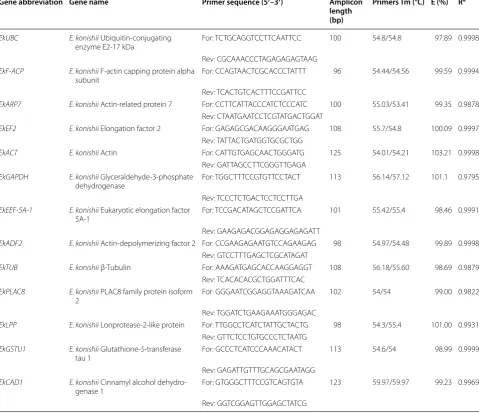
. Forward and reverse primers of all
candi-date reference genes were designed using Primer Premier
5.0 with the following parameters: Tm values ranging
from 50 to 70 °C, GC percent of 45–50%, primer lengths
of 18–25 bp and product length of 90–200 bp. All
prim-ers were synthesized by Sangon Biotech Co., Ltd
(Shang-hai, China). Primer details are shown in Table
1
.
qRT-PCR analysis for each candidate reference gene
was performed on a 7500 Fast ABI Real-time PCR system
(Applied Biosystems, US) using FastStart Universal SYBR
Green Master (Roche, Switzerland). A 20 μL reaction
mixture contained: 10 μL 2
×
SYBR Green Master, 0.4 μL
forward primer (10 μM), 0.4 μL reverse primer (10 μM),
2 μL cDNA and 7.2 μL dd H
2O in a 96-well plates. The
amplification conditions were as follows: 50 °C for 2 min,
95 °C for 10 min, 40 cycles of 95 °C for 15 s and 60 °C
for 30 s. Melting curve was analyzed to determine primer
specificity.
Data analysis
NormFinder and geNorm were used to analyze the
sta-bility of the 12 candidate reference genes under different
conditions. Expression levels of each reference gene were
shown by Cq values. Before using the two softwares, the
raw Cq values was used to calculate relative quantities by
the equation: Q
=
2
−(sampleCq-mimCq). The values of stability
(
M
) and pairwise variation (V) between genes was
gener-ated by geNorm, the lower
M
value is the gene expression
is more stable [
8
,
34
,
35
]. Furthermore, the normalization
factor generated by computing the pairwise variation of
the two normalization factor was used to determine the
most suitable numbers of reference genes with a cut-off
value of 0.15 [
17
]. NormFinder was used to evaluate the
stability of candidate genes by intra- and inter- group
variations. The more stable reference gene will have
lower stability value and inter- and intra-group variation.
Validation of the candidate reference genes
In order to verify the results of our experiments, the
most stable and unstable reference genes were selected
to validate the expression of the
E. konishii Cinnamyl
alcohol dehydrogenase 1
(
EkCAD1
) gene in different
tis-sue samples (root, branch, capsule, seed and leaf).
CAD1
belongs to
CAD
family, which catalyzes the reduction of
p
-coumaricaldehyde, coniferyl aldehyde and sinapyl
alde-hyde to their alcohol derivatives which are then
polymer-ized into lignin [
36
],
CAD
is one of the most used genes
Table 1 Primers used for qRT-PCR normalization
Gene abbreviation Gene name Primer sequence (5′–3′) Amplicon
length (bp)
Primers Tm (°C) E (%) R2
EkUBC E. konishii Ubiquitin‑conjugating
enzyme E2‑17 kDa For: TCT GCA GGT CCT TCA ATT CC 100 54.8/54.8 97.89 0.9998
Rev: CGC AAA CCC TAG AGA GAG TAAG EkF‑ACP E. konishii F‑actin capping protein alpha
subunit For: CCA GTA ACT CGC ACC CTA TTT 96 54.44/54.56 99.59 0.9994
Rev: TCA CTG TCA CTT TCC GAT TCC
EkARP7 E. konishii Actin‑related protein 7 For: CCT TCA TTA CCC ATC TCC CATC 100 55.03/53.41 99.35 0.9878 Rev: CTA ATG AAT CCT CGT ATG ACT GGA T
EkEF2 E. konishii Elongation factor 2 For: GAG AGC GAC AAG GGA ATG AG 108 55.7/54.8 100.09 0.9997 Rev: TAT TAC TGA TGG TGC GCT GG
EkACT E. konishii Actin For: CAT TGT GAG CAA CTG GGA TG 125 54.01/54.21 103.21 0.9998
Rev: GAT TAG CCT TCG GGT TGA GA EkGAPDH E. konishii Glyceraldehyde‑3‑phosphate
dehydrogenase For: TGG CTT TCC GTG TTC CTA CT 113 56.14/57.12 101.1 0.9795
Rev: TCC CTC TGA CTC CTC CTT GA EkEEF‑5A‑1 E. konishii Eukaryotic elongation factor
5A‑1 For: TCC GAC ATA GCT CCG ATT CA 101 55.42/55.4 98.46 0.9991
Rev: GAA GAG ACG GAG AGG AGA GATT
EkADF2 E. konishii Actin‑depolymerizing factor 2 For: CCG AAG AGA ATG TCC AGA AGAG 98 54.97/54.48 99.89 0.9998 Rev: GTC CTT TGA GCT CGC ATA GAT
EkTUB E. konishii β‑Tubulin For: AAA GAT GAG CAC CAA GGA GGT 108 56.18/55.60 98.69 0.9879 Rev: TCA CAC ACG CTG GAT TTC AC
EkPLAC8 E. konishii PLAC8 family protein isoform
2 For: GGG AAT CGG AGG TAA AGA TCAA 102 54/54 99.00 0.9822
Rev: TGG ATC TGA AGA AAT GGG AGAC
EkLPP E. konishii Lonprotease‑2‑like protein For: TTG GCC TCA TCT ATT GCT ACTG 98 54.3/55.4 101.00 0.9931 Rev: GTT CTC CTG TGC CCT CTA ATG
EkGSTU1 E. konishii Glutathione‑S‑transferase
tau 1 For: GCC CTC ATC CCA AAC ATA CT 113 54.6/54 98.99 0.9999
Rev: GAG ATT GTT TGC AGC GAA TAGG EkCAD1 E. konishii Cinnamyl alcohol dehydro‑
genase 1 For: GTG GGC TTT CCG TCA GTG TA 123 59.97/59.97 99.23 0.9969
to manipulate to obtain plants with low lignin content
[
37
]. qRT-PCR experimental method was the same as
described above, and the relative expression level was
calculated by 2
−ΔΔctmethod [
12
]. Data from three
bio-logical replicates were analyzed using analysis of variance
(ANOVA) followed by Student’s t test (P < 0.05).
Results
Primer specificity and PCR amplification efficiency
A total of 12 candidate reference genes, including three
common housekeeping genes and nine novel genes
from transcriptome sequencing data of
E. konishii
were
selected for qRT-PCR normalization. The details of gene
names, abbreviation, accession number, primer sequence,
primers Tm, product length, amplification efficiency and
correlation coefficient are shown in Table
1
. The
specific-ity for each primer set was validated by melting curve.
For all primer sets the melting curve showed a single
amplification peak (Additional file
3
). qRT-PCR efficiency
for all 12 candidate reference genes ranged from 97.89%
for
EkUBC
to 103.21% for
EkACT
, and correlation
coef-ficients varied from 0.9795 to 0.9999 (Table
1
).
Cq values of candidate reference genes
Cq values for all 12 reference genes are shown in Fig.
1
.
The Cq values varied from 15.812 (
EkF
-
ACP
) to 30.121
(
EkACT
) across all samples, and mean Cq ranged from
18.0575 (
EkF
-
ACP
) to 25.6685 (
EkACT
). Moreover,
EkACT
expression levels were the most variable with
8.905 Cq, while
EkGAPDH
showed the least variable
levels with 2.609 Cq. Since gene expression levels are
negatively correlated to Cq values,
EkF
-
ACP
had high
expression and
EkACT
with low expression.
Expression stability of candidate reference genes
Expression stability of the 12 reference genes was
ana-lyzed by geNorm and NormFinder. Samples were divided
into three different experimental groups: (1) five tissues
(root, leaf, branch, seed and capsule), (2) six seed
devel-opmental stages and (3) six capsule develdevel-opmental stages.
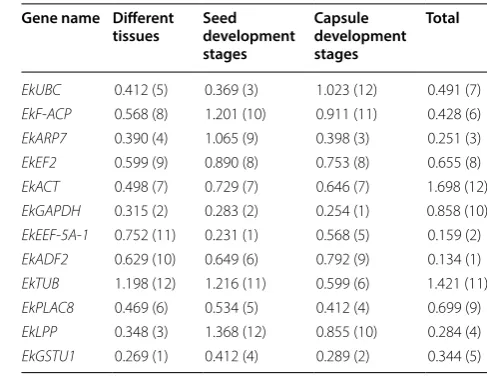
geNorm analysis
Gene expression stability was determined by
M
-value in
geNorm analysis, the lower the
M
value is, the more gene
expression stability. For the tissue group the two most
sta-ble genes were
EkGSTU1
and
EkGAPDH
with the lowest
M
value, and
EkTUB
was the most unstable gene. In the
seed group
EkEEF
-
5A
-
1
and
EkGAPDH
were the two most
stable genes through all the different developmental stages,
and
EkLPP
was the most unstable gene. Finally, in the
cap-sule group
EkGAPDH
was the most stable gene, followed
by
EkGSTU1
, and
EkF
-
ACP
and
EkUBC
were the least
stable genes (Table
2
; Fig.
2
). For all sample sets
EkADF2
and
EkEEF
-
5A
-
1
were the most stable genes, and
EkF
-
ACP
and
EkUBC
were the least stable. The minimum number of
genes required for normalization in all the different groups
was calculated by geNorm. The V2/3 values for all
differ-ent experimdiffer-ental groups were below the cut-off value of
0.15 (0.143 of all samples, 0.11 for tissues samples, 0.101
for seed development stages and 0.135 for capsule
devel-opment stages), which indicate that two reference genes
are enough to normalize gene expression data (Fig.
3
).
NormFinder analysis
Expression stability values analyzed by NormFinder
are shown in Table
3
. For tissue group,
EkGSTU1
and
EkGAPDH
were the most stable reference genes, and
Fig. 1 Cq values of the twelve candidate reference genes. The lines across the box indicate median values, boxes depict 25/75 percentiles. Whisker caps indicate the minimum and maximum values
Table 2 Gene expression stability across sample sets
calculated by geNorm
Gene name Different
tissues Seed development stages
Capsule development stages
Total
Fig. 2 Average expression stability (M‑value) of 12 candidate genes calculated by geNorm and ranking of the candidate reference genes in different experimental group. Tissues: five tissues sample sets; DSS: seed development stages; DSC: capsule development stages. Total: all samples
EkTUB
was the least stable gene, same as shown by
geNorm analysis. In the seed group
EkEEF
-
5A
-
1
and
EkGAPDH
were the most stable reference genes, while
EkARP7
was the least stable gene. In the capsule group,
EkGAPDH
and
EkGSTU1
got the top rank, while
EkUBC
and
EkF
-
ACP
were ranked at the lowest. In
gen-eral, the ranking was same as geNorm analysis (Table
3
).
EkCAD1
expression and validation of
EkGSTU1
and
EkGAPDH
In order to verify the reliability of the selected
refer-ence genes, expression profiles of
EkCAD1
gene was
determined in different tissues. Relative expression
levels were normalized using the two most stable
ref-erence genes (
EkGSTU1
and
EkGAPDH
) and the least
stable reference gene (
EkTUB
).
EkCAD1
showed similar expression levels when
sin-gle or a combination of reference genes (
EkGSTU1
and
EkGAPDH
) were used to normalize the expression.
EkCAD1
expression was up regulated in all the tissues
except in seed. However, when
EkTUB
was used for
normalization (unstable gene), relative expression
pro-file of
EkCAD1
was different when compared when the
normalization expression was done using the two most
stable reference genes identified in our study (
EkG-STU1
and
EkGAPDH
) (Fig.
4
). Our results suggest that
the expression patterns of target genes are differed
when normalized by different reference genes.
Discussion
qRT-PCR is one of the most commonly used technique
to determine gene expression in plants. To ensure the
accuracy and reliability of the results, a suitable reference
gene is necessary for data normalization. Conventionally,
some housekeeping genes such as
ACT
,
GAPDH
,
TUB
,
have been used as reference genes, however, no single
gene can be used for all plant species, experimental
con-ditions and/or tissues. Therefore, it is required to select
proper reference gene(s) for certain species under
dif-ferent conditions rather than using common reference
genes.
The development of high-throughput sequencing
tech-nology provides a more efficient approach to study plant
molecular biology, and it has been widely used in plant
genomes [
38
–
43
], plant transcriptome [
44
–
47
], plant
ncRNA [
48
–
50
], moreover, the generation of large-scale
gene segments and gene expression data by sequencing
provides a new resource for the identification of
refer-ence genes, especially in non-model species [
51
–
53
].
Therefore, transcriptome data on
E. konishii
Hayata,
available in our laboratory can be used as a tool to
iden-tify candidate reference genes. Asystematic study of 12
candidate reference genes in three conditions was carried
in this paper, and their expression stability was calculated
using geNorm and NormFinder.
ACT
and
TUB,
the most widely used reference genes,
did not show a good expression stability in
E. konishii
Hayata across all sample sets (Tables
2
,
3
). The
phenom-enon that expression levels of common reference genes
varied in a large range has been reported in several papers
[
54
,
55
].
GAPDH
, a common housekeeping gene also, has
been widely used as reference gene in different species
and experimental conditions [
51
,
56
–
60
], in our
experi-ments this gene was one of the two most stable genes in
tissue sample set and capsule development stages, but it
did not perform well in across all the sample and seed
sets. The different performance of
EkGAPDH
in different
experimental conditions in this study demonstrated that
Table 3 Gene expression stability across sample sets
calculated by NormFinder
Gene name Differenttissues Seed development stages
Capsule development stages
Total
EkUBC 0.268 (6) 0.239 (3) 0.391 (11) 0.274 (8) EkF‑ACP 0.331 (7) 0.392 (10) 0.414 (12) 0.201 (6) EkARP7 0.256 (3) 0.601 (12) 0.178 (3) 0.103 (4) EkEF2 0.367 (9) 0.521 (11) 0.369 (8) 0.348 (9) EkACT 0.546 (11) 0.379 (9) 0.365 (7) 1.495 (12) EkGAPDH 0.240 (2) 0.171 (2) 0.102 (1) 0.493 (10) EkEEF‑5A‑1 0.338 (8) 0.153 (1) 0.295 (6) 0.090 (2) EkADF2 0.458 (10) 0.358 (8) 0.384 (10) 0.035 (1) EkTUB 0.806 (12) 0.349 (7) 0.286 (5) 1.131 (11) EkPLAC8 0.261 (5) 0.273 (4) 0.251 (4) 0.259 (7) EkLPP 0.256 (3) 0.302 (6) 0.371 (9) 0.102 (3) EkGSTU1 0.165 (1) 0.285 (5) 0.116 (2) 0.159 (5)
there is no single reference gene that can be used for all
species or different experimental conditions [
61
–
65
].
In this study,
EkGSTU1
(glutathione-
S
-transferase tau
1), which belongs to tau class of glutathione transferases
(
GSTs
) [
66
], was the one of two most stable genes in
tis-sues sample and capsule development stages.
EkADF2
and
EkEEF
-
5A
-
1
were the two most stable genes in total
sample set,
ADF
(actin-depolymerizing factor) play
important roles in several cellular processes that require
cytoskeletal rearrangements, such as cell migration,
chromosome introgression, cleavage plane orientation
and furrow formation [
67
–
69
].
VvADF
has been
identi-fied as candidate reference gene for grapevine during
anthesis [
6
], rubber tree duration of latex flow [
70
] and
TrADF3
was selected as reference gene in staminate and
perfect flowers of
T. rupestris
[
71
].
It has been widely accepted that using combination of
multiple reference genes to normalize gene expression can
give more accurate and reliable expression patterns than
using a single gene in qRT-PCR analysis [
57
]. Based on
val-idation results of target gene expression, when
EkGAPDH
and
EkGSTU1
were selected as reference genes for
nor-malization either single or combination, the target gene
EkCAD1
showed the similar expression pattern among
dif-ferent tissues, which indicated that the expression pattern
of
EkCAD1
was nearly identical when normalized with a
single reference gene or two. Interestingly, in the tissue
group, the combination of traditional housekeeping gene
(
EkGAPDH
) and a novel identified reference gene (
EkG-STU1
) were identified as the most stable reference genes,
suggesting that combination of traditional housekeeping
genes and newly identified reference genes based on
tran-scriptome data can be used as a good strategy for
expres-sion normalization of
E. konishii
Hayata genes.
Conclusion
In this study, we evaluated the expression stability of
twelve candidate reference genes, including three
tradi-tional housekeeping genes and nine novel genes based
on transcriptome data of
E. konishii
Hayata. Additionally,
the expression pattern of target gene
EkCAD1
was
deter-mined in different tissues to further verify the reliability
of the identified stable reference genes. This study shows
the first data for reference genes validation on
E. konishii
Hayata. Our study will contribute in future studies of
gene expression in
E. konishii
Hayata and related species.
Additional files
Additional file 1. Sequences of 12 candidate genes and 1 validation gene.
Additional file 2. Alignment and phylogenetic tree of 12 candidate genes and 1 validation gene.
Additional file 3. Melting curves for the 12 candidate reference genes.
Authors’ contributions
WXL, XXZ, CLR, SQW and SQZ designed the experiments, LJW, XYY, WHS and HD selected the material, WXL, LJW, WHS and WH performed the experiments, WXL, XYY, HD, PFL, LN and WH analyzed the data, WXL, SQZ wrote the paper. All authors read and approved the final manuscript.
Author details
1 College of Forestry, Fujian Agriculture and Forestry University, Fuzhou, China. 2 Fujian Colleges and Universities Engineering Research Institute of Conserva‑
tion and Utilization of Natural Bioresources, Fujian Agriculture and Forestry University, Fuzhou, China. 3 Department of Microbiology and Molecular
Genetics, University of California, Irvine, USA. 4 College of Plant Protection,
Fujian Agriculture and Forestry University, Fuzhou, China. 5 College of Life Sci‑
ences, Fujian Agriculture and Forestry University, Fuzhou, China.
Competing interests
The authors declare that they have no competing interests.
Availability of data and materials
The datasets supporting the conclusions and description of a complete proto‑ col are included within the article.
Consent for publication
All authors have consented for publication.
Ethics approval and consent to participate Not applicable.
Funding
This work was supported by the National Science Foundation of China Projects (Grant No. 31700292), the Special fund for science and technol‑ ogy innovation of Fujian Agriculture and Forestry University (Project Nos. CXZX2016072, CXZX2016073, CXZX2016074).
Publisher’s Note
Springer Nature remains neutral with regard to jurisdictional claims in pub‑ lished maps and institutional affiliations.
Received: 25 October 2017 Accepted: 29 May 2018
References
1. Bustin SA. Quantification of mRNA using real‑time reverse transcription PCR (RT‑PCR): trends and problems. J Mol Endocrinol. 2002;29(1):23–39. 2. Die JV, Roman B, Nadal S, Gonzalez‑Verdejo CI. Evaluation of candidate reference genes for expression studies in Pisum sativum under different experimental conditions. Planta. 2010;232(1):145–53.
3. Schmidt GW, Delaney SK. Stable internal reference genes for normaliza‑ tion of real‑time RT‑PCR in tobacco (Nicotiana tabacum) during develop‑ ment and abiotic stress. Mol Genet Genom. 2010;283(3):233–41. 4. Bustin SA, Nolan T. Pitfalls of quantitative real‑time reverse‑transcription
polymerase chain reaction. J Biomol Tech. 2004;15(3):155–66. 5. Gutierrez L, Mauriat M, Guenin S, Pelloux J, Lefebvre JF, Louvet R,
Rusterucci C, Moritz T, Guerineau F, Bellini C, et al. The lack of a systematic validation of reference genes: a serious pitfall undervalued in reverse transcription‑polymerase chain reaction (RT‑PCR) analysis in plants. Plant Biotechnol J. 2008;6(6):609–18.
6. Gonzalez‑Aguero M, Garcia‑Rojas M, Di Genova A, Correa J, Maass A, Orellana A, Hinrichsen P. Identification of two putative reference genes from grapevine suitable for gene expression analysis in berry and related tissues derived from RNA‑Seq data. BMC Genom. 2013;14:878. 7. Jian B, Liu B, Bi Y, Hou W, Wu C, Han T. Validation of internal control for
gene expression study in soybean by quantitative real‑time PCR. BMC Mol Biol. 2008;9:59.
9. Andersen CL, Jensen JL, Orntoft TF. Normalization of real‑time quantita‑ tive reverse transcription‑PCR data: a model‑based variance estimation approach to identify genes suited for normalization, applied to bladder and colon cancer data sets. Can Res. 2004;64(15):5245–50.
10. Pfaffl MW, Tichopad A, Prgomet C, Neuvians TP. Determination of stable housekeeping genes, differentially regulated target genes and sample integrity: BestKeeper–Excel‑based tool using pair‑wise correlations. Biotechnol Lett. 2004;26(6):509–15.
11. Chen L, Zhong HY, Kuang JF, Li JG, Lu WJ, Chen JY. Validation of refer‑ ence genes for RT‑qPCR studies of gene expression in banana fruit under different experimental conditions. Planta. 2011;234(2):377–90. 12. Tong Z, Gao Z, Wang F, Zhou J, Zhang Z. Selection of reliable reference
genes for gene expression studies in peach using real‑time PCR. BMC Mol Biol. 2009;10:71.
13. Gao M, Liu Y, Ma X, Shuai Q, Gai J, Li Y. Evaluation of reference genes for normalization of gene expression using quantitative RT‑PCR under aluminum, cadmium, and heat stresses in soybean. PLoS ONE. 2017;12(1):e0168965.
14. Wang K, Niu Y, Wang Q, Liu H, Jin Y, Zhang S. Cloning and evaluation of reference genes for quantitative real‑time PCR analysis in Amor‑ phophallus. PeerJ. 2017;5:e3260.
15. Karuppaiya P, Yan XX, Liao W, Wu J, Chen F, Tang L. Correction: identi‑ fication and validation of superior reference gene for gene expres‑ sion normalization via RT‑qPCR in staminate and pistillate flowers of Jatropha curcas—a biodiesel plant. PLoS ONE. 2017;12(5):e0177039. 16. Li T, Wang J, Lu M, Zhang T, Qu X, Wang Z. Selection and validation of
appropriate reference genes for qRT‑PCR analysis in Isatis indigotica Fort. Front Plant Sci. 2017;8:1139.
17. Li J, Han X, Wang C, Qi W, Zhang W, Tang L, Zhao X. Validation of suit‑ able reference genes for RT‑qPCR data in Achyranthes bidentata Blume under different experimental conditions. Front Plant Sci. 2017;8:776. 18. Niu K, Shi Y, Ma H. Selection of candidate reference genes for gene
expression analysis in Kentucky Bluegrass (Poa pratensis L.) under abiotic stress. Front Plant Sci. 2017;8:193.
19. Zhang Y, Han X, Chen S, Zheng L, He X, Liu M, Qiao G, Wang Y, Zhuo R. Selection of suitable reference genes for quantitative real‑time PCR gene expression analysis in Salix matsudana under different abiotic stresses. Sci Rep. 2017;7:40290.
20. Xiao Z, Sun X, Liu X, Li C, He L, Chen S, Su J. Selection of reliable refer‑ ence genes for gene expression studies on Rhododendron molle G. Don. Front Plant Sci. 2016;7:1547.
21. Chen X, Mao Y, Huang S, Ni J, Lu W, Hou J, Wang Y, Zhao W, Li M, Wang Q, et al. Selection of suitable reference genes for quantitative real‑time PCR in Sapium sebiferum. Front Plant Sci. 2017;8:637.
22. Li MY, Song X, Wang F, Xiong AS. Suitable reference genes for accurate gene expression analysis in parsley (Petroselinum crispum) for abiotic stresses and hormone stimuli. Front Plant Sci. 2016;7:1481. 23. Xu L, Xu H, Cao Y, Yang P, Feng Y, Tang Y, Yuan S, Ming J. Validation of
reference genes for quantitative real‑time PCR during bicolor tepal development in asiatic hybrid lilies (Lilium spp.). Front Plant Sci. 2017;8:669.
24. Niu X, Chen M, Huang X, Chen H, Tao A, Xu J, Qi J. Reference gene selection for qRT‑PCR normalization analysis in kenaf (Hibiscus can-nabinus L.) under abiotic stress and hormonal stimuli. Front Plant Sci. 2017;8:771.
25. An H, Zhu Q, Pei W, Fan J, Liang Y, Cui Y, Lv N, Wang W. Whole‑transcrip‑ tome selection and evaluation of internal reference genes for expression analysis in protocorm development of Dendrobium officinale Kimura et Migo. PLoS ONE. 2016;11(11):e0163478.
26. Takahashi K, Kawaguchi S, Nishimura K, Kubota K, Tanabe Y. Studies on constituents of medicinal plants. XIII. Constituents of the pericarps of the capsules of Euscaphis japonica Pax. Chem Pharm Bull. 1974;22(3):650–3. 27. Cheng JJ, Zhang LJ, Cheng HL, Chiou CT, Lee IJ, Kuo YH. Cytotoxic
hexacyclic triterpene acids from Euscaphis japonica. J Nat Prod. 2010;73(10):1655–8.
28. Li YC, Tian K, Sun LJ, Long H, Li LJ, Wu ZZ. A new hexacyclic triterpene acid from the roots of Euscaphis japonica and its inhibitory activity on triglyceride accumulation. Fitoterapia. 2016;109:261–5.
29. Lee MK, Lee KY, Jeon HY, Sung SH, Kim YC. Antifibrotic activity of triterpe‑ noids from the aerial parts of Euscaphis japonica on hepatic stellate cells. J Enzyme Inhib Med Chem. 2009;24(6):1276–9.
30. Maeda H, Matsuo Y, Tanaka T, Kouno I. Euscaphinin, a new ellagitan‑ nin dimer from Euscaphis japonica (THUNB.) KANITZ. Chem Pharm Bull. 2009;57(4):421–3.
31. Lee MK, Jeon HY, Lee KY, Kim SH, Ma CJ, Sung SH, Lee HS, Park MJ, Kim YC. Inhibitory constituents of Euscaphis japonica on lipopolysaccha‑ ride‑induced nitric oxide production in BV2 microglia. Planta Med. 2007;73(8):782–6.
32. Takeda Y, Okada Y, Masuda T, Hirata E, Shinzato T, Takushi A, Yu Q, Otsuka H. New megastigmane and tetraketide from the leaves of Euscaphis japonica. Chem Pharm Bull. 2000;48(5):752–4.
33. Takeda Y, Okada Y, Masuda T, Hirata E, Takushi A, Otsuka H. Euscapholide and its glucoside from leaves of Euscaphis japonica. Phytochemistry. 1998;49(8):2565–8.
34. Guo Y, Chen JX, Yang S, Fu XP, Zhang Z, Chen KH, Huang Y, Li Y, Xie Y, Mao YM. Selection of reliable reference genes for gene expression study in nasopharyngeal carcinoma. Acta Pharmacol Sin. 2010;31(11):1487–94. 35. Han X, Lu M, Chen Y, Zhan Z, Cui Q, Wang Y. Selection of reliable reference
genes for gene expression studies using real‑time PCR in tung tree dur‑ ing seed development. PLoS ONE. 2012;7(8):e43084.
36. Vanholme R, Demedts B, Morreel K, Ralph J, Boerjan W. Lignin biosynthe‑ sis and structure. Plant Physiol. 2010;153(3):895–905.
37. Vanholme R, Morreel K, Darrah C, Oyarce P, Grabber JH, Ralph J, Boerjan W. Metabolic engineering of novel lignin in biomass crops. New Phytol. 2012;196(4):978–1000.
38. Velasco R, Zharkikh A, Affourtit J, Dhingra A, Cestaro A, Kalyanaraman A, Fontana P, Bhatnagar SK, Troggio M, Pruss D, et al. The genome of the domesticated apple (Malus × domestica Borkh.). Nat Genet. 2010;42(10):833–9.
39. Parkin IA, Koh C, Tang H, Robinson SJ, Kagale S, Clarke WE, Town CD, Nixon J, Krishnakumar V, Bidwell SL, et al. Transcriptome and methylome profiling reveals relics of genome dominance in the mesopolyploid Bras-sica oleracea. Genome Biol. 2014;15(6):R77.
40. Chapman JA, Mascher M, Buluc A, Barry K, Georganas E, Session A, Strnadova V, Jenkins J, Sehgal S, Oliker L, et al. A whole‑genome shotgun approach for assembling and anchoring the hexaploid bread wheat genome. Genome Biol. 2015;16:26.
41. Harper AL, Trick M, He Z, Clissold L, Fellgett A, Griffiths S, Bancroft I. Genome distribution of differential homoeologue contributions to leaf gene expression in bread wheat. Plant Biotechnol J. 2016;14(5):1207–14. 42. Guan R, Zhao Y, Zhang H, Fan G, Liu X, Zhou W, Shi C, Wang J, Liu W, Liang
X, et al. Draft genome of the living fossil Ginkgo biloba. GigaScience. 2016;5(1):49.
43. Lin Y, Min J, Lai R, Wu Z, Chen Y, Yu L, Cheng C, Jin Y, Tian Q, Liu Q, et al. Genome‑wide sequencing of longan (Dimocarpus longan Lour.) provides insights into molecular basis of its polyphenol‑rich characteristics. GigaS‑ cience. 2017;6(5):1–14.
44. Zhan X, Yang L, Wang D, Zhu JK, Lang Z. De novo assembly and analysis of the transcriptome of Ocimum americanum var. pilosum under cold stress. BMC Genom. 2016;17:209.
45. Evangelistella C, Valentini A, Ludovisi R, Firrincieli A, Fabbrini F, Scalabrin S, Cattonaro F, Morgante M, Mugnozza GS, Keurentjes JJB, et al. De novo assembly, functional annotation, and analysis of the giant reed (Arundo donax L.) leaf transcriptome provide tools for the development of a biofuel feedstock. Biotechnol Biofuels. 2017;10:138.
46. Abdeen A, Schnell J, Miki B. Transcriptome analysis reveals absence of unintended effects in drought‑tolerant transgenic plants overexpressing the transcription factor ABF3. BMC Genom. 2010;11:69.
47. Galla G, Vogel H, Sharbel TF, Barcaccia G. De novo sequencing of the Hypericum perforatum L. flower transcriptome to identify potential genes that are related to plant reproduction sensu lato. BMC Genom. 2015;16:254.
48. Sunkar R, Zhou X, Zheng Y, Zhang W, Zhu JK. Identification of novel and candidate miRNAs in rice by high throughput sequencing. BMC Plant Biol. 2008;8:25.
49. Nobuta K, Lu C, Shrivastava R, Pillay M, De Paoli E, Accerbi M, Arteaga‑ Vazquez M, Sidorenko L, Jeong DH, Yen Y, et al. Distinct size distribution of endogeneous siRNAs in maize: evidence from deep sequencing in the mop1‑1 mutant. Proc Natl Acad Sci USA. 2008;105(39):14958–63. 50. Liu TT, Zhu D, Chen W, Deng W, He H, He G, Bai B, Qi Y, Chen R, Deng
•fast, convenient online submission
•
thorough peer review by experienced researchers in your field
• rapid publication on acceptance
• support for research data, including large and complex data types
•
gold Open Access which fosters wider collaboration and increased citations maximum visibility for your research: over 100M website views per year
•
At BMC, research is always in progress.
Learn more biomedcentral.com/submissions
Ready to submit your research? Choose BMC and benefit from:
possible intermediate‑sized non‑coding RNAs in Oryza sativa. Mol Plant. 2013;6(3):830–46.
51. Zhuang H, Fu Y, He W, Wang L, Wei Y. Selection of appropriate reference genes for quantitative real‑time PCR in Oxytropis ochrocephala Bunge using transcriptome datasets under abiotic stress treatments. In: Frontiers in plant science. vol. 6, 2015/07/16 edn; 2015:475.
52. Wang H, Zhang X, Liu Q, Liu X, Ding S. Selection and evaluation of new reference genes for RT‑qPCR analysis in Epinephelus akaara based on transcriptome data. PLoS ONE. 2017;12(2):e0171646.
53. Demidenko NV, Logacheva MD, Penin AA. Selection and validation of reference genes for quantitative real‑time PCR in buckwheat ( Fag-opyrum esculentum) based on transcriptome sequence data. PLoS ONE. 2011;6(5):e19434.
54. Ma R, Xu S, Zhao Y, Xia B, Wang R. Selection and validation of appropriate reference genes for quantitative real‑time PCR analysis of gene expres‑ sion in Lycoris aurea. Front Plant Sci. 2016;7:536.
55. Ma S, Niu H, Liu C, Zhang J, Hou C, Wang D. Expression stabilities of candidate reference genes for RT‑qPCR under different stress conditions in soybean. PLoS ONE. 2013;8(10):e75271.
56. Monteiro F, Sebastiana M, Pais MS, Figueiredo A. Reference gene selection and validation for the early responses to downy mildew infection in sus‑ ceptible and resistant Vitis vinifera cultivars. PLoS ONE. 2013;8(9):e72998. 57. Guo J, Ling H, Wu Q, Xu L, Que Y. The choice of reference genes for assess‑
ing gene expression in sugarcane under salinity and drought stresses. Sci Rep. 2014;4:7042.
58. Tian C, Jiang Q, Wang F, Wang GL, Xu ZS, Xiong AS. Selection of suitable reference genes for qPCR normalization under abiotic stresses and hor‑ mone stimuli in carrot leaves. PLoS ONE. 2015;10(2):e0117569. 59. Cao J, Wang L, Lan H. Validation of reference genes for quantitative
RT‑PCR normalization in Suaeda aralocaspica, an annual halophyte with heteromorphism and C4 pathway without Kranz anatomy. PeerJ. 2016;4:e1697.
60. Wan D, Wan Y, Yang Q, Zou B, Ren W, Ding Y, Wang Z, Wang R, Wang K, Hou X. Selection of reference genes for qRT‑PCR analysis of gene expression in Stipa grandis during environmental stresses. PLoS ONE. 2017;12(1):e0169465.
61. Warzybok A, Migocka M. Reliable reference genes for normalization of gene expression in cucumber grown under different nitrogen nutrition. PLoS ONE. 2013;8(9):e72887.
62. Ray DL, Johnson JC. Validation of reference genes for gene expression analysis in olive (Olea europaea) mesocarp tissue by quantitative real‑time RT‑PCR. BMC Res Notes. 2014;7:304.
63. Gimeno J, Eattock N, Van Deynze A, Blumwald E. Selection and valida‑ tion of reference genes for gene expression analysis in switchgrass (Panicum virgatum) using quantitative real‑time RT‑PCR. PLoS ONE. 2014;9(3):e91474.
64. Qi S, Yang L, Wen X, Hong Y, Song X, Zhang M, Dai S. Reference gene selection for RT‑qPCR analysis of flower development in Chrysanthe-mum morifolium and Chrysanthemum lavandulifolium. Front Plant Sci. 2016;7:287.
65. Zhao Y, Luo J, Xu S, Wang W, Liu T, Han C, Chen Y, Kong L. Selection of reference genes for gene expression normalization in Peucedanum praeruptorum Dunn under abiotic stresses, hormone treatments and dif‑ ferent tissues. PLoS ONE. 2016;11(3):e0152356.
66. Lan T, Yang ZL, Yang X, Liu YJ, Wang XR, Zeng QY. Extensive functional diversification of the Populus glutathione S‑transferase supergene family. Plant Cell. 2009;21(12):3749–66.
67. Lenart P, Bacher CP, Daigle N, Hand AR, Eils R, Terasaki M, Ellenberg J. A contractile nuclear actin network drives chromosome congression in oocytes. Nature. 2005;436(7052):812–8.
68. Insall RH, Machesky LM. Actin dynamics at the leading edge: from simple machinery to complex networks. Dev Cell. 2009;17(3):310–22.
69. Kuure S, Cebrian C, Machingo Q, Lu BC, Chi X, Hyink D, D’Agati V, Gurniak C, Witke W, Costantini F. Actin depolymerizing factors cofilin1 and destrin are required for ureteric bud branching morphogenesis. PLoS Genet. 2010;6(10):e1001176.
70. Chao J, Yang S, Chen Y, Tian WM. Evaluation of reference genes for quan‑ titative real‑time PCR analysis of the gene expression in laticifers on the basis of latex flow in rubber tree (Hevea brasiliensis Muell. Arg.). Front Plant Sci. 2016;7:1149.