S O F T W A R E
Open Access
ProSave: an application for restoring
quantitative data to manipulated subsets of
protein lists
Daniel A. Machlab
1†, Gabriel Velez
1,2,3†, Alexander G. Bassuk
4and Vinit B. Mahajan
1,2,5*Abstract
Background:In proteomics studies, liquid chromatography tandem mass spectrometry data (LC-MS/MS) is quantified by spectral counts or by some measure of ion abundance. Downstream comparative analysis of protein content (e.g. Venn diagrams and network analysis) typically does not include this quantitative data and critical information is often lost. To avoid loss of spectral count data in comparative proteomic analyses, it is critical to implement a tool that can rapidly retrieve this information.
Results:We developed ProSave, a free and user-friendly Java-based program that retrieves spectral count data from a curated list of proteins in a large proteomics dataset. ProSave allows for the management of LC-MS/MS datasets and rapidly retrieves spectral count information for a desired list of proteins.
Conclusions:ProSave is open source and freely available athttps://github.com/MahajanLab/ProSave. The user manual, implementation notes, and description of methodology and examples are available on the site.
Keywords:ProSave, Proteomics, Java, Precision medicine
Background
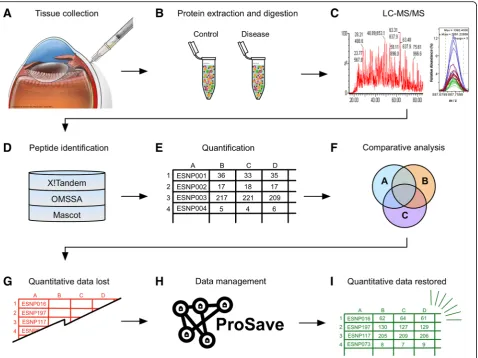
Shotgun proteomic analysis is frequently used in transla-tional biomedical research [1–5]. Mass spectrometry-based experiments generate large amounts of data, and the com-plexity and volume of this data is increasing with time. One promising application of shotgun proteomics is the molecu-lar characterization of diseased tissue samples to identify biomarkers or drug targets [6]. We have applied this method to numerous vitreoretinal diseases where there are few therapeutic options [7,8]. Liquid biopsies (e.g. vitreous or aqueous humor) can be taken at the time of surgery (Fig. 1a) [8–10]. These liquid biopsies can then be proc-essed and analyzed using liquid chromatography-tandem mass spectrometry (LC-MS/MS) to evaluate protein con-tent (Fig. 1b–c) [11]. Highly-advanced algorithms can match protein IDs to the thousands of peptide mass-spectral data obtained during the experiment (Fig.1d)
[12–15]. This quantitative data is typically represented in terms of spectral counts or ion abundance (Fig.1e). Down-stream analysis, organization, and meaningful interpret-ation of this LC-MS/MS data remains a challenge for researchers. Identified proteins can be further categorized using Venn diagrams, gene ontology (GO) categorization, clustering analysis, molecular pathway representation, and protein interaction network analysis (Fig. 1f) [1, 16, 17]. However, these analyses frequently make use of only the protein ID lists and the quantitative data (e.g. label-free spectral counts) is often ignored (Fig.1g). This can create is-sues for investigators attempting to make meaningful inter-pretations of these results, especially if they are unfamiliar with shell scripting or lack access to expensive bioinformat-ics suites (e.g. Ingenuity or Partek). To overcome this barrier, we created ProSave, a Java-based application that restores quantitative data to manipulated lists of protein IDs from larger shotgun proteomics datasets (Fig. 1h–i). ProSave is
different from other currently-available bioinformatic tools: it is free, open-source, and user-friendly (as opposed to R/ Bioconductor).
* Correspondence:[email protected]
†Daniel A. Machlab and Gabriel Velez contributed equally to this work.
1Omics Laboratory, Stanford University, Palo Alto, CA, USA
2Department of Ophthalmology, Byers Eye Institute, Stanford University, 1651 Page Mill Road, Palo Alto, CA 94304, USA
Full list of author information is available at the end of the article
© The Author(s). 2018Open Access This article is distributed under the terms of the Creative Commons Attribution 4.0 International License (http://creativecommons.org/licenses/by/4.0/), which permits unrestricted use, distribution, and reproduction in any medium, provided you give appropriate credit to the original author(s) and the source, provide a link to the Creative Commons license, and indicate if changes were made. The Creative Commons Public Domain Dedication waiver (http://creativecommons.org/publicdomain/zero/1.0/) applies to the data made available in this article, unless otherwise stated. Machlabet al. Source Code for Biology and Medicine (2018) 13:3
Implementation
ProSave was developed using Java and was successfully tested on Microsoft Windows 10 and Mac OS Sierra ver.10.12.6. It was written to maintain quantitative pro-tein data (e.g. spectral counts, propro-tein intensity, etc.) that was otherwise lost when protein ID lists were compared between tissue samples during proteomic analysis, which excludes all numerical protein data and focuses solely on the protein IDs derived from the liquid biopsies. ProSave solves this problem and restores critical protein informa-tion lost during analysis by processing original protein data before it is manipulated by downstream compara-tive analysis, such as Venn diagrams or gene ontology (GO) and network analysis. ProSave is a tool that is use-ful beyond proteomics research. It was designed to work with any large-scale gene or protein expression analysis. Further, ProSave works with protein expression data from a variety of methods, including data obtained
through data-dependent and data-independent acquisi-tion (DDA and DIA) as well as labeled methods like iTRAQ (isobaric tag for relative and absolute quantifica-tion) and SILAC (stable isotope labeling with amino acids in cell culture).
Developer documentation
ProSave is a free, open source software available athttps://
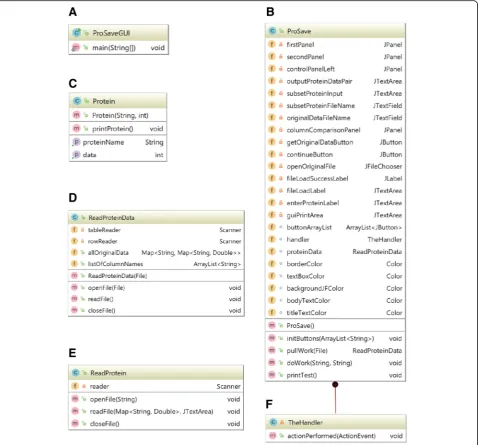
github.com/MahajanLab/ProSave/. Additionally, java class
class (Fig. 2d). The ReadProtein class (Fig. 2e) uses the hashing structure for rapid data lookup. All GUI layout and interface parameters are specified in theProSaveclass (Fig.2b), which also has an internal class for event hand-ling (Fig.2f ).
User documentation
ProSave has been designed to be applied as a tool for any large-scale gene or protein expression investigation. Below are steps on how to use ProSave on any compat-ible data set:
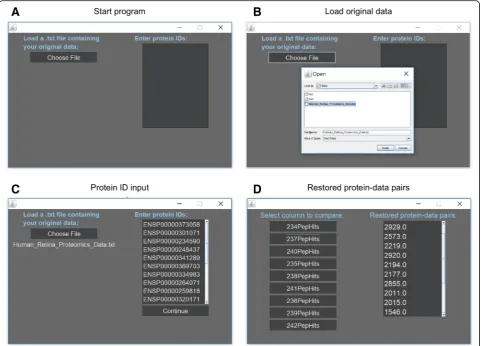
Step 1:Download ProSave.jar from https://
github.com/MahajanLab/ProSave/ and run ProSave
by opening the downloaded file (Fig. 3a). Additionally, download Java if it is not already downloaded.
Step 2:Make a .txt with the original data. To do this from Excel go to File>Export>Change File Type>Text>Save. Once ProSave opens, click ‘Choose File’ to add the .txt file of the original data. For proper function, insure all columns have one-word names and text begins on first row of the .txt file (Fig. 3b).
Fig. 2ProSave Java Class Diagram:aProSaveGUIclass creates the ProSave object and sets some GUI parameters.bTheProSaveclass creates the framework and manages layout of the GUI.cTheProteinclass stores data for a specific protein.dReadProteinDataorganizes and stores original data from the file input.eTheReadProteinclass organizes input proteins and retrieves data paired with each protein.fTheHandlermanages actions of programs in response to user events on GUI
Step 3:Enter a list of protein IDs in the textbox labeled‘Enter protein IDs’, then click‘Continue’ (Fig.3c).
Step 4:Click the button labels with the name of the column of data corresponding to the tissue for comparison.
Step 5:Get restored data from the text box labeled
‘Restored protein-data pairs’(Fig.3d).
Results
Case study
We tested ProSave on a comparative proteomics dataset of anatomical regions of the human retina: the periph-eral retina, juxta-macular, and foveomacular regions [18]. LC-MS/MS was performed on retinal punch biop-sies using an LTQ Velos and data were acquired using the DDA acquisition method as previously described. [18, 19] We identified 1,779 ± 51 individual proteins in the peripheral retina, 1,999 ± 46 individual proteins juxta-macular region, and 1,974 ± 92 individual proteins in the foveomacular region. Data were organized and
analyzed using comparative analyses (e.g. Venn dia-grams, differential protein expression, pathway represen-tation, etc.). Protein ID lists from each tissue sample were compared using Venn diagrams to identify shared and unique proteins among the different regions of the retina. This analysis identified 1,354 proteins shared among the three retinal regions. After this comparison, however, only protein IDs remained, and the protein ex-pression levels were not available for interpretation. Using ProSave, spectral count data was restored to this list of 1,354 proteins and we were able to ascertain the most abundant proteins shared among the three groups: alpha-and gamma-enolase, tubulin, pyruvate kinase, creatine kin-ase b-type, vimentin, glyceraldehyde-3-phosphate dehydro-genase, and histone H2B (types 1-D and G) [18]. A similar approach was used to gather information on the most abundant proteins unique to each anatomical region [18].
interrogating the original dataset to restore quantitative data for each protein of interest. Instead, ProSave ac-complishes the same task in a matter of seconds instead of hours or days. We applied ProSave to our shared and unique protein lists to restore spectral count data. This gave us insight into which proteins were most and least abundant, thus allowing us to increase our understand-ing of targeted tissues.
Conclusions
In conclusion, ProSave is a free and user-friendly tool to restore quantitative data to manipulated subsets of pro-tein IDs during analysis of proteomic data. It speeds up the workflow for proteomic bioinformatics and makes for meaningful interpretation of comparative data. We anticipate that ProSave will be a useful tool to simplify processing and analysis of translational proteomics data. Such a program could even be applied to other gene/ protein expression platforms where comparative analyses make use of only gene/protein IDs (e.g. RNA-seq, micro-arrays, ELISA).
Availability and requirements
Project name:ProSave
Project home page: https://github.com/MahajanLab/
ProSave
Operating system(s):Platform independent
Programming language:Java
Other requirements:None
License:GNU
Any restrictions to use by non-academics:None
Abbreviations
DDA:Data-dependent acquisition; DIA: Data-independent acquisition; GO: Gene ontology; GUI: Graphical user interface; iTRAQ: Isobaric tag for relative and absolute quantification; LC-MS/MS: Liquid chromatography-tandem mass spectrometry; SILAC: Stable isotope labeling with amino acids in cell culture
Acknowledgements
None.
Funding
VBM and AGB are supported by NIH grants [R01EY026682, R01EY024665, R01EY025225, R01EY024698, R21AG050437, and P30EY026877], VBM is also supported by the Doris Duke Charitable Foundation Grant #2013103, and Research to Prevent Blindness (RPB), New York, NY. GV is supported by NIH grants [F30EYE027986 and T32GM007337].
Availability of data and materials
The datasets generated during and/or analyzed during the current study are available from the corresponding author on reasonable request.
Financial Disclosure
None
Authors’contributions
Dr. VBM had full access to all the data in the study and takes responsibility for the integrity of the data and the accuracy of the data analysis. DAM, GV, AGB, and VBM initiated the idea of the tool and conceived the project. DAM and GV designed the tool and analyzed the data. DAM and GV tested the
tool. DAM, GV, AGB, and VBM wrote the paper. All authors read and approved the final manuscript. VBM and AGB obtained funding. VBM provided administrative, technical, and material support.
Ethics approval and consent to participate
Not applicable.
Consent for publication
Not applicable.
Competing interests
The authors declare that they have no competing interests.
Publisher’s Note
Springer Nature remains neutral with regard to jurisdictional claims in published maps and institutional affiliations.
Author details
1
Omics Laboratory, Stanford University, Palo Alto, CA, USA.2Department of Ophthalmology, Byers Eye Institute, Stanford University, 1651 Page Mill Road, Palo Alto, CA 94304, USA.3Medical Scientist Training Program, University of Iowa, Iowa City, IA, USA.4Department of Pediatrics, University of Iowa, Iowa City, IA, USA.5Palo Alto Veterans Administration, Palo Alto, CA, USA.
Received: 6 February 2018 Accepted: 1 November 2018
References
1. Mahajan VB, Skeie JM. Translational vitreous proteomics. Proteomics Clin Appl. 2014;8(3–4):204–8.
2. Duarte TT, Spencer CT. Personalized proteomics: the future of precision medicine. Proteomes. 2016;4(4):29.
3. Skeie JM, Roybal CN, Mahajan VB. Proteomic insight into the molecular function of the vitreous. PLoS One. 2015;10(5):e0127567.
4. Skeie JM, Mahajan VB. Proteomic landscape of the human choroid-retinal pigment epithelial complex. JAMA Ophthalmol. 2014;132(11):1271–81. 5. Skeie JM, Mahajan VB. Proteomic interactions in the mouse vitreous-retina
complex. PLoS One. 2013;8(11):e82140.
6. Velez G, Tang PH, Cabral T, Cho GY, Machlab DA, Tsang SH, Bassuk AG, Mahajan VB. Personalized proteomics for precision health: identifying biomarkers of vitreoretinal disease. Trans Vis Sci Tech. 2018;7(5):12. 7. Velez G, Bassuk AG, Colgan D, Tsang SH, Mahajan VB. Therapeutic drug
repositioning using personalized proteomics of liquid biopsies. JCI Insight. 2017;2(24):e97818.
8. Velez G, Roybal CN, Colgan D, Tsang SH, Bassuk AG, Mahajan VB. Precision medicine: personalized proteomics for the diagnosis and treatment of idiopathic inflammatory disease. JAMA Ophthalmol. 2016;134(4):444–8. 9. Velez G, Roybal CN, Binkley E, Bassuk AG, Tsang SH, Mahajan VB. Proteomic
analysis of elevated intraocular pressure with retinal detachment. Am J Ophthalmol Case Rep. 2017;5:107–10.
10. Skeie JM, Brown EN, Martinez HD, Russell SR, Birkholz ES, Folk JC, Boldt HC, Gehrs KM, Stone EM, Wright ME, et al. Proteomic analysis of vitreous biopsy techniques. Retina. 2012;32(10):2141–9.
11. Skeie JM, Tsang SH, Zande RV, Fickbohm MM, Shah SS, Vallone JG, Mahajan VB. A biorepository for ophthalmic surgical specimens. Proteomics Clin Appl. 2014;8(3–4):209–17.
12. Geer LY, Markey SP, Kowalak JA, Wagner L, Xu M, Maynard DM, Yang X, Shi W, Bryant SH. Open mass spectrometry search algorithm. J Proteome Res. 2004;3(5):958–64.
13. Bjornson RD, Carriero NJ, Colangelo C, Shifman M, Cheung KH, Miller PL, Williams K. X!!Tandem, an improved method for running X!Tandem in parallel on collections of commodity computers. J Proteome Res. 2008;7(1): 293–9.
14. Yen CY, Meyer-Arendt K, Eichelberger B, Sun S, Houel S, Old WM, Knight R, Ahn NG, Hunter LE, Resing KA. A simulated MS/MS library for spectrum-to-spectrum searching in large scale identification of proteins. Mol Cell Proteomics. 2009;8(4):857–69.
15. Perkins DN, Pappin DJ, Creasy DM, Cottrell JS. Probability-based protein identification by searching sequence databases using mass spectrometry data. Electrophoresis. 1999;20(18):3551–67.
16. Thomas PD, Campbell MJ, Kejariwal A, Mi H, Karlak B, Daverman R, Diemer K, Muruganujan A, Narechania A. PANTHER: a library of protein families and subfamilies indexed by function. Genome Res. 2003;13(9):2129–41. 17. Szklarczyk D, Morris JH, Cook H, Kuhn M, Wyder S, Simonovic M, Santos A,
Doncheva NT, Roth A, Bork P, et al. The STRING database in 2017: quality-controlled protein-protein association networks, made broadly accessible. Nucleic Acids Res. 2017;45(D1):D362–8.
18. Velez G, Machlab DA, Tang PH, Sun Y, Tsang SH, Bassuk AG, Mahajan VB. Proteomic analysis of the human retina reveals region-specific susceptibilities to metabolic- and oxidative stress-related diseases. PLoS One. 2018;13(2):e0193250.