Abstract
Background: detection of allergen-induced basophil activation by flow cytometry has been shown to be a useful tool for allergy diagnosis.
Objective: the aim of this study was to assess the po-tential of this technique for the diagnosis of pediatric cow milk allergy.
Material and methods: the quantification of total and specific ige and basophil activation test were per-formed to evaluate cow milk allergic (n = 9), and non-allergic children (n = 15).
Results: Allergen-induced basophil activation was de-tected as a Cd203c up-regulation. the expression of Cd203c antigen on basophils was measured with flow cytometry. the antigen Cd203c was detected on 15.4 ±10.2% basophils from allergic children after incuba-tion with specific allergens in concentraincuba-tion 1:10, whereas in the control group there were 3.0 ±1.5% of basophils positive for this molecule (P<0.05). Stimula-tion with allergen diluted 1:500 resulted in activaStimula-tion of 15.3 ±11.2% of basophils in allergic children and 3.8 ±2.3% of cells in the control group (P<0.05). Pos-itive results of an allergenicity test (above the cut- off level of 10%) were obtained in 7 out of the 9 allergic children. in 5 cases, the cut-off level was reached with both dilution of allergens (1 : 10 and 1 : 500). in 1 pa-tient, positive stimulation was observed after stimula-tion with allergen diluted 1:10 and in another case only 1 : 500 resulted in stimulation of more then 10% of basophils. in no child of the control group, stimula-tion above 10% was noted.
Conclusions: this study demonstrates that the analysis of allergen-induced Cd203c up-regulation with flow cytometry is a reliable tool for the diagnosis of cow milk allergy in pediatric patients, with sensitivity simi-lar to routine diagnostic tests and a higher specificity. Key words: cow milk allergy, basophil activation test, Cd203c, diagnosis, children
i
ntrodUCtionAllergy to cow milk is very common in young children and infants. digested fractions of the milk proteins may trigger pathological immune response and induce the production of antibodies [1, 2]. the evaluation of a child suspected of food allergy includes a
combina-tion of the several diagnostic tools [1-3]. the diagno-sis is made on the badiagno-sis on medical history and physi-cal examination, prick skin testing, patch testing, in vitro tests, elimination diet, and food challenges. none of the laboratory tests have reached adequate diagnos-tic accuracy, and the food challenge is connected with a substantial risk of exacerbation of allergy symptoms. Skin prick and patch tests are the most common in vivo tests as the first line investigation. their positive predictive accuracies, the correlation between the posi-tivity of the test, and the presence of cow milk allergy, vary between 69 and 100% and the negative predictive values between 20 to 86% [3]. Prick tests may be nega-tive and the specific ige absent especially in children with delayed reactions, a clinical problem which may be overcome by using the atopy patch test (APt) [4]. APt involves prolonged contact of the allergenic food extract with the intact skin under occlusion for 48 h. Positive reactions to patch tests consist of ery-thema and induration. the measurement of the con-centration of food-specific ige antibodies may be use-ful when identifying a subset of patients highly likely (>95% risk) to experience clinical reactions to milk [5].
A high level of milk specific ige is useful in diag-nosing symptomatic allergy to milk in the pediatric population, but the results remain inconclusive [1, 6, 7]. in most cases, a placebo-controlled food challenge, a definitive diagnostic test for cow milk allergy, is still required for a subset of patients [1, 2]. newly devel-oped, functional in vitro tests for allergic reactions are focused on circulating basophils and may overcome the need for food challenge tests in some pediatric pa-tients. the first approach to basophil functional studies has been the histamine release test. however, its clini-cal benefit remains controversial due to insufficient sensitivity and specificity [8, 9]. the next generation of basophil functional test is based on flow cytometry, as a tool to monitor basophil activation upon allergen challenge by detecting surface expression of activation markers [9]. Basophils and mast cells are the main ef-fector cells responsible for atopic reactions. A large panel of mediators including cytokines, histamine, and tryptase, is released from the cell upon degranulation [8, 9]. in addition, changes in the expression of ba-sophil surface molecules are observed: some antigens appear de novo(Cd63, Cd107a) and others significant-ly increase their expression (Cd13, Cd203c). the
eur J Med res (2010) 15(Suppl. ii): 21-26 © i. holzapfel Publishers 2010
B
ASoPhiL
A
CtiVAtion
t
eSt
B
ASed on the
e
XPreSSion of
C
d
203
C in the
d
iAGnoStiCS of
C
oW
M
iLK
A
LLerGy in
C
hiLdren
o. Ciepiela1, J. Zwiazek1, A. Zawadzka-Krajewska2, i. Kotula1, M. Kulus2, U. demkow1
Cd203c antigen is one of the most important markers of basophil activation. this antigen belongs to the type ii transmembrane protein family and is a multifunc-tional ecto-enzyme called ectonucleotide pyrophos-phatase phophodiesterase 3 (e-nPP3) [9, 10] that cat-alyzes the cleavage of a number of molecules including deoxynucleotides and nucleotide sugars. in addition, e-nPP3 contains a somatomedin B-like domain and a cell adhesive motif, but their potential functions re-main unknown.
Among leukocytes, Cd203c appears to be selective-ly expressed in the basophil/mastocytes lineage [9]. its expression increases after basophil degranulation and, therefore, is a reliable marker of basophil activation in the ige-dependent process. resting basophils are characterized by a low expression of this protein which rapidly increases upon activation [9]. Another molecule that can facilitate basophil recognition is Crth2 (chemoattractant receptor-homologous mole-cule expressed on th2 cells) as it is highly expressed on basophils. Crth2 is present only on cells associ-ated with th2 responses (th2 lymphocytes, eosinophils and basophils). Consequently, a new three-color flow cytometric protocol (Pe-Cd203c / fitC-Crth2 / PC5-Cd3) for the assessment of allergen-induced basophil activation has been developed [11, 12]. Crth2 and Cd203c staining allows for an easy distinguishing of basophils from other cells in samples of whole blood.
the goal of this study was to assess the usefulness of a basophil activation test, based on the Cd203c ex-pression, in the diagnosis of cow milk allergy in chil-dren.
M
AteriAL AndM
ethodSthe experiments were approved by the ethics Com-mittee of Warsaw Medical University in Warsaw, Poland. the blood for the analysis in this study was collected with parental approval. nine infants and chil-dren aged 5–35 months (median 11 months), suffering from cow milk allergy, confirmed with in vitrospecific ige test positive to milk allergens (Unicap, Pharmacia, Uppsala, Sweden), served as the study group. the blood had been drawn before milk-free diet was intro-duced. All allergic children showed features of eczema or gastrointestinal symptoms after ingestion of cow milk. 15 healthy, non-allergic controls aged 5–95 months (median 26 months) were included in the con-trol group. none of the subjects were treated with an-tihistamine drugs or oral corticosteroids.
BASoPhiLACtiVAtionteStS
All tests were carried out within two hours from blood collection. A residual blood sample of 400 µl, remaining from routine blood count analysis was used for the basophil activation test. Cd203c induced ex-pression was evaluated using the Allergenicity Kit (Beckman Coulter, U.K.) according to the manufac-turer's instructions. Milk proteins suspension for prick tests (Allergopharma, reinbek, Germany) was diluted 1:10 and 1:500 in phosphate buffered saline (PBS). edtA-anticoagulated peripheral blood aliquots (100
µl) stained with 20 µl of mixture of monoclonal anti-bodies (Crth2–fitC, Cd203c–Pe, Cd3-PC7) and Activation Solution (100 µl) were stimulated (37°C) for 15 min with 20 µl of optimal dilution of allergens; antibody directed against the high affinity ige recep-tor (fceri) (Beckman Coulter, U.K.) was used as a
positive control and PBS as a negative control. After incubation, the reaction was stopped with Stop Solu-tion. erythrocytes were lysed with Lysing Solution for 10 min at room temperature (rt). Suspension was centrifuged (5 min, 300 x g) after lysing, washed with PBS, once more centrifuged and resuspended in 500 µl fixative Solution. Leukocytes were analyzed using a five-color flow cytometer (Cytomics fC500, Beckman Coulter, U.K.). during acquisition, basophils were se-lected as Cd203c positive/Crth2 high/Cd3 nega-tive population using fL1/fL2 and SS/fL5 dot plots. in the negative control, the threshold for positivity was set at less than 5% of activated cells according to the literature data [1, 9]. in the positive control, sensi-tivity for the ige dependent reaction was verified. the threshold for a positive reaction was settled at less than 15% of activated cells, according to litera-ture data and the investigators’ previous studies [11, 12].
StAtiStiCALAnALySiS
results are presented as means ±Sd. A comparison of the results from different groups was performed using Mann-Whitney U test. P<0.05 was considered signifi-cant. Specificity and sensitivity were calculated accord-ing to followaccord-ing equations:
sensitivity = tP/(tP+fn) x 100% and specificity = tn/(tn+fP) x 100%; where: tP true positive, fd -false positive, tn - true negative, fn - -false negative results.
r
eSULtSthe Cd203c expression on basophils was evaluated to assess patients’ sensitivity to cow milk antigen stimula-tion. the mean fluorescence of fluorochrome bound to Cd203c was measured before and after allergenic stimulation. As a negative control, fluorescence of spontaneously activated basophils was measured. As a positive control, fluorescence of ige stimulated ba-sophil was estimated (fig. 1). the cut-off level was set at >10% Cd203c positive cells.
Fig. 1. expression of Cd203c in negative (A) and positive (B) controls.
Table 1. Percentage of activated basophils in the group of cow milk allergic children.
no Activated cells in Activated Activated cells Activated cells after fluorescence of cells in cells in after stimulation stimulation with spontaneously negative positive with allergens allergens diluted activated basophils control (%) control (%) diluted 1:10 (%) 1:500 (%) (MfC units)
1 2.8 51.4 1.7 5.3 4.9
2 3.5 29.9 33.1 37.3 6.3
3 4.1 15.4 16.9 3.7 13.3
4 3.1 5.0 9.3 4.6 11.0
5 4.7 16.2 15.6 16.7 18.7
6 4.5 17.5 23.1 26.2 25.2
7 4.1 33.3 5.9 11.8 11.7
8 3.9 18.2 13.1 19.9 6.4
9 3.5 13.1 21.2 11.8 22.1
the results above the cut-off level are bolded.
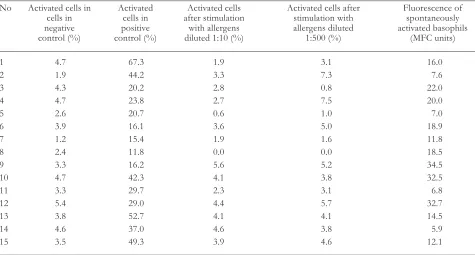
Table 2.Percentages of activated basophils in the control group.
no Activated cells in Activated Activated cells Activated cells after fluorescence of cells in cells in after stimulation stimulation with spontaneously negative positive with allergens allergens diluted activated basophils control (%) control (%) diluted 1:10 (%) 1:500 (%) (MfC units)
1 4.7 67.3 1.9 3.1 16.0
2 1.9 44.2 3.3 7.3 7.6
3 4.3 20.2 2.8 0.8 22.0
4 4.7 23.8 2.7 7.5 20.0
5 2.6 20.7 0.6 1.0 7.0
6 3.9 16.1 3.6 5.0 18.9
7 1.2 15.4 1.9 1.6 11.8
8 2.4 11.8 0.0 0.0 18.5
9 3.3 16.2 5.6 5.2 34.5
10 4.7 42.3 4.1 3.8 32.5
11 3.3 29.7 2.3 3.1 6.8
12 5.4 29.0 4.4 5.7 32.7
13 3.8 52.7 4.1 4.1 14.5
14 4.6 37.0 4.6 3.8 5.9
of 15.3 ±11.2% of basophils in the allergic children and 3.8 ±2.3% of cells in the control group (P<0.05).
Positive results of the allergenicity test were ob-tained in 7 out of the 9 allergic children. in 5 cases, the cut-off level was reached with both dilutions of al-lergens (1:10 and 1:500). in 1 patient, positive stimula-tion was observed after stimulastimula-tion with the allergen diluted 1:10 and in another case only 1:500 resulted in stimulation of more than 10% of basophils. in 2 pa-tients, significant basophil activation was not ob-served. in no child of the control group was the stim-ulation above 10% noted. in 4 healthy children, the percentage of activated basophils was 5-10%. the in-dividual results are summarized in tables 1 and 2.
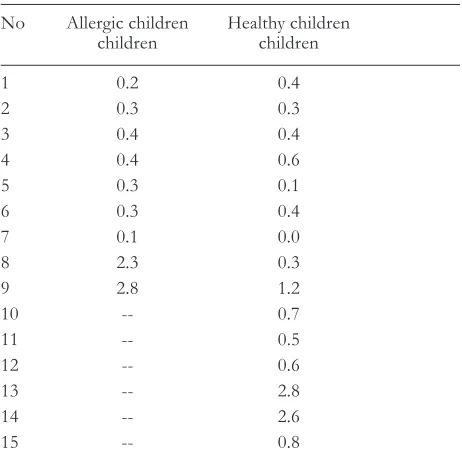
the percentage of th2 cells among lymphocytes in both allergic and non-allergic children was calculated. in the children allergic to cow milk, the percentage of th2 lymphocytes was 0.12–2.8% (median 0.33) and that in the control group was 0.02–2.8% (median 0.48); the difference being insignificant. these results are presented in table 3. diagnostic accuracy of the basophil activation test is presented in table 4. the test sensitivity was 66.7% and the specificity was 100%.
d
iSCUSSionBasophil activation with specific allergens has proven to be useful for diagnosis of pollen, latex, and food
allergy [13]. Cd203c up-regulation is more or less specific to the cross linking of fceri. hence, as
Cd203c is rapidly up-regulated after allergen chal-lenge, it has been proposed as a new tool for allergy diagnosis [9, 13-15]. our study demonstrates that the analysis of allergen-induced Cd203c up-regulation by flow cytometry is a reliable tool for diagnosis of cow milk allergy in pediatric patients, with sensitivity simi-lar to routine diagnostic tests and a higher specificity than that of specific ige determination. therefore, the basophil activation test is a highly efficient in con-firming cow milk allergy in children. Several authors have studied the diagnostic value of basophil activa-tion test in food allergy. ocmant et al [16] have found sensitivity of 89.5% and specificity of 97.1% in peanut allergy and that of 62.5% and 96.4%, respec-tively, in egg allergy. tokuda et al [17] have confirmed 85.0% sensitivity and 77.0% specificity in wheat aller-gy. in the present study, two of the examined patients with confirmed cow milk allergy presented a negative result of the basophil activation test. At least in one case, this result may be explained by a relatively low basophil count in the peripheral blood. in this patient, the response to positive control also was low (4.95%). the cause of the unresponsiveness in another case is not known. As 40-50% of milk allergy is non–ige-mediated [18], we may speculate that in this patient the allergy was induced by ige-unrelated mechanisms. two of the examined children responded to activa-tion with only one soluactiva-tion of the allergen. it con-firms the opinion of others that different concentra-tions of allergen may stimulate or block basophil re-sponse [19-21]. interestingly, two of the control chil-dren also responded in a concentration-dependent manner; however, in neither case the obtained result exceeded the cut-off value. We also observed in a child from the control group that anti-ige stimulation (positive control) did not result in increased expres-sion of Cd203c on basophils. this may be explained by disturbances in intracellular signaling commonly observed in around 5% of the general population (non-responders) [11]. on the other hand, the identi-fication of basophils using prior protocols relied on a single ige-labeling, showed that fceri expression can
vary considerably on cell surfaces from one patient to another [22]. that is why in some cases basophils were difficult or impossible to be stimulated by anti-ige monoclonal antibodies.
in the present study we also showed that there was no difference between the th2 populations of cells in the allergic and non-allergic children. the lack of dif-ference may be explained by the immaturity of the im-mune system in young children. Moreover, Crth2-staining protocol, illustrated its superiority with re-spect to basophil recovery. easy recognition of ba-sophils and a reliable assessment of their activation make this protocol the most reliable tool for investi-gating basophil activation by flow cytometry. Since Crth2 is also a marker of th2 cells and eosinophils, it may become a promising tool for flow cytometry, providing a direct overview of cells involved in ‘th2 diseases’, such as allergy [12, 16, 17].
it is a common observation that food allergy is a disease of young children, which in most cases is
out-Table 4.true positive (tP), false positive (fP), true negative (tn), and false negative (fn) results.
Basophil Presence of cow milk allergy
activation test yes no
Positive tP (n=12) fP(n=0) negative fn (n=6) tn (n=30) together tP + fn (n=18) fP + tn (n=30)
Table 3.Percentage of th2 cells among lymphocytes (%).
no Allergic children healthy children children children
1 0.2 0.4
2 0.3 0.3
3 0.4 0.4
4 0.4 0.6
5 0.3 0.1
6 0.3 0.4
7 0.1 0.0
8 2.3 0.3
9 2.8 1.2
10 -- 0.7
11 -- 0.5
12 -- 0.6
13 -- 2.8
14 -- 2.6
grown. the majority of children develop tolerance within the first 3-5 years of life [23]. the two foods responsible for most of these reactions are cow milk and hen eggs. it is then obvious that a reliable test to predict loss of sensitivity is needed. Children who acquire tolerance can continue to have positive skin test results for years, and therefore skin tests are not predictive of outgrowing the food sensitivity [23, 24]. A positive double-blind, placebo-controlled food challenge is the gold standard for the diagnosis of food allergy [1, 2]. After initiating a cow milk re-striction diet, the clinical manifestations triggered by the first challenge are difficult to predict. in contrast, if the first challenge fails, further ones may result in severe symptoms. one must also be prepared to con-duct challenges in a safe environment with available facilities for resuscitation. rubio et al [25] have shown the benefit of a basophil activation test in pre-dicting the child's reaction to the oral challenge, evalu-ating and comparing the specific ige and skin prick test results. the authors used allergen-induced ba-sophil activation based on Cd63-upregulation by flow cytometry. the test had efficiency of 90%, sensitivity of 91%, and specificity of 90%, and positive and neg-ative predictive values were 81% and 96%, respective-ly, in detecting persistently allergic patients [25]. Ac-cording to this observation, a basophil activation test may be a useful and safe tool in predicting outgrowing the food sensitivity in children. to date, there are no good indices to predict when and in whom this oc-curs.
We conclude that a basophil activation test presents with high specificity and relatively low sensitivity in cow milk allergy in children. Basophil activation de-pends on the concentration of the allergen. As flow cytometry is a valuable tool for the analysis of many different cell types and can be used to identify specific populations of cells, even when present in low num-bers, it seemed to be suitable for a study of allergen-induced basophil degranulation. th2 analysis is not a good parameter discriminating allergic and non-aller-gic children.
Conflicts of interest:the authors declared no conflict of inter-est in relation to this article.
r
eferenCeS1. de Boissieu d, dupont C. time course of allergy to ex-tensively hydrolyzed cow milk proteins in infants. J Pedi-atr 2000; 136: 119-20.
2. de Boissieu d, dupont C. Allergy to extensively hy-drolyzed cow milk proteins in infants: safety and duration of amino acid-based formula. J Pediatr 2002; 41: 271-3. 3. fiocchi A, Bouygue Gr, restani P, Bonvini G, Startari r,
terracciano L. Accuracy of skin prick tests in ige-medi-ated adverse reactions to bovine proteins. Ann Allergy Asthma immunol 2002; 89 (6 Suppl 1): 26-32.
4. de Boissieu d, Waguet JC, dupont C. the atopy patch tests for detection of cow milk allergy with digestive symptoms. J Pediatr 2003; 142: 203-5.
5. Sampson hA, ho dG. relationship between food-specif-ic ige concentrations and the risk of positive food chal-lenges in children and adolescents. J Allergy Clin im-munol 1997; 100: 444-51.
6. isolauri e, turjanmaa K. Combined skin prick and patch testing enhances identification of food allergy in infants with atopic dermatitis. J Allergy Clin immunol 1996; 97: 9-15.
7. heine rG, elsayed S, hosking CS, hill dJ. Cow milk al-lergy in infancy. Curr opin Alal-lergy Clin immunol 2002; 2: 217-25.
8. hamilton rG, Adkinson nf. in vitro assays for the diag-nosis of ige-mediated disorders. J Allergy Clin immunol 2004; 114: 213-25.
9. Boumiza r, debard AL, Monneret G. the basophil acti-vation test by flow cytometry: recent developments in clinical studies, standardization and emerging perspectives Clin Mol Allergy 2005; 3: 9-13.
10. Buhring hJ, Seiffert M, Giesert C, Marxer A, Kanz L, Va-lent P, Sano K. the basophil activation marker defined by antibody 97A6 is identical to the ectonucleotide py-rophosphatase/phosphodiesterase 3. Blood 2001; 97: 3303-5.
11. Potapinska o, Gorska e, Zawadzka-Krajewska A, Kulus M, Wasik M, demkow U. the usefulness of Cd203c ex-pression measurement on basophils after activation with grass pollen and dermatophagoides pteronyssinus anti-gens. Preliminary study. Pneumonol Alergol Pol 2009; 77: 138-44.
12. Potapinska o, demkow U, Wasik M. flow cytometric ba-sophils activation test as a method of allergy diagnosis. Pneumonol Alergol Pol 2009; 77: 152-8.
13. Gonzalez-Muñoz M, Villota J, Moneo i. Analysis of ba-sophil activation by flow cytometry in pediatric house dust mite allergy. Pediatr Allergy immunol 2002; 19: 342-7.
14. Bühring hJ, Streble A, Valent P. the basophil-specific ec-toenzyme e-nPP3 (Cd203c) as a marker for cell activa-tion and allergy diagnosis. int Arch Allergy immunol 2004; 133: 317-29.
15. Kahlert h, Cromwell o, fiebig h. Measurement of ba-sophil-activating capacity of grass pollen allergens, aller-goids and hypoallergenic recombinant derivatives by flow cytometry using anti-Cd203c. Clin exp Allergy 2003; 33: 1266-72.
16. ocmant A, Mulier S, hanssens L, Goldman M, Casimir G, Mascart f. Basophil activation tests for the diagnosis of food allergy in children. Clin exp Allergy 2009; 39: 1234-45.
17. tokuda r, nagao M, hiraguchi y, hosoki K, Matsuda t, Kouno K, Morita e, fujisawa t. Antigen-induced expres-sion of Cd203c on basophils predicts ige-mediated wheat allergy. Allergol int 2009; 58: 193-9.
18. host A, halken S. A prospective study of cow milk aller-gy in danish infants during the first 3 years of life. Clini-cal course in relation to cliniClini-cal and immunologiClini-cal type of hypersensitivity reaction. Allergy 1990; 45: 587-96.
19. Boumiza r, debard A, Monneret G. the basophil activa-tion test by flow cytometry: recent developments in clini-cal studies, standardization and emerging perspectives. Clin Mol Allergy 2005; 3: 9-14.
20. Michova A, Abugalia M, ivanova t, nikolov G, taskov h, Petrunov B. Comparison of two flow cytometry meth-ods for basophil degranulation in patients sensitized to grass pollen. Allergy 2006; 61: 1078-83.
21. Monneret G, Gutowski M, Bienvenu J. detection of aller-gen-induced basophil activation by expression of Cd63 antigen using a tricolour flow cytometric method. Clin exp Allergy 1999; 115: 393-6.
22. Kinet JP. the high-affinity ige receptor (fcεri): from physiology to pathology. Ann rev immunol 1999; 17: 931-72.
24. Sampson hA, Scanlon SM. natural history of food hy-persensitivity in children with atopic dermatitis. J Pediatr 1989; 115: 23-7.
25.rubio A, Vivinus-nébot M, Bourrier t, Saggio B, Alberti-ni M, Bernard A. Benefit of the basophil activation test in deciding when to reintroduce cow milk in allergic children. Allergy 2010; doi: 10.1111/j.1398-9995.2010.02432.
Address for correspondence:
olga Ciepiela
department of Laboratory diagnostics and Clinical immunology of developmental Age Warsaw Medical University
24 Marszalkowska St. 00-576 Warsaw Poland