R E S E A R C H
Open Access
Usability and acceptability of four
systematic review automation software
packages: a mixed method design
Gina Cleo
1*, Anna Mae Scott
1, Farhana Islam
2, Blair Julien
2and Elaine Beller
1Abstract
Aim:New software packages help to improve the efficiency of conducting a systematic review through automation of key steps in the systematic review. The aim of this study was to gather qualitative data on the usability and acceptability of four systematic review automation software packages (Covidence, SRA-Helper for EndNote, Rayyan and RobotAnalyst) for the citation screening step of a systematic review.
Methods:We recruited three volunteer systematic reviewers and asked them to use allocated software packages during citation screening. They then completed a 12-item online questionnaire which was tailored to capture data for the software packages used.
Findings:All four software packages were reported to be easy or very easy to learn and use. SRA-Helper for EndNote was most favoured by participants for screening citations and Covidence for resolving conflicts. Overall, participants reported that SRA-Helper for EndNote would be their software package of choice, primarily due to its efficiency. Conclusion:This study identified a number of considerations which systematic reviewers can use as a basis of their decision which software to use when performing the citation screening and dispute resolution steps of a systematic review.
Keywords:Automation, Qualitative report, Acceptability, Usability, Software packages, Systematic Review Accelerator
Background
Systematic reviews are the foundation of evidence-based practice. Yet, despite advancements in automation of some of the steps of systematic reviews [1,2], conducting a systematic review remains a largely manual process that requires considerable expertise, time and financial re-sources. Software packages have recently become available to help to improve the efficiency of some of the steps of the systematic review process, including literature search-ing, de-duplicating of search results, screening citations and resolving conflicts. Each software package has its strengths and limitations. This study aimed to, firstly, as-sess the usability (ease of use and learnability) and accept-ability (sufficient to serve the purpose for which it is intended) of the following, commonly used, systematic review automation software packages: Covidence,
SRA-Helper for EndNote, Rayyan and RobotAnalyst, and sec-ondly, to identify key advantages and disadvantages of each, as perceived by the users.
Methods
Three volunteer systematic reviewers, who were commen-cing a systematic review (882 total citation records to screen), were recruited via email invitation from the study authors (GC and EB). The systematic reviewers were asked to use allocated software packages for the title/ab-stract screening and dispute resolution steps of the sys-tematic review and to complete an online questionnaire which was tailored to capture data for the software pack-age used. One participant was assigned to use and review Covidence and SRA-Helper for EndNote (BJ), and one was assigned to Rayyan and RobotAnalyst (FI). The final reviewer was assigned to use and review Covidence vs SRA-Helper for EndNote vs Rayyan vs RobotAnalyst (AMS). Each software was used to screen 220 or 221 refer-ences, for a total of 882 references screened.
© The Author(s). 2019Open AccessThis article is distributed under the terms of the Creative Commons Attribution 4.0 International License (http://creativecommons.org/licenses/by/4.0/), which permits unrestricted use, distribution, and reproduction in any medium, provided you give appropriate credit to the original author(s) and the source, provide a link to the Creative Commons license, and indicate if changes were made. The Creative Commons Public Domain Dedication waiver (http://creativecommons.org/publicdomain/zero/1.0/) applies to the data made available in this article, unless otherwise stated.
* Correspondence:[email protected]
1Institute for Evidence-Based Healthcare, Bond University, Gold Coast,
Australia
Covidence (www.covidence.org) is a web-based screen-ing and data extraction tool; it is one of the tools recom-mended by the Cochrane Collaboration [3]. Covidence allows authors to import and screen citations and full-text articles, resolve conflicts, extract data using custom-isable forms and export results in various formats.
SRA-Helper for EndNote (https://github.com/CREBP/ EndNoteHelper) is a downloadable automation script which works as an add-on to EndNote; it is part of the Systematic Review Accelerator. SRA-Helper for EndNote allows users to map keyboard keys (e.g. 1, 2, 3) to folders (e.g. include, exclude, background). When the user high-lights a reference (e.g. Smith 1998), and presses the key (e.g. 1), the reference automatically moves to the rele-vant folder (e.g. include).
Rayyan (https://rayyan.qcri.org) is a web-based applica-tion which allows multiple authors to create and collaborate
on systematic reviews. Throughout the citation screening process, Rayyan offers suggestions for article inclusion based on the authors’prior selections [4].
RobotAnalyst (www.nactem.ac.uk/robotanalyst) is a web-based application, developed to support the citation screening phase of systematic reviews. RobotAnalyst prioritises references by relevancy predictions and up-dates the predictive model after the author makes each screening selection.
To identify the advantages and disadvantages of each software package, we used a 12-item questionnaire which included 3 Likert-scale questions and 9 free text questions (Additional file1: Table S1). Questions 1–8 focused on the usability and acceptability of each software package; these questions were repeated for each software package being assessed. Questions 9–11 were comparator questions, which assessed the user’s preference for one software tool
Table 1Sum of quantitative responses for each software package
Covidence SRA-Helper for EndNote Rayyan RobotAnalyst
How easy was it to learn how to use…a 8 10 10 9
How would you rate the general usability of…b 9 8 8 8
How would you rate the response time of…c 6 10 7 5
Total (out of a possible 30 points)d 23 28 25 22
a
2 = very difficult, 4 = difficult, 6 = not so difficult; 8 = easy, 10 = very easy
b
2 = not at all user friendly, 4 = not user friendly, 6 = slightly user friendly, 8 = fairly user friendly, 10 = very user friendly
c
2 = very slow, 4 = slow, 6 = manageable, 8 = quick, 10 = very quick
d
The greater the number, the more favourable the response
Table 2Comparison between software packages
Participant 1 Participant 2 Participant 3
Covidence vs SRA-Helper for EndNote
Rayyan vs RobotAnalyst Covidence vs SRA-Helper
for EndNote vs Rayyan vs RobotAnalyst
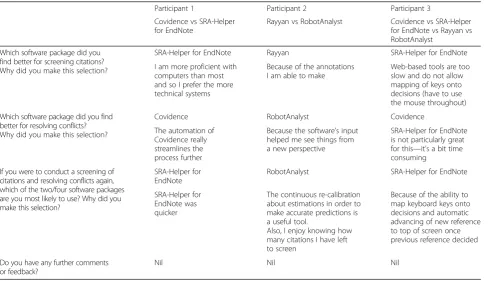
Which software package did you find better for screening citations? Why did you make this selection?
SRA-Helper for EndNote Rayyan SRA-Helper for EndNote
I am more proficient with computers than most and so I prefer the more technical systems
Because of the annotations I am able to make
Web-based tools are too slow and do not allow mapping of keys onto decisions (have to use the mouse throughout)
Which software package did you find better for resolving conflicts? Why did you make this selection?
Covidence RobotAnalyst Covidence
The automation of Covidence really streamlines the process further
Because the software’s input helped me see things from a new perspective
SRA-Helper for EndNote is not particularly great for this—it’s a bit time consuming
If you were to conduct a screening of citations and resolving conflicts again, which of the two/four software packages are you most likely to use? Why did you make this selection?
SRA-Helper for EndNote
RobotAnalyst SRA-Helper for EndNote
SRA-Helper for EndNote was quicker
The continuous re-calibration about estimations in order to make accurate predictions is a useful tool.
Also, I enjoy knowing how many citations I have left to screen
Because of the ability to map keyboard keys onto decisions and automatic advancing of new reference to top of screen once previous reference decided
Do you have any further comments or feedback?
over another when screening citations and resolving con-flicts. We used Qualtrics (www.qualtrics.com) to dissemin-ate the questionnaires and collect the data.
Results
The three systematic reviewers answered all of the ques-tions presented in the qualitative questionnaire.
We summed the participants’quantitative responses for each software package as displayed in Table1(lowest pos-sible score = 2 points; highest pospos-sible score = 10 points). All four software packages were reported to be easy or very easy to learn and use (Table 1). Covidence had the highest rating for general usability, scoring 9 out of a pos-sible 10 points. This may be due to its ‘straightforward process and simple layout’, and it being available online,
without the need to download it,‘making it versatile/ac-cessible when out of office’. SRA-Helper for EndNote was rated fastest for response time (10/10), as ‘it’s not dependent on internet connection’and RobotAnalyst the slowest (5/10). When combining scores for ease of learn-ing how to use the software, usability and response time, SRA-Helper for EndNote scored highest (28/30).
SRA-Helper for EndNote was most favoured by partic-ipants for screening citations and Covidence for resolv-ing conflicts (Table 2). Overall, participants reported that in conducting future systematic reviews, SRA-Helper for EndNote would be their software package of choice, primarily due to its efficiency (Table2).
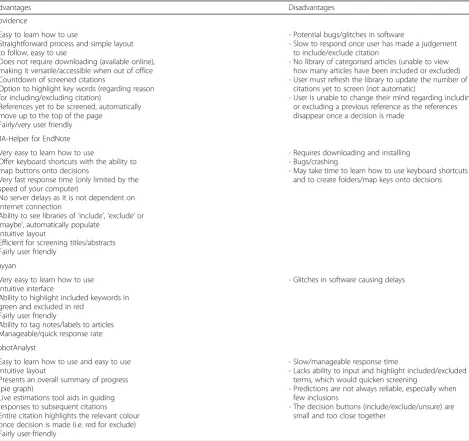
The key advantages considered relevant by systematic reviewers included visibility of already screened/yet to be
Table 3Summary of the reported advantages and disadvantages of each software package
Advantages Disadvantages
Covidence
- Easy to learn how to use
- Straightforward process and simple layout to follow, easy to use
- Does not require downloading (available online), making it versatile/accessible when out of office - Countdown of screened citations
- Option to highlight key words (regarding reason for including/excluding citation)
- References yet to be screened, automatically move up to the top of the page
- Fairly/very user friendly
- Potential bugs/glitches in software
- Slow to respond once user has made a judgement to include/exclude citation
- No library of categorised articles (unable to view how many articles have been included or excluded) - User must refresh the library to update the number of
citations yet to screen (not automatic)
- User is unable to change their mind regarding including or excluding a previous reference as the references disappear once a decision is made
SRA-Helper for EndNote
- Very easy to learn how to use
- Offer keyboard shortcuts with the ability to map buttons onto decisions
- Very fast response time (only limited by the speed of your computer)
- No server delays as it is not dependent on internet connection
- Ability to see libraries of‘include’,‘exclude’or ‘maybe’, automatically populate
- Intuitive layout
- Efficient for screening titles/abstracts - Fairly user friendly
- Requires downloading and installing - Bugs/crashing
- May take time to learn how to use keyboard shortcuts and to create folders/map keys onto decisions
Rayyan
- Very easy to learn how to use - Intuitive interface
- Ability to highlight included keywords in green and excluded in red
- Fairly user friendly
- Ability to tag notes/labels to articles - Manageable/quick response rate
- Glitches in software causing delays
RobotAnalyst
- Easy to learn how to use and easy to use - Intuitive layout
- Presents an overall summary of progress (pie graph)
- Live estimations tool aids in guiding responses to subsequent citations - Entire citation highlights the relevant colour
once decision is made (i.e. red for exclude) - Fairly user-friendly
- Slow/manageable response time
- Lacks ability to input and highlight included/excluded terms, which would quicken screening
- Predictions are not always reliable, especially when few inclusions
screened citations (e.g. in a form of a countdown or summary of progress), ability to highlight key terms for inclusion and exclusion, ability to use keyboard short-cuts, fast response time of the software (e.g. between de-cision to include and the reference moving off the screen and into the‘included’folder), ability to add notes or labels to the references, guidance of decision for sub-sequent references on the basis of prior decisions and ease of learning how to use the tool and intuitiveness of the layout.
The key disadvantages considered relevant by the sys-tematic reviewers included glitches in the software (e.g. crashes), slow response time of the software, inability to see progress (references screened vs those remaining to be screened), inability to change mind once decision to include/exclude was made, requirement to download or install software, inability to highlight included/excluded terms, unreliable predictions and poor layout (e.g. deci-sion buttons too close together). The advantages and disadvantages of using each automation software pack-age to screen citations and resolve conflicts are sum-marised in Table3.
Discussion
Overall, the systematic reviewers found all four of the soft-ware tools easy to learn and use. SRA-Endnote helper was strongly preferred (28/30 points), with RobotAnalyst, Covidence and Rayyan scoring lower but similarly (22, 23 and 24/30, respectively). The strong preference for SRA-Endnote Helper may be explained by its ease of learning to use and very quick response time due to it being a desk-top (rather than web-based) tool.
Among the key characteristics considered relevant were display of screening progress, ability to revise deci-sions, ability to highlight inclusion/exclusion terms, abil-ity to use keyboard shortcuts rather than the mouse, software response time and reliability (i.e. no bugs or crashes). Users, particularly those newer to systematic reviews, also cited the intuitiveness of the layout and ease of learning how to use the tool as important.
It is worth emphasising here that what is considered an advantage or disadvantage will vary by systematic re-viewer: one may prefer a web-based tool that is a bit slower in response time but available anywhere without a download or install, whilst another may prefer a down-loadable tool that is faster in response time but requires a download or install. However, whilst the individual preferences will vary, our aim here was to identifywhat those key considerations are—to help systematic re-viewers (particularly those new to these tools) to make their own decisions which to use.
Although the sample of systematic reviewers included in the present assessment is small (n= 3), it deliberately included both novice systematic reviewers and an
experienced systematic reviewer. We are therefore confident that the considerations they raised are likely to be the issues considered relevant by the larger systematic review population. This can only be formally measured with a larger sample in future research.
Ongoing and future developments in the automation of screening—including automated screening and text mining—would help to increase the efficiency and re-duce human effort required [1,2].
Conclusion
The results of this qualitative report highlight multiple ad-vantages and disadad-vantages of automation software pack-ages for screening in systematic reviews. The outcomes show that the SRA-Endnote helper was the preferred soft-ware due to the fast response time, user-friendly set up, intuitive layout and the fact that it does not rely on inter-net connection. This study identified a number of relevant considerations for systematic review software packages, and individual systematic reviewers can take this into con-sideration whilst performing the citation screening and dispute resolution steps of a systematic review.
Additional file
Additional file 1:Table S1.Qualitative questionnaire schedule. (DOCX 16 kb)
Abbreviation
SRA:Systematic Review Accelerator
Acknowledgements Not applicable
Authors’contributions
GC developed the interview schedule and analysed the data. AMS, FI and BJ tested the software and completed the questionnaires. EB conceived and was overseeing the study. All authors read, contributed to and approved the final manuscript.
Funding
GC, FI and BJ received no funding with respect for this study. AMS and EB are supported by a NHMRC grant APP1044904 (Centre for Research Excellence in Minimising Antibiotic Resistance for Acute Respiratory Infection, CREMARA).
Availability of data and materials
All data generated or analysed during this study are included in this published article [and its supplementary information files].
Ethics approval and consent to participate
As this research involved staff participating by virtue of their professional role, ethics approval was not sought.
Consent for publication Not applicable
Competing interests
Author details
1Institute for Evidence-Based Healthcare, Bond University, Gold Coast,
Australia.2Faculty of Health Sciences and Medicine, Bond University, Gold Coast, Australia.
Received: 7 August 2018 Accepted: 10 June 2019
References
1. Tsafnat G, Glasziou P, Karystianis G, Coiera E. Automated screening of research studies for systematic reviews using study characteristics. Syst Rev. 2018;25:64.
2. O’Mara-Eves A, Thomas J, McNaught J, Miwa M, Ananiadou S. Using text mining for study identification in systematic reviews: a systematic review of current approaches. Syst Rev. 2015;4:5.
3. Covidence. Cochrane Community.https://community.cochrane.org/help/ tools-and-software/covidence. Accessed 3 Jul 2018.
4. Ouzzani M, Hammady H, Fedorowicz Z, Elmagarmid A. Rayyan-a web and mobile app for systematic reviews. Syst Rev. 2016;5:210.
Publisher’s Note