
R E S E A R C H
Open Access
Transcriptome profiling in engrailed-2 mutant
mice reveals common molecular pathways
associated with autism spectrum disorders
Paola Sgadò
1*†, Giovanni Provenzano
1†, Erik Dassi
2, Valentina Adami
3, Giulia Zunino
1, Sacha Genovesi
1,
Simona Casarosa
4,5and Yuri Bozzi
1,5Abstract
Background:Transcriptome analysis has been used in autism spectrum disorder (ASD) to unravel common pathogenic pathways based on the assumption that distinct rare genetic variants or epigenetic modifications affect common biological pathways. To unravel recurrent ASD-related neuropathological mechanisms, we took advantage of theEn2−/−mouse model and performed transcriptome profiling on cerebellar and hippocampal adult tissues. Methods:Cerebellar and hippocampal tissue samples from threeEn2−/−and wild type (WT) littermate mice were assessed for differential gene expression using microarray hybridization followed by RankProd analysis. To identify functional categories overrepresented in the differentially expressed genes, we used integrated gene-network analysis, gene ontology enrichment and mouse phenotype ontology analysis. Furthermore, we performed direct enrichment analysis of ASD-associated genes from the SFARI repository in our differentially expressed genes. Results:Given the limited number of animals used in the study, we used permissive criteria and identified 842 differentially expressed genes inEn2−/−cerebellum and 862 in theEn2−/−hippocampus. Our functional analysis revealed that the molecular signature ofEn2−/−cerebellum and hippocampus shares convergent pathological pathways with ASD, including abnormal synaptic transmission, altered developmental processes and increased immune response. Furthermore, when directly compared to the repository of the SFARI database, our differentially expressed genes in the hippocampus showed enrichment of ASD-associated genes significantly higher than previously reported. qPCR was performed for representative genes to confirm relative transcript levels compared to those detected in microarrays.
Conclusions:Despite the limited number of animals used in the study, our bioinformatic analysis indicates the En2−/−mouse is a valuable tool for investigating molecular alterations related to ASD.
Keywords:En2, Neurodevelopmental disorders, Mouse models, Immune response, Synaptic function,Scn1a,Grm5,Nrxn3
Background
Autism spectrum disorder (ASD) defines a complex group of neurodevelopmental disabilities characterized by a wide range of impairments in social and communicative skills, stereotyped behaviors, and restricted mental flexi-bility [1]. The neurodevelopmental and neuroanatomical bases of ASD have been confirmed by a number of clinical,
neuroimaging and neuropathological studies [1-3]. The most evident abnormality in ASD consists in an early (perinatal) brain overgrowth followed by an arrest of growth during the first year of age [4]. Neuropathological studies on post-mortem samples from ASD patients also showed a number of cellular and cytoarchitectural abnormalities at the level of the cerebral cortex, cerebellum, amygdala and forebrain limbic structures. Anomalies in the cerebellum are the most reproducible neuropathological alterations in ASD patients [3,5].
A large series of evidence clearly indicates that neuro-pathological features and behavioral deficits of ASD have * Correspondence:[email protected]
†Equal contributors 1
Laboratory of Molecular Neuropathology, Centre for Integrative Biology (CIBIO), University of Trento, Via delle Regole 101, 38123 Trento, Italy Full list of author information is available at the end of the article
a primarily genetic origin. However, the etiology of ASD remains essentially unknown [6,7]. Transcriptome analysis has also been used to unravel common pathogenic path-ways based on the assumption that distinct rare genetic variants or epigenetic modifications affect common bio-logical pathways dysregulated in ASD [6]. Several studies have analyzed genome-wide expression profiles of ASD patients using lymphoblastoid cell lines and blood sam-ples, supporting upregulation of immune genes and down-regulation of neurodevelopmental genes as key players in the pathogenesis of ASD (see [8] for a review). Recently, gene co-expression network analysis of autistic brain areas revealed defects in cortical patterning and an enrichment of differentially expressed genes associated with ASD [9].
The homeobox-containing transcription factorengrailed-2 (En2) is crucially involved in the regionalization, patterning and neuronal differentiation of the midbrain and hindbrain [10-15]. Human studies indicated association of two intronic single-nucleotide polymorphisms (SNPs) in the human engrailed-2(EN2) gene with ASD [16,17]. Furthermore, the ASD associated A-C haplotype markedly affected EN2promoter activity when tested with a luciferase re-porter assay in rat, mouse and human cell lines [18]. A recent study of the epigenetic evaluation ofEN2in post-mortem cerebellar samples from autistic patients indi-cated a persistent upregulation of this homeobox gene induced by epigenetic abnormalities in histone methyla-tion patterns that may contribute to Purkinje cell loss in some individuals with autism [19].
Mice lacking the homeobox domain of En2 (En2hd/hd mice; [20], referred to asEn2−/−) have been proposed as a model for ASD, due to their complex neuroanatomical and behavioral phenotype.En2−/−mice display cerebellar hypoplasia, including a reduced number of Purkinje cells, and a defect in the antero-posterior pattern of cerebellar foliation [20-23]. The behavior ofEn2−/−mice is also rem-iniscent of some features of ASD individuals. Deficits in social behaviors were detected in En2−/−mice, including decreased play and reduced social interactions; locomotor impairment, as well as defective spatial learning and mem-ory, was also reported in these mice [24-26]. Furthermore, we reported dysfunctions in GABAergic interneurons in adultEn2−/−mice and demonstrated engrailed protein ex-pression in specific subpopulations of adult hippocampal and cortical interneurons [27].
To unravel recurrent ASD-related neuropathological mechanisms, we took advantage of the En2−/− mouse model and performed genome-wide expression profiling on cerebellar and hippocampal adult tissues. Our tran-scriptome analysis of the cerebellum and hippocampus ofEn2−/−mice suggests convergent pathological pathways with ASD, including abnormal synaptic transmission and increased immune response. Furthermore, we provide evidence for a significant enrichment of differentially
expressed genes associated to ASD in this mouse model of the disease.
Methods Animals
Experiments were conducted in conformity with the European Communities Council Directive of 24 November 1986 (86/609/EEC) and were approved by the Italian Ministry of Health and Ethics Committee of the University of Trento. Animals were housed in a 12 hr light/dark cycle with food and water available ad libitum. All surgery was performed under chloral hydrate anesthesia, and all efforts were made to minimize suffering. The generation ofEn2−/− mice was previously described [20]. The originalEn2mutants (mixed 129Sv x C57BL/6 and outbred genetic background) were crossed at least five times into a C57BL/6 background. Heterozygous matings (En2+/−xEn2+/−) were used to gener-ate theEn2+/+(wild type, WT) andEn2−/−littermates used in this study. PCR genotyping was performed according to the protocol available at the Jackson Laboratory website (www.jax.org; mouse strain En2tm1Alj). WT and En2−/− age-matched adult (3 to 5 months old; weight = 25 to 35 g) littermates mice of both sexes were used.
Microarrays
RNAs from dissected hippocampi and cerebella from three adult mice for each genotype were purified using standard column purification according to the manufacturer’s proto-col (RNAeasy Mini Kit, Qiagen, USA). RNA quality was analyzed by microfluidic gel electrophoresis on RNA 6000 NanoChips using the Agilent 2100 Bioanalyzer. Only RNA with a high (>9) RNA integrity number was selected and used for subsequent retro-transcription, labeling and array hybridization according to Agilent protocols. Mouse gene expression arrays (Agilent 4X44K slides) were hybridized and scanned with the Agilent microarray station.
Bioinformatics
To focus the functional analysis on brain expressed genes we used, as background for our functional analyses, a list of tissue specific ‘expressed genes’ for both the cerebellum and the hippocampus. Our‘expressed genes’lists were ob-tained by filtering the genes by the normalized expression values and excluding the ones with the lowest expression levels (<10th percentile), and include 13,652 genes for the cerebellum and 13,141 for the hippocampus. The hypergeo-metric test and the Student’st-test were computed with R (http://www.r-project.org).
Quantitative PCR
Total RNAs were extracted by Trizol™reagent (Invitrogen Life Technologies, USA) from dissected hippocampi and cerebella from four WT and fourEn2−/−adult mice. RNAs were DNAse-treated and purified with RNeasy Mini Kit (Qiagen, USA). cDNA was synthesized from pooled RNAs (2μg) using the SuperScript™VILO™(Invitrogen Life Technologies, USA) according to the manufacturer’s instructions. Individual PCR reactions were conducted in a volume of 20μl using the KAPA FAST SYBR qPCR kit (KAPABiosystems, USA) according to manufacturer’s instructions. Mouse mitochondrial ribosomal protein L41 (Mrpl41) was used as a standard for quantification as previously shown [30]. Primers (MWG, Germany) were designed on different exons to avoid amplification of genomic DNA. A list of primer sequences is reported in Additional file 1. Each PCR cycle consisted of denaturation for 10 s at 94°C, annealing for 20 s at 60°C and extension for 30 s at 72°C. The fluorescence intensity of SYBR green I was read and acquired at 72°C after completion of the ex-tension step of each cycle. PCR conditions for individual primer sets were optimized by varying template cDNA and primer concentration in order to obtain a single PCR prod-uct and amplification efficiency >90%. Relative expression values were calculated using the Pfaffl method [31].
Results
Differential gene expression in cerebellum and hippocampus of En2−/−mice
The cerebellum of En2−/− mice shows Purkinje cell loss and structural abnormalities resembling the neuropatho-logical features observed in ASD patients [20,21,23]. To identify genes and pathways altered inEn2−/−mice, we ini-tially performed transcriptome profiling of the whole cere-bellar tissue. En2−/− and WT cerebella from adult mice were assessed for differential gene expression by microarray and bioinformatical analysis (see Methods). We found 842 differentially expressed genes in the cerebellum of En2−/− mice compared to their control littermates. Among these, 407 and 435 were up- and downregulated, respectively. Alterations in limbic structures have also been shown in the temporal lobes of autistic patients. The main abnormal-ities were shown in the superior temporal sulcus and the
ventral-basal temporal region, both of which are involved in decoding social stimuli and therefore are associated with the social deficits [32-34]. Most importantly, we previously showed anatomical defects in theEn2−/−hippocampus that might contribute to the behavioral deficits displayed by these mutants [27]. We therefore combined the cerebellar gene expression profile to that of the hippocampus. We found 862 differentially expressed genes in the hippo-campus, among those 378 were upregulated and 484 were downregulated inEn2−/−mice compared to their littermate controls. Additional file 2 shows the entire list of genes differentially expressed in the cerebellum and hippocampus ofEn2−/−mice with the differential expressionPvalue and the percentage of false prediction (pfp) value calculated by RankProd. Given the profound structural and cytoarchitec-tural phenotype of theEn2−/−cerebellum and the variability of the phenotype among individuals, we chose to be more permissive and include genes with smaller differential expression fold changes applying a moderate cutoff to the uncorrectedP value [see Additional file 2]. Differentially expressed genes, which are common in the hippocampus and the cerebellum, are summarized in Figure 1 and listed in Additional file 3. Remarkably,En2was not among the differentially expressed genes. The microarray probe for En2(A_51_P397876) was designed on the 3′untranslated region of the gene that is not deleted in theEn2−/−locus [20]. Our data confirm the previous reports indicating the presence of a residual transcript from theEn2−/−locus [20]. Furthermore, real-time quantitative PCR (qPCR) ana-lysis of En2 expression using homeobox specific primers revealed no expression of the full-length gene inEn2−/− mice [see Additional file 4].
Functional analysis
To explore the biological processes most relevant to the phenotype of the En2−/−mice, the differentially expressed
Figure 1Venn diagram of differentially expressed genes in En2−/−adult cerebellum and hippocampus.A total of 842 and 862 differentially expressed genes were identified in the adult cerebellum (CB, blue) and hippocampus (Hippo, red) ofEn2−/−
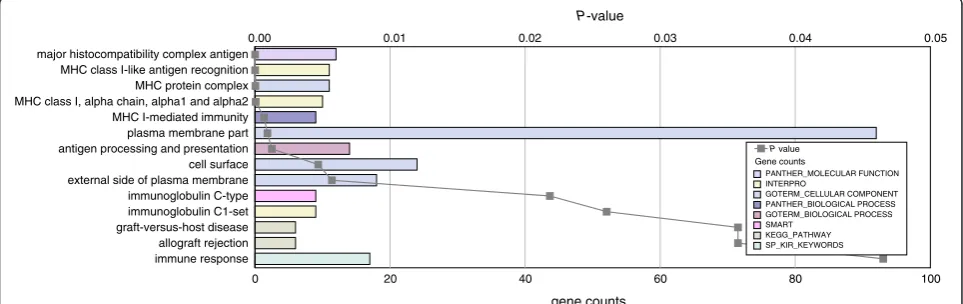
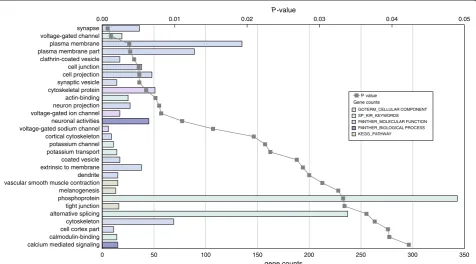
genes were analyzed through integrated gene-network ana-lysis using the curated Ingenuity Pathway Anaana-lysis (IPA) database and the Database for Annotation, Visualization and Integrated Discovery (DAVID). Additional file 5 shows the most significantly enriched disease and cellular function categories obtained with IPA and gene ontology analysis. Functional categories included increased seizure and decreased neurotransmission release in the hippocampus, and decreased cancer-related diseases and development of lymphocytes as cellular function in the cerebellum. To identify statistically significant over-representation of key neurobiological processes, functional annotation ana-lysis was performed with DAVID using a tissue specific list of‘expressed genes’as background (see Methods). To ver-ify the tissue-expression pattern of the samples, we first classified the differentially expressed genes based on their tissue expression (P <0.05, calculated using Benjamini multiple testing correction). We only found significant tissue expression terms for En2−/−hippocampus show-ing significant enrichment in expression of genes related to‘brain cortex’,‘brain’,‘hypothalamus’,‘eye’and‘ hippocam-pus’[see Additional file 6]. We then analyzed the functional annotation using gene sets from the gene ontology (GO) public databases and our‘expressed genes’list as back-ground. Figure 2 shows all GO terms enriched in the differentially expressed genes ofEn2−/−cerebellum with the gene counts and the relativePvalue (P<0.05, calculated using Benjamini multiple testing correction). Among the most represented functional categories were several terms related to the major histocompatibility complex (MHC)-mediated immunity and immune response. The GO terms related to theEn2−/−hippocampus are shown in Figure 3 with the gene counts and the relativePvalue (P <0.05, calculated using Benjamini multiple testing correction). Of the enriched terms, many related to the
cellular components synapse, synaptic vesicle and neuronal projection. Within the biological processes, the most represented terms were‘neuronal activities’and‘calcium mediated signal’. Interestingly, the keyword ‘ phospho-protein’was significantly enriched, suggesting a generic alteration in the protein phosphorylation state in the En2−/−hippocampus.
To assess the functional consequences ofEn2ablation, we analyzed enrichment of the differentially expressed genes based on the mouse phenotype from the Mammalian Phenotype Ontology (MPO) project [35], using ToppGene [36]. In the En2−/− cerebellum the only significantly enriched mouse phenotype was ‘loss of dopaminergic neurons’, a term associated with the cerebellar phenotype by the role ofEn2in midbrain/hindbrain development and dopaminergic neuron survival [37,38]. For the hippocam-pus we found significant enrichment for terms related to seizure and altered synaptic transmission (Figure 4). These data are in accordance with our previously described in-crease in seizure susceptibility and dein-crease in GABAergic neuron subpopulations inEn2−/−mice [27,30].
Remarkably, when analyzed specifically for ASD-associated genes, the differentially expressed genes showed significant over-representation of known ASD susceptibil-ity genes when compared directly to the repository of the Simons Foundation and Autism Research Initiative (SFARI) database (gene.sfari.org). Since the SFARI database com-prises genes related to neurodevelopmental disorders, there-fore expressed in the brain, we filtered the SFARI database gene list with our list of‘expressed genes’in the cerebellum and in the hippocampus (see Methods for details). We used these SFARI gene lists to calculate enrichment with our differentially expressed genes. Table 1 shows the list of the ASD-associated differentially expressed genes for the cerebellum and the hippocampus. To compute significant
P-value
gene counts
2
0 0 40 60 80 100
immune response allograft rejection graft-versus-host disease immunoglobulin C1-set immunoglobulin C-type external side of plasma membrane cell surface antigen processing and presentation plasma membrane part MHC I-mediated immunity MHC class I, alpha chain, alpha1 and alpha2 MHC protein complex MHC class I-like antigen recognition major histocompatibility complex antigen
0.00 0.01 0.02 0.03 0.04 0.05
Gene counts
P value
GOTERM_CELLULAR COMPONENT
GOTERM_BIOLOGICAL PROCESS
KEGG_PATHWAY INTERPRO
SP_KIR_KEYWORDS SMART
PANTHER_MOLECULAR FUNCTION
PANTHER_BIOLOGICAL PROCESS
enrichment between our differentially expressed genes and the SFARI genes, we employed the hypergeometric test. The statistical analysis indicated significant enrichment only for the hippocampus (P <0.05), whereas no significant enrich-ment was observed for the cerebellum.
To compare our findings with the three major genome-wide expression studies on ASD brain tissue [9,39,40], we matched the publicly available differentially expressed genes with the same ASD-related gene lists that we used for our analysis. To increase accuracy, we computed, for each study, the hypergeometric test and obtained an enrichment P value that we used for direct comparison. Table 2 summarizes the results of the enrichment analyses,
separated in tissue-specific groups, and the comparison between the studies. For Voineaguet al.[9] we re-analyzed the cerebellum data using the GEO2R tool with default pa-rameters and used these results to evaluate the correspond-ence with our study. The results for cerebellum show a significant enrichment with ASD-associated genes only for the Voineagu et al. study (4.75% enrichment, P= 0.0343). Our study, however, was the only one to display significant enrichment of ASD-related genes (4.24% enrichment, p = 0.0265) in the limbic regions.
To validate microarray findings with qPCR analysis, we selected eight and eighteen representative genes from the cerebellum and the hippocampus differentially expressed
0 50 100 150 200 250 300 350
calcium mediated signaling calmodulin-binding cell cortex part cytoskeleton alternative splicing tight junction phosphoprotein melanogenesis vascular smooth muscle contraction dendrite extrinsic to membrane coated vesicle potassium transport potassium channel cortical cytoskeleton voltage-gated sodium channel neuronal activities voltage-gated ion channel neuron projection actin-binding cytoskeletal protein synaptic vesicle cell projection cell junction clathrin-coated vesicle plasma membrane part plasma membrane voltage-gated channel synapse
0.00 0.01 0.02 0.03 0.04 0.05
Gene counts P value
GOTERM_CELLULAR COMPONENT
KEGG_PATHWAY SP_KIR_KEYWORDS PANTHER_MOLECULAR FUNCTION PANTHER_BIOLOGICAL PROCESS
P-value
gene counts
Figure 3Overrepresented gene ontology categories for differentially expressed genes in theEn2−/−adult hippocampus.Differentially expressed genes (n = 862) were analyzed for enrichment in gene ontology categories using public databases with a Benjamini correctedPvalue cutoff of 0.05. Further details regarding the figure and inset are described in the legend to Figure 2. Data details are also reported in Additional file 5.
0 2 0 50
abnormal excitatory postsynaptic currents seizures abnormal synaptic transmission abnormal CNS synaptic transmission
0.00 0.01 0.0 .0
1
0 0 30 4
2 0 3 0.04 0.05
Gene counts P value
MOUSE PHENOTYPE
Gene counts
P-value
Figure 4Mouse phenotype categories associated with differentially expressed genes in theEn2−/−hippocampus.Differentially expressed genes inEn2−/−hippocampus were analyzed for enrichment in mouse phenotypes using ToppGene with a correctedPvalue cutoff of 0.05.
Table 1 Enrichment of autism spectrum disorder (ASD)-related genes inEn2−/−cerebellum and hippocampus differentially expressed genes
(a) Cerebellum
Gene Symbol Gene Name Pvalue Fold change
Ada adenosine deaminase 3.50E-03 1.705
Ahi1 Abelson helper integration site 1 4.70E-03 1.690
Cacna1g calcium channel, voltage-dependent, T type, alpha 1G subunit 8.20E-03 0.670
Cdh10 cadherin 10 4.40E-03 1.662
Eml1 echinoderm microtubule associated protein like 1 2.80E-03 0.581
Erbb4 v-erb-a erythroblastic leukemia viral oncogene homolog 4 (avian) 9.90E-03 0.653
Glo1 glyoxalase 1 6.00E-03 0.625
Gnas GNAS (guanine nucleotide binding protein, alpha stimulating) complex locus 5.60E-03 1.565
Grm5 glutamate receptor, metabotropic 5 3.70E-03 1.656
Itgb7 integrin beta 7 1.00E-04 0.453
Kdm5c lysine (K)-specific demethylase 5C 8.50E-03 0.660
Kit kit oncogene 3.00E-03 0.591
Nrp2 neuropilin 2 0.00 2.503
Nrxn3 neurexin III 1.80E-03 1.843
Park2 Parkinson disease (autosomal recessive, juvenile) 2, parkin 5.20E-03 1.723
Pinx1 PIN2/TERF1 interacting, telomerase inhibitor 1 1.00E-03 1.871
Plcb1 phospholipase C, beta 1 3.60E-03 1.677
Rb1cc1 RB1-inducible coiled-coil 1 6.90E-03 1.635
Rpp25 ribonuclease P 25 subunit (human) 8.00E-03 0.619
Stk39 serine/threonine kinase 39, STE20/SPS1 homolog (yeast) 9.40E-03 1.548
Th tyrosine hydroxylase 7.90E-03 1.564
(b) Hippocampus
Gene Symbol Gene Name Pvalue Fold change
Aff4 AF4/FMR2 family, member 4 1.30E-03 4.490
Atp2b2 ATPase, Ca++ transporting, plasma membrane 2 2.80E-03 0.544
Baiap2 brain-specific angiogenesis inhibitor 1-associated protein 2 8.00E-04 0.478
Camta1 calmodulin binding transcription activator 1 4.40E-03 0.561
Dab1 disabled homolog 1 (Drosophila) 4.10E-03 0.552
Dctn5 dynactin 5 4.10E-03 1.733
Dlg4 discs, large homolog 4 (Drosophila) 0.00 0.346
Egr2 early growth response 2 7.00E-04 2.099
Eif4ebp2 eukaryotic translation initiation factor 4E binding protein 2 3.90E-03 0.551
Ep400 E1A binding protein p400 2.00E-04 2.361
Foxp1 forkhead box P1 3.00E-04 0.425
Gabra4 gamma-aminobutyric acid (GABA) A receptor, subunit alpha 4 4.00E-04 2.151
Gnas GNAS (guanine nucleotide binding protein, alpha stimulating) complex locus 3.90E-03 0.555
Gsk3b glycogen synthase kinase 3 beta 3.50E-03 0.541
Gtf2i general transcription factor II I 3.80E-03 0.552
Kit kit oncogene 2.00E-04 0.417
Klc2 kinesin light chain 2 4.80E-03 0.565
Lrrc1 leucine rich repeat containing 1 4.20E-03 1.742
Nrcam neuron-glia-CAM-related cell adhesion molecule 3.10E-03 1.777
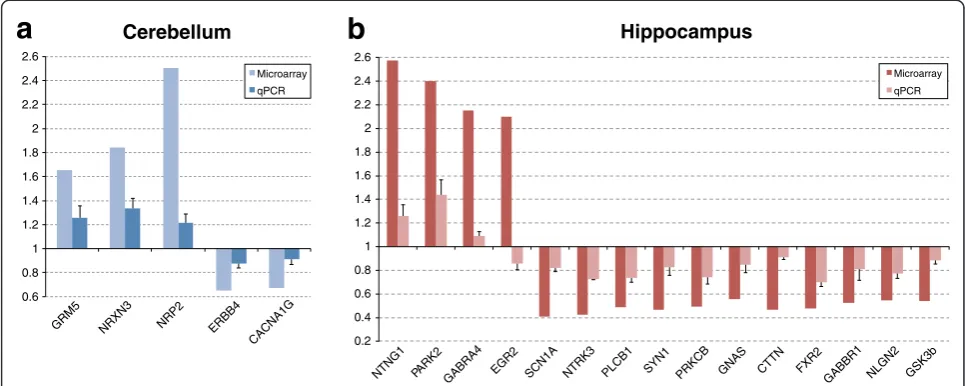
gene lists, respectively. The selected genes reported dif-ferential expression values in microarray experiments ran-ging between 0.41 fold decrease to 2.5 fold increase. With qPCR, five of the eight selected genes showed statistically significant differential expression in theEn2−/−cerebellum [glutamate receptor, metabotropic 5 (Grm5)P= 0.031; neurexin III (Nrxn3)P= 0.032; neuropilin 2 (Nrp2)P= 0.009; v-erb-a erythroblastic leukemia viral oncogene
homolog 4 (Erbb4) P= 0.003; calcium channel, voltage-dependent, T type, alpha 1G subunit (Cacna1g)P= 0.003] (Figure 5a). Fifteen genes of the eighteen selected were instead significantly changed in theEn2−/− hippocam-pus [netrin G1 (Ntng1) P= 0.008; Parkinson disease (autosomal recessive, juvenile) 2, parkin, (Park2)P= 0.004; gamma-aminobutyric acid (GABA) A receptor, subunit alpha 4 (Gabra4)P= 0.007; early growth response 2 (Egr2)
Table 1 Enrichment of autism spectrum disorder (ASD)-related genes inEn2−/−cerebellum and hippocampus
differentially expressed genes(Continued)
Ntrk3 neurotrophic tyrosine kinase, receptor, type 3 1.00E-04 0.426
Park2 Parkinson disease (autosomal recessive, juvenile) 2, parkin 1.00E-04 2.402
Plcb1 phospholipase C, beta 1 8.00E-04 0.487
Prkcb protein kinase C, beta 8.00E-04 0.490
Rpp25 ribonuclease P 25 subunit (human) 1.10E-03 0.487
Sbf1 SET binding factor 1 4.40E-03 0.562
Scn1a sodium channel, voltage-gated, type I, alpha 1.00E-04 0.410
Scn8a sodium channel, voltage-gated, type VIII, alpha 1.00E-04 0.414
Syn1 synapsin I 5.00E-04 0.469
Syne1 synaptic nuclear envelope 1 4.80E-03 0.562
Thra thyroid hormone receptor alpha 1.00E-04 0.419
Ube2h ubiquitin-conjugating enzyme E2H 4.00E-03 0.559
Ubl7 ubiquitin-like 7 (bone marrow stromal cell-derived) 3.70E-03 0.557
ASD-related genes enriched in theEn2−/−(a) cerebellum and (b) hippocampus with their differential expressionPvalue and fold change.
Table 2 Correlation of Simons Foundation and Autism Research Initiative (SFARI) database genes with published transcriptome studies in Autism Spectrum Disorder (ASD) brain and our study
Cerebellum # SFARI
genes
% enrichment Pvalue Gene names
This study(3En2−/−, 3 WT) 21 2.79% 4.98E-01 Ada,Ahi1,Cacna1g, Cdh10, Eml1, Erbb4, Glo1, Gnas, Grm5, Itgb7, Kdm5c, Kit, Nrp2, Nrxn3, Park2, Pinx1, Plcb1, Rb1cc1, Rpp25, Stk39, Th
Voineaguet al.[9] (11 autism, 10 controls)
16 4.75% 3.43E-02 (*) AHI1, ANK3,CACNA1G, CBS,EN2, EPHB6, FAT1, FOXP1,GAP43, GRIN2A, HSD11B1, NLGN3, NTNG1, RAB11FIP5, SLC30A5, UBE3A
Purcellet al.[39] (9 autism, 9 controls)
1 3.33% 5.85E-01 CNR1
Limbic regions # SFARI
genes
% enrichment Pvalue Gene names
This study(3En2−/−, 3 WT) 33 4.24% 2.65E-02 (*) Aff4,Atp2b2, Baiap2, Camta1, Dab1, Dctn5, Dlg4, Egr2,Eif4ebp2, Ep400, Foxp1, Gabra4, Gnas, Gsk3b, Gtf2i, Kit, Klc2, Lrrc1, Nrcam, Ntng1,Ntrk3, Park2, Plcb1,Prkcb,Rpp25, Sbf1, Scn1a, Scn8a, Syn1,
Syne1, Thra,Ube2h, Ubl7
Voineaguet al.[9] (13 autism, 13 controls)
36 3.70% 1.04E-01 AHI1, APBA2,ATP2B2, ATRNL1, AUTS2, BCL2, BTAF1, CADM1, CD99L2,
DNM1L, DPP10,EIF4EBP2, FAT1, GRIN2A, ICA1, MAOA,MSN,NTRK3,
PCDH9, PPFIA1,PRKCB, PTCHD1, RAB11FIP5, RGS7,RPP25, SLC16A3,
SLC25A12,SLC9A9,STXBP1, SYT17, TOMM20, TSC2, TUBGCP5,UBE2H,
UBR5, UPF3B
Garbettet al.[40] (6 autism, 6 controls)
4 3.05% 5.52E-01 AHI1,MSN, SDC2,SLC9A9
P= 0.007; sodium channel, voltage-gated, type I, alpha (Scn1a) P= 0.001; neurotrophic tyrosine kinase, receptor, type 3 (Ntrk3)P= 0.0003; phospholipase C, beta 1 (Plcb1) P= 0.0001; cortactin (Cttn) P= 0.0005; synapsin I (Syn1) P= 0.007; fragile X mental retardation, autosomal homolog 2 (Fxr2)P= 0.0004; protein kinase C, beta (Prkcb)P= 0.001; gamma-aminobutyric acid (GABA) B receptor, 1, (Gabbr1) P= 0.03; neuroligin 2 (Nlgn2)P= 0.001; glycogen synthase kinase 3 beta (Gsk3b)P= 0.003; GNAS (guanine nucleotide binding protein, alpha stimulating) complex locus (Gnas) P= 0.01] (Figure 5b). Except forEgr2, in all tested genes the expression differences reported by qPCR correlated with the microarray data (Pearson r = 0.84,P< 0.00005).
Discussion
To date, more than 500 autism-associated genes have been identified (SFARI Gene; gene.sfari.org; updated mar/2013); yet the etiology of ASD remains essentially unknown [6,7]. The significance of animal models in ASD research has been widely recognized as important for unraveling the molecular, cellular, anatomical, electrophysiological and behavioral consequences of gene dysfunction in ASD. Here, we present a transcriptome analysis in a mouse model of ASD of two brain areas, the cerebellum and the hippocampus, areas that are profoundly affected in ASD patients. Despite the small number of samples used for the microarray analysis and the sample gender heterogen-eity, the low genetic variance among individuals allowed a reasonable statistical power for our bioinformatic analysis. Our study revealed that the molecular signature of these two brain regions shares convergent pathological pathways
with ASD, including abnormal synaptic transmission and increased immune response. Furthermore, when directly compared to the repository of the SFARI database (gene.sfari.org), our differentially expressed genes in the hippocampus show an enrichment of ASD-associated genes significantly higher than previously reported [41].
Transcriptome analysis has been employed to unravel common pathways based on the assumption that the core phenotypes of ASD may be caused by convergent molecular mechanisms [6]. Several studies have analyzed genome-wide expression profiles of lymphoblastoid cell lines and blood samples from ASD patients, pointing to an upregulation of immune genes as key mechanisms in the pathogenesis of ASD [8]. Despite the limited source of brain tissue samples from ASD cases and the technical restrictions, studies of ASD brain transcriptome are emer-ging as strategic for uncovering functionally relevant alter-ations in gene expression. A previous microarray study found alterations of glutamatergic neurotransmission in ASD cerebellum [39], and expression profiles from ASD patient temporal cortices showed upregulation of genes involved in innate immune response and downregulation of several neurodevelopmental genes [40]. Moreover, the transcriptome profiles from three different brain regions (frontal cortex, temporal cortex and cerebellum) of nine-teen autism cases and sevennine-teen controls were investigated recently using classical differential expression analysis and a network-based approach [9]. These analyses showed up-regulation of genes involved in immune response and downregulation of genes involved in synaptic function and vesicular transport [9]. Our results are in accordance with
0.6 0.8 1 1.2 1.4 1.6 1.8 2 2.2 2.4 2.6
GRM5 NRXN3 NRP2 ERBB4 CACNA1G Cerebellum
Microarray
qPCR
0.2 0.4 0.6 0.8 1 1.2 1.4 1.6 1.8 2 2.2 2.4 2.6
NTNG1 PARK2 GABRA4 EGR2 SCN1A NTRK3 PLCB1 SYN1 PRKCB GNAS CTTN FXR2 GABBR1 NLGN2 GSK3b Hippocampus
Microarray
qPCR
a
b
Figure 5Quantitative PCR validation of differentially expressed genes.A selected number of differentially expressed genes in theEn2−/−
cerebellum(a)and hippocampus(b)were validated by qPCR. Relative mRNA expression level (fold expression) as obtained by qPCR performed on whole cerebellum or hippocampus extracts of adult wild type (WT) andEn2−/−mice. Correlation of fold expression from qPCR (light color bars) and
these findings. Using gene ontology enrichment, integrated gene-network analysis and mouse phenotypes analysis, we report significantly enriched functions and pathways that were previously associated to ASD [42]. In detail, we found increased immune response and major histocompatibility complex-related immunity in the En2−/− cerebellum; decreased and abnormal neurotransmission and increased seizures in the En2−/−hippocampus [see Additional file 5 for details]. Moreover, by direct comparison with the SFARI repository of ASD-related genes, we show that the gene ex-pression changes observed in theEn2−/−hippocampus were significantly enriched in ASD-related genes. Furthermore, the proportion of ASD-associated genes enrichment in En2−/−hippocampus was significantly higher than previous studies (Table 2) when compared with Voineaguet al. [9], likely the most comprehensive transcriptome study of ASD post-mortem brain to date. In the case of the cerebellum, in contrast to Voineaguet al.[9] we did not find significant enrichment of ASD-associated genes inEn2−/−mice. Such difference could be the result of the complex structural and cytoarchitectural abnormalities in En2−/− cerebellum [20,21] and the consequent phenotypical variability, or could simply reflect differences between mouse and human phenotypes, as the incidence of cerebellar hypoplasia was not reported in the diagnostic criteria used in the study [9]. Remarkably, EN2 was among the differentially expressed genes found in Voineaguet al.[9], confirming our evidence about the role ofEn2in the neuropathology of ASD, and in anterior brain structures [27].
Among the differentially expressed genes, Grm5, Nrxn3 andScn1aare of particular interest for ASD.Grm5encodes mGluR5, a G-protein coupled receptor for the neuro-transmitter glutamate [43]. In a recent study, mGluR5 has been shown to participate in the pathogenesis of fragile X syndrome (FXS) while genetic downregulation ofGrm5 was able to compensate for some of the symptoms in a mouse model of FXS [44]. Furthermore,Grm5was shown to be downregulated in hippocampal neurons lacking Shank3, another ASD-associated gene [45]. These data support a central role forGrm5in neurobiological pathways related to ASD pathogenesis. Our results show an increased expression ofGrm5in the cerebellum ofEn2−/−mice, sug-gesting a role ofGrm5in the cerebellar phenotype of these mice. The contribution of Grm5 and its interaction with Fmr1in theEn2−/−hippocampus remains to be established and could open new perspective of pharmacological and genetic rescue of the ASD-related phenotype of these mice.
Nrxn3 encodes neuronal adhesion proteins of the Neurexin (NRXN) family. NRXNs are presynaptic cell adhesion proteins that form trans-synaptic complexes with their postsynaptic counterpart neuroligins (NLGNs) and have important roles in synapse development and function [46]. Recently, a report of hemizygous andde novo
deletions involving NRXN3 in ASD families provided
strong support for a causative link between the loss of NRXN3and the development of ASD [47]. Our results of an increased expression ofNrxn3in the cerebellum suggest alterations in Purkinje cell synaptic formation, where NRXNs have been shown to participate to the forma-tion of glutamatergic synapses through interacforma-tion with Cerebellin 1 precursor protein (also downregulated in theEn2−/−cerebellum) and GluR∂2 [48,49].
Scn1aencodes the voltage-gated sodium channel alpha subunit.De novonull mutations inSCN1Aresult in severe myoclonic epilepsy of infancy [50].SCN1Amutations have been associated to a number of neurological disorders, including generalized epilepsy with febrile seizures plus, Dravet syndrome, borderline myoclonic epilepsy in infancy, intractable childhood epilepsy with generalized tonic-clonic seizures, familial hemiplegic migraine, and a number of cryptogenic focal and generalized epilepsies. Recently, de novomutations inSCN1Ahave been associated with ASD [51], and a report of a recognized mutation inSCN1A suggests a wide phenotypic variation of the gene mutations causing a variety of neurologic disorders, including ASD [52]. In mice, heterozygous loss-of-function mutation in Scn1a(Scn1a+/−), reproduces several of the symptoms asso-ciated to the human mutation, such as thermally induced and spontaneous seizures, premature death, ataxia and sleep disorder [53,54].Scn1a+/−mice show both cognitive deficits and autistic traits that are caused by impaired GABAergic neurotransmission and can be rescued by drug treatment. Scn1a down-regulation in the En2−/− hippo-campus could contribute to the abnormal excitability and altered GABAergic neurotransmission shown in these mice by our previous studies [27,30]. Pharmacological rescue of the hippocampal phenotype in theEn2−/−with GABAergic drugs is currently under investigation.
support downregulation of EN2during perinatal develop-ment [19]. Taken together, this evidence suggests that an overall imbalance in EN2 expression may be relevant for ASD pathogenesis, as it could produce alterations in critical brain functions. Comparable evidence of a similar dosage effect has been reported in the case of mutations of other genes critically involved in gene expression regulation and maintenance of synaptic and neuronal homeostasis, such as MECP2andARX[58,59]. It remains to be established whether En2overexpressing mice display abnormal be-haviors relevant to autism. Microarray data have been produced forEn2overexpressing Purkinje cells on a differ-ent platform; however, the results overlap only marginally with the herein reported study [60].
Conclusions
Using transcriptome analysis, we identified over 800 genes differentially expressed in the cerebellum and hippocampus ofEn2−/−mice. Despite the small number of samples used and the relatively small statistical power, our study is the first to analyze molecular changes occurring in two brain structures with neuroanatomical alterations relevant to ASD in a mouse model of this disease. Our bioinformatic analysis of the molecular signature of En2−/− cerebellum and hippocampus shows a significant convergence of neurobiological pathways previously linked to ASD path-ology in brain samples from ASD patients. Overall, the present study points to a strong impact of transcriptome analysis on mouse models for identifying neurobiological pathways commonly altered when ASD genes are disrupted in a human patient and in a mouse model alike. Further-more, together with the frequent association of cerebellar neuroanatomical alterations to the neuropathology of ASD, our molecular analysis suggests a contribution also for the hippocampus, where molecular changes relevant to ASD may occur also in human patients. This notion is supported by the consistent enrichment of ASD-related genes in the En2−/− hippocampus compared to the cerebellum and to other similar studies performed on ASD patient tissue samples [41]. Finally, our results confirm the En2−/−mouse model of ASD as a valuable tool for in-vestigating neuroanatomical, behavioral, as well as mo-lecular alterations related to ASD.
Availability of supporting data
The data sets supporting the results of this article are available in the GEO repository, GSE51612.
Additional files
Additional file 1:RT-qPCR primers used in the study.
Additional file 2:Differentially expressed gene in the cerebellum and in the hippocampus ofEn2−/−mice.Tables showing differentially expressed genes in theEn2−/−(a) cerebellum and (b) hippocampus with
fold change expression compared to WT littermates, differential expressionPvalue and percentage of false prediction (pfp) calculated with RankProd.Pvalue cut-offP<0.01 for the cerebellum andP<0.005 for the hippocampus.
Additional file 3:Genes differentially expressed in bothEn2−/− cerebellum and hippocampus.Genes commonly regulated in the En2−/−cerebellum and hippocampus with differential expressionPvalue
and fold change.
Additional file 4:En2full-length expression.Quantitative PCR analysis of En2 full-length expression in the WT andEn2−/−cerebellum and
hippocampus. Values are expressed asEn2/L41comparative quantitation ratios normalized on the expression of WT in the cerebellum
(mean ± s.e.m of three replicates from pools of three animals per genotype;P<0.01, Student’st-test, WT versusEn2−/−).
Additional file 5:Integrated gene-network analysis and gene ontology enrichment.Tables a-f show the ten most significant disease and functional annotations obtained with Ingenuity Pathways Analysis (IPA) forEn2−/−cerebellum (a-c) andEn2−/−hippocampus (d-f) differentially
expressed genes. Functional categories and annotations are shown with their Pvalue, the predicted activation state, the activation z-score, the associated genes and the number of enriched genes. Activation z-score >2 or <−2 indicates significantly increased or decreased annotations. Tables g-j show gene ontology analysis details forEn2−/−cerebellum (g, h) andEn2−/−
hippocampus (i, j) differentially expressed genes. Gene ontology annotations are shown with gene counts and correctedPvalues. Significant disease and functions for up- (c, f, h) and downregulated (b, e, j) genes are shown separately.
Additional file 6:Tissue expression of differentially expressed genes inEn2−/−hippocampus.Table showing gene ontology tissue expression annotations for differentially expressed genes in theEn2−/−
hippocampus. No significant tissue expression annotations were found for differentially expressed genes inEn2−/−cerebellum.
Abbreviations
ASD:Autism spectrum disorders; pfp: Percentage of false positives; DAVID: Database for Annotation, Visualization and Integrated Discovery; FXS: Fragile X syndrome; GABA: Gamma aminobutyric acid; GO: Gene ontology; IPA: Ingenuity pathway analysis; MHC: Major histocompatibility complex; MPO: Mammalian phenotype ontology; NLGN: Neuroligin; NRXN: Neurexin; RP: Rank product; SFARI: Simons Foundation and Autism Research Initiative; SNP: Single-nucleotide polymorphism; WT: Wild type.
Competing interests
The authors declare that they have no competing interests.
Authors’contribution
PS, GP and YB conceived the study. PS, GP, VA, GZ and SG performed microarray and qPCR experiments. PS, GP and ED performed bioinformatic analysis. PS, GP and YB analyzed data. PS and YB wrote the paper. PS, SC and YB provided funding. All authors read and approved the final manuscript.
Acknowledgements
P.S. is supported by Provincia Autonoma di Trento and the European Community’s FP7/20072013 under grant agreement Marie Curie FP7 -PCOFUND-GA-2008- 226070‘progetto Trentino’, project EnCort. This work was funded by the Italian Ministry of University and Research (PRIN 2008 grant # 200894SYW2_002 and PRIN 2010–2011 grant # 2010N8PBAA_002 to Y. B.) and the University of Trento (CIBIO start-up grant to S.C. and Y.B.). We thank Andrea Messina, Federico Vaggi and Tommaso Schiavinotto for helpful discussions, and Patrizia Paoli for administrative support.
Author details
University of Trento, Via delle Regole 101, 38123 Trento, Italy.5C.N.R. Neuroscience Institute, via G. Moruzzi 1, 56124 Pisa, Italy.
Received: 8 July 2013 Accepted: 27 November 2013 Published: 19 December 2013
References
1. Rapin I, Tuchman RF:Autism: definition, neurobiology, screening, diagnosis.Pediatr Clin North Am2008,46:1129. viii.
2. Dicicco-Bloom E, Lord C, Zwaigenbaum L, Courchesne E, Dager SR, Schmitz C, Schultz RT, Crawley J, Young LJ:The developmental neurobiology of autism spectrum disorder.J Neurosci2006,26:6897–6906.
3. Pardo CA, Eberhart CG:The neurobiology of autism.Brain Pathol2007,
17:434–447.
4. Courchesne E:Brain development in autism: early overgrowth followed by premature arrest of growth.Ment Retard Dev Disabil Res Rev2004,
10:106–111.
5. Bailey A, Luthert P, Dean A, Harding B, Janota I, Montgomery M, Rutter M, Lantos P:A clinicopathological study of autism.Brain1998,121:889–905. 6. Voineagu I:Gene expression studies in autism: moving from the genome
to the transcriptome and beyond.Neurobiol Dis2012,45:69–75. 7. Huguet G, Ey E, Bourgeron T:The genetic landscapes of autism spectrum
disorders.Annu Rev Genomics Hum Genet2013,14:191–213.
8. Lintas C, Sacco R, Persico AM:Genome-wide expression studies in autism spectrum disorder, Rett syndrome, and Down syndrome.Neurobiol Dis 2012,45:57–68.
9. Voineagu I, Wang X, Johnston P, Lowe JK, Tian Y, Horvath S, Mill J, Cantor RM, Blencowe BJ, Geschwind DH:Transcriptomic analysis of autistic brain reveals convergent molecular pathology.Nature2011,474:380–384. 10. Cheng Y, Sudarov A, Szulc KU, Sgaier SK, Stephen D, Turnbull DH, Joyner AL:
The Engrailed homeobox genes determine the different foliation patterns in the vermis and hemispheres of the mammalian cerebellum. Development2010,137:519–529.
11. Gherbassi D, Simon HH:The engrailed transcription factors and the mesencephalic dopaminergic neurons.J Neural Transm Suppl2006,70:47–55. 12. Herrup K, Murcia C, Gulden F, Kuemerle B, Bilovocky N:The genetics of
early cerebellar development: networks not pathways.Prog Brain Res 2005,148:21–27.
13. Joyner AL:Engrailed, Wnt and Pax genes regulate midbrain–hindbrain development.Trends Genet1996,12:15–20.
14. Sgaier SK, Lao Z, Villanueva MP, Berenshteyn F, Stephen D, Turnbull RK, Joyner AL:Genetic subdivision of the tectum and cerebellum into functionally related regions based on differential sensitivity to engrailed proteins.Development2007,134:2325–2335.
15. Orvis GD, Hartzell AL, Smith JB, Barraza LH, Wilson SL, Szulc KU, Turnbull DH, Joyner AL:The engrailed homeobox genes are required in multiple cell lineages to coordinate sequential formation of fissures and growth of the cerebellum.Dev Biol2012,367:25–39.
16. Gharani N, Benayed R, Mancuso V, Brzustowicz LM, Millonig JH:Association of the homeobox transcription factor, ENGRAILED 2, 3, with autism spectrum disorder.Mol Psychiatry2004,9:474–484.
17. Benayed R, Gharani N, Rossman I, Mancuso V, Lazar G, Kamdar S, Bruse SE, Tischfield S, Smith BJ, Zimmerman RA, Dicicco-Bloom E, Brzustowicz LM, Millonig JH:Support for the homeobox transcription factor gene ENGRAILED 2 as an autism spectrum disorder susceptibility locus.Am J Hum Genet2005,
77:851–868.
18. Benayed R, Choi J, Matteson PG, Gharani N, Kamdar S, Brzustowicz LM, Millonig JH:Autism-associated haplotype affects the regulation of the homeobox gene, ENGRAILED 2.Biol Psychiatry2009,66:911–917. 19. James SJ, Shpyleva S, Melnyk S, Pavliv O, Pogribny IP:Complex epigenetic
regulation of Engrailed-2 (EN-2) homeobox gene in the autism cerebellum. Transl Psychiatry2013,3:e232.
20. Joyner AL, Herrup K, Auerbach BA, Davis CA, Rossant J:Subtle cerebellar phenotype in mice homozygous for a targeted deletion of the En-2 homeobox.Science1991,251:1239–1243.
21. Millen KJ, Wurst W, Herrup K, Joyner AL:Abnormal embryonic cerebellar development and patterning of postnatal foliation in two mouse Engrailed-2 mutants.Development1994,120:695–706.
22. Millen KJ, Hui CC, Joyner AL:A role for En-2 and other murine homologues of Drosophila segment polarity genes in regulating positional information in the developing cerebellum.Development1995,121:3935–3945.
23. Kuemerle B, Zanjani H, Joyner A, Herrup K:Pattern deformities and cell loss in Engrailed-2 mutant mice suggest two separate patterning events during cerebellar development.J Neurosci1997,17:7881–7889. 24. Gerlai R, Millen KJ, Herrup K, Fabien K, Joyner AL, Roder J:Impaired motor
learning performance in cerebellar En-2 mutant mice.Behav Neurosci 1996,110:126–133.
25. Cheh MA, Millonig JH, Roselli LM, Ming X, Jacobsen E, Kamdar S, Wagner GC:En2 knockout mice display neurobehavioral and neurochemical alterations relevant to autism spectrum disorder.Brain Res2006,
1116:166–176.
26. Brielmaier J, Matteson PG, Silverman JL, Senerth JM, Kelly S, Genestine M, Millonig JH, Dicicco-Bloom E, Crawley JN:Autism-relevant social abnormalities and cognitive deficits in engrailed-2 knockout mice.PLoS ONE2012,7:e40914. 27. Sgadò P, Genovesi S, Kalinovsky A, Zunino G, Macchi F, Allegra M, Murenu E,
Provenzano G, Tripathi PP, Casarosa S, Joyner AL, Bozzi Y:Loss of GABAergic neurons in the hippocampus and cerebral cortex of Engrailed-2 null mutant mice: Implications for autism spectrum disorders.Exp Neurol2013,247:496–505. 28. Hong F, Breitling R, McEntee CW, Wittner BS, Nemhauser JL, Chory J:
RankProd: a bioconductor package for detecting differentially expressed genes in meta-analysis.Bioinformatics2006,22:2825–2827.
29. Breitling R, Armengaud P, Amtmann A, Herzyk P:Rank products: a simple, yet powerful, new method to detect differentially regulated genes in replicated microarray experiments.FEBS Lett2004,573:83–92. 30. Tripathi PP, Sgado P, Scali M, Viaggi C, Casarosa S, Simon HH, Vaglini F,
Corsini GU, Bozzi Y:Increased susceptibility to kainic acid-induced seizures in Engrailed-2 knockout mice.Neuroscience2009,159:842–849. 31. Pfaffl MW:A new mathematical model for relative quantification in
real-time RT-PCR.Nucleic Acids Res2001,29:e45.
32. Lauvin M-A, Martineau J, Destrieux C, Andersson F, Bonnet-Brilhault F, Gomot M, El-Hage W, Cottier J-P:Functional morphological imaging of autism spectrum disorders: current position and theories proposed. Diagn Interv Imaging2012,93:139–147.
33. Boddaert N, Chabane N, Gervais H, Good CD, Bourgeois M, Plumet M-H, Barthélémy C, Mouren M-C, Artiges E, Samson Y, Brunelle F, Frackowiak RSJ, Zilbovicius M:Superior temporal sulcus anatomical abnormalities in childhood autism: a voxel-based morphometry MRI study. Neuroimage2004,23:364–369.
34. Gendry Meresse I, Zilbovicius M, Boddaert N, Robel L, Philippe A, Sfaello I, Laurier L, Brunelle F, Samson Y, Mouren M-C, Chabane N:Autism severity and temporal lobe functional abnormalities.Ann Neurol2005,58:466–469. 35. Smith CL, Goldsmith C-AW, Eppig JT:The Mammalian Phenotype
Ontology as a tool for annotating, analyzing and comparing phenotypic information.Genome Biol2005,6:R7.
36. Chen J, Xu H, Aronow BJ, Jegga AG:Improved human disease candidate gene prioritization using mouse phenotype.BMC Bioinformatics2007,8:392. 37. Alvarez-Fischer D, Fuchs J, Castagner F, Stettler O, Massiani-Beaudoin O,
Moya KL, Bouillot C, Oertel WH, Lombès A, Faigle W, Joshi RL, Hartmann A, Prochiantz A:Engrailed protects mouse midbrain dopaminergic neurons against mitochondrial complex I insults.Nat Neurosci2011,14:1260–1266. 38. Sgadò P, Albéri L, Gherbassi D, Galasso SL, Ramakers GMJ, Alavian KN, Smidt
MP, Dyck RH, Simon HH:Slow progressive degeneration of nigral dopaminergic neurons in postnatal Engrailed mutant mice.Proc Natl Acad Sci USA2006,103:15242–15247.
39. Purcell AE, Jeon OH, Zimmerman AW, Blue ME, Pevsner J:Postmortem brain abnormalities of the glutamate neurotransmitter system in autism. Neurology2001,57:1618–1628.
40. Garbett K, Ebert PJ, Mitchell A, Lintas C, Manzi B, Mirnics K, Persico AM:
Immune transcriptome alterations in the temporal cortex of subjects with autism.Neurobiol Dis2008,30:303–311.
41. Ziats MN, Rennert OM:Expression profiling of autism candidate genes during human brain development implicates central immune signaling pathways.PLoS ONE2011,6:e24691.
42. Buxbaum JD, Betancur C, Bozdagi O, Dorr NP, Elder GA, Hof PR:Optimizing the phenotyping of rodent ASD models: Enrichment analysis of mouse and human neurobiological phenotypes associated with high-risk autism genes identifies morphological, electrophysiological, neurological, and behavioral features.Mol Autism2012,3:1.
43. Bear MF, Huber KM, Warren ST:The mGluR theory of fragile X mental retardation.Trends Neurosci2004,27:370–377.
44. Dölen G, Osterweil E, Rao BSS, Smith GB, Auerbach BD, Chattarji S, Bear MF:
45. Verpelli C, Dvoretskova E, Vicidomini C, Rossi F, Chiappalone M, Schoen M, Di Stefano B, Mantegazza R, Broccoli V, Böckers TM, Dityatev A, Sala C:
Importance of Shank3 Protein in Regulating Metabotropic Glutamate Receptor 5 (mGluR5) Expression and Signaling at Synapses.J Biol Chem 2011,286:34839–34850.
46. Siddiqui TJ, Craig AM:Synaptic organizing complexes.Curr Opin Neurobiol 2011,21:132–143.
47. Vaags AK, Lionel AC, Sato D, Goodenberger M, Stein QP, Curran S, Ogilvie C, Ahn JW, Drmic I, Senman L, Chrysler C, Thompson A, Russell C, Prasad A, Walker S, Pinto D, Marshall CR, Stavropoulos DJ, Zwaigenbaum L, Fernandez BA, Fombonne E, Bolton PF, Collier DA, Hodge JC, Roberts W, Szatmari P, Scherer SW:Rare deletions at the neurexin 3 locus in autism spectrum disorder.Am J Hum Genet2012,90:133–141.
48. Uemura T, Lee S-J, Yasumura M, Takeuchi T, Yoshida T, Ra M, Taguchi R, Sakimura K, Mishina M:Trans-Synaptic Interaction of GluRδ2 and Neurexin through Cbln1 Mediates Synapse Formation in the Cerebellum.Cell2010,
141:1068–1079.
49. Mishina M, Uemura T, Yasumura M, Yoshida T:Molecular mechanism of parallel fiber-Purkinje cell synapse formation.Front Neural Circuits2012,6:90. 50. Claes L, Del-Favero J, Ceulemans B, Lagae L, Van Broeckhoven C, De Jonghe P:De novo mutations in the sodium-channel gene SCN1A cause severe myoclonic epilepsy of infancy.Am J Hum Genet2001,68:1327–1332. 51. O’Roak BJ, Vives L, Fu W, Egertson JD, Stanaway IB, Phelps IG, Carvill G,
Kumar A, Lee C, Ankenman K, Munson J, Hiatt JB, Turner EH, Levy R, O’Day DR, Krumm N, Coe BP, Martin BK, Borenstein E, Nickerson DA, Mefford HC, Doherty D, Akey JM, Bernier R, Eichler EE, Shendure J:Multiplex targeted sequencing identifies recurrently mutated genes in autism spectrum disorders.Science2012,338:1619–1622.
52. Frosk P, Mhanni AA, Rafay MF:SCN1A Mutation associated with intractable Myoclonic Epilepsy and Migraine Headache.J Child Neurol2013,28:389–391. 53. Yu FH, Mantegazza M, Westenbroek RE, Robbins CA, Kalume F, Burton KA,
Spain WJ, McKnight GS, Scheuer T, Catterall WA:Reduced sodium current in GABAergic interneurons in a mouse model of severe myoclonic epilepsy in infancy.Nat Neurosci2006,9:1142–1149.
54. Oakley JC, Kalume F, Yu FH, Scheuer T, Catterall WA:Temperature- and age-dependent seizures in a mouse model of severe myoclonic epilepsy in infancy.Proc Natl Acad Sci USA2009,106:3994–3999.
55. Jankowski J, Holst MI, Liebig C, Oberdick J, Baader SL:Engrailed-2 negatively regulates the onset of perinatal Purkinje cell differentiation. J Comp Neurol2004,472:87–99.
56. Baader SL, Sanlioglu S, Berrebi AS, Parker-Thornburg J, Oberdick J:Ectopic overexpression of engrailed-2 in cerebellar Purkinje cells causes restricted cell loss and retarded external germinal layer development at lobule junctions. J Neurosci1998,18:1763–1773.
57. Sillitoe RV, Vogel MW, Joyner AL:Engrailed homeobox genes regulate establishment of the cerebellar afferent circuit map.J Neurosci2010,
30:10015–10024.
58. Olivetti PR, Noebels JL:Interneuron, interrupted: molecular pathogenesis of ARX mutations and X-linked infantile spasms.Curr Opin Neurobiol2012,
22:859–865.
59. Na ES, Nelson ED, Kavalali ET, Monteggia LM:The impact of MeCP2 loss- or gain-of-function on synaptic plasticity.Neuropsychopharmacology2013,
38:212–219.
60. Holst MI, Maercker C, Pintea B, Masseroli M, Liebig C, Jankowski J, Miething A, Martini J, Schwaller B, Oberdick J, Schilling K, Baader SL:Engrailed-2 regulates genes related to vesicle formation and transport in cerebellar Purkinje cells.Mol Cell Neurosci2008,38:495–504.
doi:10.1186/2040-2392-4-51
Cite this article as:Sgadòet al.:Transcriptome profiling in engrailed-2 mutant mice reveals common molecular pathways associated with autism spectrum disorders.Molecular Autism20134:51.
Submit your next manuscript to BioMed Central and take full advantage of:
• Convenient online submission
• Thorough peer review
• No space constraints or color figure charges
• Immediate publication on acceptance
• Inclusion in PubMed, CAS, Scopus and Google Scholar
• Research which is freely available for redistribution



![Diisopropyl{2 [2 (2 oxopyrrolidin 1 yl)acetamido]ethyl}ammonium hydrogen sulfate](data:image/gif;base64,R0lGODlhAQABAIAAAP///wAAACH5BAEAAAAALAAAAAABAAEAAAICRAEAOw==)