Open Access
Research article
Concomitant mitral valve surgery with aortic valve replacement: a
21-year experience with a single mechanical prosthesis
Niall C McGonigle*, J Mark Jones
†, Pushpinder Sidhu
†and
Simon W MacGowan
†Address: Department of Cardiac Surgery, Royal Victoria Hospital, Grosvenor Road, Belfast, UK
Email: Niall C McGonigle* - [email protected]; J Mark Jones - [email protected];
Pushpinder Sidhu - [email protected]; Simon W MacGowan - [email protected] * Corresponding author †Equal contributors
Abstract
Background: Long-term survival for combined aortic and mitral valve replacement appears to be determined by the mitral valve prosthesis from our previous studies. This 21-year retrospective study assess long-term outcome and durability of aortic valve replacement (AVR) with either concomitant mitral valve replacement (MVR) or mitral valve repair (MVrep). We consider only a single mechanical prosthesis.
Methods: Three hundred and sixteen patients underwent double valve replacement (DVR) (n = 273) or AVR+MVrep (n = 43), in the period 1977 to 1997. Follow up of 100% was achieved via telephone questionnaire and review of patients' medical records. Actuarial analysis of long-term survival was determined by Kaplan-Meier method. The Cox regression model was used to evaluate potential predictors of mortality.
Results: There were seventeen cases (5.4%) of early mortality and ninety-six cases of late mortality. Fifteen-year survival was similar in both groups at 44% and 57% for DVR and AVR+MVrep respectively. There were no significant differences in valve related deaths, anticoagulation related complications, or prosthetic valve endocarditis between the groups. There were 6 cases of periprosthetic leak in the DVR group. Sex, pre-operative mitral and aortic valve pathology or previous cardiac surgery did not significantly affect outcome.
Conclusion: The mitral valve appears to be the determinant of survival following double valve surgery and survival is not significantly influenced by mitral valve repair.
Background
Replacement of the aortic valve at the time of double valve surgery is not contentious. However, the relative merits of either mitral valve repair or mitral valve replacement in these patients remains to be elucidated. In our previous study over 13 years with the St. Jude Medical (SJM) mechanical prosthesis valve, we observed that long-term
survival for combined aortic and mitral valve replacement was similar to that for mitral valve replacement alone [1]. Therefore, we decided to include in present study all patients with a SJM aortic valve replacement (AVR), and concomitant mitral valve repair (MVrep) or mitral valve replacement (MVR) in a 21-year period to determine long-term survival for combined procedures. This study
Published: 24 May 2007
Journal of Cardiothoracic Surgery 2007, 2:24 doi:10.1186/1749-8090-2-24
Received: 9 May 2006 Accepted: 24 May 2007
This article is available from: http://www.cardiothoracicsurgery.org/content/2/1/24 © 2007 McGonigle et al; licensee BioMed Central Ltd.
considered only patients in whom the SJM prosthesis was used for valve replacement.
Methods
Three hundred and sixteen patients (227 female; 89 male) had AVR with either mitral valve replacement (DVR n = 273) or mitral valve repair (AVR+MVrep n = 43), between January 1977 and December 1997. All prosthetic valves were St. Jude Medical (SJM) mechanical prosthesis (St. Jude Medical, St. Paul. Mn.)
In the MVrep group, 28 patients had open mitral com-misurotomy and 15 patients annuloplasty representing mitral stenosis and rheumatic fever as the major cause of mitral valve disease in this group.
The New York Heart Association (NYHA) functional clas-sification III or IV was similar in each group (DVR 55.7%; AVR +MVrep 67.4%) (p = NS). The median age of patients undergoing DVR was 60.1 + 9.4 and 57.9 + 8.6 in the AVR + MVrep group (p = NS).
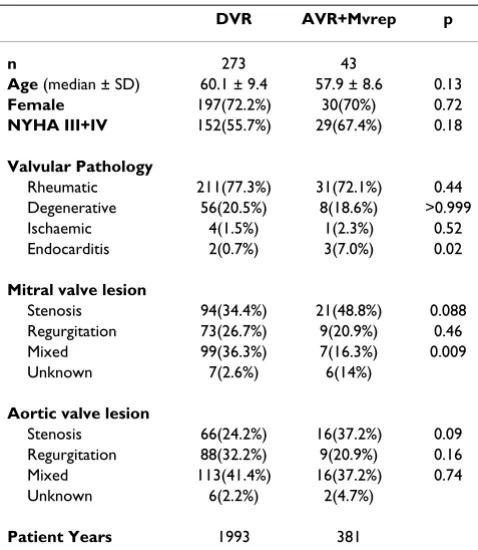
Patient clinical characteristics and pre-operative valve pathophysiology are shown in Table 1.
Rheumatic or degenerative pathology was determined according to pre-operative diagnosis, intra-operative and pathological assessment. All patients with symptomatic
mitral valve disease following an episode of confirmed endocarditis prior to surgery were considered as mitral valve disease secondary to endocarditis.
Concomitant procedures included coronary artery bypass grafting (CABG) in 37 patients, of which 5(11.6%) patients underwent mitral valve repair and 32 (11.7%) patients underwent mitral valve replacement (p = NS). Thirty-seven patients had tricuspid valve repair, including 2(4.7%) with MVrep and 35(12.8%)patients with DVR (p = NS).
Previous cardiac surgery was performed in 144(52.7%) patients in the DVR group and 9(20.9%) patients in the AVR+MVrep group (p = 0.0001), which suggests a greater likelihood to replace the valve at the time of redo opera-tion (Table 2).
Surgical procedure
A total of 589 prosthetic valves were implanted, 316 of these were aortic and 273 mitral. The median implanted valve size in the aortic position was 23 mm(19–29) and in the mitral position 31 mm(25–33).
The operative technique varied depending on the surgeon performing the procedure, but all surgeons used moderate hypothermia (28°C to 32°C) along with cold crystalloid or blood cardioplegia. Mitral valve repair or replacement was the decision of the individual surgeon. Mitral valve repair was classified as all procedures performed in keep-ing with the techniques as originally described by carpen-tier [2].
All patients were anticoagulated with warfarin. The goal for the therapeutic range of international normalised ratio (INR) was 2.0 to 3.0 and more recently (1992 onwards), 2.0 to 2.5 for AVR +MVrep and 2.5 to 3.0 for DVR. The changes in INR resulted from data previously published from our unit showing a decrease in haemorrhagic events with no resultant changes in thromboembolic complica-tions for isolated mechanical prosthesis in the aortic posi-tion [1]. Until a therapeutic internaposi-tional normalized
Table 2: Reoperation patient characteristics
DVR AVR+Mvrep
n 144(52.7%) 9(20.9%)
Age (median ± SD) 59.2 ± 9.3 56.0 ± 1.6
Previous operation
Aortic valve 12(4.4%) 2(4.7%)
Mitral valve 68(24.9%) 6(14%)
Aortic and Mitral valves 57(20.9%) 1(2.3%)
Other than valve 4(1.5%) 0
Unknown 3(1.1%) 0
Table 1: Patient Characteristics
DVR AVR+Mvrep p
n 273 43
Age (median ± SD) 60.1 ± 9.4 57.9 ± 8.6 0.13
Female 197(72.2%) 30(70%) 0.72
NYHA III+IV 152(55.7%) 29(67.4%) 0.18
Valvular Pathology
Rheumatic 211(77.3%) 31(72.1%) 0.44
Degenerative 56(20.5%) 8(18.6%) >0.999
Ischaemic 4(1.5%) 1(2.3%) 0.52
Endocarditis 2(0.7%) 3(7.0%) 0.02
Mitral valve lesion
Stenosis 94(34.4%) 21(48.8%) 0.088
Regurgitation 73(26.7%) 9(20.9%) 0.46
Mixed 99(36.3%) 7(16.3%) 0.009
Unknown 7(2.6%) 6(14%)
Aortic valve lesion
Stenosis 66(24.2%) 16(37.2%) 0.09
Regurgitation 88(32.2%) 9(20.9%) 0.16
Mixed 113(41.4%) 16(37.2%) 0.74
Unknown 6(2.2%) 2(4.7%)
Patient Years 1993 381
ratio was achieved, patients were maintained in hospital on either subcutaneous heparin or enoxaparin.
Data collection and follow up
Follow-up for surviving patients was carried out by tele-phone interview with the patient, their family physician, or a close relative during a closing interval of 220 days and ranged from 3 months to 21 years (9.03 + 4.82 years). During the follow up period 96 patients died. Overall, 50% of surviving patients were followed to 8.02 years, 36.7% to 10 years and 9.6% to 15 years.
Data for deceased patients were obtained from hospital and family physicians' records as well as from death certif-icates obtained from the Statistics and Research Agency of Northern Ireland. We adhered to the guidelines of the Society of Thoracic Surgeons [3] for reporting morbidity and mortality after cardiac valvular operations. Follow up of 100% was achieved with a total of 2374 patient years.
Statistical analysis
Continuous variables were expressed as median + stand-ard deviation. For univariate comparisons the Χ2 test and
Fisher's exact probability test were used. A p value of less than 0.05 was considered to be significant. The Kaplan-Meier method was used for actuarial analysis, applying either Breslow's or log-rank significance tests. All opera-tive deaths were included in actuarial analysis. The Stats-direct software package (StatsStats-direct.com) was used with a compatible desktop computer.
Results
In hospital mortality
Seventeen patients (5.4%) died either in hospital or in the first 30 days following operation (range 0 to 40 days). Of these patients 16 had undergone DVR and 1 AVR+MVrep (p = NS). The major causes of hospital death were post-operative low cardiac output (8) or multiple organ failure (2). One death occurred due to fracture of the aortic pros-thetic valve. A further death occurred due to rupture of the left ventricle along the posterior atrio-ventricular junction in a patient undergoing DVR following two previous mitral valve procedures.
Late mortality
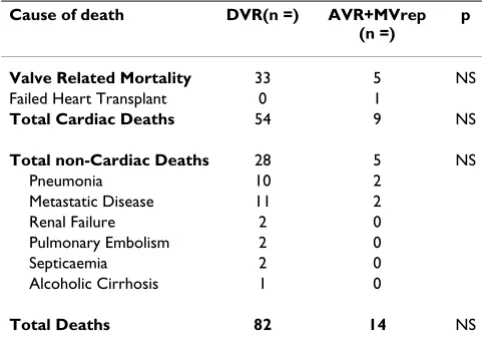
Ninety-six patients died during the follow-up period. The causes of death are listed in table 3.
Valve related deaths
We documented a total of thirty-eight deaths as valve-related. Thirty-three occurred in the DVR group: myocar-dial infarct (9), prosthetic valve endocarditis (8), intracra-nial haemorrhage (7), thromboembolic CVA (5), mesenteric infarct (2), mitral valve thrombosis (1), and periprosthetic leak (1). There were five valve related
deaths within the AVR+MVrep group: myocardial infarct (1), prosthetic valve endocarditis (2), thromboembolic CVA (1), and sudden death (1). The patient who died of sudden death died at home nine years following surgery and no post-mortem was performed. The death was pre-sumed to be valve-related, for the purposes of analysis (p = NS).
Anticoagulation related complications
Thromboembolic complications were observed in 14 of 273 (5.1%) patients in the DVR group these included: thromboembolic CVA (10), mesenteric infarction (2), and valve thrombosis (2). Of these 14 patients there were 8 deaths (as detailed above). One patient with mitral valve thrombosis had an international normalized ratio of 1.4 times normal on admission and was treated suc-cessfully with anticoagulation. There were two episodes of thromboembolic CVA (4.7%) in the AVR+MVrep group with one mortality (p = NS).
Haemorrhagic complications were observed in 12 (4.4%) patients in the DVR group: intracranial haemorrhage (7), gastrointestinal bleed (4), and nose bleed (1). All of the patients with intracranial haemorrhage died, and the other patients all required admission to hospital and blood transfusion. Haemorrhagic complications were observed in 3 of 43 (7.0%) patients in the AVR+Mvrep group: gastrointestinal bleed (1), per vaginal bleed (1), nose bleed(1). There were no mortalities but all required blood transfusion (p = NS)
Prosthetic valve endocarditis
Twelve patients (12/316) patients were identified as hav-ing prosthetic valve endocarditis (PVE). Three patients (3/ 43;7.0%) in the AVR+MVrep group had PVE, two died and one survives. He remains well after conservative manage-ment. In the DVR group there were 9 patients (9/ 273;3.3%) who developed PVE (p = NS). Eight patients
Table 3: Late causes of death
Cause of death DVR(n =) AVR+MVrep
(n =)
p
Valve Related Mortality 33 5 NS
Failed Heart Transplant 0 1
Total Cardiac Deaths 54 9 NS
Total non-Cardiac Deaths 28 5 NS
Pneumonia 10 2
Metastatic Disease 11 2
Renal Failure 2 0
Pulmonary Embolism 2 0
Septicaemia 2 0
Alcoholic Cirrhosis 1 0
died and one survives following conservative manage-ment.
Structural dysfunction
One patient died on the day of surgery in the DVR group and post mortem showed a fracture of one of the aortic valve leaflets.
Non-structural dysfunction
One patient in the DVR group required re-operation and further mitral valve replacement six years later for mitral valve leaflet entrapment due to pannus formation.
Periprosthetic leak
Six patients in the DVR group required re-operation for periprosthetic leak, whilst no patients in the AVR+MVrep group developed a leak (P = NS). Of those patients in the DVR group requiring re-operation, one was for aortic valve periprosthetic leak and five for mitral valve peripros-thetic leak.
Actuarial analysis
At follow up, 203 patients were alive to give a total of 2374 patient years for this study. Actuarial survival, regardless of cause of death, for DVR at 5, 10, 15 years was 79%(CI 74–84), 62%(CI 55–68), 44(CI 34–53) respec-tively, and 86%(CI75–96), 76%(CI62–90), 57%(CI36– 79) respectively for the AVR+MVrep group (p = NS).
Actuarial survival for the patients(n = 163) undergoing either DVR or AVR+MVrep, as a first time cardiac proce-dure, at 5, 10, 15 years was 81%(CI 74–88), 58%(CI 47– 69), 39%(CI 21–56), and 82%(CI69–95), 77%(CI62– 93), 58%(CI32–84) for the DVR and AVR+MVrep groups respectively (p = NS).
Cox regression analysis was performed using all patients with the variables; procedure performed, sex, mitral valve pathology, aortic valve pathology and redo procedure. Using a forward selection process, only the variable age was significant (p < 0.001), with all the other variables exceeding p = 0.05. However, these results should be treated with caution given the relatively small sample size.
Age significantly affects survival with a hazard ratio of 1.93 (CI 1.47–2.45) per decade.
Discussion
Our experience in this 21-year study shows that both DVR and AVR+MVrep lead to excellent long-term survival and low morbidity as comparable to other studies [4-7].
The higher early mortality rate appears less favourable than other studies [8-12]. This may be related to the high proportion of patients in NYHA III-IV. Moreover, there
was a high incidence of patients undergoing redo opera-tions (153/316; 48.4%). Although redo operation follow-ing previous mitral valve repair is associated with low mortality [13] a number of these patients had previous valve replacement which is associated with a higher oper-ative mortality. Patients undergoing concomitant coro-nary artery bypass were also included and again this is associated with higher mortality [13]. These data were also analysed for the twenty-one years as a whole. Interest-ingly, the data for the United Kingdom heart valve registry [14] over the period 1987–1997 estimates early mortality at 9.3% for double valve procedures inclusive of re-opera-tions.
Much of the data recently published comparing DVR to AVR+MVrep considers a heterogeneous population of patients undergoing replacement with various mechanical and bioprosthetic valves [4-6]. A major strength of this study, is that it is confined to a single prosthetic valve and hence removes the confounding influences of the differ-ent mechanical valves and the earlier structural deteriora-tion associated with bioprosthetic valves.
Gillinov et al [5] had a population of 813 patients under-going combined aortic valve replacement with mitral valve procedure. They included all patients undergoing surgery irrespective of the valvular prosthesis used during the 23 year period. In total they identified 301 patients receiving a mechanical aortic prosthesis with associated mitral procedure, compared to 316 in the current study.
Long term survival was comparable in both studies. How-ever, the high incidence of bioprosthetic valve insertion in their study population resulted in a higher re-operation rate, as would be expected. Hamamoto et al [4] also stud-ied a similar population, again regardless of the type of prosthesis used. Additionally, they excluded patients undergoing concomitant coronary artery bypass grafting or other procedure. In comparison, only 135 patients within the DVR (135/299) group received a mechanical prosthesis and 31 patients in the AVR+MVrep group received a mechanical prosthesis in the aortic position.
Freedom from thromboembolic complications at 10 years was similar for each group (DVR 29% (CI 15–43); AVR+MVrep 41% (CI 4–79)). There was also no signifi-cant difference in the freedom from haemorrhagic com-plications resulting from anticoagulation therapy.
This study population exhibited a high number of redo operations following previous cardiac surgery (DVR n = 144; AVR+MVrep = 9). In our experience all patients requiring a redo operation had a previous valve other than a SJM, usually a bioprosthesis, inserted at the time of the first cardiac procedure. Survival analysis of patients under-going first time cardiac surgery of either DVR or AVR+MVrep was similar at 15 years and was independent of concomitant tricuspid valve repair or coronary artery bypass grafting.
There was one re-operation within the AVR+MVrep group with the patient undergoing a further AVR+MVrep. In this case the aortic valve was initially replaced with a biopros-thetic valve. In contrast, there were 6 re-operations for periprosthetic leak within the DVR group. There were no further valve procedures within the DVR group.
In their study Hamamoto et al [4] found that 49% of patients (39/80) required re-operation following AVR+MVrep. However 34 (87.2%) of these patients required re-operation for deterioration of a bioprosthetic valve in the aortic position or pannus associated with a mechanical AVR.
There was a higher incidence of rheumatic fever in the DVR group suggesting that surgeons were more likely to perform a mitral valve replacement for a stenotic rheu-matic mitral valve.
The operative mortality rates were 5.9% and 2.3% respec-tively for DVR and AVR+Mvrep, suggesting a clinical dif-ference.
As is common to retrospective reviews this study has sev-eral limitations. Obviously patients were not randomised to the two treatment modalities. The decision to perform either DVR or AVR+MVrep was dependent on the operat-ing surgeon and thus indications naturally varied accord-ing to surgical experience. The absolute numbers of patients were relatively small, but these are at least com-parable to recently reported series [4-6].
Conclusion
Our previous data shows that survival following DVR is similar to that for isolated MVR - see Fig 1. This current study suggests that patients undergoing combined aortic and mitral valve procedures may benefit from mitral valve repair but unfortunately the available data but did not
reach a statistically significant difference in outcome for survival. The authors accept that as a result of the disparity in patient numbers between the two study groups, there is a suggested clinical difference. Both mitral valve repair and replacement are good options for the rheumatic valve patient and the choice should be determined by surgical judgement and experience. Whether repairing or replacing a rheumatic mitral valve at the time of aortic valve replace-ment makes no significant difference to long-term out-come. These results must be interpreted with caution, however, in the modern era with more myxomatous mitral valve pathology amenable to repair. This study also demonstrates that the use of a mechanical prosthesis in this subgroup of patients results in good long-term sur-vival without the need for reoperation associated with a bioprosthetic valve.
Competing interests
The author(s) declare that they have no competing inter-ests.
Authors' contributions
NCMG participated in the design of the study, performed the statistical analysis and coordinated and helped to draft the paper. JMJ and PS participated in the design and helped to draft the paper. SWMG conceived of the study, participated in its design and helped to draft the paper.
Acknowledgements
Deirdre Lovell for data collection.
Gordon Cran for assistance with data interpretation.
Kaplan-Meier survival curve for all patients undergoing DVR or AVR+MVrep (log rank p = 0.18)
Figure 1
Kaplan-Meier survival curve for all patients undergoing DVR or AVR+MVrep (log rank p = 0.18).
0 5 10 15 20
0.00 0.25 0.50 0.75 1.00
AVR+MVrep
Cumulative Survival
DVR
Publish with BioMed Central and every scientist can read your work free of charge "BioMed Central will be the most significant development for disseminating the results of biomedical researc h in our lifetime."
Sir Paul Nurse, Cancer Research UK
Your research papers will be:
available free of charge to the entire biomedical community
peer reviewed and published immediately upon acceptance
cited in PubMed and archived on PubMed Central
yours — you keep the copyright
Submit your manuscript here:
http://www.biomedcentral.com/info/publishing_adv.asp
BioMedcentral
References
1. Ibrahim M, O'Kane H, Cleland J, Gladstone D, Sarsam M, Patterson C: The St. Jude medical prosthesis: A 13 year experience. J Thorac Cardiovas Surg 1994, 108:221-230.
2. Carpentier A: Cardiac valve surgery-the "French correction.".
J Thorac Cardiovasc Surg 1983, 86:323-337.
3. Edmunds LH, Clark RE, Cohn LH, Grunkemeier GL, Miller DG, Wei-sel RD: Guidelines for reporting morbidity and mortality after cardiac valvular operations. Ann Thorac Surg 1996,
62:932-5.
4. Hamamoto M, Bando K, Kobayashi J, Tosihiko S, Sasako Y, Niwaya K, Tagusari O, Yagihara T, Kitamura S: Durability and outcome of aortic valve replacement with mitral valve repair versus double valve replacement. Ann Thorac Surg 2003, 75:28-34. 5. Gillinov MA, Blackstone EH, Cosgrove DM, White J, Kerr P, Marullo
A, McCarthy P, Lytle B: Mitral valve repair with aortic replace-ment is superior to double valve replacereplace-ment. J Thorac Cardi-ovasc Surg 2003, 125:1372-87.
6. Remadi JP, Baron O, Tribouilly C, Roussel JC, Al_Habasch 0, Despins P, Michaud JL, Duveau D: Bivalvular mechanical mitral-aortic valve replacement in 254 patients: Long-term results – A 22-year follow-up. Ann Thorac Surg 2003, 76:487-92.
7. Fiore AC, Swartz MT, Sharp TG, Kesler KA, Barner HB, Naunheim KS, Grunkemeier GL, Moroney DA, Kaiser GC: Double-valve replacement with Medtronic-Hall or St. Jude valve. Ann Tho-rac Surg 1995, 59:1113-9.
8. Milano A, Guglielmi C, De Carlo M, Di Gregorio O, Borzoni G, Verunelli F, Bortolotti U: Valve-related complications in elderly patients with biological and mechanical aortic valves. Ann Thorac Surg 1998, 66:S82-7.
9. Birkmeyer NJO, Marrin CAS, Morton JR, Leavitt BJ, Lahey SJ, Char-lesworth DC, Hernandez F, Olmstead EM, O'Connor GT: Decreas-ing mortality for aortic and mitral valve surgery in Northern New England. Ann Thorac Surg 2000, 70:432-7.
10. Armenti F, Stephenson LW, Edmunds H: Simultaneous implanta-tion of St. Jude Medical aortic and mitral prostheses. J Thorac Cardiovasc Surg 1987, 94:733-9.
11. Remadi JP, Bizouarn P, Baron O, Al Habash O, Despins P, Michaud J, Duveau D: Mitral valve replacement with the St. Jude medical prosthesis: A 15 year follow-up. Ann Thorac Surg 1998, 66:762-7. 12. Kawachi Y, Matuzaki K, Tominaga R, Yasui H, Tokunaga K: The risks of re-operation for prosthetic valve dysfunction. Surgery Today
1994, 24:415-9.
13. Jones JM, O'Kane H, Gladstone DJ, Sarsam MA, Campalani G, MacGowan SW, Cleland J, Cran GW: Repeat heart surgery: Risk factors for operative mortality. J Thorac Cardiovasc Surg 2001,
122:913-8.
14. The United Kingdom heart valve registry report 2001: Department of cardiothoracic surgery, Imperial College Faculty of Medicine, Ham-mersmith Hospital. London. United Kingdom..
15. Fasol R, Mahdjoobian K, Joubert-Hubner E: Mitral repair in patients with severely calcified annulus: feasibility, surgery and results. J Heart valve Dis 2002, 11:153-9.