
Ames Laboratory Publications
Ames Laboratory
3-1-2013
Stability maps to predict anomalous ductility in B2
materials
Ruoshi Sun
University of Illinois at Urbana-Champaign
Duane D. Johnson
Iowa State University, [email protected]
Follow this and additional works at:
http://lib.dr.iastate.edu/ameslab_pubs
Part of the
Condensed Matter Physics Commons
,
Engineering Physics Commons
, and the
Materials Science and Engineering Commons
The complete bibliographic information for this item can be found at
http://lib.dr.iastate.edu/
ameslab_pubs/278
. For information on how to cite this item, please visit
http://lib.dr.iastate.edu/
howtocite.html
.
Stability maps to predict anomalous ductility in B2 materials
Abstract
While most B2 materials are brittle, a new class of B2 (rare-earth) intermetallic compounds is observed to
have large ductility. We analytically derive a
necessary condition
for ductility (dislocation motion) involving
⟨
111
⟩
versus
⟨
001
⟩
slip and the relative stability of various planar defects that must form. We present a
sufficient condition
for antiphase boundary bistability on {11¯0} and {112¯} planes that allows multiple slip
systems. From these energy-based criteria, we construct two stability maps for B2 ductility that use only
dimensionless ratios of elastic constants and defect energies, calculated via density functional theory. These
two conditions fully explain and predict enhanced ductility (or lack thereof) for B2 systems. In the 23 systems
studied, the ductility of YAg, ScAg, ScAu, and ScPd, ductile-to-brittle crossover for other rare-earth B2
compounds, and brittleness of all classic B2 alloys and ionic compounds are correctly predicted.
Keywords
Materials Science and Engineering
Disciplines
Condensed Matter Physics | Engineering Physics | Materials Science and Engineering
Comments
This article is from Phys. Rev. B
87
, 104107 (2013), doi:10.1103/PhysRevB.87.104107. Posted with
permission.
PHYSICAL REVIEW B87, 104107 (2013)
Stability maps to predict anomalous ductility in B2 materials
Ruoshi Sun1,2and D. D. Johnson1,3,4,*
1Materials Science and Engineering, University of Illinois at Urbana-Champaign, 1304 West Green Street, Urbana, Illinois 61801, USA 2Materials Science and Engineering, Massachusetts Institute of Technology, 77 Massachusetts Avenue, Cambridge,
Massachusetts 02139, USA
3The Ames Laboratory, US Department of Energy, 311 TASF, Iowa State University, Ames, Iowa 50011-3020, USA 4Materials Science and Engineering, Iowa State University, Ames, Iowa 50011-2300, USA
(Received 15 January 2013; revised manuscript received 5 March 2013; published 19 March 2013)
While most B2 materials are brittle, a new class of B2 (rare-earth) intermetallic compounds is observed to have large ductility. We analytically derive anecessary conditionfor ductility (dislocation motion) involving
111versus001slip and the relative stability of various planar defects that must form. We present asufficient conditionfor antiphase boundary bistability on{1¯10}and{11¯2}planes that allows multiple slip systems. From these energy-based criteria, we construct two stability maps for B2 ductility that use only dimensionless ratios of elastic constants and defect energies, calculated via density functional theory. These two conditions fully explain and predict enhanced ductility (or lack thereof) for B2 systems. In the 23 systems studied, the ductility of YAg, ScAg, ScAu, and ScPd, ductile-to-brittle crossover for other rare-earth B2 compounds, and brittleness of all classic B2 alloys and ionic compounds are correctly predicted.
DOI:10.1103/PhysRevB.87.104107 PACS number(s): 62.20.fk, 61.72.Nn, 81.05.Bx, 71.20.−b
I. INTRODUCTION
In 2003, Gschneidner et al. discovered a family of duc-tile rare-earth/transition-metal (RM) intermetallic compounds with the body-centered-cubic-based B2 (or CsCl) crystal structure.1 The current list of known ductile B2 compounds can be found in Ref. 2. In contrast to the brittleness of classic B2 alloys, the ductility of YAg is comparable to face-centered-cubic Al, and YCu is half that of YAg. As line compounds are usually brittle,3the reason for anomalous ductility in RM compounds remains open. Moreover, some RM compounds, such as (Tb0.88Dy0.12)Zn (Ref.4) and YMg,5
are brittle. Hence, the questions: Why are they different? Can anomalous ductility be predicted on a system-dependent basis? Much work has been done in determining the dominant slip systems of the B2 alloys. As discussed in the review articles by Yamaguchi and Umakoshi6 and Baker,7 111and001are the two main observed slip directions for dislocation motion in B2 materials (Fig.1). Yet no previous theories have attempted to predict B2 ductility because all the known alloys and ionic compounds are brittle. For example, polycrystalline NiAl has only a 2% elongation upon fracture.3 Baker concluded that limited ductility is associated with001slip, and brittleness with111 slip.7 While off-stoichiometric B2 alloys exhibit improved ductility, yield strength is sacrificed, which is not useful for practical purposes.3 In contrast to B2 alloys, this new class of RM compounds has an exact stoichiometry, and the compounds are nearly elastically isotropic.1
Following the discovery of the RM compounds, there have been several experimental4,8,9 and theoretical2,10–12 studies. Morris et al. have hypothesized that the enhanced ductility in the Y-based compounds is due to the competing structural stability of B33 and B27 phases, obtained by introducing a periodic array of a2001{1¯10} superintrinsic stacking faults (SISFs) to the B2 lattice.12 However, the fact that not all the RM-B2 compounds are ductile highlights the complications with classification of the slip modes and the prediction of their ductility. More recently, Gschneidneret al.established a
correlation between the absence ofd electrons and measured ductility.2However, a direct explanation from the perspective of ductility involving dislocation motion and defect ener-getics is lacking. Such a theory permits prediction, as well as correlations to specific electronic features, to be made, while relating observed ductility measures to features in the electronic structure is fruitful but not a theory.
To address the atypical ductility possessed by some RM compounds and the unresolved issue of predicting 111 versus001slip, we provide a quantitative explanation from mesoscale dislocation mechanics using energy-based stability criteria, whose parameters can be calculated from density functional theory (DFT). In short, we present a predictive theory for ductility in ideal B2 compounds. From stability criteria derived for the B2 structure, we provide anecessary andsufficientcondition for increased ductility in B2 systems, which are displayed in terms of predictive dimensionless maps. We apply these maps to three types of B2 materials: (1) Y-based and Sc-based compounds (YAg, YCu, YIn, YRh, YMg, YZn, ScAg, ScAu, ScCu, ScPd, ScPt, ScRh, and ScRu), (2) classic alloys (NiAl, FeAl, AuCd, AuZn, CuZn, and AgMg), and (3) ionic compounds (CsCl, CsI, TlBr, and TlCl). Any proposed B2 compound can be added to the map to predict its relative ductility. The possibilities can be narrowed using only the Zener anisotropy ratio.
II. BACKGROUND
For dislocation-mediated deformation, both elastic anisotropy and planar defect energies (e.g., antiphase bound-ariesγAPBhkl or stacking faultsγSFhkl) in the competing Miller-indexed (hkl) slip planes are relevant. Clearly, the more elas-tically isotropic a system, the easier for dislocation movement to other slip planes under shear. As noted, the new ductile B2 systems are nearly elastically isotropic,1with Zener anisotropy ratioAclose to 1, where
A= 2c44
c11−c12. (1)
104107-1
(a) (b)
FIG. 1. For B2 systems, the (a) [001] and [111] slip in the (1¯10) plane and (b) [¯1¯11] slip in the (11¯2) plane. (a) Perfect111 superdislocation can dissociate [Eq.(7a)] into perfect110and001 dislocations (dashed lines), with possible dissociation of110into
100and010(grey dashed lines).
Here, thecij’s are the cubic elastic constants, and, in particular,
c44 is the shear modulus. For a B2 lattice constant ofa, the product ofc44ahas units ofγ(in mJ/m2). For an energy-based
criterion for ductility under shear, dimensionless ratios are relevant, reflecting relative energies; two ratios associated with the energetics of slip directions and defect formation, making the simple maps, are
C=γAPB1¯10c44a, (2) δ=γSF1¯10γAPB1¯10. (3) These quantities can be obtained via DFT calculations.
In a recent study of the L12binaries and pseudobinaries, the
occurrence/loss of the yield-stress anomaly was predicted13in all systems studied by considering thenecessarycondition for the stability of APB versus SISF and a sufficientcondition for the stability of APB(111) versus (100) for cross-slip of screw dislocation segments. The APB and SISF energies, as well as cij, were obtained using DFT. The necessary and
sufficient conditions were derived, respectively, by Paidar, Pope, and Yamaguchi14(modified by Liuet al.13) and Saada and Veyssiere.15The resulting stability map is applicable to any L12material. Here, we adopt a similar approach. We construct
two maps based on energy-stability criteria for competing slip modes in B2 structures that fully explain and predict enhanced ductility (or lack thereof) in B2 systems.
III. METHODS
DFT16,17 calculations were performed to obtain required parameters of the theory. We employed the Vienna Ab Initio Simulation Package (VASP)18–21 that uses pseudopotentials with a projector augmented wave (PAW) basis.22,23 We adopted the generalized gradient approximation (GGA) to the exchange-correlation functional.24,25 The lattice a and elastic cij constants were calculated for two-atom B2 cells
with 20×20×20 k-point meshes.26 Total energies (forces) were converged below 0.1 meV/cell (1 meV/A). Due to errors˚ in GGA functionals,afor metals are overestimated (atheory> aexptup to 1%), which affect the valuescij andγ because the
defect planes are farther apart and lowers the defect energy, giving material-dependent errors. Therefore, we used aexpt (if known) to create the maps to remove nonsystematic errors from calculated quantities. (The value ofaexptis unknown for
YIn.) Note that removing such nonsystematic error is critical for predicting quantitatively other deformation processes, such as twinning,27,28 because the atomic planes away from the planar defects are separated by geometric multiples ofaexpt
(the same distances as in experiment), but relaxation around the defects plane are included, so DFT provides a more correct shear surface energy.
The planar defect energies of APB{1¯10}and SF{1¯10}were calculated for 32-atom unit cells having at least 12×12×2 kpoints. The APB{11¯2}was calculated using a 24-atom unit cell and 8×8×4kpoints. Examples of the various unit cells are shown in Fig.2. Thek-point meshes were chosen such that the reciprocal axes had a similar density ofkpoints. The aspect ratio inkspace, then, was roughly the reciprocal of that in real space. APBs and SFs on the{1¯10}plane were separated by
[1 1 0]
[1 1 0]
[0 0 1]
(a) (b)
(c)
[1 1 1]
[1 1 2]
[1 1 0]
FIG. 2. Unit cells used for (a) APB{1¯10}, (b) SF{1¯10}, and (c) APB{11¯2}. In (a) and (b), solid and open circles represent different atomic species. In (c), APB{11¯2}is projected onto the (1¯10) plane. Solid symbols represent atoms in the plane; open symbols represent atoms a
[image:4.608.315.554.257.685.2]STABILITY MAPS TO PREDICT ANOMALOUS DUCTILITY. . . PHYSICAL REVIEW B87, 104107 (2013) eight layers of atoms, whereas APB{11¯2}’s were separated by
six layers. To remove errors fork-point meshes, the perfect cell had the same number of atoms and cell shape as the defective cell. (Note that defect planes may shift off their ideal lattice positions, an effect for which we have not accounted in the DFT results.) Defect energies were computed from
γ = Edefect−Eperfect mT1×T2
(4)
for m defect planes per unit cell. Each unit cell contained two defect planes, so that orthogonal translation vectorsT1,2,3
could be used as coordinate axes along the defect plane. In defective cells, two layers of atoms on each side of the defect plane were relaxed alongT3, with the cell shape and volume
fixed to remove systematic errors. Specifically, the translation vectors were 1 a ⎡ ⎢ ⎣ T1 T2 T3 ⎤ ⎥ ⎦= ⎧ ⎪ ⎪ ⎪ ⎪ ⎪ ⎪ ⎪ ⎪ ⎨ ⎪ ⎪ ⎪ ⎪ ⎪ ⎪ ⎪ ⎪ ⎩ ⎡ ⎢ ⎣
¯1 1 0 0 0 1 8 8 0
⎤ ⎥
⎦APB and SF{1¯10}
⎡ ⎢ ⎣
¯1 1 0 ¯1 ¯1 1 2 2 4
⎤ ⎥
⎦APB{11¯2}
. (5)
Following Mehlet al.,29we obtained the necessary elastic constants cij by solving for c44, c=(c11−c12)/2, and
bulk modulusB=(c11+2c12)/3 through appropriate lattice distortion, where the Zener ratioA=c44/candG=c44. The
total energy for each strain distortion in B2 is proportional to 2, withO(4) error, giving more accurate coefficients. The
Poisson ratio in TableIis computed from
ν= 3B−2G
6B+2G. (6)
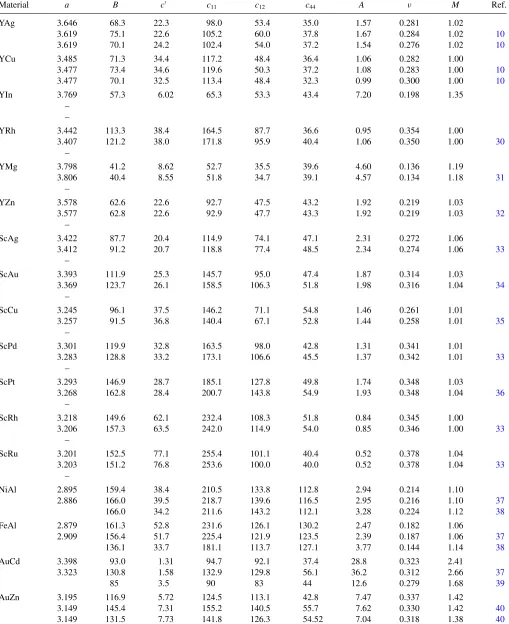
We provide in Table Ithe DFT and known observed values of all required quantities that are necessary in the maps that indicate enhanced ductility using elastic properties and relative defect energies.
IV. NECESSARY AND SUFFICIENT CONDITIONS FOR B2 DUCTILITY
We now derive the two conditions for ductility, applying them in Sec. V. Multiple slip can occur via formation of
111 APBs on the{1¯10}and{11¯2}planes. (For simplicity, the a
2111{1¯10} and a
2111{11¯2} APBs and a
2001{1¯10}
SFs are denoted as APB{1¯10}, APB{11¯2}, and SF{1¯10}.) It is necessary, then, that the 111 APBs have to be more energetically favorable than the001 SFs. To predict111 versus 001 slip, Rachinger and Cottrell44 gave a simple criterion in terms of width of APB: IfwAPB/a 1, then111
slip is favorable; else ifwAPB/a ≈1, then001is favorable. We have derived a more quantitative necessary condition45 (see AppendixA) in light of Paidar, Pope, and Yamaguchi’s work in L12systems.14
Saada and Veyssiere39investigated the sufficient condition for cross-slip of a111screw superdislocation on{1¯10}and
{11¯2}planes that leads to multiple-slip systems. The possible dissociation mechanisms for a111 screw superdislocation
are
a111 →a110 +a001
→a100 +a010 +a001, (7a) a001 → a
2001 +SF+ a
2001, (7b)
a111 → a
2111 +APB+ a
2111. (7c) In Eq.(7a), the111screw dislocation can further dissociate into perfect dislocations along the cube edges (Fig.1); hence, there are no APBs or SFs. Equation(7b)involves formation of SFs.
A. Necessary condition
As described above, there are two criteria that must be met simultaneously that provide thenecessarycondition for ductility: 001 should be the dominant slip direction, yet
111 slip should also be possible with formation of 111 APBs; see Fig.1. An overview of the derivation is provided in AppendixA.
On purely energetic grounds, for B2 materials to possess multiple slip during plastic flow,001{1¯10}slip must be more favorable than111{1¯10}slip via APB{1¯10}formation, which occurs45(see AppendixA) if
wAPB kea∼5.9a or (8a)
lnC −3.9. (8b)
Equation(8)justifies the criterion imposed by Rachinger and Cottrell44 and gives a fixed measure across B2 systems. The second form is useful for presenting the maps.
Now, to have enhanced ductility, both001as the dominant slip direction, and111 slip also possible by formation of
111APBs, the APBs must be more energetically favorable than SFs. The keynecessarycondition45 (see Appendix A), using Eqs.(2)and(3), is
δ >0.119C−1/4 or (9a) lnδ >−2.132−14lnC, (9b)
where the second form is easier for plotting the maps. Together Eqs.(8)and(9)constitute the map for B2 systems that will have both dominant001slip and111slip due to formation of APBs.
For our generic map and necessary conditions, as a standard simplification, we used a Poisson ratio of 1/3 (not values in TableI), which yields integer coefficients related toν. We also used an effective dislocation interaction range of twice the core width (r=2r0=2ka; see AppendixA). Whileν=1/3 and
the estimatedksimplifies the algebra for the maps, the reader should appreciate that the exact borders for each material can be shifted by the actual values—the price for a generic map; hence, borderline cases should be assumed possibly relevant. Also, differences in various DFT calculations could alter locations in the maps, as we show explicitly.
B. Sufficient condition
As noted earlier, a ductile B2 material can have multiple slip only if APBs have bistable existence on both{1¯10}and
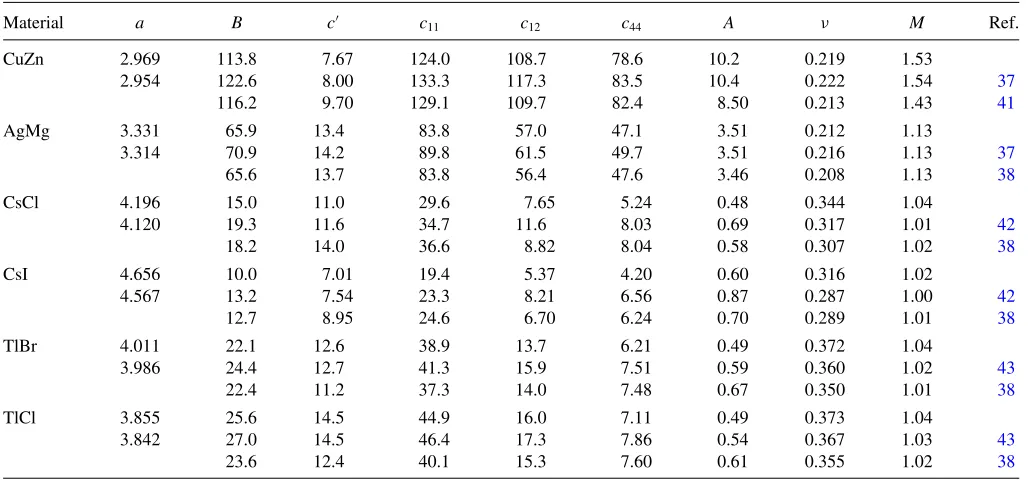
TABLE I. Calculated and observed B2 lattice constants (ain ˚A), bulk modulus (Bin GPa), and elastic constants (cijin GPa).A,ν, andM are defined in the main text. In the first (second) row of each system, DFT calculations were performed ataDFT(aexpt). References foraexptare given in the second row. In the third row,B,c,A,ν, andMwere derived from the experimental elastic constants. Dashes indicate that no data are available.
Material a B c c11 c12 c44 A ν M Ref.
YAg 3.646 68.3 22.3 98.0 53.4 35.0 1.57 0.281 1.02
3.619 75.1 22.6 105.2 60.0 37.8 1.67 0.284 1.02 10
3.619 70.1 24.2 102.4 54.0 37.2 1.54 0.276 1.02 10
YCu 3.485 71.3 34.4 117.2 48.4 36.4 1.06 0.282 1.00
3.477 73.4 34.6 119.6 50.3 37.2 1.08 0.283 1.00 10
3.477 70.1 32.5 113.4 48.4 32.3 0.99 0.300 1.00 10
YIn 3.769 57.3 6.02 65.3 53.3 43.4 7.20 0.198 1.35
– –
YRh 3.442 113.3 38.4 164.5 87.7 36.6 0.95 0.354 1.00
3.407 121.2 38.0 171.8 95.9 40.4 1.06 0.350 1.00 30
–
YMg 3.798 41.2 8.62 52.7 35.5 39.6 4.60 0.136 1.19
3.806 40.4 8.55 51.8 34.7 39.1 4.57 0.134 1.18 31
–
YZn 3.578 62.6 22.6 92.7 47.5 43.2 1.92 0.219 1.03
3.577 62.8 22.6 92.9 47.7 43.3 1.92 0.219 1.03 32
–
ScAg 3.422 87.7 20.4 114.9 74.1 47.1 2.31 0.272 1.06
3.412 91.2 20.7 118.8 77.4 48.5 2.34 0.274 1.06 33
–
ScAu 3.393 111.9 25.3 145.7 95.0 47.4 1.87 0.314 1.03
3.369 123.7 26.1 158.5 106.3 51.8 1.98 0.316 1.04 34
–
ScCu 3.245 96.1 37.5 146.2 71.1 54.8 1.46 0.261 1.01
3.257 91.5 36.8 140.4 67.1 52.8 1.44 0.258 1.01 35
–
ScPd 3.301 119.9 32.8 163.5 98.0 42.8 1.31 0.341 1.01
3.283 128.8 33.2 173.1 106.6 45.5 1.37 0.342 1.01 33
–
ScPt 3.293 146.9 28.7 185.1 127.8 49.8 1.74 0.348 1.03
3.268 162.8 28.4 200.7 143.8 54.9 1.93 0.348 1.04 36
–
ScRh 3.218 149.6 62.1 232.4 108.3 51.8 0.84 0.345 1.00
3.206 157.3 63.5 242.0 114.9 54.0 0.85 0.346 1.00 33
–
ScRu 3.201 152.5 77.1 255.4 101.1 40.4 0.52 0.378 1.04
3.203 151.2 76.8 253.6 100.0 40.0 0.52 0.378 1.04 33
–
NiAl 2.895 159.4 38.4 210.5 133.8 112.8 2.94 0.214 1.10
2.886 166.0 39.5 218.7 139.6 116.5 2.95 0.216 1.10 37
166.0 34.2 211.6 143.2 112.1 3.28 0.224 1.12 38
FeAl 2.879 161.3 52.8 231.6 126.1 130.2 2.47 0.182 1.06
2.909 156.4 51.7 225.4 121.9 123.5 2.39 0.187 1.06 37
136.1 33.7 181.1 113.7 127.1 3.77 0.144 1.14 38
AuCd 3.398 93.0 1.31 94.7 92.1 37.4 28.8 0.323 2.41
3.323 130.8 1.58 132.9 129.8 56.1 36.2 0.312 2.66 37
85 3.5 90 83 44 12.6 0.279 1.68 39
AuZn 3.195 116.9 5.72 124.5 113.1 42.8 7.47 0.337 1.42
3.149 145.4 7.31 155.2 140.5 55.7 7.62 0.330 1.42 40
STABILITY MAPS TO PREDICT ANOMALOUS DUCTILITY. . . PHYSICAL REVIEW B87, 104107 (2013) TABLE I. (Continued.)
Material a B c c11 c12 c44 A ν M Ref.
CuZn 2.969 113.8 7.67 124.0 108.7 78.6 10.2 0.219 1.53
2.954 122.6 8.00 133.3 117.3 83.5 10.4 0.222 1.54 37
116.2 9.70 129.1 109.7 82.4 8.50 0.213 1.43 41
AgMg 3.331 65.9 13.4 83.8 57.0 47.1 3.51 0.212 1.13
3.314 70.9 14.2 89.8 61.5 49.7 3.51 0.216 1.13 37
65.6 13.7 83.8 56.4 47.6 3.46 0.208 1.13 38
CsCl 4.196 15.0 11.0 29.6 7.65 5.24 0.48 0.344 1.04
4.120 19.3 11.6 34.7 11.6 8.03 0.69 0.317 1.01 42
18.2 14.0 36.6 8.82 8.04 0.58 0.307 1.02 38
CsI 4.656 10.0 7.01 19.4 5.37 4.20 0.60 0.316 1.02
4.567 13.2 7.54 23.3 8.21 6.56 0.87 0.287 1.00 42
12.7 8.95 24.6 6.70 6.24 0.70 0.289 1.01 38
TlBr 4.011 22.1 12.6 38.9 13.7 6.21 0.49 0.372 1.04
3.986 24.4 12.7 41.3 15.9 7.51 0.59 0.360 1.02 43
22.4 11.2 37.3 14.0 7.48 0.67 0.350 1.01 38
TlCl 3.855 25.6 14.5 44.9 16.0 7.11 0.49 0.373 1.04
3.842 27.0 14.5 46.4 17.3 7.86 0.54 0.367 1.03 43
23.6 12.4 40.1 15.3 7.60 0.61 0.355 1.02 38
{11¯2} planes (see Fig. 1)—this is the sufficient condition. Following Head46 and Hirth and Lothe,47 the dissociation of
111B2 screw superdislocations was analyzed by Saada and Veyssiere,39and expanded on by Sun,48in terms of the relative energetics of those planes,
λ≡γAPB11¯2γAPB1¯10, (10) and a ratio ofSij elements
M=
S11S44 S11S44−S152
. (11)
See Ref.47for the full derivation ofMand the definition of Sij, which are obtained by a rotation of thecij from cubic axes
to the111axis, as we also present in AppendixB. To satisfy the sufficient condition, expressed in terms of a dimensionless map (λversusM), theλmust be strictly bounded as48
√
3
2 λ
2
√
3. (12)
Within this bound, Sun found48 that both slip directions are active, but (1¯10) is dominant for M1/3< λ <2/√3 while
(11¯2) is dominant for√3/2< λ < M1/3.
C. Prediction from combined maps
As the major results, we now have the necessary and sufficient conditions for enhanced B2 ductility. First, our more quantitative “Rachinger-Cottrell” criterion, Eq.(8), is used to predict dominant001slip. Then, on the same map, Eq.(9) compares the relative stability of APB{1¯10}and SF{1¯10}so that, if APBs are favorable, the systems possessing both001 and111 slip directions satisfy the necessary condition for ductility. Second, multiple slip in{1¯10}and{11¯2}via APB formation is governed by the sufficient condition [Eq.(12)] in a second map. Practically, if the necessary condition is fulfilled
(the first map), then the sufficient condition is checked (the second map) for whether the material possesses bistability of APBs, and, hence, multiple slip can occur for enhanced ductility. We now use these to predict ductility for several B2 systems.
V. RESULTS
A. Necessary condition
A necessary condition map is constructed in Fig.3. The dimensionless ratiosCandδ are defined in Eqs.(2)and(3), respectively. From Eq.(10)in AppendixA, it is shown that
-2.5 -2.0 -1.5 -1.0 -0.5 0.0 0.5 1.0 1.5 2.0 2.5 3.0
-6.0 -5.5 -5.0 -4.5 -4.0 -3.5 -3.0 -2.5 -2.0 -1.5
ln
δ
ln C <111> APB
<001> SF
<111> slip <001> slip
YAg YCu YIn
YRh YMg
YZn ScAg
ScAu ScCu
ScPd
ScPt ScRh ScRu
NiAl FeAl
AuZn CuZn
AgMg
CsCl CsI
[image:7.608.49.564.84.325.2]TlBr TlCl
FIG. 3. Necessary condition (lnδversus lnCmap) for preferred slip and APB/SF stability. To the right (left) of the vertical line,
001(111) slip is more favorable. Above the slanted line, APBs are more stable than SFs. Systems in the upper-right region satisfy the necessary condition for ductility. Note the data shown lie roughly along a line of slope slightly less than−1.
[image:7.608.317.557.506.680.2]Eq. (8) can be expressed in terms of C. This condition translates to the vertical line drawn in Fig. 3, where 001 slip (111 slip) is more favorable for systems lying to the right (left). Equation (9) translates to the slanted line in Fig.3. Therefore, the necessary condition is satisfied in the upper-right region defined by these two lines, in which001 is the dominant slip direction and formation of APBs, rather than SFs, is preferred. We note that the data in Fig.3lie along a line of slope slightly less than−1.
Systems favoring 001 slip include all the ionic com-pounds, all the Y-based compounds except for YMg, all the Sc-based compounds except for ScRu, and NiAl. Notably, ScPt is ductile2 but just barely predicted to be brittle from our analytic necessary conditions, a result that does depend on the accuracy of the DFT-derived inputs, or the underlying simplifications. For example, ScPt in Fig.3 does satisfy the necessary conditions if k≈4 (rather than the k=2.17 we assumed for all alloys, but it is in the acceptable range; see AppendixA). Fork≈4, the APB versus SF slanted line shifts slightly down but parallel to thek=2.17 line and ScPt falls in the upper-right region.
Ionic compounds are expected to exhibit001slip because ions encounter lower charge repulsion as they slip along cubic edges rather than cube diagonals. CuZn and FeAl fall on the left-hand side of the vertical line, showing that 111 slip is favorable, agreeing with their observed exclusive 111 slip.44,49–52 Interestingly, both 111 slip44 and 001 slip53 have been observed in AgMg, with a transition from111 to 001 slip at low temperatures.6 For AuZn (A∼7.5), the predicted 111 slip does not agree with the reported
001 slip44,53 and further investigation is required. From Table Ithe largest errors in our calculated elastic constants are found in AuCd; we have omitted it from our ductility maps. The discrepancies observed in the two Au compounds may be caused by the usage of nonrelativistic
pseudopo-tentials. It has been shown that relativistic effects play an important role in the bonding of Au clusters54 and may also pertain to the study of bulk compounds. For all the other systems, our simple model predicts 001 versus 111 slip accurately.
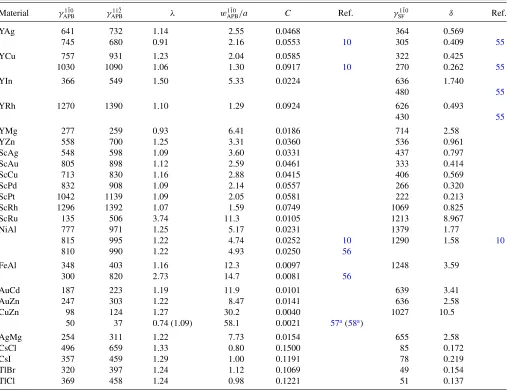
Figure 3 also compares the relative stability of SF{1¯10} and APB{1¯10}. For the ionic compounds, SFs are more stable than APBs. Charge repulsion in the APB is much higher than that in the SF. (See TableIIfor the calculated planar defect energies.) On the other hand, APBs are relatively stable in both the Y-based compounds and the classic B2 alloys.
Systems in the upper-right region, as defined by the vertical and slanted lines, of Fig.3satisfy thenecessarycondition for ductility. In this region,001slip is favorable but111APBs are stable, which means that a2111 partial dislocations can coexist with the111-dissociated perfect001dislocations. Indeed, it has been reported59 that 111 dislocations are metastable in NiAl and that they have been observed in the Y-based compounds.1
The first central finding is that the B2 stability map in Fig.3identifies candidates for multiple slip, and only a subset of Y- and Sc-based systems and some others qualify, namely, YAg, YCu, YIn, YRh, YZn, ScAg, ScAu, ScCu, ScPd, (ScPt), ScRh, NiAl, CsI, and (CsCl), where the parentheses reflect a borderline case that should be checked.
B. Sufficient condition
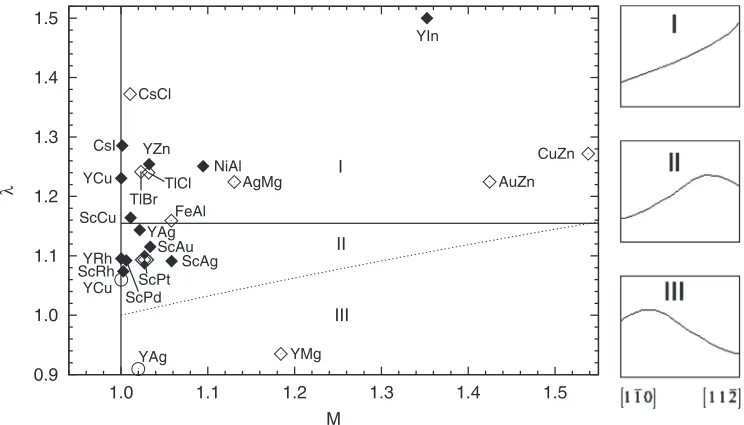
Thenecessarycondition alone cannot predict ductility. The sufficientcondition (Fig. 4)—whether the APBs are bistable on{1¯10}and{11¯2}planes—must be verified. Dimensionless ratiosλandMare defined in Eqs.(10)and(11), respectively. The condition for bistability of APBs is satisfied in regions II and III, according to Eq.(12). In region II, the{1¯10}APB has lower energy, and vice versa in region III (see Fig.4).
0.9 1.0 1.1 1.2 1.3 1.4 1.5
1.0 1.1 1.2 1.3 1.4 1.5
λ
M YAg
YCu
YIn
YRh ScAuScAg ScCu
ScPd ScRh
YZn
NiAl CsI
YMg ScPt
FeAl
AuZn CuZn
AgMg CsCl
TlBr TlCl
YAg YCu
I
II
[image:8.608.120.492.488.701.2]III
STABILITY MAPS TO PREDICT ANOMALOUS DUCTILITY. . . PHYSICAL REVIEW B87, 104107 (2013) TABLE II. Calculated B2 APB and SF energies (in mJ/m2). The dimensionless parametersC,δ,λ, andMare defined in Eqs.(2),(3),(10), and(11), respectively. Calculated results are listed in the first row of each system. Other calculated results ofγAPB andγSFare provided, if available.
Material γ1¯10
APB γAPB11¯2 λ wAPB1¯10/a C Ref. γSF1¯10 δ Ref.
YAg 641 732 1.14 2.55 0.0468 364 0.569
745 680 0.91 2.16 0.0553 10 305 0.409 55
YCu 757 931 1.23 2.04 0.0585 322 0.425
1030 1090 1.06 1.30 0.0917 10 270 0.262 55
YIn 366 549 1.50 5.33 0.0224 636 1.740
480 55
YRh 1270 1390 1.10 1.29 0.0924 626 0.493
430 55
YMg 277 259 0.93 6.41 0.0186 714 2.58
YZn 558 700 1.25 3.31 0.0360 536 0.961
ScAg 548 598 1.09 3.60 0.0331 437 0.797
ScAu 805 898 1.12 2.59 0.0461 333 0.414
ScCu 713 830 1.16 2.88 0.0415 406 0.569
ScPd 832 908 1.09 2.14 0.0557 266 0.320
ScPt 1042 1139 1.09 2.05 0.0581 222 0.213
ScRh 1296 1392 1.07 1.59 0.0749 1069 0.825
ScRu 135 506 3.74 11.3 0.0105 1213 8.967
NiAl 777 971 1.25 5.17 0.0231 1379 1.77
815 995 1.22 4.74 0.0252 10 1290 1.58 10
810 990 1.22 4.93 0.0250 56
FeAl 348 403 1.16 12.3 0.0097 1248 3.59
300 820 2.73 14.7 0.0081 56
AuCd 187 223 1.19 11.9 0.0101 639 3.41
AuZn 247 303 1.22 8.47 0.0141 636 2.58
CuZn 98 124 1.27 30.2 0.0040 1027 10.5
50 37 0.74 (1.09) 58.1 0.0021 57a(58a)
AgMg 254 311 1.22 7.73 0.0154 655 2.58
CsCl 496 659 1.33 0.80 0.1500 85 0.172
CsI 357 459 1.29 1.00 0.1191 78 0.219
TlBr 320 397 1.24 1.12 0.1069 49 0.154
TlCl 369 458 1.24 0.98 0.1221 51 0.137
aExperiment.
In regions I (λ >2/√3) and IV (λ <√3/2, not shown), respectively, {11¯2} and {1¯10} APBs are unstable. ScRu is not shown as its λvalue falls out of range (TableII). ScCu satisfies the necessary condition and just barely does not satisfy the sufficient conditions; this borderline case is sensitive to DFT approximations. For example, a 1.4% increase in the γAPB1¯10, i.e., from 713 to 723 mJ/m2, in Table II would put ScCu below the bistability line; hence, we include ScCu as ductile. The compounds that satisfy both the necessary and sufficient conditions are YAg, YRh, ScAu, ScAg, (ScPt), ScPd, (ScCu), and ScRh. For these B2 materials we predict enhanced ductility; all other compounds are predicted to be brittle.
Out of all the B2 systems, only YAg and YCu have been examined in other DFT calculations.10 There are two notable things: (1) elastic constants in TableI from our and Morris et al.’s results are the same and agree with experiment, but (2) the defect energies are significantly different in TableII. We have been unable to reproduce their defect energies for YCu, and for YAg the values are similar but swapped, changing the relative energies λ in Fig. 4. If Morriset al.’s λ values for
YCu and YAg are plotted in Fig.4, their locations both shift downward, with YCu (YAg) now in region II (III), and both (not just YAg) satisfy bistability explaining enhanced ductility. Thesecond central findingis that the sufficient condition shown in Fig.4identifies B2 materials that can exhibit multiple slip. Systems that do not satisfy the necessary condition are included for comparison. Only YAg, [YCu], YRh, ScAu, ScAg, (ScPt), ScPd, (ScCu), and ScRh possess {1¯10} and
{11¯2}bistability, while other candidates lie away from the bistability region. Bracketed YCu reflects the unresolved DFT values. The bistability of APBs explains the observation of many111dislocations in the ductile Y-based1and Sc-based compounds, even though001is the dominant slip direction.
VI. DISCUSSION
The systems that satisfy thenecessary conditions (Fig.3 showing dominant001slip existing with111slip and stable APBs, not SFs) and thesufficient condition(Fig.4, regions II and III, showing APBs having bistable slip) are predicted to
have significant enhanced ductility unexpected in B2 systems. Borderline cases (if using DFT inputs) should be carefully addressed. It happens that none of the elastically anisotropic B2 materials satisfy both the necessary and sufficient conditions, explaining the observation of brittleness in all the classic B2 alloys, which are anisotropic.7 The ductile materials are all nearly isotropic. Hence, elastic isotropy (A∼1) should serve as an indicator for enhanced ductility. It is, however, not a quantitative indicator because YCu is more isotropic than YAg, but YCu is less ductile.
ScRu is predicted to be brittle, which agrees with experiment.2 ScAg, ScAu, and ScPd are correctly predicted to be ductile. ScPt is ductile2but is a borderline case barely not satisfying the necessary condition. And, if we take ScPt to satisfy the necessary condition, then it is ductile because the sufficient condition is also satisfied. (If ScPt is taken to satisfy necessary condition, then so too should CsCl, but it does not satisfy the sufficient condition.) The Rh compounds YRh and ScRh are brittle2but predicted to be ductile. Further investigation in this chemical space is required to understand the source of the discrepancy. As noted, the neglect of a shift of the defect planes from the ideal position, the sensitivity to the specific DFT exchange-correlation functional, or the neglect of other defect formations may change these cases.
Not all Y-based compounds are predicted to be ductile: B2 YIn does not satisfy the sufficient condition (similar to AuZn,A∼7.5, which means that it is not very isotropically elastic); YMg does not satisfy the necessary condition, so it is brittle, as found experimentally.5 YIn has been observed to form a B2 phase.60,61 However, YIn has been reported to crystallize also into a tetragonal phase,62 which is ductile. Our DFT calculations (unpublished) show that YIn has a shallow energy trough versus c/a making it susceptible to c/adistortion depending on sample treatment. Thus, while the B2 YIn is brittle from our theory for B2 ductility (using our DFT results), ifc/adistortion occurs, a more general ductility criterion for the dislocation-defect reactions should be derived accounting forc/adependence.
Finally, regarding correlation of measured ductility with d-electron density of states (DOS), we note that our theory addresses the ductility criterion based on defect energies and elastic constants that inherently reflect the bonding represented within DFT, as did the theory of Liuet al.on yield-strength anomalies in L12compounds.13A similar approach for
quan-titative prediction of twinning in elements and solid-solution alloys (based on the interacting dislocation and planar-defect arrays in a twin nucleus) also reflect bonding, which can be correlated directly to the electronic structure.28 As noted above, a significant (but not absolute) correlation of calculated d-electron DOS at the Fermi energy was cited for B2 alloys that were measured to have little to no ductility.2Importantly, from our maps for the necessary and sufficient conditions (using our DFT results), we can predict ductility and, if desired, attempt to correlate behavior with the DFT-derived DOS.
In Fig.5, we show the DOS for B2 ScRu (brittle), ScRh (predicted ductile, observed brittle), and ScPd and ScAg (both ductile) in order of increasing electron-per-atom ratio, or e/a. ScRu has the largest d-state DOS at the Fermi level and correlates with the predicted/observed lack of ductility. ScRh, with its extra electron over ScRu, is in low-d-state DOS
between bonding and antibonding d states, which suggests a crossover in bonding behavior—not incompatible with the present results takenin toto. Both ScPd and ScAg are ductile, with the Fermi energy beginning to climb into higherd-band DOS and the bonding peak of thed-band DOS falling farther below the Fermi energy. These results appear to agree with the results of Gschneidneret al.,2but their DOS contains no detail to make any direct comparison. They argue only that a broadd-band DOS at the Fermi energy explains the lack of ductility, whereas, for ScPd and ScAg, thisd-band feature is farther below the Fermi energy and accounts for ductility; how it does so is not explained. Of course, that the Fermi energy is entering the DOS with antibonding character should make ductility, i.e., defect formation, more energetically favorable, as inherently represented in the present theory. We can correlate our predicted brittleness, brittle-to-ductile crossover, and ductility with the change in DOS features. Thus, we agree that the magnitude of thed-band DOS at the Fermi energy can be correlated with ductility if already known, but such a correlation by itself is not predictive theory. Indeed, the change in DOS under shear is more relevant, as is known for aluminum;63 for example, s bonds under shear become very directional, giving rise to a large stacking fault energy, as observed. Hence, investigating the behavior of the charge density under shear may be more fruitful than DOS.
Finally, for completeness, we note that the underlying theory for higher ductility is generally more complicated than the simple dissociations present here as a starting analysis. That is, there are key factors determining slip systems, e.g., elastic anisotropy, the “correct” vectors of possible faults in (101) planes (not always corresponding to the usually presumed APBs), and the energies of these faults. So, it is possible that the splittings could be different from the usual APBs considered here. As a starting point, if all B2 systems are treated equally, we assume that there are well-defined APBs on{1¯10}and{11¯2}planes with the displacement vector1
2111
and also a stacking fault on {1¯10} planes with the vector
1
2001. However, the existence of such metastable faults is
by no means guaranteed—indeed they are system specific. The metastability of such faults is the crucial condition for any further considerations employing standard (anisotropic) dislocation theory. The symmetry does not provide a guarantee of the stability of these faults. On {1¯10} planes there may be metastable 12111 faults in some materials, e.g., CuZn or FeTi.64 However, the vectors corresponding to metastable faults may differ from12111; for example, simulations using empirical potentials found in NiAl that the APB with 12111 is not actually stable but other faults on{1¯10}planes existed.65 The point is that vectors of the faults on{1¯10}planes vary from material to material and are by no means the same in all B2 compounds.
STABILITY MAPS TO PREDICT ANOMALOUS DUCTILITY. . . PHYSICAL REVIEW B87, 104107 (2013)
E
−
E
F (a) ScRuE
−
E
F (b) ScRhE
−
E
Fs
p
d
(c) ScPd
E
−
E
F (d) ScAgs
p
d
s
p
d
s
p
d
FIG. 5. (Color online) Electronic DOS [relative to Fermi energyEF(ineV), in arbitrary units] for B2 Sc-based alloys in order of (a) Ru, (b) Rh, (c) Pd, and (d) Ag, i.e., increasinge/a. ScRu is predicted/observed to be brittle, ScPd and ScAg are predicted/observed to be ductile, and, at the crossover, ScRh is predicted to be ductile but observed to be brittle.
altered, possibly changing the maps and predictions, which, nonetheless, already appear highly accurate.
VII. CONCLUSIONS
Through solely energy-based criteria for ductility (dis-location and defect formation), we have addressed 001 versus 111 slip, the relative stability of APBs and SFs, and the bistability of APB{1¯10} and {11¯2}, which are the dominant slip modes and defects in B2 systems that can lead to enhanced ductility. Through these criteria, we have provided a set of stability maps requiring only ratios of defect energies and/or elastic constants, obtained here from DFT calculations. For design, these maps determinea priori whether a B2 material is brittle or ductile and indicate typical versus enhanced ductility. These maps explain and predict the enhanced ductility observed (or lack thereof) in RM intermetallic compounds. One may consider temperature effects, point defects, or disorder to modify the maps for system-specific predictions, as well as more system-specific superdislocation reactions that we did not consider.
We have examined 23 B2 materials, some of which show dramatically enhanced ductility, comparable to fcc aluminum. For B2 materials,001slip is more favorable than111if the width of APB{1¯10}is less than 6a. To summarize our results from the B2 stability maps:
(1) For ionic compounds, only 001 slip is possible, as the necessary condition for ductility is not satisfied. If the borderline CsI were assumed to satisfy the necessary condition, the lack of APB bistability would account for its brittleness.
(2) For classic B2 alloys, all but NiAl fail the necessary condition. Again, APBs of NiAl do not possess bistability (multiple slip) so there is no increased ductility.
(3) For Y- and Sc-based compounds, YAg, YRh, ScAg, ScAu, (ScPt), ScPd, (ScCu), and ScRh satisfy both conditions for multiple-slip systems. Thus, we predict them to exhibit high ductility (observed for YAg). YIn and YMg do not satisfy either condition, so they are predicted to be brittle (observed in YMg), while B2 YIn has competing tetragonal distortions that will affect prediction.
(4) We predicted some systems, such as ScRh, that are duc-tile but brittle; these appear at a crossover, e.g., between ScRu
[image:11.608.117.492.69.437.2](brittle) and ScPd (ductile) correctly predicted, suggesting the more detailed dislocation reaction or computational details may be at issue, not the general theory.
Overall the results are in very good agreement with experiment and, if desired, can be correlated directly with the underlying electronic-structure details, as done with other sim-ilar theories for yield-strength anomalies in L12compounds or
twinning in fcc metals, because the theory inherently contains all the bonding information within the defect energy and elastic constants that are needed.
In closing, an energy-based mesoscale dislocation analysis combined with first-principles calculations accurately char-acterizes permitted slip modes in B2 systems and predicts enhanced ductility due to coexistence of 001 slip and
111 APBs, and bistability of APBs on {1¯10} and {11¯2} planes. The Zener anisotropy ratio can be used to screen candidates for further investigation via these stability maps. Given that ductility is such a complex phenomenon at the atomistic level, it is remarkable that our ductility model (with some simplifying assumptions) and associated necessary and sufficient conditions give fairly accurate predictions by simply considering dissociation energies of a single superdislocation and the planar energies of the resulting defects.
ACKNOWLEDGMENTS
We thank Karl Gschneidner, Jr. and James Morris for sharing their results, respectively, on YMg and B33 versus B27 stability. We thank Vaclav Vitek for discussions on complexi-ties for more general theory. Funding was from the Department of Energy, Basic Energy Sciences, Division of Materials Science and Engineering (Grant No. DEFG02-03ER46026) and “materials discovery” seed funding in Ames. The research was performed at the Ames Laboratory. The Ames Laboratory is operated for the US Department of Energy by Iowa State University under Contract No. DE-AC02-07CH11358. In preparation for this work, RS did an undergraduate summer REU with DDJ at Illinois supported partially by the National Science Foundation (Grant No. DMR-07-05089).
APPENDIX A: DERIVATION OF THE NECESSARY CONDITIONS
We outline the derivation of Eq.(8), i.e.,wAPB 5.9a. We
also provide computed lattice constants, elastic constants, and APB and SF planar defect energies used for the necessary and sufficient condition design maps, with experimental values shown for comparison wherever available. Figure2shows the unit cells used for the three planar defect calculations.
First, recall that the self-energies of a screw and an edge dislocation are66
Es =
Gbs2 4π ln
r r0
, (A1)
Ee=
Gb2 e
4π(1−ν)ln r r0
, (A2)
whereG=c44is the shear modulus;bsandbeare the Burgers
vectors of the screw and edge dislocations, respectively;r0is the radius of the dislocation core; and r is the cutoff radius of the dislocation interaction. Note thatr is finite because its
strain field is canceled by the strain field of other dislocations.67 The pure screw-screw and edge-edge interaction energies are66
Ess =
Gb2 s
2π ln r
w, (A3)
Eee =
Gb2 e
2π(1−ν)ln r
w, (A4)
wherewis the separation distance between APBs or SFs. In Eq.(7a) of the main text, the111 screw dislocation dissociates into perfect dislocations along the cube edges; hence, there are no APBs or SFs. The dissociation does not result in any change in the total energy. Thus, with ba,s =a111 and b2a,s =3a2, the total energy of the screw
dislocation is
Ea =
Gb2 a,s
4π ln r r0 =
3Ga2
4π ln r r0
. (A5)
In Eq.(7c) of the main text, the111 screw dislocation can dissociate into two12111partials bounding an APB. The partials are purely screw, with Burgers vectorbc,s =a2111
and b2
c,s =3a2/4. Given the separation width wAPB of the
partials, with planar defect energyγAPB, the total energy is Ec=2Ec,s +Ec,ss+γAPBwAPB. (A6)
We minimize the energy with respect towAPB, from which
we find that
wAPB= Gb 2 c,s
4π γAPB
= 3Ga2
8π γAPB
. (A7)
Then, purely on energy grounds, in order for001{1¯10}slip to be more favorable than APB{1¯10}formation,Eain Eq.(A5)
must be less thanEcin Eq.(A6):
3Ga2
4π ln r r0
< 3Ga 2
8π
ln r r0 +
ln r wAPB +
1
or
lnwAPB r0
<1. (A8)
The dislocation core isr0 =kafor some constantk. Then, by
Eq.(A8), the condition for001slip is
w1¯10 APB
a < ke, (A9)
or, in terms of the planar defect energy, as
γAPB1¯10 Ga >
3
8π ke, or (A10a)
lnC >ln
3 8π ke
∼ −3.126−lnk. (A10b)
The core of the dislocation can be simulated using semiempir-ical and first-principles calculations, from which the radius of the core, and hencek, can be obtained for each B2 material. In general,r0has a range68 ofbto 5b, sokis between√3/2 and 5√3/2 in our case. Eshelby69 estimated analyticallyr
0
to be about 1.5b for screw dislocations, which, according to Read,70 is an underestimate. A simulation study by Xu and Moriarty71 shows that 2b, where b= a
2111, is a good
STABILITY MAPS TO PREDICT ANOMALOUS DUCTILITY. . . PHYSICAL REVIEW B87, 104107 (2013) dislocation in bcc. Thus, we simply take r0 to be between
2.5b(k≈2.17) and 5b(k≈4.33) for all B2 materials. Then ke in Eq.(A9) is between 5.9 and 11.8, which justifies the criterion imposed by Rachinger and Cottrell. For k=2.17, we obtained Eq.(8), which gives the vertical line analytically in Fig.3at lnC= −3.9 and provides a quantitative measure for comparison of many systems.
The derivation of the necessary [Eq.(9)] condition, δ > 0.119C−1/4, is more involved. It results from an energy-based
comparison between APB and SF planar defect energies.45 Equation(7b) shows that thea001 dislocation can further dissociate into a2001 partial dislocations, creating a super-intrinsic stacking fault. The screw and edge components of the partial dislocation can be found by projecting a2001onto a111:
a
2001 = a 6111
bb,s
+a
6¯1¯12
bb,e
. (A11)
Thus, withbb,s2 =a2/12 andb2b,e=a2/6, and using the self-energies from Eqs.(A1)and(A2)and the interaction energies from Eqs.(A3)and(A4), the total energy associated with SF formation is
Eb =
Ga2 24π
ln r r0 +
ln r wSF
+ Ga2
12π(1−ν)
ln r r0
+ln r wSF
+γSFwSF. (A12)
Minimizing energy with respect towSF, the separation width
is found to be
wSF=
3−ν 1−ν
Ga2 24π γSF
. (A13)
Then Eq.(A12)becomes, withν=1/3,
Eb=
3−ν 1−ν
Ga2 24π
ln r r0 +
ln r wSF +
1
. (A14)
Finally, we compare SF formation [Eq. (7b)] with APB formation [Eq.(7c)]. Note, we must multiplyEbby 3 for a fair
comparison, since each111dislocation dissociates into three families of001dislocations, where each of them can create SFs independently. So, for APBs to be more energetically favorable than SFs, we needEcin Eq.(A6)to be less than 3Eb
in Eq.(A14); i.e.,
3 ln r wAPB
− 2ν
1−ν
1+ln r r0
<3−ν 1−νln
r
wSF
. (A15)
With r0 =ka, and assuming consistently that ν=1/3 and r=2r0≈4.33a, we get a criterion for APB formation to be
more favorable than SF formation, i.e., Eq.(9).
APPENDIX B: ELASTIC CONSTANTS FOR BISTABILITY MAP
Here we provide an overview of how compliance elements Sijare related to standard elastic constantscij. The derivations
can be found by combining information in Refs.46and47.
Bistability is determined by the anisotropic elastic response of the B2 lattice.M is a function ofcij.46,47LetH =2c44+ c12−c11 =(c11−c12)(A−1), where A is the Zener ratio,
Eq.(1). Rotating the cubic elastic constants to the [111] axis yields
cij =
⎡ ⎢ ⎢ ⎢ ⎢ ⎢ ⎢ ⎢ ⎢ ⎣
c11 c12 c13 0 c15 0 c12 c11 c13 0 −c15 0 c13 c13 c33 0 0 0
0 0 0 c44 0 −c15
c15 −c15 0 0 c44 0 0 0 0 −c15 0 c66
⎤ ⎥ ⎥ ⎥ ⎥ ⎥ ⎥ ⎥ ⎥ ⎦ , (B1) where
c11=c11+
1 2H, c
12=c12−
1 6H,
c13=c12−
1 3H, c
33=c11+
2 3H,
c44=c44−
1 3H, c
66=c44−
1 6H,
c15= − √
2 6 H.
Note, for an isotropic material,A=1,H =0, andcij =cij.
The third row and column are deleted to obtain the inverse,46 yielding
Sij = ⎡ ⎢ ⎢ ⎢ ⎢ ⎢ ⎣
S11 S12 0 S15 0
S12 S11 0 −S15 0
0 0 S44 0 −2S15
S15 −S15 0 S44 0
0 0 −2S15 0 S66
⎤ ⎥ ⎥ ⎥ ⎥ ⎥ ⎦ , (B2) where
S11 = c
11c44−c152
2(c11+c12)c44c66−c152,
S12 = − c
12c44+c152
2(c11 +c12)c44 c66 −c152,
S44 = c66 c44 c66−c2
15
, S66 = c44 c44c66−c2
15 ,
S15 = −
c15 2c44 c66 −c2
15 .
Finally, the parameterMis defined as
M=
S11S44 S11S44−S152
. (B3)
As discussed by Sun,48M1, where the equality holds only for isotropic materials, whereA=0 and, hence,H=0.
1K. Gschneidner, Jr., A. Russell, A. Pecharsky, J. Morris, Z. Zhang,
T. Lograsso, D. Hsu, C. H. C. Lo, Y. Ye, A. Slager, and D. Kesse,
Nat. Mater.2, 587 (2003).
2K. Gschneidner, Jr., M. Ji, C. Wang, K. Ho, A. Russell, Y. Mudryk,
A. Becker, and J. Larson,Acta Mater.57, 5876 (2009).
3A. M. Russell,Adv. Eng. Mater.5, 629 (2003).
4A. M. Russell, Z. Zhang, K. A. Gschneidner, Jr., T. A. Lograsso,
A. O. Pecharsky, A. J. Slager, and D. C. Kesse,Intermetallics13, 565 (2005).
5K. Gschneidner, Jr. (private communication).
6M. Yamaguchi and Y. Umakoshi,Prog. Mater. Sci.34, 1 (1990). 7I. Baker,Mater. Sci. Eng. A192, 1 (1995).
8A. M. Russell, Z. Zhang, T. A. Lograsso, C. C. H. Lo,
A. O. Pecharsky, J. R. Morris, Y. Ye, K. A. Gschneidner, Jr., and A. J. Slager,Acta Mater.52, 4033 (2004).
9G. H. Cao, D. Shechtman, D. M. Wu, A. T. Becker, L. S. Chumbley,
T. A. Lograsso, A. M. Russell, and K. A. Gschneidner, Jr.,Acta Mater.55, 3765 (2007).
10J. R. Morris, Y. Ye, Y. B. Lee, B. N. Harmon, and K. Gschneidner,
Jr.,Acta Mater.52, 4849 (2004).
11Q. Chen and S. B. Biner,Acta Mater.53, 3215 (2005).
12J. R. Morris, Y. Ye, M. Krcmar, and C. L. Fu, Mater. Res. Soc.
Symp. Proc.980, 113 (2007).
13J. B. Liu, D. D. Johnson, and A. V. Smirnov,Acta Mater.53, 3601
(2005).
14V. Paidar, D. P. Pope, and M. Yamaguchi,Scr. Metall.15, 1029
(1981).
15G. Saada and P. Veyssiere,Philos. Mag. A66, 1081 (1992). 16P. Hohenberg and W. Kohn,Phys. Rev.136, B864 (1964). 17W. Kohn and L. J. Sham,Phys. Rev.140, A1133 (1965). 18G. Kresse and J. Hafner,Phys. Rev. B47, 558 (1993). 19G. Kresse and J. Hafner,Phys. Rev. B49, 14251 (1994). 20G. Kresse and J. Furthm¨uller,Phys. Rev. B54, 11169 (1996). 21G. Kresse and J. Furthm¨uller,Comput. Mater. Sci.6, 15 (1996). 22P. E. Bl¨ochl,Phys. Rev. B50, 17953 (1994).
23G. Kresse and D. Joubert,Phys. Rev. B59, 1758 (1999). 24J. P. Perdew and A. Zunger,Phys. Rev. B23, 5048 (1981). 25J. P. Perdew and Y. Wang,Phys. Rev. B45, 13244 (1992). 26H. J. Monkhorst and J. D. Pack,Phys. Rev. B13, 5188 (1976). 27D. D. J. S. Kibey, J. B. Liu, and H. Sehitoglu,Acta Mater.55, 6843
(2007).
28S. A. Kibey, L. L. Wang, J. B. Liu, H. T. Johnson, H. Sehitoglu,
and D. D. Johnson,Phys. Rev. B79, 214202 (2009).
29M. J. Mehl, B. M. Klein, and D. A. Papaconstantopolous, in
Intermetallic Compounds: Principles and Practice, edited by J. H. Westbrook and R. L. Fleischer (Wiley, London, 1995), Chap. 9, p. 195.
30D. Seipler, B. Bremicker, U. Goebel, H. Happel, H. E. Hoenig, and
B. Perrin,J. Phys. F7, 599 (1977).
31D. G. Nagengast, A. T. M. van Gogh, E. S. Kooij, B. Dam, and
R. Griessen,Appl. Phys. Lett.75, 2050 (1999).
32C. C. Chao, H. L. Luo, and P. Duwez,J. Appl. Phys.35, 257 (1964). 33J. K¨ubler,J. Phys. F8, 2301 (1978).
34A. Palenzona and P. Manfrinetti,J. Alloys Compd.257, 224 (1997). 35N. Arıkan and S¸. Uˇgur,Comput. Mater. Sci.47, 668 (2010).
36T. H. Geballe, B. T. Matthias, V. B. Compton, E. Corenzwit, G. W.
Hull, and L. D. Longinotti,Phys. Rev.137, A119 (1965).
37W. B. Pearson,A Handbook of Lattice Spacings and Structures of
Metals and Alloys, Vol. 2 (Pergamon, Oxford, 1967).
38G. Simmons and H. Wang,Single Crystal Elastic Constants and
Calculated Aggregate Properties: A Handbook, 2nd ed. (MIT Press, Cambridge, MA, 1971).
39G. Saada and P. Veyssiere,Phys. Status Solidi B172, 309 (1992). 40R. J. Schiltz, Jr., T. S. Prevender, and J. F. Smith,J. Appl. Phys.42,
4680 (1971).
41D. Lazarus,Phys. Rev.76, 545 (1949). 42S. Satpathy,Phys. Rev. B33, 8706 (1986).
43A. Smakula and J. Kalnajs,Phys. Rev.99, 1737 (1955). 44W. A. Rachinger and A. H. Cottrell,Acta Metall.4, 109 (1956). 45R. Sun, Senior thesis, University of Illinois at Urbana-Champaign
(2008),http://hdl.handle.net/2142/42599. 46A. K. Head,Phys. Status Solidi6, 461 (1964).
47J. P. Hirth and J. Lothe,Theory of Dislocations(Krieger, Malabar,
FL, 1992).
48Y. Q. Sun,Acta Metall. Mater.43, 3775 (1995).
49A. Ball and R. E. Smallman,Acta Metall.14, 1517 (1966). 50M. Yamaguchi and Y. Umakoshi,Acta Metall.24, 1061 (1976). 51D. Wu, I. Baker, P. R. Munroe, and E. P. George,Intermetallics15,
103 (2007).
52T. Yamagata and H. Yoshida,Mater. Sci. Eng.12, 95 (1973). 53T. Yamagata,J. Phys. Soc. Jpn.45, 1575 (1978).
54H. H¨akkinen, M. Moseler, and U. Landman,Phys. Rev. Lett.89,
033401 (2002).
55J. R. Morris and Y. Y. Ye (private communication).
56C. L. Fu and M. H. Yoo,Acta Metall. Mater.40, 703 (1992). 57H. Saka, M. Kawase, A. Nohara, and T. Imura,Philos. Mag. A50,
65 (1984).
58G. Dirras, P. Beauchamp, and P. Veyssiere,Philos. Mag. A65, 815
(1992).
59J. Brown, R. Srinivasan, M. J. Mills, and M. S. Daw,Philos. Mag.
A80, 2855 (2000).
60J. Moriarty, J. Humphreys, R. Gordon, and N. Baenziger, Acta
Crystallogr.21, 840 (1966).
61S. Yatsenko, A. Semyannikov, H. Shakarov, and E. Fedorova, J.
Less-Common Met.90, 95 (1983).
62K. Gschneidner, Jr., Y. Mudryk, A. Becker, and J. Larson,
CALPHAD: Comput. Coupling Phase Diagrams Thermochem.33, 8 (2009).
63S. Ogata, J. Li, and S. Yip,Science298, 807 (2002).
64V. Paidar, Yi-Shen Lin, M. Cak, and V. Vitek, Intermetallics18,
1285 (2010).
65R. Schroll, V. Vitek, and P. Gumbsch,Acta Mater.46, 903 (1998). 66F. R. N. Nabarro,Adv. Phys.1, 269 (1952).
67T. H. Courtney, Mechanical Behavior of Materials, 2nd ed.
(McGraw-Hill, Boston, MA, 2000).
68D. Hull and D. J. Bacon, Introduction to Dislocations, 4th ed.
(Butterworth-Heinemann, Woburn, MA, 2001). 69J. D. Eshelby,Proc. Phys. Soc. A62, 307 (1949).
70W. T. Read, Dislocations in Crystals(McGraw-Hill, New York,
1953).

![FIG. 5. (Color online) Electronic DOS [relative to Fermi energy E(b) Rh, (c) Pd, and (d) Ag, i.e., increasingF (in eV), in arbitrary units] for B2 Sc-based alloys in order of (a) Ru, e/a](https://thumb-us.123doks.com/thumbv2/123dok_us/8126514.241087/11.608.117.492.69.437/online-electronic-relative-fermi-energy-increasingf-arbitrary-alloys.webp)
