Volume:2, Issue:12, December:2019
ISSN(O):2581-6934
Analysis procedure for Raw Material Physical test
Parameter - I
________________________________________________________________________________________
Ankur Aggarwal
11 Department of Quality control, Assistant Manager,
UniMedicolabs Dehradun, (U.K), India
Abstract:- Raw materials are the basic materials which were required for the manufacturing of the drugs. Present article is compiled with the analysis procedure of the various analytical procedure used to analyze the raw material in quality control laboratory.
Keywords: Solubility, Loss on Drying, Acid Value, Saponification value, Iodine value, Sulphated ash
___________________________________________________________________________________________________________
Introduction
Raw materials are the primary commodity used in the manufacturing of the drugs, cosmetics and other so it is very important to analyze the raw material in correct manner as they leads to develop any lifesaving drug manufacturing. Basically raw material is divided into two categories one is active material and other is Inactive.Following are the Physical parameter basically used to analyze a raw material:
1) Description 2) Solubility 3) Loss on Drying 4) Sulphated Ash 5) Residue on Ignition 6) Acetyl Value 7) Acid value 8) Ester Value 9) Hydroxyl value 10) Iodine Value 11) Peroxide Value 12) Saponification Value 13) Unsaponifiable matter 14) Oxidising Substances 15) Percentage of Ash 16) Acid Insoluble Ash
17) Magnesium and Alkaline Earth Materials 18) Water
19) Relative Density
20) Weight per ml 21) Acidity 22) Alkalinity
23) Appearance of solution 24) Bulk Density
25) Tapped Density 26) Disintegration test 27) Water Soluble extract 28) Ether Soluble Extract 29) Residue on Evaporation 30) Distillation Range 31) Identification 32) Limit Test 33) Heavy Metal 34) Arsenic
Basically the above mention tests are the commonly performed during the analysis. Other tests are also performed as per the requirement mention in the monograph.
In this article we will cover the analytical procedure from 1 to 20.
DESCRIPTION: Take sample as per requirement, for solid raw material in petridish and liquid in test tube and observe the description of the sample.
solute.Following table [1] [2] [3] [4] shows the descriptive nature and parts of solvent required for parts of solute:
The term partly soluble is used to describe a mixture where only some of the component dissolves. The term miscible is used to describe a liquid that is miscible in all proportions with the stated solvent.[5]
LOSS ON DRYING [6]:
Loss on Drying (LOD) is used to determine the loss of percentage occur for the mass when dried under prescribed condition of temperature etc.Prescribed quantity of the substance to be examined shall be placed in a weighing bottle previously dried under the conditions prescribed for the substance to be examined. Dried the substance to constant mass or for the time as mention in the monograph by one of the following procedures.
First method is to carry out the drying in a desiccator. The drying is carried out over diphosphoruspentoxide R at atmospheric pressure and room temperature.
Second method is to carry out the drying in a Vacuum Oven. The drying is carried out over diphosphoruspentoxide R, at a pressure of 1.5 kPa to 2.5 kPa at room temperature.
Third method is to carry out the drying in a Vacuum Oven within a specified temperature range. The drying is carried out over diphosphoruspentoxide R, at a pressure of 1.5 kPa to 2.5 kPa within the temperature range prescribed in the monograph.
Fourth method is to carry out the drying in an oven within a specified temperature range. The drying is carried out in an
oven within the temperature range prescribed in the monograph.
Fifth method is to carry out the drying under high vacuum. The drying is carried out over diphosphoruspentoxide R at a pressure not exceeding 0.1 kPa, at the temperature prescribed in the monograph.
Where the drying temperature is indicated by a single value rather than a range, drying is carried out at the prescribed temperature ± 2 °C.
Calculation Formula: Weight of LOD = w1 Weight of sample = w2
Weight of sample + LOD weight = w3 After dry weight of sample+ LOD weight= w4 % LOD = w3-w4 x 100
w2
SULPHATED ASH
Method I (No Ph. Eur. method)
Heat a platinum dish to redness for 10 minutes, allowed to cool in desiccators and weigh. Unless otherwise specified in the monograph, place 1 g of the substance being examined in the dish, moisten with sulfuric acid, ignite gently, again moisten with sulfuric acid and ignite at about 800°. Cool, weigh again, ignite for 15 minutes and repeat this procedure until two successive weighing do not differ by more than 0.5 mg.
Method II [7].
If the amount of the residue so obtained exceeds the prescribed limit, repeat the moistening with sulfuric acid R and ignition, as previously, for 30 min periods until 2 consecutive weighings do not differ by more than 0.5 mg or until the percentage of residue complies with the prescribed limit.
The amount of substance used for the test (usually 1-2 g) is chosen so that at the prescribed limit the mass of the residue (usually about 1 mg) can be measured with sufficient accuracy.
Calculation Formula: Weight of Crucible = w1 Weight of sample = w2
Weight of sample + Crucible weight = w3
After dry weight of sample+ Crucible weight (Residue weight) = w4
% Sulphated Ash = Weight of residue x 100 Weight of sample which taken in gm
RESIDUE ON IGNITION [8]
Ignite a suitable crucible (for example, silica, platinum, quartz, or porcelain) at 600 ± 50° for 30 minutes, cool the crucible in a desiccators (silica gel or other suitable desiccant), and weigh it accurately. Weigh accurately 1 to 2 g of the substance, or the amount specified in the individual monograph, in the crucible. Moisten the sample with a small amount (usually 1 mL) of sulfuric acid, then heat gently at a temperature as low as practicable until the sample is thoroughly charred. Cool; then, unless otherwise directed in the individual monograph, moisten the residue with a small amount (usually 1 mL) of sulfuric acid; heat gently until white fumes are no longer evolved; and ignite at 600 ± 50°, unless another temperature is specified in the individual monograph, until the residue is completely incinerated. Ensure that flames are not produced at any time during the procedure. Cool the crucible in desiccators (silica gel or other suitable desiccant), weigh accurately, and calculate the percentage of residue. Unless otherwise specified, if the amount of the residue so obtained exceeds the limit specified in the individual monograph, repeat the moistening with sulfuric acid, heating and igniting as before, using a 30-minute ignition period, until two consecutive
weighing of the residue do not differ by more than 0.5 mg or until the percentage of residue complies with the limit in the individual monograph.
ACETYL VALUE
The acetyl value of a substance is the number of mg of potassium hydroxide required to neutralise the acetic acid liberated by the hydrolysis of 1 g of the acetylated substance. Acetylate by the following method: Place 10 g with 20 ml of acetic anhydride in a long necked, Round-bottomed 200-ml flask attached to a reflux air condenser. Support the flask on a sheet of heat-resistant material in which a hole of about 4 cm in diameter has been cut and heat it with a small, naked flame, not more than 25 mm in height and which does not impinge on the bottom of the flask. Boil gently for 2 hours, allow to cool, pour into 600 ml of water contained in a large beaker, add 0.2 g of pumice powder and boil for 30 minutes. Cool, transfer to a separator and discard the lower layer. Wash the acetylated product with three or more quantities, each of50 ml, of a warmed saturated solution of sodium chloride until the washings are no longer acid to litmus paper. Finally shake with 20 ml of warm water and remove the aqueous layer as completely as possible. Pour the acetylated substance into a small dish, add 1 g of powdered anhydrous sodium sulphate, stir thoroughly and filter through a dry pleated filter. Determine the saponification value of the acetylated substance Calculate the acetyl value from the expression:
1335(b–a)/ (1335–a) Where
a is the saponification value of the substance & b is the saponification value of the acetylated substance
ACID VALUE [9]
Acid value =5.61 n/w
Where, n = the number of ml of 0.1 M potassium hydroxide required;
w = the weight, in g, of the substance.
NOTE - If the oil has been saturated with carbon dioxide for the purpose of preservation, gently reflux the solution of the oil in ethanol (95 per cent) and ether for 10 minutes before titration. The oil may be free from the carbon dioxide by exposing it in a shallow dish in a vacuum desiccator for 24 hours before weighing the sample.
ESTER VALUE
As per IP [10]
The ester value is the number of mg of potassium hydroxide required to saponify the esters present in 1 g of the substance. Determine the acid value, of the substance being examined and the saponification value,
Calculate the ester value by subtracting the acid value from the specification value.
As per EP [11]
The ester value IE is the number that expresses in milligrams the quantity of potassium hydroxide required to saponify the esters present in 1 g of the substance. It is calculated from the saponification value IS and the acid value IA:
HYDROXYL VALUE[1]
The hydroxyl value IOH is the number that expresses in milligrams the quantity of potassium hydroxide required to neutralize the acid combined by acylation in 1 g of the substance.
METHOD A
Introduce the quantity of the substance to be examined shown in Table 2.5.3.-1 (m g) into a 150 mL acetylation flask fitted with an air condenser, unless another quantity is prescribed in the monograph. Add the quantity of acetic anhydride solution R1 stated in Table 2.5.3.-1 and attach the air condenser.
Heat the flask in a water-bath for 1 h keeping the level of the water about 2.5 cm above the level of the liquid in the flask. Withdraw the flask and allow to cool. Add 5 mL of water R through the upper end of the condenser. If cloudiness appears add sufficient pyridine R to clear it, noting the volume added. Shake the flask and replace in the water-bath for 10 min. withdraw the flask and allow to cool. Rinse the condenser and the walls of the flask with 5 mL of alcohol R, previously neutralized to phenolphthalein solution R1. Titrate with 0.5 M alcoholic potassium hydroxide using 0.2 mL of phenolphthalein solution R1 as indicator (n1 mL of 0.5 M alcoholic potassium hydroxide). Carry out a blank test under the same conditions (n2 mL of 0.5 M alcoholic potassium hydroxide).
METHOD B
To take account of any water present, determine this (y per cent) by the semi-micro determination of water (2.5.12). The hydroxyl value is then given by the equation: IOH = (hydroxyl value as determined) – 31.1y
IODINE VALUE [13]
The iodine value II is the number that expresses in grams the quantity of halogen, calculated as iodine that can be fixed in the prescribed conditions by 100 g of the substance.
When the monograph does not specify the method to be used, method A is applied. Any change from method A to method B is validated.
METHOD A
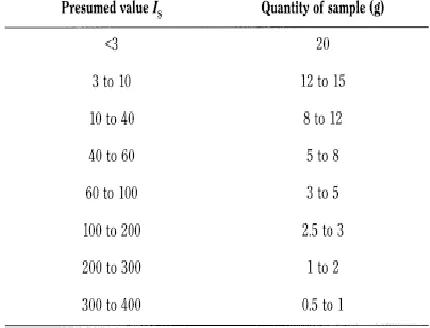
Unless otherwise prescribed, use the following quantities (Table 2.5.4.-1) for the determination.
Introduce the prescribed quantity of the substance to be examined (m g) into a 250 mL flask fitted with a ground-glass stopper and previously dried or rinsed with glacial acetic acid R, and dissolve it in 15 mL of chloroform R unless otherwise prescribed. Add very slowly 25.0 mL of iodine bromide solution R. Close the flask and keep it in the dark for 30 min unless otherwise prescribed, shaking frequently. Add 10 mL of a 100 g/L solution of potassium iodide R and 100 mL of water R. Titrate with 0.1 M sodium thiosulfate, shaking vigorously until the yellow colour is almost discharged. Add 5 mL of starch solution R and continue the titration adding the 0.1 M sodium thiosulfate dropwise until the colour is discharged (n1 mL of 0.1 M sodium thiosulfate). Carry out a blank test under the same conditions (n2 mL of 0.1 M sodium thiosulfate).
METHOD B
Unless otherwise prescribed, use the following quantities (Table 2.5.4.-2) for the determination.
The mass of the sample is such that there will be an excess of iodine chloride solution R of 50 per cent to 60 per cent of the amount added, i.e. 100 per cent to 150 per cent of the amount absorbed.
IODINE MONOCHLORIDE METHOD:
When the use of iodine flasks is prescribed, use flasks with a nominal capacity of 250 mL and complying with British Standard 2735:1956 (Specification for iodine flasks), unless otherwise specified.
Dissolve the specified quantity of the substance being examined in 10 mL of dichloromethane in a dry iodine flask. Add 20 mL of iodine monochloridesolution, insert the stopper, previously moistened with dilute potassium iodide solution, and allowstanding in the dark at 15° to 25° for 30 minutes. Place 15 mL of dilute potassium iodide solution in the top cup, carefully remove the stopper, rinse the stopper and the sides of the flask with 100 mL of water, shake and titrate with 0.1M sodium thiosulfate VS using starch mucilage, added towards the end of the titration, as indicator. At the same time carry out the operation in exactly the same manner, but without the substance being examined.
Calculate the iodine value from the expression 1.269 v/w where v is the difference, in mL, between the titrations and w is the weight, in g, of the substance taken. The approximate weight, in g, of the substance to be taken may be calculated by dividing 20 by the highest expected iodine value. If more than half of the available halogen is absorbed, the test must be repeated, using a smaller quantity of the substance.
PEROXIDE VALUE [14]
The hydroxyl value IOH is the number that expresses in milligrams the quantity of potassium hydroxide required to neutralize the acid combined by acylation in 1 g of the substance.
METHOD A:
Place 5.00 g of the substance to be examined (m g) in a 250 ml conical flask fitted with a ground-glass stopper. Add 30 ml of a mixture of 2 volumes of chloroform R and 3 volumes of glacial acetic acid R. Shake to dissolve the substance and add 0.5 ml of saturated potassium iodide solution R. Shake for exactly 1 min then add 30 ml of water R. Titrate with 0.01 M sodium thiosulphate, adding the titrant slowly with continuous vigorous shaking, until the yellow colour is almost discharged. Add 5 ml of starch solution R and continue the titration, shaking vigorously, until
the colour is discharged (n1 ml of 0.01 M sodium thiosulphate). Carry out a blank test under the same conditions (n2 ml of 0.01 M sodium thiosulphate). The volume of 0.01 M sodium thiosulphate used in the blank titration must not exceed 0.1 ml.
Method B
Carry out the operations avoiding exposure to actinic light. Place 50 ml of a mixture of 2 volumes of trimethylpentane R and 3 volumes of glacial acetic acid R in a conical flask and replace the stopper. Swirl the flask until the substance to be examined (m g; see Table 2.5.5.-1) has dissolved. Using a suitable volumetric pipette, add 0.5 ml of saturated potassium iodide solution R and replace the stopper. Allow the solution to stand for 60 ± 1 s, thoroughly shaking the solution continuously, then add 30 ml of water R.
Titrate the solution with 0.01 M sodium thiosulphate (V1 ml), adding it gradually and with constant, vigorous shaking, until the yellow iodine colour has almost disappeared. Add about 0.5 ml of starch solution R1 and continue the titration, with constant shaking especially near the end-point, to liberate all of the iodine from the solvent layer. Add the sodium thiosulphate solution drop wise until the blue colour just disappears.
Depending on the volume of 0.01 M sodium thiosulphate used, it may be necessary to titrate with 0.1 M sodium thiosulphate.
amount (0.5 per cent to 1.0 per cent (m/m)) of high HLB emulsifier (for example polysorbate 60) may be added to the mixture to retard the phase separation and decrease the time lag in the liberation of iodine.
Carry out a blank determination (V0 ml). If the result of the blank determination exceeds 0.1 ml of titration reagent, replace the impure reagents and repeat the determination.
c = concentration of the sodium thiosulphate solution in moles, per litre.
SAPONIFICATION VALUE [15]
The saponification value is the number of mg of potassium hydroxide required to neutralize the free acids and to saponify the esters in 1 g of the substance.
Use Method I unless otherwise specified in the monograph. Method I
Dissolve 35 to 40 g of potassium hydroxide in 20 mL of water and add sufficient ethanol (96%) to produce 1000 mL. Allow to stand overnight and pour off the clear liquid.
Weigh 2 g of the substance into a 200-mL flask, add 25.0 mL of the ethanolic solution of potassium hydroxide and boil under a reflux condenser for 1 hour, rotating the contents frequently. While the solution is still hot, titrate the excess of alkali with 0.5M hydrochloric acid VS using 1 mL of phenolphthalein solution R1 as indicator. Repeat the operation without the substance being examined.
Calculate the saponification value from the expression 28.05 v/w where v is the difference, in mL, between the titrations and w is the weight, in g, of substance taken.
Method II
The Saponification value is the number that expresses in milligrams the quantity of potassium hydroxide required to neutralize the free acids and to saponify the esters present in 1 g of the substance.
Unless otherwise prescribed, use the quantities indicated in Table 2.5.6.-1 for the determination.
Introduce the prescribed quantity of the substance to be examined (m g) into a 250 mL borosilicate glass flask fitted with a reflux condenser. Add 25.0 mL of 0.5 M alcoholic potassium hydroxide and a few glass beads. Attach the condenser and heat under reflux for 30 min, unless otherwise prescribed. Add 1 mL of phenolphthalein solution R1 and titrate immediately (while still hot) with 0.5 M hydrochloric acid (n1 mL of 0.5 M hydrochloric acid). Carry out a blank test under the same conditions (n2 mL of 0.5 M hydrochloric acid).
UNSAPONIFIABLE MATTER
The Unsaponifiable matter is the percentage content, w/w, of material not volatile at 100° to 105° that is obtained by extraction with an organic solvent from the saponified substance being examined.
Use Method I unless otherwise specified in the monograph. Use ungreased ground- glass glassware for each method.
PROCEDURE :
Method I:
solutions in a separating funnel containing 20 mL of water. (If the ether solutions contain solid suspended matter, filter them into the separating funnel through a fat-free filter paper and wash the filter paper with peroxide-free ether .) Gently rotate the separating funnel for a few minutes without violent shaking, allow the liquids to separate and discard the aqueous layer. Wash the ether solution by shaking vigorously with two 20-mL quantities of water and then treat with three 20-mL quantities of 0.5M potassium hydroxide, shaking vigorously on each occasion, each treatment being followed by washing with 20 mL of water. Finally wash with successive 20-mL quantities of water until the aqueous layer is no longer alkaline to phenolphthalein solution R1. Transfer the ether extract to a weighed flask, rinsing the separating funnel with peroxide-free ether, distil the ether and add 3 mL of acetone to the flask. With the aid of a gentle current of air, remove the solvent completely from the flask, which is almost entirely immersed in boiling water and preferably held obliquely and rotated. Dry to constant weight at a temperature not exceeding 80° and dissolve the contents of the flask in 10 mL of freshly boiled ethanol (96%), previously neutralised to phenolphthalein solution R1. Titrate with 0.1M ethanolic sodium hydroxide VS using phenolphthalein solution R1 as indicator.
If the volume of 0.1M ethanolic sodium hydroxide VS required does not exceed 0.1 mL, the amount of residue weighed is to be taken as the unsaponifiable matter. Calculate the unsaponifiable matter as a percentage of the substance being examined.
If the volume of 0.1M ethanolic sodium hydroxide VS required exceeds 0.1 mL, the amount of residue weighed cannot be taken as the unsaponifiable matter and the test must be repeated.
Method II: [16]
The term "unsaponifiable matter" is applied to the substances non-volatile at 100-105 °C obtained by extraction with an organic solvent from the substance to be examined after it has been saponified. The result is calculated as per cent m/m. Use ungreased ground-glass glassware.
Introduce the prescribed quantity of the substance to be examined (m g) into a 250 mL flask fitted with a reflux condenser. Add 50 mL of 2 M alcoholic potassium hydroxide R and heat on a water-bath for 1 h, swirling frequently. Cool
to a temperature below 25 °C and transfer the contents of the flask to a separating funnel with the aid of 100 mL of water R. Shake the liquid carefully with 3 quantities, each of 100 mL, of peroxide-free ether R. Combine the ether layers in another separating funnel containing 40 mL of water R, shake gently for a few minutes, allow to separate and reject the aqueous phase. Wash the ether phase with 2 quantities, each of 40 mL, of water R then wash successively with 40 mL of a 30 g/L solution of potassium hydroxide R and 40 mL of water R; repeat this procedure 3 times. Wash the ether phase several times, each with 40 mL of water R, until the aqueous phase is no longer alkaline to phenolphthalein. Transfer the ether phase to a tared flask, washing the separating funnel with peroxide-free ether R.
Distil off the ether with suitable precautions and add 6 mL of acetone R to the residue. Carefully remove the solvent in a current of air. Dry to constant mass at 100- 105 °C. Allow to cool in a desiccator and weigh (a g).
Dissolve the residue in 20 mL of alcohol R, previously neutralised to phenolphthalein solution R and titrate with 0.1 M ethanolic sodium hydroxide. If the volume of 0.1 M ethanolic sodium hydroxide used is greater than 0.2 mL, the separation of the layers has been incomplete; the residue weighed cannot be considered as "Unsaponifiable matter". In case of doubt, the test must be repeated.
OXIDISING SUBTANCES [17]
1 mL of 0.002 M sodium thiosulfate is equivalent to 34 µg of oxidizing substances, calculated as hydrogen peroxide.
PERCENTAGE OF ASH
Method I For herbal drugs:
Incinerate 2 to 3 g of the ground drug in a tarred platinum or silica dish at a temperature not exceeding 450° until free from carbon, cool and weigh. If a carbon- free ash cannot be obtained in this way, exhaust the charred mass with hot water, collect the residue on an ashless filter paper, incinerate the residue and filter paper, add the filtrate, evaporate to dryness and ignite at a temperature not exceeding 450°. Calculate the percentage of ash with reference to the air-dried drug. For other substances:
Carry out the above method using 1 g, unless otherwise stated. Calculate the percentage of ash.
Method II: PROCEDURE:
Heat a silica or platinum crucible to redness for 30 min, allow to cool in a desiccators and weigh. Unless otherwise prescribed, evenly distribute 1.00 g of the substance or the powdered herbal drug to be examined in the crucible. Dry at 100 °C to 105 °C for 1 h and ignite to constant mass in a muffle furnace at 600 °C ± 25 °C, allowing the crucible to cool in desiccators after each ignition. Flames should not be produced at any time during the procedure. If after prolonged ignition the ash still contains black particles, take up with hot water, filter through an ash less filter paper and ignite the residue and the filter paper. Combine the filtrate with the ash, carefully evaporate to dryness and ignite to constant mass.
ACID INSOLUBLE ASH [18]
Method I:
Boil the ash for 5 minutes with 25 ml of 2M hydrochloric acid, collect the insoluble matter in a sintered-glass crucible or on an ash less filter paper, wash with hot water and ignite. Calculate the percentage of acid-insoluble ash with reference to the air- dried drug.
Method II:
Ash insoluble in hydrochloric acid is the residue obtained after extracting the sulfated or total ash with hydrochloric acid, calculated with reference to 100 g of drug.
To the crucible containing the residue from the determination of sulfated or total ash, add 15 mL of water R and 10 mL of hydrochloric acid R cover with a watch-glass boil the mixture gently for 10 min and allow to cool. Filter through an ash less filter, wash the residue with hot water R until the filtrate is neutral, dry, ignite to dull redness, allow to cool in desiccators and weigh. Repeat until the difference between 2 consecutive weightings is not more than 1 mg.
MAGNESIUM AND ALKALINE-EARTH METALS [19]
To 200 mL of water R add 0.1 g of hydroxylamine hydrochloride R, 10 mL of ammonium chloride buffer solution pH 10.0 R, 1 mL of 0.1 M zinc sulfate and about 15 mg of mordant black 11 triturate R. Heat to about 40 °C. Titrate with 0.01 M sodium edetate until the violet colour changes to full blue. To the solution add the prescribed quantity of the substance to be examined dissolved in 100 mL of water R or use the prescribed solution. If the colour of the solution changes to violet, titrate with 0.01 M sodium edetate until the full blue colour is again obtained.
The volume of 0.01 M sodium edetate used in the second titration does not exceed the prescribed quantity.
WATER:
Water is determined using the Karl Fischer titrator. Quantity as prescribed in the monograph or if not given then 0.1 g is used to determine in the prescribed solvent or otherwise in dried methanol.
RELATIVE DENSITY [20]:
Density of any sample is determined relative to the density of water.
Procedure to determine is as follow:
Take a pycnometer with 25 ml mark or as required. Weigh the empty weight of pycnometer. Fill the water upto the mark and record the weight. Find the weight of water used and calculate the density of water by the formula
Similarly, Calculate the Density of the Sample.
Further, Relative density of the sample is calculated by dividing density of sample observed to the density of water observed.
WT/ML:
Take a measuring cylinderof10 ml or as required. Weigh the empty weight of measuring cylinder. Fill the sampler upto themark and record the weight. Find the weight of sample used and calculate the wt/ml o sample by the formula
Wt/ml = Weight of sample / volume used.
References:
1. “Pharmacopeia of the United States of America. 2. “Indian Pharmacopeia”
3. “British Pharmacopeia” 4. “European Pharmacopeia”
5. Clugston, M.; Fleming, R. (2000). Advanced Chemistry (1st ed.). Oxford: Oxford Publishing. p. 108.
6. “European Pharmacopeia, chapter 2.2.32. Loss on Drying”
7. “European Pharmacopeia, chapter 2.4.14. Sulphated Ash”
8. “Pharmacopeia of the United States of America , Residue on Ignition”
9. “European Pharmacopeia, chapter 2.5.1. Acid Value” 10. Indian Pharmacopeia, chapter 2.3.26. Ester Value 11. “European Pharmacopeia, chapter 2.5.2. Ester Value” 12. “European Pharmacopeia, chapter 2.5.3. hydroxyl
Value”
13. “European Pharmacopeia, chapter 2.5.4. Iodine Value”
14. “European Pharmacopeia, chapter 2.5.5. Peroxide value”
15. “European Pharmacopeia, chapter 2.5.6. Saponification value”
16. “European Pharmacopeia, chapter 2.5.7. Unsaponifiable matter”
17. “European Pharmacopeia, chapter 2.5.30. Oxidising substances”
18. “European Pharmacopeia, chapter 2.8.1. Acid Insoluble Ash”
19. “European Pharmacopeia, chapter 2.4.7. Magnesium and Alkaline Earth materials”