Research Article
ISSN:2230-7346
Journal of Global Trends in Pharmaceutical Sciences
Vol.3, Issue 2, pp 584-596-, April–June 2012
DEVELOPMENT AND VALIDATION OF STABILITY INDICATING
ASSAY METHOD FOR PIOGLITAZONE DRUG SUBSTANCE BY
REVERSE PHASE HPLC
G. Radha Krishna Reddy *, Prof. V. Surya Narayana Rao
Department of Chemistry, Sri Krishna Devaraya University, Anantapur, India.
*Corresponding Author E-mail: [email protected]
ABSTRACT
Pioglitazone is used for the treatment of diabetes mellitus type 2. A simple, precise cost effective and stability indicating Reverse Phase-HPLC method has been developed and validated for the determination of Assay of Pioglitazone Drug Substance. Separation of all known impurities from Pioglitazone was achieved with in shorter run time with required, accuracy and precision thus enabling the utility of the method for routine analysis. Chromatographic separation was achieved on a Prontosil C8 SH (250*4.6mm), 5µ using a mobile phase consisting of 550ml of pH 4.0 Phosphate buffer, 300ml Acetonitrile and 150ml of Methanol at a flow rate of 1.5 ml per minute. The detection was made at 254nm. The retention time of Pioglitazone peak is 5.9 minutes. The method was found linear over the range of 50 to 150%. The proposed method was validated as per the ICH and USP guidelines.
Key words:Pioglitazone, HPLC Method development and validation
INTRODUCTION:
Pioglitazone is a prescription drug of the class thiazolidinedione (TZD) with hypoglycemic (antihyperglycemic, antidiabetic) action. [1]. It is used for the treatment of diabetes mellitus type 2. Pioglitazone acts as an agonist at
utilization. In this way, pioglitazone both enhances tissue sensitivity to insulin and reduces hepatic gluconeogenesis. Thus, insulin resistance associated with type 2 diabetes mellitus is improved without an increase in insulin secretion by pancreatic β cells.
Name : Pioglitazone
hydro0.chloride
Synonyms : [5-[[4-[2-(5-Ethyl-2-pyridinyl)ethoxy]phenyl]methyl]-2,4-] thiazolidinedione hydrochloride
Molecular Formula : C19H20N2O3S.HCl
Molecular Weight : 392.90
Pioglitazone selectively stimulates
the nuclear receptor peroxisome
proliferator-activated receptor gamma (γ) and to a lesser extent PPAR-α.[2][3] It modulates the transcription of the insulin-sensitive genes involved in the control of glucose and lipid metabolism in the muscle, adipose tissue, and the liver. As a result, pioglitazone reduces insulin resistance in the liver and peripheral tissues; increases the expense of insulin-dependent glucose; decreases withdrawal of glucose
from the liver; reduces quantity of glucose, insulin and glycated hemoglobin in the bloodstream. Although not clinically significant, pioglitazone decreases the level of triglycerides and increases that of high-density lipoproteins (HDL) without changing low-density lipoproteins (LDL) and total cholesterol in patients with disorders of lipid metabolism, although statins are the drug of choice for this. [4][5] Pioglitazone is used for the treatment of diabetes mellitus type 2 (previously known as non-insulin-dependent diabetes mellitus,
NIDDM) in monotherapy and in
combination with a sulfonylurea, metformin, or insulin. Pioglitazone has also been used to treat non-alcoholic steatohepatitis (fatty liver), but this use is presently considered experimental.[6] Pioglitazone has also been found to reduce the risk of conversion from prediabetes to diabetes mellitus type 2 by 72%. [7] Pioglitazone is currently being reviewed. A meta-analysis released subsequently showed that pioglitazone reduced the number of ischemic cardiac events rather than increase the risk, but increases CHF.[8] Chronic administration of the drug has led to occasional instances of cholestatic
hepatitis, reversible upon drug
French Agency for the Safety of Health Products decided to withdraw pioglitazone in regards to high risk of bladder cancer [10] On June 10, 2011 Germany's Federal Institute for Drugs and Medical Devices also advised doctors not to prescribe the medication until further investigation of the cancer risk had been conducted.[11] On June 15, 2011 the U.S. FDA announced that pioglitazone use for more than one year may be associated with an increased risk of bladder cancer, and that the information about this risk will be added to the Warnings and Precautions section of the label for pioglitazone-containing medicines. The patient Medication Guide for these medicines will also be revised to include information on the risk of bladder cancer.[12]
MATERIALS AND METHODS I. Chemicals and Reagents:
Pioglitazone working standard, Water (Milli Q), Acetonitrile (HPLC Grade),
Methanol (HPLC Grade), Potassium
dihydrogen orthophosphate (AR Grade), Triethylamine (AR Grade) AND Ortho Phosphoric Acid (88%, AR Grade).
II. Apparatus and Chromatographic Conditions:
HPLC analysis was performed on Waters HPLC system with diode array
detector. Separations were carried on a Prontosil C8 SH (250*4.6mm), 5µ) using isocratic elution. The flow rate was 1.5 mL min-1. UV detection was performed at 254 nm. HPLC Column temperature was 40°C. Peak identity was confirmed by retention time comparison and the HPLC was operated at room temperature.
III. Preparation of Mobile Phase and Diluent:
Mobile Phase: Mix thoroughly 550 mL of 4.0 pH Phosphate buffer with 300 mL of filtered Acetonitrile and 150 mL of filtered Methanol.
Diluent: Mix Water and Methanol in the ratio of 1:1
IV. Preparation of Standard Solution:
Accurately weigh and transfer about 50 mg of Pioglitazone working standard into a 50 mL volumetric flask, dissolve in and dilute to volume with Methanol. Dilute 5 mL of this solution to 50 mL with diluent.
V. Preparation of Sample Solution:
RESULTS AND DISCUSSION Method Development
Chromatographic parameters were preliminary optimized to develop a stability indicating Assay method for Pioglitazone with short analyses time (<10 min). Since Pioglitazone is having three impurities. So these impurities need to separate from main analyte to show the stability indicating Assay method. I have tried solubility of the drug with different buffers and found that Potassium dihydrogen orthophosphate was suitable. The development trials were initiated with the selection of mobile phase. Since the opted development method is Reverse phase, various polar solvents and buffers (Solvents such as Acetonitrile, Methanol andEthanol etc.) were used in the initial developmental trials and concluded with the efficient mobile phase i.e. mixture of Phosphate buffer, Acetonitrile and Methanol. Various compositions of the selected solvents were tried on different columns available such as Symmetry, ACE, Phenomenex and Hypersil BDS etc.
With the better resolution and peak shape the method was optimized by the mobile phase composition of Phosphate buffer (pH 4.0), Acetonitrile and Methanol in the ratio of 550:300:150 on Prontosil C8 SH (250*4.6mm), 5µ. System Suitability
parameters were evaluated and limits fixed. USP Tailing factor and %RSD of five injections for Pioglitazone standard performed and found that within the limits
Method Validation
The above method was validated according to ICH and USP guidelines to establish the performance characteristics of a method (expressed in terms of analytical parameters) to meet the requirements for the intended application of the method [13].
System Suitability
In order to determine the reproducibility of the proposed methodology, suitability parameters including Retention Time, USP Tailing factor, and %RSD of Pioglitazone peak areas were investigated. The results are summarized in Table 1.
Specificity
Interference from Blank:
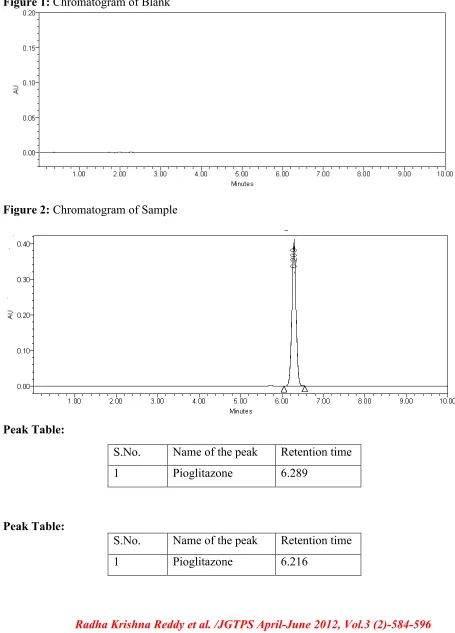
chromatograms were shown in figure-1-2.
Interference from Impurities:
All known impurities were injected individually and spiked into test at specification level and injected in to the system. All the impurities were well separated from main analyte. The Spiked chromatogram was shown in Figure- 3.
Forced degradation Studies:
Drug Substance subjected to forced degradation at various stressed conditions like acid, base, hydrolysis, peroxide, heat, photo light, U.V light and Humidity. All the samples were analyzed for peak purity of
Pioglitazone peaks using Empower
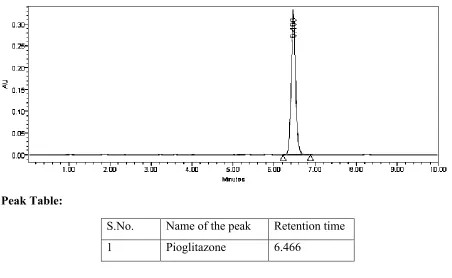
software. For all stressed samples the peak purity of Pioglitazone was found within the limits. The results are summarized in Table 2 and degradation chromatograms are shown in figure-4-6.
Precision:
The precision of an analytical procedure expresses the closeness of agreement (degree of scatter) between a series of measurements obtained from multiple sampling of the same homogeneous sample under the prescribed conditions. Precision may be considered at three levels: repeatability, intermediate precision and reproducibility.
Six replicate samples were prepared and analyzed as per the test procedure. The % Relative standard deviations for Assay of Pioglitazone calculated and the results are found to be within the acceptance criterion. The results are summarized in Table 3
Accuracy:
The accuracy of an analytical procedure expresses the closeness of agreement between the value which is accepted either as a conventional true value or an accepted reference value and the value found. Accuracy may be inferred once precision, linearity and specificity have been established.
Linearity of Detector Response:
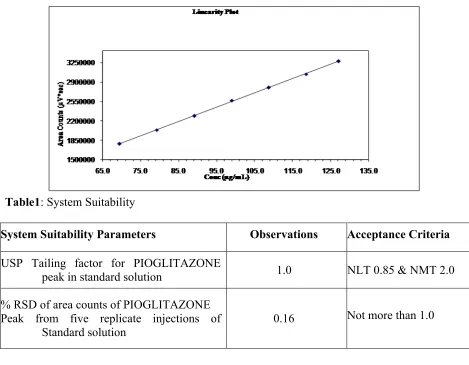
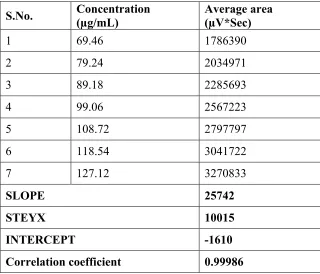
The linearity of an analytical procedure is its ability (within a given range) to obtain test results which are directly proportional to the concentration (amount) of analyte in the sample. Linearity of detector response for
Pioglitazone was established by
response. Slope, correlation coefficient (R) and intercept were found to be within the limit. The results are shown in Table 4.
Robustness:
Robustness of the method was verified by deliberately varying the following conditions. by changing the flow rate by 10%. By changing the column
oven temperature by 5°C. By changing
the organic content in mobile phase by 2% absolute.
Standard Solution and test solutions were prepared as per the test procedure and analysed in each varied condition. System suitability parameters and RRT of all known impurities were evaluated with each varied condition and compared with test method conditions was found to be within the limit.
Ruggedness:
Bench Top Stability of Test Solution:
Bench top stability of test solution of Pioglitazone drug substance was conducted over a period of 2 days and found that test solution is stable on Bench top for 2 days.
Refrigerator Stability of test solution:
Refrigerator stability of test solution of Pioglitazone drug substance was conducted over a period of 2 days and found that test solution is stable in refrigerator for 2 days.
Bench Top Stability of Mobile Phase:
Bench top stability of mobile phase was conducted over a period of 2 days and found that mobile phase is stable on Bench top for 2 days.
CONCLUSIONS:
A simple, rapid, cost effective and accurate Reverse Phase-HPLC method was developed for the Stability indicating Assay method for Pioglitazone drug substanc. The
HPLC method was validated and
demonstrated that good linearity, precision, accuracy, specificity and stability indicating capacity thus, the developed HPLC method can be utilized for routine analysis and stability studies for Pioglitazone Drug Substance.
Figure 1: Chromatogram of Blank
Figure 2:Chromatogram of Sample
Peak Table:
Peak Table:
Radha Krishna Reddy et al. /JGTPS April-June 2012, Vol.3 (2)-584-596
S.No. Name of the peak Retention time
1 Pioglitazone 6.289
S.No. Name of the peak Retention time
Figure 3:Chromatogram and Purity Plot of Pioglitazone Drug Substance spiked with related impurities.
Figure 4: Chromatogram and Purity Plot of Heat Stressed Pioglitazone Drug Substance
Peak Table:
Radha Krishna Reddy et al. /JGTPS April-June 2012, Vol.3 (2)-584-596
S.No. Name of the peak Retention time
Figure 5:Chromatogram and Purity Plot of Humidity Stressed Pioglitazone Drug substance
Peak Table:
Figure 6:Chromatogram and Purity Plot of Photolytically Stressed (UV Light) Pioglitazone Drug Substance
Peak Table:
Radha Krishna Reddy et al. /JGTPS April-June 2012, Vol.3 (2)-584-596
S.No. Name of the peak Retention time
1 Pioglitazone 6.472
S.No. Name of the peak Retention time
Figure 7:Linearity plot of Pioglitazone
Table1: System Suitability
System Suitability Parameters Observations Acceptance Criteria
USP Tailing factor for PIOGLITAZONE
peak in standard solution 1.0 NLT 0.85 & NMT 2.0
% RSD of area counts of PIOGLITAZONE Peak from five replicate injections of
Standard solution
0.16 Not more than 1.0
Table: 2Forced Degradation Data
Pioglitazone Assay - Forced Degradation
Condition %Degradation Purity
Angle
Purity Threshold
Purity Flag Exposed to heat at 105°C for
358 hours 0 0.120 1.089 No
Stressed with Humidity
25°C/97% RH for 358 hours 0 0.113 1.077 No Exposed to UV light for 358
hours (432.0 watts hours/m2). 0 0.112 1.102 No
Table 3: Precision
S. No. Assay
(%w/w, on Anhydrous and Solvent free basis)
1 99.43
2 99.63
3 99.46
4 98.75
5 98.66
6 98.89
Average 99.14
%RSD 0.42
Table: 4Linearity Data
S.No. Concentration (µg/mL) Average area(µV*Sec)
1 69.46 1786390
2 79.24 2034971
3 89.18 2285693
4 99.06 2567223
5 108.72 2797797
6 118.54 3041722
7 127.12 3270833
SLOPE 25742
STEYX 10015
INTERCEPT -1610
Correlation coefficient 0.99986
Acknowledgments:
The author thankful to Sri scientific Company, pondicherry for providing the working standards of Pioglitazone.
References:
1. Gillies, PS; Dunn, CJ (August 2000). "Pioglitazone". Drugs 60 (2): 333–43; discussion 344–5. doi:10.2165/00003495-200060020-00009. PMID 10983737.
2. Smith U (September 2001). "Pioglitazone: mechanism of action". Int J Clin Pract Suppl (121): 13–8. PMID 11594239.
3. Colca, JR; McDonald, WG; Waldon, DJ; Leone, JW; Lull, JM; Bannow, CA; Lund, ET; Mathews, WR (February 2004). "Identification of a novel mitochondrial protein ("mitoNEET") cross-linked specifically by a thiazolidinedione photoprobe". Am. J. Physiol. Endocrinol. Metab. 286 (2): E252–60. doi:10.1152/ajpendo.00424.2003. PMID 14570702.
4. Paddock, ML; Wiley, SE; Axelrod, HL; Cohen, AE; Roy, M; Abresch, EC; Capraro, D; Murphy, AN et al (September 2007). "MitoNEET is a uniquely folded 2Fe 2S outer mitochondrial membrane protein stabilized by pioglitazone". Proc. Natl. Acad. Sci. U.S.A. 104 (36): 14342–7. doi:10.1073/pnas.0707189104. PMC 1963346. PMID 17766440.
5. Belfort, R; Harrison, SA; Brown, K; Darland, C; Finch, J; Hardies, J; Balas, B; Gastaldelli, A et al (November 2006). "A placebo-controlled trial of pioglitazone in subjects with nonalcoholic steatohepatitis". N. Engl. J. Med. 355 (22): 2297–307. doi:10.1056/NEJMoa060326. PMID 17135584.
6. DeFronzo, Ralph A.. "Pioglitazone for Diabetes Prevention in Impaired Glucose Tolerance". N Eng J Med 2011; 364: 1104-1115. Retrieved March 29, 2011.
7. Lincoff AM, Wolski K, Nicholls SJ, Nissen SE (2007). "Pioglitazone and risk of cardiovascular events in patients with type 2 diabetes mellitus: a meta-analysis of randomized trials". JAMA 298 (10): 1180–8. doi:10.1001/jama.298.10.1180. PMID 17848652.
8. R. Baselt, Disposition of Toxic Drugs and Chemicals in Man, 8th edition, Biomedical Publications, Foster City, CA, 2008, pp. 1271-1272.
9. http://www.lefigaro.fr/flash-actu/2011/06/09/97001-20110609FILWWW00505-info-le-figaro-lantidiabetique-actos-retire-du-marche.php.
10. Topham, James (June 10, 2011). "UPDATE 2-Germany joins France in suspending top Takeda drug". Reuters.
11.http://www.fda.gov/Drugs/DrugSafety/ucm, FDA Drug Safety Communication: Update to ongoing safety review of Actos (pioglitazone) and increased risk of bladder cancer. 12. ICH, Validation of Analytical Proceedures: Text and Methodology [Q2 (R1)]:
International conference on hormonization, IFPMA, Geneva, 2005.