International Journal of Science Technology
Management and Research
Available online at: www.ijstmr.com
IJSTMR © 2016 |
All Rights Reserved
16
Integrated stack testing: securing enterprise web
applications
Aishwarya A. Kadam1 Harshada R. Chaudhari2 .Department of Computer Department of Computer Gangamai College of Engineering, Nagaon, Gangamai College of Engineering, Nagaon, Maharashtra, India Maharashtra, India
Chandani M. Patil3 Prof.S P Chavhan4
Department of Computer Asst. Prof., Department of Computer Gangamai College of Engineering, Nagaon, Gangamai College of Engineering, Nagaon, Maharashtra, India Maharashtra, India
_________________________________________________________________________________________________________________________
Abstract-: Recently, many Infrastructure and communication Service platforms avilable. stack Consumer, Developer and stack Providers needs to make decision about which platform is well suited for them. Since, last decades open-source technology help people who do not wish to use commercial infrastructure for stack. Among them different open-source platform OpenNebula, Eucalyptus, OpenStack and CloudStack are the platform which have been majorly used stack management platform and also alternatives of commercially provided stack. Here, we compare and analyzing OpenNebula, Eucalyptus, OpenStack and Cloud` stack platform. These all are providing infrastructure as a Service. In this paper we start with short summary of feature set of these projects. And after that we do detailed analysis of different software packages and describe how these stack management platforms relate to other . Here, we also analyze overall architecture of component stack management platforms and refer differing features.
Keywords: - OpenNebula, Eucalyptus, OpenStack, Cloud Stack, stack Management Platforms.
_________________________________________________________________________________
I. INTRODUCTION
The cloud computing is a very broad area and it covers about each and every online service. "cloud computing is a model
for enabling ubiquitous, convenient, on-demand network access to a shared pool of configurable computing resources
(e.g., networks, servers, storage, applications and services) that can be rapidly provisioned and released with minimal
management effort or service provider interaction."[1]. There are usually three models of cloud service under
consideration, Software as a Service (SaaS), Platform as a Service (PaaS), and Infrastructure as a Service (IaaS).
1. Software as a Service (SaaS): Is the model in which an application is hosted as a service to customers who access it via
the Internet. When the software is hosted off-site, the customer doesn’t have to maintain it or support it. Applications of
SaaS include
2. Platform as a Service (PaaS): Is another application delivery model. PaaS supplies all the resources required to build
IJSTMR © 2016 |
All Rights Reserved
17
3. Infrastructure as a Service (IaaS): It is comprised of highly automated and scalable compute resources, complemented
by cloud storage and network capability which can be self-provisioned, metered, and available on-demand [2]. Main
difference between SaaS, PaaS and IaaS is shown by figure 1.
Fig.1-: Difference between cloud services
Here, in this paper we only concentrate on IaaS Platform. Single processor can’t perform heavy computation efficiently.
For heavy computational jobs we require hundred or even thousands of cores, different paradigms have been developed
for harnessing the computation power of large group of processors. The two biggest project LHC (Large Hydrogen
Collider) and SGE(Sun Grid Engine)[3] have their own infrastructure for IaaS platform and require very high
computation of data.
II. STANDARDS OF CLOUD COMPUTING
Large companies require that cloud-computing platforms meet the highest standards of services. To meet these
requirements seven standards have been developed for clouding computing these are [4, 5].
1. Security – Providing world class security using different algorithms and techniques to each and every level of cloud
environment.
2. Belief and transparency – Providing transparent environment and availability information. Services are delivered on
real-time basis with high performance
3. Accurate multitenancy – Providing maximum scalability and performance to satisfy the requirement of the customers
with a true multitenant architecture.
4. Confirmed scale –Providing Support for the millions of users with confirmed scalability.
5. Great performance –Providing reliable and high-speed performance globally.
6. Disaster recovery – Providing several techniques for protecting data of customer by several data centers. Providing
backup, data archive recovery form failover.
IJSTMR © 2016 |
All Rights Reserved
18
III. GENERIC ARCHITECTURE OF CLOUD COMPUTING PLATFORM
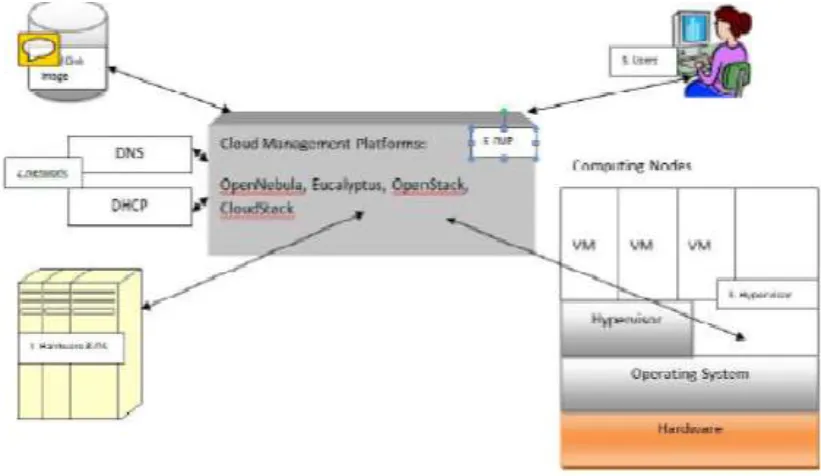
In generic architecture of cloud computing system we have six basics components
1. Hardware & Operating System
2. Network includes DNS, DHCP & Subnet organization of the physical machines and it depends based on different
cloud management platforms.
3. Hypervisors Sits between operating system & virtual machines. Different types of hypervisors are Xen, KVM &
VMWare etc.
4. VM Disk Images
I. Template Disk Images: Used for creating multiple VMs on the cloud platform.
II. Run-time Images : Actually used by Virtual Machines at run-time.
5. Front-end user interface. There are basically two types of interfaces Cloud provider/administrator and cloud consumer
are those who request for virtual machines.
6. Cloud Management Platforms (CMPs) like OpenNebula, Eucalyptus, OpenStack, CloudStack. The CMP provides the
interface at the front-end, uses the disk images from the repository signals VMM(Virtual Machines Manager) to set up
VM & then signals DHCP & IP Bridging program to setup MAC & IP address for the VM
Figure 2-: Generic Architecture of Cloud Management Platforms
IV. OVERVIEW OF OPENNEBULA, EUCALYPTUS, OPENSTACK AND CLOUDSTACK
A. OpenNebula is an open source manager of virtual infrastructure [6], able to build private, public and hybrid clouds.
OpenNebula offers flexible architecture, interfaces and components that could be integrated into any data center. This
tool supports Xen, KVM and VMware and access to Amazon EC2s.OpenNebula was designed to be integrated into any
IJSTMR © 2016 |
All Rights Reserved
19
establishment of dynamic multi-level services (groups of interconnected virtual machines) on the distributed
infrastructure, combining the resources of physical machines and cloud distance, based allocation policies OpenNebula
consists of three components [7]
B. Eucalyptus Eucalyptus commands can manage either Amazon or Eucalyptus instances. Users can also move instances
between a Eucalyptus private cloud and the Amazon Elastic Compute Cloud[8] to create a hybrid cloud. Hardware
virtualization isolates applications from computer hardware details. [9]
C. OpenStack OpenStack is a global collaboration of developers and cloud computing technologists producing the open
standard cloud operating system for both public and private clouds. Cloud service providers, enterprises and government
organizations can take advantage of the the freely available, Apache-licensed software to build massively scalable cloud
environments. OpenStack currently consists of three core software projects: OpenStack Compute (code-name Nova),
OpenStack Object Storage (code-name Swift), and OpenStack Image Service (code-name Glance). These projects, along
with a vibrant ecosystem of technology providers and future OpenStack projects underway, deliver a pluggable
framework and operating system for public and private clouds [10].
D. CloudStack A CloudStack installation consists of two parts: the Management Server and the cloud infrastructure that
it manages [11].
V. COMPARISON OF OPENNEBULA, EUCALYPTUS, OPENSTACK, CLOUDSTACK Based on Cloud Computing Perspectives [12]
1. Developer Perspective-: i. Development Model ii. Development Engagement iii.Governance Model.
2. User Perspective: There will be two types of user perspective one is from the “Cloud Consumer” and other is “Cloud Builder” i. API Ecosystem ii. Production Readiness
OpenStack CloudStack Eucalyptus OpenNebula
Development Model Public development Public development Public development Public development
Developer Engagement
Contributor license agreement
Contributor license agreement
Contributor license agreement
Contributor license agreement
Governance Model Foundation Technical
meritocracy
Benevolent dictator Benevolent dictator
API Ecosystem OpenStack API Amazon API Amazon API Amazon API
Production Readiness No, only available through any of the
several vendor
specific “stacks”
Enterprise-ready and direct support from developers
Enterprise-ready and direct support from developers
Enterprise-ready and direct support from developers
TABLE 1 CLOUD COMPUTING USER PERSPECTIVE
CONCLUSION
When study of different open source cloud management platforms, we observe that there are different concept involve
while designing the Cloud Management Platforms. OpenNebula and CloudStack is more towards the Datacenter
Virtualization and Eucalyptus and OpenStack is more towards the infrastructure provisioning. Among all four CMP’s
OpenNebula is more flexible compare to all other platforms. Also it is possible to do so much of customization and
IJSTMR © 2016 |
All Rights Reserved
20
REFERENCES 1. NIST Cloud Definition, http://www.nist.gov/itl/csd/cloud-102511.cfm
2. Amir Mohamed Talib” Security Framework of Cloud Data Storage Based on Multi Agent System Architecture: Semantic Literature Review”
Computer and Information Science Vol. 3, No. 4; November 2010
3. W. Gentzsch. Sun Grid Engine: Towards Creating a Compute Power Grid. Proceedings of the 1st International Symposium on Cluster Computing and the Grid, 2001
4. Anthony T. Velte Toby J. Velte, Ph.D. Robert Elsenpeter Cloud Computing: A Practical Approach Copyright © 2010 by The McGraw-Hill Companies5. S. Schechter, A. J. B. Brush, and S. Egelman, “It’s no secret. Measuring the security and reliability of authentication via secret questions,” in Proceedings of the 2009 30th IEEE Symposium on Security and Privacy, ser. SP ’09, 2009, pp. 375–390.
5Matthew J. Harmon Cloud Security (ISC)2 Twin Cities Area Chapter 2013 Annual Meeting 18 June 2013 7.
6. Open Nebula Project Home Page http://opennebula.org/, January 2014
7.Capacity Leasing in Cloud Systems using the OpenNebula Engine https://phoenixforge.cs.uchicago.edu/svn
/haizea/branches/1.1/html/pubs/Haizea_CCA08.pdf
8. Amazon Elastic Cloud Computing page http://aws.amazon.com/ec2/, January, 2014.
9.The Eucalyptus Open-source Cloud-computing System by Daniel Nurmi, Rich Wolski, Chris Grzegorczyk, Graziano Obertelli, Sunil Soman, Lamia
Youseff, Dmitrii Zagorodnov http://www.cca08.org/papers/Paper32Daniel-Nurmi.pdf
10.Open stack datasheet overview and architecture http://www.openstack.org/downloads/openstack-overviewdatasheet.pdf
11.Cloudstack deployment architecture https://cloudstack.apache.org/docs/en-US/Apache_CloudStack /4.0.2/html/API_Developers_Guide/deployment-architecture-overview.html.