Available Online at www.ijpret.com 187
INTERNATIONAL JOURNAL OF PURE AND
APPLIED RESEARCH IN ENGINEERING AND
TECHNOLOGY
A PATH FOR HORIZING YOUR INNOVATIVE WORK
STUDY OF ELECTRICAL CONDUCTIVITY OF COPOLYMER RESINS BASED ON
P-NITROPHENOL
VIJAY RAMKRISHNA CHINCHAMALATPURE1, PAWAN PRAKASH KALBENDE2
1. Department of Physics, Hutatma Rashtriya Arts and Science College, Ashti-442202, Dist. Wardha, (M.S.), India. 2. Department of Chemistry, Jagdamba Mahavidyalaya, Achalpur - 444525, Dist:- Amravati (M.S.), India.
Accepted Date: 15/03/2016; Published Date: 01/05/2016
\
Abstract: Copolymer resins have been synthesized by condensation of p-nitrophenol, 4,4’-oxydianiline and formaldehyde in presence of 2 M HCl as a catalyst with different molar proportions of reacting monomers. The electrical property of p-NP-4,4’-ODA-F copolymer resins was measured over a wide range of temperature (313–423 K). From the electrical conductivity of this copolymer resin, activation energy of electrical conduction has been evaluated and was found to be in the range of 109.73 to 156.82 KJ. The electrical conductivity of the copolymers was found to be lies in the range of 6.91 × 10⁻¹¹ to 1.96 × 10 -11 ohm-1 cm-1. The plot of log σ vs 103 /T was found to be linear over a wide range of
temperature, which indicates that the Wilson’s exponential law σ = σo exp (Ea/kT) is obeyed. On the basis of above studies these copolymers can be ranked as semiconductors. When a voltage is applied to a thin film of this copolymer resins then it has emitted light. This remarkable property may be used to make a wide range of semiconducting electronic devices such as transistors, light emitting diodes, solar cells and even lasers which can be manufactured by much simpler way than conventional inorganic semiconductors.
Keywords: Copolymer, Electrical property, Activation energy, Semiconductor
Corresponding Author: MR. PATIL V R
Access Online On:
www.ijpret.com
How to Cite This Article:
Vijay Ramakrishna Chinchamalatpure., IJPRET, 2016; Volume 4 (9): 187-192
Available Online at www.ijpret.com 188
INTRODUCTION
The semiconducting properties of terpolymer resins have gained sufficient ground in recent years. Electrically conducting terpolymers are undoubtedly one of the focal points of current interest in solid-state physics and chemistry. Their discovery has led to the emergency of not only new types of materials capable of replacing metals but also new concepts to explain their high conductivity. In fact, their conductivity and other properties such as thermoconduction, photoconduction, luminescence, etc. are in close connection with their physical and chemical structure. In this connection, studies were made to establish a correlation between the chemical structure and characteristics defining semiconducting properties [1].
Work on organic conducting polymers is carried out extensively due to their wide applications[2] in areas such as chemically modified electrodes, sensors etc. Pekaln and Kolosonov[3] have studied the electrical conductivity of phenol-formaldehyde resin. Industrially useful semiconducting materials have been reported by Dewar et al[4]. The conductivity of 8-hydroxyquinoline–oxamide-formaldehyde terpolymer resins have been reported over a wide range of temperature [5]. Pal et al[6-8] have reported electrical conductivity of salicylic acid-biuret/ dithioxamide/dithibiuret-trioxane terpolymer resins. Patel and Manavalan[9] reported the electrical properties of p-hydroxybenzoic acid-thioureatrioxane terpolymers. The electrical resistivity of 2-hydrexyaceto-phenoneoxime-thioureatrioxane resin was reported and these polymers are ranked as semiconductors[10]. Since delocalized electrons and conjugation impart semiconducting properties to compounds, the present study deals with electrical properties of some copolymer resins which may serve as potential semiconductors.
Materials
p-Nitrophenol, 4,4’-oxydianiline and formaldehyde were purchased from S. D. Fine Chemicals, India. All the chemicals used were of analytical grade purity.
Synthesis
Available Online at www.ijpret.com 189
by dissolving in 1:1 (v/v) concentrated HCl/water with constant stirring and filtered. The resulting polymer sample was washed several times with boiling water to remove unreacted monomers and dried in a desiccator at room temperature. Further, a dried polymeric sample extracted with diethyl ether to remove the excess dimmers formed during the reaction. Finally, the copolymer was passed through a 300-mesh size sieve and kept in a vacuum over silica gel[11]. A similar procedure has been applied for the synthesis of the other two copolymers, viz., p-NP-4,4’-ODA-F-II and p-NP-4,4’-ODA-F-III, for the molar proportion of 3:1:4 and 4:1:5 respectively. Purity of all copolymers is checked by thin layer chromatography.
a) Preparation of pellets for resistance measurements:-
Copolymer sample were dried properly and thoroughly ground to a fine powder in agate mortar and pestle. The pellets were prepared by well-powdered copolymer resins isostatically in a steel dia at a pressure of 10 metric tons/cm2 using hydraulic press and obtained pellets were hard and crack free[12]. A thin layer of silver metal was applied on both sides of pellets and dried at room temperature for 4-6 hours. The silver layer on either side of pellet functioned as electrode and surface continuity of pellet was tested by means of multimeter.
b) Measurement of dc electrical conductivity:-
The connecting wires from the sample holder kept in the furnace were connected to the terminals of LCR-Q tester model 4910. Corresponding resistance was measured keeping the pellet in sample holder at different temperatures starting from 303 K to 453 K. Resistivity (𝜌) was then calculated using the relation as follows,
𝜌 = 𝑟.𝐴
𝑙 Where, r is resistance of the pellet, A be surface area of pellet
l is thickness of the pellet , 𝜌 is Resistivity.
Conductivity was measured over a wide range of temperature. It was observed that the electrical conductivity () varies exponentially with absolute temperature according to well known relationship as follows,
𝜎 = 𝜎0 𝑒𝑥𝑝. (−
𝐸𝑎 𝑘𝑇)
Available Online at www.ijpret.com 190
Ea be the activation energy of electrical conduction, k be Boltzmann Constant (0.8625 x 10⁻⁴ eV.
deg-1 or 1.3817 x 10⁻²³ J. mol.-1 K-1), T is absolute temperature.
This relation has been modified as,
𝑙𝑜𝑔𝜎 = 𝑙𝑜𝑔𝜎0− 𝐸𝑎
2.303𝑘𝑇
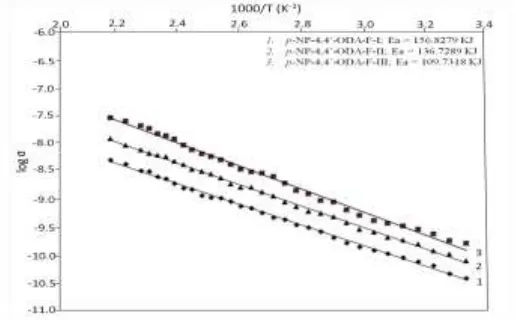
According to this relation, a plot of log vs 1/T would be linear with –ve slope. Such plots were made on the basis of each set of data. From the slopes of plots, activation energy (Ea) of electrical conduction can be calculated.
RESULTS AND DISCUSSION
Electrical conductivity measurement of all copolymers was carried out from room temperature to 453 K by applying a constant voltage (50 volts) across pellets. Results of electrical conductivity and activation energy have been reported in Table 1. A plot between temperature dependence (1000/T) versus electrical conductivity log (σ) of these copolymers is shown in Fig. 1. The electrical conductivity of p-NP-4,4’-ODA-F copolymer resins at room temperature (303 K) was found in the range of 6.91 x 10⁻¹¹ to 1.96 x 10⁻¹¹ ohm-1 cm-1. As the temperature increases from room temperature, electrical conductivity of the polymers was also found to increase uniformly and it attains the lowest value of conductivity 1.06 x 10⁻⁸ ohm-1 cm-1. The sequence of electrical conductivity for three different 4,4’-ODA-F copolymers was found to be p-NP-4,4’-ODA-F-I < p-NP-p-NP-4,4’-ODA-F-II < p-NP-p-NP-4,4’-ODA-F-III. This increase in conductivity of the polymers indicates that as molar ratio of reacting monomer increases corresponding conductivity also increases and hence electrical conductivity may depend on the concentration of the reacting monomer.
Available Online at www.ijpret.com 191
copolymers, which is in good agreement with the most probable structure proposed for the newly synthesized p-NP-4,4’-ODA-F copolymer resins under study[16].
CONCLUSIONS
From the results of electrical conductivity of these copolymers the followings conclusions can be drawn:
1. The electrical conductivity of p-NP-4,4’-ODA-F copolymers at room temperature lies in the range of 6.91 × 10⁻¹¹ to 1.96 × 10⁻¹¹ ohm-1 cm-1.
2. The plots of log σ vs 1/T is found to be linear in the temperature range under study, which indicate that the Wilson’s exponential law σ = σ o exp(- E/KT) is obeyed.
3. Electrical conductivity of each of these terpolymer resins increases with increase in temperature. Hence, these copolymers may be ranked as semiconductors.
Table (1): Electrical conductivity data of p-NP-4,4’-ODA-F copolymer resins.
Copolymers Electrical Conductivity ΔT (K) ΔE (KJ)
313 K 423 K
p-NP-4,4’- ODA-F-I 3.209 × 10⁻¹¹ 1.745 × 10⁻⁹ 313- 423 156.82
p-NP-4,4’- ODA-F-II 8.281 × 10⁻¹¹ 3.725 × 10⁻⁹ 313- 423 136.72
p-NP-4,4’- ODA-F-III 8.270 × 10⁻¹¹ 6.142 × 10⁻⁹ 313- 423 109.73
Available Online at www.ijpret.com 192
REFERENCES
1. L. Gautman, O.L.E. Lyons, “Organic Semiconductors”, John Wiley, New York, 1967.
2. E.M. Genies, A.A. Syed, C. Tsintavis, Mol. Cryst. Liq. Cryst., 1985, 121, 181.
3. L.A. Perkin, A.S. Kotaosonow, Konstr. Materosn Grafita, 1974, 8, 122.
4. J.S. Dewar, A.M. Talati, J. Am. Chem. Soc., 1964, 86, 1592.
5. P.S. Lingala, L.J. Paliwal, H.D. Juneja, National Seminar on Polymers, Chennai, 1999,21
6. T.K. Pal, R.B. Kharat, Die. Angew. Makromol. Chemie, 1989, 55, 173.
7. T.K. Pal, R.B. Kharat, Indian J. Chem., 1989, 28A, 55.
8. T.K. Pal, R.B Kharat, J. Indian Chem. Soc., 1989, 27A, 85.
9. M.M. Patel, R.J. Manavalan, Macromol. Sci-Chem, (A) 1983, 19, 951.
10. H.B. Pancholi, M.J. Patel, Indian Chem. Soc., 1998, 75, 86.
11. W.B. Gurnule, H.D. Juneja, L.J. Paliwal, Asin J. Chem., 2000, 12(1), 51.
12. A. Assadi, C. Svensson, M. Willander, O. Inganas, ‘Field-effect mobility of poly (3-hexylthiophene),’ Applied Physics Letters 1988, 53, 195.
13. J.E. Katon, Organic Semiconducting Polymers, Marcel Dekker Inc., New York, 1968.
14. L. Pardeshi, A. Rasheed, R.A. Bhobe, J. Ind. Chem. Soc., 1980, 57, 388.
15. M. Spiratos, G.I. Rusr, A. Ciobana, Die Angew. Makromol. Chemie., 1982, 107, 33.