Available Online at www.ijpret.com 138
INTERNATIONAL JOURNAL OF PURE AND
APPLIED RESEARCH IN ENGINEERING AND
TECHNOLOGY
A PATH FOR HORIZING YOUR INNOVATIVE WORK
SIMULATION ON THREE AXIS MEMS ACCELEROMETER
ABIRAMI A
Assistant Professor/ECE Department/Apollo Engineering College.
Accepted Date: 22/11/2014; Published Date: 01/12/2014
\
Abstract: In developing Micro Electro Mechanical Systems (MEMS), Finite Element Analysis (FEA) is usually relied upon to study these micro-structures in determining stress, deformation, resonance, temperature distribution, electromagnetic interference, and electrical properties. With this kind of approach, the performance of the devices can be easily expanded, as well as reducing the time and cost of MEMS production. Instead of constructing the MEMS devices in the laboratory, the simulation of MEMS using FEA programs like ANSYS, ABAQUS, LS-DYNA, INTELLISUITE, etc. in that INTELLISUITE now boasts the widest range of features available in a MEMS tool, and remains unsurpassed in its simulation capabilities, robustness and ease of use. The conventional MEMS accelerometers are used to sense two dimensional acceleration of the vehicle. Due to that car airbag can deploy early or later not in an exact time, hence it will not protect the accidental damage. This work focuses on the modeling of three axis MEMS accelerometer with INTELLISUITE software and recognition of motion in all three axes is noted.
Keywords: Micro Electro Mechanical Systems (MEMS), Accelerometer, Intellisuite
Corresponding Author: MR. A. ABIRAMI
Access Online On:
www.ijpret.com
How to Cite This Article:
Available Online at www.ijpret.com 139
INTRODUCTION
Micro-Electro-Mechanical Systems, or MEMS, is a technology that in its most general form can be defined as miniaturized mechanical and electro-mechanical elements (i.e., devices and structures) that are made using the techniques of micro fabrication. The critical physical dimensions of MEMS devices can vary from well below one micron on the lower end of the dimensional spectrum, all the way to several millimetres. Likewise, the types of MEMS devices can vary from relatively simple structures having no moving elements, to extremely complex electromechanical systems with multiple moving elements under the control of integrated microelectronics.
The one main criterion of MEMS is that there are at least some elements having some sort of mechanical functionality whether or not these elements can move. The term used to define MEMS varies in different parts of the world. In the United States they are predominantly called MEMS while in some other parts of the world they are called “Microsystems Technology” or “micro machined devices”.
While the functional elements of MEMS are miniaturized structures, sensors, actuators, and microelectronics, the most notable (and perhaps most interesting) elements are the micro sensors and micro actuators. Micro sensors and micro actuators are appropriately categorized as “transducers”, which are defined as devices that convert energy from one form to another. In the case of micro sensors, the device typically converts a measured mechanical signal into an electrical signal.
NEED FOR MINIATURATION
Miniaturization (Miniaturisation) is the creation of ever-smaller scales for mechanical, optical, and electronic products and devices. Miniaturization is a continuing trend in the production of such devices. Items which take up less space are more desired than items which are bigger and bulkier because they are easier to carry, easier to store, and much more convenient to use.
FEATURE OF MEMS
Available Online at www.ijpret.com 140 MEMS technology has the potential to change our daily lives as much as the computer has. However, the material needs of the MEMS field are at a preliminary stage. A thorough understanding of the properties of existing MEMS materials is just as important as the development of new MEMS materials.
Future MEMS applications will be driven by processes enabling greater functionality through higher levels of electronic-mechanical integration and greater numbers of mechanical components working alone or together to enable a complex action. Future MEMS products will demand higher levels of electrical-mechanical integration and more intimate interaction with the physical world. The high up-front investment costs for large-volume commercialization of MEMS will likely limit the initial involvement to larger companies in the IC industry. Advancing from their success as sensors, MEMS products will be embedded in larger non-MEMS systems, such as printers, automobiles, and biomedical diagnostic equipment, and will enable new and improved systems
ADVANTAGE OF MEMS
MEMS are devices that integrate mechanical elements, sensors, actuators, and electronics on a common silicon substrate. Many typically have dimensions in the 1 micron to 100 micron range. They have proven to be a key enabling technology of developments in areas such as transportation, telecommunications and health care, but the range of MEMS applications covers nearly every field.
The most significant advantage of MEMS is their ability to communicate easily with electrical elements in semiconductor chips. Other advantages include small size, lower power consumption, lower cost, increased reliability and higher precision.
EXPERIMENTS
Open the 3D builder module. The 3D Builder window will open as shown below
Creation of level 1
Available Online at www.ijpret.com 141
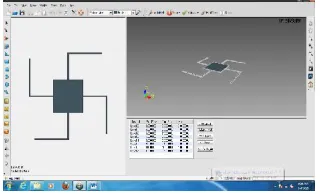
Figure 1 creation of level 1
Creation of level 2
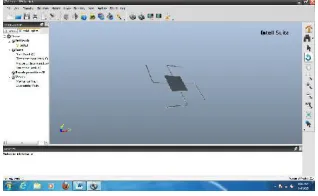
Click on the Add Rectangle button in the left pane. And we have to draw the square between the anchors followed by the fringes that connect them to the square on all four sides. Then define the height as given in the Fig 2 below
Figure 2 creations of level 2
Entity definition
Represent different layers by different entities. For this, select a layer and choose an entity from the “Entity Selection” drop down list. Now your device will look like this save the 3Dbuilder file using file. Save. “accel.solid” in any desired folder.
Available Online at www.ijpret.com 142
Analysis
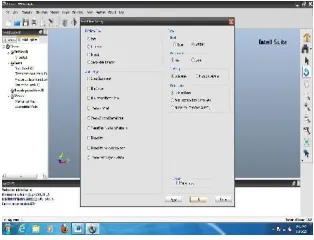
To export the file to the analysis module, select file export to analysis module. Select the two check boxes that request for mesh verification and click on the “check” button as shown in the Fig 4 given below
Figure 4 Validate mesh dialog box
Then click on thermo electromechanical module option as shown in Fig 5 below
Figure 5 TEM Analysis modules
Save the analysis file as “accelanalyse.save” The thermo electromechanical analysis module will be displayed as shown in Fig 6 below
Available Online at www.ijpret.com 143
Meshing
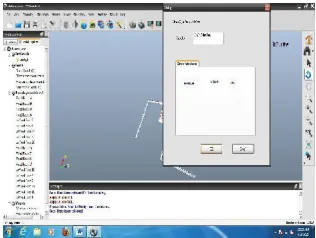
To create a mesh for a job, Mesh…Auto Mesh option and give a value of 10 in the auto mesh dialog box as shown in Fig 7.
Figure 7 Auto mesh dialog box
Simulation settings
To define simulation settings, select Simulation …Simulation settings from the menu and choose “Static” option and select Stress/Displacement option and click OK
Figure 8 Simulation setting window
Material selection
Available Online at www.ijpret.com 144
Figure 9 Selecting material properties
Select Level 1 and choose its properties as those as Si3N4_Bulk_General select the top surface.
Boundary Setting
Define the boundary for the base and anchors by selecting on every face which has to be fixed without any movement. Every parts of the device that should move freely in any direction required. The boundaries are defined fix the bottom surface. In a similar manner fix the anchors on all sides. Now define the boundary for the top surface by selecting the Boundary…Free option and by clicking on it.
Loading Definition
The loads to be applied on the accelerometer are given by the following Fig 10. To apply load, click loads…voltage. A voltage of 0V is to be given to the base line layer
Figure 10 Applying load dialog box
Available Online at www.ijpret.com 145
RESULTS AND DISCUSSION
Static analysis
Select “start Static analysis” option in the menu bar to start the analysis of the device the result can be viewed by selecting Result…displacement….Z as shown in the Fig 11 below:
Fig 11 Selecting result displacement
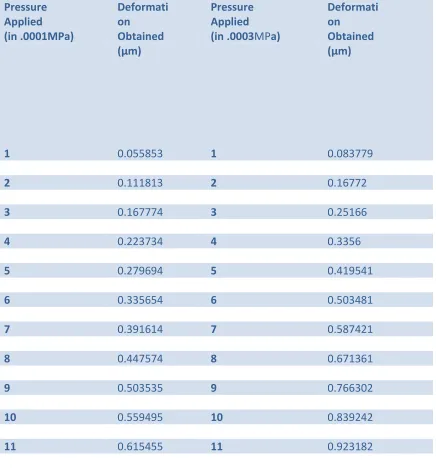
The input was applied in various pressure values of .0001 and .0003 (MPa) the respective deformation was obtained was shown in Fig 12, Fig 13.
Figure 12 Deflections of 3D MEMS
Available Online at www.ijpret.com 146
SAMPLE OBSERVATION:
TABLE 1 DEFORMATION OBSERVATION
Pressure Applied
(in.0001MPa)
Deformati on
Obtained (µm)
Pressure Applied (in.0003MPa)
Deformati on
Obtained (µm)
1 0.055853 1 0.083779
2 0.111813 2 0.16772
3 0.167774 3 0.25166
4 0.223734 4 0.3356
5 0.279694 5 0.419541
6 0.335654 6 0.503481
7 0.391614 7 0.587421
8 0.447574 8 0.671361
9 0.503535 9 0.766302
10 0.559495 10 0.839242
Available Online at www.ijpret.com 147
Fig 14 Deformation comparison Graph
The deformation obtained for various applied pressure and the comparison were shown in Fig 14 it shown that when the applied force is increased the deformation value also increased.
CONCLUSION
It has been shown that Finite Element Simulation of MEMS is very important and valuable in determining and optimizing device characteristics, and is thus valuable in the industry. Using the FEA software INTELLISUITE, many modeling tasks on MEMS can be implemented and the design was completed easily, so that it satisfies the needs of various fields. Additionally, their performance was determined in this work. Complete finite element simulation methods for MEMS accelerometer was carried out.
REFERENCES
1. Meftah Hrairi, Badrul Hanafi bin Baharom “Design and Modeling of Silicon
MEMSAccelerometer” 978-1-61284-437-4/11/$26.00 ©2011 IEEE.
2. Jiahui Wu, Gang Pan, Daqing Zhang, Guande Qi, and Shijian Li “Gesture Recognition with 3-D
Accelerometer” UIC 2009, LNCS 5585, pp. 25–38, 2009. © Springer-Verlag Berlin Heidelberg 2009.
3. B. S. Sreeja and S. Radha, “Design andimplementation of MEMS based differential voltage
controlled oscillator”, In Proceedings of EIT'2009, Windsor, Canada, 2009, p.202-206.
4. B. S. Sreeja and S. Radha, “Design and implementation of MEMS based differential voltage
controlled oscillator”,In Proceedings of EIT'2009, Windsor,Canada, 2009, p.202-206.
5. K. H. Denishev, and M. R. Petrova, “Accelerometer design”, In Proceedings of
Available Online at www.ijpret.com 148
6. K. H. Denishev, and M. R. Petrova, “Accelerometer design”, In Proceeding of
LECTRONICS’2007, 2007, pp. 159-164.
7. N. Yazdi, F. Ayazi, and K. Najafi, “Micromachined inertial sensors”, in IEEE Proceedings, vol
86, no 8, 1998, pp. 1640– 1659.
8. B. Liu, Q. Yao and B. Kriegbaum, “Finite element based design and optimization for
piezoelectric accelerometers”, Proceedings of Inter-Noise 98,Christchurch,
9. New ealand, 1998.N. Yazdi, F. Ayazi, and K. Najafi, “Micromachined inertial sensors”, in IEEE
Proceedings, vol 86, no 8, 1998, pp. 1640–1659.
10.B. Liu, Q. Yao and B. Kriegbaum, “Finite element based design and optimization for