Available Online at www.ijpret.com 1592
INTERNATIONAL JOURNAL OF PURE AND
APPLIED RESEARCH IN ENGINEERING AND
TECHNOLOGY
A PATH FOR HORIZING YOUR INNOVATIVE WORK
CHANGE IN BLOOD CAPACITANCE WITH GESTATIONAL AGE LINKED WITH DATA
MINING
ARPITA GUPTA1, G. U. KHARAT2 1.EC Dept, Krishna Engineering College, Ghaziabad, 201006, India.
2.EC Dept, Sharadchandra Pawar College of Engineering, Pune, 412409, India.
Accepted Date: 05/03/2015; Published Date: 01/05/2015
Abstract: It has been observed recently that the dielectric property of blood and thus the blood capacitance shows a definite change at different stages of pregnancy. The authors have discussed their observations in the paper. Blood samples of pregnant ladies at different gestational age have been collected from recognized laboratory. Erythrocyte Sedimentation Rate (ESR), hemoglobin (Hb) and dielectric of the samples have been measured. The changes in ESR, Hb, dielectric of blood and the blood capacitance with gestational age have been studied in detail and their relation has been established. The trend of the gestational age can be correlated with the simulated output for which classification is done in the data mining using software DTREG for helping the physicians so that they can prescribe the treatment of the subject in a precise manner.
Keywords: Dielectric property of blood, Gestational age, Erythrocyte Sedimentation Rate (ESR), equivalent circuit of blood, data mining.
Corresponding Author: MS. ARPITA GUPTA
Access Online On:
www.ijpret.com
How to Cite This Article:
Arpita Gupta, IJPRET, 2015; Volume 3 (9): 1592-1599
Available Online at www.ijpret.com 1593 INTRODUCTION
The dielectric property of blood cell changes with diseases thus changing the capacitance of blood cell. Diabetes, cancer, renal disorder and other chronic diseases have significant impact on the dielectric properties of blood [S. Gabriel , et al (1996); H. F. Cook, et al (1951); Irimajiri, etbal (1991)]. The white (WBC) and red blood cell (RBC) count increases with pregnancy. The significant increase in RBC mass (250-450mL) is due to the increase in erythropoietin production [American Pregnancy Association (2008)]. Though RBC increases in pregnancy but plasma volume increases much higher which causes anemia during pregnancy. Thus Hemoglobin of pregnant women decreases with gestational age [H. Kieler et al (1995)]. Due to high RBC mass the Erythrocyte Sedimentation Rate (ESR) also increases. ESR reflects the tendency of RBC to settle more rapidly [van den Broe NR, et al (2001); Alexander Zhbanov , et al (2012)]. The plasma and the cell interior consist of conducting fluids with certain electrical resistance which can be simulated by resistors, whereas the membrane is consist of phospholipids and proteins with dielectric properties and can be represented by capacitance. The equivalent model of the blood is as shown in the fig1. Rp represents plasma resistance, Ri represents cell interior resistance and Cm represents membrane capacitance [L. I. Kalakutskiy, et al (2009); Arpita Gupta, et al (2014)]
Fig1: Equivalent Circuit of blood
Recently a close association between the dielectric property of blood and ESR has been reported. It has been observed that the dielectric property of blood is also affected by the gestational age of pregnancy [Anil Lonappan (2012)]. With the change in the dielectric property of blood cell the capacitance of the cell changes too because C=εA/D.The area (A) and distance (D) is constant but the dielectric constant of blood cell changes with ESR. It is observed from fig 6 that with increase in ESR of blood, the dielectric constant of blood increases [G.W.Parker (2002); T. K. Basak, et al (2009); T.K.Basak, et al (2012)].
Available Online at www.ijpret.com 1594
analyze a relation between ESR and membrane capacitance of blood cell with gestational age [T.K.Basak , et al (2008); J. A. Costa , et al (2001); Han, et al (2005)].
METHODOLOGY:
Blood samples of pregnant women have been collected from recognized pathological lab from Ghaziabad at regular interval. The ESR and Hemoglobin have been measured. The dielectric of the blood samples have been measured in BNN Laboratory. The measured values of four patients are as shown in table1.
Table 1: change in ESR and Hemoglobin with gestational age
RESULT AND CONCLUSION:
It has been observed that the hemoglobin of a pregnant women decreases with increase in gestational age as shown in fig2.
Fig 2 Relation between gestational age and hemoglobin
Available Online at www.ijpret.com 1595 Fig3: Relation between gestational age and ESR
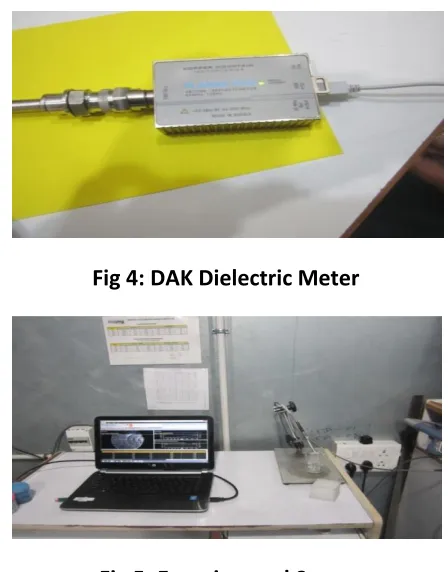
The dielectric of blood has been measured using DAK dielectric meter as shown in fig 4 and the experimental setup is shown in fig 5.
Fig 4: DAK Dielectric Meter
Fig 5: Experimental Setup
Available Online at www.ijpret.com 1596 Fig 6: Relation between ESR and Dielectric of the blood cell
As a result the capacitance of the blood also increases. Fig 7 shows the relation between ESR and capacitance of blood cell.
Fig 7: Relation between ESR and Capacitance of blood cell
DATA MINING
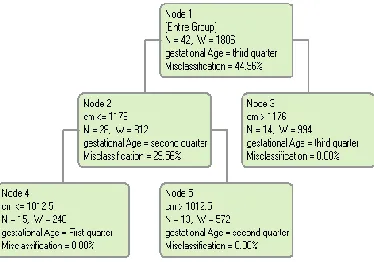
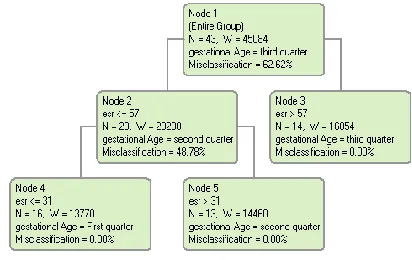
Fig 8 shows the decision tree of the prediction of gestational age with membrane capacitance. Figure 9 indicates the prediction of gestational age and esr.
Available Online at www.ijpret.com 1597 Fig 9: Prediction of Gestational age with ESR
Conclusion:
The status of pregnancy with ESR and hemoglobin has a great impact on the physiological condition of the subject. In this respect the gestational age can be estimated easily with the dielectric property or blood capacitance of the subject.
ACKNOWLEDGMENT:
The authors are very thankful to Krishna Engineering College, Ghaziabad for its valuable support. We thank all our friends and family for their encouragement and help. The experiments could not be completed without the help of careplus pathology labs and BNN labs.
REFERENCE:
1. S. Gabriel, R. W. Lau and C. Gabriel (1996) “The Dielectric Properties of Biological Tissues” Physics in Medicine and Biology, Vol. 41, No. 11, pp. 2251-2269.
2. H. F. Cook, (1951) “Dielectric Behavior of Human Blood at Microwave Frequencies,” Nature, Vol. 168, pp. 247-248.
3. Irimajiri, Akihiko; Suzaki, Toshinobu; Asami, Koji; Hanai, Tetsuya, (1991) ‘Dielectric Modeling of Biological Cells : Models and Algorithm’ Bull. Inst. Chem. Res., Kyoto Univ., Vol. 69,pp 420-428
4. American Pregnancy Association, “Pregnancy Symptoms Early Signs of Pregnancy,” American Pregnancy Association Report, Las Vegas
Available Online at www.ijpret.com 1598
6. H. Kieler, O. Axelsson, S. Nilsson and U. Waldenströ, (1995) “The Length of Human Pregnancy as Calculated by Ul- trasonographic Measurement of the Fetal Biparietal Di- ameter,” Ultrasound in Obstetrics and Gynecology, Vol. 6, pp. 353-357.
7. van den Broe NR, Letsky EA (2001) ‘Pregnancy and the erythrocyte sedimentation rate.’pubmed.gov US National Library of Medicine National Institutes of Health BJOG. Nov;108 (11):1164-7.
8. Alexander Zhbanov, Sung Yang , (2012) ‘Effect of Erythrocyte Sedimentation and Aggregation on the Conductivity of Blood in a Miniature Chamber’ ICQNM : The Sixth International Conference on Quantum, Nano and Micro Technologies ISBN: 978-1-61208-214-1, pp 18-24
9. L. I. Kalakutskiy, S. A. Akulov (2009) Modeling of the bioelectrical impedance of blood by synthesis of the equivalent electrical circuits World Congress on Medical Physics and Biomedical Engineering, Germany IFMBE Proceedings Volume 25/7,pp 575-577
10.Arpita Gupta, G.U.Kharat, (2014) Effect of Diabetes on Dielectric Property of Blood Plasma, International Journal of Multidisciplinary Educational Research IJMER, ISSN: 2277-7881; IF-2.735; V:5.16; Vol 3, Issue 3(6) pp 94-98.
11.Anil Lonappan, (2012) ‘Novel Method of Detecting Pregnancy Using Microwaves’ Journal of Electromagnetic Analysis and Applications, 4, pp340-343
12.G.W.Parker (2002) Electric field outside a parallel plate capacitor, American Journal of Physics 70(5) American Associations of physiscs teachers pp 502-507
13.T. K. Basak, T. Ramanujam, J. C. Kavitha, Poonam Goyal, Deepali Garg, Arpita Gupta, Suman Halder (2009 ) ‘pH Homeostasis Linked with Capacitance Relaxation Phenomena and Electrostrictive Energy in Cancer Cells’ Vol. 109, Issue 10, pp. 147-153.
14.T.K.Basak, Arpita Gupta, G.U.Kharat, Vivek Srivastava, Poonam Goyal, (2012) ‘The Disease Dependent Electrical Properties of Living Cell -A Review’ proceedings of ICCE-, pp180-184
Available Online at www.ijpret.com 1599
16.J. A. Costa and A. O. Hero, (2001) Classification Constrained Dimensionality Reduction. In IEEE International Conference on Accoustic Speech, and Signal Processing (ICASSP), volume 5, pages 1077-1080.