Available Online at www.ijpret.com 245
INTERNATIONAL JOURNAL OF PURE AND
APPLIED RESEARCH IN ENGINEERING AND
TECHNOLOGY
A PATH FOR HORIZING YOUR INNOVATIVE WORK
VIRTUAL THEORY OF MACHINE LAB
MANISH ARUN KHODKE1, DIPAK VINAYAK SHIRBHATE2, ANANT BOMBATKAR3
1. Research Scholar, Dr. Sau. K.G.I.T, Darapur, Maharashtra, INDIA. 2. Principal, Dr. Sau. K.G.I.T, Darapur, Maharashtra, INDIA.
3. Lecturer, Department of Mechanical Engineering, Vikramshila Polytechnic, Darapur, Maharashtra, INDIA. Accepted Date: 05/03/2015; Published Date: 01/05/2015
\
Abstract: This paper demonstrates the utilization of VRML (Virtual Reality Modeling Language) as a tool for interactive environment for teaching learning process. We have taken a problem of Virtual Theory of Machine Laboratory to check and test effectiveness of VRML capabilities. The traditional teaching/ learning multimedia in engineering involves 2D graphics mostly created with Adobe Dreamweaver or animated .gif files whereas this paper focus on interactive 3D models, which will be more realistic to real word mechanisms. VRML enables user to explore 3D models in their working condition on any Internet browser like Internet Explorer, Chrome, Mozilla Firefox or Opera etc. The paper focus on methodology adopted for creating Virtual Models, its application and future scope of VRML capabilities in teaching learning Process.
Keywords: Virtual, Machine Lab, Chrome
Corresponding Author: MR. MANISH ARUN KHODKE
Access Online On:
www.ijpret.com
How to Cite This Article:
Manish Arun Khodke, IJPRET, 2015; Volume 3 (9): 245-255
Available Online at www.ijpret.com 246 INTRODUCTION
3D graphics are available in all range today. We see them everywhere: in video games, advertising, even movies. We have come to a point in history where we can create completely synthetic worlds that exist entirely inside a computer's memory. These worlds have been referred to in the popular media as "virtual reality," "cyberspace," or "the metaverse." These terms are great for a science fiction writer in search of a new book idea, but we are many years away from virtual worlds that are anywhere near the rich detail of the real world. However, 3D graphics give us much more than the future promise of virtual reality. They give us a powerful new tool for the presentation of information, art, and entertainment. And while I don't think virtual reality will ever overtake the real world, as so many science fiction movies would like us to believe, they will add to our repertoire of creative outlets. The World Wide Web adds an interesting new twist to the use of 3D graphics. In the past, the presentation of art or information was limited to those who could get their work shown in an art gallery, or to someone with access to a publishing house or television studio. But, access to the Web is relatively inexpensive, so almost anyone can communicate their ideas, as long as they know how to use the tools that turn their dreams into reality.
VRML is the tool for creating 3D virtual experiences on the World Wide Web. Even though it is in its infancy, VRML will allow you to realize your visions and make them available to everyone on the Web.
Methodology
The entire creation of virtual Theory of Machine lab can be divided into following steps/stages
Solid Modelling
Simulation
Representation
Each step explain in brief as below
Solid Modelling: The first basic step to create Virtual World is to create 3D models of the
Available Online at www.ijpret.com 247
Part modelling
Assembly
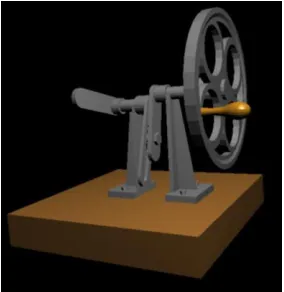
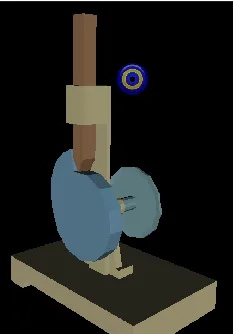
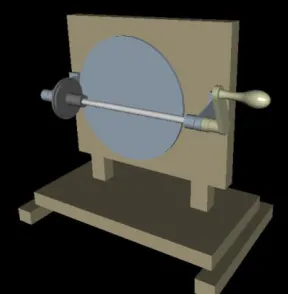
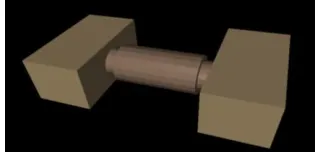
Following mechanisms were chosen for Virtual Lab:
Fig. 1: Withowrth Quick Return Mechanism
Fig. 2: Oscillating Cylinder
Available Online at www.ijpret.com 248 Fig. 4: Cam with Knife Edge Follower
Fig. 5: Helical Gear
Available Online at www.ijpret.com 249 Fig. 7: Friction Wheel Drive
Fig. 8: Cam Offset Follower
Available Online at www.ijpret.com 250 Fig. 10: Turning Pair
Fig. 11: Screw Pair
Fig. 12: Friction Disk
Fig. 13: Epycycloid Gear
Available Online at www.ijpret.com 251 Fig. 15: Crank and Slotted Lever Mechanism
Fig. 16: Shoe Brake
Fig. 17: Disk Brake
Available Online at www.ijpret.com 252 Fig. 19: Bevel Gear
Fig. 20: Cycloidal Gear
Fig. 21: Oldham Coupling
Available Online at www.ijpret.com 253 Fig. 23: Internal Expanding Brake
Fig. 24: Pawl and Ratchet Mechanism
Simulation: Simulation here means Graphical Simulation i.e. Giving required motions to the links of Mechanism imported from solid Modelling package. 3DS Max Studio was used for this purpose.
Available Online at www.ijpret.com 254 Fig. 25: Step by Step Procedure Adopted for Creation of Virtual Lab
Create solid Models using commercialy available softwares
like Pro/E, Catia or AutoCad etc.
Export Models to 3Ds Max studio
Simulate necessary motion of the Mechanisms using 3DsMax capabilities
Export simulated models to .wrl format
using 3DsMax
Install necessary browser plugin like BS Contact Player, Cosmo Player, Instareality player etc. to view
.wrl files
Open .wrl file using browser like Chrome,
Available Online at www.ijpret.com 255 CONCLUSION
This work has given us a chance to tryout our hands on modelling, simulation and VRML.
FUTURE SCOPE
VRML is a powerful tool for representation of 3D objects. We are planning to add following in the next version of the Interactive Virtual Theory of Machine Lab
Sound (Intensity increasing/ Decreasing as user comes closer/goes away from the object)
Mapping ( Real skin of Metal/wood/Paint etc)
Incorporation of software sensors like proximity, touch etc to make Virtual Lab more
interactive.
Organizing all models under one roof exactly like a real lab with detail mapping for floor,
Windows, Door, Glass, Curtains, Plywood , Table, Chair, celling fan and other objects if any.
REFERENCES
1. Project Report on “ Virtual Theory of Machine Lab” submitted by Mr. Amol Khurana, Mr. Anurag Goel, Mr. Gaurav Rampal, Mr. Santosh Tiwari and Mr. Hemant Ade in the year 2004 under the Guidance of Prof. D.V. Shirbhate for the partial fulfillment of award of Bachelor of Production Engineering at College of Engineering and Technology, Babhulgaon (Jh) Akola (M.S.)