Please cite this article as: M. S. EL-Wazery, Fabrication and Characteristics of 8YSZ/Ni Functionally Graded Materials by Applying Spark Plasma Sintering Procedure, International Journal of Engineering (IJE), TRANSACTIONS C: Aspects Vol. 27, No. 12, (December 2014) 1907-1912
International Journal of Engineering
J o u r n a l H o m e p a g e : w w w . i j e . i rFabrication and Characteristics of 8YSZ/Ni Functionally Graded Materials by
Applying Spark Plasma Sintering Procedure
M. S. EL-Wazery*
Department of Production Engineering and Mechanical Design, Faculty of Engineering, Menoufiya University, Shebin El-Kom, Egypt
P A P E R I N F O
Paper history:
Received 8 January 2014
Received in revised form 01 July 2014 Accepted 18 September 2014
Keywords:
Functionally Graded Materials (FGM) Yttria Stabilized Zirconia (YSZ) Spark Plasma Sintering (SPS) Relative Density and Microstructure
A B S T R A C T
Functionally graded materials (FGM) in the form of layered structure consisting of yttria stabilized zirconia (8 %mol Y2O3) and nickel were fabricated by spark plasma sintering procedure. The relative
density, linear shrinkage and Vickers hardness of each layer of graded materials were measured. The microstructure and the composition of these components were studied. The results obtained show that functionally graded materials produced by spark plasma sintering exhibited consequently fully dense specimens. Also, the results demonstrate that the composition and microstructure of YSZ/Ni FGM have the expected gradient distribution. There are no macroscopic distinct interfaces in YSZ/Ni FGM due to the gradient change in components. This good continuity of microstructure can eliminate the disadvantage of traditional macroscopic interface in YSZ/Ni joint, and reflect the design idea of FGM. Vicker’s hardness of YSZ/Ni is lower than that of pure zirconia (YSZ) and increases by increasing the relative density of the layer of YSZ/Ni.
doi: 10.5829/idosi.ije.2014.27.12c.14
1. INTRODUCTION1
The concept of functionally graded materials (FGM),
first proposed in the mid-1980s in Japan [1], is based on
the development of compositional and/or
microstructural gradients within the material leading towards graded properties in one, two or three dimensions [2, 3]. Compared to monolithic and composite materials, these structures offer the possibility of improving performance of components under demanding technological applications, e.g. in fuse-large surfaces of spacecraft, thermal and environmental barrier coatings for turbines and engines, super-hard cutting tools or artificial bones [4]. The zirconia/nickel FGMs can be designed to reduce thermal stresses and take advantage of the heat and corrosion resistances of ceramic and the mechanical strength, high toughness, good machinability and bonding capability of metals without severe internal thermal stresses.
1*Corresponding Author’s Email: [email protected](M. S.
EL-Wazery)
YSZ/Ni FGM are an ideal solution to the problem of metal–ceramic bonding [5-7].
Spark plasma sintering (SPS) is a newly developed process which makes possible sintering high quality materials in short periods by charging the intervals between powder particles with electrical energy. 8-mol% yttria-stabilized zirconia (8YSZ) is widely chosen as the electrolyte in solid oxide fuel cells (SOFCs) because of its excellent high temperature ionic conductivity and excellent mechanical properties [8-10]. The influence of YSZ content and sintering temperature on microstructures and mechanical properties of Al2O3/YSZ composites was investigated by Menga et al. [11]. All samples could be fully densified at a temperature lower than 1400◦C. Vickers hardness and fracture toughness of composites increased with increasing YSZ content, and the samples containing 10 wt.% of YSZ had the highest Vickers hardness of 18GPa. The mechanical properties of Si3N4–Al2O3 FGM joints with 15 layers for high-temperature applications were investigated [12]. Scanning electron microscopy (SEM) observations of fracture surfaces indicated the absence of any glassy phase at the triple points. This
testing revealed severe strength degradation at high temperatures. Shahrjerdi et al. [13] have demonstrated the functionally graded metal-ceramic composite fabricated via pressureless sintering. The pure metallic and ceramic components were Titanium (Ti) and Hydroxyapatite (HA), which were located at the ends of a cylindrical specimen. The properties of all FGM products were characterized by shrinkage, optical microscope (OM), SEM, energy dispersive spectrometry (EDX) and hardness test. The grade of the FGM material was proven by results from all recorded measurements, as well as linearity of shrinkage. The microstructure and mechanical properties of PSZ/NiCr FGMs fabricated by powder metallurgy were investigated experimentally. It was found that hardness increases and ductility decreases with the increase of partially stabilized zirconia (PSZ), which is attributed to the variation of the matrix phase from the metal to the ceramic [14]. Zhou and Li [15] have introduced the inverse homogenization for FGM microstructure design, where layered periodic base cells (PBC) were topologically optimized individually for specific graded properties. To ensure connectivity between different PBCs, heat sinks were prescribed on the PBC boundaries for maximizing their conduction. Lia et al. [16] have fabricated YSZ–FGM–NiCr joints by hot pressingprocess and studied their thermal properties by thermal cycling test and shear testing. The joint showed good thermal stability and good oxidation resistance up to 1000˚C. Also, Mishina et al. [17] studied the
fabrication method of another constituent,
PSZ/AISI316L FGMs by applying SPS procedure for use in joint prostheses and their mechanical and biotribological properties were evaluated through fracture toughness, bending strength, and Vicker hardness studies.
In this article, FGMs consisting of yttria stabilized zirconia (YSZ) and Ni were fabricated by spark plasma sintering procedure. The relative density, linear shrinkage and Vickers hardness of the FGM were studied. The compositional and microstructure analysis of all samples sets was examined after the sintering process through X-ray diffraction (XRD) and scanning electron microscopic (SEM) with energy dispersive X-ray analysis (EDAX). Vickers hardness was measured by performing indentations at a load of 5 kg within a dwell time of 15 s on the synthesized samples.
2. MATERIALS AND EXPERIMENTAL PROCEDURE
2. 1. Materials Yttria stabilized zirconia (8 mol%
Y2O3) powder (TOSOH, Japan) and Ni powder (MERK, USA) were used as the raw powders to fabricate the FGMs by utilizing the powder metallurgy technique.
powders were mixed in weigh ratios of 10:0, 9:1, 8:2, 7:3, 6:4 and 5:5, respectively. The composition of each layer in graded material is shown in Table 1, and each mixture was suspended in alcohol, milled for five hrs by horizontal ball miller. The ratio of powder to ball was 1:2 and the milling speed was 100 rpm 30wt. % ethyl alcohol was added to the mixtures powders to cover the media (balls). After milling, the mixed powders were sieved using a 125 µm steel mesh to remove the remaining agglomerates. 10wt. % ethyl alcohol, as a lubricant, was added to the powders to form pure ceramic and intermediated layers. Then, the mixture powders were dried in a furnace at 70ºC for 24 hrs. The powder blends were put to form a non-graded composition or were layered so as to form graded composition in a rectangular hot work tool steel die with 35 mm length and 10 mm width. The powder compacts were pressed up to 0.5 MPaat room temperature for one minute. Hydraulic press was used to compact the powder layers once at the same pressure. The die and punch set-up used to produce the non-graded composites (NGC) and FGM are reviewed in our paper [18, 19]. Using the same pressing conditions, a larger thickness (6.5 mm) FGM green compact was also formed but under lower pressure (0.1 MPa) during stacking the layers, which would be used for mechanical property testing.
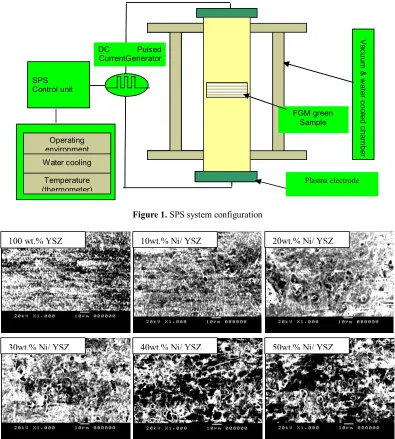
In the SPS process a green compact of the FGM was placed inside the plasma electrode, Figure 1 phenomena throughout the FGM specimen, resulting in a rapid and thorough heat distribution, high homogeneity and especially strong bonds between particles.
2. 2. Materials Characterization The actual
density and the theoretical density of the sintered specimens were measured by using the water immersion method (Archimedes method) and the rule of mixture, respectively. The radial shrinkage of the NGC was measured by the thermo-mechanical analyzer (TMA -50 Shimadzu - Japan).The composition and microstructures of each layer of the graded materials specimens were examined by X-ray diffraction (XRD) and the scanning electron microscope (SEM-JSM 5400) with energy dispersive X-ray analysis (EDAX). A hardness tester (HSV-40) was used to measure the Vickers hardness of each layer in the YSZ/Ni FGM.
TABLE 1. Composition distribution model of YSZ/Ni FGM
YSZ wt. % Ni wt. % Layer
100 - 1
90 10 2
80 20 3
70 30 4
60 40 5
Figure 1. SPS system configuration
Figure 2a. The micrographs of the FGM layers (gray part is nickel in YSZ)
Figure2b. SEM images of the layers of the YSZ/Ni FGM
3. RESULTS AND DISCUSSION
3. 1. Microstructure and XRD Figure 2a shows
the microstructure of the fabricated YSZ/Ni FGM. It has six layers: a pure YSZ layer and five YSZ/Ni composite layers containing 10, 20, 30, 40 and 50 % of Ni, Figure 2b. It applies large DC pulsed current (3 kA) directly to the green compact of FGM layers. Large DC pulsed current is considered to generate sparks between the powder particles and eventual repeat of momentary ultra-high temperature (1400°C) under vacuum for one hour. The high frequency transfers and disperses the heat. The white and gray regions exhibit the Ni and YSZ phases, respectively. The white area in each
1 2 3 4 5 6
30wt.% Ni/ YSZ 40wt.% Ni/ YSZ 50wt.% Ni/ YSZ
20wt.% Ni/ YSZ 10wt.% Ni/ YSZ
100 wt.% YSZ
FGM grain compact Sample DC Pulsed
CurrentGenerator
SPS Control unit
Water cooling
Thermometer
Operating environment
V
ac
u
um
&
w
ate
r c
o
ol
e
d c
h
am
b
er
Temperature (thermometer)
V
ac
u
um
&
w
ate
r c
o
ol
e
d c
h
am
b
er
SPS Control unit
Water cooling Operating environment
FGM green Sample DC Pulsed
CurrentGenerator
contents from 0 to 50 wt.% and no distinct boundaries are exhibited. It can be seen that metal particles are homogeneously distributed into the ceramic matrix and there is no evidence of agglomerates. As the particle size of the zirconia powder was considerably smaller than that of the Ni powders, zirconia particles would have entered gaps between Ni particles on the fabrication. As a result, the Ni particles are dispersed in the zirconia matrix in the material with high content of Ni (40%Ni and 50%Ni).
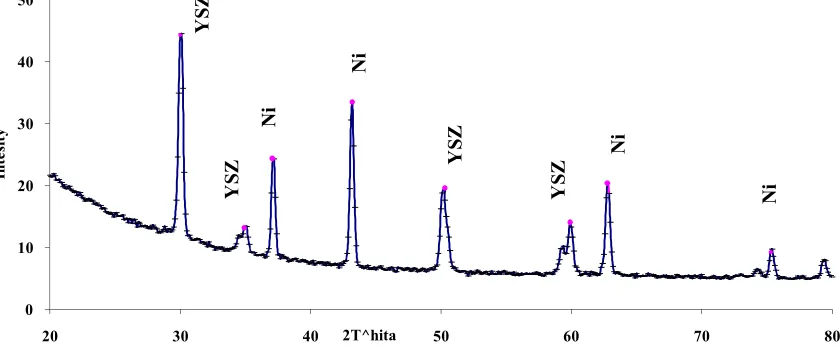
The X-ray diffraction patterns (XRD) from the surface of the cross-section for the NGCs (YSZ/40% Ni) after the spark plasma sintering under vacuum at 1400 ºC for one hour are shown in Figure 3. No new phase was formed between zirconia and Ni during sintering process. No other impurities above the detection limit have been detected.
3. 2. Densi ication Behavior The relative
densities of the layers in homogenous specimens and the YSZ/Ni FGM compacts are shown in Figure 4. Spark plasma sintering is an effective method to produce full dense specimens. It is noted that relatively high density (in the range of 0.90–0.99) for each layer in the FGM was obtained after the spark plasma sintering stage. The relative density has a maximum value (99 %) for the pure YSZ and a minimum value (89.87%) for the homogeneous specimen with 50 % nickel. Among the layers, layer 1 has the highest relative density, which is mainly attributed to a small initial particle size (0.5µm) of zirconia selected for making the ceramic layer (pure ceramic layer) of the model structures. The higher relative density of zirconia is mainly due to its higher melting point and higher sinterability.
Among the five composite layers, the relative density decreases with increasing the content of nickel
its large particle size (15 µm). The FGMs exhibit a low porosity level and a relatively high relative density 99% by SPS procedure. The high value of the relative density of the YSZ/Ni FGM is related to the high densification, high homogeneity, rapid temperature increase and good bonding between the layers of FGM.
An important factor, which should be considered when analyzing the sinterability of YSZ/Ni FGM is the accurate prediction of the change in thermo-mechanical properties as shrinkage at each temperature. The thermal expansions coefficient of Ni and YSZ were (αNi =15.4 x10⁻⁶ °C-1 and αYSZ = 7 x10⁻⁶°C-1 ), respectively [20]. The TMA was carried out on the layers of the FGM in air with a heating rate of 5˚C/min up to 1400 ◦C. The parameter of TMA is temperature, time and composition of phases. To indirectly estimate the linear shrinkage of the layers in the FGMs fabricated by a spark plasma sintering procedure, the shrinkages of the NGC corresponding to each layer were measured by the thermo mechanical analyzer (TMA-50, Shimadzu-Japan), Figure 5. It could be seen that the maximal value of linear shrinkage among the layers specimens is 19% for 10%Ni/YSZ. Among the other NGC layers, the linear shrinkage decreases with increasing the content of nickel and reached to the minimum linear shrinkage (7%) at 50% Ni. This is because the lower sinterability of nickel compared to YSZ.
3. 3. Mechanical Properties The Vickers hardness
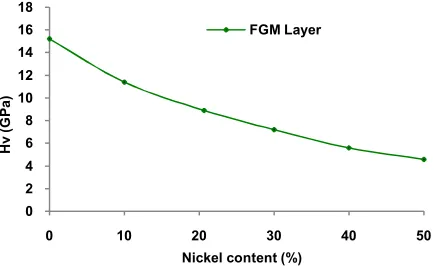
of the YSZ/Ni FGM was measured using a hardness tester (HSV-40) on a polished surface under a load of 5 kg at 30 sec. Average of five indentations in each layer at the center and used to calculate the hardness values of the layers. The Vickers hardness has a maximum value (15GPa) for pure YSZ and a minimum value (5GPa) for the homogeneous specimen with 50 % nickel (Figure 6).
Figure 3. XRD patterns from the surface of the cross-section of the NGCs (YSZ/40%Ni) 0
10 20 30 40 50
20 30 40 50 60 70 80
In
te
si
ty
2T^hita
Ni
Ni
Y
SZ
Ni
Ni
Y
SZ
Y
SZ
Y
Figure5. Relation between linear shrinkage and time of the FGM layers
Figure 4. The relative densities of the non-graded composite and FGM specimens.
Figure 6. Vickers hardness of the layers in YSZ/Ni FGM
Also, it should be noted that the vickers hardness decreased with increasing nickel content. This is mainly attributed to the pores in intermediate layers in the FGM after sintering stage, where the pores were increased in the FGM layers with increasing nickel content from 0% to 50% Ni and the relative density was decreased also.
Furthermore, hardness was reduced as the
transformation from pure ceramic layer (YSZ) to intermediate layers (mixtures of zirconia and nickel powders) took place.
4. CONCLUSIONS
The spark plasma sintering (SPS) seems to be an effective method to obtain full dense specimens.
· FGMs exhibit a low porosity level and high relative density (99%). There are no macroscopic distinct interfaces in YSZ/Ni FGM due to the gradient change in components.
· This good continuity of microstructure can eliminate the disadvantage of traditional macroscopic interface in YSZ/Ni joint, and reflect the design idea of FGM.
· The linear shrinkage of the NGC was reduced with an increase in nickel content. There are more dimples in the microstructure resulted from agglomeration of nickel (metal) in 50% NGC.
· Vicker’s hardness of YSZ/Ni is lower than that of pure zirconia (YSZ) and increases by increasing the relative density of the layer of YSZ/Ni.
5. REFFERENCES
1. Yamanouchi, M., Koizumi, M., Hirai, T. and Shiota, I., "Fgm-90", in Proceedings of the First International Symposium on Functionally Gradient Materilas, FGM Forum, Tokyo, Japan., (1990).
2. Neubrand, A. and Rödel, J., "Gradient materials: An overview of a novel concept", Zeitschrift Fur Metallkunde, Vol. 88, No. 5, (1997), 358-371.
3. Kieback, B., Neubrand, A. and Riedel, H., "Processing techniques for functionally graded materials", Materials Science
and Engineering: A, Vol. 362, No. 1, (2003), 81-106.
4. Miyamoto, Y., Kaysser, W., Rabin, B., Kawasaki, A. and Ford, R., "Functionally graded materials: Design, processing and applications", (1999).
5. Wosko, M., Paszkiewicz, B., Piasecki, T., Prażmowska, J., Paszkiewicz, R. and Tłaczała, M., "AIII-BV (N) photodetectors with functionally graded active area", Optica Applicata, Vol. 37, No. 1-2, (2007), 161-165.
6. Kawasaki, A. and Watanabe, R., "Thermal fracture behavior of metal/ceramic functionally graded materials", Engineering
Fracture Mechanics, Vol. 69, No. 14, (2002), 1713-1728.
7. Ruys, A., Popov, E., Sun, D., Russell, J. and Murray, C., "Functionally graded electrical/thermal ceramic systems",
Journal of the European Ceramic Society, Vol. 21, No. 10,
(2001), 2025-2029.
8. Matula, G., Jardiel, T., Jimenez, R., Levenfeld, B. and Varez, A., "Microstructure, mechanical and electrical properties of Ni-YSZ anode supported solid oxide fuel cells", Archives of
Materials Science, Vol. 22, (2008), 21-25.
9. Rajeswari, K., Suresh, M.B., Hareesh, U., Rao, Y.S., Das, D. and Johnson, R., "Studies on ionic conductivity of stabilized zirconia ceramics (8YSZ) densified through conventional and non-conventional sintering methodologies", Ceramics
International, Vol. 37, No. 8, (2011), 3557-3564.
-20 -16 -12 -8 -4 0 4 8
0 5000 10000 15000 20000 25000 30000 35000
L
in
ea
r
S
h
ri
n
ka
g
e
R
a
ti
o
, (
%)
Time (s)
10%Ni/YSZ 20%Ni/YSZ 30%Ni/YSZ 40%Ni/YSZ
99
96.43
94.08
92.27 91.2
89.87
٩٩
80 85 90 95 100
0 10 20 30 40 50
R
el
at
iv
e
den
si
ty
(
%)
Nickel content (%)
NGC
FGM
0 2 4 6 8 10 12 14 16 18
0 10 20 30 40 50
H
v
(G
P
a)
No. 2, (2007), 926-932.
11. Meng, F., Liu, C., Zhang, F., Tian, Z. and Huang, W., "Densification and mechanical properties of fine-grained Al2O3―ZrO2 composites consolidated by spark plasma
sintering", Journal of Alloys and Compounds, Vol. 512, No. 1, (2012), 63-67.
12. Lee, C., Lemberg, J., Cho, D., Roh, J. and Ritchie, R., " Mechanical properties of Si3N4–Al2O3 FGM joints with 15
layers for high-temperature applications ", Journal of the
European Ceramic Society, Vol. 30, No. 7, (2010), 1743-1749.
13. Shahrjerdi, A., Mustapha, F., Bayat, M., Sapuan, S. and Majid, D., "Fabrication of functionally graded hydroxyapatite-titanium by applying optimal sintering procedure and powder metallurgy", International Journal of the Physical Sciences, Vol. 6, No. 9, (2011), 2258-2267.
14. Jin, X., Wu, L., Sun, Y. and Guo, L., " Microstructure and mechanical properties of ZrO2/NiCr functionally graded
materials ", Materials Science and Engineering: A, Vol. 509, No. 1, (2009), 63-68.
16. Li, J., Zeng, X., Tang, J. and Xiao, P., "Fabrication and thermal properties of a ysz–nicr joint with an interlayer of ysz–nicr functionally graded material", Journal of the European
Ceramic Society, Vol. 23, No. 11, (2003), 1847-1853.
17. Mishina, H., Inumaru, Y. and Kaitoku, K., " Fabrication of ZrO2/AISI316L functionally graded materials for joint
prostheses ", Materials Science and Engineering: A, Vol. 475, No. 1, (2008), 141-147.
18. EL-Wazery, S., EL-Desouky, R., Hamed, A., Mansour, A. and Hassan, A., "Fabrication and mechanical properties of zirconia/nickel functionally graded materials", International
Journal of Advanced Materials Research, Vol. 463, (2012),
463-447.
19. EL-Desouky, A. and EL-Wazery, M., "Mixed mode crack propagation of zirconia/nickel functionally graded materials", International Journal of Engineering-Transactions B:
Applications, Vol. 26, No. 8, (2013), 885-894.
20. Jingchuan, Z., Zhongda, Y., Zhonghong, L. and Jian, L., "Microstructure and thermal stress relaxation of ZrO2/Ni fun
ctionally graded material (d", Trans. Nonferrous Met. Soc.
China, (1996),94-99.
Fabrication and Characteristics of 8YSZ/Ni Functionally Graded
Materials by Applying Spark Plasma Sintering Procedure
RESEARCH NOTE
M. S. EL-Wazery
Department of Production Engineering and Mechanical Design, Faculty of Engineering, Menoufiya University, Shebin El-Kom, Egypt
P A P E R I N F O
Paper history:
Received 8 January 2014
Received in revised form 01 July 2014 Accepted 18 September 2014
Keywords:
Functionally Graded Materials (FGM) Yttria Stabilized Zirconia (YSZ) Spark Plasma Sintering (SPS) Relative Density and Microstructure
هﺪﯿﮑﭼ
داﻮﻣ هﺪﺷيﺪﻨﺑﻪﺟرد ﺪﻨﻤﻓﺪﻫ
(FGM)
ﺐﻟﺎﻗرد ﻪﯾﻻﻪﯾﻻرﺎﺘﺧﺎﺳ زاﻞﮑﺸﺘﻣ
ﺎﯾﺮﺘﯾايﺎﻫمﺎﻧ ﺖﯿﺒﺜﺗ ﺎﺑهﺪﺷ ﺎﯿﻧﻮﮐﺮﯾز ) 8 ﺪﺻرد ﯽﻟﻮﻣ
Y2O3 ( ﻞﮑﯿﻧو شورﻪﺑ ﺖﺨﭘ ﺎﻤﺳﻼﭘ ﻪﻗﺮﺟ ﺪﺷﻪﺘﺧﺎﺳ . ﯽﺒﺴﻧﻢﮐاﺮﺗ ، ضﺎﺒﻘﻧا ﯽﻄﺧ ﯽﺘﺨﺳو زﺮﮑﯾو زا ﺮﻫ زاﻪﯾﻻ داﻮﻣ ﻪﺟرد ﺪﺷيﺮﯿﮔهزاﺪﻧا
.
رﺎﺘﺧﺎﺳ ﺐﯿﮐﺮﺗو ءاﺰﺟاﻦﯾا ﺪﻨﺘﻓﺮﮔراﺮﻗﻪﻌﻟﺎﻄﻣدرﻮﻣ
.
هﺪﻣآﺖﺳﺪﺑﺞﯾﺎﺘﻧ ﺪﻫدﯽﻣنﺎﺸﻧ
ﻪﮐ داﻮﻣ هﺪﺷيﺪﻨﺑﻪﺟرد ﺪﻨﻤﻓﺪﻫ
ﻂﺳﻮﺗهﺪﺷﺪﯿﻟﻮﺗ ﺖﺨﭘ
ﺎﻤﺳﻼﭘ ﻪﻧﻮﻤﻧﻪﺑﻪﻗﺮﺟ ﻼﻣﺎﮐ
ﻢﮐاﺮﺘﻣ ﺪﻫدﯽﻣﻪﺠﯿﺘﻧ
.
،ﻦﯿﻨﭽﻤﻫ
ﺪﻫدﯽﻣنﺎﺸﻧﺞﯾﺎﺘﻧ ﺐﯿﮐﺮﺗﻪﮐ و رﺎﺘﺧﺎﺳ YSZ/Ni FGM ياراد ﻊﯾزﻮﺗ نﺎﯾداﺮﮔ درﻮﻣ رﺎﻈﺘﻧا دﻮﺑ . ﭻﯿﻫ كﺮﺘﺸﻣﻞﺼﻓ اﺰﺠﻣ ﯽﭘﻮﮑﺳوﺮﮐﺎﻣ رد
YSZ/Ni FGM
ﺖﻠﻋﻪﺑ ﺮﯿﯿﻐﺗ نﺎﯾداﺮﮔ رد ءاﺰﺟا دﻮﺟو ﻧ دراﺪ . ﯾا ﻦ مواﺪﺗ بﻮﺧ رﺎﺘﺧﺎﺳ ﺪﻧاﻮﺗ ﯽﻣ تاﺮﻀﻣ كﺮﺘﺸﻣ ﻞﺼﻓ ﯽﭘﻮﮑﺳوﺮﮐﺎﻣ ﯽﺘﻨﺳ لﺎﺼﺗا رد YSZ/Ni
ﺪﻨﮐفﺬﺣار هﺪﯾاو
ﯽﺣاﺮﻃ
FGM
ﺪﻨﮐﺲﮑﻌﻨﻣار
. ﯽﺘﺨﺳ ﺮﮑﯾو ياﺮﺑ YSZ/Ni زاﺮﺘﻤﮐ ﺎﯿﻧﻮﮐﺮﯾز ﺺﻟﺎﺧ (YSZ) ﺪﺷﺎﺑﯽﻣ و ﺎﺑ ﺶﯾاﺰﻓا ﯽﺒﺴﻧﻢﮐاﺮﺗ ﻪﯾﻻ YSZ/Ni ﺶﯾاﺰﻓا ﺪﺑﺎﯾﯽﻣ .