Please cite this article as:B. Vahdani, M. Salimi , S. M. Mousavi, A New Compromise Decision-making Model Based on TOPSIS and VIKOR for Solving Multi-objective large-scale Programming Problems with a Block Angular Structure under Uncertainty, International Journal of Engineering (IJE), TRANSACTIONS B: Applications Vol. 27, No. 11, (November 2014) 1673-1680
International Journal of Engineering
J o u r n a l H o m e p a g e : w w w . i j e . i rA New Compromise Decision-making Model Based on TOPSIS and VIKOR for
Solving Multi-objective Large-scale Programming Problems with a Block Angular
Structure under Uncertainty
B. Vahdani*a, M. Salimia ,S. M. Mousavib
a Faculty of Industrial and Mechanical Engineering, Qazvin Branch, Islamic Azad University, Qazvin, Iran
b Industrial Engineering Department, Faculty of Engineering, Shahed University, Tehran, Iran
P A P E R I N F O
Paper history: Received 06May 2014
Received in revised form 21June 2014 Accepted 26 June 2014
Keywords:
Multi-objective Uncertainty TOPSIS VIKOR
A B S T R A C T
This paper proposes a compromise model, based on a new method, to solve the multi-objective large-scale linear programming (MOLSLP) problems with block angular structure involving fuzzy parameters. The problem involves fuzzy parameters in the objective functions and constraints. In this compromise programming method, two concepts are considered simultaneously. First of them is that the optimal alternative is closer to fuzzy positive ideal solution (FPIS) and farther from fuzzy negative ideal solution (FNIS). Second of them is that the proposed method provides a maximum ‘‘group utility’’ for the ‘‘majority’’ and a minimum of an individual regret for the ‘‘opponent’’. In proposed method, the decomposition algorithm is utilized to reduce the large-dimensional objective space. A multi objective identical crisp linear programming is derived from the fuzzy linear model for solving the problem. Then, a compromise solution method is applied to solve each sub problem based on TOPSIS and VIKOR simultaneously. Finally, to illustrate the proposed method, an illustrative example is provided.
doi: 10.5829/idosi.ije.2014.27.11b.04
1. INTRODUCTION1
Decision makingcan be regarded as the mental processes encountered under various situations where a number of competing alternatives need to be chosen based on a set of criteria. Decision making problems are introduced in many fields such as management and engineering. MCDM is divided into multi-objective decision making (MODM) and multi-attribute decision making (MADM). MADM is applied to find suitable option among several alternatives versus multi-attribute but MODM studies decision problems in which the decision space is continuous. In other words, there are many decision problems with multi objective during decision making so they may conflict with each other [1-3]. The rate complexity is associated with proportional enhancements in number of variables. As
1*Corresponding Author’s Email: [email protected] (B. Vahdani)
the number of variables increases, the complexity of problem increases. In other words, there are various factors in the objective functions and constraints in these problems. Further, in large scale problems, there is so great scope to solve them by usual methods in a less time. Because optimization of large scale problems takes a long time, the original programming problems are decomposed into several smaller sub problems. Moreover, the complexity of optimization method is reduced. Furthermore, the decomposition methods are so great scope to solve the large scale problems by usual methods in a less time. Block angular structure problems are one of the most common large scale programming problems. Fortunately, these problems have special structures that can be decomposed easily [1, 4-6]. A suitable approach for treating large-scale problems is to reduce the size of the problem using model-reduction techniques. The block angular structure problems can be solved by a decomposition method. Dantzig-wolf and Benderz are two types of
decomposition methods [4]. A Dantzig-wolf decomposing algorithm is introduced for parametric space in large scale linear optimization problems with fuzzy parameter [4, 7]. Then this method is applied on largescale linear programming problems with block angular structure [6, 8]. Recently, some compromise multi-criteria decision making (MCDM) methods are extended and applied to find the suitable solution for MOLSNLP problems. TOPSIS method is applied to solve multi-objective dynamics programming problems [9]. TOPSIS is applied for evaluating project risk response in fuzzy environment [10, 11]. An extended TOPSIS method is introduced for solving MODM problems [12]. TOPSIS is extended to solve MOLSNLP problems with block angular structure [1, 13]. VIKOR is another compromise MCDM method that is extended for solving MOLSNLP problems [6, 14].An integrated VIKOR methodology is proposed for plant location selection[15].
Moreover, much knowledge in the real world is uncertainty rather than crisp [16, 17]. Fuzzy set theory is valuable tool to describe this concept. Fuzzy set theory was proposed as a vagueness concept for decision-making problems with conflict of preferences involved in the selection process [16, 18]. Moreover, the fuzzy set concept and the MCDM method were manipulated to consider the fuzziness in the decision-making parameter and group decision-decision-making process [19, 20]. The VIKOR method is applied for solving MOLSNLP problems where the formulation of objective functions and constraints is introduced with crisp data whereas coefficient of objective function and constraint may not be exact and complete.
This paper presents a model based on a novel compromised solution method to solve the multi-objective large-scale programming problems with block angular structure involving fuzzy coefficients. In this method, an aggregating function that is developed from TOPSIS and VIKOR is proposed based on the particular measure of ‘‘closeness” to the ‘‘ideal” solution. Because in a real case, the information of decision maker related to coefficient of objective function and constraint may not be exact and complete, we proposed a simple method which is applied to formulate the equivalent crisp model of the fuzzy optimization problem. The decomposition algorithm is utilized to reduce the large-dimensional objective space into a two-dimensional space. Because the feasiblespace of each sub problem is bigger than feasiblespace of original problem [1]. Then a multi-objective identical crisp programming is derived from each fuzzy linear model. In other words, a model with fuzzy coefficients in objective function will be transferred to crisp model.
Then this method is applied for fuzzy
constraints.Furthermore, two independent solution methods are proposed to solve convex problems. In the last step of proposed method, single objective
programming problem is solved to find the final solution. In this paper, the advantages of TOPSIS and VIKOR are utilized simultaneously. The new proposed method is developed based on the strategy of the majority criteria and the individual regret in order to calculate the distance of alternatives from the ideal solutions. On the other hand side, unlike the traditional VIKOR method which did not consider both of relative distance from positive ideal solution (PIS) and negative ideal solution (NIS), this paper considers the distance of alternatives from the PIS and NIS simultaneously. Finally, to justify the proposed method, an illustrative example is provided. Then, the sensitivity analysis is described.
Some large scale problems are very hard to separate. Fortunately, some largescale programming problems contain special structure where the new proposed decomposition method is applied to solve largescale programming problem. Each of the independent sub problems can be treated separately. The problem also can be solved separately. Each of these features suggests problems composed solely of independent subsystems. In fact, the large scale programming problems represent the conditions of big company.
The remaining of this paper is organized as follows. The problem formulation is presented in the next section. In this section, the decomposed problem is introduced and then the parameters and variables are described. In section 3, the VIKOR solution method for fuzzy MOLSLP is introduced. In section 4, an example is proposed to illustrate the process of proposed method step by step. Then, the sensitivity analysis is described for each sub problem. The last section is devoted to conclusion.
2. PROBLEM STATEMENT
Consider the following fuzzy MOLSLP problem with the block angular structure:
: Max (Min) ( , ͠͠) Max (Min) ( , ͠͠ )
. .
Max (Min) ( , ͠͠ ) . . =
⎩ ⎪ ⎪ ⎨ ⎪ ⎪
⎧ ͠ ( 1)≤ ͠͠ = 1, 2, … , ͠ ( 2)≤ ͠͠ = + 1, … ,
. . . . . .
͠ ( )≤ ͠͠ = + 1, … ,
͠( ) =∑ ℎ͠ ( )≤ ͠ = 1, 2, … , w
(1)
( , ͠͠) = ͠͠ =∑ ͠͠ = 1, 2, … , L (2) ͠ ( ) = ~ ; = 1, 2, … , are the inequality
͠( ) =∑ ~ = 1, 2, …,
Where ~ = ( , , )
~ = ( , , )
͠͠ = ( , , )
͠= ( , , )
Model parameters:
L the number of objective functions
q the number of sub problems
Nthe number of variables
the set of variables of the ith sub problem,
i= 1,2,. . . ,q
pith sub problem
Rthe set of all real numbers
anN-dimensional row vector of fuzzy parameters for the ith objective function
thecrisp coefficient for the jth variable of ith objective function
the crisp coefficient for the jth constraint of ith variable
the crisp coefficient for the ith common constraint for the jth variable
͠͠an N-dimensional row vector of fuzzy parameters for the ith objective function
͠͠ the fuzzy parameters for the jth variable of the ith objective function
~ the fuzzy parameters for the ith constraint of the jth variable
~the fuzzy parameters for the jth variable of the ith common constraint
the number of common constraints on
maximum amount of index for the constraints for the ith variable
͠
an w-dimensional column vector of right-hand sides of the common constraints
͠an -dimensional column vector of independent constraints right-hand sides whose elements are fuzzy parameters for the ith sub problem, i = 1,2,. . . ,q; where = ( , , . . , )is the N-dimensional decision vector.f(X, U͠͠), i=1, 2… L is the objective function. It is assumed that the objective functions have an additively separable form. There are two types of constraints. First of them is separable form constraints which is applied in own sub problem. Second of them is common constrains which is applied in all of sub problems. Using Dantzig-Wolfe decomposition algorithm, the fuzzy MOLSLP problem can be decomposed into q sub-problems. The ith sub-problem for i = 1, . . , q is defined as:
⎩ ⎪ ⎪ ⎪ ⎨ ⎪ ⎪ ⎪
⎧Max (Min) ( , ͠͠) =∑ ∈ , ͠͠ =∑ ∈ ͠͠ Max (Min) ( , ͠͠) =∑ ∈ , ͠͠ =∑ ∈ ͠͠
. . .
Max (Min) ( , ͠͠) =∑ ∈ , ͠͠ =∑∈ ͠͠
. . = ∑͠(∈) =͠ ∑ ℎ͠≤ (͠͠ = + 1, … , )≤ ͠
= 1, 2, … ,
(3)
As shown in problem (3), the ith sub problem consists of L objective functions. Moreover, h͠ (X)= O~ e X , where h is the function of jth variable in ith common constraint and U͠ is the coefficient of the objective function and B͠is the coefficient of the right-hand side of constraints in problem (3). It is pointed out that all of the coefficients are presented as triangular fuzzy numbers.
3. NEW COMPROMISED SOLUTION METHOD FOR FUZZY MOLSLP
In this section, in the first attempt, the Dantzig-wolf decomposition method is successfully applied to decompose the original problem into the q independent linear sub problems. In other words, the L-dimensional problem space is reduced to a one-dimensional space by applying the Dantzig-Wolfe decomposition algorithm. Appling new compromised method; the objectives of each sub problem are aggregated. To this mean, the individual positive ideal solution (PIS) and negative ideal solution (NIS) are calculated for each objective. Applying PIS and NIS, the bi- objective problems are constructed for jth sub problem. Finally, the final single objective problem is solved to obtain final optimal solution. The proposed method has the following steps: Step 1. Applying the Dantzig-wolf ecomposition method, decompose the primal problem into q
independent sub problems for all objective functions and constraints to reduce the dimension of primal problem.
Step 2.Transfer each fuzzy programming problem into three crisp problems according to the following procedure. This method is proposed and extended to defusing some fuzzy problems [21-23].The coefficients of objective functions and constraints are considered as triangular fuzzy numbers.Therefore, there are three crisp objective functions for each fuzzy objective function. Moreover, each fuzzy constraint can be changed into three crisp constrains. The ith sub problem is transferred as:
:
Min(Max)( − )
Max (Min)( )
Max (Min)( − ) (4)
: Min(Max)( Max (Min)( − ) )
Max (Min)( − )
(5)
. . .
:
Min(Max)( − ) Max (Min)( ) Max (Min)( − )
. .
⎩ ⎪ ⎪ ⎪ ⎨ ⎪ ⎪ ⎪
⎧ ( )≤ ( )≤ ( )≤
= + 1, … ,
∑ ≤
∑ ≤
∑ ≤
= 1 , … ,
(7)
Step 3. Calculate the positive ideal solution (PIS) and the negative ideal solution (NIS) of each objective function with fuzzy coefficient under the given constraints. Note that the values of PIS and NIS are calculated through solving the multi-objective problem as a single objective using, each time, only one objective.
PIS: ∗= {Max (Min) ( , ∀ (∀ )} (8)
NIS: = {Min (Max) ( , ∀ (∀ )} (9)
Benefit objective for maximization Cost objective for maximization
Step 4. Applying PIS and NIS from the results of step 3, construct the functions ofs , R as a maximum
‘‘group utility’’ for the ‘‘majority’’ and a minimum of an individual regret for the ‘‘opponent’’.Furthermore, construct the values s andR to obtain a compromise solution,as shown follow:
=∑ ∗ ∗
∈ +∑
∗
∗
∈ (10)
= max ∗
∗ (11)
=∑ ∗
∈ +∑∈ ∗ (12)
= ∗
∗ (13)
In order to obtain a compromise solution, the following bi-objective problem is introduced:
We can utilize a single objective instead of problem (13) based on a max-min decision making model. This method is proposed by Bellman and Zadeh and extended by Zimmermann [19, 23]. The steps of this model is shown in the following steps:
Step 5.Applying TOPSIS method, calculate the PIS and NIS ofS and R . Furthermore, calculate the PIS and NIS ofS and R among all objective functions. Step 6.Applying VIKOR method, construct the two objective function problems, relative closeness to the PIS and separation from NIS is as follow:
Min
Max (14) ∈ where
= (∑ ( )∗
( ) ( )∗
∈ ) + (1− )
( )∗
( ) ( )∗ (15)
∑ ∗ ∗
∈ + (1− ) (
)∗
( )∗ ( ) (16)
Step 7. Construct the two membership functions for Q and Q , respectively.
The linear membership function for the negative (orQ ) objective can be defined as:
( ) = (
) ( )
( ) ( )∗ (17)
The linear membership function for the positive (orQ ) objective can be defined as:
( ) = (
) ( )
( )∗ ( ) (18)
Step 8. Construct the final single objective problem for each sub problem based on the membership functions. Then solve it to obtain the final optimal solution. Problem (14) is equivalent to the form of following problem as:
max
. .
⎩ ⎪ ⎨ ⎪
⎧(( )) (( ))∗≥
( ) ( ) ( )∗ ( ) ≥
(19)
0≤ ≤1, ∈
The final compromised solution and satisfactory level are obtained by solving problem (19).
4. ILLUSTRATIVE NUMERICAL EXAMPLE
In this section, we work out a numerical example to illustrate the new proposed method.This example has three objective functions. The objective functions and constrains are proposed as linear on R where the coefficient of the objective functions and constraints are assumed as triangular fuzzy numbers. Moreover, the weights of objective functions are same for all sub problems. The linear programming example is proposed as:
P:
max ( ) = (1, 2, 3) + (2, 4, 6) + (1, 3, 5)
(20) max ( ) = (1, 3, 5) −(2, 5, 7) −(1, 2, 3)
max ( ) = (2, 4, 6) + (1, 3, 5) −(3, 6, 9) Subject to:
=
⎩ ⎨
⎧(1, 3, 5)(0, 0, 0)+ (2, 4, 6)≤(2, 4, 6)−(1, 2, 3)≤(5, 10, 15)≤(4, 8, 12)
(0, 0, 0)≤(1, 2, 3) ≤(2, 5, 8) (0, 0, 0)≤(1, 3, 5) ≤(1, 5, 9) ⎭⎬
⎫
Then stepsof the problem are given below.
separately. The decomposed sub problems P, P and P are proposed as:
:
max ( ) = (1,2, 3)
(21)
max ( ) = (1,3, 5)
max ( ) = (2,4, 6)
=
+ 2 −2 ≤4
3 + 4 −2 ≤8
5 + 6 −3 ≤12
0≤ ≤2.5
:
max ( ) = (2,4, 6)
(22)
max ( ) =−(2,5, 7)
max ( ) = (1,3, 5)
=
+ 2 −2 ≤4
3 + 4 −2 ≤8
5 + 6 −3 ≤14
0≤ ≤2
:
max ( ) = (1,3, 5)
(23)
max ( ) =−(1, 2, 3)
max ( ) =−(3, 6, 9)
=
+ 2 −2 ≤4
3 + 4 −2 ≤8
5 + 6 −3 ≤14
0≤ ≤1
Step 2.Using Equations (5)–(8), transfer each fuzzy programming problem P into three crisp sub problems.P, P and Pare converted into three crisp objective functions programming problems. The sub problem P can be transfer as follow:
:
:
min ( ) =
max ( ) = 2
max ( ) =
Subject to:
:
min ( ) = 2
max ( ) = 3
max ( ) = 2
Subject to:
:
min ( ) = 2
max ( ) = 4
max ( ) = 2
Subject to:
∈ (24) ∈ (25) ∈ (26)
Like the first problem, the second problem Pcan be transferred into three crisp sub problems as:
:
:
min ( ) = 2 max ( ) = 4 max ( ) = 2 Subject to:
:
min ( ) =−3 max ( ) =−5 max ( ) =−2 Subject to:
:
min ( ) = 2 max ( ) = 3
max ( ) = 5 Subject to:
∈ (27) ∈ (28) ∈ (29)
The third problem is similar to the other two problems as:
:
: min ( ) = 2 max ( ) = 3 max ( ) = 5 Subject to:
: min ( ) =− max ( ) =−2 max ( ) =−3 Subject to:
: min ( ) =−3 max ( ) =−6 max ( ) =−9 Subject to:
∈ (30) ∈ (31) ∈ (32)
Step3.Calculate the individual PIS and NIS of each objective function for sub problemsP, P and P. The obtained PIS and NIS of sub problem Pare shown in Tables 1and 2.
PIS: ∗= ( ∗, ∗, ∗) = (0.0000,5.0000,2.5000).
∗= ( ∗, ∗, ∗) = (0.0000,7.5000,5.0000) ∗= ( ∗, ∗, ∗) = (0.0000,10.0000,5.0000).
TABLE 1.PIS payoff table of (P)
min 0.0000∗ 0.0000 0.0000 0.0000
max 2.5000 5.0000∗ 2.5000 2.5000
max 2.5000 5.0000 2.5000∗ 2.5000
min 0.0000∗ 0.0000 0.0000 0.0000
max 5.0000 7.5000∗ 5.0000 2.5000
max 5.0000 7.5000 5.0000∗ 2.5000
min 0.0000∗ 0.0000 0.0000 0.0000
max 5.0000 10.0000∗ 5.0000 2.5000
max 5.0000 10.0000 5.0000∗ 2.5000
TABLE 2.NIS payoff table of (P)
max 2.5000 5.0000 2.5000 2.5555
min 0.0000 0.0000 0.0000 0.0000
min 0.0000 0.0000 0.0000 0.0000
max 5.000 7.5000 5.0000 2.5000
min 0.0000 0.0000 0.0000 0.0000
min 0.0000 0.0000 0.0000 0.0000
max 5.0000 10.0000 5.0000 2.5000
min 0.0000 0.0000 0.0000 0.0000
min 0.0000 0.0000 0.0000 0.0000
NIS: = ( , , ) = (2.5000,0.0000,0.0000).
= ( , , ) = (5.0000,0.0000,0.0000) =
( , , ) = (5.0000,0.0000,0.0000)
Steps 4 and 5. Applying PIS and NIS from the results of step 3, construct the functions of S and R as
shorter distance from the PIS and S , R as farther
the PIS and NIS of S , R , S and R as shown below:
∗= 0.4444 ∗= 0.0000
=1.4444 = 0.3200
∗= 1.8333 ∗= 0.3333
= 0.8333 = 0.0133
Step 6.Applying PIS and NIS from the results of step 5, construct the two objective functions (Q , Q ) problem as follow:
= 0.0749 + 0.3334 (33)
=−0.2750 + 0.2 (34)
∗= 0.3334
= 0.5132
∗= 0.2
=−0.46
Step 7. Construct the two membership functions for Q and Q , respectively.
( ) = 1−0.4166 (35)
( ) =−0.4166 + 1 (36)
Step 8.Final solution is obtained by solving the single problem (37) as:
max
1−0.4166 ≥
0≤ ≤1, ∈
∗= 1.0000 ∗= 0.0000
(37)
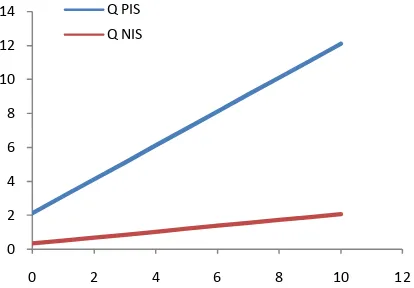
λ∗is the maximum satisfactory level and x ∗is the final compromised solution for first sub problem. We want to obtain the ideal compromised solution. In other words, the objective function Q should be minimized whereas the function Q should be maximized. As shown in Figure 1, pointx ∗= 0 is optimum compromised solution. Moreover, the maximum level of λ is λ∗= 1.0000
Now, we solve the second sub problem similar to first sub problem. In this sub problem, Q and Q are optimized as shown in Figure 2. The maximum level of
λoccurs atλ∗= 0.5. In other words, the more value ofx in this problem is better. But considering the constraint, the optimum compromised solution is x ∗= 1.000 . Similar to sub problemsPandP, the problem P is solved.The maximum satisfactory level (λ∗= 0.5000) is achieved for the compromised solutionx ∗= 0.5000. As shown in Figure 3, the best final solution of third sub problem is x ∗= 0.5000. Moreover, the maximum
satisfactory level is λ∗= 0.5000. In addition, the proposed method is applied for each sub problem independently. Therefore, this method allows utilizing the TOPSIS and VIKOR to obtain a compromise solution for each sub problems.
Figure1.The values of function Q for problem
Figure2.The values of function Q for problem P
Figure3. The values of function for problem
-3 -2.5 -2 -1.5 -1 -0.5 0 0.5 1 1.5
0 2 4 6 8 10 12
Q PIS
Q NIS
-1 0 1 2 3 4 5 6
0 2 4 6 8 10 12
Q PIS Q NIS
0 2 4 6 8 10 12 14
0 2 4 6 8 10 12
Moreover, the satisfactory level of each objective is determined.Applying VIKOR method, the result of sub problem 1 is solved and the optimum value of x ∗=
0.5000and final solution of x ∗ in the proposed method is 0.5000. Moreover, the values of x ∗, x ∗are 1.0000, 0.5000 respectively, whereas the final solution of x ∗, x ∗are 4.0000, 1.0000 applying new proposed method.
5. CONCLUSION
In this paper, we focused on applying a new compromised approach to deal with MOLSLP problems with block angular structure.Our new method combines concepts from the TOPSIS and VIKOR methods. In other words, the proposed method, applies the advantages of TOPSIS and VIKOR methods simultaneously.Unlike the traditional VIKOR method which did not consider both relative distance from positive ideal solution (PIS) and negative ideal solution (NIS), this paper considered the distance of alternatives from the PIS and NIS simultaneously. Finally, to justify the proposed method, an illustrative example was provided. Then, the sensitivity analysis was described.Using TOPSIS and VIKOR, the new proposed method aggregated the fuzzy multi-objective into single objective based on new compromised logic. Because the uncertainty is the feature of real word decision making problems, the values of decision matrix can be presented with uncertainty. The proposed method assists experts to take data in the forms of linguistic terms in a programming problem. This leads to more realistic decision-making process in real situations. The Dantzig-Wolf decomposition method is utilized to reducean N-dimension problem into some q space sub problems. Therefore, the complexity of decision making problem is reduced. Then a useful method was applied to transfer each fuzzy sub problem to three crisp sub problems. Moreover, the fuzzy constraints were transferred into crisp constraints. Then, the proposed new compromised method was applied to obtain a suitable compromise solution. To obtain compromise solution of original problem, the individual positive ideal solution (PIS) and negative ideal solution (NIS) were calculated for each objective. Moreover, the VIKOR method is applied to calculate the amounts of
‘‘group utility’’ for the ‘‘majority’’ and the individual regret for the ‘‘opponent’’.The concept of membership function is introduced and applied to aggregate the objective functions in each sub problem. Therefore, this method can help the decision makers when the coefficient of objective functions and constraint is not crisp and the problem is large scale. Therefore, this method is applied in greater number of issues to deal with the real world problems. Finally, to justify the proposed method, an illustrative example was provided.
The objective functions and constraints may be proposed as a fuzzy linear programming problem. Moreover, the programming problem can be proposed gray data. These subjects give a new opportunity for further research.
6. ACKNOWLEDGMENT
The authors would like to acknowledge the partially financial support of Islamic Azad University, Qazvin Branch, Qazvin, Iran for this research.
7. REFERENCE
1. Abo-Sinna, M.A. and Amer, A.H., "Extensions of topsis for multi-objective large-scale nonlinear programming problems",
Applied Mathematics and Computation, Vol. 162, No. 1, (2005), 243-256.
2. Zegordi, S., Nik, E. and Nazari, A., "Power plant project risk assessment using a fuzzy-anp and fuzzy-topsis method",
International Journal of Engineering-Transactions B: Applications, Vol. 25, No. 2, (2012), 107-120.
3. Hu, C., Shen, Y. and Li, S., "An interactive satisficing method based on alternative tolerance for fuzzy multiple objective optimization", Applied Mathematical Modelling, Vol. 33, No. 4, (2009), 1886-1893.
4. Dantzig, G.B. and Wolfe, P., "The decomposition algorithm for linear programs", Econometrica: Journal of the Econometric Society, (1961), 767-778.
5. Sakawa, M., "Large scale interactive fuzzy multiobjective programming: Decomposition approaches, Physica-Verlag, (2000).
6. Heydari, M., Kazem Sayadi, M. and Shahanaghi, K., "Extended vikor as a new method for solving multiple objective large-scale nonlinear programming problems", RAIRO-Operations Research, Vol. 44, No. 02, (2010), 139-152.
7. El-Sawy, A.A., El-Khouly, N.A. and Abou-El-Enien, T.H.M., "An algorithm for decomposing the parametric space in large scale linear vector optimization problems: A fuzzy approach",
Journal of Advances in Modelling and Analysis, Vol. 55, No. 2, (2000), 1-16.
8. Sakawa, M., Sawada, K. and Inuiguchi, M., "A fuzzy satisficing method for large-scale linear programming problems with block angular structure", European Journal of Operational Research, Vol. 81, No. 2, (1995), 399-409.
9. Lai, Y.-J., Liu, T.-Y. and Hwang, C.-L., "Topsis for modm",
European Journal of Operational Research, Vol. 76, No. 3, (1994), 486-500.
10. Tavakkoli-Moghaddam, R., Heydar, M. and Mousavi, S., "An integrated ahp-vikor methodology for plant location selection",
International Journal of Engineering-Transactions B: Applications, Vol. 24, No. 2, (2011), 127-137.
11. Yahyaei, M., Bashiri, M. and Garmeyi, Y., "Multi-criteria logistic hub location by network segmentation under criteria weights uncertainty", International Journal of Engineering, Vol. 27, No. 8, (2014)., 1205-1214.
12. Kaya, T. and Kahraman, C., "Multicriteria decision making in energy planning using a modified fuzzy topsis methodology",
13. Chou, Y.-C., Yen, H.-Y. and Sun, C.-C., "An integrate method for performance of women in science and technology based on entropy measure for objective weighting", Quality & Quantity, Vol. 48, No. 1, (2014), 157-172.
14. Vahdani, B., Hadipour, H., Sadaghiani, J.S. and Amiri, M., "Extension of vikor method based on interval-valued fuzzy sets", The International Journal of Advanced Manufacturing Technology, Vol. 47, No. 9-12, (2010), 1231-1239.
15. Mousavi, S., Makoui, A., Raissi, S. and Mojtahedi, S., "A multi-criteria decision-making approach with interval numbers for evaluating project risk responses", International Journal of Engineering-Transactions B: Applications, Vol. 25, No. 2, (2012), 121-130.
16. Jolai, F., Yazdian, S.A., Shahanaghi, K. and Azari Khojasteh, M., "Integrating fuzzy topsis and multi-period goal programming for purchasing multiple products from multiple suppliers", Journal of Purchasing and Supply Management, Vol. 17, No. 1, (2011), 42-53.
17. Zadeh, L.A., "Fuzzy sets", Information and Control, Vol. 8, No. 3, (1965), 338-353.
18. Bellman, R.E. and Zadeh, L.A., "Decision-making in a fuzzy environment", Management Science, Vol. 17, No. 4, (1970), B-141-B-164.
19. Mahdavi, I., Mahdavi-Amiri, N., Heidarzade, A. and Nourifar, R., "Designing a model of fuzzy topsis in multiple criteria decision making", Applied Mathematics and Computation, Vol. 206, No. 2, (2008), 607-617.
20. Lai, Y.-J. and Hwang, C.-L., "A new approach to some possibilistic linear programming problems", Fuzzy Sets And Systems, Vol. 49, No. 2, (1992), 121-133.
21. Wang, R.-C. and Liang, T.-F., "Applying possibilistic linear programming to aggregate production planning", International Journal of Production Economics, Vol. 98, No. 3, (2005), 328-341.
22. Torabi, S.A. and Hassini, E., "An interactive possibilistic programming approach for multiple objective supply chain master planning", Fuzzy Sets And Systems, Vol. 159, No. 2, (2008), 193-214.
23. Zimmermann, H.-J., "Fuzzy sets, decision making, and expert systems, Springer, (1987).
A New Compromise Decision-making Model Based on TOPSIS and VIKOR for
Solving Multi-objective Large-scale Programming Problems with a Block Angular
Structure under Uncertainty
B. Vahdania, M. Salimia ,S. M. Mousavib
a Faculty of Industrial and Mechanical Engineering, Qazvin Branch, Islamic Azad University, Qazvin, Iran
b Industrial Engineering Department, Faculty of Engineering, Shahed University, Tehran, Iran
P A P E R I N F O
Paper history: Received 06 May 2014
Received in revised form 21June 2014 Accepted 26 June 2014
Keywords:
Multi-objective Uncertainty TOPSIS VIKOR
هﺪﯿﮑﭼ
رﺎﺘﺧﺎﺳﺎﺑگرﺰﺑسﺎﯿﻘﻣﻪﻓﺪﻫﺪﻨﭼيﺰﯾرﻪﻣﺎﻧﺮﺑﻞﺋﺎﺴﻣﻞﺣرﻮﻈﻨﻣﻪﺑﺪﯾﺪﺟشورﮏﯾسﺎﺳاﺮﺑﯽﺷزﺎﺳلﺪﻣﮏﯾﻪﻟﺎﻘﻣﻦﯾارد دﻮﺷﯽﻣﻪﺋارايزﺎﻓيﺎﻫﺮﺘﻣارﺎﭘﻞﻣﺎﺷرادﻪﯾوازﯽﮐﻮﻠﺑ
.
ﻪﻠﺌﺴﻣ ﺖﯾدوﺪﺤﻣوفﺪﻫﻊﺑاﻮﺗرديزﺎﻓيﺎﻫﺮﺘﻣارﺎﭘﻞﻣﺎﺷﯽﺳرﺮﺑدرﻮﻣ
ﺪﺷﺎﺑﯽﻣﺎﻫ
.
دﻮﺷﯽﻣﻪﺘﻓﺮﮔﺮﻈﺗردنﺎﻣﺰﻤﻫرﻮﻃﻪﺑمﻮﻬﻔﻣودﯽﺷزﺎﺳيﺰﯾرﻪﻣﺎﻧﺮﺑيﺎﻫشوررد
.
ﻮﯿﺗﺎﻧﺮﺘﻟآﯽﮑﯾدﺰﻧمﻮﻬﻔﻣﻦﯿﻟوا
ﺪﺷﺎﺑﯽﻣﯽﻔﻨﻣلاهﺪﯾاباﻮﺟزايرودويزﺎﻓﺖﺒﺜﻣلاهﺪﯾاباﻮﺟﻪﺑﺎﻫ
.
ﻓﺮﮔﺮﻈﻧردمﻮﻬﻔﻣﻦﯿﻣود ﺖﯿﺑﻮﻠﻄﻣﺮﺑﯽﻨﺘﺒﻣهﺪﺷﻪﺘ
ﺪﺷﺎﺑﯽﻣتاﺮﻈﻧزاﯽﻧﺎﻤﯿﺸﭘﻞﻗاﺪﺣوﺮﺜﮐاﺪﺣياﺮﺑﯽﻫوﺮﮔ
.
دﺎﻌﺑاﺶﻫﺎﮐرﻮﻈﻨﻣﻪﺑﻪﯾﺰﺠﺗﻢﺘﯾرﻮﮕﻟاﮏﯾهﺪﺷﻪﺋاراشوررد
ﺖﺳاﻪﺘﻓﺮﮔراﺮﻗهدﺎﻔﺘﺳادرﻮﻣفﺪﻫﻊﺑﺎﺗگرﺰﺑيﺎﻀﻓ
.
لﺪﻣزاهﺪﺷﻪﺘﻓﺮﮔﺮﺑﻪﻓﺪﻫﺪﻨﭼﯽﻌﻄﻗيﺰﯾرﻪﻣﺎﻧﺮﺑشورﮏﯾهوﻼﻋﻪﺑ
ﺣياﺮﺑيزﺎﻓﯽﻄﺧ ﺖﺳاهﺪﺷﻪﺋاراﻪﻠﺌﺴﻣﻦﯾاﻞ
.
يﺎﻫشوريﺎﻨﺒﻣﺮﺑﯽﺷزﺎﺳيﺮﯿﮔﻢﯿﻤﺼﺗشورﮏﯾﺲﭙﺳ
TOPSIS
و
VIKOR
ﺖﺳاهﺪﺷﻪﺘﻓﺮﮔرﺎﮑﺑﻪﻠﺌﺴﻣﺮﯾزﺮﻫﻞﺣياﺮﺑ نﺎﻣﺰﻤﻫترﻮﺻﻪﺑ
.
ﮏﯾهﺪﺷﻪﺋارالﺪﻣﺢﯾﺮﺸﺗرﻮﻈﻨﻣﻪﺑمﺎﺠﻧاﺮﺳ
ﺖﺳاهﺪﺷهدادﺢﯿﺿﻮﺗلﺎﺜﻣ
.