VOLUME NO.6(2016),ISSUE NO.09(
SEPTEMBER
) ISSN2231-5756A Monthly Double-Blind Peer Reviewed (Refereed/Juried) Open Access International e-Journal - Included in the International Serial Directories Indexed & Listed at:
Ulrich's Periodicals Directory ©, ProQuest, U.S.A., EBSCO Publishing, U.S.A., Cabell’s Directories of Publishing Opportunities, U.S.A., Google Scholar, Open J-Gage, India [link of the same is duly available at Inflibnet of University Grants Commission (U.G.C.)],
Index Copernicus Publishers Panel, Poland with IC Value of 5.09 & number of libraries all around the world.
Circulated all over the world & Google has verified that scholars of more than 5000 Cities in 187 countries/territories are visiting our journal on regular basis.
VOLUME NO. 6 (2016), ISSUE NO. 09 (SEPTEMBER)
ISSN
2231-5756
INTERNATIONAL JOURNAL OF RESEARCH IN COMMERCE, IT & MANAGEMENT
CONTENTS
Sr.
No.
TITLE & NAME OF THE AUTHOR (S)
Page
No.
1
.
OPTIMIZING CAPITAL STRUCTURE THROUGH DEBT TO EQUITY BALANCING: A STUDY OF SELECTED
ZIMBABWE STOCK EXCHANGE LISTED COMPANIES
DR. B. NGWENYA
1
2
.
MAIZE CULTIVATION IN KARNATAKA & GROWERS’ AWARENESS ON PRICE RISK MANAGEMENT TOOLS.
V. CHANDRA SEKHAR RAO & DR. G V KESAVA RAO
5
3
.
A STUDY OF LEAD LAGS RELATIONSHIP BETWEEN NSE EQUITY MARKET AND SINGLE STOCK FUTURES
DR. SANDHYA SRIDEVI MARIPINI & SATYANARAYANA KOILADA
11
4
.
MOBILE PHONE MESSAGING INTERVENTIONS MAY PROVIDE BENEFIT IN SUPPORTING THE
SELF-MANAGEMENT OF LONG-TERM ILLNESSES: AN ANALYSIS
SURENDRA NATH SHUKLA & DR. J K SHARMA
18
5
.
LECTURERS’ PERCEPTION ON STUDENTS’ APPRAISAL OF COURSES AND TEACHING: A CASE OF UNIVERSITY
OF CAPE COAST, GHANA
EMMANUEL KOFI GYIMAH, ALBERT JUSTICE KWARTENG, ERIC ANANE & IVY KESEWAA NKRUMAH
21
6
.
EDUCATION AS A MEANS OF WOMEN’S EMPOWERMENT: A STUDY ON THE PARENTS’ ATTITUDES
DEEPRAJ CHAKRABARTY, DEBOSMITA NATH & DR. D. GHOSE
27
7
.
A STUDY ON OVERALL IMPACT OF TRAINING AND DEVELOPMENT ON JOB PERFORMANCE, MORALE OF
EMPLOYEES AND TO REDUCE THE EMPLOYEE RESISTANCE TO NEW TECHNOLOGY
DR. MAHESHA KEMPEGOWDA & PURUSHOTHAM.C.J
30
8
.
MILLING STUDIES OF PULSES USING DIFFERENT PRE-MILLING TREATMENT OF PIGEON PEA (
CAJANUS
CAJAN
)
MEDHA VYAS & PRIYANKA BHADOURIYA
35
9
.
A STUDY ON FINANCIAL DERIVATIVE OPTIONS WITH REFERENCE TO SELECTED SECTORS
BHAGYA LAKSHMI.K & DR. N. BABITHA THIMMAIAH
41
10
.
AN ARTICLE ON PERFORMANCE APPRAISAL: A STUDY WITH REFERENCE TO KIRLOSKAR ELECTRIC CO. LTD.,
MYSORE
SOWMYA.H.L
48
11
.
TECHNOLOGICAL INNOVATIONS IN INDIAN BANKING SECTOR: AN INSTRUMENT FOR ECONOMIC GROWTH
DR. PRAGYA PRASHANT GUPTA
50
12
.
LITERACY AND LITERARY PROGRAMMES AND THEIR IMPLEMENTATION IN INDIA
HARISH R.
56
13
.
THE DEVELOPMENT OF MANAGERIAL WOMEN OF BELOW POVERTY LINE SELF HELP GROUP IN DISTRICT
GONIDA IN MAHARASHTRA
KU.MRUNALI S. LILHARE
60
14
.
PROBLEMS AND PROSPECTS OF KUDUMBASREE LINKED MICRO ENTERPRISES
VARGHESE JOY
62
15
.
PROBLEMS AND PROSPECTS OF LEATHER INDUSTRY IN VELLORE DISTRICT
DR. AJAY KUMAR SHARMA
66
16
.
CHANGING E-TAIL TRENDS IN INDIA
AMIT KISHORE SINHA & DR. GYANENDRA B. S. JOHRI
73
17
.
A STUDY ON TWO WHEELER PURCHASING PATTERN OF COLLEGE STUDENTS IN KOTTARAKARA TALUK
ANCY SAM
79
18
.
HUMAN INTERACTION WITH SMART MOBILE PHONE
DR. C. NIRMALA
84
19
.
POLITICIZATION OF STUDENTS' UNIONS: A STUDY IN BHUBANESWAR, ODISHA
PRASANTA MOHAPATRA
87
20
.
RELEVANCE OF UNORGANISED RETAILERS AND THEIR PROBLEMS WITH SPECIAL EMPHASIS TO CALICUT
CITY
SHAHIBA.EC
93
VOLUME NO. 6 (2016), ISSUE NO. 09 (SEPTEMBER)
ISSN
2231-5756
INTERNATIONAL JOURNAL OF RESEARCH IN COMMERCE, IT & MANAGEMENT
CHIEF PATRON
PROF. K. K. AGGARWAL
Chairman, Malaviya National Institute of Technology, Jaipur
(An institute of National Importance & fully funded by Ministry of Human Resource Development, Government of India)
Chancellor, K. R. Mangalam University, Gurgaon
Chancellor, Lingaya’s University, Faridabad
Founder Vice-Chancellor (1998-2008), Guru Gobind Singh Indraprastha University, Delhi
Ex. Pro Vice-Chancellor, Guru Jambheshwar University, Hisar
FOUNDER PATRON
LATE SH. RAM BHAJAN AGGARWAL
Former State Minister for Home & Tourism, Government of Haryana
Former Vice-President, Dadri Education Society, Charkhi Dadri
Former President, Chinar Syntex Ltd. (Textile Mills), Bhiwani
FORMER CO-ORDINATOR
DR. S. GARG
Faculty, Shree Ram Institute of Business & Management, Urjani
ADVISORS
PROF. M. S. SENAM RAJU
Director A. C. D., School of Management Studies, I.G.N.O.U., New Delhi
PROF. M. N. SHARMA
Chairman, M.B.A., Haryana College of Technology & Management, Kaithal
PROF. S. L. MAHANDRU
Principal (Retd.), Maharaja Agrasen College, Jagadhri
EDITOR
PROF. R. K. SHARMA
Professor, Bharti Vidyapeeth University Institute of Management & Research, New Delhi
CO-EDITOR
DR. BHAVET
Faculty, Shree Ram Institute of Engineering & Technology, Urjani
EDITORIAL ADVISORY BOARD
DR. RAJESH MODI
Faculty, Yanbu Industrial College, Kingdom of Saudi Arabia
PROF. SANJIV MITTAL
University School of Management Studies, Guru Gobind Singh I. P. University, Delhi
PROF. ANIL K. SAINI
Chairperson (CRC), Guru Gobind Singh I. P. University, Delhi
DR. SAMBHAVNA
VOLUME NO. 6 (2016), ISSUE NO. 09 (SEPTEMBER)
ISSN
2231-5756
INTERNATIONAL JOURNAL OF RESEARCH IN COMMERCE, IT & MANAGEMENT
DR. MOHENDER KUMAR GUPTA
Associate Professor, P. J. L. N. Government College, Faridabad
DR. SHIVAKUMAR DEENE
Asst. Professor, Dept. of Commerce, School of Business Studies, Central University of Karnataka, Gulbarga
ASSOCIATE EDITORS
PROF. NAWAB ALI KHAN
Department of Commerce, Aligarh Muslim University, Aligarh, U.P.
PROF. ABHAY BANSAL
Head, Department of I.T., Amity School of Engineering & Technology, Amity University, Noida
PROF. A. SURYANARAYANA
Department of Business Management, Osmania University, Hyderabad
PROF. V. SELVAM
SSL, VIT University, Vellore
DR. PARDEEP AHLAWAT
Associate Professor, Institute of Management Studies & Research, Maharshi Dayanand University, Rohtak
DR. S. TABASSUM SULTANA
Associate Professor, Department of Business Management, Matrusri Institute of P.G. Studies, Hyderabad
SURJEET SINGH
Asst. Professor, Department of Computer Science, G. M. N. (P.G.) College, Ambala Cantt.
FORMER TECHNICAL ADVISOR
AMITA
Faculty, Government M. S., Mohali
FINANCIAL ADVISORS
DICKIN GOYAL
Advocate & Tax Adviser, Panchkula
NEENA
Investment Consultant, Chambaghat, Solan, Himachal Pradesh
LEGAL ADVISORS
JITENDER S. CHAHAL
Advocate, Punjab & Haryana High Court, Chandigarh U.T.
CHANDER BHUSHAN SHARMA
Advocate & Consultant, District Courts, Yamunanagar at Jagadhri
SUPERINTENDENT
VOLUME NO. 6 (2016), ISSUE NO. 09 (SEPTEMBER)
ISSN
2231-5756
INTERNATIONAL JOURNAL OF RESEARCH IN COMMERCE, IT & MANAGEMENT
CALL FOR MANUSCRIPTS
We invite unpublished novel, original, empirical and high quality research work pertaining to the recent developments & practices in the areas of Com-puter Science & Applications; Commerce; Business; Finance; Marketing; Human Resource Management; General Management; Banking; Economics; Tourism Administration & Management; Education; Law; Library & Information Science; Defence & Strategic Studies; Electronic Science; Corporate Gov-ernance; Industrial Relations; and emerging paradigms in allied subjects like Accounting; Accounting Information Systems; Accounting Theory & Practice; Auditing; Behavioral Accounting; Behavioral Economics; Corporate Finance; Cost Accounting; Econometrics; Economic Development; Economic History; Financial Institutions & Markets; Financial Services; Fiscal Policy; Government & Non Profit Accounting; Industrial Organization; International Economics & Trade; International Finance; Macro Economics; Micro Economics; Rural Economics; Co-operation; Demography: Development Planning; Development Studies; Applied Economics; Development Economics; Business Economics; Monetary Policy; Public Policy Economics; Real Estate; Regional Economics; Political Science; Continuing Education; Labour Welfare; Philosophy; Psychology; Sociology; Tax Accounting; Advertising & Promotion Management; Management Information Systems (MIS); Business Law; Public Responsibility & Ethics; Communication; Direct Marketing; E-Commerce; Global Business; Health Care Administration; Labour Relations & Human Resource Management; Marketing Research; Marketing Theory & Applications; Non-Profit Or-ganizations; Office Administration/Management; Operations Research/Statistics; Organizational Behavior & Theory; Organizational Development; Pro-duction/Operations; International Relations; Human Rights & Duties; Public Administration; Population Studies; Purchasing/Materials Management; Re-tailing; Sales/Selling; Services; Small Business Entrepreneurship; Strategic Management Policy; Technology/Innovation; Tourism & Hospitality; Transpor-tation Distribution; Algorithms; Artificial Intelligence; Compilers & Translation; Computer Aided Design (CAD); Computer Aided Manufacturing; Computer Graphics; Computer Organization & Architecture; Database Structures & Systems; Discrete Structures; Internet; Management Information Systems; Mod-eling & Simulation; Neural Systems/Neural Networks; Numerical Analysis/Scientific Computing; Object Oriented Programming; Operating Systems; Pro-gramming Languages; Robotics; Symbolic & Formal Logic; Web Design and emerging paradigms in allied subjects.
Anybody can submit the soft copy of unpublished novel; original; empirical and high quality research work/manuscriptanytime in M.S. Word format
after preparing the same as per our GUIDELINES FOR SUBMISSION; at our email address i.e. [email protected] or online by clicking the link online
submission as given on our website (FOR ONLINE SUBMISSION, CLICK HERE).
GUIDELINES FOR SUBMISSION OF MANUSCRIPT
1. COVERING LETTER FOR SUBMISSION:
DATED: _____________
THE EDITOR
IJRCM
Subject: SUBMISSION OF MANUSCRIPT IN THE AREA OF .
(e.g. Finance/Mkt./HRM/General Mgt./Engineering/Economics/Computer/IT/ Education/Psychology/Law/Math/other, please specify)
DEAR SIR/MADAM
Please find my submission of manuscript titled ‘___________________________________________’ for likely publication in one of your journals.
I hereby affirm that the contents of this manuscript are original. Furthermore, it has neither been published anywhere in any language fully or partly, nor it is under review for publication elsewhere.
I affirm that all the co-authors of this manuscript have seen the submitted version of the manuscript and have agreed to inclusion of their names as co-authors.
Also, if my/our manuscript is accepted, I agree to comply with the formalities as given on the website of the journal. The Journal has discretion to publish our contribution in any of its journals.
NAME OF CORRESPONDING AUTHOR :
Designation/Post* :
Institution/College/University with full address & Pin Code :
Residential address with Pin Code :
Mobile Number (s) with country ISD code :
Is WhatsApp or Viber active on your above noted Mobile Number (Yes/No) :
Landline Number (s) with country ISD code :
E-mail Address :
Alternate E-mail Address :
Nationality :
* i.e. Alumnus (Male Alumni), Alumna (Female Alumni), Student, Research Scholar (M. Phil), Research Scholar (Ph. D.), JRF, Research Assistant, Assistant
Lecturer, Lecturer, Senior Lecturer, Junior Assistant Professor, Assistant Professor, Senior Assistant Professor, Co-ordinator, Reader, Associate
Profes-sor, ProfesProfes-sor, Head, Vice-Principal, Dy. Director, Principal, Director, Dean, President, Vice Chancellor, Industry Designation etc. The qualification of
VOLUME NO. 6 (2016), ISSUE NO. 09 (SEPTEMBER)
ISSN
2231-5756
INTERNATIONAL JOURNAL OF RESEARCH IN COMMERCE, IT & MANAGEMENT
NOTES:
a) The whole manuscript has to be in ONE MS WORD FILE only, which will start from the covering letter, inside the manuscript. pdf.
version is liable to be rejected without any consideration.
b) The sender is required to mention the following in the SUBJECT COLUMNof the mail:
New Manuscript for Review in the area of (e.g. Finance/Marketing/HRM/General Mgt./Engineering/Economics/Computer/IT/
Education/Psychology/Law/Math/other, please specify)
c) There is no need to give any text in the body of the mail, except the cases where the author wishes to give any specific message
w.r.t. to the manuscript.
d) The total size of the file containing the manuscript is expected to be below 1000 KB.
e) Only the Abstract will not be considered for review and the author is required to submit the complete manuscript in the first instance.
f) The journal gives acknowledgement w.r.t. the receipt of every email within twenty-four hours and in case of non-receipt of acknowledgment from the journal, w.r.t. the submission of the manuscript, within two days of its submission, the corresponding author is required to demand for the same by sending a separate mail to the journal.
g) The author (s) name or details should not appear anywhere on the body of the manuscript, except on the covering letter and the cover page of the manuscript, in the manner as mentioned in the guidelines.
2. MANUSCRIPT TITLE: The title of the paper should be typed in bold letters, centeredand fully capitalised.
3. AUTHOR NAME (S) & AFFILIATIONS: Author (s) name, designation, affiliation (s), address, mobile/landline number (s), and
email/al-ternate email address should be given underneath the title.
4. ACKNOWLEDGMENTS: Acknowledgements can be given to reviewers, guides, funding institutions, etc., if any.
5. ABSTRACT: Abstract should be in fully Italic printing, ranging between 150 to 300 words. The abstract must be informative and
eluci-dating the background, aims, methods, results & conclusion in a SINGLE PARA. Abbreviations must be mentioned in full.
6. KEYWORDS: Abstract must be followed by a list of keywords, subject to the maximum of five. These should be arranged in alphabetic
order separated by commas and full stop at the end. All words of the keywords, including the first one should be in small letters, except special words e.g. name of the Countries, abbreviations etc.
7. JEL CODE: Provide the appropriate Journal of Economic Literature Classification System code (s). JEL codes are available at
www.aea-web.org/econlit/jelCodes.php. However, mentioning of JEL Code is not mandatory.
8. MANUSCRIPT: Manuscript must be in BRITISH ENGLISH prepared on a standard A4 size PORTRAIT SETTING PAPER. It should be free
from any errors i.e. grammatical, spelling or punctuation. It must be thoroughly edited at your end.
9. HEADINGS: All the headings must be bold-faced, aligned left and fully capitalised. Leave a blank line before each heading.
10. SUB-HEADINGS: All the sub-headings must be bold-faced, aligned left and fully capitalised.
11. MAIN TEXT:
THE MAIN TEXT SHOULD FOLLOW THE FOLLOWING SEQUENCE:
INTRODUCTION
REVIEW OF LITERATURE
NEED/IMPORTANCE OF THE STUDY
STATEMENT OF THE PROBLEM
OBJECTIVES
HYPOTHESIS (ES)
RESEARCH METHODOLOGY
RESULTS & DISCUSSION
FINDINGS
RECOMMENDATIONS/SUGGESTIONS
CONCLUSIONS
LIMITATIONS
SCOPE FOR FURTHER RESEARCH
REFERENCES
APPENDIX/ANNEXURE
VOLUME NO. 6 (2016), ISSUE NO. 09 (SEPTEMBER)
ISSN
2231-5756
INTERNATIONAL JOURNAL OF RESEARCH IN COMMERCE, IT & MANAGEMENT
12. FIGURES & TABLES: These should be simple, crystal CLEAR, centered, separately numbered & self-explained, and the titles must be
above the table/figure. Sources of data should be mentioned below the table/figure. It should be ensured that the tables/figures are
referred to from the main text.
13. EQUATIONS/FORMULAE: These should be consecutively numbered in parenthesis, left aligned with equation/formulae number placed
at the right. The equation editor provided with standard versions of Microsoft Word may be utilised. If any other equation editor is utilised, author must confirm that these equations may be viewed and edited in versions of Microsoft Office that does not have the editor.
14. ACRONYMS: These should not be used in the abstract. The use of acronyms is elsewhere is acceptable. Acronyms should be defined
on its first use in each section e.g. Reserve Bank of India (RBI). Acronyms should be redefined on first use in subsequent sections.
15. REFERENCES: The list of all references should be alphabetically arranged. The author (s) should mention only the actually utilised
references in the preparation of manuscript and they may follow Harvard Style of Referencing. Also check to ensure that everything
that you are including in the reference section is duly cited in the paper. The author (s) are supposed to follow the references as per
the following:
•
All works cited in the text (including sources for tables and figures) should be listed alphabetically.•
Use (ed.) for one editor, and (ed.s) for multiple editors.•
When listing two or more works by one author, use --- (20xx), such as after Kohl (1997), use --- (2001), etc., in chronologically ascending order.•
Indicate (opening and closing) page numbers for articles in journals and for chapters in books.•
The title of books and journals should be in italic printing. Double quotation marks are used for titles of journal articles, book chapters, dissertations, reports, working papers, unpublished material, etc.•
For titles in a language other than English, provide an English translation in parenthesis.•
Headers, footers, endnotes and footnotes should not be used in the document. However, you can mention short notes to elucidatesome specific point, which may be placed in number orders before the references.
PLEASE USE THE FOLLOWING FOR STYLE AND PUNCTUATION IN REFERENCES:
BOOKS
•
Bowersox, Donald J., Closs, David J., (1996), "Logistical Management." Tata McGraw, Hill, New Delhi.•
Hunker, H.L. and A.J. Wright (1963), "Factors of Industrial Location in Ohio" Ohio State University, Nigeria.CONTRIBUTIONS TO BOOKS
•
Sharma T., Kwatra, G. (2008) Effectiveness of Social Advertising: A Study of Selected Campaigns, Corporate Social Responsibility, Edited by David Crowther & Nicholas Capaldi, Ashgate Research Companion to Corporate Social Responsibility, Chapter 15, pp 287-303.JOURNAL AND OTHER ARTICLES
•
Schemenner, R.W., Huber, J.C. and Cook, R.L. (1987), "Geographic Differences and the Location of New Manufacturing Facilities," Jour-nal of Urban Economics, Vol. 21, No. 1, pp. 83-104.CONFERENCE PAPERS
•
Garg, Sambhav (2011): "Business Ethics" Paper presented at the Annual International Conference for the All India Management Asso-ciation, New Delhi, India, 19–23UNPUBLISHED DISSERTATIONS
•
Kumar S. (2011): "Customer Value: A Comparative Study of Rural and Urban Customers," Thesis, Kurukshetra University, Kurukshetra.ONLINE RESOURCES
•
Always indicate the date that the source was accessed, as online resources are frequently updated or removed.WEBSITES
VOLUME NO. 6 (2016), ISSUE NO. 09 (SEPTEMBER)
ISSN
2231-5756
INTERNATIONAL JOURNAL OF RESEARCH IN COMMERCE, IT & MANAGEMENT
LITERACY AND LITERARY PROGRAMMES AND THEIR IMPLEMENTATION IN INDIA
HARISH R.
ASST. PROFESSOR
KSEF COLLEGE OF EDUCATION
TUMKUR
ABSTRACT
India is the second highest populated country in the world, it was achieved 67% of literacy and 33% will be inroad because of poverty, religion, school environment community, social cultural condition. To overcome from this Govt. has taken strong will and steps to eradicate illiteracy from India by providing free education, books for 1st to 10th standard for both boys and girls and give more importance to girls education for all the communities to bridge the general gap at elementary
school level by 2001 to 2011, this makes citizens educationally strong and meet their demands and those of their family needs by increasing their productivity and their potential to achieve a higher standards of living. Govt. has made special scheme for backward classes such as scheduled tribes and scheduled castes in the name of Tribal special programme. and also Government has introduced several programmes towards the society like Akshara scheme, Akshara Deepa, sar-vashikshana abiyana etc. In this way the Government has taken the decisions to overcome from the illiteracy in this country.
KEYWORDS
literacy, community, UNESCO, UNICEF, backward classes, Bharata darshana, Aganawadis, saksharata.
INTRODUCTION
iteracy the world itself indicates that it’s not only education of the human beings, it is to prepare them to live life with the society how to interact with others. Literacy is one of the most important aspect of social development and also the integral part of human development it is a basic human need. Therefore, opens unlimited possibilities calling for responses that are creative constructive and challenging.
Literacy is now part of the human rights and index of their development. Education deepens their understanding of themselves and the world. There are so many programmes are undertaken by state and central government for the education of human to make them literates.
LITERACY
Literacy is one of the most important aspects of social development and also the integral part of the human development. it is a basic human need. Therefore, opens unlimited possibilities calling for responses that are creative constructive and challenging.
Literacy and defined as senses operations is the ability to read and write with understanding in any language. Mahatma Gandhi ji said that education of a boy means education of men, education of girl of education of a family.
Education has the dual function of transmitting to the new generation, the waitage of the past with its accumulate wisdom and preparing it for the present and the future, that the emergent needs of society and individuals hold before us.
India has emerged as a leader in the current knowledge based global economy and Karnataka state as forms to literacy at grass root level also. The literacy and education have been termed as the essential requirement of the society against the social evils.
IMPORTANCE
1. LITERACY AND HUMAN RIGHTS
Literacy is now part of the human rights. Most of the nations of the world have also accepted their obligation to provide at least free elementary education to their citizens.
Article 26 of the universal declaration of human rights declares that Everyone has the right to education, education shall be free, at least in the elementary and fundamental stage, elementary education shall be compulsory. Technical and professional education will be generally available and higher education shall be equally accessible to all on the basis of merit.
This right is also repeated in the on declaration of the rights of the child which seeks to ensure right to free and compulsory education at least in the elementary stages and education to promote general culture, abilities, judgment and sense of responsibility to become a useful member of society and opportunity to recre-ation and play to attain the same purpose as of educrecre-ation.
India has ratified the above, and these have thus the poser of domestic laws, from the human rights perspective constitutional guarantees arise automatically.
2. LITERACY AND HUMAN DEVELOPMENT
Literacy is now part of the human development index. Government of India has also accepted this position and one of the important components in the National Human development initiative announced in the union budget 1999-2000 is education forming also a component in the prime minister’s special action plan. By improving people’s ability to acquire and use information, education deepens their understanding of themselves and the world, enriches their minds by brood-ing their experience and improves the choice they make as consumers, producers and citizens education strengthens their ability to meet their wants and those of their family by increasing their productivity and their potential to achieve a higher standard of living. by improving people’s confidence and their ability to create and innovate, it multiplies their opportunities for personal and social achievement.
In the field of development economics, literacy holds an important place as a parameter to measure development one of the three components used in the calculation of H.D.I. is literacy as it is a cumulative measure of several factors that contribute to human development.
Education is thus viewed as an integral part of national development; development is not only economic growth rather it compared is not only economic growth rather it comprehended opportunities to all people for better life with man as end of development are linked in a variety of ways.
EDUCATION AND SOCIAL TRANSFORMATION
Indian constitution has recognized the significance of education for social transformation. It is a document committed to social justices. Preamble affirms a deter-mination to secure liberty of thought, expression, belief faith and worship and equality of status and opportunity and to promote amongst the people a feeling of fraternity, ensuring the dignity of the individual and the unity of the nation.
Literacy forms the cornerstone for making the provision of equality of opportunity a reality. The objective specified in the preamble contains the basic structure of the constitution, which cannot be amended and the preamble may be invoked to determine the ambition of fundamental rights and directive principles of state policy.
We think that the right to life includes right to live with human dignity and all that goes along with it namely the bare necessaries of life such as adequate nutrition, clothing and shelter and facilities for reading, writing and expressing oneself in diverse form, freely moving about mixing and mingling with fellow human beings.
HISTORY OF LITERACY
If we come to know the literacy rate. There was a big gap between men and women that is total literacy rate was 19.23 % in urban and rural area was 21.23%.
VOLUME NO. 6 (2016), ISSUE NO. 09 (SEPTEMBER)
ISSN
2231-5756
INTERNATIONAL JOURNAL OF RESEARCH IN COMMERCE, IT & MANAGEMENT
In the total Indian population 3,04,34,962 are literates. Among them 1,76,61,211 were men, 1,27,13,751 were women. This shows the decrease or loss of women literacy in India.
There is also a gap between district of Karnataka, Dakshina Kannada occupied first place in having 83.35 % of total literacy 8 districts had literacy rates of within 50% and in districts in rural area had literacy rates of within 50% Gulbarga 29.43% Raichur in rural 28.26%
The literacy rate of SC and ST is 58.87% total population of the district from this man were 63.75% women were 41.72% in Bangalore 70.23% in Raichur 38.76% This shows that literacy is one of the major problem forced by every states mentioned and also in the whole world. And hence to fulfill these gap and make of people educator. Indian govt. took plenty of programmes from pre independence to post independence so that Karnataka also adopted so many literacy pro-grammes and implementation to make the people literates.
National adult education programme was started in 1978 under the NAEP the rural functional literacy programme and state adult education programme were started.
State Govt. started the Akshara scheme in 1983 and Akshara deepa in 1983 which called special literacy programme.
1986 mass programme for functional literacy was led by four years. By starting the national literacy mission in 1988 the state literacy programme has become more important.
LITERACY PROGRAMMES
India has emerged as a leader in the current knowledge based global economy and Karnataka state has focus to tackle illiteracy at grass root level. The literacy and education have been termed as the essential requirement of the society against the social evils.
Within the national policy frame work the department of mass education, has the mission to provide lifelong and continuous, has the mission to provide lifelong and continuous education and to create a learning society through provision of comprehensive educational facility in every village to enable learners, neo literates and dropouts to continue their learning skills beyond literacy the KSLMA has implemented many literacy programs through Zilla saksharatha Samithi rates was not clear and to completely eradicate illiteracy polydenate approach is required to achieve the literacy level of the developed society.
The impact of the following literacy programmes should clearly show and from the major thrust areas like acquiring, using and improving literacy skills by day to day practice. Leading to life enrichment / quality life improvement and an impact on the different aspects of society in Karnataka.
1. CONTINUING EDUCATION PROGRAMME (C.E.P)
Continuing education programme was launched to provide lifelong learning opportunity to all beyond basic learning and primary education. This program was designed to reinforce strengthen and develop the literacy and other skill gained by the neo- literate through the non-formal literacy program. The objective of the program was to provide comprehensive educational facility in each village for retention, up gradation continuation and application of literacy skills to enable learners, neo literate’s dropouts and all those who are interested to continue their learning skill beyond basic literacy.
For every 2000- 2500 population one continuing education centre (CEC) and for every 10 continuing education centres, one Nodal continuing education centre (NCEC) have been established.
The CEC, and NCEC are managed by the breraks and assistant preraks who are members of the local community. they are paid a nomial honorarium presacks conduct activities like neo – literates class, reading room, library characha mandal. Information centre, sports and cultural activities, training mobilization of the people etc. the assistant preach runs the learning centre for 20 non literates for every 6 months assist the preach.
2. LITERACY THROUGH STUDENTS (L.T.S)
Literacy through school students is a new programme to kindle social responsibility among youth and thereby to bring the change in the society. It is aimed at
involving the students in the process of literacy campaign. The programme emphasizes literacy programme implemented through students studying in 9th and 11th
standards. Each student’s teacher to non-literates.
Z.S.S. identified the non-literates and matching batching is made at the school level. Training on teaching methodology is imported to students by the resource
person in the same institution. Teaching learning process is for 5 months and at the end of 5th month evaluation of the learners is being conducted. This Programme
is operational in 24 districts.
3. CAMP BASED LITERACY PROGRAMME
New approach of providing literacy rapid learning camps. On – going rapid learning campus are targeted to cover SC/ ST non – literates under SCP and TSP components. Each camp conducted for 50 learners. The durations of the camp is 30/60 days.
Directorate of mass education has invited for a research proposal to assess the impact of all literacy programmes as mentioned above.
4. EDUCATION FOR ALL – AN INDIAN SCENARIO
In December 1993, the first ever education for all submit was hosted by India attended by leaders of nine highly populated developing nations of the world. The submit reaffirmed the global commitment to provide basic learning opportunities to all peoples.
The submit sponsored by UNESCO UNICEF and UNFDA (and the world bank) saw the participation of 23 other international organizational and carried forward the vision of the 1990 world conference on education for all held at jonstien. One of the deliberations of the conference focused an education for girls, women and empowerment of women.
The focus of the Delhi declaration and the programs of action adopted to empowerment the pledge taken by nations and organizations at the summit, resets on universal primary education and universal literacy with a special emphasis on removing gender disparities.
5. PROJECT FOR ERADICATION OF RESIDUAL ILLITERACY (P.R.I)
This is on- going program in 14 districts and expected to be junction for 3 more districts each district is divided in number of clusters each cluster would have
minimum 5 gram panchayath 2-3 worlds. The districts are under preparatory work and will start the teaching learning process by 1st week of June after conducting
the tracing the volunteers.
6. SPECIAL COMPONENT PROGRAM / PLAN (S.C.P.)
Special compound plan is designed to channelize the flow of outlays and benefits from the general sectors. In the plans of the states and the central ministries for development of scheduled castes at least in proportion to their population to the total population. Twenty-one state and three union territories are formulating their respective special component plan. The special plan of the states is supplemented with special central assistance with a view to creating a multiplier effect and helping fill the gaps which the normal financial flows from the central and state plans are not able to provide.
SPECIAL CENTRAL ASSISTANCE (S.C.A)
To special component plan of the state/ UTS for scheduled castes people is linked to government of India’s strategy for the socio economic development of these people. the centrally sponsored scheme and the most important programme of the ministry of welfare for the alleviation of the poverty among scheduled caste people. the underlying objective SCA which provides hundred percent (poverty among scheduled caste people) grant to states and UT,s as an additive to their special component plans is that it would be used to give un added thrust to the development programmes for ST people with reference to their occupational pattern and the need for increasing the productivity of and income from their limited assets by taking up family oriented schemes for them the SCA is use to fill the critical gaps and vital missing inputs in family oriented income generating schemes and through non- recurring items, so as to make the schemes more mean-ingful and effective.
VOLUME NO. 6 (2016), ISSUE NO. 09 (SEPTEMBER)
ISSN
2231-5756
INTERNATIONAL JOURNAL OF RESEARCH IN COMMERCE, IT & MANAGEMENT
TRIBAL SPECIAL PROGRAMMES (TSP)
There are so many programmes held by Government to the upliftment of scheduled tribes particularly in the field of education.
1. EDUCATION
It is clear that backwardness in education is an important cause for economic backwardness. Central and state government, attach greater importance to scheduled tribes economic progress.
Under this scheme 43 Balawadis were setup. This excludes the balawadis run by social welfare department. The scheme is meant to develop attitudes in learning to encourage children for accelerating the development of their intellectual capacity to make them strongly attached to hygienic circumstances.
2. NURSERY SCHOOLS/ SINGLE TEACHER SCHOOLS
The scheduled tribe development dept. runs 14 nursery schools and 12 single teacher schools. The children studying in nursery schools are given free mid- day meals and dress in addition to lump sum grant. The single teacher schools set up with the intention of creating awareness about education, health and cleanliness of the surroundings among the scheduled tribes, especially among those who dwell in for areas and spread education among their children’s.
3. GRANT TO PARENTS
The scheduled tribe’s students who seek admission in boarding are being paid Rs. 200 per month apart from free uniform cloths
4. EDUCATIONAL FACILITIES UP TO THE HIGH SCHOOL LEVEL
Apart from giving full free concession to all scheduled tribe’s students lump sum grant and special stipend are also being given to them. In the case of students. Who fail in the final examinations of one class are being given half the amount of lump sum grants.
5. HOSTEL FACILITIES
One hundred and eleven parametric hostels and 3 GRB schools and being run to help the education of ST students. It is those students who do not stay within reasonable distance from the school are beneficiaries. 30 students are given accommodation in each hostel.
6. EDUCATIONAL RECREATION CENTRES.
Educational recreation centres are being run in the scheduled tribes residential centres. these centres are being provided with furniture, books newspapers and recreational aids.
7. ENCOURAGEMENT IN ATHLETICS AND ART FORM
Prizes are given to scheduled tribe’s students who score victories in art and sport activities at the state level in the following manner. Who get the first and second place at the state level competitions, prize is given at the rate of Rs. 400 and Rs. 300 for district level winners Rs. 300 to Rs. 500 is offered.
8. PRE- EXAMINATION TRAINING CENTRES
The training candidates for appointment to the vacancies notified by the Kerala public service omission, union public service commission, banks and other institu-tion of public sector. 3 pre- examinainstitu-tion training centres are funcinstitu-tioning in Thiruvananthapuram, Ernakulam and Kozhikode district.
9. COLLEGE EDUCATION
Students of the scheduled tribes are being exempted from paying fees including the examination fee. In addition to the above, they are given lump sum grant and monthly stipend at various rates.
10. SELF-EMPLOYMENT
Candidates who have undergone training in technical subjects are being given financial assistance for all self-employment to the time of Rs. 3000. the scheduled tribes and scheduled casts development corporation carrying out various projects in this connection.
11. ASSISTANCE FOR AMRID
To find out training for self-employment, vocational training, campus of leadership training and providing tutorial facilities for students failing in SSLC and pre degree examination etc.
12. ASSISTANCE FOR STUDY AT TUTORIALS
Students who fail in SSLC examinations are given assistance in the following manner lumps um grant Rs. 100 monthly stipend Rs. 600, tution fees Rs. 450 assistances are being made available to students who fail in pre-degree examination also.
13. BHARATHA DARSHAN/ KERALA DARSHAN
30 boys who scored high marks in SSLC examination are selected for Bharath darshan program of 20 days where as 30 girl’s students are selected for Kerala darshan program.
Like this the government provided all the facilities to scheduled tribes.
IMPROVEMENT OF LITERACY RATES
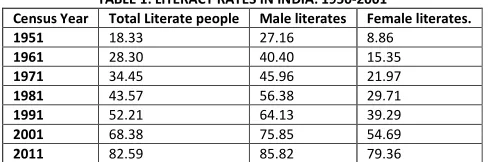
More than the decline in population growth rate, it is the spurt in literacy rates that makes the present census stand out from other in the post independent India more than three fourths of our made population and a little more than half of the female population are now literates.
Thus one third of our population still do not process even the basic proficiency in literacy. During 1991-2000 literacy rates improved imprecisely from 52.21% in 1991 to 65.38% is 2001. Thus showing an improvement for more than 13% of points.
More interesting aspects of improving literacy rates is the significant increase of 14.87% points is the significant increase of 14.87% points in case of female literacy rate, which is more than the increase in the female literacy rate, which increased by 11.72% However, still the male/ female differential in literacy rate is of the tune of almost 22% this is also repeated in sex ratio among literate population which is as low as 667 compared to 933 overall sex ratio. Despite the decline in number of illiterates and improved literacy rates. India has to go a long way to achieve the goal of universal literacy. The program in literacy during the previous decade looks impressive mainly because of the fact that during the last four decades the name remained very low and only a little progress should be achieved. Because of the parental thirst for education the literacy rates have now reached to somewhat reasonable levels. Therefore, a literacy rate at 65% appears quite credible. It is rather a matter of great concern that though Kerala attained 65% literacy way back in 60 many status even now have literacy rates well below the national average of 65% the more detailed census data when available will throw more light on the status of literates being produced However 1991 census suggests that about 25% of the total literates were just literates without completing even primary education as mentioned above the census definition of literacy in ability to read and write, but even the poorest of parents want their child to complete a bare minimum elementary education.
TABLE 1: LITERACY RATES IN INDIA: 1950-2001
Census Year Total Literate people Male literates Female literates.
1951 18.33 27.16 8.86
1961 28.30 40.40 15.35
1971 34.45 45.96 21.97
1981 43.57 56.38 29.71
1991 52.21 64.13 39.29
2001 68.38 75.85 54.69
2011 82.59 85.82 79.36
VOLUME NO. 6 (2016), ISSUE NO. 09 (SEPTEMBER)
ISSN
2231-5756
INTERNATIONAL JOURNAL OF RESEARCH IN COMMERCE, IT & MANAGEMENT
Provisional data regarding population, decadal growth, density, literacy and gender ratios of the Indian population has recently become available and although there has been some important gain since the last Indian census from 1991, there are some exceedingly disturbing trends in the data that has been published so for.
On the positive side some of the most dramatic improvement in literacy have been seen in what were previously considered as highly back ward states, called Rajasthan, Chhattisgarh and Madhya Pradesh whose literacy rates have now reached close to the national average.
TABLE 2
States Decadal Growth Literacy 2001
Rajasthan 22.5% 61%
Chhattisgarh 23.3% 65.2%
Madhya Pradesh 19.4% 65.1%
India 13.75% 65.4%
PROBLEM FOR GROWTH OF LITERACY
1. FAMILY ECONOMIC CONDITION
Generally, economically backward family, many parents send their daughters to school. The cost of education to families which living in poverty is not affordable while in many countries primary education is free, a poor family may not be able to meet the cost of school uniform, school supplies and other miscellaneous expenses. The opportunities cost of education is also a consideration for poor families. if the girls are sent to school, the family gives up the income from girls who work to supplement family income.
2. COMMUNITY SOCIO CULTURAL CONSIDERATION
The low status of women in the selected countries is a major factors lindering girl’s enrolment and retention, since most of the societies are male oriented and male dominated community and parental attitude. Towards girl’s education count a lot in decisions affecting girl’s education.
3. LOW LEVEL FAMILY EDUCATION
Studies also revealed correlation between the level of education of the family and that of girl’s education. A study by S.A Qader and S.K Kunder showed that the highest correlate of participation was the highest level of education attained by the household., followed by the family heads education
4. GIRLS ATTITUDE TOWARDS EDUCATION
This factors may be attributed as a concomitant result of the three previous problems as well as other in school factors. The problems of the attitude of the girls themselves must be separately addressed girls because of the low status afforded parents, are bound to have low self-esteem and would perceive themselves as inferior to boys, their motivation for schooling is very low since their parents are ignorant or don’t see the benefits of education for girls.
5. PHYSICAL ENVIRONMENT OF SCHOOL
By reason of geography and topography school sometimes are at a considerable distance from the homes of girls. Going to school becomes inconvenient for the young children specially girls traveling a long distance to school also may cause a special hazard for older girls. Parents fear that they will be more exposed to sexual liaison or sexual harassment while traveling
6. LACK OF FEMALE TEACHERS
In a tradition bound society preference for female teachers has been recurring (note parents feel more comfortable when their girls are under the care of female teachers). In most cases, trained women teachers who would be willing to be posted in rural schools.
7. CURRICULUM
Generally, the school curriculum has been described as being irrelevant to needs of girls. In some case, it is so urban oriented that rural girls feel even more alienated. The curriculum is overloaded and unsuited to the development levels of the children.
8. IRREGULAR SCHOOL SUPERVISION
Effective supervision of school is hampered by several problems. There are too few supervisions to cover the vast areas that need to covered some of which are virtually inaccessible moreover supervisors have to look into multifarious concerns where in the problems of girl’s education may not be a specific one.
9. GIRLS BRIDGING THE GAP
The gap between boys and girl’s participation in elementary education is the biggest single gap that needs to be filled for universal action the problem of UEE is in essence. The problems of girl child. The gender disparity. Particularly in the rural areas, reflects the discriminating social attitude to the girl child.
Therefore, in addition to monetary inputs, interventions have to be specifically designed to bring about a change in attitudes.
India is going to host and international meet on education with focus on girl’s education, the meet is to evolve strategies to bridge the gender gap at elementary school level by 2001. India is committed to not only impart elementary education to all children of 14 years by that year but also to ensure that girls do not log behind the boys in education.
CONCLUSION
India is the second highest populated country in the world it comes under the pressure of various administration and foreign invention due to which lack behind in the field of education there was no proper importance was given during the foreign administration after. After independence much importance is given to education as a result of this India has achieved about 67% of literacy still 33% literacy was to be inroad there are many reason for the illiteracy in India like poverty religion, school environment community social. cultural condition. Low level family education etc. the govt. has taken many steps in regard by introducing adult education program for which a separate department is open which is working hard in this direction.
Even govt. has provided nursery’s anganawadies aakshara dasoha programme and free book supply upto 10th std free education for 1-14 years govt. has taken
strong will & steps to eradicate illiteracy from India, and made India meaning full democratic country.
REFERENCES
1. Saksharathegagi vinuthana heggegalu – Dr. T. Venkatesh’ 2008
2. Current challenger in Education-Dr. Haseen Taj’2005
VOLUME NO. 6 (2016), ISSUE NO. 09 (SEPTEMBER)
ISSN
2231-5756
INTERNATIONAL JOURNAL OF RESEARCH IN COMMERCE, IT & MANAGEMENT
REQUEST FOR FEEDBACK
Dear Readers
At the very outset, International Journal of Research in Commerce, IT & Management (IJRCM) acknowledges
& appreciates your efforts in showing interest in our present issue under your kind perusal.
I would like to request you to supply your critical comments and suggestions about the material published
in this issue, as well as on the journal as a whole, on our e-mail
for further
improve-ments in the interest of research.
If you have any queries, please feel free to contact us on our e-mail
.
I am sure that your feedback and deliberations would make future issues better – a result of our joint effort.
Looking forward to an appropriate consideration.
With sincere regards
Thanking you profoundly
Academically yours
Sd/-
Co-ordinator
DISCLAIMER
VOLUME NO. 6 (2016), ISSUE NO. 09 (SEPTEMBER)
ISSN
2231-5756