Ancient DNA from Human and Animal
Remains from North-West Iran
E. Mohandesan,
1.2.4S.J. Mowla,
1A. Hejbari Noobari,
3and M. Hofreiter
4,*1Department of Genetics, Faculty of Basic Science, Tarbiat Modares University, Teheran, Islamic Republic of Iran
2Department of Molecular BioScience, Allan Wilson Center for Molecular Ecology and Evolution, Massey University, Auckland, New Zealand
3Department of Archaeology, Faculty of Humanities, Tarbiat Modares University, Teheran, Islamic Republic of Iran
4Department of Genetic Evolution, Max-Planck Institute for Evolutionary Anthropology, Leipzig, Germany
Abstract
Research on ancient DNA (aDNA) has the potential to enable molecular
biologists and archeologists to decipher certain aspects of history by direct
looking into the past. However, several major problems in this field limit the
applicability of aDNA studies, most importantly contamination with modern DNA
and postmortem DNA degradation. In this study we extracted and analyzed aDNA
obtained from ~3500 year-old human and animal skeletal remains from two burial
sites in north-western Iran. We attempted to determine the species of origin for the
animal bones using general primers that allow amplification of mitochondrial
DNA from almost all mammalian species. In addition, we designed the
experiments in a way that allows monitoring the overall rate of potential
contamination. In order to investigate the level of biomolecular preservation we
employed HPLC (High Performance Liquid Chromatography) analyses to
measure the extent of amino acid racemization. Despite the fact that amino acid
preservation was low, we successfully extracted DNA from all samples. The data
revealed that the level of contamination with human DNA was higher than the
amount of DNA originating from other sources. Also, the frequency of DNA
sequences from pig and horse was higher than other species. In general, while our
data suggest that aDNA can provide valuable information on such ancient
samples, the retrieval of aDNA is still a challenge due to both the problem of
contamination with modern DNA and degradation of endogenous DNA.
Keywords: Ancient DNA; Animal husbandry; Domestication; Molecular archaeology
* Corresponding author, Tel.: +49(341)3550523, Fax: +49(341)3550555, E-mail: [email protected]
Introduction
The successful amplification of DNA from a
has been continuously growing and expanding in scope [18,26]. However, ancient DNA is notoriously difficult to analyze and its analysis is limited by physico-chemical assault, endonuclease action and ubiquitous modern DNA that contaminates samples. Despite the problems associated with ancient DNA research, a wide range of ancient DNA sequences have now been published from many different taxa. The above problems apply to all aDNA studies, but they are most severe in studies of hominid samples as shown by the common occurrence of several haplotypes on samples from one single individual [5,6,8,9,14,21].
There are a number of proposed guidelines that aim at minimizing the problem of contamination and supporting the authenticity of ancient DNA work. For example, ancient DNA analyses should be carried out in a dedicated laboratory that undergoes regular decontamination. Moreover, tests of biochemical preservation, the use of extraction and amplification controls, quantification of the DNA target, cloning of PCR products and sequencing of multiple clones, and reproducibility of the results in two separate laboratories are some of the main criteria that are suggested for research in this field [2,5,8,11,14,16,18].
The most problematic form of contamination is the occurrence of contamination in DNA extracts while the negative controls show no evidence for contamination. This fact is best explained by contamination of the samples rather than of the laboratory reagents [9,14,21]. In this study, we investigated the possibility of cross contamination between samples and/or carrier effects in bone extracts by using a general primer pair which allows detecting all mammalian DNA sequences that exist in a sample. The specific objective of this research is to detect the entire array of DNA sequences amplified from animal and human samples.
Material and Methods
Sample Collection and Contamination Prevention
In this study, we used 12 samples of animal and human bones (Table 1) which were kindly provided by the Department of Archaeology at Tarbiat Modares University, Tehran. These samples originate from two different burial sites in the Northwest of Iran (Ardabil and Masjede Kabood burial sites – Tabriz; Figure 1). The age of the samples was estimated at 3000-3500 years using anthropological evaluation [15]. In order to reduce the rate of contamination, a range of contamination precautions were employed. These include separate PCR set-up and extraction rooms with
regular overnight UV irradiation, protective cloths, sterile latex gloves and the use of disposable mask and face shield.
Biological Preservation Assessment
According to a previous study assessing the presence of endogenous DNA in tissue, aDNA sequence could
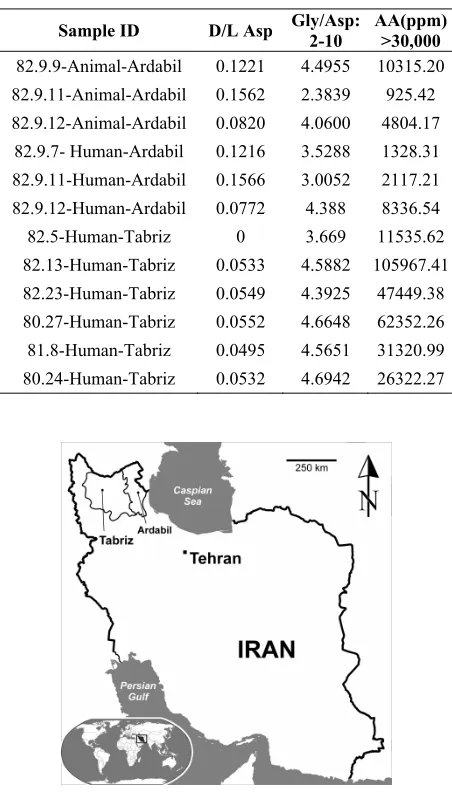
Table 1. Amino acid racemization levels (HPLC method) of the samples obtained from two burial sites from northwestern Iran. To expect possible DNA preservation a D/L Asp of below 0.12 is widely regarded as the appropriate cut-off. As can be seen from the data, the samples from Tabriz are quite well preserved even considering the revised and more stringent criteria by Serre et al. 2004, whereas the samples from Ardabil show relatively poor preservation
Sample ID D/L Asp Gly/Asp: 2-10 AA(ppm)>30,000
82.9.9-Animal-Ardabil 0.1221 4.4955 10315.20 82.9.11-Animal-Ardabil 0.1562 2.3839 925.42 82.9.12-Animal-Ardabil 0.0820 4.0600 4804.17 82.9.7- Human-Ardabil 0.1216 3.5288 1328.31 82.9.11-Human-Ardabil 0.1566 3.0052 2117.21 82.9.12-Human-Ardabil 0.0772 4.388 8336.54 82.5-Human-Tabriz 0 3.669 11535.62 82.13-Human-Tabriz 0.0533 4.5882 105967.41 82.23-Human-Tabriz 0.0549 4.3925 47449.38 80.27-Human-Tabriz 0.0552 4.6648 62352.26 81.8-Human-Tabriz 0.0495 4.5651 31320.99 80.24-Human-Tabriz 0.0532 4.6942 26322.27
not be retrieved from samples in which the D/L ratio of aspartic acid exceeds 0.08, [19]. In this study we determined the aspartic acid racemization using HPLC (High Performance Liquid Chromatography).
DNA Extraction
DNA extraction and amplification were performed in a dedicated ancient DNA laboratory at the Max Planck Institute for Evolutionary Anthropology in Leipzig that undergoes regular decontamination. After the pre-preparation steps, aimed at removing any surface contaminants, DNA from 12 samples was extracted as in Ref. 22. In brief, DNA is extracted by binding of DNA to silica particles in high concentrations of guanidinium thiocyanate (GuSCN).
First, the bones were ground using mortar and pestle and incubated overnight in 5 ml extraction buffer (0.45 M EDTA, 0.25 mg/ml Poteinase K) in darkness at room temperature [22]. Second, the samples were centrifuged, the supernatant transferred to a new tube and 100 µl silica and 20 ml L2 Buffer (GuSCN 5M, Tris 0.05 M, Nacl 0.025 M) were added. After incubation for 3 hours at room temperature and centrifugation at 1,500 g (~4,000 rpm) for 1 min, the supernatant was discarded and the pellet re-suspended in 1 ml L2 Buffer and transferred into a fresh 2 ml tube. The next centrifugation step was done for 5 sec at 16,000 g (~13,200 rpm) in a mini-centrifuge and after discarding the supernatant, the pellets were washed using 1ml New Wash (EtOH 51.3%, Nacl 125 mM, Tris 10 mM, EDTA 1 mM). Samples were then again centrifuged for 10 sec and the supernatant again discarded. Finally, the pellets were dried at room temperature for 10 min with open lids and suspended in 100 µl TE (1X) buffer (EDTA 1 mM, Tris 10 mM), after 1 min centrifugation at maximal speed 16,000 g (~ 13,200 rpm) the supernatant was transferred to a new tube and stored at −20°C for further experiments.
DNA Amplification and Sequencing
In the current study, we successfully amplified an approximately 170pb long fragment of mtDNA using the general mammalian primer pairs 12S a′/o [20] designed to amplify a region of the mitochondrial 12S gene.
12Sa′ Forward primer: 5′-CTG GGA TTA GAT ACC CCA CTA-3′
12So Reverse primer: 5′-GTC GAT TAT AGG ACA GGT TCC TCT A-3′
The PCR consisted of 1X buffer (Applied Biosystems), 4mM MgCl2 (Applied Biosystems), 0.5
mM dNTP mix (Amersham Biosciences), 0.25 µM each primer (MWG-Biotech AG), 0.5 unit Taq Gold (Roche), 1 mg/ml BSA, and 5 µl DNA extract in a total volume of 20 µl.
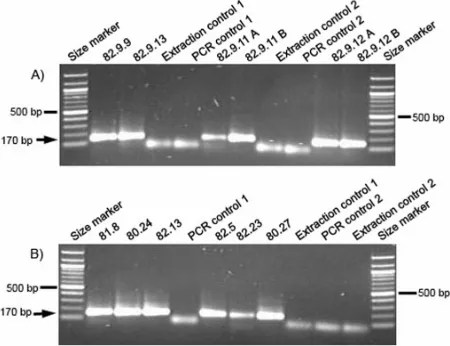
After the initial denaturation step (94°C for 4 min) the DNA was amplified by 60 cycles of PCR involving denaturation of templates at 93°C for 20 sec, binding of primers at 52°C for 30 sec and strand replication at 72°C for 30 sec followed by a final extension at 72°C for 10 min. PCR products were detected on 1.5% agarose gels using ethidium bromide (Figs. 2A-B). In cases of primer dimers, PCR products of the expected length were isolated from the gel, purified with QIAquick Gel Extraction Kit (QIAGEN, Germany) and cloned using the TOPO TA® Cloning Kit (Invitrogen, The Netherlands) according to the manufacturer’s instruction. The insert sequences for eight clones were sequenced for each sample on an ABI 3700 capillary sequencer after colony PCR and purification (QIAGEN BioRobot 9600) and analyzed using the Bioedit sequence alignment editor version 7.0.4. We used BLAST (National Center for Biotechnology Informa-tion) to compare the similarity of the recovered sequ-ences to published sequsequ-ences available in GenBank.
Results
Assessing the Biological Preservation of the Samples
In total, 12 animal/human samples from two different burial sites from the north-western part of Iran were
analyzed for molecular determination of the species of the samples (Table 1). The general appearance of human samples excavated from Tabriz burial site (Masjede Kabood) suggested them to be much better preserved compared to the animal bones obtained from Ardabil site (data not shown). In order to further assess how well the ancient bones were preserved, we employed HPLC analyses and determined the extent of racemization of Aspartic acid, Alanine and Leucine. According to this criterion, the samples obtained from Ardabil burial site had extensive racemization and low amounts of amino acids preserved. In contrast the samples from Tabriz showed good preservation also according to the revised criteria by Serre et al., [23] that, in addition to Asp racemization also take the amount of amino acids preserved and the ratio of glycine to aspartic acid into account (Table 1).
Determining the Species Origin of the Samples
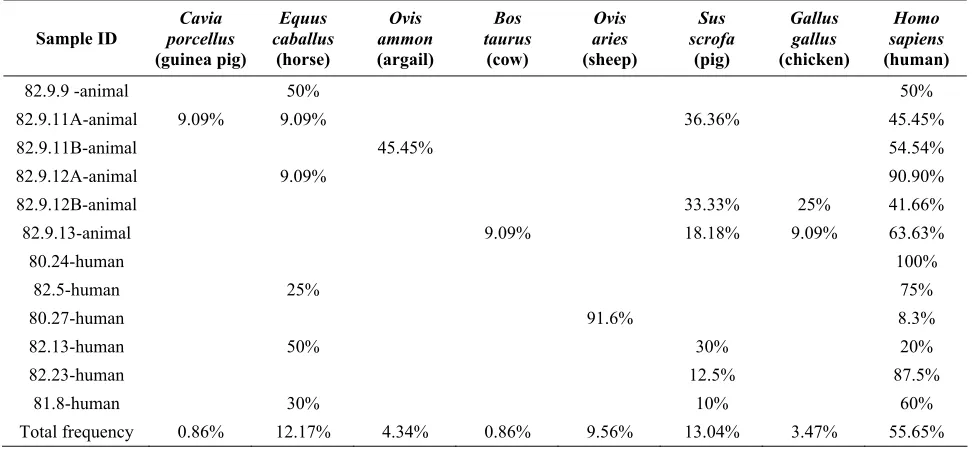
Despite low levels of biomolecular preservation of the samples investigated here, we successfully extracted aDNA from 12 samples using a silica-based DNA extraction method. All of these DNA extracts allowed DNA amplification using general mammalian primers, which were designed for the 12S rRNA gene on the mitochondrial genome. PCR products were detected on 1.5% agarose gels and visualized by ethidium bromid staining (Figs. 1A-B). The PCR products with the expected size of approximately 170 bp were cloned and sequenced. The sequencing data revealed a mixture of different haplotypes of various taxa for each sample. In this mixture of DNA sequences we found traces of various species, such as horse (Equus caballus), pig
(Sus scrofa), cow (Bos taurus), argail (Ovis amon),
chicken (Gallus gallus), guinea pig (Cavia porcellus), sheep (Ovis aries), and human (Homo sapiens) (Table 2). As can be seen from Table 2, all of the animal samples showed contamination with human DNA. Moreover, three of the six animal samples were found to yield more than one animal species sequence, probably due to cross contamination. Except for sample 80.24, which showed no evidence for cross contamination with animal DNAs, all human samples had contamination with at least one type of animal DNA (Table 2). The results also displayed the frequency of different DNA sequences that were present in all samples. The DNA sequences found at highest frequency belonged to human, pig and horse.
Discussion
Ancient DNA is a very attractive field of science
which could help molecular biologists to address questions that were to date un-approachable issues. This new field of science opened a window to diverse research areas such as species phylogeny and genetic diversity of extinct species, plant and animal domestication, diet and behavior, disease evolution, gender determination and population history and phylogeography [18].
The long-term survival of DNA, sample preservation and contamination of samples with modern DNA are some of the main problems restricting the wide-spread application of ancient DNA studies. The extreme susceptibility of ancient human DNA research to contamination with modern human DNA has resulted in skepticism about the authenticity of some previous studies [1,3,6,9,21,24]. Several studies have shown that despite rigorous protocols [2], contaminants can still be identified in amplified products [6,8,9,10,21]. Contaminating DNA is a major concern in the study of ancient DNA [5,6,8,9,17,18] as the small amount of sporadic contaminants are indistinguishable from endogenous ancient DNA and will preferentially amplify and give rise to erroneous DNA sequence [18]. In order to reduce the risk of contamination there are several precautions that are usually conducted in ancient DNA laboratories [18].
Regarding the problem of DNA preservation, most researchers have concentrated on mtDNA due to its high copy number of ~1000-10,000 copies per cell. Due to this fact, it is expected that at similar rates of DNA degradation, mtDNA will survive for longer time compared to the nuclear DNA [25]. Thus, most ancient DNA studies have focused on this type of genetic material.
Despite the problems mentioned above, data based on ancient DNA sequences from a wide range of taxa have been published, often in high profile journals, even though some of them were unintentionally-erroneous results [4, 27]. The problem of contamination is especially severe if the study is focused on human remains. For that reason, it is necessary to have accurate controls, throughout the complete work procedure [2,5,8,13].
In this study, we excavated several 3,000-3,500 year old animal and human bones from two well-known archeological sites in north-western Iran. The aim of the study was to determine if ancient DNA can provide information about the husbandry/hunting of ancient societies. For that reason we tried to determine not only the species we expected to find but also to monitor the occurrence of additional DNA sources for each sample.
Table 2. Frequency of different DNA sequences found on animal/human samples
Sample ID
Cavia porcellus (guinea pig)
Equus caballus (horse)
Ovis ammon (argail)
Bos taurus
(cow)
Ovis aries (sheep)
Sus scrofa
(pig)
Gallus gallus (chicken)
Homo sapiens (human)
82.9.9 -animal 50% 50%
82.9.11A-animal 9.09% 9.09% 36.36% 45.45%
82.9.11B-animal 45.45% 54.54%
82.9.12A-animal 9.09% 90.90%
82.9.12B-animal 33.33% 25% 41.66% 82.9.13-animal 9.09% 18.18% 9.09% 63.63%
80.24-human 100%
82.5-human 25% 75%
80.27-human 91.6% 8.3%
82.13-human 50% 30% 20%
82.23-human 12.5% 87.5%
81.8-human 30% 10% 60%
Total frequency 0.86% 12.17% 4.34% 0.86% 9.56% 13.04% 3.47% 55.65%
further confirmed by analysis of the extent of racemization of Aspartic acid, Alanine and Leucine in samples. However, it should be noted that the first Neanderthal specimen from which a DNA sequence was obtained showed a value of 0.12 [10]. Therefore samples with aspartic acid racemization beyond 0.1 may still yield ancient DNA. Despite the low level of preservation of samples, DNA was successfully obtained from most of the samples. DNA was amplified with a pair of mammalian general primers which were designed for 12S rRNA gene on the mitochondrial genome in order to detect all mammalian DNA sources occurring on the samples.
Our results suggest that almost all of the samples show cross-contamination with at least one other species. The source of contamination is not clear. However, for contamination with human DNA, modern DNA coming from people handling the samples in the field or lab is the prime suspect. As far as the contamination with animal DNAs is concerned, the mixture of bones in burial sites is likely to represent the main source of contamination, although contamination of reagents cannot be excluded 100% [12]. Interestingly, the highest frequency of animal DNAs in all samples belongs to pig. Due to Islamic beliefs and the practice of people in the area pigs are not living in the region now. However, according to the archaeological reports there are several bones in the burial sites with the morphology of pigs (Dr. Alireza Hejbari Noobari, personal communication). This suggests that at that time pigs were a valuable source of
food, although it is not clear whether the animals had been hunted or domesticated.
The other interesting observation of the work is that we detected no cross-contamination with DNA from species on which work had been done in the laboratory concomitant with our work, such as cave-bear and mammoth. The findings suggest that the procedure of decontamination in the laboratory was working effectively and that the source of contamination is within the samples themselves.
In general, while our data suggest that aDNA can potentially provide valuable information on archeological samples, the isolation of authentic aDNA is obviously a major challenge due to notorious contamination of samples with exogenous DNA and poor preservation of endogenous DNA. In fact, none of the samples analyzed in this study yielded results from only a single species. Thus, the consideration of the criteria for ancient DNA authenticity and contamination precautions are major factors for generating reliable data, but even if all precautions are taken as in this study, sometimes it may not be possible to obtain meaningful data. Therefore, we recommend always performing pilot studies on a small number of samples from a site before large numbers of samples are damaged and both money and work are invested.
Acknowledgments
Anthropology for illuminating discussions, great helps and ideas. In addition, we thank Miss. Semira Mohandesan for her assistance in sample collecting in Masjede Kabood burial site and Prof. David Lambert for valuable comments on writing the article. This research was supported by the Max Plank Society and a research grant from Trabiat Modares University.
References
1. Cooper A. Reply to Stoneking: Ancient DNA - How do you really known when you have it? Am. J. Hum. Genet.,
60: 1001-1002 (1997).
2. Cooper A. and Poinar H.N. Ancient DNA: do it right or not at all. Science, 289:1139 (2000).
3. Cooper A., Rambaut A., Macaulay V., Willerslev E., Hansen A.J., and Stringer C. Human origins and ancient human DNA. Science, 292: 1655-1656 (2001).
4. Golenberg E.M., Giannasi D.E., Clegg M.T., Smiley C.J., Durbin M., Henderson D., and Zurawski G. Chloroplast DNA sequence from a miocene Magnolia species.
Nature, 344: 656-658 (1990).
5. Handt O., Hoss M., Krings M., and Pääbo S. Ancient DNA: methodological challenges. Experientia, 50: 524-529 (1994).
6. Handt O., Krings M., Ward R.H, and Pääbo S. The retrieval of ancient human DNA sequences. Am. J. Hum. Genet., 59: 368-376 (1996).
7. Higuchi R., Bowman B., Freiberger M., Ryder O.A., and Wilson A.C. DNA sequences from quagga, and extinct member of the horse family. Nature, 312: 282-284 (1984).
8. Hofreiter M., Serre D., Poinar H.N., Kuch M., and Pääbo S. Ancient DNA. Nat. Rev. Genet., 2: 353-359 (2001). 9. Kolman C. J. and Tuross N. Ancient DNA analysis of
human populations. Am. J. Phys. Anthropol., 111: 5-23 (2000).
10. Krings M., Stone A., Schmitz R., Krainitzki H., Stoneking M., and Pääbo S. Neanderthal DNA sequences and the origin of modern humans. Cell, 90: 19-30 (1997). 11. Kwok S. and Higuchi R. Avoiding false positives with
PCR. Nature, 339: 237-238 (1989).
12. Leonard J.A., Shanks O., Hofreiter M., Kreuz E., Hodges L., Ream W., Wayne R.K, and Fleischer R.C. Animal DNA in PCR reagents plagues ancient DNA research.
Archaeol. Sci., 34: 1361-1366 (2007).
13. Lindahl T. Recovery of antediluvian DNA. Nature, 365: 700 (1993).
14. Malmstrom H., Stora J., Dalen L., Holmlund G., and Gotherstrom A. Extensive human DNA contamination in extract rom ancient dog bones and teeth. Mol. Biol. Evol.,
22: 2040-2047 (2005).
15. Mohandesan E., Mowla S.J., Noobari A.H., Yaghoobi M.M., and Mesbah-Namin S.A. Extraction and analysis of ancient DNA from human remains of Masjede Kabood burial site. Iranian Journal of Biotechnology,2: 236-242 (2004).
16. Pääbo S., Gilford J.A., and Wilson A.C. Mitochondrial DNA sequences from a 7000-year old brain. Nucleic Acids Res., 16: 9775-9787 (1988).
17. Pääbo S. Ancient DNA: Extraction, characterization, molecular cloning, and enzymatic amplification. Proc. Natl. Acad. Sci. USA, 86: 1939-1943 (1989).
18. Pääbo S., Poinar H.N., Serre D., Jaenicke-Despre’s V., Hebler J., Rohland N., Kuch M., Krause J., Vigilant L., Hofreiter M. Genetic analyses from ancient DNA. Annu. Rev. Genet., 38:645-679 (2004).
19. Poinar H.N., Höss M., Bada J.L., and Pääbo S. Amino Acid Racemization and the Preservation of Ancient DNA.
Science,272: 864-866 (1996).
20. Poinar H.N, Hofreiter M., Spaulding W.G., Martin P.S., Stankiewicz B.A., Bland H., Evershed R.P., Possnert G., and Pääbo S. Molecular coproscopy: dung and diet of the extinct ground sloth Nothrotheriops shastensis. Science,
281: 402-406 (1998).
21. Richards M.B., Sykes B.C, and Hedges R.E.M. Authenticating DNA extracted from ancient skeletal remains. J. Archaeol. Sci., 22: 291-299 (1995).
22. Rohland N. and Hofreiter M. Comparison and optimization of ancient DNA extraction. Biotechniques,
42: 343-52 (2007).
23. Serre D., Langaney A., Chech M., Teschler-Nicola M., Paunovic M., Mennecier P., Hofreiter M., Possnert G., and Pääbo S. No evidence of Neandertal mtDNA contribution to early modern humans. PLoS Biol., 2: E57 (2004).
24. Stoneking M. Ancient DNA: how do you know when you have it and what can you do with it? Am. J. Hum. Genet.,
57:1259-1262 (1995).
25. Taanman J-W. The mitochondrial genome: structure, transcription, translation and replication. Biochem. Biophys. Acta, 1410: 103-123 (1999).
26. Willerslev E., Cooper A. Ancient DNA. Proc.Biol. Sci.,
272: 3-16 (2005).
27. Woodward S.R., Weyand N.J., and Bunnell M. DNA sequence from Cretaceous period bone fragments.