1
Perfume
Theresa Lingg, University of Huddersfield,
Accepted date: 17th December 2018
Published date: 13th March 2019
Abstract
This article provides an insight into my final-year project, Perfume, created as part of the Costume with Textiles course at the University of Huddersfield, comprising the design and construction of a costume for a theatre adaptation of Patrick Süskind’s novel Perfume: The Story of a Murderer.
Initially, the analysis of the underlying literature, i.e. the script and its key themes, including the motives of identity and scent, built the foundation for the project Perfume. Additional literature research into cultural, historical and artistic influences, as well as practical experiments, influenced the design, textile and making process of a costume that uniquely unites both eighteenth-century period construction and interactive technology.
Ultimately, the costume construction reaches completion in its final disintegration. This article explores this alleged contradiction and, as a result, the modifications necessary to make my project work in a practical theatre context.
Despite these conflicts, the project succeeds in combining traditional and new craftsmanship, bridging the fields of costume, art and technology in an innovative way.
Keywords
2 Acknowledgements
I am deeply grateful to all the people that believed in this project and supported me in its pursuit. I particularly want to thank my brother who gave me the courage to follow my curiosity and Stephen Calcutt and Ryan Durrant, without whom this project would have never disintegrated as beautifully as it did.
3 Introduction
The word costume can apply to many things depending on the context in which it is used. Common definitions perceive a costume as a theatrical garment, or a set of traditional clothing. Yet, when consulting a dictionary, the term costume is widely defined as:
1. a style of dress, [...] peculiar to a nation, region, group, or historical period.
2. dress or garb characteristic of another period, place, person, etc., as worn on the stage or at balls.
3. fashion of dress appropriate to a particular occasion or season.
(Harper, 2010) Arguably, the most intriguing part of this definition is that a costume reflects the identity of a nation, a period, or a person. The concept of identity describes an individual’s relationship to and perception of themselves (Olson, 2017). This conceptualisation of oneself is influenced by a person’s origin and as such by the culture’s understanding of materials, colours and shapes. Because of this, clothing does not only serve a practical or decorative purpose, but can evoke a sense of belonging – or of dissociation.
This characteristic is commonly utilised in a performance context, as costumes do not only function as garments but are used to support the message of the story line. In fact, a well-designed and executed costume concept has the ability to bring a whole new depth to a performance by relating to the underlying literature, thereby either complementing a character’s identity, as set out by the script, or purposefully challenging it to evoke irritations and, as such, emotions in the audience.
4
odourless? Can a costume contain the whole identity of a character and, when taken away, leave the actor without identity? Can a costume find its completion in its disintegration? In an attempt to find answers to these questions, the article initially elaborates the methodology behind project and paper, before providing a short summary of its main inspiration, the novel Perfume: The Story of a Murderer by Patrick Süskind. In the course of this paper, the project is referred to as Perfume, whereas the background novel is always given its official title Perfume: The Story of a Murderer.
Following on from the summary, the context and setting, along with the artistic and technological influences, are explored as part of the literature review. This research and the following evaluation thereof built the foundation for the design process and the construction of the costume.
Finally, the article highlights the adjustments necessary to make the project work under real-life circumstances before ending with the conclusion.
Methodology
The following methodology addresses two different methodological problems. The first section covers the methods that went into my final-year costume project Perfume, whereas the second part elaborates the methods behind the present article.
5
as a result, the choice of materials and processing techniques best suited to the project. The concluding evaluation of the document research determined the project’s research question, including parameters to assess the validity of future data. Despite the careful selection of the literature, document research has a tendency to only apply partially to a project (Bryman, 1992), due to each project’s individual setting and requirements. In order to gain more information, relating specifically to the costume project’s approach to Perfume, semi-structured interviews were conducted with selected experts. As part of the purposive sampling, where participants are selected according to the researcher’s own judgement (Dudovskiy, 2018), semi-structured interviews enable the researcher to question people directly regarding both their knowledge and perception of the research question (Bryman, 1992). This responsive approach not only allows the researcher to clarify the research question but also to discuss it freely with those being questioned, leading to an increase in information and creative ideas.
This exchange, triggering unanticipated ideas and knowledge regarding the techniques and materials, was particularly essential for facing the challenges of this project, which derived from aiming to visualise various abstract concepts in an entirely new, experimental and technical way. All of this information translated directly into the development of the project’s costume design and built the foundation for its construction process.
6
prototype has to then be assessed against the requirements determined by the research question.
Despite the efforts to create authentic external circumstances for the prototype, simulations are subject to artificiality and as such have to be treated as limited representations of reality (Bryman, 1992). There is always the possible danger that a prototype works in simulations but not under realistic circumstances – in this project’s case, the concept had to be re-assessed and the prototype modified to meet the practical requirements of the research question.
The project’s findings and its development process are mapped out and reviewed in the present article. Analogous to Kolb’s and Fry’s ‘Learning Cycle’ (Stahl, 2015), the experiences gained through a project like Perfume are highly subjective until they are being analysed and reflected upon – which leads to an abstraction of the subject. The deductions of this process are elaborated and concluded within the framework of a project evaluation. As elaborated in the Glossary of Key Terms by the OECD (OECD, 2010), a project evaluation is a systematic and objective assessment of a project, aiming to clarify the relevance and success of the project. In order to do so, this project’s research question is narrowed down to the thesis of the article which explores the novelty of visualising the abstract in costume, as well as the potential of technology therein.
7
determine research gaps. The identified deficiencies support the credibility of the warrant and, as a result, the article’s thesis.
The post-project review concludes the implications of the findings, including the identified deficiencies as well as the successes of the project as analysed, ultimately concluding the legitimacy of the article’s claim.
Influences
The novel
Based on the novel Perfume: The Story of a Murderer by Patrick Süskind, the project Perfume challenges the boundaries of what a costume can be. Through the innovative use
of interactive technology, highly abstract concepts such as identity and transience are conveyed in costume.
In the novel, Jean-Baptiste Grenouille is born in 1738 in Paris. Left to die by his mother, he is raised in an orphanage and, whilst growing up, the boy discovers his unparalleled sense of smell. After encountering a young girl with the most radiant smell, Grenouille is so overwhelmed by his desire to possess the scent that he kills the girl. Gradually, as her body withers, her scent, incorporating her identity, fades. Grenouille despairs and becomes obsessed in learning how to preserve scents.
During his journey to Grasse, the mecca of perfumers, Grenouille indulges in his own world and realises that he has no inherent odour. His whole worldview – based purely on scents – falls apart. ‘What he now felt was the fear of not knowing much of anything about himself’ (Süskind, 1994, p. 54). After this experience, Grenouille develops a number of human scents in order to create an artificial identity and blend in with people.
8
in fat. However, Grenouille explores this technique to extract human scents, in particular, one of another young girl, Laure, who will turn out to be the keynote of his ultimate scent, the essence of beauty and life itself. From then onwards, he kills one girl after another – including Laure – extracting their scents to accomplish his twelve-note perfume.
Eventually, Grenouille is captured and sentenced to death. On the day of his execution, Grenouille uses the finished essence to beguile the audience and is pardoned. Disgusted
by the nature of humans and overcome with the realisation that no-one except himself will ever understand the beauty of his masterpiece, he returns to Paris to commit suicide. There, he pours the perfume over himself and the people devour him in blind worship and self-dissolution.
Context and setting
9
With a person’s smell already being considered a unique fingerprint of identity, the perfumery business in the eighteenth-century flourished with ‘the art of the parfumier [being] one of masking and [a] secret means of revealing inner identity’ (Corbin, 1986, p. VI). Yet, in eighteenth-century France, perfumery was a luxury item of the noble class. Expensive scents were withheld from the general population and differentiated into royal and bourgeois perfumes, with the latter merely functioning as air disinfection (Wiedenhöft, 2015). In fact, several therapeutic health characteristics were attributed to scents, which chemist Lemery elaborated in his Pharmacopee Universelle, concluding that smells were not only pleasant but penetrated the mind ‘increasing the movement of animal spirits’ (Doty, 2015, p. 14). These attributes may partly explain humans’ fascination with scents and, as a result, the long history of the perfumery trade, with the perfumery technique of enfleurage being one of the oldest of its kind (Power, 2016). As part of enfleurage, natural products are immersed in cold layers of purified animal fat over days, absorbing the ingredients’ natural oils until the fat has reached its required fragrance saturation (The editors of Encyclopaedia Britannica, n.d.). The resulting product is diluted with alcohol to gain the absolute, the essence of each perfume and the extract that the novel’s protagonist, Grenouille, desires.
10
The immorality and ruthlessness of his murders add to the question regarding Grenouille’s identity as human. In fact, the protagonist’s ambitions are entirely fed by primary instincts – an observation that is reflected in Lemery’s claim about the connection between scents and animal spirits. While Grenouille initially aims to capture identities with lifeless components, the results are not satisfying. Only the ruthless use of animate ingredients succeeds in delivering the essence of life necessary to create a sufficient mirror of the victim’s identity.
Approaching the abstract
The search for identity is a concept that can be found in all aspects of art. Visualising the abstract, including aspects like identity, has repeatedly challenged and influenced both the fashion and art industries.
According to journalist van Twist (Evans, 2005), designer Hussein Chalayan has been one of the most ardent explorers pursuing the incorporation of philosophical concepts in fashion. Addressing the complexity of the term ‘identity’, the designer covered his models’ faces with egg-shaped capsules in 2005 – robbing them of their identity, whilst simultaneously providing protection both physically and from the audience’s gaze. It is a thought-provoking contrast, which was strengthened by other models on stage being framed by mirrors, forcing the audience to face their own reflection (Evans, 2005). In 2016, Chalayan approached the topic ‘identity’ from a different angle by dressing two models in uniform lab coats: only when exposed to water, the coats dissolved and revealed unique crystal-embellished dresses underneath. This performance successfully combined both uniformity and transience in one collection, showcasing the great theatrical potential in the use of water-soluble textiles.
11
artist constructed a dress out of knitted plastic tubing for singer Robyn’s new music video ‘Indestructible’ (McRae, n.d.).
Electric drill pumps fed hundreds of litres of coloured liquid through a tubing structure. The dynamic structure was wrapped around the singer Robyn by following her body shape. Through the liquid running at different speeds and changing colour, the whole set-up appeared like a living textile – evoking strong associations of veins and blood vessels encircling the singer.
Similarly to McRae, fashion designer Ying Gao’s work also develops around the person. In her creations, Gao has integrated sensors and pneumatic mechanisms (Gao, 2006) into clothing. Interactive garments react to the participants’ touch and inflate different panels of the garment, simulating the fluid movement of breathing. Gao manages to enhance the visual message of her garments by marrying technology and textile manipulation: By pleating individual panels of her work – similar to Japanese origami – the garments are able to open and close, enhancing the association with respiration.
In one of her following projects, Gao even equipped the garment with the technology to recognise the spectators’ breath (Schmidt & Stattman, 2009). In response to the signal triggered from the detector, individual panels of the garment slowly unfolded.
12
Developers promised that, by the use of sensors to transfer biometric data into an advice system, the user’s awareness of individual mental and physical needs and, consequently, the wearer’s lifestyle would improve.
Ironically, by relying on the aforementioned smart technology, people’s relation to their own bodies and minds is further estranged, resulting in a distorted identity image. The initial conceptualisation of oneself, that feeds into one’s personal notion of identity, is influenced by aspects like how we feel, look and act. According to Leary & Tangney (2012, p. 69) our identities then function as lenses which enable us to make meaning of external and internal factors and to put perceptions into immediate context. The increasing use of smart technology in people’s direct proximity, e.g. in their clothing, could possibly lead to people subconsciously shaping their initial conceptualisation in response to sensors rather than to their own sensory perception.
Following the modern aspiration of increased synchronisation of mental and physical wellbeing, the next chapter of smart fashion will be to monitor users’ biometric data to gain interpretations about their emotional and mental wellbeing (Gokey, 2016). While this development could be particularly promising in sectors where people cannot communicate their needs, e.g. patients with severe mental health issues and disabilities, it also comes with an increasing vulnerability and conditional identity image caused by the ultimate disclosure of the individual.
13
Evaluation
Usually descriptions in a performance’s underlying script, that evoke strong visuals, e.g. the age of a character, their origins, whether they are poor or wealthy etc. are applied to the design choices behind a character’s costume. In this case, mapped out through the initial analysis of the novel, the key themes of identity, scent and transience showed a strong potential for creating a thought-provoking, visually convincing costume. Corbin’s claim (Corbin, 1986, ref. p. 8), that scents are able to convey an individual’s identity more truthfully than their appearance, was a particularly intriguing starting point for the design process of a costume project. In order to visualise such an abstract concept, I had to refer to other artists for practical inspiration.
As elaborated in the introduction, the idea of a costume reflecting the wearer’s identity is widely recognised – to create a costume bearing the entire identity of someone’s inherent odour, however, was a concept that had yet to be investigated.
The document research showed the diversity in which abstract concepts such as identity and transience could be addressed in clothing, while also highlighting the theatrical potential for this project’s unusual exploration of technology in textiles.
14
and scent. However, for Perfume to work in a theatre context, the garment had to be reusable.
Ying Gao’s use of smart technology to create interactive clothing however, provided a starting point for the construction development of Perfume. The applied technology was hidden within the garment and interlinked directly with the model through sensors, hence, blurring the clearly separated identities of garment and wearer.
The use of additional means to shape someone’s identity in order to feel a more accepted part of society, whether that may be scents in the eighteenth-century, clothing or sensors at present, indicates the power but also the danger of these resources. The concluding potential, of literally putting on and taking off identity, highlighted the novel’s suitability for a costume-based project and established the research question:
Is it possible to create a dissolvable while also reusable garment for theatre, in accordance
with the available financial and technical resources within the given timeframe?
Realisation
The project is based on the murdered girls in the novel Perfume: The Story of a Murderer. The description of their personality and appearance, as well as the murderer’s character profile influenced the design, textile and construction development profoundly. Both characters could not be treated as separate entities as they are irrevocably linked: The girls’ scents represent Grenouille’s sole ambition and reason for living while their essence can also only be acknowledged by the murderer himself.
15
Grenouille perceives himself as a genius – a connoisseur of beauty and scent, a true
craftsman in capturing the scent and essence of the surrounding world – rather than a murderer. While despising all other people, he craves to be acknowledged as his true self. This longing fades throughout the novel as he realises that he and his masterpiece, the ultimate perfume, will never be acknowledged by society.
The ingredients to his masterpiece, the girls, have no stand-alone personality in the novel. To the reader their personality becomes as replaceable and vague as their person is to Grenouille.
The victims’ identity only has value in its ‘ripening’ process, perceptible in their inherent odour – the metamorphosis from a girl’s innocent and pure body into that of a woman. This natural transformation is portrayed as deeply sensual, far more enticing than a sexually fully developed woman. The first time Grenouille smells one of his victims, he has the foresight of a scent that is not only the link to all other odours but also to the essence of life. These girls become something holy to him, an icon whom Grenouille wants to strip of its odour and wear himself. This idea highlights that Grenouille does not perceive his victims as humans but as sheer means to his final goal, as objects. In addition to the simplified description of the girls in the novel, reducing them to naivety, innocence and beauty, their already
mentioned objectification matches the decorative status of women during the first half of the eighteenth-century. Without personality of their own, the girls serve as canvases on which Grenouille projects his aspiration to the ‘higher principle’.
16
Design
As outlined previously, the novel Perfume: The Story of a Murderer is pervaded with elements of transformation and identity: abstract themes that can only be translated into a garment via evoking emotions and associations with the audience.
In order to convey the project’s interpretation, the use of colours, volume, texture and the movement of the garment had to be chosen carefully.
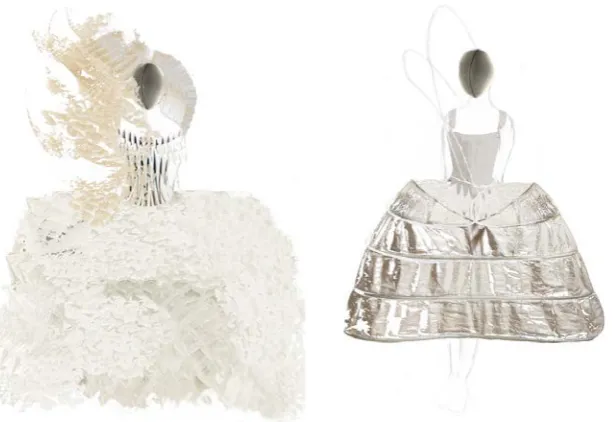
The late eighteenth-century setting of the novel provides striking, inspiring fashion as a starting point. Its hooped petticoats, voluminous and ornate dresses (i.e. the fashionable mantuas of the late seventeenth to eighteenth-century), rigid corsets and stomachers do not
only tell a journey of beauty and class but also of restrictions and illusion. A seemingly opposing combination that bears strong links to Grenouille’s aspirations. Within the book, to extract the girls’ inherent odour, the protagonist confines their bodies in huge vessels filled with fat. Despite the strong visual imagery, the literal use of fat in a costume for a stage performance had to be classed as impractical. However, the visual incorporation of contained and restrained life in the design could be achieved through the eighteenth-century silhouette. In addition to the appropriate symbolism, the inclusion of eighteenth-century fashion proved vital for practical purposes as discussed later in this article.
Within the novel, the girls only possess identity within their scent. The girls themselves providing mere vessels for the essence within. This revocation of any value as a person, once again leads to objectification and facelessness. The resulting anonymity is visualized through the use of masks – a design choice already made by Chalayan in his collection in 1998.
17
beauty. To visually support this association evoked by the script, the colour palette was kept in light, natural shades, dominated by the colour of innocence itself, white.
Transience and scent however – as underlying themes of the novel – could not be entirely translated into a garment through shape, colour or accessories. Just as both transience and scent are characterised by their ever changing state, the garment had to metamorphose by naturally disintegrating – an act of transformation that had not yet been explored in a theatrical costume.
The dissolving fashion of Hassan Chalayan and the scientifically inspired garments by Lucy McRae provided inspiration on how to approach the disintegration process but were not applicable in a theatre performance context. Instead, in various interviews and experiments, the idea was developed of using fabrics in combination with water-soluble thread. Using the thread in key structural points of the garment meant that it would collapse when exposed to water but could also be easily restored. However, traditionally, costumes for the stage are made to last. The choice of cloth is vital, with top fabrics often being backed to offer additional strength and support. Hence, creating a costume with water-soluble thread could be classed as impractical for theatre use and, as a result, within the world of costume there was no prior use of the material that I could refer to as guidance. Consequently, I needed to start my own series of experiments in order to make the water soluble thread work in my costume. The administration of the water had to happen either externally as part of the show or be technologically implemented from within the costume. Traditionally, theatre performances aim for an effect on the audience that translates from distance. From this aspect the use of external tools to trigger the disintegration would have been sufficient.
18 Figure 1
Costume design before and after disintegration (author’s image)
Construction
19
Problematically, by piercing tiny holes in the tubes for the soluble threads, the necessary air pressure for the circuit was challenged. In response, the tubes had to be made of suitable material with the right diameter and length. Even more importantly, the water pump had to be powerful yet light enough to counteract the dropping air pressure and cover several metres in height.
To activate the pump itself, I still had to manually press a button. Ying Gao’s use of breathing sensors provided an alternative solution. If a breathing detector could trigger panels of a garment to unfold, there had to be a way that it could also trigger the disintegration of a garment. In fact, a self-destruction process by breathing related directly to the novel as people ‘could not escape scent. For scent was the brother of breath. Together with breath it entered human beings, who could not defend themselves against it, not if they wanted to live.’ (Süskind, 1994, p. 61).
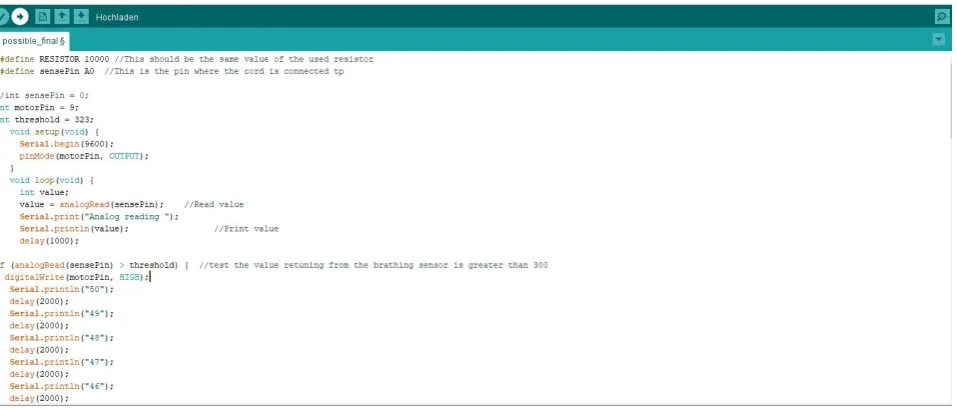
Unfortunately, commercially advertised breathing sensors exceeded the project’s financial resources and, also, my entire research did not produce any examples of interactive sensors being used in theatrical costume. Without any existing prototypes to be guided by, prior technical knowledge or literary back up, the solution had to be developed by trial and error. Through various interviews with technicians, a simplified detector utilising conductive sensor cords in combination with an Arduino controller board could be constructed. Aside from the financial benefits, using an Arduino meant that the activation and also disruption of the pumping process – and hence the disintegration – could be controlled without any choreographed actions during the show.
20
eighteenth-century silhouette with its top and undergarment, consisting of petticoat and corset, provided the ideal foundation for such a structure: The rigidity of the hooped petticoat served as a frame for the tubing structure, which was further strengthened with steel wire to achieve the desired volume and height, while the corset was stiff enough to anchor the tubes running through the shoulder piece.
For the pumping process to work, the pump had to be entirely submerged in water at all times. Therefore, I integrated two containers in deep pockets on both sides of the petticoat – one containing all electrical components while the other held the water and pump.
When connected to an electric circuit, a flexible sensor cord conducts electricity. Once stretched, the electrical resistance increases as the current has to cover a bigger distance. If connected to an Arduino, one can utilise the received data as a trigger.
As the performer was put in a corset, their breathing had to be naturally impaired. To polarise the difference in the received data, the cord was situated tightly under the bust, where the ribcage is maximally dilated.
21 Figure 2
Arduino code (author’s image)
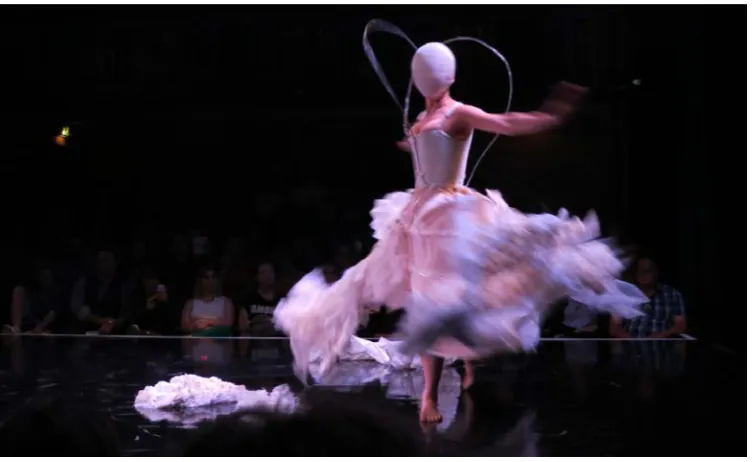
After constructing the undergarment, serving as the framework for all the technical components, I focused on the development of the top garment. In order for this to easily disintegrate, it had to be made up of individual textile pieces instead of one continuous garment. To visually enhance the disintegration process, the textiles of the top garment had to be so lightweight that, when falling onto the ground, they would turn into an unrecognisable ‘puddle’ of fabric.
Experiments with different materials revealed that only select polyester chiffon had the right properties: the fabric was light enough to create the desired movement while also keeping its shape when 3D manipulated.
Inspired by Ying Gao’s use of pleats to increase the mobility of her garments, the bodice was assembled using origami techniques while the majority of the top garment was French smocked.
22
enough structural strength to achieve the desired definition and volume when supported by additional tulle smocking, while collapsing into undefinable pleats when dropped.
To evoke a more natural, uneven disintegration, I constructed the skirt from layered panels of smocking that were connected with the dissolvable thread to the tubing structure. When the water circuit started flowing and individual threads dissolved, singular panels dropped, changing the movement and look of the entire skirt.
Figure 3
The costume dissolving (author’s image)
Adjustments
23
Firstly, the sensor cord stretched out further with every test run which implied that the Arduino code had to be readjusted each time. These adjustments were not only time consuming but also difficult to undertake as the technical components were hard to reach under the different layers of the garment. Secondly, the sensor did not only respond to heavy breathing but also to coughing, sneezing or laughing which resulted repeatedly in unexpected disintegration.
These technical flaws showed that the prototype was unsuitable for the set out performance area but that, ideally, the costume would have been presented as part of an art installation and would have dissolved entirely there and then. The beauty of this approach would have been the emphasised irreversibility of the disintegration process – first showcasing the presence of the garment and then highlighting the lack thereof while a trace of its former identity, similar to a note of scent, lingered.
However, due to the set out requirement that the garment had to be worn multiple times for theatre, the project’s concept had to be reassessed.
The most sensible solution within the tight time frame and the limited financial budget was to add a small push button. This button was secured to the performer’s body and connected to the relay switch instead of the sensor cord. The Arduino was reprogrammed to switch on in response to the pushed button, linking the pump and battery for the length of the choreography before automatically disconnecting.
24 Conclusion
From the beginning, this project has used the original script as the main source of inspiration. While the novel’s setting and storyline are dominated by obsession and death, it is also filled with beauty and creativity. This intriguing contrast demanded a project that would unite both worlds in its disintegration and innovation.
Despite having to commit to compromises, the challenging concept of creating a self-destructive garment that responded to the performer's breath, including the construction and incorporation of a breathing sensor, had proven successful.
While the initial approach related directly to the scenario of Grenouille's victims enticing their murderer through their inherent odour – which links directly to their breathing as elaborated on page 19 – the developed prototype could not meet the practical requirements. Despite the beauty of the initial concept, the project's goal was to create a functional theatre costume. When this functionality was challenged the project had to be adjusted.
However, the developed prototype proved that there is a place for the application of new technology in costume. When introduced to the public, the prototype excited and inspired people. By interlinking the visual experience of the costume directly with the performer’s breathing, it evolved into an immediate expression of the performer living: it moved and breathed alongside the performer and, in the end when disintegrating, took away the entire entity’s identity. Only in its dissolution did the costume’s independent existence and function become evident, answering the hypothesis set out in the introduction: a costume really can find completion in its disintegration.
25
of this approach: as the costume did not try to portray a specific character, it was open to interpretation. While not every person – when asked – had realised that Perfume had tried to create a costume about identity and scent, all associated it with something abstract. The costume became a canvas for the audience's thoughts and interpretations – in a way that is similar to the girls being a canvas for Grenouille’s dreams and aspirations in the novel. This is a phenomenon comparable to those that can be witnessed in fine arts. Art requires inter-action with the spectator in order to come to life, while people need the interinter-action with art to feel and reflect.
Throughout the development process of Perfume the costume became less and less of a garment but perpetually more of an art piece. The connection it built to the audience, the emotions and thoughts it triggered, made it a strong example for the validity of abstract concepts in theatrical costume. After all, is it not the aim of theatre to convey a story? What better way to do so than with a costume that engages people by inspiring their curiosity and wonder – and hopefully making them think.
Perfume has succeeded in combining traditional and new craftsmanship, bridging the fields
26 References
Bryman, A. (1992). Research methods and organization studies (1st ed.). London: Routledge.
Corbin, A. (1986). The foul and the fragrant: odor and the French social imagination. Berg Publishers Ltd: Oxford.
Doty, R.L. (2015). Handbook of Olfaction and Gustation. John Wiley & Sons, Inc: Hoboken, New Jersey.
Dudovskiy, J. (2018). Writing a dissertation. Retrieved January 01, 2018 from
https://research-methodology.net/sampling-in-primary-data-collection/purposive-sampling/
The editors of Encyclopaedia Britannica. (n.d.). Perfume. Retrieved January 29, 2018 from https://www.britannica.com/art/perfume#ref13686
Evans, C., & Groninger Museum voor Stad en Lande. (2005). Hussein chalayan. Rotterdam: NAi.
Gao, Y. (2006). Waking City. Retrieved November, 2017, from http://yinggao.ca/interactifs/walking-city/
Gokey, M. (2016). Smart Clothes. Retrieved February 4, 2018, from https://www.digitaltrends.com/wearables/smart-clothing-is-the-future-of-wearables/ Harper, D. (2010). Online Etymology Dictionary. Retrieved September 10, 2018, from
https://www.dictionary.com/browse/costume
Leary, M.R., & Tangney, J.P. (2012). Handbook of Self and Identity. New York: The Guilford Press.
Mayer, P. (2009). Guidelines for writing a review article. Zurich-Basel Plant Science Center. Retrieved November 28, 2018, from
27
McRae, L. (n.d.). Robyn. Retrieved September 14, 2017, from https://www.lucymcrae.net/robyn
OECD. (2010). Glossary of Key Terms in Evaluation and Results Based Management. Retrieved November 30, 2018, from http://www.oecd.org/dac/evaluation/2754804.pdf Olson, E. (2017). Personal Identity. The Stanford Encyclopedia of Philosophy. Retrieved
September 26, 2018 from
https://plato.stanford.edu/archives/sum2017/entries/identity-personal/
Power, J. (2016). Enfleurage. Retrieved January 29, 2018, from https://artisanessentialoils.com/what-are-enfleurage-essential-oils/
Sawh, M. (2017). Smart Clothing. Retrieved February 2, 2018, from https://www.wareable.com/smart-clothing/best-smart-clothing
Schmidt, P., & Stattman, N. (2009). Unfolded: Paper in design, art, architecture and industry. Basel: Birkhäuser.
Stahl, A. (2015). Methode: Projekttagebuch. Christian-Albrechts-Universität zu Kiel. Retrieved November 30, 2018, from http://www.einfachgutelehre.uni-kiel.de/allgemein/projekttagebuch/
Sweetman, J. (1998). The enlightenment and the age of revolution, 1700–1850. London: Longman.
Süskind, P. (1994). Das Parfum: Die Geschichte eines Mörders. Zürich: Diogenes Verlag. Thomas, B., & Skinner, H. (2012). Dissertation to Journal Article: A Systematic Approach.
Education Research International, vol. 2012, Article ID 862135, Retrieved November 25, 2018, from https://doi.org/10.1155/2012/862135
Wiedenhöft, D. (2015). History of perfume. Retrieved January 28, 2018, from http://www.perfumeplanet.net/