Journal of Studies in Learning and Teaching English Vol. 1, No. 4, (2013), 1-21
Relationship Between Learning Styles Of
Advanced Iranian EFL Learners and Their
Achievment
Fateme Barzegar∗
Islamic Azad University, Shiraz Branch Shiraz, Iran
GhaffarTajalli
Islamic Azad University, Shiraz Branch Shiraz, Iran
Abstract. This study investigated language learning styles of Iranian EFL learners and their class achievement. To this end, sixty female ad-vanced learners of instruction and different ages (15-30), studying at a language institute in Shiraz were asked to take part in the study. A 30-item language learning styles questionnaire developed by Reid (1987) was employed to elicit information for the study. The data obtained through the questionnaire were subjected to Pearson correlation in order to check the relationship between the learning style and class achieve-ment. Results showed that students use different learning styles in class and indicated that kinesthetic and group learning styles were the most favorable ones among Iranian EFL learners. The aforementioned styles positively correlated with the learners’ achievement.
Keywords: Learning preferences, class achievement. 1. Introduction
Teaching English as a Second or Foreign Language (ESL/EFL) has changed tremendously over the past two decades. Curricula, teaching
Received: October 2013; Accepted: December 2013 ∗
Corresponding author
methods, and teaching materials have been developed to meet the chang-ing needs of the ESL/EFL population. Research on learnchang-ing styles, has provided teachers with a different view of learning and demonstrated how to apply it to classroom teaching. An awareness of individual differ-ences in learning has made ESL/EFL educators and program designers more sensitive to their roles in teaching, learning and learners‘ success and course achievement.
A learning style is a student’s consistent way of responding to and using stimuli in the context of learning. Keefe (1979) defines learning styles as the “composite of characteristic cognitive, affective, and physi-ological factors that serve as relatively stable indicators of how a learner perceives, interacts with, and responds to the learning environment”. (p.15). Stewart and Felicetti (1992) define learning styles as those “edu-cational conditions under which a student is most likely to learn”. Thus, learning styles are not really concerned with “what” learners learn, but rather “how” they prefer to learn.
Students preferentially take in and process information in differ-ent ways: by seeing and hearing, reflecting and acting, reasoning log-ically and intuitively, analyzing and visualizing, steadily and in fits and starts. According to Reid (1987), the different ways of how a learner acquires, retains and retrieves information are collectively termed as learning styles or learning preferences. She contends that learning styles are internally based characteristics, often not perceived or consciously used by learners, for the intake and comprehension of new informa-tion. In general, students retain these preferred learning styles despite the teaching styles and classroom atmospheres they encounter, although the students may, overtime, acquire additional styles.
A comprehensive definition is given by Keef (1989) who describes learning styles as the cognitive, affective, and physiological factors that serve as relatively stable indicators of how learners perceive, interact with, and respond to the learning environment. Included in this compre-hensive definition are “cognitive styles” which are intrinsic information-processing patterns that represent a person’s typical mode of perceiving, thinking, remembering, and problem-solving.
approaches-Relationship Between Learning Styles ... 3
for example, global or analytical, auditory or visual-that students use in acquiring a new language or in learning any other subjects. These styles are the overall patterns that give a general direction to language behavior. Brown (2000) defines learning styles as the manner in which individuals perceive and process information in learning situations. He argues that learning preferences is one aspect of learning style, and refers to the choice of one learning situation or condition over another.
As every teacher discovers, no two students approach learning in exactly the same way. Some get more from visual imagery while oth-ers prefer verbal explanations; some tend to try things out and see what happens and others are more inclined to think things through first; some reason in a relatively sequential manner and others have a more holis-tic orientation; some are most comfortable with concrete (“real-world”) information and others are more drawn to abstract theories and sym-bolism, and so on.
Research on learning styles is based on the assumption that learners receive information through their senses and prefer some senses to others in specific situations (O’Brien 1989, Oxford & Ehrman 1993, Kroonen-berg 1995). Usually, students learn more effectively when they learn through their own initiatives. When their learning styles are matched with appropriate approaches in teaching, then their motivation, perfor-mances, and achievements will increase and be enhanced (Brown, 1994). Thus, researchers and educators try to establish optimal environmental and psychological climates that foster learning by allowing students to learn in accordance with their own preferred learning styles.
Researchers have tested some hypotheses about L2 learning. One of the most well-researched areas is field-independence (FI)/field depen-dence (FD). FD/FI refers to how people perceive and memorize infor-mation (Chapelle, 1995). The FD individual is a global learner who is socially oriented and extrinsically motivated. Conversely, the FI individ-ual is an analytic learner who tends to work independently (Ramirez & Price-Williams 1974).
suc-cessful in deductive lessons, while those with FD styles performed better in inductive lessons. Chapelle and Abraham (1990) also found a corre-lation between the FI style and language success.
2. Literature Review
2.1. Definitions of learning styles
Learning styles are internally-based characteristics of individuals for the intake or understanding of new information (Reid, 1995). All learners have individual attributes relating to their learning processes. Some peo-ple may rely heavily on visual presentation; others may prefer spoken language; still others may respond better to hands-on activities. It is ev-ident that people learn differently and at different paces because of their biological and psychological differences (Reiff, 1992). Naturally, these differences in learning abound in any ESL/EFL setting where students come from different cultural and educational backgrounds.
A learning style is multidimensional (Kinsella, 1996). Its elements can be classified into five stimulus categories: environmental elements (sound, light, temperatures, and design), emotional elements (moti-vation, persistence, and responsibility), physical elements (perception, intake, time, and mobility), and sociological elements (self, partner, team, mentor, varied), psychological elements (global/analytical, im-pulsive/reflective) (Reiff, 1992). Clearly, learning styles include not only the cognitive domain, but also the affective and physiological domains (Oxford and Ehrman, 1993).
Relationship Between Learning Styles ... 5 2.2. Categorizations of learning styles
2.2.1. Brown’s category
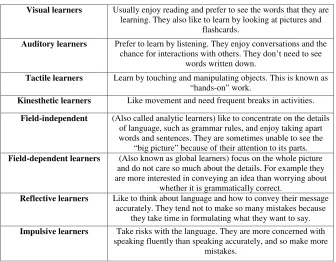
Language researchers have categorized the various learning styles in nu-merous ways. Brown (2000), in discussing language learning style, classi-fies language learners into several categories. The following table presents these categories.
Table 1. Browns’ categorization of learning styles
2.2.2. Reid’s category
Reid (1995) divides learning-style research into three major categories: cognitive learning style, sensory learning style, and personality learning styles. ������������ ������� �������� ������ ��� � ���� ��������������� �� �������� ������ ������ ������� �������� �������� ����������� ���� ����������� ��� ������� �������� ������ �� �������� ����� ����� ������� �� ���������� �������� �������� ������ ��������� �������� �������� ���� ������� ����������� ��� ��������� ����� �������� ����� ����������� ����� ���� ������� �������������� �� �������� ������ ������ ������ �������� ���� ������ ������� �������������� �������� ���� ����� ����� ����������� ��������� �������� ������ ������� �������� ������ ��� ����������� �������� ������� ������������ ������� �������� ������ ��� � ���� ��������������� �� �������� ������ ������ ������� �������� �������� ����������� ���� ����������� ��� ������� �������� ������ �� �������� ����� ����� ������� �� ���������� �������� �������� ������ ��������� �������� �������� ���� ������� ����������� ��� ��������� ����� �������� ����� ����������� ����� ���� ������� �������������� �� �������� ������ ������ ������ �������� ���� ������ ������� �������������� �������� ���� ����� ����� ����������� ��������� �������� ������ ������� �������� ������ ��� ����������� �������� ������� �� ����������������������������������������������������� ���������������� ���������������������������������������������������������������� ������������������������������������������������������������� ������������ ������������������ ��������������������������������������������������������������� ������������������������������������������������������������ �������������������� ����������������� ������������������������������������������������������������� ����������������� ��������������������� ������������������������������������������������������ ������������������ ������������������������������������������������������������������� ����������������������������������������������������������� ���������������������������������������������������������� ������������������������������������������������������� ������������������������� ����������������������������������������������������������� ������������������������������������������������������������ ������������������������������������������������������������� ������������������������������������� �������������������� ������������������������������������������������������������� ����������������������������������������������������������� ����������������������������������������������������� ������������������� ����������������������������������������������������������� ������������������������������������������������������������� ���������� ����������������������� ����� ������� �������� ��������������� ��������� ����� ������ ������ ������������ ���������� ������������������������������������������������������������������������� ������������������������� ���������������������������������� ��������� �������� ���������������� ��������� ������ ����� ������������ ����� ��� ������ ���������� ����� ���������� ������ ���� ����������� ��� ������� �����������������������������������������������������������������������������������
Relationship Between Learning Styles ... 5
2.2. Categorizations of learning styles 2.2.1. Brown’s category
Language researchers have categorized the various learning styles in nu-merous ways. Brown (2000), in discussing language learning style, classi-fies language learners into several categories. The following table presents these categories.
Table 1. Browns’ categorization of learning styles
2.2.2. Reid’s category
Cognitive learning style
Field-independent/field-dependent learning styles: Field-depen-dent learners learn more effectively step by step, beginning with analyz-ing facts and proceedanalyz-ing to ideas. Field dependent learners, in contrast prefer to learn in context and holistically.
Analytic/global learning style: Analytic learners learn individually, and prefer setting goals. Global learners, on the other hand, learn more effectively through concrete experience, and by interaction with other people.
Reflective/impulsive learning style: Reflective learners learn more effectively when they have time to consider options before responding. This is while, impulsive learners are able to respond immediately and take risks.
Sensory learning style Perceptual learning styles
Auditory learner: learns more effectively through the ear (hearing). Visual learner: learn more effectively through the eyes (seeing). Tactile learner: learn more effectively through touch (hands on)
Kinesthetic learner: learns more effectively through body experience (whole body movement)
Haptic learner: learns more effectively through touch and whole body involvement.
Environment learning style
Physical learner: learns more effectively when such variables as temper-ature, sound, light, food, mobility, time and classroom/study arrange-ment are considered.
Sociological learner: learns more effectively when such variables as group, individual, pair, and team work, or level of teacher authority are con-sidered.
Personality learning styles
Relationship Between Learning Styles ... 7
Introverted learners, on the other hand, learn more effectively in indi-vidual, independent situations that are more involved with ideas and concepts.
Sensing vs. perception: Sensing learner: learns more effectively from reports of observable facts and happenings; prefers physical, sense-based input. Sensing people choose to reply on their five senses. This is while, Perception learner: learn more effectively from meaningful experiences and relationship with others.
Thinking vs. feeling: Thinking learner learn more effectively from impersonal circumstances and logical consequences. On the other hand, Feeling learners learn more effectively from personalized circumstances and social values
Judging vs. perceiving:Judging learnerlearns more effectively by re-flection, analysis, and processes that involve closure.Perceiving learner, in contrast, learn more effectively through negotiation, feeling, and in-ductive processes that postpone closure.
Ambiguity-tolerant learner vs. ambiguity-intolerant learner: ambiguity-tolerant learners learn more effectively when opportunities for experience and risk, as well as interaction, are present. Ambiguity-intolerant learner, however, learns more effectively when in less flexible, less risky, more structured situations.
Left-brained vs. right-brained: Left-brain learners tend toward vi-sual, analytic, reflective, self-reliant learning. On the other hand, right-brained learners tend toward auditory, global, impulsive, interactive learning.
2.3. Language learning styles preferences research 2.3.1. Learner’s learning preferences
1) Visual learning (for example, reading and studying charts)
2) Auditory learning (for example, listening to lectures or audiotapes) 3) Kinesthetic learning (involving physical responses)
4) Tactile learning (hands on learning, as in building models)
By using perceptual learning style preferences questionnaire (PLSPQ) she asked 1388 students to identify their perceptual learning style pref-erences. Generally speaking, the results of the study showed that ESL students strongly preferred kinesthetic and tactile learning styles. Most groups showed a negative preference for group learning. Graduate stu-dents indicated a significantly greater preference for visual and tac-tile learning than undergraduates. Both graduates and undergraduates strongly preferred to learn kinesthetically and tactilely. With regard to the effect of sex, males preferred visual and tactile learning significantly more than females. With respect to age, the results showed that the older students, the higher the preference means for visual, auditory, kines-thetic, and tactile learning. Regarding language background, Korean students were the most visual in their learning style preferences; they were significantly more visual than U.S and Japanese students. Arabic and Chinese groups were also strong visual learners. Reid came to the conclusion that the learning style preferences of nonnative speakers of-ten differ significantly from those of native speakers; that ESL students from different language backgrounds sometimes differ from one another in their learning style preferences; and that variables such as sex, length of time studying English in the U.S, field of study, level of education, TOEFL score, and age are related to differences in learning style; and that modifications and extensions of ESL student learning style may occur with changes in academic environment and experience. The weak point of her study is that there is no mention of the teacher‘s attitudes toward the learning preferences of their students.
Relationship Between Learning Styles ... 9
the language learning difficulties experienced by many Japanese stu-dents. Moreover, because the visual modality is a negative style for many Japanese, many students are unable to take full advantage of an educa-tion system which emphasized the importance of reading texts, compo-sition and written grammar exercises. On the other hand, students with mixed modality strength are able to process information in a number of ways and often have a better chance of success than do those with single modality strength. The research suggests that while Japanese learners have no major learning style preferences, they appear to favor three modalities and individual learning as minor styles. They expressed pref-erences for auditory, tactile and kinesthetic.
Wintergerst and DeCapua (1998) attempted to identify the learning styles of ESL students through an analysis and comparison of partici-pants‘ responses to three elicitation instrument: Reid‘s (1987) PLSPQ, a background questionnaire, and data from oral interviews. The study participants were undergraduate Russian-speaking students enrolled in credit-bearing intermediate or advanced ESL courses. There were 32 participants at two private institutions of higher learning in metropoli-tan New York-a major university in New York City and a small college on Long Island. Findings from the data indicated that the preferred major learning style of these Russian-speaking students was kinesthetic, closely followed by auditory. In addition, the results of the data suggested that the learning style preferences of these participants reflected more their personal learning style preferences than the influence of cultural traditions. This finding was an outcome of comparing the participants, PLSPQ responses with those from the oral interviews of a sampling of the population. Descriptions, however, arose in the findings among the three elicitation instruments, raising questions with respect to the reli-ability and validity of the PLSPQ.
2.3.2. Effect of learning style on course achievement
students need the positive attitude to succeed academically. Often, one’s learning style is identified to determine strengths for academic achieve-ment. Dunn, Beaudry and Klavas (1989) assert that through voluminous studies, it has been indicated that both low and average achievers earn higher scores on standardized achievement and attitude tests when they are taught within the realm of their learning styles.
Chuah Chong-Cheng (1988) discusses the importance of learning styles as being not only necessary, but also important for individuals in academic settings. Most students favor to learn in particular ways with each style of learning contributing to the success in retaining what they have learnt. As such, studies carried out conclude that students retain %10 of what they read, %26 of what they hear, %30 of what they see, %50 of what they see and hear, %70 of what they say, and %90 of what they say as they do something (Chuah Chong-Cheng, 1988). These facts reveal that each learning style has its own strengths and weak-nesses. Some students learn in many ways, while others might only favour one or two. Those students with multiple learning styles tend to gain more and obtain higher scores compared to those who rely solely on one style (Dunn, Beaudry & Klavas, 1989). Additionally, the dif-ferences in learning styles have also been reported between gifted and the underachievers; between the learning disabled and average achiev-ers; among different types of special education students; and among secondary students in comprehensive schools and their counterparts in vocational education and industrial arts (Dunn & Dunn, 1986). Some special students favor Kinesthetic instruction, such as experiential, ac-tive and hands-on, while many others are more auditory and visually oriented (Dunn, 1991). International Journal of Humanities and Social Science Vol. 1, No. 10; August 2011, 145.
Relationship Between Learning Styles ... 11
compared to reflective ones, show poor academic achievement (Kagan & Kagan, 1970).
Other studies show that Field Independent students achieve more than Field Dependent ones (Chapelle, 1995). Studies also reveal that matching teaching and learning styles can significantly enhance aca-demic achievement at the primary and secondary school levels (Smith & Renzulli, 1984). According to Felder (1995), students learn more when information is obtainable in a variety of approaches than when only a sin-gle approach is applied. Much experiential research indicates that learn-ing styles can either hamper or increase academic performance in several aspects even though not much research has been conducted on the rela-tionship between instructional design of learning materials and learning styles (Riding & Cheema, 1991). In general, rich data have been ob-tained through studies on learning styles; however, the data have rarely been exploited by designers of instructional programs thereby a greater understanding of learners’ approaches to learning can be obtained.
Considering the aforementioned literature and the problems depicted above, attempts were made in this study to address the following ques-tions:
1. What are the language learning styles of Iranian EFL learners? 2. Is there any relationship between individual learning style preferences and student achievement?
3. Objectives of the Study
4. Method
4.1. Participants
Participants in this study consisted of 60 female advanced learners study-ing English at a language institute in Shiraz. They were all native speak-ers of Pspeak-ersian and ranged from 20 to 35 in age. The students were cruited (based on the convenient sampling) from four classes the re-searcher had access to.
4.2. Instruments
The instrument used in this study was a 30-item questionnaire devel-oped by Reid (1987). In this questionnaire students were supposed to state how they preferred to learn the language, for example, whether they benefited from working in groups, pairs, or individually. This ques-tionnaire was used to determine the learners’ learning styles preferences that can be categorized into six major learning styles: visual, tactile, auditory, group, kinesthetic, and individual learning style. Each item in the questionnaire explores a particular learning style. In this ques-tionnaire students were asked to state whether they are strongly agree, agree, undecided, disagree or strongly disagree with the statements. The maximum score for each item is 25.
4.3. Procedures for data collection
Relationship Between Learning Styles ... 13
was carried out by the researcher herself, and some with the cooperation of the colleagues. Finally, after their final exam, their scores were gath-ered by the researcher to determine the student’s achievement based on their learning styles.
4.4. Data analysis
To analyze the data, SPSS 16 was used. To analyze the information of learning styles questionnaire, descriptive statistics was used and for finding the relationship between the variables, Pearson Product Moment Correlation Coefficient was used.
5. Results and Discussion
The responses to the research questions are examined in the following section. In order to test the null hypotheses for each research question, paired sample t-tests were performed.
5.1. Student’s responses
Table 2. The mean score and standard deviation of students’ learning style descriptive statistics
As this study has tailored Reid’s measuring instrument (1987), the re-sults were compared to Reid’s assigned mean score classification of ma-jor, minor and negligible learning style categories. The preference mean score for each set of variables was divided into three categories, namely,
14 F. Barzegar and Gh. Tajalli
major, minor and negligible learning styles. The mean score of 38 and above represented the major learning style while the mean range be-tween 25 and 37 stood for the minor learning style, and finally a mean score of 24 or less showed a negligible learning style. Table 2 displays the mean scores and standard deviation of students’ learning style dimen-sions. The highest mean score of 40.54 belonged to kinesthetic learning style while the lowest mean score of 28.30 was obtained for individual learning style. The high mean score reflects major learning style for audi-tory, Kinesthetic and group type in descending order of preferences. The result indicated that most students possessed multiple learning styles.
Table 3. The percentage of learning style usage
It can be concluded from the results (Table 2) that learners seem to favor a communicative approach to language learning by showing re-luctance to working on their own. As shown, only %6.67 of students expressed their preference for working individually, although it is less stressful than talking in pairs or groups. On the other hand, %25 of the students preferred other ways of learning the language, such as learning in pairs or groups. This study is in line with Witergerst, DeCapua, and Marlyn (2003) whose findings revealed that language learners clearly prefer group activity over individual work, with the Russian EFL and Asian ESL students favoring group work and project work.
Relationship Between Learning Styles ... 15
Regarding Kinesthetic learning style, students, by %33.33 expressed
their interest toward learning English by doing something in class or participating in role-playing. Group learning style also received rela-tively high percentage from students (%25). It seems they feel more comfortable, productive, and relaxed by working in their ways, e.g. in pairs, or in groups where their voices would be heard, and views lis-tened to and valued. This can be a massage for teachers not to get their students to work alone. Rather it is more faithful to encourage them to have interaction with each other and share ideas. One advantage of this practice may be the fact that such interaction provokes greater in-volvement and participation than working individually. It fosters learner responsibility and independence, can improve motivation and contribute to a feeling of cooperation and warmth in class. Such findings are in line with Wintergerst, DeCapua, and Marlyn (2003) study which claimed language learners clearly prefer group activity to individual work. How-ever Reid’s (1987) study contradicts such findings. The findings of her study revealed that ESL learners gave group work a minor or negative preference mean. Her findings are the opposite of what proved to be true in the present study. As can be seen auditory learning style also received a high percentage (%23.33) after kinesthetic and group
learn-ing style. On the other hand visual and tactile learnlearn-ing styles received a low percentage as %8.33 and %3.33 that may be due to the lack of
equipment in this area.
5.2. The relationship between different learning styles and class achievements
As mentioned earlier, the main objective of the present study was to find out the relationship between different learning styles and students’ class achievement. To this end, student‘s final scores were compared with their learning styles to discover which students are more successful in English classes. That is, whether students who use the group learning styles are more successful or students who use the individual learning style.
Items 6, 10, 12, 24 and 29 asked about visual learning style. Based on Table 4.1, only %8.33 of the learners expressed their willingness towards learning visually. As it is clear from the table above, in the correlations table there is no significant correlation between the visual learning style and learners’ achievement.
Items 11, 14, 16, 22, and 25 asked about tactile learning style, these items asked if they prefer to learn things by doing something or making drawings as they study. It is obvious that it is the least favorable learning style among this group as only %3.33 of them used it. And there is no significant relationship between tactile learning style and class achieve-ment.
The next 5 items ask about auditory learning style (1, 7, 9, 17, and 20) that is more popular among this Iranian EFL group but there is no relationship between this style and student’s achievement.
In items 3, 4, 5, 21, and 23, students were asked about if they prefer to learn language in groups or working on an assignment with some class-mates. Correlational analysis suggests a significant positive correlation between the student’s achievement and group learning style. Students by %23.3 were of the opinion that they enjoy working on an assignment with two or three classmates and they prefer to study with others. In other words as the students, use of group learning style increases their class achievement increases too.
Items 2, 8, 15, 19, 1nd 26 were about kinesthetic learning style which received the highest percentage among the other learning styles and showed a positive correlation.
Relationship Between Learning Styles ... 17
6. Conclusion
Some major points concluded from the study are summarized below: 1) Regarding working styles, students do not like working individu-ally.
2) Types of learning styles that emphasize productive skills appeal to students more than receptive skills. They do not like to be sitting passively in classroom, but to be engaged in classroom practices,
3) Students’ most favored learning styles are kinesthetic and group learning styles. And their least favored one is individual learning style.
4) There is a positive correlation between kinesthetic and group learning styles and the student’s achievement. The more they used these styles the better scores they received.
5) There is a negative correlation between individual learning style and class achievement. The more they used this style the lower scores they received.
6) There is a strong correlation between kinesthetic, group, tactile and auditory learning styles, that is, as the learners, use of kinesthetic style increase the use of group, tactile and auditory increases.
7) There is a negative relationship between kinesthetic, group, audi-tory and individual learning styles. In other words, as the learners, use of kinesthetic, group and auditory increase the use of individual learning style decreases.
7. Pedagogical Implications
The authors:
Fateme Barzegarholds an M.A in TEFL teaching preparatory courses for M.A examinations and working as an English instructor in different institutes in Shiraz. Her main areas of interest are translation, language learning strategies and styles and language assessment.
Ghaffar Tajalli holds an M.A in TEFL and is retired now. He is presently a lecturer at Islamic Azad University, Shiraz Branch. He is the author of several textbooks and has published some papers nationally and internationally. His main areas of interest are phonetics, phonology and translation
References
[1] Abraham, R. (1985). Field independence-dependence and teaching gram-mar.TESOL Quarterly, 19,689-702.
[2] Anderson, J. (1993). Discovering learners, perceptions of ESL classroom teaching/learning activities in a South African context.TESOL Quarterly, 32,85-108.
[3] Brown, H. (1994).Principles of language learning and teaching.(3rd Ed). Englewood Cliffs, NJ: Prentice Hall Regents.
[4] Brown, H. D. (2000). Principles of language teaching and learning. (4thEd.). White Plains, NY: Longman.
[5] Chapelle, C. (1995). Field-dependence/field-independence in the second language classroom. In Learning styles in the ESL/EFL classroom.Ed. J. Reid. Boston: Heinle and Heinle Publishers.
[6] Chapelle, C. & Abraham, R. (1990). Cloze method: What difference does it make?Language Testing, 7,121-146.
[7] Chuah, C. (1988). Sinar Cendekia. Malaysia, Penang: University Sains Malaysia (USM).
[8] Coffield, F., Moseley, D., Hall, E., & Ecclestone, K. (2004). Learning styles and pedagogy in post-16 learning: A systematic and critical review. www.LSRC.ac.uk: Learning and Skills Research Centre. Retrieved Jan-uary 15, 2011: http://www.lsda.org.uk/files/PDF/1543.pdf
The authors:
Fateme Barzegarholds an M.A in TEFL teaching preparatory courses for M.A examinations and working as an English instructor in different institutes in Shiraz. Her main areas of interest are translation, language learning strategies and styles and language assessment.
Ghaffar Tajalli holds an M.A in TEFL and is retired now. He is presently a lecturer at Islamic Azad University, Shiraz Branch. He is the author of several textbooks and has published some papers nationally and internationally. His main areas of interest are phonetics, phonology and translation
References
[1] Abraham, R. (1985). Field independence-dependence and teaching gram-mar.TESOL Quarterly, 19,689-702.
[2] Anderson, J. (1993). Discovering learners, perceptions of ESL classroom teaching/learning activities in a South African context.TESOL Quarterly, 32,85-108.
[3] Brown, H. (1994).Principles of language learning and teaching.(3rd Ed). Englewood Cliffs, NJ: Prentice Hall Regents.
[4] Brown, H. D. (2000). Principles of language teaching and learning.
(4thEd.). White Plains, NY: Longman.
[5] Chapelle, C. (1995). Field-dependence/field-independence in the second language classroom. In Learning styles in the ESL/EFL classroom.Ed. J. Reid. Boston: Heinle and Heinle Publishers.
[6] Chapelle, C. & Abraham, R. (1990). Cloze method: What difference does it make?Language Testing, 7,121-146.
[7] Chuah, C. (1988). Sinar Cendekia. Malaysia, Penang: University Sains Malaysia (USM).
[8] Coffield, F., Moseley, D., Hall, E., & Ecclestone, K. (2004). Learning styles and pedagogy in post-16 learning: A systematic and critical review.
Relationship Between Learning Styles ... 19
[9] Dunn, R. (1984). Learning styles: State of the science.Theory into Prac-tice, 23(1), 11-19.
[10] Dunn, R. & Dunn, K. (1972). Practical approaches to individualizing in-struction.Englewood Cliffs, NJ: Parker Division of Prentice-Hall.
[11] Dunn, R., Dunn, K., & Price, G. (1979). Identifying individual learn-ing styles. In Student learning styles: Diagnosing and prescribing pro-grams.Reston, VA: National Association of Secondary School Principals.
[12] Dunn, R. 1991). Do students from different cultures have learning styles?InterEd, 15,12-16.
[13] Dunn, R. & Dunn, K. (1986). The Dunn and Dunn learning style model of instruction.[Online] Available:
http://www.unc.edu/depts/ncpts/publications/learnstyles.htm. Retrieved August 10, 2011.
[14] Dunn, R., Beaudry, J., & Klavas, A.(1989). Survey of research on learning styles.Educational Leadership, 7,50-58.
[15] Felder, R. M.(1995). Learning styles. [Online] Available:
http://www2.ncsu.edu/unity/lockers/users/f/felder/public/Learningstyles. html. Retrieved September 6, 2011.
[16] Hayman-Abello S. E. & Warriner, E. M. (2002). Child clinical/pediatric neuropsychology: some recent advances.Annual Review of Psychology, 53,
309-339.
[17] Hofstede, G. (1980).Culture’s consequences.Sage, Newbury Park: CA.
[18] Hyland, K. (1993). Culture and learning: A study of the learning style preferences of Japanese students.RELC Journal, 24(2), 68-78.
[19] Kagan, J. & Kagan, N. (1970). Individual variation in cognitive pro-cesses. In P. Mussen (Ed.),Carmichael’s manual of child psychology(3rd Ed. Vol. 1). New York: Wiley.
[20] Keefe, J. W. (1979). Learning style: An overview. In NASSP’s Student learning styles: Diagnosing and proscribing programs(pp. 1-17). Reston, VA. National Association of Secondary School Principles.
[21] Kinsella, K. (1996). Designing group work that supports and enhances diverse classroom work styles.TESOL Journal, 6(1), 24-31.
Relationship Between Learning Styles ... 19
[9] Dunn, R. (1984). Learning styles: State of the science.Theory into Prac-tice, 23(1), 11-19.
[10] Dunn, R. & Dunn, K. (1972). Practical approaches to individualizing in-struction.Englewood Cliffs, NJ: Parker Division of Prentice-Hall.
[11] Dunn, R., Dunn, K., & Price, G. (1979). Identifying individual learn-ing styles. In Student learning styles: Diagnosing and prescribing pro-grams.Reston, VA: National Association of Secondary School Principals.
[12] Dunn, R. 1991). Do students from different cultures have learning styles?InterEd, 15,12-16.
[13] Dunn, R. & Dunn, K. (1986). The Dunn and Dunn learning style model of instruction.[Online] Available:
http://www.unc.edu/depts/ncpts/publications/learnstyles.htm. Retrieved August 10, 2011.
[14] Dunn, R., Beaudry, J., & Klavas, A.(1989). Survey of research on learning styles.Educational Leadership, 7,50-58.
[15] Felder, R. M.(1995). Learning styles. [Online] Available:
http://www2.ncsu.edu/unity/lockers/users/f/felder/public/Learningstyles. html. Retrieved September 6, 2011.
[16] Hayman-Abello S. E. & Warriner, E. M. (2002). Child clinical/pediatric neuropsychology: some recent advances.Annual Review of Psychology, 53, 309-339.
[17] Hofstede, G. (1980).Culture’s consequences.Sage, Newbury Park: CA.
[18] Hyland, K. (1993). Culture and learning: A study of the learning style preferences of Japanese students.RELC Journal, 24(2), 68-78.
[19] Kagan, J. & Kagan, N. (1970). Individual variation in cognitive pro-cesses. In P. Mussen (Ed.),Carmichael’s manual of child psychology(3rd Ed. Vol. 1). New York: Wiley.
[20] Keefe, J. W. (1979). Learning style: An overview. In NASSP’s Student learning styles: Diagnosing and proscribing programs(pp. 1-17). Reston, VA. National Association of Secondary School Principles.
[22] Kolb, L. (2006). Learning styles: State of science. Theory into Practice, 23(1), 11-19.
[23] Kroonenberg, N. (1995). Meeting language learners sensory-learning style preference. InLearning styles in the ESL/EFL classroom.(Ed.) J. Reid. Boston, MA: Heinle and Heinle Publishers.
[24] Marzano, R. J. (1998). A theory-based meta-analysis of research on in-struction.Mid-continent Regional Educational Laboratory, 34,64-86.
[25] Merrill, D. (2000). Instructional strategies and learning styles: Which takes precedence? In Robert Reiser and Jack Dempsey (Eds.)Trends and issues in instructional technology.Prentice Hall.
[26] Ming, T. S. (2003). Investigating Malaysian distance learners’ conceptions of their learning styles in learning English.Theory into Practice, 26 (1), 67-87.
[27] O’Brien, L. (1989). Learning styles: Make the student aware. National Association of Secondary School Principals’ Bulletin, 73: 85-89.
[28] Oxford, R. (1990). Language learning strategies: What every teacher should know.New York: Newbury House.
[29] Oxford, R., Hollaway, M., & Horton-Murrillo, D. (1992). Language learn-ing style and strategies in the multicultural, tertiary L2 classroom.System, 20(3), 439-456.
[30] Oxford, R. & Ehrman, M. (1993). Second language research on individual differences.Annual Review of Applied Linguistics, 13,188-205.
[31] Ramirez, M. & Price-Williams, D. (1974). Cognitive styles of children of three ethnic groups in the United States. Journal of Cross-Cultural Psychology, 5(2), 212-219.
[32] Reid, J. (1995). Learning styles in the ESL/EFL classroom. Boston, M. A: Heinle and Heinle Publishers.
[33] Reiff, J. (1992).What research says to the teacher: Learning styles. Wash-ington, DC: National Education Association.
[34] Riasati, M. J. (2005).Students’ language learning style preferences.M. A Thesis. Shiraz University.
[22] Kolb, L. (2006). Learning styles: State of science. Theory into Practice, 23(1), 11-19.
[23] Kroonenberg, N. (1995). Meeting language learners sensory-learning style preference. InLearning styles in the ESL/EFL classroom.(Ed.) J. Reid. Boston, MA: Heinle and Heinle Publishers.
[24] Marzano, R. J. (1998). A theory-based meta-analysis of research on in-struction.Mid-continent Regional Educational Laboratory, 34, 64-86.
[25] Merrill, D. (2000). Instructional strategies and learning styles: Which takes precedence? In Robert Reiser and Jack Dempsey (Eds.)Trends and issues in instructional technology.Prentice Hall.
[26] Ming, T. S. (2003). Investigating Malaysian distance learners’ conceptions of their learning styles in learning English. Theory into Practice, 26(1), 67-87.
[27] O’Brien, L. (1989). Learning styles: Make the student aware. National Association of Secondary School Principals’ Bulletin, 73: 85-89.
[28] Oxford, R. (1990). Language learning strategies: What every teacher should know.New York: Newbury House.
[29] Oxford, R., Hollaway, M., & Horton-Murrillo, D. (1992). Language learn-ing style and strategies in the multicultural, tertiary L2 classroom.System, 20(3), 439-456.
[30] Oxford, R. & Ehrman, M. (1993). Second language research on individual differences.Annual Review of Applied Linguistics, 13,188-205.
[31] Ramirez, M. & Price-Williams, D. (1974). Cognitive styles of children of three ethnic groups in the United States. Journal of Cross-Cultural Psychology, 5(2), 212-219.
[32] Reid, J. (1995). Learning styles in the ESL/EFL classroom. Boston, M. A: Heinle and Heinle Publishers.
[33] Reiff, J. (1992).What research says to the teacher: Learning styles. Wash-ington, DC: National Education Association.
Relationship Between Learning Styles ... 21
[35] Riding, R. & Cheema, I. (1991). Cognitive styles: An overview and inte-gration.Educational Psychology, 11(3), 193-215.
[36] Sein, M. & Robey, D. (1991). Learning style and the efficacy of computer training methods.Perceptual and Motor Skills, 72, 243-248.
[37] Stewart, K. L. & Felicetti, L. A. (1992). Learning styles of marketing majors.Educational Research Quarterly, 15(2), 15-25.
[38] Smith, L. & Renzulli, J. (1984). Learning style preference: A practical approach for classroom teachers.Theory into Practice, 23(10), 45-50.
[39] Willing, K. (1988). Learning styles in adult migrant education. Sydney: NSW Adult Migrant Education Service.
[40] Wintergerst, A. C. & DeCapua, A. (1998). Exploring learning styles of Russian ESL students.Paper presented at the 32nd Annual TESOL Con-vention, Seattle, WA, 37-58.
[41] Wintergerst, A. C., DeCapua, A., & Itzen, R. C. (2001). The construct validity of one learning style instrument.System, 29,385-403.
[42] Wintergerst, A. C., DeCapua, A., & Marlyn, A. V. (2003). Conceptualiz-ing learnConceptualiz-ing style modalities for ESL/EFL students.System, 31, 85-106.
Relationship Between Learning Styles ... 21
[35] Riding, R. & Cheema, I. (1991). Cognitive styles: An overview and inte-gration.Educational Psychology, 11(3), 193-215.
[36] Sein, M. & Robey, D. (1991). Learning style and the efficacy of computer training methods.Perceptual and Motor Skills, 72,243-248.
[37] Stewart, K. L. & Felicetti, L. A. (1992). Learning styles of marketing majors.Educational Research Quarterly, 15(2), 15-25.
[38] Smith, L. & Renzulli, J. (1984). Learning style preference: A practical approach for classroom teachers.Theory into Practice, 23(10), 45-50.
[39] Willing, K. (1988). Learning styles in adult migrant education. Sydney: NSW Adult Migrant Education Service.
[40] Wintergerst, A. C. & DeCapua, A. (1998). Exploring learning styles of Russian ESL students.Paper presented at the 32nd Annual TESOL Con-vention, Seattle, WA, 37-58.
[41] Wintergerst, A. C., DeCapua, A., & Itzen, R. C. (2001). The construct validity of one learning style instrument.System, 29,385-403.