
Volume 17
Issue 4
December
Article 5
December 1981
Blake's Illustrations to Gray's "The Bard"
Frank A. Vaughan
Follow this and additional works at:
https://digitalcommons.colby.edu/cq
This Article is brought to you for free and open access by Digital Commons @ Colby. It has been accepted for inclusion in Colby Quarterly by an
authorized editor of Digital Commons @ Colby. For more information, please [email protected].
Recommended Citation
Blake's Illustrations
to Gray's "The Bard"
by FRANK A. VAUGHAN
I
N HIS 1809 "Descriptive Catalogue" Blake implies that hisinspira-tion for his design of "The Bard, from Gray" was lines I. 2.1-6 and lines II. 1.1-2 of the poem:
On a rock, whose haughty brow
Frown'd o'er old Conway's foaming flood, Robed in the sable garb of woe,
With haggard eyes the Poet stood, Loose his beard, and hoary hair
Stream'd like a meteor to the troubled air. Weave the warp, and weave the woof, The winding sheet of Edward's race.I
Very pointedly the opening strophe, containing the dramatic intensity of the Bard as he shouts down to Edward, is ignored. Missing also are all but the first two lines of the second ternary of the poem, the portion of the Bard's vision in which he describes the retribution that will befall Edward's line. Instead of the Bard's vehemence, Blake concentrates on what he sees to be the poem's "most masterly conception": "Weaving the winding sheet of Edward's race by means of sounds of spiritual music and its accompanying expressions of articulate speech is a bold, and daring, and most masterly conception, that the public have em-braced and approved with avidity. Poetry consists in these concep-tions . . . (E, p. 532). Though the bulk of the description is really a defense of painting as it "exists and exalts in immortal thought," and of Blake's own "mode of representing spirits with real bodies," clearly Blake's appreciation of "The Bard" did not lie in the intensity of the Bard's wrath. He was affected primarily by the image of the lone poet fighting overwhelming odds and by the impression of the destiny-creating effects of the poet's words.
Although this image and impression are Blake's major concerns, an-other reason for avoiding the second ternary is that, as Blake came to
see by the time he had writtenMilton (c. 1803-see E, p. 727), wrath is
All illustrations to this article are from the collection of Paul Mellon, and are published with permis-sion.
1. The Poetry and Prose of William Blake, ed. David Erdman (Garden City, N.Y.: Doubleday, 1965), p. 531. All further references to this volume appear in the text, where it is identified as "E."
212 COLBY LIBRARY QUARTERLY
potentially a destructive emotion. It is created through the divisions and oppressions within the fallen world and therefore it is indicative of man's separation from man, a perversion of the exuberant clashing of Eternity. While earlier (1795) Blake could also see wrath as the
legiti-mate chaffing at oppression and potentially prophetic (Book of Los
4.19; E, p. 91), as it insists on vengeance it insists on the essentiallimita-tion and passivity of mere reacessentiallimita-tion. What is truly necessary for man's ultimate regeneration is not reaction, but the patience to allow error to evolve, to take shape, and to be experienced as a contrary to truth. As
Blake makes clear inMilton, it is only the education of passing through
"the Polypus" of experiential existence that allows man to "behold
Golgonooza" (Milton 35.19; E, p. 134). Also in Milton, one of the
primal causes of the Fall is "Rintrah and his rage" (Milton 9.10; E, p.
102) and at another point Calvin and Luther both are accused of "fury premature" which "Sow'd War and stern division" though they were
placed "here by the Universal Brotherhood & Mercy" (Milton
23.47-49; E, p. 118).
Additionally, while in the 1809 "Descriptive Catalogue" statement
Blake seems to be following the text by fusing the acts of weaving and singing to the idea of the absolute determination of fate (I. 3.19-20), in the third strophe of the ode the Bard becomes more apparently merely a perceiver of what will be (111.1.8-11). In fact, Blake's conception of the prophet's creative role opposes both of these functions. As he makes clear as early as 1798, a prophet is not one who absolutely determines what will be, nor is he one who passively, objectively, sees and knows what will be. He is one who acutely sees the forces that presently exist and only what, if they are not changed, will be created from them. He is a prophet only if he actively participates, speaks out both publicly and privately, about what he knows to be the truth of these forces:
Prophets in the modern sense of the word have never existed Jonah was no prophet in the modern sense for his prophecy of Nineveh failed Every honest man is a Prophet he utters his opinion both of private&public matters Thus If you go on So the result is So He never says such a thing Shall happen let you do what you will. a Prophet is a Seer not an Arbitrary Dictator. Itis mans fault if God is not able to do him good. for he gives to the just &to the unjust but the unjust reject his gift
(Anno. to An Apology for the Bible; E, PP. 606-7)
pre-FRANK A. VAUGHAN 213
determined pain, but the realization of the invincibility of visionary cer-titude. To see the 1809 statement as Blake expressing his uncritical support for the spirit of Gray's poem is to place him in the position of demanding both rage and patience from his prophet.
Historically, as David Erdman suggests, by 1798 Blake had become more aware of the dangers of blind wrath, had realized that "Orc chained to the rock is not the human fire of 1776 or 1789 but an 'iron hand' which having 'crushed the Tyrants head has become a Tyrant in
his stead.' " 2 In the later 1790's he watched as England moved into war
against France, as the desire for democracy turned into strident nation-alism which identified the monarchy with the welfare of Britain, and as
the war-tax burden ate away the support for the arts.3Perhaps because
of these traumatic disappointments, during the decade 1795-1805 he published no new written work. At the same time, however, Blake did not reject his ultimate revolutionary goals. Instead he worked and
re-worked Vala, coming to see, as expressed in Milton, the profound
neces-sity of the process of educating the energy longing to be free, of cleans-ing the gates of perception.
While as early as 1789, in Thel, Blake expressed the need to overcome
fear, in 1797-98 he created 116 designs for the thirteen published poems of Thomas Gray. In this set of illustrations, done for the library of his friends John and Anne Flaxman, the basic themes are both an explora-tion of the source of fear and an exploraexplora-tion of the outcome of wrathful actions. Of course, in these folio-sized watercolor designs the fourteen designs to "The Bard" hold a central place. In essence, "The Bard" series is a series that depicts the Bards as they suddenly learn the self-destructiveness of the vengeance expressed in the second ternary. Equal-ly important, because this series has been misread as much as has Blake's 1809 statement, the true coherence of the entire Gray set has never been clearly seen. Generally speaking, for each poem in this truly remarkable set Blake subtly isolates a specific error, or mixture of error
and truth, that for him is typical of the eighteenth centurymalaise. Each
of the thirteen series in the set, ranging in number from two to the four-teen found in "The Bard" designs, then expresses these separate yet interdependent themes. Hence, as a poet Gray implicitly becomes a spokesman articulating the dilemmas, fears, and misguided hopes of his period. Even more remarkably, as Blake created the 116 designs he ad-hered to his idea of a prophet, one who not only sees and tells what is but also one who tells what could be. From each poem he selected a major idea so that, though the order of the individual poems is the tra-ditional one of the 1790 Murray edition (i.e., beginning with "Spring"
2. David Erdman,Blake: Prophet Against Empire (Garden City, N.Y.: Doubleday Anchor, 1964),p. 308.
214 COLBY LIBRARY QUARTERLY
and ending with "An Elegy"),4 the major themes of each one of the
series moves from depicting the mental qualities causing the Fall, to the errors the Fall begets, to the gradual realization of error as error, and, finally, to the mental qualities that could potentially lead toward regen-eration. Each series thus is both an independent examination of a single poem, as well as a portion of a profound imaginative whole.
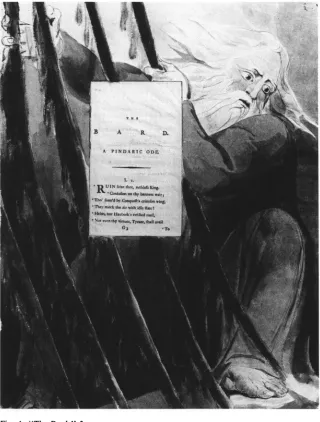
To gloss over Blake's critical interpretation of "The Bard" is to gloss over the meaning of what is perhaps the most seminal series in the Gray set and therefore to obscure the unity of the whole. But if we do come to "The Bard" with the impression that Blake was simply favorably im-pressed by the poem's vision, including that of the second ternary, the first design should effectively curtail this bias. Bard 1 (fig. 2) is only distantly related to the text and functions as a pictorial expression of the Bard's state of vision. He is not Blake's typical redemptive poet-an energetic, muscular, free-flying, curly-headed, nude youth. He is a high-waisted and rigid "Welsh Bard,"5 who is an expression of what Ralph Cohen calls the "statuesque sublime."6 In detail the yellow harp he holds is too large to be mobile, he stares out toward the reader blankly, he stands on a ledge near the water rather than on a mountain top (the traditional place of visionary experience), and the blue rocks into which his' gown almost merges surround him. His situation is somewhat reminiscent, although not as bleak, as that of the earlier separate en-graving, "Joseph of Arimathea Among the Rocks of Albion," but he looks more like a Urizenic figure. The blue and starred gown he wears is
a symbol of the occult or magical.7Thus he is trapped in a world made
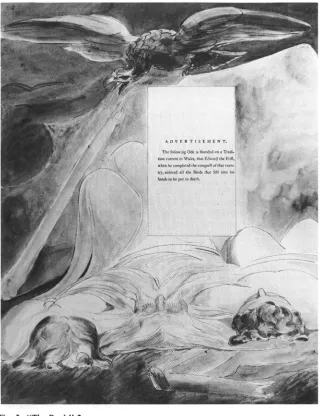
up of sand, rock, water, dull vegetation, and the rigidity of the harp. The form of vision created from this rigid and vacuous state is then the subject of Bard 2 (fig. 3), titled "The Slaughtered Bards. Taken from the line 'The famished eagle screams and passes by.' " Above the textbox is a bird flying. Below, on the ground, are three dead Bards, slightly in the foreground. These Bards Keynes identifies as prophecy of
the present, past, and future.8
Symbolizing the death of true inspiration, the harp is shattered into two pieces, one in the lower left and the other thrusting up and nearly touching the bird. Behind the Bards are large rocks and behind the bird are gray clouds.
Because of the activity of the bird, the bird is the major point of inter-est in the design. By the title it appears to be an eagle and in the text (I. 3.10) the eagle's departure is used by the Bard to signify both the death
4. For the physical description of the Gray set see Irene Tayler's "Introduction" inB/ake's Illustra-tions to the Poems of Thomas Gray (Princeton, N.J.: Princeton Univ. Press, 1971).
5. The titles of each series are to be found accompanying the final design of the preceding series. In the case of theBard series they are to be found accompanying the twelfth design to the "Progress of Poesy" series (see fig. 1).
' (
,;j( /
\
Fig. I. "TheProgress of Poesy," (12).
Fig. 3. "The Bard," 2.
ADVERTISEMENT.
The: (ollo"-ing Ode:i.(oumkd on • Tradi. lton currC'll1 in W.ln, that &hun' the Firfl'! ",·hen he comp1tttd the conquc:A o( that
218 COLBY LIBRARY QUARTERL Y
of the other Bards and the resistance of poetry to tyranny. Blake's actual graphic creation, however, appears to be less an eagle as a symbol
of vision than as a bird of prey-i.e., similar to that found in The
Vi-sions of the Daughters of Albion, plate 3; America, plate 13; and Mil-ton, plate 42. Additionally it is not passing by as much as hovering
over-head while screaming. Thus the bird reminds one of the more traditional scavenger of the battlefield, the raven mentioned by the Bard (I. 3.9). In other words, while Blake seems to be following the text's intention of presenting the Bard's intense mental state and then the reason for it (Le., I. 3, Edward's oppression), in the first design we really see Blake's pression of the Bard's true mental state and in the second design his im-pression of the reason for the vacuousness; the reason is not merely Edward's oppression but either the eagle in flight, the loss of genius be-cause of oppression, or, more likely, the eagle as it has become a bird of prey or a carrion-eater looking down and screaming at the field of battle. For Blake, if not for Gray, vision created from immediate hate-filled response to oppression is vision feeding on the results of the very oppression that it claims to oppose.
Giving added support to the idea that Blake's portrayal of the Bard and the eagle are images of prophetic energy gone awry, the next four
designs (figs. 4-7) select and transform details from the first ternary in
order to create a graphic presentation of the nature, causes, and results
of this revenge-bound energy. The Bard of Bard 3 (fig. 4) is seen as a
powerful figure with a worried look who, the title tells us, is "Weaving Edward's fate." Typical of Blake, the Bard's heroic strength is derived from the compression of severely foreshortened limbs. His left leg and foot are thrust so far forward that his foot is as large as his head. The long white hair on his head and face is not so much blown as electrically straight out, increasing the impression of internal energy; in fact he ap-pears less at the mercy of the elements without than the energy within. His feet, head, hair, and hands stand out of the gray background as his hands manipulate the lines of the loom. These lines, by the way they are held, are also lines of a harp. Even more interesting, by their red color and the fact that they drip red, they are also the "gore" the speaker sees as covering the "griesly" remains of the Bards. Thus Blake has fused the Bard's playing and weaving in II. 1.1-2, the description of the dead Bards in I. 3.8, and the idea of "weaving with bloody hands the tissue of thy line" in I. 3.20. In so doing he has created the impression that the Bard's articulation is creation, that this creation stems from his fear, and that the material from which he creates is limited to the hideous results of oppression.
FRANK A. VAUGHAN 221
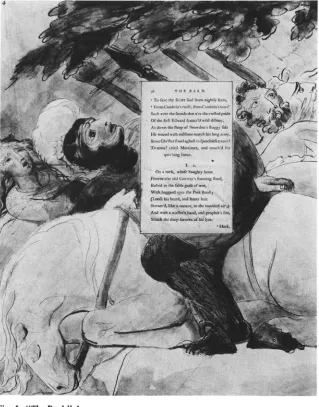
ished at the Bard's song." Very loosely based on the whole of I. 1, the major human character of Bard 4, by color and by central location, is Edward. Rather than being merely astonished as the title says, his ex-pression is that of one standing "aghast in speechless trance" (I. 1.13). Beneath him, his horse is curled up, as if either asleep or dead. The horse, especially when associated with a warrior, is a conventional
sym-bol of the passions.9 In Blake's own vocabulary they are seen to be the
force behind Urizenic reason, opposing the wrath of the tiger (Marriage
of Heaven and Hell, pI. 9), but disastrously capable of being guided by
wrath, thus giving order to a force that can petrify "all the Human
Imagination into rocks& sand" (Four Zoas, 25.3-6; E, p. 310). In the
Gray set, especially in the series of designs immediately following the
Bard series, those for "The Fatal Sisters" and "The Descent of Odin,"
the horse becomes the force carrying forward the mind overwhelmed by the desire to tyrannize. Its sleep / death here, then, expresses the debilita-tion of this desire through Edward's fear.
Yet, while Edward and his horse are the major figures and his fear the focal point of interest, of equal concern thematically is Eleanor, who is seen on the left side. Blake added her with no basis in either history or the text and the reason he did so was because, for the eighteenth cen-tury, Eleanor, Edward's consort, evoked the idea of a tender, loyal, lov-ing, dedicated, and somewhat pathetic woman, a "type" of the best of womanly self-sacrificing love. One historical painting, exhibited at the Royal Academy in 1776, in fact styles her as "The tender Eleanor suck-ing the venom out of the wound which Edward I, her royal consort,
re-ceived with a poison dagger from an assassin in Palestine."10By placing
her here Blake expresses the idea of the woman who desires to give her-self up to the male, in Blake's own terms an Oothoon or the created form of mind as it exists in Beulah, who along with Edward and his nobles appears to be the object of the Bard's desire for revenge. Finally, as the Bard of Bard 3 looks downward toward the objects of his fearful gaze, they stare upward at him in equal fear. Thus the thematic impact of Bard 3 and Bard 4 together becomes the implication of fear begetting fear, suppression suppression, as well as the very real danger involved in this existence, the threat to the Eleanor-type.
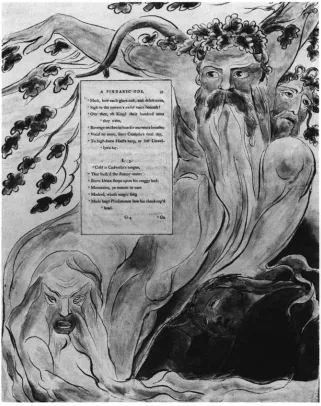
Bard 5 (fig. 6) stems from 1.2.9-11 and the largest figure in it is that
of a humanized tree familiar in Blake. The Oak/Man is lightly colored in green, bearded, and placed against an open sky. With arms outspread in a hands-down manner, his posture strikes one as Christ-like. His right leg is root-like in a stream while his left leg is foreshortened beneath him and he wears what appears to be a crown of oak leaves, common Blak-ean signs of error. The expression on his face is one of patience and
FRANK A. VAUGHAN 223
titude, and beneath his left arm is another, perhaps sadder, face of another Oak/Man. Below him is the head of the personified stream or torrent. As this Torrent looks directly out of the design and at the read-er, to his left, looking at him, is a feminine figure of the Desert-Cave. The Cave, however, is at the water's edge, created by its turbulent action, and covered with green moss-like hair. With a despairing open-mouth look she is listening to the Torrent's voice, reacting to the fierce-ness of his countenance and sound.
The lines upon which this design is based express the Bard's belief that one day the natural world will, of its own accord, rise in justifiable wrath at the deeds done by Edward. But Blake's graphic portrayal does not quite express the same idea. In the world that Blake has envisioned stemming from the Bard's desire for vengeance, the human figures sym-bolically remain trapped in their natural or fallen forms. The river, com-monly a symbol of life or experience, here expresses a deep hostility as it sustains the Oak/Man and creates the despair of the Cave, enclosed per-ceptual energy. Additionally the Christ-like posture, quiet fortitude and down-turned hands of the Oak reenforce the Oak as Blake's symbol of error by portraying him as a resigned victim of a God insisting on sin
and punishment. In fact, ultimately, Bard 5 appears to put forth the
view that this resignation within the belief in sin and punishment is the leading quality of the world the Bard's wrath will create; ironically the desire to act, to lash out against oppression, begets a world essentially passive, nonprogressive.
Completing the group which began with Bard 3, Bard6 (fig. 7) is of
the Avengers conjured up by the Bard in order to intensify, or to
har-monize with, his song (I. 3.16-20). Perhaps because these three Bards
simply reflect his will, they play the same instrument and are seen in a
position similar, but mirror, to the Bard of Bard 3. The major
differ-ences are that they are three in number, they appear more white (Le., "and ghastly pale," I. 3.8) than gray, they are more glassy-eyed than fearful and they are less powerful in impact or size. The design therefore seems to have been created less to forward anyone idea or aspect of the theme than to illustrate all of the principal characters in their proper
relationships. Hence the major lines ofBard3 sweep from the upper left
to the lower right and those of Bard6 sweep from upper right to lower
left, creating a valley in which Edward ofBard 4 exists.
What the Bard has in store for Edward's race specifically is seen in
the next group of designs,Bard7 through 9 (figs. 8-10) as they interpret
the second ternary. In Bard7 (fig. 8) the major figure is linked to the
theme of sin and punishment of Bard 5 by being "The Scourge of
Heaven" that over Edward's country will hang (II. 1.11-12). Beneath a
226 COLBY LIBRARY QUARTERLY
ground figures are Flight (head down, male, partially nude), Amaze-ment (female, looking at the scourge and loosely dressed in green), Sorrow (hands over face, dressed in blue/gray), and Solitude (outlined in the distant lower left). Irene Tayler shrewdly points out that to create the design Blake took Gray's personified "terrors [that] round him wait" (II. 1.11-12) and gave them a source in the scourge held high,
divine punishment and revenge.11Taking this idea one step deeper, since
the Bard is creating Edward's destiny, and thus creating the punitive Scourge, he is the Terrors' ultimate source and what will happen to Edward's line in the future reflects as much upon his sense of justice and mercy as it does upon Edward's present crimes. By emphasizing the pain of the punishment rather than the source of the crimes, as does the Bard ("From thee be born," II. 1.12), Blake is again insisting that revenge or punishment creates a tyranny in which the oppressed, like the Bard, become the oppressors.
The primary theme of Bard 8 (fig. 9), based on 11.2.8-14, is the clash of hope and danger in the fallen world. Beneath the textbox is a large blue gowned figure sleeping in a shell-like fount of water (a whirlpool rather than the whirlwind of II. 2.13) and carrying a snake-like horn. This is obviously Triton in a sea shell, the personification of roaring waters in "grim repose," and he carries a twisting horn because tradi-tionally he is said to carry a twisted sea shell on which he blows to con-trol the waves. Additionally, Blake generally associated twisting horns with the dangers of winter, whirlwinds and storms (as, for instance, in the Night Thoughts design VI.35). Over to the right, lighting the sky into a bright yellow and the gray clouds into pink, is the orange rising sun (II. 2.8-9). Coming toward it, unaware of the dangers represented by Triton, is a tiny ship (II. 2.10-11). By placing Triton in the fore-ground and making the ship so small, Blake has changed the interest of the text, what is happening to Edward's line before our eyes, to a clash between danger-the compositional dominance of the Triton figure-and the hope of a new day or age-the bright color of the rising sun. It is only after these elements of composition and color are noticed that the small detail of the ship is perceived. Still this ship upon the sea head-ing toward the rishead-ing sun embodies the traditional motif of the quest. Where Bard 7 condemns the motivation of the Bard's vision and the tex-tual basis for Bard 8 presents only the end of Edward's line, Bard 8 it-self more widely focuses on the clash between hope and threat in the fallen world. Again, in his role as a prophetic artist, Blake, opposing the nature of the Bard's prophetic will, resists asserting what must be in order to assert what can be.
The text from which Blake created Bard 9 (II. 3.1-10; fig. 10) begins with an ironic banquet scene served by Famine and Thirst and then
Fig. 9. "The Bard," 8.
TIf£ •A It '"
" No piryingtin",noC').~,aRnrd .. A ltu10gr:ac~hi, obfc'lul«. "blhefabltlnlTiortk.l?
"Thy'iJni.gone. l-iercllt.anlOnglh~dl.;l(f. .. 'fbc f",'arm thar inthynoon.ti.1ebt:'~1111\'(1'C
born?
"(~rtt:to(,Iule the riling Mom. IlooYt, .. J:aitlaugh. the Mom, .00lOti the uphyr
.. Whik proudly ridingo·er the atUl'C' ralnl .. In galbnr trim the J;illkJ vrtfd g<ltIl
..YouthonttM-rro"",andplaful'C'lIlf~hdfTIl
.. Rt'prdlcfloftho::fwec::pingWhirl..ind"(WlIf• .. Thsr,hulll'd in grim rcp:sk, cJrpcdJm.
.. n'tning_ptry.
II.
J-·<nn.ighrhcfpartling:bowl•.
FRANK A. VAUGHAN 229
moves on as the Bard asks Edward I, "Heard ye the din of battle bray, / Lance to lance, and horse to horse?" This text Blake transforms by graphically portraying "Close by the regal chair" (II. 3.4) as the tradi-tional position of servitude at the feet of the regal chair. Also this king,
presumably Richard 1112
who was murdered in prison, is not "Reft of crown" (II. 3.3) and is really generalized to represent any king. Finally, in the design the "ye" who hears or sees the battle is not Edward I, as in the text, but Richard himself. Thus, as traditionally visions come after fasting, here Richard is witnessing in dismay what his descendents, Ed-ward Ill's children, will do-begin the War of the Roses, the "rose of snow" of 11.3.15. The emaciated and heavily cloaked figure of Richard sits on a throne, gray-faced and in despair, looking upward as Famine, a wizened old man, smiles, looks at him and points to what apparently are stones. Thirst, also, as grayly emaciated as the king but cloaked only on the lower portion of his body, looks at him and grimly smiles as he holds a goblet upside down. Above the king's head is the real source of his despair, horsemen clashing lance to lance, and on the right hand
side, a boar which, as Keynes points out is "the device of Richard III"13
who is credited with responsibility for the deaths of Henry VI, Henry's son, his own brother, and his two nephews. The boar also significantly looks like a dragon, a creature Blake often associates with the fallen mind's self-destructiveness. The boar / dragon here, then, is appropri-ately said by the text to wallow in "infant gore."
Hence Bard 9 defines closely the realization by Edward's line of the
scourge which the Bard is creating for them. The thrust ofBard 10 (fig.
11) then extends less from the text than from the idea of self-realization; it is the Bards' own realization of their own error in creating the scourge. In the text the Bard returns from his more distant prophecy of what will be to declare Edward's "sudden fate," the death of Eleanor (who his-torically did die in 1286, just after Edward had suppressed the Welsh bards). Once this immediate doom has been announced the Bard's work is done ("The web is wove. The work is done," III. 1.4), the vision be-gins to fade and the Bard himself bebe-gins to feel his immediate situation, his isolation in his mourning ("Stay, oh stay! nor thus forlorn / Leave me unbless'd, unpitied, here to mourn," III. 1.5-6). Blake's graphic portrayal subtly transforms the verbal scene. On the ground is Edward in war-gear, crested plumage, hand on head while in dismay he awk-wardly holds the prostrate figure of Eleanor. The most dramatic figures are the Avengers, above, whose expression and yellowish hair exploding outward are testimonials that they feel not forlorn but genuine horror at what they see below, the fact that their desire for retribution has culmi-nated in the death of Eleanor. Thus Blake has taken the idea of bardic realization which ends the poem (111.3.15-18) and transferred it here. In
12. Keynest "Commentary/' p. 59.
FRANK A. VAUGHAN 231
doing so he has transformed the Bard's feelings of forlornness into at least shocked realization. Where the Bard of the text learns merely that one day he will be vindicated, these Bards, paralleling the realization of
Edward in Bard 9, learn the error of retribution.
Bard 11 (fig. 12) is titled "Elizabeth. 'girt with many a Baron Bold.' "
and therefore fuses 111.2.1, which is really meant for the whole of Brit-annia's (Le., Welsh) issue, to the "form divine" (III. 2.5). At the same time that this "form divine" in the text is identified by her "lion-port" and "awe commanding face" (III. 2.7) as Elizabeth, Blake's design stresses only the qualities of sweetness and grace (III. 2.8), as well as a certain harmony or "symphoniousness" (III. 2.9) of compositional line.
Bard 11 thus is a general state of the fallen mind as a result of the
reali-zation made inBard 9 and 10, the erroneousness of both oppression and
vengeance . We do not see here, however, the historical Elizabeth, to Blake a coy virgin and a shrewd politician in whose court "Knavery Is
Wisdom" ("Anno. to Bacon's Essays Moral, Economical and
Politi-cal;" E, p. 610). Instead this is an Elizabeth whose form suggests the
sweetness and grace of Eleanor. Hence she is Elizabeth only as Elizabeth may be said to contain the qualities of Eleanor and, perhaps, as she reflects the qualities of the art in her reign. If so Blake here is more interested in presenting accurately the outcome of the bardic realization than he is either in accurately presenting the text or his own feelings about Elizabeth. He therefore concentrates on the quality of symphoni-ousness by placing the Bards and the Barons, the spiritual and the tem-poral powers, in a smooth arching line rising toward Elizabeth who radi-ates a soft yellow glow, all of which is unified within a visionary cloud. Ultimately then, the result of the Bards' realization is, at least momen-tarily, a harmonious fusion of the imaginative and temporal powers, specifically what may be seen as the idealization of both Elizabeth and England by the great artists of her day, Spenser and Shakespeare.
The quality of this art and the "poetical vigour" ("Descriptive Cata-logue"; E, p. 534) of this visionary account of the age of Elizabeth is
found inBard 12 (fig. 13), "Spenser Creating his Fairies," a graphic
ex-pansion of the hint given by lines III. 3.1-3. In the upper right hand corner are two pale figures, one loosely garbed, long-haired and read-ing. The other is more tightly clad, pen and scroll in hand as he looks upward to the cherubs above. These are, as Irene Tayler sees, "Truth severe" and "fairy Fiction" (III. 3.3)14 and so personify either the impulse to concentrate on the materially real or the impulse to create, Truth as it is limited to fact perceived by the set assumptions symbolized by the book and Fiction as it articulates imaginative truths. Opposing them, in the lower left corner, smaller but the lower more brightly col-ored to catch the reader's eye, are two scenes which Tayler shrewdly
/ '
/
Fig. 12. "The Bard," 11.
II
/
d .. 12
"TheBar, .
234 COLBY LIBRARY QUARTERLY
identifies as coming from Spenser's Faerie Queene. They are the two
most potentially dangerous errors into which the imagination can fall as it struggles to escape the Selfhood, despair, and the quest after false forms of success.
Generally clouds, especially dark clouds, are Blake's symbols of ob-scurity or Urizen, but clouds also traditionally function as signals for the visionary nature of what is presented within them. The clouds in
Bard 11 and 12 unify all the elements of each design, as well as the two
designs together. Within this environment is the large pink Spenser who, as the title tells us, is creating his fairies. In Blake's vocabulary fairies
are the fallen mind's ability to create forms of truth15and here Spenser
is looking down at a small humanoid fairy in his left hand. By stance and expression this fairy is apparently frightened. Spenser's right hand is raised to shield him from a portion of the textbox and it appears that this shielding, the only action that Spenser is taking, is the act identified in the title as creative. The portion of the text that he hides from the fairy is the portion of the Bard's speech that asserts the golden flood-a phrase easily interpreted by Blake as the imagination rising-will be re-paired inevitably. Spenser's act of creating his fairies then appears to be Spenser as he forms his creative impulse without full knowledge of the mental warfare that is to be; implicitly the idea is that the fallen creative faculty can not withstand the full shock of the truth, an idea familiar in Blake (e.g., "Little Black Boy"). Finally, that this delusion or half truth
is created under the influence of Elizabeth ofBard 11, and is the
culmi-nation of the learning experienced by the Bards ofBard 10, reenforces
the notion that patience is needed until the errors of the fallen mind have contracted.
In Bard 13 (fig. 14) the need for patience is reaffirmed as the Bard,
having learned the lesson, leaps into "endless night" (III. 3.20). For the Bard of the text this is an act stemming from his realization of the error
of hasty and vindictive reaction. For this reason the Bard ofBard 13 no
longer resembles the Bard ofBard 1. Now, harp in hand and dressed in
flowing white gown, he looks intensely into the water as he less "plunges" than gracefully dives in.
The immediate result of this dive, or reentry into experience, is seen
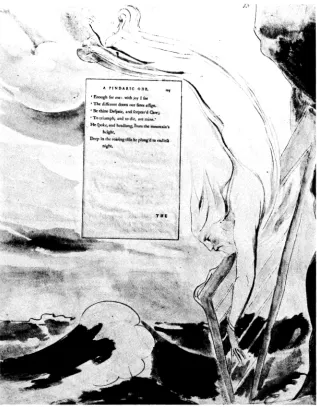
in the last design to the Bard series, entitled "A Welsh Goatherd" (fig.
15). With no specific source in the text, but in marked contrast to the
frontispiece of the Songs of Innocence, this goatherd sits listlessly in
front of a geometric rock, enclosed in a frame of a barren tree. His eyes are downcast, the flute barely held in his hand and, while there are some brighter greens, the primary color of the design is a dull brown. In the background the goats he is supposed to be tending crop grass with
FRANK A. VAUGHAN 237
rather silly expressions on their faces. The goatherd is also an obvious allusion to Pan and, as he is a Welsh goatherd, he is more specifically the Welsh state of the arts or the imagination after the Bard has made his leap.
Thus the series of designs expressing the capacity of the Bards to learn both the dangers of wrath and the necessity of patience appears to end with a figure graphically insisting on a resulting listlessness of the imag-ination, as if the Bards, learning had effectively debilitated the power to create, to perceive. Yet, this final design must be seen as merely a mo-ment in the whole movemo-ment toward regeneration that is expressed in the Gray set. The real meaning of learning the necessity of patience is the capacity to reenter the symbolic sea, an act repeated later by Milton in order to redeem his "Sixfold Emanation" (Milton 2.19-21; E, p. 95) and to allow "all that can be annihilated" to be annihilated (Milton 40.30; E, p. 141). In the Gray set this process of redemption begins in the next two series, the designs to "The Fatal Sisters" and to "The De-scent of Odin." In the stark monochrome of these designs Blake depicts a budding awareness of the self-destructiveness of the desire to tyran-nize. Thus, where in Bard 1 the glassy look of the Bard denotes an iner-tia caused by acceptance of wrath and reaction, in Bard 14 the down-ward listless gaze expresses a suspension of creative activity until error is defined away from truth. In fact, perception of this distinction is per-ception of the lesson learned in, and taught by, the series as a whole.

![Fig. 15. "The Bard," [14].](https://thumb-us.123doks.com/thumbv2/123dok_us/217944.2016280/27.432.56.377.109.524/fig-the-bard.webp)