INFECTIOUS DISEASES, NSW: MAY 1999
TRENDS
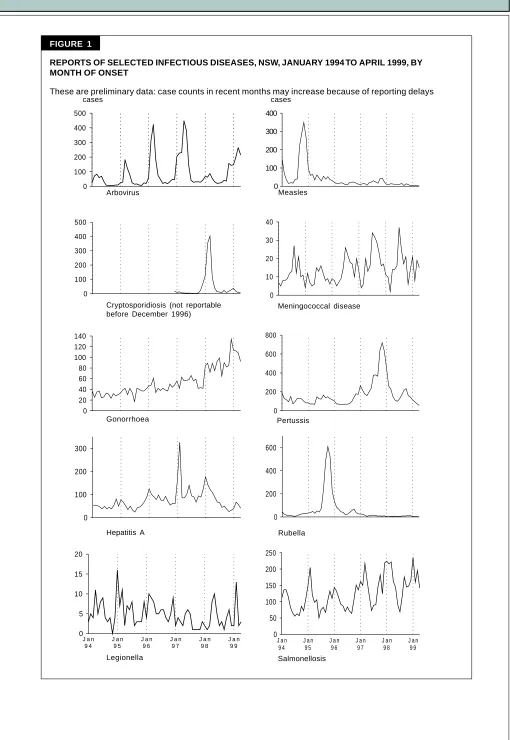
Reports of notifiable infectious diseases reflect usual patterns for this time of year (Figure 1, Table 1). However, influenza appears to have arrived a little early this season (see below), and cases of gonorrhoea continue to be reported among young men in eastern Sydney (see earlier
NSW Public Health Bulletin reports).
THE IMPORTANCE OF INFECTION CONTROL Alison Rutherford, Leena Gupta and Patrick Maywood
Central Sydney Public Health Unit (CSPHU) recently investigated a centre in Campsie where an unqualified person had been practising as a doctor and performing minor surgical operations. The centre had been obtaining clients through advertisements placed in local ethnic newspapers. The person had recently been prosecuted by the NSW Medical Board, which then advised the Public Health Unit in May 1999 because of possible public health concerns.
On receiving notification from the Medical Board, CSPHU established an inquiry under Section 71 of the
Public Health Act 1991 to inspect the premises and to
view records. This inspection suggested that the transmission of blood-borne viruses may have been possible in the past because of the poor standards of infection control at the centre. The unit found and copied records of persons who had visited the centre. The records were written in languages other than English, were incomplete in their details and were stored haphazardly. It is believed from the records and discussions with some local people that many who had attended the centre may have been from non-English speaking backgrounds.
Because of the poor and incomplete record keeping, it was not possible to use the records obtained to contact everyone who had attended the centre. Therefore a media release was issued advising anyone who had visited the centre that they might be at risk of blood-borne virus transmission. The media release urged them to contact their local doctor or public health unit and suggested that they be tested for blood-borne viruses. Broad coverage was achieved in mainstream and ethnic press.
Other public health action included:
• attempting to interview the person concerned, with the assistance of an interpreter, to establish the scope and extent of what had occurred at the centre • translating all records available from the centre in
order to write to those whose contact details were discernible
advising them of steps to be taken should they be contacted by people who had visited the centre • establishing a protocol for responding to telephone
inquiries and ensuring necessary care and/or counselling for people who might contact the CSPHU • issuing a warning letter to the practitioner advising them of their obligations under the Public Health
Regulation 1991.
Using powers granted under the Public Health Act 1991, staff from the CSPHU revisited the premises with suitably qualified clinical waste removal contractors.
The investigation relied on liaison with a range of agencies, individuals and organisations including: the local police, councils and general practitioners; AIDS/Infectious Diseases and Legal and Pharmaceutical Services Branches of the NSW Department of Health; and the NSW Medical Board. Further liaison with the NSW Medical Board and referral of the matter to the NSW Health Care Complaints Commission is planned.
HEPATITIS A IN A BAKERY WORKER Gerard Finnigan and Tony Kolbe
On Friday, 30 April, the Greater Murray Public Health Unit was notified by telephone of a positive hepatitis A serology (anti-HAV IgM) result in a bakery worker who had presented to an Emergency Department four days earlier with a two-day history of nausea, malaise and vomiting.
Standard follow-up identified the case as a worker whose job was to manually detach bread rolls from bunches and insert the rolls into plastic bags. This person had attended work for 12 days while potentially infectious and was involved in processing approximately 140,000 bread rolls for distribution to the ACT and rural areas of western and southern NSW. Gloves were not used by workers on this production line.
52 Vol. 10 No. 5 52
FIGURE 1
REPORTS OF SELECTED INFECTIOUS DISEASES, NSW, JANUARY 1994 TO APRIL 1999, BY MONTH OF ONSET
These are preliminary data: case counts in recent months may increase because of reporting delays
Arbovirus Measles
Cryptosporidiosis (not reportable before December 1996)
Meningococcal disease
Gonorrhoea Pertussis
Hepatitis A Rubella
Legionella Salmonellosis
cases cases
0 100 200 300 400 500
0 100 200 300 400
0 100 200 300 400 500
0 10 20 30 40
0 20 40 60 80 100 120 140
0 200 400 600 800
0 100 200 300
0 200 400 600
J a n 9 4
J a n 9 5
J a n 9 6
J a n 9 7
J a n 9 8
J a n 9 9 0
50 100 150 200 250
J a n 9 4
J a n 9 5
J a n 9 6
J a n 9 7
J a n 9 8
J a n 9 9
V
ol.
10 No
. 5
Area Health Service (1999) Total
Condition CSA NSA WSA WEN SWS CCA HUN ILL SES NRA MNC NEA MAC MWA FWA GMA SA for Apr+ To date+
Blood-borne and sexually transmitted
AIDS 3 1 – 1 – 1 2 – 5 – – – – – – – – 13 73
HIV infection* – – – – –Reported second monthly– – – – – – – – – – – 89
Hepatitis B: acute viral* – – – – – – – – 2 – – 1 – – – – – 3 21
Hepatitis B: other* 69 36 6 4 2 3 3 4 55 5 2 5 1 3 7 6 2 213 1134
Hepatitis C: acute viral* 2 – – – – – – – 2 – – – – – – – – 4 29
Hepatitis C: other* 100 44 2 27 4 53 43 14 81 46 37 18 2 31 4 19 29 556 2838
Hepatitis D: unspecified* – – – – – – – – – – – – – – – 1 – 1 2
Hepatitis, acute viral (not otherwise specified) – – – – – – – – – – – – – – – – – – –
Chancroid* – – – – – – – – – – – – – – – – – – –
Chlamydia (genital)* 18 10 4 8 2 5 23 15 47 17 14 2 3 5 11 10 2 200 757
Gonorrhoea* 29 9 1 3 – – – 2 50 1 1 1 2 – 6 1 – 106 462
Syphilis 17 3 3 2 1 2 – 1 13 2 1 2 – 2 2 2 – 53 218
Vector-borne
Arboviral infection* – 7 4 4 1 11 40 30 4 81 18 3 1 1 3 8 30 246 834
Malaria* – 3 – 2 – – – 2 5 1 1 – – – – 3 – 18 79
Zoonoses
Brucellosis* – – – – – – – – – – – – – – – – – – 2
Leptospirosis* – – – – – – – – – 3 1 1 – – – – – 5 16
Q fever* – – – – – – – 1 – 2 1 1 1 – 1 1 – 8 47
Respiratory and other
Blood lead level* 2 1 – – – 1 3 – – 1 – – – – 9 – – 17 247
Legionnaires’ disease* – 2 1 – – – – – – – – 1 – – – 1 – 5 22
Leprosy – – – – – – – – – – – – – – – – – – –
Meningococcal infection (invasive) – – 1 1 1 – 1 3 3 – 1 – 1 1 1 – – 14 59
Mycobacterial tuberculosis 2 9 2 1 – 2 – 1 2 – 1 – – – – – – 20 128
Mycobacteria other than TB 3 4 – 1 – – 2 – 5 – – 3 – – – 1 – 19 136
Vaccine-preventable
Adverse event after immunisation 1 – – – – – – – – – – – – – – – – 1 24
H. influenzae b infection (invasive)* – – – – – – – – – – – – – – – – – – 3
Measles – – – – – 1 – – – – – – – – – – – 1 15
Mumps* – 1 – – – – – 1 – – – – – – – – – 2 7
Pertussis 3 5 3 5 10 4 13 1 10 – 2 – 2 3 – 3 2 67 427
Rubella* – – – – – – – – – 1 – – – – – – – 1 15
Tetanus – – – – – – – – – – – – – – – – – – –
Faecal-oral
Botulism – – – – – – – – – – – – – – – – – – –
Cholera* – – – – – 1 – – – – – – – – – – – 1 2
Cryptosporidiosis* – 1 1 – – – 1 – 3 2 1 1 – – – – 2 12 84
Giardiasis* 6 13 7 2 2 7 4 2 23 10 6 6 1 3 1 3 1 98 442
Food-borne illness (not otherwise specified) – – – – – – – – – 2 – – – – – – – 2 8
Gastroenteritis (in an institution) 3 – – – – – – – – – – – – – 1 – – 4 64
Haemolytic uraemic syndrome – – – – – – – – – – – – – – – – – – 7
54 Vol. 10 No. 5 54
References
1. Warburton AR, Wreghitt TG, Rampling A, et al. Hepatitis A outbreak involving bread. Epidemiol Infect 1991; 106:199– 202.
2. Weltman AC, Bennet NM, Ackman DA, et al. An outbreak of hepatitis A associated with a bakery. Epidemiol Infect 1996; 117:333–341.
NSW INFLUENZA SURVEILLANCE ACTIVITY UPDATE
Rob Menzies
This report is prepared from weekly NSW Influenza
Surveillance Activity Updates, produced in collaboration
with: the AIDS/Infectious Diseases Branch of the NSW Department of Health; South East Area Laboratory Service; Institute of Clinical Pathology and Medical Research Westmead; South West Area Pathology Service; Pacific Laboratory Medical Services; participating general practitioners; and the Hunter, New England, Northern Sydney and Southern Public Health Units.
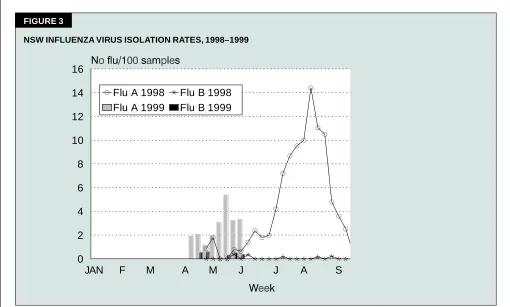
Influenza activity during May continued at a moderate level and was higher than the level in April.
Clinical Activity
Rates of influenza-like illness reached levels similar to those reported for the same period last year. Weekly reports
were received from approximately 30 general practitioners (GPs) through four public health units covering more than 3500 consultations per week (Figure 2).
Virological Activity
The laboratory reporting rate for influenza A diagnoses increased in May to a level higher than that for the same period last year. In the last week of May, 14 cases of influenza A (13 virological, one serological), three cases of influenza B (two virological, one serological) and 67 respiratory syncytial virus were reported. In the corresponding week last year, two cases of influenza A, one of influenza B and 71 of respiratory syncytial virus were reported (Figure 3).
Directed Virological Surveillance
During May, approximately 15 GPs submitted specimens from up to five patients a week who had influenza-like illnesses. Of 54 samples submitted, five were positive for influenza A and one for influenza B (11 per cent). This is similar to the overall positive rate of 14 per cent for last year. No other respiratory viruses were detected. Samples were taken from a broad age range (0–79 years) of patients. Approximately 30 GPs from the Central Sydney, South Eastern Sydney, Western Sydney, Wentworth, Central Coast, Hunter, Illawarra, Greater Murray and Southern areas are participating in the scheme this year.
JAN F M A M J J A S
0 1 0 2 0 3 0 4 0 5 0 6 0
1 9 1 9 FIGURE 2
International Surveillance
The 1998–99 season in the United States included widespread epidemic activity that peaked in mid-March and was similar in severity to the previous two seasons. In Europe, influenza activity reached epidemic levels in most countries that reported to the World Health Organization. The predominant strain in most countries was A(H3N2): A/Sydney/5/97-like. Influenza B was also isolated in most countries and was the predominant strain in parts of Europe. No country has reported significant influenza activity during May. New Zealand has reported only sporadic activity, Chile reported a regional outbreak in early May and Argentina has reported no activity.
INFLUENZA OUTBREAK IN A METROPOLITAN BOARDING SCHOOL
Lorraine Young, Mark Ferson, Mary Short and David Townson
In the first week of May, the South Eastern Sydney Public Health Unit (SESPHU) was notified by the school health nurse from a local boarding school of a sudden outbreak of a respiratory illness among student boarders. The
high fever of up to 39°C, sore throat and cough. Seven of the 11 live-in boarding staff members had also been affected.
Because new cases continued to occur, on Thursday, 6 May, the SESPHU organised for the collection, transport and virological testing of nasal swabs from any new cases. This was done in conjunction with the school’s general practitioner, the school nurse, staff of the South East Area Laboratory Service Virology Department, and St Vincent’s Hospital Microbiology Department. Three nasal swabs were collected on Friday, 7 May, and the laboratory reported the following day that all three specimens were positive for influenza.
The school accommodates a total of 180 boarders and 11 live-in boarding staff. By Wednesday, 12 May, at least 77 boarders and seven of the 11 staff members had reported illness. The exact number of student boarders affected was not ascertained because many had gone home during this period. The majority of cases presented during the first three to five days of the outbreak, with some cases continuing to occur up until the 12th day. There had also
JAN F M A M J J A S
0 2 4 6 8 10 12 14 16
Flu A 1998 Flu B 1998
Flu A 1999 Flu B 1999