A TWO-THRESHOLD GUARD CHANNEL SCHEME
FOR MINIMIZING BLOCKING PROBABILITY
IN COMMUNICATION NETWORKS
Hamid Beigy
Department of Computer Engineering, Sharif University of Technology Tehran, Iran, [email protected]
M. R. Meybodi
Department of Computer Engineering, Amirkabir University of Technology Tehran, Iran, [email protected]
(Received: March 4, 2003 – Accepted in Revised Form: June 10, 2004)
Abstract In this paper, we consider the call admission problem in cellular network with two classes of voice users. In the first part of paper, we introduce a two-threshold guard channel policy and study its limiting behavior under the stationary traffic. Then we give an algorithm for finding the optimal number of guard channels. In the second part of this paper, we give an algorithm, which minimizes the number of channels subject to hard constraints on the blocking and dropping probabilities of calls. Finally, we propose an optimal prioritized channel assignment for multi-cells cellular networks with two classes of voice users.
Key Words Call Admission Control, Guard Channels, Two-Threshold Guard Channels, Wireless Networks
ﻩﺪﻴﻜﭼ
ﻦﻳﺍ ﺭﺩ ﻪﻟﺎﻘﻣ ﯽﺗﻮﺻ ﺲﻳﻭﺮﺳ ﻭﺩ ﺎﺑﯽﻟﻮﻠﺳ ﺭﺎﻴﺳﯼﺎﻫ ﻪﮑﺒﺷ ﺭﺩﺎﻫﺖﺳﺍﻮﺧﺭﺩ ﺵﺮﻳﺬﭘ ﻝﺮﺘﻨﮐﻪﻠﺌﺴﻣ
ﺮﺑ ﯽﺳﺭ ﯽﻣ ﺩﻮﺷ
.
ﺎﺘﺴﻳﺍﯼﺎﻫﮏﻴﻓﺍﺮﺗﯼﺍﺮﺑﻥﺁﺭﺎﺘﻓﺭﻭﻪﺋﺍﺭﺍﯼﺍﻪﻧﺎﺘﺳﺁﻭﺩ ﻁﺎﻴﺘﺣﺍﻝﺎﻧﺎﮐﺵﻭﺭ،ﻪﻟﺎﻘﻣﻝﻭﺍ ﺶﺨﺑﺭﺩ
ﯽﻣﯽﺳﺭﺮﺑ ﺩﺩﺮﮔ
.
ﻪﻨﻴﻬﺑﺩﺍﺪﻌﺗ ﻥﺩﺮﮐﺍﺪﻴﭘﯼﺍﺮﺑﯽﻤﺘﻳﺭﻮﮕﻟﺍﺲﭙﺳ ﻝﺎﻧﺎﮐ
ﯽﻣﻪﺋﺍﺭﺍﻁﺎﻴﺘﺣﺍﯼﺎﻫ ﺩﻮﺷ
.
ﻡﻭﺩ ﺶﺨﺑﺭﺩ
،ﻪﻟﺎﻘﻣ ،ﺎﻬﺘﺳﺍﻮﺧﺭﺩﺩﺭﻊﻄﻗﻝﺎﻤﺘﺣﺍﺖﻳﺩﻭﺪﺤﻣﻪﺑﻪﺟﻮﺗﺎﺑ ﻝﺎﻧﺎﮐﻪﻨﻴﻤﮐﺩﺍﺪﻌﺗﻥﺩﺮﮐﺍﺪﻴﭘﯼﺍﺮﺑﯽﻤﺘﻳﺭﻮﮕﻟﺍ
ﺩﺭﻮﻣﯼﺎﻫ
ﯽﻣﻪﺋﺍﺭﺍﻝﻮﻠﺳﺯﺎﻴﻧ ﺩﺩﺮﮔ
.
ﻭﺩ ﺎﺑﺭﺎﻴﺳﯽﻟﻮﻠﺳ ﯼﺎﻫﻪﮑﺒﺷ ﯼﺍﺮﺑﺭﺍﺩﺖﻳﻮﻟﻭﺍ ﻝﺎﻧﺎﮐﺏﺎﺴﺘﻧﺍﻢﺘﻳﺭﻮﮕﻟﺍ ﮏﻳ،ﺎﻬﺘﻧﺍﺭﺩ
ﺍﯽﺗﻮﺻﺲﻳﻭﺮﺳ ﯽﻣﻪﺋﺍﺭ
ﺩﻮﺷ
.
1. INTRODUCTION
In cellular networks, geographical area covered by mobile network is divided into smaller regions called cells. Each cell has a base station (BS), which is located at its center. A number of base stations are connected to a mobile switching center (MSC), which acts as a gateway of the mobile network to the existing wired-line networks. In order for a mobile user to be able to communicate with other user(s), a connection usually must be established between the users. When a mobile user needs a connection, sends his request to the base station of the cell residing it. Then, the base station
before its completion. The disconnection in the middle of a call is highly undesirable and one of the goals of the network designer is to keep such disconnections low.
Introduction of micro cellular networks leads to efficient use of channels but increases expected rate of handovers per call. As a consequence, some network performance parameters such as blocking probability of new calls and dropping probability of handoff calls are affected. These two parameters are dependent to each other. For example, accepting more handoff calls increases the blocking probability of new calls and vice versa. As a result, there is a trade-off between these two performance parameters. In order to have these performance parameters at reasonable level, call admission policies are used. The call admission policies determine whether a call should be admitted or blocked. Both blocking probability of new calls and dropping probability of handoff calls are affected by call admission policies. Blocking more new calls generally improves dropping probability of handoff calls and admitting more new calls generally improve blocking probability of new calls. Since dropping of handoff calls is more serious than blocking of new calls, call admission policies give the higher priority to handoff calls. This priority is usually implemented through allocation of more resources (channels) to handoff calls [1]. Many schemes have been proposed to reduce the dropping of voice calls such as guard channel scheme (GC) [2-4], fractional channel scheme (FC) [5], limited fractional channel scheme (LFC) [5], and uniform fractional channel scheme (UFC) [6]. Some schemes allow either handoff calls [7] or new calls [8] to be queued until free channels are obtained in the cell. These schemes may not be used adaptively to deal with changes in such traffic parameters as arrival rates and/or holding time of calls. Therefore, several adaptive call admission schemes have been introduced [9-14].
All of the above mentioned call admission policies consider only one threshold to decide for accepting/rejecting new calls. These policies cannot be used when different classes of users need different level of QoS. In such cases, we need multi-threshold guard channel scheme, which provides different set of guard channels for different classes of users. The only reported multi-threshold guard channel scheme, called
dual-threshold reservation (DTR) scheme, is given in [15]. The basic idea behind the DTR scheme is to use two thresholds, one for reserving channels for voice handoff, while the other is used to block data traffic into the network in order to preserve the voice performance in terms of handoff dropping and call blocking probabilities. DTR assumes that the bandwidth requirement of voice and data are the same. The equations for blocking probabilities of DTR are calculated using a two-dimensional Markov chain and the effect of different values for the number of guard channels on dropping and blocking probabilities are plotted, but no algorithm is given to find the optimal number of guard channels.
In this paper, we consider a cellular network with two classes of voice users. In this system, the dropping probability of handoff calls of class 2 is less than the dropping probability of handoff calls of class 1 which is less than the blocking probability of new calls. In order to maintain the predefined level of QoS, we introduce a two-threshold guard channel scheme, which is similar to the idea given in [15]. The proposed scheme minimizes the blocking probability of both types of new calls subject to the hard constraint on the dropping probabilities of handoff calls for both classes. In the proposed call admission scheme, set of channels allocated to the given cell is partitioned into three subsets: ordinary channels, shared guard channels and dedicated guard channels. The ordinary channels are shared among all types of calls while the shared guard channels are shared only among handoff calls of two classes, and the dedicated guard channels are used only for the handoff calls of class 2. The limiting behavior of this scheme is analyzed under stationary traffic. In this paper, we also consider three prioritized channel assignment problems: finding the optimal number of guard channels, minimizing the number of required channels and the optimal channel assignment in multi-cells cellular system subject to the hard constraints on the dropping probabilities of handoff calls of both classes. The call admission scheme proposed in this paper can easily be extended to multi-classes traffic.
are studied in section 4. Section 5 gives an algorithm to find the optimal number of guard channels. An algorithm for finding the minimum number of channels required maintaining the predefined level of QoS is given in Section 6. Section 7, presents an optimal channel assignment algorithm for multi-cells cellular network and section 8 concludes the paper.
2. BASICS IN GUARD CHANNEL POLICY
In this section, we first review guard channel policy and then compute its blocking performance. We assume that the given cell has a limited number of full duplex channels, C, in its channel pool. We define the state of a particular cell at time t to be the number of busy channels in that cell and is represented by c(t). The guard channel policy reserves a subset of channels allocated to a particular cell for handoff calls (say C-T channels) [2]. The description of guard channel policy is given algorithmically in Figure 1. Whenever the channel occupancy exceeds the certain threshold T, the guard channel policy rejects new calls until the channel occupancy goes below the threshold. The guard channel policy accepts handoff calls as long as channels are available.
For computing the blocking performance of GC
policy, we consider a homogenous cellular network where all cells have the same number channels C and experience the same new and handoff call arrival rates. In each cell, the arrival of new calls and handoff calls are Poisson distributed with arrival rates λn and λh, respectively and the channel holding time of new and handoff calls are exponentially distributed with mean µ−1. Let
h n+λ
λ =
λ ,
λ λ =
α h and
µ λ =
ρ . This set of assumptions have been found reasonable as long as the number of mobile users in a cell is much greater than the number of channels allocated to that cell.
{
c
( )
t
t
≥
0
}
is a continuous-time Markov chain (birth-death process) with states 0,1,…,C. The state transition rate diagram of a cell with C full duplex channels and GC call admission scheme is shown in Figure 2.Define the steady state probability
( )
[
ct n]
problim P
t
n = =
∞
→ n=0,1,...,C (1)
From [2], the steady state probability P that n n channels are busy is given by the following expression.
⎪ ⎪ ⎩ ⎪⎪ ⎨ ⎧
≤ < α
ρ
≤ ≤ ρ
=
−
C n T P
! n
T n 0 P
! n P
0 T n n
0 n
n (2)
where P is the probability that all channels are 0 free and is calculated by the following expression.
1 C
T k
T k k 1
T
0 k
k 0
! k !
k P
−
=
− −
= ⎥⎥⎦
⎤ ⎢
⎢ ⎣
⎡ ρ α
+ ρ
=
∑
∑
(3)Using above expressions, we can drive an if (HANDOFF CALL) then
if c(t) < C then accept call else
reject call end if end if
if (NEW CALL) then if c(t) < T then accept call else
reject call end if end if Figure 1. Guard channel policy.
expression for dropping probability of handoff calls using C channels and C-T guard channels.
(
)
! C P
T , C
Bh = C =ρCαC−T (4)
Similarly, the blocking probability of new calls is given by the following expression.
(
)
∑
∑
=
−
=
α ρ =
= C
T k
T k k C
T
k k
n
! k P
T , C
B (5)
It has been shown that there is an optimal threshold T in which the blocking probability of * new calls is minimized subject to the hard constraint on the dropping probability of handoff calls [5]. Algorithms for finding the optimal number of guard channels are given in [3-5]. If only the dropping probability of handoff calls is considered, the guard channel scheme gives very good performance, but the blocking probability of new calls is degraded to a great extent. In order to have more control on both the dropping probability of handoff calls and the blocking probability of new calls, limited fractional guard channel scheme (LFG) is proposed [5]. The LFG scheme reserves non-integral number of guard channels for handoff calls. The limited fractional guard channel scheme uses an additional parameter π and operates the same as the guard channel scheme except when T channels are occupied in the cell, in which case new calls are accepted with probability π. It has been shown that there is an optimal pair
(
T*,π*)
, which minimizes the blocking probability of new calls subject to the hard constraint on the dropping probability of handoff calls [5]. An algorithm for finding such optimal parameters is given in [5]. In [6], uniform fractional channel scheme (UFC) isintroduced, which accepts new calls with probability of π independent of channel occupancy. It is shown that there is an optimal π*, which minimizes the blocking probability of new calls with the constraint on the dropping probability of handoff calls. An algorithm for finding such optimal parameter and conditions for which the uniform fractional guard channel performs better than guard channel is given in [6]. It is concluded that, the uniform fractional guard channel scheme performs better than guard channel scheme in low handoff traffic conditions.
3. TWO-THRESHOLD GUARD CHANNEL POLICY
In this section, we first introduce a two-threshold guard channel policy and then compute its blocking performance. We consider a homogenous cellular network where all cells have the same number channels, C, with two classes of voice users and experience the same new and handoff call arrival rates. In each cell, the arrival of new calls and handoff calls for class i (i=1,2) are Poisson distributed with arrival rates λni and λhi, respectively. Thus, the total call arrival rates for classes i are λi=λni+λhi. In each cell, the channel holding time of new and handoff calls for class i (i=1,2) are exponentially distributed with mean
µ
ni−1 and 1hi
µ
− , respectively. This set of assumptions have been found reasonable as long as the number of mobile users in a cell is much greater than the number of channels allocated to that cell.Assume that the quality of service (QoS) for handoff calls of class 2 is greater than the QoS for other calls and the QoS for handoff calls of class 1 if (HANDOFF CALL OF CALL 2) then
if (c
( )
t <T2) then accept call elsereject call end if end if
if (HANDOFF CALL OF CALL 2) then if (c
( )
t <C) thenaccept call else
reject call end if end if if (NEW CALL) then
if (c
( )
t <T1) then accept call elsereject call end if end if
is greater than the QoS for new calls. In order to maintain such level of QoS, channels allocated to cell are partitioned into three subsets: ordinary channels, shared guard channels and dedicated guard channels. The ordinary channels are shared between all types of calls while the shared guard channels are shared only between handoff calls and dedicated guard channels are used only for handoff calls of class 2. In order to partition the channel sets, we use two thresholds, T and 1 T 2 (0<T1≤T2≤C). The procedure for accepting calls in the proposed two-threshold guard channel policy, as shown in Figure 3, can be described as follows. When a handoff call of class 2 arrives and an idle channel is available in the channel pool, the call is accepted and a channel is assigned to it; otherwise the call will be dropped. When a handoff call of class 1 arrives, it is accepted provided that the number of busy channels is smaller than T ; 2 otherwise the call will be dropped. When a new call arrives at the cell, it will be accepted provided that the number of busy channels is smaller than
1
T (T1≤T2); otherwise, the incoming call will be blocked. In the above procedure, the highest priority is given to the handoff calls of class 2 and the lowest priority is given to the new calls.
If the cell is in statistical equilibrium, then it can be modeled as a four-dimensional Markov chain with the following state space.
(
)
{
}
C n n n n , 0 n , 0 n , 0 n , 0 n n , n , n , n S 2 h 2 n 1 h 1 n 2 h 2 n 1 h 1 n 2 h 2 n 1 h 1 n ≤ + + + ≥ ≥ ≥ ≥ = (6) where n , n1 n , h1 n and n2 n denote the number of h2new calls of class 1, the number of handoff calls of class 1, the number of new calls of class 2 and the number handoff calls of class 2 in the cells, respectively. Let
(
nn1,nh1,nn2,nh2;nn1,nh1,nn2,nh2)
q be the
transition rate from state
(
nn1,nh1,nn2,nh2)
to state(
nn1,nh1,nn2,nh2)
. Then, we have the following.(
,i ,jk, ;l,i ,jk,l 1)
h2q + =λ
C l k j i , 0 l , 0 k , 0 j , 0
i≥ ≥ ≥ ≥ + + + <
(
,i ,jk,l 1;,i ,jk,l) ( )
l 1 h2q + = + µ
C l k j i , 0 l , 0 k , 0 j , 0
i≥ ≥ ≥ > + + + <
(
,i ,jk, ;l ,i ,jk 1,l)
n2q + =λ
1 T l k j i , 0 l , 0 k , 0 j , 0
i≥ ≥ ≥ ≥ + + + <
(
,i ,jk 1, ;l ,i ,jk,l) (
k 1)
n2q + = + µ
C l k j i , 0 l , 0 k , 0 j , 0
i≥ ≥ > ≥ + + + <
(
,i ,jk, ;l ,ij 1,k,l)
h1q + =λ
2 T l k j i , 0 l , 0 k , 0 j , 0
i≥ ≥ ≥ ≥ + + + <
(
,ij 1,k,;l ,i ,jk,l) ( )
j 1 h1q + = + µ
C l k j i , 0 l , 0 k , 0 j , 0
i≥ > ≥ ≥ + + + <
(
,i ,jk, ;li 1, ,jk,l)
n1q + =λ
1 T l k j i , 0 l , 0 k , 0 j , 0
i≥ ≥ ≥ ≥ + + + <
(
i 1, ,jk,;l ,i ,jk,l)
n1q + =λ
C l k j i , 0 l , 0 k , 0 j , 0
i> ≥ ≥ ≥ + + + <
(7) Let p
(
nn1,nh1,nn2,nh2)
be the steady stateprobability that there is n new calls of class 1, n1
1 h
n handoff calls of class 1, n new calls of class n2 2, and n handoff calls of class 2 in the cells of h2 the network. From Equations 7, we obtain the following balance equations.
(
) (
)
(
)
(
)
(
)
(
0,0,0,1)
p 0 , 1 , 0 , 0 p 0 , 0 , 1 , 0 p 0 , 0 , 0 , 1 p 0 , 0 , 0 , 0 p 2 h 2 n 1 h 1 n 2 h 2 n 1 h 1 n µ + µ + µ + µ = λ + λ + λ + λ(
)
(
)
( )
(
) ( )
(
)
(
)
(
) ( )
(
)
(
)
(
)
(
,i ,jk,l 1)
p(
,i ,jk,l 1)
p l , k , 1 j ,i p l , k ,j , 1 i p 1 l , k ,j ,i p 1 l l , 1 k ,j ,i p 1 k l , k , 1 j ,i p 1 j l , k ,j , 1 i p 1 i l , k ,j ,i p l k j i 2 h 2 n 1 h 1 n 2 h 2 n 1 h 1 n 2 h 2 n 1 h 1 n 2 h 2 n 1 h 1 n − λ + − λ + − λ + − λ + + µ + + + µ + + + µ + + + µ + = µ + µ + µ + µ + λ + λ + λ + λ0<i+j+k+l<T1
(
) (
)
( )
(
) ( )
(
)
(
)
(
) ( )
(
)
(
,ij 1,k,l)
p(
,i ,jk,l 1)
p 1 l , k ,j ,i p 1 l l , 1 k ,j ,i p 1 k l , k , 1 j ,i p 1 j l , k ,j , 1 i p 1 i l , k ,j ,i p l k j i 2 h 1 h 2 h 2 n 1 h 1 n 2 h 2 n 1 h 1 n 2 h 1 h − λ + − λ + + µ + + + µ + + + µ + + + µ + = µ + µ + µ + µ + λ + λT1≤i+j+k+l<T2
(
) (
)
( )
(
) ( )
(
)
(
)
(
) ( )
(
)
(
,i ,jk,l 1)
p 1 l , k ,j ,i p 1 l l , 1 k ,j ,i p 1 k l , k , 1 j ,i p 1 j l , k ,j , 1 i p 1 i l , k ,j ,i p l k j i 2 h 2 h 2 n 1 h 1 n 2 h 2 n 1 h 1 n 2 h − λ + + + µ + + + µ + + + µ + + + µ + = µ + µ + µ + µ + λ C l k j i(
) (
)
(
,i ,jk,l 1)
pl , k ,j ,i p l k j i
2 h 2
h 2 n 1 h 1 n
− λ
= µ
+ µ + µ + µ
C l k j
i+ + + =
(8) and p
(
,i ,jk,l)
=0 for i<0 or j<0 or k<0 or l<0.Let Bh2
(
C,T1,T2)
, Bh1(
C,T1,T2)
, Bn(
C,T1,T2)
be the dropping probability of handoff calls of class 2, the dropping probability of handoff calls of class 1, and the blocking probability of new calls, respectively when using C channels, C−T2 dedicated guard channels and T2−T1 shared guard channels. Thus, we obtain(
)
∑
(
)
= + + +
=
C l k j i 2 1 2
h C,T,T pi,j,k,l
B (9)
(
)
+ +∑
+=(
)
≥ + + +
= i j k l C
T l k j i 2 1 1 h
2 l , k , j , i p T
, T , C
B (10)
(
)
+ +∑
+=(
)
≥ + + +
=i j k l C
T l k j i 2 1 n
1 l , k , j , i p T
, T , C
B (11)
In order to calculate the above equations, we need to calculate the steady state probabilities p
(
,i ,jk,l)
, which can be obtained using a recursive technique first proposed in [16]. This technique is based on typical feature of Chapman-Kolomorogoff system of equations in which there exist a subset of states, called boundary states, for which all other state probabilities can be expressed as a function of state probabilities of the boundary states. The basic idea of this technique is to choose the boundary states first to derive the expressions for all remaining state probabilities and then solve a reduced system of equations for these boundaries. Then all state probabilities can be determined by means of the boundary states. Since, this technique does not leadto suitable closed form equations for all Markov chains including the four-dimensional Markov chain for the proposed model. So, we make some assumptions regarding the traffic parameters in order to reduce the dimensionality of the Markov chain to one. We make the following assumption.
Assumption 1
The channel holding times for alltypes of calls are exponentially distributed with the same mean µ−1, i.e. µ = µn1 = µh1 = µn2 = µh2. Let c(t) denote the number of occupied channel in the given cell for which
{
c( )
t t≥0}
is a continuous-time Markov chain (birth-death process) with states 0,1,…,C. The state transition diagram of a particular cell in the network, which has C full duplex channels and uses two-threshold guard channel policy, is shown in Figure 4.It is apparent that the state dependent arrival rate in the birth-death process, is equal to
( )
⎪ ⎩ ⎪ ⎨ ⎧
≤ ≤ λ
≤ ≤ λ
≤ λ
= λ
C n T if
T n T if
T n if n
1 2 h
2 1
h
1
(12)
where λ=λ1+λ2 and λh =λh1+λh2. We can easily write down the solution to the steady-state balance equations of the Markov chain. Define the steady state probability
∞ →
=
t
n lim
P Prob
[
c( )
t =n]
n=0,1,..C (13)By writing down the equilibrium equations for the steady-state probabilities P (n n=0,1,...,C), we obtain
n 1
n n P
P = µ
λ − if n≤T1
n 1 n
hP =nµP
n 1 n 2
h P =nµP
λ − if T2<n≤C
Then, we have the following expression for P (n n = 0,1, … ,C).
( )
(
)
⎪ ⎪ ⎪ ⎪ ⎩ ⎪⎪ ⎪ ⎪ ⎨ ⎧ ≤ < ρα ⎟⎟ ⎠ ⎞ ⎜⎜ ⎝ ⎛ α α α ≤ < ρα α ≤ ρ = − − C n T if P ! n T n T if P ! n T n if P ! n P 2 0 n 2 T 2 T 2 1 0 n T 1 0 n n 2 11 (14)
where µ λ = ρ , λ λ = α h ,
λ λ = α h2
2 and P is the 0
probability that all channels are free and obtained from equation
∑
Cn=0Pn =1. Thus, P is equal to 0 the following expression.( )
(
)
1C T n n 2 T 2 T 1 T T n n T 1 T 0 n n 0 2 2 1 2 1 1 1 ! n ! n ! n P − = − − = − − = ⎥ ⎥ ⎦ ⎤ ρα ⎟⎟ ⎠ ⎞ ⎜⎜ ⎝ ⎛ α α α + ⎢ ⎢ ⎣ ⎡ ρα α + ρ =
∑
∑
∑
Note that if we set T1=T2=C, then expression (14) reduces to the classical Erlang-B formula [17] and if we set T1=T2 =T, then expression (14) reduces to the classical guard channel policy [2]. Now we can write expressions for the dropping probability of handoff calls. The dropping probability of handoff calls of class 2 using C channels, C−T2 dedicated guard channels and
1
2 T
T − shared guard channels is equal to
(
)
(
)
0C 2 T 2 T C 2 1 2
h C,T,T P C! P
B 2 1 ρα ⎟⎟ ⎠ ⎞ ⎜⎜ ⎝ ⎛ α α α =
= − (15)
and the dropping probability of handoff calls of class 1 is equal to
(
)
∑
∑
(
)
= − = ρα ⎟⎟ ⎠ ⎞ ⎜⎜ ⎝ ⎛ α α α = = C T n 0 n 2 T 2 T C T n n 2 1 1 h 2 2 1 2 P ! n P T , T , C B (16)Similarly, the blocking probability of new calls is given by the following expression.
(
)
(
)
(
)
∑
∑
∑
= − − = = ρα ⎟⎟ ⎠ ⎞ ⎜⎜ ⎝ ⎛ α α α + ρα = = C T n 0 n 2 T 2 T 1 T T n 0 n 2 C T n n 2 1 n 2 2 1 2 1 1 P ! n P ! n P T , T , C B (17)4. PROPERTIES OF DROPPING AND BLOCKING PROBABILITIES
(
1 2)
2
h C,T,T
B , Bh1
(
C,T1,T2)
and Bn(
C,T1,T2)
have interesting properties which will be used in the rest of the paper. In this section, we list some of important properties of Bh2(
C,T1,T2)
, Bh1(
C,T1,T2)
and Bn
(
C,T1,T2)
and prove them in the appendix B. From Equation 14 trough 17, it is clear that(
1 2)
2
h C,T,T
B ≤ Bh1
(
C,T1,T2)
≤ Bn(
C,T1,T2)
.For the blocking probability of new calls,
(
1 2)
n C,T,T
B , the following relations hold.
Property 1
For any given values ofC T T
0< 1≤ 2≤ , Bn
(
C,T1,T2)
is a monotonically decreasing function of T provided that 11 n T C 1 − < ⎟ ⎠ ⎞ ⎜ ⎝ ⎛ λ
λ and
1
T
<
ρα , i.e. Bn
(
C,T1+1,T2)
(
1 2)
n C,T,T B
< . This implies that the blocking probability of new calls decreases whenever the number of ordinary channels is increased.
Property 2
For any given values ofC T T
0< 1≤ 2≤ , Bn
(
C,T1,T2)
is a monotonically increasing function of T , i.e. 2 Bn(
C,T1,T2+1)
(
1 2)
n C,T,T Bprobability of new calls.
Property 3
For any given values ofC T T
0< 1≤ 2≤ , Bn
(
C,T1,T2)
is a monotonically increasing function of C or equivalently(
1 2)
n(
1 2)
n C 1,T,T B C,T,T
B + > .
Property 3 implies that the blocking probability of new calls increases when a new channel is used as the dedicated guard channels. This is because, increasing the number of dedicated guard channels increases the probability of accepting handoff calls of class 2 and also the probability of having large number of busy channels. This results in decreasing the probability of accepting new calls and hence increasing the blocking probability of new calls.
For the dropping probability of handoff calls of class 1, Bh1
(
C,T1,T2)
, the following relations hold.Property 4
For any given values ofC T T
0< 1≤ 2≤ , Bh1
(
C,T1,T2)
is a monotonically increasing function of T (1 Bh1(
C+1,T1,T2)
(
1 2)
1h C,T,T B
> ). This implies that the dropping probability of handoff calls of class 1 is increased when the number of shared guard channels is decreased.
Property 5
For any given values ofC T T
0< 1≤ 2≤ , Bh1
(
C,T1,T2)
is a monotonically decreasing function of T if 22 n
T C
1
− < ⎟ ⎠ ⎞ ⎜ ⎝ ⎛
λ λ
and
1 T
1
2 2< +
ρα , i.e. Bh1
(
C,T1,T2+1)
<Bh1(
C,T1,T2)
, which implies that the dropping probability of handoff calls of class 1 is decreased when the number of shared guard channels is increased.Property 6
For any given values ofC T T
0< 1≤ 2≤ , Bh1
(
C,T1,T2)
is an increasing function of C, i.e. Bh1(
C+1,T1,T2)
>Bh1(
C,T1,T2)
, which implies that the dropping probability of handoff calls of class 1 is increased when a new channel is added to the set of dedicated guard channels. This is because increasing the number of dedicated guard channels increases the probabilityof accepting handoff calls of class 2 and hence the probability of having more busy channels. This causes that the dropping probability of handoff calls of class 2 is increased.
For the dropping probability of handoff calls of class 1, Bh2
(
C,T1,T2)
, the following relations hold.Property 7
For any given values ofC T T
0< 1≤ 2≤ , Bh2
(
C,T1,T2)
is a decreasing function of T (1 Bh2(
C,T1+1,T2)
>Bh2(
C,T1,T2)
).Property 8
For any given values 0<T1≤T2≤C,(
1 2)
2
h C,T,T
B is a decreasing function of T . That 2 is Bh2
(
C,T1,T2+1)
>Bh2(
C,T1,T2)
.Properties 7 and 8 imply that the dropping probability of handoff calls of class 2 is increased when the number of dedicated guard channels is decreased.
Property 9
For any given values ofC T T
0< 1≤ 2≤ , Bh2
(
C,T1,T2)
is a decreasing function of C if ρα2<(
C+1)
, i.e.(
1 2)
h2(
1 2)
2
h C 1,T,T B C,T,T
B + < .
Two graphs of the blocking probabilities
(
1 2)
n C,T,T
B , Bh1
(
C,T1,T2)
and Bh2(
C,T1,T2)
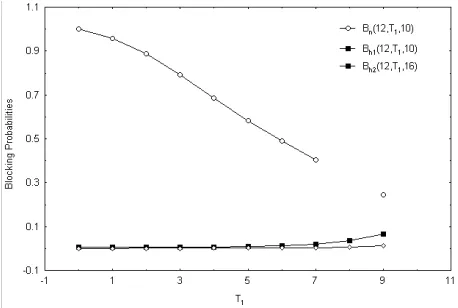
versus T and 1 T are shown in Figures 5 and 6, 2 respectively. The traffic parameters correspond to16
=
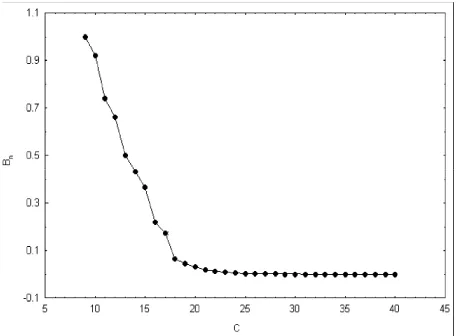
ρ , α=0.3 and α2=0.2 and the cell has 12 full duplex channels. These graphs also confirm the properties given in this section.
5. OPTIMAL NUMBER OF GUARD CHANNELS
In this section, we consider the problem of finding the optimal number of guard channels, which can be described as: Given C channels allocated to a cell, the objective is to find T and 1* T that 2* minimizes the Bn
(
C,T1*,T2*)
with constraints(
1* 2*)
h2 2h C,T ,T p
B ≤ and Bh1
(
C,T1*,T2*)
≤ph1. The values of p and h1 p are specified by the h2 quality of service provided by the network. Since, cellular networks usually provides the same level of quality of service as that the public switched telephone networks (PSTN), p is set equal to the h1 quality of service of PSTN, which may range from one percent to five percent and two percent being the most common used values. Since the handoff calls of class 2 must have the higher quality of service, then p must be smaller than the h2 p . h1 However, the value of p is defined by the h2 network engineers. Thus, we have the following nonlinear integer programming for the prioritized channel assignment problem.Problem 1
Minimize Bn(
C,T1,T2)
subject tothe hard constraint
(
1 2)
h1 1h C,T,T p
B ≤ (18)
and
(
1 2)
h2 2h C,T,T p
B ≤ (19)
where p and h2 p (h1 ph1≥ph2) are the levels of QoS to be satisfied for handoff calls of classes 2 and 1, respectively.
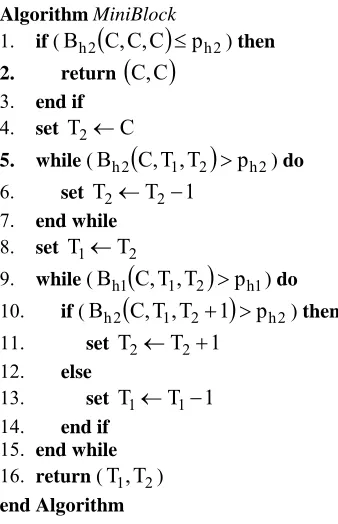
We now present an algorithm, which is called MinBlock and shown in Figure 7. The MinBlock algorithm minimizes the blocking probability of new calls with constraints on the dropping probabilities of handoff calls of both classes.
Theorem 1
Algorithm MinBlock minimizes theblocking probability of new calls while satisfying the constraints on the dropping probabilities of handoff calls of class 1 (Bh1
(
C,T1,T2)
≤ph1) and handoff calls of class 2 (Bh2(
C,T1,T2)
≤ph2).Proof
According to property 1, in order to prove the optimality of algorithm MinBlock, it is Figure 6. The effect of T2 on the blocking probabilities.AlgorithmMiniBlock
1. if (Bh2
(
C,C,C)
≤ph2) then 2. return(
C,C)
3. end if
4. set T2←C
5. while (Bh2
(
C,T1,T2)
>ph2) do6. set T2←T2−1
7. end while
8. set T1←T2
9. while (Bh1
(
C,T1,T2)
>ph1) do10. if (Bh2
(
C,T1,T2+1)
>ph2) then11. set T2←T2+1
12. else
13. set T1←T1−1
14. end if
15. end while
16. return (T1,T2) end Algorithm
sufficient to prove that this algorithm finds the largest value for T such that constraints on 1 B h1 and B are satisfied. The MinBlock algorithm h2 first (if-then 1) checks for maximum allowed value of T . When the maximum allowed value of 1
1
T doesn't satisfy the constraint on B , then h2 while-do 5 finds the largest value of T satisfying 1 the constraints on B . The value of h2 T obtained 1 from while-do 5 is a feasible solution in a sense that it finds the largest value of T to satisfy 1 constraint (19). Since the assignment obtained from while-do 5 doesn't necessarily satisfy the constraint on the B , the h1 while-do 9 finds the largest value of T and a value of 1 T such that the 2 constraints (18) and (19) are satisfied.
Example 1
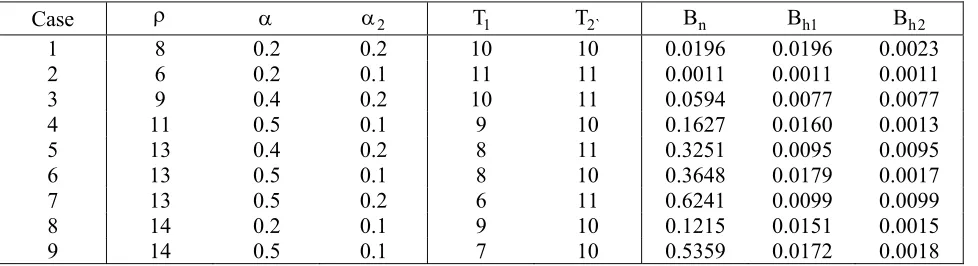
In Table 1, the usefulness of two-threshold guard channel policy is shown. This example assumes that the given cell has 12 full duplex channels (C=12) and constraints are025 . 0
ph1≤ and ph2≤0.01. Columns 2 through 4 show the normalized arrival rate, probability that a call is being a handoff call, and probability that a call being a handoff call of class 2, respectively. Columns 5 and 6 show that the optimal number of guard channels obtained by algorithm of Figure 7. Columns 7 through 9 show the blocking probabilities of different types of calls.
The following cases are considered in this example. The first row of Table 1 (Case 1) considers the case when there are no handoff calls
of class 1. When there are no handoff calls of class 1, there is no need to have shared guard channels. In this case the probability of a call being a handoff call of class 1 is zero and the proposed algorithm does not reserve any shared guard channels. This result is the same as results found by algorithms given in [3-5]. The second row of Table 1 (case 2) considers the situations that no shared guard channel is needed. The next 7 cases show different traffic patterns, which each of them needs different sets of guard channels.
6. MINIMIZING NUMBER OF CHANNELS WITH HARD CONSTRAINTS
In this section, we consider the problem of finding a call admission policy that minimizes the number of channels while satisfying the hard constraints on the blocking probability of new calls and the dropping probabilities for both handoff calls. Thus, we have the following nonlinear optimization problem.
Problem 2
Minimize C and find the maximum values of T and 1 T such that 2(
1 2)
nn C,T,T p
B ≤ (20)
(
1 2)
h1 1h C,T,T p
B ≤ (21)
(
1 2)
h2 2h C,T,T p
B ≤ (22)
with constraints 0<T1≤T2≤C and pn ≥ph1≥ph2. TABLE 1. Prioritized Channel Assignment by Algorithm Given in Figure 7.
Case ρ α α2 T 1 T 2` B n B h1 B h2
1 8 0.2 0.2 10 10 0.0196 0.0196 0.0023
2 6 0.2 0.1 11 11 0.0011 0.0011 0.0011
3 9 0.4 0.2 10 11 0.0594 0.0077 0.0077
4 11 0.5 0.1 9 10 0.1627 0.0160 0.0013
5 13 0.4 0.2 8 11 0.3251 0.0095 0.0095
6 13 0.5 0.1 8 10 0.3648 0.0179 0.0017
7 13 0.5 0.2 6 11 0.6241 0.0099 0.0099
8 14 0.2 0.1 9 10 0.1215 0.0151 0.0015
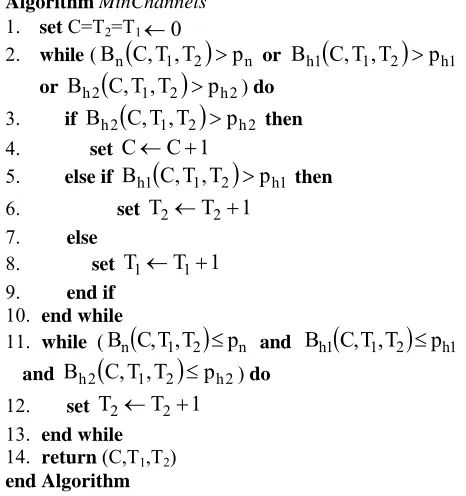
Algorithm MinChannels shown in Figure 8 finds minimum value of C such that constraints (20) through (22) are satisfied.
Theorem 2
Algorithm shown in Figure 8minimizes the number of channels used by the cell and also finds pair of (T ,1 T ), while satisfying the 2 constraints on the blocking probability of new calls (Bn
(
C,T1,T2)
≤pn), the dropping probabilities ofhandoff calls of class 1 (Bh1
(
C,T1,T2)
≤ph1) and handoff calls of class 2 (Bh2(
C,T1,T2)
≤ph2).Proof
In order to prove the optimality of the given algorithm, from properties 1 through 9 it is sufficient to prove that the algorithm finds minimum value of C and maximum values of T 1 and T . The initial assignment obtained by 2 while-do 2 is an undominated solution, in the sense that it uses the minimum number of channels to satisfy the constraints defined by problem 2. This assignment results in the minimum value of C subject to the given constraints, because it assigns the channels to the given cell one by one and also finds T and 1 T . Since the initial assignment may 2 not maximize T and 1 T , then it is not necessarily 2 the optimal solution. In order to find the maximum values of T and 1 T , 2 while-do 13 and 15 maximizes them. Hence, the given algorithm minimizes C and maximizes T and 1 T subject to 2 the hard constraints defined by problem 2, which results in the optimal solution.Example 2
In Table 2, the result of algorithm MinChannels is given. This example assumes that the constraints are pn ≤0.05, 025ph1≤0. and01 . 0
ph2≤ . Columns 2 through 4 of Table 2 show the normalized arrival rate, probability that a call is being a handoff call, and probability that calls being a handoff call of class 2, respectively. Columns 5 through 7 of this table show the minimum number of channels and the optimal number of guard channels obtained by algorithm MinChannels. Columns 8 through 10 of show the Algorithm MinChannels
1. set C=T2=T1←0
2. while (Bn
(
C,T1,T2)
>pn or Bh1(
C,T1,T2)
>ph1 or Bh2(
C,T1,T2)
>ph2) do3. if Bh2
(
C,T1,T2)
>ph2 then4. set C←C+1
5. elseif Bh1
(
C,T1,T2)
>ph1 then6. set T2←T2+1
7. else
8. set T1←T1+1
9. end if
10. end while
11. while (Bn
(
C,T1,T2)
≤pn and Bh1(
C,T1,T2)
≤ph1and Bh2
(
C,T1,T2)
≤ph2) do12. set T2←T2+1
13. end while
14. return (C,T1,T2)
end Algorithm
Figure 8. Algorithm for finding the minimum number of channels of two-threshold guard channel policy required by cell.
TABLE 2. Prioritized Channel Assignment by Algorithm Given in Figure 8.
Case ρ α α2 T1 T2 C Bn Bh1 Bh2
1 27 0.6 0.1 34 35 36 0.047 0.015 0.001
2 27 0.6 0.2 34 35 36 0.048 0.016 0.002
3 28 0.6 0.1 35 36 37 0.048 0.016 0.001
4 29 0.2 0.1 35 36 36 0.049 0.006 0.006
5 29 0.9 0.1 38 38 39 0.020 0.020 0.001
blocking probabilities of different types of calls.
7. OPTIMAL PRIORITIZED CHANNEL ASSIGNMENT IN MULTI-CELLS
CELLULAR NETWORKS
In this section, we extend problem 1 to the multi-cells cellular networks and introduce a prioritized channel assignment algorithm for multi-cells cellular networks. We consider a multi-cells system consisting of several clusters, where a typical cluster m contains N cells. Assume that a m total of C full duplex channels are allocated to the whole network and hence to each cluster. Under our prioritized channel assignment scheme, the allocated channels will be divided into N m disjoint channel sets, where each channel set is allocated to one cell in the cluster. Then, the channel set of each cell is divided into three subsets: ordinary channels, shared and dedicated guard channels. By applying the proposed algorithm to each cluster in the system, the prioritized channel assignment is obtained for the whole network. Let Λ =
∑
N=mλ1 i
i n
n be the total
arrival rate of new calls over all cells in cluster m and λni is the arrival rate of new calls in cell i of cluster m. Define the overall blocking probability
of new calls by
(
)
∑
= Λλ = Nm
1 i
i 2 i 1 i i n n
i n
N B C ,T ,T
B (23)
where Bni
(
Ci,T1i,T2i)
is the blocking probability of new calls in cell i when C channels are i allocated to this cell and T and 1i T are thresholds 2i for this cell. The objective is to find the optimal value for tuple(
Ci,T1i,T2i)
(i = 1, 2, …, Nm),which minimizes the overall blocking probability of new calls subject to the hard constraint on the dropping probabilities of both calls. This problem is formulated as the following non-linear optimization problem.
Problem 3
Minimize the overall blockingprobability of new calls, BN, subject to the
following hard constraints.
(
i 1i 2i)
h1i
hv C ,T ,T p
B ≤ (24)
(
i 1i 2i)
h2i
ht C ,T ,T p
B ≤ (25)
C C m
N
1 i
i =
∑
=(26)
where 0<T1i ≤T2i≤Ci for all i = 1, 2, …, Nm in
cluster m.
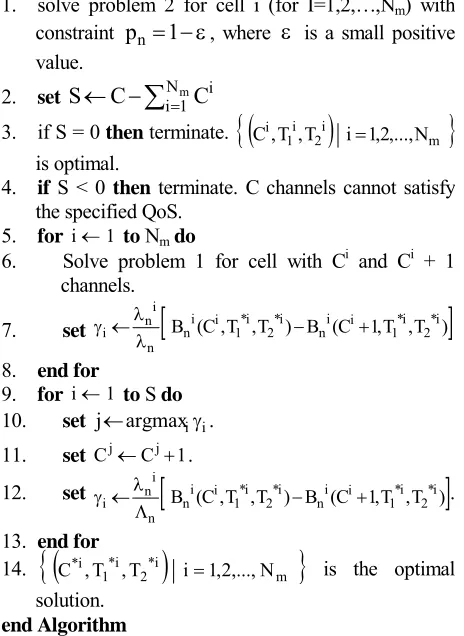
In what follows, we propose a greedy algorithm for solving problem 3. This algorithm can be described as follows. Initially for each cell i, the smallest number of channels required to satisfy the given QoS is found. To do this, we use the algorithm MinChannels with the constraint
ε − =1
pn , where ε is a small positive value. Then the remaining channels, if any, are allocated to cells one by one. Let γi denotes the amount of decrement in B brought by allocation of an ni additional channel to cell i. Note that the additional channel can be used as an ordinary channel/ shared guard channel/ dedicated guard channel. In order to find the usage of the additional channel, the algorithm used for solving problem 1 is used. The amount of decrement in B are computed for all ni cell i (for i = 1, 2, …, Nm) according to the
following equation:
[
Bni(Ci,T1*i,T2*i) Bni(Ci 1,T1*i,T2*i)]
n i n
i Λ − +
λ = γ
where T (for j = 1, 2) are the thresholds obtained j*i by MinBlock algorithm. Note that γi is always nonnegative. Then a cell with the largest decrement in Bn is found among all cells in the
cluster and an additional channel is assigned to it. This procedure is repeated until all available channels C in the cluster are used. This fact is shown in Figure 9. Algorithm given in Figure 10 summarizes this procedure.
Theorem
Algorithm given in Figure 10 findsthe optimal solution of problem 3.
Proof
The initial assignment is an undominated solution, in the sense that it uses the minimum number of channels to satisfy the constraints (24) and (25). This assignment results in the maximum value of BN subject to the constraints (24) and (25).Then the algorithm assigns the remaining channels one by one to cells which results in the largest decrement in blocking probability of new calls. This strategy results in the optimal solution. Let ji
be the index of the cell with the largest decrement in BN at step i (for I =1, 2, …, S). Assume that
there is another strategy which is optimal and chooses cell ki ≠ ji at step i. Thus we have
i j ki =γ i −δ
γ for δi >0. Then interchanging cell
i
j with cell k results in assignment ii
(
)
∑
= Λ
λ = m
i
N
1 l
l 2 l 1 l l n n l
n k
N B C ,T ,T
B .
Subtracting ji
N
B from ki
N
B , we obtain
i j N k Ni Bi
B − =δ . Repeating this procedure for S steps, we obtain
∑
[
]
∑
= =
δ =
− S
1 i i S
1 i
j N k Ni Bi
B , which is
positive. Thus, no index other than the index with the largest value of γi would results in the optimal solution. Hence, the proposed cell selection mechanism minimizes the value of BN subject to
the hard constraints (24) and (25) and results in the optimal solution.
Example 3
Consider a cellular system with clusters having 7 cells. Assume that a total of 110 Algorithm MultiCells1. solve problem 2 for cell i (for I=1,2,…,Nm) with constraint pn =1−ε, where ε is a small positive value.
2. setS←C−
∑
iN=1mCi3. if S = 0 then terminate.
{
(
Ci,T1i,T2i)
i=1,2,...,Nm}
is optimal.4. if S < 0 then terminate. C channels cannot satisfy
the specified QoS. 5. fori←1 to Nmdo
6. Solve problem 1 for cell with Ci and Ci + 1 channels.
7. set
[
Bni(Ci,T1*i,T2*i) Bni(Ci 1,T1*i,T2*i)]
ni n
i λ − +
λ ← γ
8. end for
9. fori←1 to S do
10. set j←argmaxiγi.
11. setCj←Cj+1.
12. set
[
B (C,T ,T ) B (C 1,T ,T*i)]
2 i * 1 i i n i * 2 i * 1 i i n ni n
i Λ − +
λ ←
γ .
13. end for
14.
{
(
*i)
m}
2 i * 1 i
*,T ,T i 1,2,...,N
C = is the optimal
solution.
end Algorithm
Figure 10. Multi-cells prioritized channel assignment algorithm.
TABLE 3. The Traffic Parameters of Cellular Network.
Cell λn λh λh2
full duplex channels are available in this system. The upper bounds on the dropping probabilities of handoff calls of classes 1 and 2 are set to 0.025 and 0.01, respectively. The call arrival rates, which are normalized to the call holding time, are given in Table 3. The result of algorithm of Figure 10 is given in Table 4.
From Table 4, it is evident that all constraints are satisfied and the obtained solution is also optimal.
Remark 1
Extension of problem 2 to multi-cellnetworks has no engineering profit, because the number of channels allocated to the network is fixed and minimizing the number of channels wastes the system resources.
8. CONCLUSIONS
In this paper, we studied the problem of call admission in cellular network. We introduced a two-threshold guard channel policy when there are two classes of voice users and derived blocking probabilities for the network. We also introduced and solved three prioritized channel assignment problems: finding the optimal number of guard channels, minimizing the number of required channels and the optimal channel assignment in multi-cells cellular network subject to the hard constraints on the dropping probabilities of handoff calls of both classes. Through simulations, we showed that for all the proposed algorithms, the numerical results confirm the analytical results.
9. ACKNOWLEDGMENT
The authors would like to thank the referees for their useful suggestions and comments.
10. APPENDIXES
A. Appendix
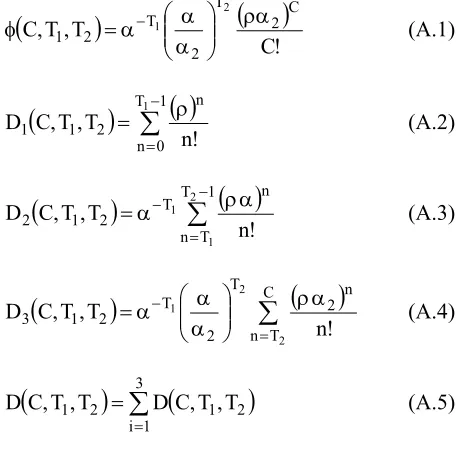
In this appendix, we first givesome notations and then some properties that will be used in next appendix for proofs of properties 1 through 9. We will use the following notations throughout the appendices.
(
)
(
)
! C T
, T , C
C 2 T
2 T 2 1
2
1 ρα
⎟⎟ ⎠ ⎞ ⎜⎜ ⎝ ⎛
α α α =
φ − (A.1)
(
)
∑
−( )
=
ρ =T 1
0 n
n 2
1 1
1
! n T
, T , C
D (A.2)
(
)
∑
−( )
=
− ρα
α
= T 1
T n
n T
2 1 2
2 1 1
! n T
, T , C
D (A.3)
(
)
∑
(
)
=
− ρα
⎟⎟ ⎠ ⎞ ⎜⎜ ⎝ ⎛
α α α
= C
T n
n 2 T
2 T 2 1 3
2 2 1
! n T
, T , C
D (A.4)
(
)
∑
(
)
=
= 3
1
i 1 2
2
1,T DC,T,T
T , C
D (A.5)
D
(
C,T1,T2)
have the following properties, assuming that all other system parameters are TABLE 4. The Result of Prioritized Channel Assignment for Multi-Cell System.Case T1 T2 C Bn Bh1 Bh2
1 11 13 13 0.112727 0.008052 0.008052
2 13 16 16 0.233747 0.009029 0.009029
3 14 17 17 0.267828 0.008846 0.008846
4 13 15 15 0.154768 0.008658 0.008658
5 13 15 16 0.178981 0.021289 0.002365
6 19 21 22 0.198081 0.021024 0.001752
fixed.
Property 10 For any given values of C
T T
0< 1≤ 2≤ , D
(
C,T1,T2)
satisfies the following condition.(
C,T,T)
D(
C,T,T 1)
D 2 1 2
2
1 >αα +
Proof In order to prove the inequality
(
C,T,T)
D(
C,T,T 1)
D 2 1 2
2
1 α +
α
> , we show that
(
C,T,T)
D(
C,T,T 1)
D 2 1 2
2
1 −αα + is greater than
zero. From (A.5) and by some algebraic simplification, we have
(A.6) Since α>α2, then
(
C,T,T)
D(
C,T,T 1)
D 2 1 2
2
1 α +
α
> for all values of C
T T
0< 1≤ 2≤ .
Property 11 For any given values of C
T T
0< 1≤ 2≤ , D
(
C,T1,T2)
satisfies the following condition.(
C,T1,T2)
D(
C,T1 1,T2)
D >α +
Proof In order to prove the inequality
(
C,T1,T2)
D(
C,T1 1,T2)
D >α + , we show that
(
C,T1,T2)
D(
C,T1 1,T2)
D −α + is greater than zero. From expression (A.5) and by some algebraic simplification, we have
(A.7) Since α is less than 1, then D
(
C,T1,T2)
isgreater than αD
(
C,T1+1,T2)
for all values of CT T
0< 1≤ 2≤ .
Property 12 For any given values of C
T T
0< 1≤ 2≤ , D
(
C,T1,T2)
is a monotonically increasing function of C, that is(
C 1,T1,T2)
D(
C,T1,T2)
D + >
Proof From (A.5) and (A.1), we obtain
(A.8) which holds for all values of 0<T1≤T2≤C.
Property 13 For any given values of C
T T
0< 1≤ 2≤ , D
(
C,T1,T2)
is a monotonically increasing function of T . That is 2(
C,T1,T2 1)
D(
C,T1,T2)
D + >
Proof In order to prove that D
(
C,T1,T2)
is an increasing function of T , we show that 2(
C,T1,T2 1) (
DC,T1,T2)
D + − is greater than zero.
Let
(
)
! T X
2 T 2 T
2 T
T2 1 2 ρα 2
⎟⎟ ⎠ ⎞ ⎜⎜ ⎝ ⎛
α α α
= − . From (A.5) and
by some algebraic simplification, we obtain
(A.9) Since α is less than 1, then D
(
C,T1,T2)
isgreater than αD
(
C,T1+1,T2)
for all values of CT T
0< 1≤ 2≤ .
B. Appendix
In this appendix, we give the proofs of properties 1 through 9.B.1 Proof of Property 1 In order to prove that
(
1 2)
n C,T,T
,
(B.10)
,
(B.11)
,
(B.12)
(B.13)
Since and , we
have
(B.14)
(B.15)
(B.16)
Since k>T2, we have
, the above inequality becomes
(B.17)
(B.18)
(B.19)
From the above inequality and inequality (B.13) the proof will be completed.
B.2 Proof of Property 2 In order to prove that
(
1 2)
n C,T,T
B is an increasing function of T , we 2 show that Bn
(
C,T1,T2+1)
−Bn(
C,T1,T2)
is greater than zero. Let( )
!
T
ρα
α
α
α
X
2 T 2 T
2 T T
2 2
1
2
⎟⎟
⎠
⎞
⎜⎜
⎝
⎛
=
− .From (17) and (A.5), and by some algebraic simplification, we obtain
(B.20) which is greater than zero for all values of
C T T
0< 1≤ 2≤ .
B.3 Proof of Property 3 In order to prove that
(
1 2)
n C,T,T
(B.21) which is greater than zero for all values of
C T T
0< 1≤ 2≤ .
B.4 Proof of Property 4 In order to prove that
(
1 2)
1
h C,T,T
B is an increasing function of T , we 1 show that Bh1
(
C,T1+1,T2)
Bh1(
C,T1,T2)
is greater than one. By some algebraic simplification, we have(B.22) From property 11, it is apparent that the above equation is greater than one for all values of
C T T
0< 1≤ 2≤ .
B.5 Proof of Property 5 In order to prove that
(
1 2)
1
h C,T,T
B is an decreasing function of T , we 2 show that Bh1
(
C,T1,T2+1)
−Bh1(
C,T1,T2)
is negative, that is(B.23) Using property 13, we obtain
(B.24)
(B.25) (B.26)
(B.27)
where
( )
!
T
ρα
α
α
α
X
2 T 2 T
2 T T
2 2
1
2
⎟⎟
⎠
⎞
⎜⎜
⎝
⎛
=
− . Sinceand , we have
(B.28) (B.29)
(B.30) From the above inequality and inequality (B.27), the proof will be completed.
B.6 Proof of Property 6 In order to prove that
(
1 2)
1
h C,T,T
B is an increasing function of C, we show that Bh1
(
C+1,T1,T2)
−Bh1(
C,T1,T2)
is positive. Thus, we have(B.31) which is positive for all values of 0<T1≤T2≤C.
B.7 Proof of Property 7 In order to prove that
(
1 2)
2
h C,T,T
B is an increasing function of T , we 1 show that Bh2
(
C,T1+1,T2)
Bh2(
C,T1,T2)
is greater than one. Thus, we have(B.32) From property 11, it is apparent that the above equation is greater than one for all values of
C T T
0< 1≤ 2≤ .
(
1 2)
2
h C,T,T
B is an increasing function of T , we 2 show that Bh2
(
C,T1,T2+1)
Bh2(
C,T1,T2)
is greater than one. Thus, we have(B.32) From property 10, it is apparent that the right hand side of the above equation is greater than one for all values of 0<T1≤T2≤C.
B.9 Proof of Property 9 In order to prove that
(
1 2)
2
h C,T,T
B is a decreasing function of C, we show that Bh2
(
C+1,T1,T2)
−Bh2(
C,T1,T2)
is less than zero. Using property 12 and some algebraic simplification, we obtain(B.34) which is less than zero for all values of
C T T
0< 1≤ 2≤ if ρ<C.
11. REFERENCES
1. Lin, Y. B., Mohan, S. and Noerpel, A., “Queuing Priority Channel Assignment Strategies for PCS Handoff and Initial Access”, IEEE Transactions on Vehicular Technology, Vol. 43, (August 1994), 704-712.
2. Hong, D. and Rappaport, S., “Traffic Modeling and Performance Analysis for Cellular Mobile Radio Telephone Systems with Prioritized and Non-prioritized Handoffs Procedure”, IEEE Transactions on Vehicular Technology, Vol. 35, (August 1986), 77-92.
3. Oh, S. and Tcha, D., “Prioritized Channel Assignment in a Cellular Radio Network”, IEEE Transactions on Communications, Vol. 40, (July 1992), 1259-1269. 4. Haring, G., Marie, R., Puigjaner, R. and Trivedi, K.,
“Loss Formulas and Their Application to Optimization for Cellular Networks”, IEEE T ra nsac tions o n
Vehicular Technology, Vol. 50, (May 2001), 664-673.
5. Ramjee, R., Towsley, D. and Nagarajan, R., “On Optimal Call Admission Control in Cellular Networks”, Wireless Networks, Vol. 3, (1997), 29-41.
6. Beigy, H. and Meybodi, M. R., “A New Fractional Channel Policy”, Journal of High Speed Networks, Vol.
13, No. 1, (2004), 25-36.
7. Yoon, C. H. and Kwan, C., “Performance of Personal Portable Radio Telephone Systems with and without Guard Channels”, IEEE Journal on Selected Areas in Communications, Vol. 11, (August 1993), 911-917.
8. Guern, R., “Queuing-Blocking System with Two Arrival Streams and Guard Channels”, IEEE Transactions on Communications, Vol. 36, (February 1988), 153-163. 9. Senouci, S. M., Beylot, A. L. and Pujolle, G., “A
Dynamic Q-Learning-Based Call Admission Control for Multimedia Cellular Networks”, In Proceedings of the 3rd IEEE International Conference in Mobile and Wireless Communication Networks, MWCN2001,
Recife, Brazil, (August 2001), (37-43).
10. Chen, G. C. and Lee, S. Y., “Modeling of Static and Dynamic Guard Channel Schemes for Mobile Transactions”, IEICE Transactions on Information and Systems, Vol. E84-D, (January 2001), 87-99.
11. Senouci, S. M., Beylot, A. L. and Pujolle, G., “Call Admission Control for Multimedia Cellular Networks Using Neuro-Dynamic Programming”, Proceedings of the IFIP Networking, NETWORKING’02, Pisa, Italy,
(May 2002).
12. Beigy, H. and Meybodi, M. R., “An Adaptive Limited Fractional Guard Channel Policy Using Continuous Action Learning Automata”, Proceedings of the 10th IEEE International Conference on Software,
Telecommunications and Computer Networks, Croatia,
Italy, (October 2002).
13. Beigy, H. and Meybodi, M. R., “A Learning Automata Based Dynamic Guard Channel Scheme”, Vol. 2510 of Springer-Verlag Lecture Notes in Computer Science, Springer-Verlag, Shiraz, (October 2002), 643-650. 14. Beigy, H. and Meybodi, M. R., “Adaptive Uniform
Fractional Channel Algorithms”, Iranian Journal of Electrical and Computer Engineering, Vol. 3, No. 1,
(2004), 47-53.
15. Yin, L., Li, B., Zhang, Z. and Lin, Y., “Performance Analysis of a Dual-Threshold Reservation (DTR) Scheme for Voice/Data Integrated Mobile Wireless Networks”, In Proceedings of the IEEE Wireless Communications and Networking Confernce, WCNC. 2000, (September 2000),
258-262.
16. Herzog, U., Woo, L. and Chandy, K., “Solution of Queuing Problems by a Recursive Techniques”, IBM Journal of Research and Development, Vol. 19, No. 3,
(May 1975), 295-300.