NSW PUBLIC HEALTH
BULLETIN
Improving foodborne disease surveillance in NSW
GUEST EDITOR
Gwendolyn L. Gilbert
Centre for Infectious Diseases and Microbiology, Institute of Clinical Pathology and Medical Research, Westmead Hospital, NSW Email: [email protected]
The term ‘enteric diseases’ includes a multitude of condi-tions. In the public health context, it usually refers to infec-tions (or intoxicainfec-tions) that are food- or waterborne, or otherwise transmitted by the faecal-oral route. Symptoms are usually non-specific – nausea, vomiting, diarrhoea, abdominal pain and fever in varying combinations – and unpleasant, rather than serious or life threatening. The importance of enteric infections lies mainly in their numbers. The results from The National Gastroenteritis Survey 2001–2002 estimated that 17.2 million cases of gastro enteritis occur annually in Australia, leading to 7 million courses of medication (including antibiotics), 6 million days of paid work lost, 3.7 million doctor visits and 0.5 million stool tests.1A third of gastroenteritis cases (5.4 million each year) are due to foodborne infection. There are also approximately 6000 cases annually of other food-borne diseases in which gastrointestinal symptoms are not prominent, such as invasive listeriosis.2Overall, foodborne diseases are responsible for approximately 18 000 hospital admissions and 120 deaths, and cost $1249 million, annu-ally in Australia.3
The perception within the community that foodborne and institutional outbreaks of enteric disease may represent neg-ligence or system failure can often provoke substantial and disproportionate attention and, occasionally, litigation.4 Combined with the high disease burden, this provides a strong incentive for active surveillance to identify outbreaks. Periodic reviews of the value and effectiveness of disease prevention programs are important and this special issue of the NSW Public Health Bulletincontributes to this field.
Routine notifiable disease data capture only a tiny fraction of enteric disease burden, namely from confirmed cases due to some specific pathogens and easily recognised disease outbreaks. The number of notifications
depends on variables other than actual disease rates, includ-ing: whether a general practitioner orders a stool examina-tion; laboratory diagnostic and strain typing methods; and the local capacity for outbreak recognition and investiga-tion. For example, the article by Cretikos, Telfer and McAnulty on enteric disease outbreak reporting in New South Wales notes that the highest rate of outbreaks was reported by the only Public Health Unit with resources ded-icated to enteric disease surveillance and control. Presumably this reflects better ascertainment of cases rather than higher disease rates. An evaluation of the enteric disease outbreak surveillance system by the same authors showed that many users found it cumbersome and labour intensive. The proposed changes should improve the system’s efficiency and reduce inconsistencies of rates and delays in outbreak reporting.
The consistency and timeliness of disease notification depend on resources and competing priorities; and the value of the data obtained depends on data quality and how rapidly it is analysed and acted on. Increasingly, the time-consum-ing form filltime-consum-ing and duplication of paper-based notification is being replaced by electronic systems. These have the potential for simultaneous, immediate data transfer from multiple sources to a central database where information can be combined and analysed rapidly. Although electronic systems, such as the NetEpi Collectiondiscussed by Viney and McAnulty, have significant advantages, they may not be immediately acceptable to users without access to appropri-ate facilities, training and support.5The Public Health Real-time Emergency Department Surveillance System (PHREDSS) is an electronic syndromic surveillance system, recently introduced in NSW.6 It automatically receives and analyses data from existing emergency depart-ment clinical information systems, in near real-time. The PHREDSS is designed to identify outbreaks rapidly that
w w w. p u b l i s h . c s i r o. a u / j o u r n a l s / p h b CONTENTS – See back page
Special Issue – Enteric diseases
may not be easily recognised by individual public health units. As illustrated by the report of a gastroenteritis out-break at a school music camp, Mannes et al. show that PHREDSS can also provide individual patient information and identify additional cases in recognised outbreaks.
When based on spatiotemporal clustering of specific pathogens, laboratory notification can also identify out-breaks that are not otherwise recognisable, as described in two following papers by Viney et al. and Wang et al. Although insensitive, this method is generally consistent, objective and specific and, in conjunction with epidemio-logical investigations, can identify risk factors and poten-tial sources. However, diagnostic laboratories identify common enteric pathogens, like Salmonella entericaand Campylobacter jejuni, only to the level of species, and additional typing is needed to identify outbreaks against high background rates. None of the many possible
Campylobacter strain-typing methods are generally
accepted or used routinely.7Therefore outbreaks are rarely recognised and campylobacteriosis is not notifiable in NSW, although data from elsewhere in Australia indicate that it is significantly more common than salmonellosis. State reference laboratories throughout Australia perform Salmonella serotyping (see Wang et al. in this issue). Reference laboratories can identify suspected outbreaks due to uncommon serotypes, but further subtyping of the most common serotype, S. Typhimurium, is needed. Faster, more discriminatory methods for S.Typhimurium typing, as described by Gilbert, have the potential to iden-tify more outbreaks more rapidly. While such methods may stretch public health resources, they should increase the success rate of investigations.
The mainstays of prevention for most enteric diseases are safe food production and handling, and good infection control practice, especially to prevent outbreaks of norovirus in institutions. A few enteric diseases are pre-ventable by vaccines, including polio, which is close to being eradicated worldwide, and hepatitis A, which occurs at low rates in Australia (see Ward and McAnulty in this issue). Continued surveillance of these viral diseases is
needed to monitor, control and identify appropriate target populations for immunisation. More generally, the consis-tent surveillance and investigation of foodborne disease and institutional outbreaks of enteric infections, are essen-tial for understanding the changing epidemiology of these diseases and for evaluating the effectiveness of interven-tions, on which control and prevention depend.
References
1. Hall G and the OzFoodNet Working Party. The National
Gastroenteritis Survey 2001–2002.Canberra: OzFoodNet
2004. Available at http://hdl.handle.net/1885/43181. Accessed 29 December 2007.
2. Hall G, Kirk M. Foodborne illness in Australia. Annual
incidence circa 2000.Canberra: Australian Department of
Health and Ageing 2005. Available at www.ozfoodnet.org.au/. Accessed 29 December 2007.
3. Abelson P, Potter Forbes M, Hall G. The annual cost of
foodborne illness in Australia.Canberra: Australian
Department of Health and Ageing 2006. Available at http://www.ozfoodnet.org.au/. Accessed 29 December 2007.
4. Pengilley W. The Wallis Lake oyster litigation: appellate precedents in relation to a gallimaufry of product liability claims.JCULaw Rev2003; 8 (10): 143. Available at http://www.austlii.edu.au/au/journals/JCULRev/2003/8.html. Accessed 4 January 2008.
5. NSW Department of Health. NetEpi Case Manager Quick
Reference Guide.Available at http://www.netepi.org
6. Muscatello DJ, Chruches T, Kaldor J, Zheng W, Chiu C, Correll P. et al. An automated, broad-based, near real-time public health surveillance system using presentations to hospital emergency department in New South Wales, Australia.
BMC Public Health2005; 5: 141. Available at
http://www.biomedcentral.com/1471-2458/5/141. Accessed 28 December 2007.
7. O’Reilly LC, Inglis TJJ, Unicomb L, the Australian Campylobacter Subtyping Study Group. Australian Multicentre Comparison of Subtyping Methods for the Investigation of Campylobacter Infection.Epidemiol Infect 2006; 134: 768–79. doi:10.1017/S0950268805005777
While many infectious agents can cause outbreaks, most of the outbreaks reported in NSW involve enteric diseases, which are caused by the ingestion of infectious agents or toxins, and result in nausea, vomiting, diarrhoea, abdomi-nal cramps and fever, or other symptoms.1,2
Enteric diseases place a substantial burden on the com -munity. It has been estimated that in Australia there are approximately 17.2 million cases of gastroenteritis each year.3 A national survey of gastroenteritis in Australia during 2001–2002 found that one-third of working adults miss at least one day of work when they have gastro-enteritis, and one-third of cases result in a caregiver missing work.3
Of these gastroenteritis cases, 5.4 million are estimated to be cases of foodborne-associated gastroenteritis, equiva-lent to 0.3 episodes of foodborne gastroenteritis per person per year, and resulting in approximately 18 000 hospitali-sations and 120 deaths in Australia annually.4Many
out-Enteric disease outbreak reporting,
New South Wales, Australia, 2000 to 2005
Abstract: Objective: To review enteric disease outbreaks reported to the NSW Department of Health. Methods: Data from existing electronic enteric disease outbreak summary databases were used to describe the number and type of outbreaks reported, burden of illness and cause of the out-breaks. Results: Between 2000 and 2005, 998 enteric disease outbreaks were reported (148 food-borne and 850 non-foodfood-borne), affecting 24260 people and associated with 771 hospitalisations and 21 deaths. Salmonellawas confirmed in 28 per cent of foodborne outbreaks, and norovirus in 18 per cent of non-foodborne outbreaks.
Conclusions: Enteric disease outbreaks cause a substantial burden of disease in NSW.
Michelle Cretikos
A,C, Barbara Telfer
Band
Jeremy McAnulty
BANSW Public Health Officer Training Program,
NSW Department of Health
BCommunicable Diseases Branch, NSW Department of Health
CCorresponding author: Email: [email protected].
breaks of gastroenteritis occur in institutions, such as schools, childcare centres and residential care facilities. Institutional outbreaks of gastroenteritis are usually caused by highly infectious viruses such as norovirus and rotavirus, and spread predominantly through person-to-person contact.1,5
Under the Public Health Act (NSW)1991, 12 enteric con-ditions are currently notifiable in NSW and must be reported to NSW Health by doctors, laboratories and hos-pitals, including: botulism, cholera, cryptosporidiosis, giardiasis, haemolytic uraemic syndrome (HUS), shiga-toxigenic Escherichia coli (STEC) infection, hepatitis A, hepatitis E, listeriosis, salmonellosis, shigellosis and typhoid. Some of these diseases are primarily foodborne in origin, such as salmonellosis, typhoid and listeriosis.
In addition to individual disease notifications, outbreaks of suspected foodborne disease in two or more people related in time or place, and outbreaks of gastroenteritis among people of any age in an institution (eg an educa-tional, residential, childcare or healthcare institution) are also notifiable by doctors and institutions. Where public health units identify clusters of disease or outbreaks, they will launch an outbreak investigation. Summary reports of enteric disease outbreaks are provided by public health units and entered into the relevant enteric disease outbreak databases held at the NSW Department of Health.
We analysed enteric disease outbreaks reported to the NSW Department of Health for the five-year period July 2000–June 2005. This analysis aimed to describe the number, epidemiology and cause of the enteric disease outbreaks reported during this period.
Methods
The two existing NSW Health enteric disease outbreak databases – the OzFoodNet Outbreak Summary Database and the Gastroenteritis in Institutions Database – were used. For the purposes of the present study, the data con-tained within the two enteric disease outbreak summary databases was separated into two categories:
• foodborne and suspected foodborne outbreaks, and • non-foodborne outbreaks of enteric disease.
to be a non-foodborne outbreak unless Salmonella, which is commonly transmitted by the foodborne route, was identified. Only two Salmonellaoutbreaks in institutions were attributed to a foodborne route as a result of this deci-sion. For the purposes of analysis, all foodborne and sus-pected foodborne outbreaks (including those occurring in an institutional setting) were considered to be foodborne outbreaks. All other outbreaks were considered to be non-foodborne outbreaks.
The number and type of enteric disease outbreaks, the reported number of people affected, the reported number of hospitalisations, the reported number of deaths and the annual rate of enteric disease outbreaks reported by NSW public health units for each 100 000 population were esti-mated. Mode of transmission, extent of spread and cause were also examined.
An enteric agent (organism or toxin) was considered to have caused the outbreak if it was identified through microbiological testing of a clinical specimen and/or the
implicated food vehicle and the epidemiologic features were consistent with the features of disease caused by the agent.
Tests of proportions were performed using the chi-square test. Tests of duration of illness were performed using the Kruskal–Wallis test.
Results
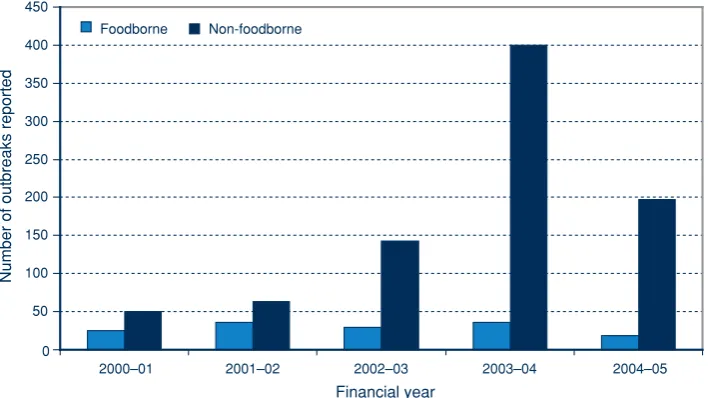
Between 1 July 2000 and 30 June 2005, 998 enteric disease outbreaks were reported in NSW (Table 1). The number of foodborne outbreaks reported each year was reasonably stable, with an average of 30 (15 per cent of all outbreaks). The number of reported non-foodborne outbreaks increased substantially between 2000 and 2005, with an epidemic year of viral gastroenteritis in 2004 (Figure 1). The majority of non-foodborne outbreaks occurred in institutions.
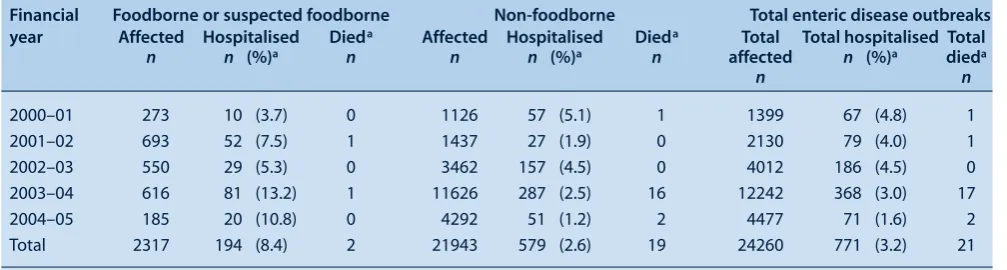
These outbreaks affected 24 260 people. At least 2072 people (8.5 per cent) reported seeing a doctor as a result of Table 1. Number and type of enteric disease outbreaks, New South Wales, 2000–2005
Financial year Foodborne or suspected foodborne Non-foodborne
Institutional Non-institutional Institutional Non-institutional
n n n n
2000–01 0 25 43 7
2001–02 1 36 51 11
2002–03 2 28 121 21
2003–04 11 26 390 9
2004–05 0 19 181 16
Total 14 134 786 64
Source: Gastroenteritis in Institutions Database; OzFoodNet Outbreak Summary Database.
0 50 100 150 200 250 300 350 400 450
2000–01 2001–02 2002–03 2003–04 2004–05
Financial year
Number of outbreaks reported
Foodborne Non-foodborne
their illness, 771 people (3.2 per cent) required hospitali-sation and 21 people (<0.1 per cent) died (Table 2).
The median duration of reported illness in affected people was 1.5 days (inter-quartile range (IQR) 1–2 days). The median duration was significantly longer for foodborne illness (2 days, IQR 1–4 days) than for non-foodborne illness (1.3 days, IQR 1–2 days, p < 0.001). In 17 of the out-breaks, several people were still reported to be ill at the time the summary report was provided, which indicates the true duration of illness would be longer than that reported.
Among the foodborne outbreaks, 14 of the 198
institutional outbreaks were quite widespread, with five state outbreaks and nine outbreaks involving multi-ple Area Health Service regions within NSW. Nine of these 14 multi-region outbreaks were reported to be caused by various Salmonellaspecies. In the remainder, the cause was unknown. The most commonly reported mode of transmission of non-foodborne outbreaks was person-to-person (320/850 person-to-person: 37.6 per cent; 452/850 suspected person-to-person: 53.2 per cent).
The total rates of reporting of enteric disease outbreaks by public health unit were highly variable, ranging from 0.5 to 7.4 per 100 000 population (Figure 2).
Enteric disease reporting in NSW
0 1 2 3 4 5 6 7 8
A B C D
Rate per 100
000 population
EF G H I J KL M N O P Q
Foodborne Non-foodborne Total
Figure 2. Rate of reporting of enteric disease outbreaks in New South Wales by public health unit, 2000–2005. Source: Gastroenteritis in Institutions Database; OzFoodNet Outbreak Summary Database.
Table 2. Number of people affected, hospitalised and dying in association with enteric disease outbreaks, New South Wales, 2000–2005
aOf those affected
Financial Foodborne or suspected foodborne Non-foodborne Total enteric disease outbreaks
year Affected Hospitalised Dieda Affected Hospitalised Dieda Total Total hospitalised Total
n n (%)a n n n (%)a n affected n (%)a dieda
n n
2000–01 273 10 (3.7) 0 1126 57 (5.1) 1 1399 67 (4.8) 1
2001–02 693 52 (7.5) 1 1437 27 (1.9) 0 2130 79 (4.0) 1
2002–03 550 29 (5.3) 0 3462 157 (4.5) 0 4012 186 (4.5) 0
2003–04 616 81 (13.2) 1 11626 287 (2.5) 16 12242 368 (3.0) 17
2004–05 185 20 (10.8) 0 4292 51 (1.2) 2 4477 71 (1.6) 2
Total 2317 194 (8.4) 2 21943 579 (2.6) 19 24260 771 (3.2) 21
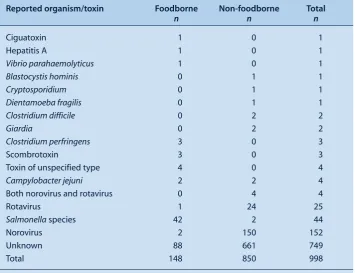
At least one stool specimen was reported to have been collected in a significantly smaller proportion of food-borne (54/148: 36 per cent) than non-foodfood-borne out-breaks (391/850: 46 per cent, p = 0.02). The causative agent for the outbreak was determined in a significantly larger proportion of the foodborne (60/148; 41 per cent) than non-foodborne outbreaks (189/850: 22 per cent, p < 0.001). By far the most common cause of the outbreaks was salmonellosis for foodborne outbreaks, and norovirus and rotavirus for non-foodborne outbreaks (Table 3).
Discussion
Enteric disease outbreaks create a substantial burden of illness in NSW, but these outbreaks rarely result in severe illness or death. The majority of the enteric disease out-breaks reported during 2000–2005 were non-foodborne institutional outbreaks of viral gastroenteritis, particularly during the epidemic year of 2004. These outbreaks affected many thousands of people and were associated with a small number of deaths. Rapid control of viral insti-tutional outbreaks should be a priority in order to prevent such large institutional outbreaks in the future.
There are several limitations to the present study. First, given that there are approximately 17.2 million cases of gastroenteritis in Australia annually, it is likely that many enteric disease outbreaks that occur in NSW are not detected or reported.3This indicates that these results are likely to be an underestimate of the true burden of disease
from enteric disease outbreaks in NSW. Second, the rate of reporting of enteric disease outbreaks is also inconsistent in public health units, which suggests that the enteric disease outbreaks reported do not represent the true distri-bution of disease in NSW. Finally, the mode of trans -mission for the majority of the outbreaks was unconfirmed, making the determination of a transmission mode uncertain.
It is important to note that the public health unit with the highest rate of reporting of enteric disease outbreaks (PHU I) is the only unit in NSW that has staff funded exclusively to perform enteric disease surveillance and control activities. This may account for the high rates of reporting of enteric disease outbreaks from this area. Other reasons for the variation in outbreak reporting are unclear, but may include: variations in public health unit capacity due to other competing public health activities; the number of staff trained to investigate enteric diseases; the number of institutions, such as aged care facilities, in each area; the level of notification from institutions and the community; and other local characteristics, including exposure to farm animals, water quality and other environ-mental factors.
Conclusion
Given the burden of illness caused by enteric disease out-breaks, the identification, investigation, control and pre-vention of enteric disease outbreaks in NSW are important public health activities.
Table 3. The reported cause of enteric disease outbreaks, New South Wales, 2000–2005
Reported organism/toxin Foodborne Non-foodborne Total
n n n
Ciguatoxin 1 0 1
Hepatitis A 1 0 1
Vibrio parahaemolyticus 1 0 1
Blastocystis hominis 0 1 1
Cryptosporidium 0 1 1
Dientamoeba fragilis 0 1 1
Clostridium difficile 0 2 2
Giardia 0 2 2
Clostridium perfringens 3 0 3
Scombrotoxin 3 0 3
Toxin of unspecified type 4 0 4
Campylobacter jejuni 2 2 4
Both norovirus and rotavirus 0 4 4
Rotavirus 1 24 25
Salmonellaspecies 42 2 44
Norovirus 2 150 152
Unknown 88 661 749
Total 148 850 998
Acknowledgements
Thanks to Jennie Musto for reviewing earlier versions of this docu-ment and providing valuable feedback. Thanks also to all the public health unit staff who provided outbreak summary reports during the period of the evaluation.
References
1. NSW Department of Health Year in Review: Communicable Disease Surveillance, 2004.N S W Public Health Bull2005; 16: 77–87. doi:10.1071/NB05019
2. OzFoodNet Working Group Reported foodborne illness and gastroenteritis in Australia: Annual report of the OzFoodNet network, 2004.Commun Dis Intell2005; 29: 165–85.
3. Hall G. OzFoodNet Working Group. Results of the national gastroenteritis survey 2001–2: working paper series no. 50. Canberra: National Centre for Epidemiology and Population Health, 2004.
4. Hall G, Kirk MD. OzFoodNet Working Group. Foodborne illness in Australia: Annual incidence circa 2000. Canberra: Australian Government Department of Health and Ageing, 2005.
5. Department of Health SA. Guidelines for the management of infectious gastroenteritis in aged care facilities in South Australia. Adelaide: Communicable Disease Control Branch, 2005.
Enteric disease reporting in NSW
NSW Public Health Bulletin
Subscription Form and
Electronic Early Alert Service
To subscribe to the hard copy of the NSW Public Health Bulletinor to change your subscription details please
complete this form and return it by email ([email protected]) or fax (61 2 9391 9232).
The Bulletincan be accessed electronically from www.publish.csiro.au/journals/phb. Subscribe to the Early Alert service to be notified as soon as it appears online (http://publish.csiro.au/nid/226.htm?nid=25&aid=685).
Subscription information
䊐
I wish to receive the NSW Public Health Bulletin:My details are as follows
Name: ...
Organisation: ...
Mailing Address: ...
...
State: ...Postcode: ... Country: ...
Telephone:... Facsimile: ...
Email: ...
Change of Address
䊐
I wish to change my mailing details, as follows:Name: ...
From: [Insert old address] ...
...
...
To: [Insert new address] ...
...
Surveillance systems are designed to identify, investigate, control and report rapidly on outbreaks of disease, and to identify factors that can help prevent future outbreaks.1 Enteric disease outbreaks have been notifiable in NSW since 1991, and surveillance has been progressively improved from 2000 onwards with the introduction of OzFoodNet, a collaborative national network for the sur-veillance of enteric disease.2This network aims to provide better understanding of the causes and incidence of food-borne disease in the community, and an evidence base for policy formulation.2
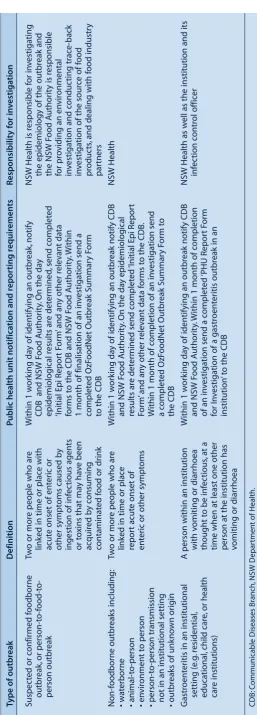
A description of the notification and reporting require-ments for enteric disease outbreaks in NSW is provided in Table 1. In NSW, public health units (PHUs) are
responsi-Evaluation of the system of surveillance for
enteric disease outbreaks, New South Wales,
Australia, 2000 to 2005
Abstract: Aim: To evaluate the NSW enteric disease outbreak surveillance system. Evaluation methods: We performed unstructured interviews with NSW Health Communicable Diseases Branch staff and analysed summary outbreak reports for July 2000 to June 2005.Performance of the sur-veillance system:The system provided a mecha-nism for meeting all of its objectives to some level. Limitations included difficulty in monitoring out-breaks, incomplete outbreak information, difficulty in linking and collating information, and the cum-bersome and inflexible data management system.
Conclusions:The NSW enteric disease outbreak surveillance system is serving a useful public health function, but could be improved through the use of more sophisticated electronic data management techniques.
Michelle Cretikos
A,C, Barbara Telfer
Band
Jeremy McAnulty
BANSW Public Health Officer Training Program,
NSW Department of Health
BCommunicable Diseases Branch, NSW Department of Health
CCorresponding author: Email: [email protected]
ble for investigating notifications of enteric disease, and providing summary reports of enteric disease outbreaks to the NSW Department of Health using standard reporting forms. Outbreaks may also be detected through review of routinely collected notifiable diseases surveillance data, the NSW Food Authority complaints hotline, or reports from clinicians, institutions or laboratories, and members of the public (Figure 1).
The NSW enteric disease outbreak surveillance system collects data from all NSW public health units; it therefore covers the entire population of NSW. The specific objec-tives of the NSW enteric disease outbreak surveillance system as described in the NSW Health Notifiable Diseases Manualare to:
• identify the source of the outbreak • prevent further cases
• monitor the epidemiology to inform the development of better prevention strategies
• monitor the development of unusual or emerging pathogens
• fulfil international reporting requirements.3
We undertook the first evaluation of the NSW enteric disease outbreak surveillance system, which aimed to: • determine whether the objectives of the system are
being met
• evaluate the specific attributes of the system • identify areas for improvement.
Evaluation methods
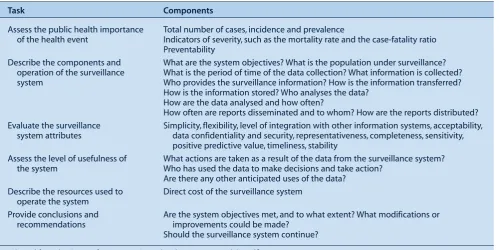
The evaluation was based on the Centers for Disease Control and Prevention guidelines for evaluating surveil-lance systems (Table 2).4,5The public health importance was derived from the results of the accompanying enteric disease outbreak review presented in this issue.6
Surveillance for enteric disease outbreaks
T
able 1.
Notifica
tion and r
epor
ting r
equir
ements f
or ent
eric disease outbr
eaks in New South
W
ales
T
y
pe of outbr
eak
Definition
P
ublic health unit notifica
tion and r
epor ting r equir ements R esponsibilit y f or in v estiga tion Suspec
ted or c
o
nfirmed f
oodborne
Tw
o or mor
e people who ar
e
Within 1 w
o
rk
ing da
y of identifying an outbr
eak, notify NSW Health is r esponsible f or in v estigating outbr eak, or person-t o-f ood-t o-link
ed in time or plac
e with
CDB and NSW F
ood A
uthorit
y.
On the da
y
the epidemiology of the out
break and
person outbr
eak
acut
e onset of ent
eric or
epidemiological r
esults ar
e det
ermined
, send c
omplet
ed
the NSW F
ood A
u
thorit
y is r
espo
nsible
other sympt
oms caused b
y
‘Initial Epi Repor
t F
orm
’ and an
y other r
elev
ant data
for pr
o
viding an en
vir
onmental
ingestion of inf
ec
tious agents
forms t
o the CDB and NSW F
ood A uthorit y. Within in v
estigation and c
onduc
ting trac
e-back
or t
o
xins that ma
y ha
v
e been
1 month of finalisation of an in
v
estigation send a
in
v
estigation of the sour
ce of f
o od acquir ed b y c onsuming complet ed OzF oodNet Outbr eak Summar y F orm pr oduc ts
, and dealing with f
ood industr
y
contaminat
ed f
ood or drink
to the CDB
par tners Non-f oodborne outbr eaks including: Tw
o or mor
e people who ar
e
Within 1 w
ork
ing da
y of identifying an outbr
eak notify CDB
NSW He
alth
• wat
erborne
link
ed in time or plac
e
and NSW F
ood A
uthorit
y.
On the da
y epidemiological
• animal-t
o-person
repor
t acut
e onset of
results ar
e det
ermined send c
omplet
ed
‘Initial Epi Repor
t • en vir onment t o person ent
eric or other sympt
oms
Form
’ and an
y other r
elev
ant data f
orms t
o the CDB
.
• person-t
o-person transmission
Within 1 month of c
ompletion of an in
v
estigation send
not in an institutional setting
a c omplet ed OzF oodNet Outbr eak Summar y F orm t o • outbr
eaks of unk
no wn origin the CDB G astr o ent
eritis in an institutional
A person within an institution
Within 1 w
ork
ing da
y of identifying an outbr
eak notify CDB
NS
W Health as w
ell as the institution and its
setting (e
.g
. r
esidential,
with v
omiting or diarrhoea
and NSW F
ood A
uthorit
y.
Within 1 month of c
ompletion inf ec tion c ontr ol of fic er educational, child car e
, or health
thought t
o be inf
ec
tious
, at a
of an in
v
estigation send a c
omplet ed ‘PHU Repor t F orm car e institutions)
time when at least one other
for In
v
estigation of a gastr
o
ent
eritis outbr
eak in an
person at the institution has
institution
’ t
o the CDB
v
o
miting or diarrhoea
CDB:
C
ommunicable Diseases Br
anch,
NSW D
epar
To assess the completeness of enteric disease outbreak reporting by PHUs, we calculated the proportion of all outbreaks first reported in any form (including phone calls, emails and other initial reports) to the CDB from January to December 2005 that had a completed final out-break summary report. Timeliness of reporting was evalu-ated by determining the period between the date of symptom onset for the first case and the date of the final summary outbreak report.
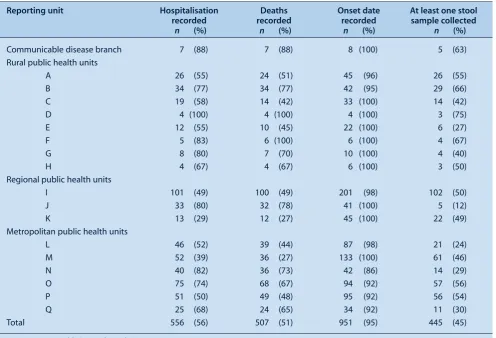
Completeness was assessed by examining the completeness of key data fields, including: onset date for the first case; summary report date; number of people at risk; number of people affected; number of hospitalisations; number of deaths; and number of clinical specimens collected.
The usefulness of the system was examined by reviewing the objectives of the surveillance system, interviewing key informants from the CDB enteric diseases team and reviewing the output of the system, including reports and policy interventions. Policy outputs for the period 1 July 2000 to 30 June 2005 were identified in past editions of the NSW Public Health Bulletin and through interviews with the CDB staff.
Performance of the surveillance system
Simplicity
Enteric disease outbreaks in NSW were identified and reported through several mechanisms (Figure 1). The maintenance and integration of the flow of outbreak infor-mation along these pathways was primarily a manual
Occurrence of disease in two or more people related in time or place
Identification of suspected outbreak by a NSW public health unit, the NSW Food Authority, a health care provider, laboratories, an institution*,
or a member of the public
NSW Public Health Unit
Communicable Diseases Branch, NSW Department of Health
Foodborne and other non-institutional outbreaks
Non -foodborne outbreaks in institutions
Data entered into the OzFoodNet Outbreak Database
Data entered into the Gastroenteritis in Institutions
Outbreak Database
National OzFoodNet database
Journal publications; contribution to health policy and advocacy
Collation and publication in fortnightly, quarterly and annual
OzFoodNet reports
Figure 1. The flow of information relating to suspected or confirmed enteric disease outbreaks in New South Wales.
process involving considerable work by staff from notify-ing laboratories, PHUs, CDB and the NSW Food Authority. There were few automated components to this process. The CDB enteric diseases team entered all data from outbreak summary forms received from PHUs into the relevant enteric disease outbreak database – either the OzFoodNet Outbreak Summary Database or the Gastroenteritis in Institutions Database – as there was no mechanism for PHUs to enter their own data.
Flexibility
Key informants reported that these databases only cap-tured final summary outbreak information and provided no mechanism to track the course of outbreaks from initial identification through to completion. Some outbreaks were incompletely reported and others were not entered into the database. The system could not readily capture and organise the large amount of information generated throughout the course of an outbreak investigation in a timely fashion. The outbreaks reported ranged in size and scope. The surveillance system catered for this; however, the databases were not flexible enough to incorporate additional information where required, and data from other Australian states could not be readily accessed.
Level of integration with other surveillance and health information systems
It was not possible to determine the potential relationships between individual disease notifications in the NSW Notifiable Diseases Database and enteric disease outbreaks recorded in the enteric disease outbreak data-bases. In addition, cross-checking whether cases identi-fied in outbreaks had also been entered into the
NSW Notifiable Diseases Database was not possible, as information on individuals was not captured as part of the outbreak summary reporting process.
Acceptability
The CDB staff who managed and maintained the surveil-lance system for enteric disease outbreaks reported that it was cumbersome and labour intensive. The system for reporting enteric disease outbreaks created a large paper trail and involved many hours of data entry work, particu-larly during epidemic winter seasons of viral gastroenteri-tis. The outbreak summary forms provided by PHU staff often required interpretation by the CDB enteric diseases team, and required additional work to gather missing information where forms were incomplete.
Data confidentiality and security
Completed outbreak summary forms were mailed, sent by secure fax or emailed to the CDB. Individual case identi-fiers were not included in the data forms; information was reported in summary form only. Information on individual institutions and businesses with suspected or confirmed outbreaks was included, highlighting the need to ensure security of data at all times. With no system for tracking outbreaks, and the large paper, email and fax trails gener-ated by the outbreak reporting system along the numerous reporting pathways, there was considerable potential for information to be misplaced or lost.
Representativeness
The true representativeness of the surveillance system could not be evaluated because this can only be measured through comparison to the true rate of enteric disease Surveillance for enteric disease outbreaks
Table 2. Tasks for the evaluation of a surveillance system
Task Components
Assess the public health importance Total number of cases, incidence and prevalence
of the health event Indicators of severity, such as the mortality rate and the case-fatality ratio
Preventability
Describe the components and What are the system objectives? What is the population under surveillance?
operation of the surveillance What is the period of time of the data collection? What information is collected?
system Who provides the surveillance information? How is the information transferred?
How is the information stored? Who analyses the data? How are the data analysed and how often?
How often are reports disseminated and to whom? How are the reports distributed?
Evaluate the surveillance Simplicity, flexibility, level of integration with other information systems, acceptability,
system attributes data confidentiality and security, representativeness, completeness, sensitivity,
positive predictive value, timeliness, stability
Assess the level of usefulness of What actions are taken as a result of the data from the surveillance system?
the system Who has used the data to make decisions and take action?
Are there any other anticipated uses of the data?
Describe the resources used to Direct cost of the surveillance system
operate the system
Provide conclusions and Are the system objectives met, and to what extent? What modifications or
recommendations improvements could be made?
Should the surveillance system continue?
outbreaks in NSW, which is not known. An approximate assessment of representativeness can be made by compar-ing the rates of enteric disease outbreaks across different areas of NSW, assuming that the occurrence of enteric disease outbreaks do not vary by location. The population-adjusted public health unit total rate of reporting of enteric disease outbreaks was highly variable, ranging from 0.5 to 7.4 per 100 000 population.6
Completeness
The completeness of the surveillance system was judged by assessing the proportion of critical data fields that were completely collected for all outbreaks during the period of the evaluation. The outbreak data were almost 100% com-plete for the date of onset of the first case and the number of people affected. Completeness for other important fields, such as the number at risk, the number hospitalised, the number of deaths, the number of stool specimens and the summary report date, was variable both over time and between public health units (Table 3). In addition, CDB staff reported that it was common for data on the environ-mental component of foodborne disease investigations to be incomplete, and that they were unable to monitor the completeness of outbreak reporting or be sure that they had received all essential outbreak data.
During 2005, final summary outbreak forms were received for 132 (63 per cent) of 209 provisionally reported out-breaks, including summary reports for 49/116 (42 per cent) of foodborne outbreaks and 83/93 (89 per cent) of institu-tional outbreaks. Some of the outbreaks provisionally reported may not have been considered to warrant further investigation or summary reporting by the PHU.
Sensitivity and positive predictive value
Sensitivity could not be evaluated, as data on the true total number of enteric disease outbreaks in NSW is not avail-able. Positive predictive value could also not be formally evaluated, but all of the outbreaks reported using the final summary reporting form appeared to be true enteric disease outbreaks, as no non-enteric pathogens were identified.
Timeliness
There was inevitably a delay between the date of onset of symptoms in the first case and the final date of the outbreak summary report. The median time to summary reporting of all enteric outbreaks over the 5-year period was 20 days (inter-quartile range 6–52 days). For foodborne outbreaks, the median time to a summary report was 32 days (inter-quartile range 10–105 days), and for non-foodborne out-breaks 19 days (inter-quartile range 6–47 days). The time to Table 3. Completeness of enteric disease outbreak data field by reporting unit, New South Wales, 2000–2005
Reporting unit Hospitalisation Deaths Onset date At least one stool
recorded recorded recorded sample collected
n (%) n (%) n (%) n (%)
Communicable disease branch 7 (88) 7 (88) 8 (100) 5 (63)
Rural public health units
A 26 (55) 24 (51) 45 (96) 26 (55)
B 34 (77) 34 (77) 42 (95) 29 (66)
C 19 (58) 14 (42) 33 (100) 14 (42)
D 4 (100) 4 (100) 4 (100) 3 (75)
E 12 (55) 10 (45) 22 (100) 6 (27)
F 5 (83) 6 (100) 6 (100) 4 (67)
G 8 (80) 7 (70) 10 (100) 4 (40)
H 4 (67) 4 (67) 6 (100) 3 (50)
Regional public health units
I 101 (49) 100 (49) 201 (98) 102 (50)
J 33 (80) 32 (78) 41 (100) 5 (12)
K 13 (29) 12 (27) 45 (100) 22 (49)
Metropolitan public health units
L 46 (52) 39 (44) 87 (98) 21 (24)
M 52 (39) 36 (27) 133 (100) 61 (46)
N 40 (82) 36 (73) 42 (86) 14 (29)
O 75 (74) 68 (67) 94 (92) 57 (56)
P 51 (50) 49 (48) 95 (92) 56 (54)
Q 25 (68) 24 (65) 34 (92) 11 (30)
Total 556 (56) 507 (51) 951 (95) 445 (45)
Pre 2005 Area Health Service boundaries.
summary reporting of foodborne outbreaks was signifi-cantly longer than for non-foodborne outbreaks (p< 0.001, Kruskal–Wallis test), although the median time to summary reporting for all outbreaks was well within the required 30 days since the last outbreak case was identified.
Stability
As the period of evaluation covered the introduction of two outbreak databases, one during early 2000 and another in 2003, the methods for surveillance and reporting of enteric disease outbreaks changed over the five-year time period investigated, both in terms of the reporting forms used, data fields collected and databases used. This meant that some data were incomplete or not completely comparable, even over this relatively short time period.
Cost of the surveillance system
The cost of the surveillance system was not assessed due to time constraints.
Public health importance of the surveillance system Between 2000 and 2005, 998 enteric disease outbreaks were reported (148 foodborne and 850 non-foodborne), affecting 24 260 people, and associated with 771 hospital-isations and 21 deaths. The outbreaks reported during the evaluation period are described in more detail in ‘Enteric disease outbreak reporting, New South Wales, Australia, 2000 to 2005’ in this issue.6
Usefulness of the surveillance system
Despite the limitations of the surveillance system, the key informants indicated that they were able to use the enteric disease outbreak surveillance system data to produce
useful information, such as: the incidence of outbreaks in NSW; assessment of the success of outbreak control efforts; identification of the probable cause of an out-break; and identification of measures that could contribute to more effective prevention of enteric disease outbreaks.6
The CDB users of the system, and the results of an analy-sis of the information available from the enteric disease outbreak databases, indicated that the surveillance system did provide a mechanism for meeting all the objectives of the surveillance system at some level.
System products
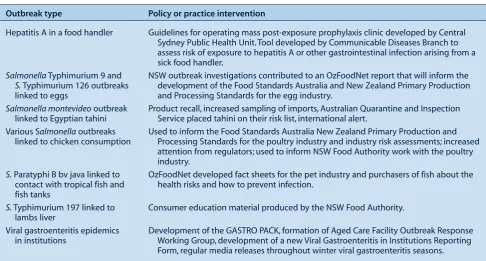
Policy outputs of the NSW enteric disease outbreak sur-veillance system were difficult to identify due to an absence of a system for identifying, organising and record-ing policy outcomes of outbreak investigations. Products of the surveillance system that were identified through document review and interviews with key informants included:
• fortnightly, quarterly and annual NSW Health and OzFoodNet reports (published as part of the national OzFoodNet reports in Communicable Diseases Intelligence)
• summary institutional outbreak data published in each issue of the NSW Public Health Bulletinand available from the NSW Health website
(www.health.nsw.gov.au)
• ad hocprovision of outbreak data as requested by other jurisdictions, government agencies, research institutions and industry
• information that contributed to policy development within the NSW Department of Health and the NSW
Surveillance for enteric disease outbreaks
Table 4. Examples of policy outputs from enteric disease outbreak investigations, New South Wales, 2000 to 2005
Outbreak type Policy or practice intervention
Hepatitis A in a food handler Guidelines for operating mass post-exposure prophylaxis clinic developed by Central
Sydney Public Health Unit. Tool developed by Communicable Diseases Branch to assess risk of exposure to hepatitis A or other gastrointestinal infection arising from a sick food handler.
SalmonellaTyphimurium 9 and NSW outbreak investigations contributed to an OzFoodNet report that will inform the
S.Typhimurium 126 outbreaks development of the Food Standards Australia and New Zealand Primary Production
linked to eggs and Processing Standards for the egg industry.
Salmonella montevideooutbreak Product recall, increased sampling of imports, Australian Quarantine and Inspection
linked to Egyptian tahini Service placed tahini on their risk list, international alert.
Various Salmonellaoutbreaks Used to inform the Food Standards Australia New Zealand Primary Production and
linked to chicken consumption Processing Standards for the poultry industry and industry risk assessments; increased
attention from regulators; used to inform NSW Food Authority work with the poultry industry.
S.Paratyphi B bv java linked to OzFoodNet developed fact sheets for the pet industry and purchasers of fish about the
contact with tropical fish and health risks and how to prevent infection.
fish tanks
S.Typhimurium 197 linked to Consumer education material produced by the NSW Food Authority.
lambs liver
Viral gastroenteritis epidemics Development of the GASTRO PACK, formation of Aged Care Facility Outbreak Response
in institutions Working Group, development of a new Viral Gastroenteritis in Institutions Reporting
Food Authority, and also to national foodborne illness and health policies
• information that contributed to advocacy measures, including media releases (Table 4).
Discussion
This evaluation determined that the surveillance system was performing a useful function, and was able to meet all of its pre-defined objectives to some extent. A principal limitation of the system was the inability to track the course of outbreaks efficiently and comprehensively, making central monitoring of the extent of outbreaks and the impact of control efforts difficult. In addition, the fact that enteric disease data was not linked with the NSW Notifiable Diseases Database delayed the sharing and reporting of outbreak information. A final limitation was the complicated, cumbersome and time-consuming nature of the enteric disease outbreak surveillance data-bases and information collation techniques, and the lack of flexibility of the data management system.
Given the absence of a system for tracking outbreaks and resultant policy outcomes, the findings presented here are likely to be incomplete. Nevertheless the system did appear to perform reasonably well with respect to prevention efforts and policy outputs. This report provides an impre-cise indication of the comprehensiveness and time liness of reporting due to the absence of a method for systematically tracking the course of an outbreak, and the absence of crit-ical data fields, such as onset date of last case.
The sensitivity and specificity of the system could not be evaluated. Due to enhanced surveillance in the one site with the highest rates of reporting, the surveillance system is unlikely to be representative of the true distribution of enteric disease outbreaks. Furthermore, approximately 17.2 million cases of gastroenteritis occur in Australia annually, but only a minority of people with gastroenteri-tis go to a doctor, and only a minority of these provide a stool sample.7Hence, the reported rates of enteric disease outbreaks are likely to be a substantial underrepresenta-tion of the true rates of enteric disease outbreaks in the community. The rates of enteric outbreaks reported from this evaluation were comparable with previous estimates of reported rates of enteric disease outbreaks in NSW, indicating some system stability.8
The evaluation itself was limited: it was not independent of the health system, and only a limited number of key informants within the NSW Department of Health were interviewed. Local PHU staff were not interviewed, and may have been able to provide important insights into the performance and usefulness of the enteric disease surveil-lance system. This evaluation focussed mainly on the sur-veillance processes within the Department, and not on the notifications to PHUs, or the PHU investigations
them-selves. In addition, the cost-effectiveness of the system was not evaluated.
This evaluation produced some recommendations to improve the efficiency and effectiveness of the surveil-lance system. Recommendations from the review, together with the development of a tender for a new notifiable dis-eases surveillance database system, have resulted in agree-ment to the following improveagree-ments to the system: • consolidation of all disease outbreak information into
one database
• linkage of enteric disease outbreak data with enteric disease data in the redeveloped state and national notifiable disease databases
• development of a mechanism to monitor the course of outbreaks and assist in comprehensive outbreak data collection.
Once the new database has been constructed and imple-mented, simplification and consolidation of the data col-lection forms will be undertaken as a matter of priority.
Conclusion
The NSW enteric disease outbreak surveillance system is serving a useful public health function and should be con-tinued. The system could be improved through the use of more sophisticated electronic data management techniques.
Acknowledgements
Thanks to Jennie Musto for reviewing earlier versions of this docu-ment and providing valuable feedback. Thanks also to all the public health unit staff who provided outbreak summary reports during the period of the evaluation.
References
1. Thacker SB, Berkelman RL. Public health surveillance in the United States.Epidemiol Rev1988; 10: 164–90.
2. OzFoodNet. OzFoodNet website: Introduction and Aims. Available at http://www.ozfoodnet.org.au/internet/ozfoodnet/ publishing.nsf/Content/what-is-ozfoodnet-1.
3. NSW Department of Health. Notifiable Diseases Manual. Sydney: NSW Department of Health; 2004.
4. Centers for Disease Control and Prevention. Guidelines for evaluating surveillance systems.MMWR1988; 37: 1–18. S5
5. Centers for Disease Control and Prevention. Updated guide-lines for evaluating Public Health Surveillance Systems. MMWR2001; 50: 1–35.
6. Cretikos C, Telfer B, McAnulty J. Enteric disease outbreak reporting, New South Wales, Australia, 2000 to 2005.N S W
Public Health Bull2008; 19: 3–7. doi:10.1071/NB07078
7. Hall G. OzFoodNet Working Group. Results of the national gastroenteritis survey 2001–2: working paper series no. 50. Canberra: National Centre for Epidemiology and Population Health; 2004.
Cryptosporidiosis is a diarrhoeal disease caused by the intestinal parasite, Cryptosporidium.1 Outbreaks are common and have been associated with swimming pools, drinking water supplies and, rarely, consumption of con-taminated beverages.1Under the NSW Public Health Act 1991, cryptosporidiosis is a notifiable disease and must be reported to NSW Health by laboratories. In NSW, eight public health units (PHUs) located across 16 sites are responsible for following up notifications of communica-ble diseases including cryptosporidiosis. PHU staff enter cases of cryptosporidiosis onto the state-wide surveillance system, the Notifiable Diseases Database (NDD), and investigate these using a standardised cryptosporidiosis questionnaire.
The evaluation of web-based data collection
for enhanced surveillance of cryptosporidiosis
Abstract:Following an increase in the number of people diagnosed with cryptosporidiosis in November 2005, the Communicable Diseases Branch initiated enhanced surveillance using a developmental version of NetEpi Collection, an open-source, web-based data collection tool. We evaluated the usefulness of NetEpi Collectionfor enhanced surveillance, using the Centers for Disease Control and Prevention’s Updated Guidelines for Evaluating Public Health Surveil -lance Systems as a guide. Most staff (73 per cent) who used NetEpi Collectionfound it easy to use. Although ongoing support was thought to be ade-quate by 82 per cent of respondents who used NetEpi Collection, 36 per cent reported that train-ing was limited and 27 per cent reported technical problems such as internet, server and password problems. In order to improve its usefulness in enhanced surveillance, training in NetEpi Collectionshould be enhanced and the stability of the system improved.
Kerri A. Viney
A,Cand Jeremy M. McAnulty
BANSW Public Health Officer Training Program,
NSW Department of Health
BCommunicable Diseases Branch, NSW Department of Health
CCorresponding author. Email: [email protected]
Establishing enhanced surveillance
In November 2005, analysis of routinely collected surveil-lance data by the NSW Department of Health identified an increase in the number of people notified with cryp-tosporidiosis. Following initial anecdotal reports that many of these cases reported contact with farms or cattle, the NSW Department of Health initiated enhanced surveil-lance to explore and quantify risk factors among the cases.
From 1 November 2005 to 29 May 2006 (the outbreak period), PHU staff were asked to interview all cases of cryptosporidiosis using the standard NSW Health ques-tionnaire. The questionnaire included potential risk factors associated with cryptosporidiosis, including farm visits, preschool attendance, swimming and contact with another case. Cryptosporidiosis cases were entered into NDD in the usual way. However, as NDD does not have the capacity to capture enhanced surveillance data, staff from the Communicable Diseases Branch at the NSW Department of Health designed a database usingNetEpi Collection soft-ware for this purpose.NetEpi Collectionis an open-source, web-based software that has been developed by the Centre for Epidemiology and Research, at the NSW Department of Health, to collect structured information about cases and contacts through web browsers on the internet.2
One PHU staff member from each PHU site was asked to enter additional risk factor data and the NDD case number into the developmental version (version 0.95) of NetEpi Collection.Training was provided to PHU staff via a teleconference, and ongoing individual support was provided using email or telephone. Data from NDD and NetEpi Collection were then merged and analyses per-formed using SAS (version 8.2) to determine what risk factors were important in ongoing transmission during the outbreak.3
The aim of the present study was to assess the usefulness of a web-based data collection system (such as NetEpi Collection) for enhanced surveillance during a communi-cable disease outbreak.
Methods
We used the Centers for Disease Control and Prevention’s Updated Guidelines for Evaluating Public Health Surveil -lance Systems as a framework to:
• assess the public health importance of the surveillance system
• describe attributes of the surveillance system (i.e. simplicity, flexibility, data quality, acceptability, predictive value positive, representativeness, timeliness and stability).4
Public health importance of cryptosporidiosis
A review of the public health literature was undertaken to assess the outbreak potential and preventability of cryp-tosporidiosis. NSW cryptosporidiosis data were analysed to compare notifications for the outbreak period with the previous five years (2000–2005).
Description of surveillance system components
Managers of NDD and NetEpi Collectionwere asked to provide a description of each system component.
Usefulness of the surveillance system
At the end of the outbreak period, one person from each of the 16 PHU sites was asked to complete a question-naire (Box 1). The questionquestion-naire outlined their experience of using NetEpi Collection, and responses were collated in Excel (version 5.0.2). Risk factor data was analysed at a state level to determine if NetEpi Collection was useful in assessing statewide risk factors associated with cryptosporidiosis.
Attributes of the surveillance system Acceptability
We asked PHU staff if they used NetEpi Collection, whether it was useful or burdensome, and whether there were barriers to using NetEpi Collectionin this outbreak. We also asked about the adequacy of training and ongoing support provided by the Communicable Diseases Branch.
Stability
To determine the system’s ability to manage data without failure, PHU staff were asked about any technical difficul-ties experienced while using NetEpi Collection.
Quality and representativeness of data
A comparison of the cryptosporidiosis data in NetEpi Collectionand NDD was used to determine the complete-ness of Net Epidata and whether it was representative of all cases. This allowed us to determine which PHUs entered data into NetEpi Collectionand what was different about the cases that were not entered. We also examined the completeness of data in the risk factor fields in NetEpi Collection.
Results
Public health importance of cryptosporidiosis
In NSW and elsewhere, cryptosporidiosis has been linked to swimming in contaminated swimming pools.5–7 Although outbreaks associated with drinking water sup-plies are rare in Australia, there is the potential for large outbreaks due to contaminated water sources, such as the Milwaukee outbreak of 1993.8,9Early detection of crypto -sporidiosis outbreaks may help public health attempts to develop interventions aimed at preventing further disease.
Between 1997–2006, the number of cryptosporidiosis notifications in NSW has ranged from 1130 in 1998 to 121 in 1999, with an average of 423 cases per year. In the out-break period, a total of 871 cases of cryptosporidiosis were reported to NSW Health. During the same time period in the previous five years, there was average of 235 cases of cryptosporidiosis reported each year.
Components of the surveillance system
Surveillance of cryptosporidiosis begins when a person with symptoms visits a doctor, and a faecal specimen is ordered and sent to a laboratory for testing. If the result is positive, the laboratory notifies the local PHU where the case is entered into the NDD and the person interviewed for risk factors. PHU staff review these data to identify clus-tering of cases (time and location) and, where necessary, initiate control measures following the NSW Health Crypto sporidiosis Response Protocol for NSW Public Health Units.10Data are then available for analysis by the Communicable Diseases Branch, and reports are compiled for the NSW Health Public Health Bulletin and NSW Health website.11,12
The NDD is a secure, decentralised database used for storing information on cases of notifiable diseases in NSW.13 Cryptosporidiosis data entered into NDD includes demo-graphic variables, disease characteristics, disease outcome, laboratory information, organism, specimen type, identifi-cation method and other variables. Risk factors are not entered into NDD, but NDD does contain a ‘clinical notes’ text field, where risk factors for disease may be entered.
During the outbreak period, specific risk factor informa-tion was entered into the NetEpi Collectiondatabase. This database contained a unique identifier common to NDD and NetEpi Collection, as well as fields on risk factors for cryptosporidiosis such as: swimming; contact with another case; preschool attendance; and farm visit. PHU staff entered the common identifier and risk factor data into the NetEpi Collectiondatabase after entering the case into NDD in the usual manner.
Usefulness of the surveillance system
Just over two-thirds of PHU sites reported using NetEpi Collectionduring the outbreak. Of those who used NetEpi Box 1. Items addressed in the questionnaire
* Did PHU staff use NetEpiCollection?
* Was NetEpiCollection easy to use?
Collection, most found it easy to use (Table 1). Just under one-third of those who used NetEpi Collection exported data for analysis and the data were infrequently used to assess local risk factors associated with cryptosporidiosis.
At the statewide level, Communicable Diseases Branch staff thought that NetEpi Collectionprovided useful infor-mation on risk factors, in particular the geographic distri-bution and timing of exposures.14 Analysis of statewide data entered into NetEpi Collectionrevealed that the out-break may have started in rural areas of NSW with farm animal contact as a risk factor. The outbreak then appeared to involve spread by contact to other parts of NSW, with person-to-person contact and swimming pool contamina-tion becoming more important as risk factors.14
Attributes of the surveillance system Acceptability
Of the 11 PHU staff who used NetEpi Collection, 9 (82 per cent) found it useful because it provided: an improvement of surveillance; an analysis of disease trends; and assis-tance in determining clusters and risk factors. Time was a factor for those who found the system burdensome, and barriers to using NetEpi Collection for analysis ranged from technical difficulties to lack of training (Table 1).
While training was perceived to be adequate by more than half of the users, most reported that they did not analyse the data collected through NetEpi Collection (Table 1). Two people who thought that training was not adequate were unable to attend the initial training session.
Stability
PHU staff experienced technical difficulties using NetEpi Collection (Table 1). These included: difficulty with accessing the internet; occasional server/program crashes;
slow internet connection; and an inability to use the return key to move between data entry fields (the tab key needs to be used instead). Some respondents mentioned that problems had been fixed after liaison with staff from the Communicable Diseases Branch.
Quality and representativeness of data
At June 2007, a total of 846 cases of cryptosporidiosis were reported for the outbreak period (Table 2). Of these, 458 (54 per cent) were entered into NetEpi Collection (Table 2). In the risk factor fields in NetEpi Collection, the data fields were, on average, 86 per cent complete.
Lack of time meant that it was not possible to enter data into NetEpi Collection at all PHU sites (5/16 or 31 per cent). Cases entered into NetEpi Collectionwere similar to the NDD cases with respect to gender and age (p= 0.073 and 0.900 respectively) (Table 2). A larger proportion of cases from metropolitan Sydney were entered into NetEpi Collectionthan from other parts of NSW (p= 0.045) and a higher proportion were entered at the beginning of the outbreak than later in the outbreak (p= 0.000).
Discussion
In an outbreak setting, enhanced surveillance of crypto -sporidiosis using a web-based data collection system allowed identification of risk factors for disease that could not have been achieved using NDD alone. Information describing risk factors also allowed identification of area of residence of those potential exposures over time.
PHU staff infrequently exported and used NetEpi Collection data to assess local risk factors for trans -mission. No comparison can be made with using the NDD system in this way. Nevertheless, despite time and techno-Web-based data collection for cryptosporidiosis
Table 1. Responses to questions on enhanced surveillance using NetEpi Collectionfrom 11 Public Health Unit staff located across NSW, during a statewide cryptosporidiosis outbreak
Question ‘yes’ responses Reasons given for a ‘no’ response
n %
Was NetEpieasy to use? 8 73 Unable to attend training Internet/technical problems
Was training adequate? 7 64 Unable to attend training
Was ongoing support adequate? 9 82 Not sure how to access data (i.e. for export and
analysis)
Any technical difficulties? 7 64 Internet problems. Server crashing. Unable to use
return key. Problems recalling password
Did you export and analyse data? 3 27 Didn’t try to export
Did you assess local risk factors using your data? 2 18 Not applicable
Barriers to using NetEpifor analysis? Not applicable Time. Small number of cases. Not sure how to export
and analyse data. General difficulties in using NetEpi. Trouble accessing website/ internet connectivity
Would it be helpful if NetEpiwas incorporated into NDD? 10 91 Depends on ease of use
Was enhanced surveillance useful? 9 82 Analysis not carried out so not sure of usefulness
logical limitations, most PHU staff thought that using enhanced surveillance would help in determining clusters and risk factors.
The information entered into NetEpi Collectionwas useful for analysing risk factors at a statewide level. Such web-based data collection systems may offer greater advan-tages for the co-ordinating site, as they enable analysis of risk factor information for the whole dataset. The use of web-based data collection tools may also be a more streamlined method of data collection than other methods (such as faxing or emailing single databases to a central point) and so could prevent time delays and errors in data transcription. However, where broadband access is unreli-able or slow, the use of web-based data collection tools may be limited.
The observed decreasing compliance with entering data into NetEpi Collection suggests that enhanced surveil-lance may be more sustainable over short periods.
To improve the use of web-based data collection tools, both training and support with technical problems should be improved. This could include repeating introductory training sessions and providing training in data analysis. In addition, PHU sites require adequate and reliable access to the internet.
With regards to the system itself, the stability needs to be improved and the data entry interface should allow staff to use the return key to move between fields when entering data. The authors of NetEpi Collection have advised that version 1.0 of the software, which includes numerous enhancements, will be publicly available at http://www.netepi.org when this paper is published.
In previous outbreak investigations carried out by NSW
Health, risk factor information has been collected by faxing forms to a central point, then entering into a data-base. Elsewhere in Australia, Canada and the United Kingdom, enhanced surveillance has been used to collect risk factor data for a range of diseases in outbreak situa-tions. This approach has been recently applied to the analysis of risk factors for hepatitis B,15,16meningococcal disease,17 haemolytic uraemic syndrome,18 hepatitis C19 and campylobacter,20 among other diseases. OzFoodNet have used an even earlier developmental version of NetEpi Collectionduring an outbreak of SalmonellaHvittingfoss in order to identify potentially implicated foods and the investigators concluded that using a web-based data col-lection system such as NetEpi Collectionwas a dramatic improvement in the collection of data in a geographically dispersed outbreak.21
Conclusion
Enhanced surveillance of cryptosporidiosis provided useful information on potential exposures during an out-break with widespread geographic distribution. Using the web-based data collection tool, NetEpi Collection, made analysis of data easier for the co-ordinating site, but was difficult and time-consuming for some PHU staff.
Where systems data are complete and representative, enhanced surveillance during outbreaks using web-based data collection tools can provide useful information about exposures for disease.
Acknowledgements
Many thanks to Tim Churches (Population Health Information Branch, NSW Health) for advice on the manuscript and to the Public Health Unit network for their co-operation during the outbreak and in returning questionnaires.
Table 2. Number and proportion of cryptosporidiosis cases entered and not entered into NetEpi Collection, 1 November 2005 to 29 May 2006
Cases Entered into NetEpi Not entered into NetEpi pvalue
n % n %
Gender
Male 219 48 190 49
Female 237 52 194 50 0.073
Unknown 2 <1 4 1
Age
0–4 years 188 41 161 41
>5 years 270 59 227 59 0.900
Residence
Metro Sydney 231 50 168 43
Remainder of NSW 227 50 220 57 0.045
Report date
1 Nov–31 Dec 2005 169 37 66 17
1 Jan–29 May 2006 289 63 322 83 <0.001
References
1. Heymann DL. Control of Communicable Diseases Manual 18th edition. Washington DC: American Public Health Association, 2004.
2. NSW Department of Health. NetEpi Case Manager Quick Reference Guide. Available at: http://www.netepi.org, accessed 15 February, 2007.
3. SAS Institute. The SAS System for Windows version 8.02. Cary NC: SAS Institute, 2003.
4. Centers for Disease Control and Prevention Updated guide-lines for evaluating public health surveillance systems: Recommendations from the Guidelines Working Group. MMWR2001; 50: 1–36. RR-13
5. Puech MC, McAnulty JM, Lesjak M, Shaw N, Heron L, Watson JM. A statewide outbreak of cryptosporidiosis in New South Wales associated with swimming at public pools.
Epidemiol Infect2001; 126(3): 389–96.
doi:10.1017/S0950268801005544
6. Stafford R, Neville G, Towner C. McCall B. A community outbreak of Cryptosporidium infection associated with a swimming pool complex.Commun Dis Intell2000; 24(8): 236–9.
7. Veverka F, Shapiro N, Parish MK, York S, Becker W, Smith F et al. Protracted outbreaks of cryptosporidiosis associated with swimming pool use-Ohio and Nebraska, 2000.MMWR2001; 50(20): 406–10.
8. Lester R. A mixed outbreak of cryptosporidiosis and
giardia-sis.Quarterly Bull Infect Dis1992; 1(1): 14–15.
9. Mac Kenzie WR, Hoxie NJ, Proctor ME, Gradus MS,
Blair KA, Peterson DE et al. A massive outbreak in Milwaukee of cryptosporidium infection transmitted through the public water supply.N Engl J Med1994; 331(3): 161–7.
doi:10.1056/NEJM199407213310304
10. Health NSW. Cryptosporidiosis Response Protocol for NSW Public Health Units. Available at: http://www.health.nsw. gov.au/infect/pdf/cryptosporidiosis_protocol_2006.pdf, accessed 1 August, 2007.
11. NSW Health Notifiable Diseases Database System. Crypto -sporidiosis notifications. Available at: http://www.health.
nsw.gov.au/data/diseases/cryptosporidiosis.html, accessed 1 August, 2007.
12. Health NSW. NSW Public Health Bulletin. Available at: http://www.publish.csiro.au/nid/226.htm, accessed 1 August, 2007.
13. Persson L, Bartlett M. Notifiable Diseases Database System: review and developme