Spring 2019
Probability recurrences on simple graphs in a forest building
Probability recurrences on simple graphs in a forest building
process
process
Joseph S. Alameda
Iowa State University, [email protected]
Follow this and additional works at: https://lib.dr.iastate.edu/creativecomponents
Part of the Discrete Mathematics and Combinatorics Commons
Recommended Citation Recommended Citation
Alameda, Joseph S., "Probability recurrences on simple graphs in a forest building process" (2019). Creative Components. 125.
https://lib.dr.iastate.edu/creativecomponents/125
by
Joseph Alameda
A creative component submitted to the graduate faculty
in partial fulfillment of the requirements for the degree of
MASTER OF SCIENCE
Major: Mathematics
Program of Study Committee: Steve Butler, Major Professor
Bernard Lidick´y Michael Young
Iowa State University
Ames, Iowa
2019
DEDICATION
I would like to dedicate this thesis to Scarlitte Ponce who taught me how to add fractions
TABLE OF CONTENTS
LIST OF FIGURES . . . iv
ABSTRACT . . . v
CHAPTER 1. DEFINITIONS AND BACKGROUND . . . 1
1.1 Definitions . . . 1
1.2 Background . . . 2
CHAPTER 2. THE GRAPHS`(r)Kn . . . 4
2.1 Construction of `(r)Kn . . . 4
2.2 Probability recurrence for`(r)K n . . . 4
CHAPTER 3. THE GRAPHSKn−Kt . . . 7
3.1 Construction of Kn−Kt . . . 7
3.2 Probability recurrence forKn−Kt. . . 7
3.3 The Fan graphFn−2,2 . . . 9
3.4 The graphs Kn−Kn−3 . . . 11
3.5 Guessing game . . . 12
CHAPTER 4. THEG2n+1 CONJECTURE . . . 13
4.1 Construction of G2n+1 and its probability recurrence . . . 13
4.2 Conjectures . . . 14
LIST OF FIGURES
Figure 1.1 Forest Building Process onK4 . . . 2
Figure 2.1 The`(1)K4 graph . . . 4
ABSTRACT
Consider the following process on a simple graph with no isolated vertices: Randomly
order the edges and remove an edge if and only if the edge is incident to two vertices already
incident to some preceding edge. This process results in a spanning forest of the graph.
Recurrences are given for the process for multiple families of graphs, and the probability
of obtainingkcomponents in the above process is given by a new method for the Fan graph
CHAPTER 1. DEFINITIONS AND BACKGROUND
We first introduce the necessary definitions that are used throughout the paper, and we
also introduce the forest building process.
1.1 Definitions
Let V be a finite nonempty set. A graph G = (V, E) is a pair of sets V and E such
that E contains 2 element subsets of V. Elements in V and E are called vertices and
edges respectively, and are often denotedV(G) andE(G). Given verticesuand vinV(G),
u and v are said to be adjacent if {u, v}, denoted uv, is in the edge set E(G). Adjacent
vertices are often called neighbors and the set of neighbors of a vertex v in V(G) is called
theneighborhood ofv. This set will be denotedN(v). Anindependent set is a set of vertices
inV(G) that are not adjacent to one another. Aleaf is a vertex with exactly one neighbor.
An isolated vertex is a vertex with no neighbor. A graph H is a subgraph of graph G if
V(H) ⊆V(G) and E(H) ⊆E(G). A subgraph H is said to be a spanning subgraph of a
graphG ifV(H) =V(G).
A tree T is a graph in which any two vertices is connected by a unique path, and a
forest F is the disjoint union of trees. A complete graph, denoted Kn, is the graph on n
vertices with all possible edges, and a complete bipartite graph, denoted Km,n, is the graph
on m+nvertices with an independent set of size m and an independent set of sizenwith
all possible edges between both sets.
LetGbe a simple graph with no isolated vertices. Consider the followingforest building
1. Take a random ordering of edges of E(G), say e1, e2, . . . , en
2. Remove the edge ej from E(G) if it is incident to two vertices that are incident to
ej−a and ej−b for some positive numbers aand b.
We note that since this does not allow cycles, the end result is a forest. This must be a
spanning forest of Gsince every vertex remains in the graph. We illustrate this process on
K4 in Figure 1.1.
1 3
2
4 6 5
1 3
2
6 5
1 3
2
6
1 3
[image:8.612.209.437.269.499.2]2
Figure 1.1 Forest Building Process on K4
1.2 Background
This process was first considered in (2). Let F(G, k) denote the number of edge
order-ings that result in the forest building process producing k trees. Let P(G, k) denote the
probability that a random ordering produces k trees and let pG(x) = PkP(G, k)xk. The
Theorem 1.2.1 (Butler-Chung-Cummings-Graham). For the complete graphKn we have
pKn(x) =
X k
n−1 n−2k,k,k−1
2n−2k
2n−2 n
x k.
The polynomial pG(x) was also found for the complete bipartite graph in (1).
Theorem 1.2.2 (Berikkyzy-et al.). For the complete bipartite graph Ks,t, we have
pKs,t(x) =
X k
k(s+t) ks t k
st s+ts x k.
In following chapters, we establish a process to build recurrences for multiple graphs,
find the polynomial pG(x) for the Fan graph Fn−2,2, and also discuss a way to prove a
CHAPTER 2. THE GRAPHS `(r)Kn
We will first construct the graphs `(r)Kn, and then give a probability recurrence that
looks at a certain point in the tree building process.
2.1 Construction of `(r)K n
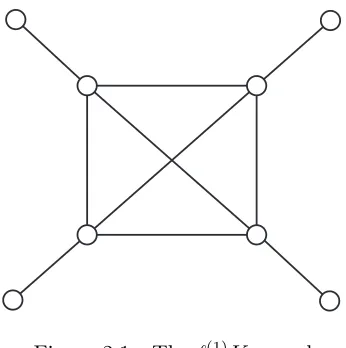
Given a complete graph Kn, we form `(r)Kn by attaching r leaves to each vertex.
[image:10.612.236.409.383.557.2]Figure 2.1shows an example of such a graph.
Figure 2.1 The `(1)K
4 graph
2.2 Probability recurrence for `(r)Kn
Theorem 2.2.1. Let G=`(r)K
n and letQn(a, `) be the probability that the forest building
process will terminate withk trees given thatn−avertices have already been chosen in the
Qn(a, `) =
a−1
2n+ 2r−a−1Qn(a−2, `−1)
+ 2(n−a)
2n+ 2r−a−1Qn(a−1, `)
+ 2r
2n+ 2r−a−1Qn(a−1, `−1)
with
Qn(0, `) =
0 `6= 0
1 `= 0.
Proof. We first observe two things, we only need to look at what changes the state of the
current process, and any edges incident to leaves attached to then−apicked vertices will
automatically be picked in the forest building process without changing counts, so we do
not need to consider those edges. Notice that there are exactly three situations that can
happen given the current state the process is in.
• We add an edge between a vertex in the set ofn−avertices and the set ofavertices.
There are a(n−a) edges where this happens and if it does the set of avertices loses
one vertex and no new tree is formed.
• We add an edge between two vertices in the set of a vertices. There are a2 edges
where this happens and if it does, the set of avertices loses two and one new tree is
formed.
• We add an edge between a leaf and a vertex in the set of a vertices. There are ra
edges where this happens and if it does, the set of a vertices loses one and one new
tree is formed.
Therefore there are a total of a(n−a) + a2+ra=a2n+2r2−a−1 edges. Thus we get the
Qn(a, `) =
a−1
2n+ 2r−a−1Qn(a−2, `−1)
+ 2(n−m)
2n+ 2r−a−1Qn(a−1, `)
+ 2r
2n+ 2r−a−1Qn(a−1, `−1).
Solving this recurrence is an open problem. The graphs that were previously solved
were found by examination of values appearing in the recurrence and then guessing and
verifying the solution. These cases had small primes showing up in the recurrences which
suggested that they came from multiplication of small terms. What makes it difficult to
solve this recurrence is the presence of large primes; for example,
p`(1)K 7(x) =
232 3003x+
5771 15015x
2+ 53938
135135x
3+ 16871
135135x
4+ 89
6435x
5+ 1
1755x
6+ 1
135135x
7
where 16871 is a prime number. In the following section we show that even though we
cannot always solve a general recurrence, we can still use the recurrence to solve certain
CHAPTER 3. THE GRAPHS Kn−Kt
We will first construct the graphsKn−Kt, and again give a probability recurrence that
looks at a certain point in the tree building process.
3.1 Construction of Kn−Kt
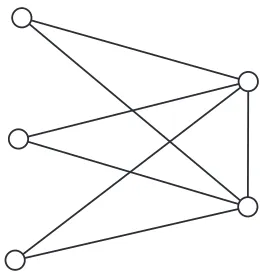
Given the complete graph Kn and the complete graph Kt with n ≥t, let Kn−Kt be
the complete graph onnvertices with the edges ofKt removed from it. Figure3.1gives an
[image:13.612.256.386.406.546.2]example of this graph.
Figure 3.1 The graphK5−K3 also denoted F3,2
3.2 Probability recurrence for Kn−Kt
Notice that in the construction of the graph, what is left is an independent set on t
vertices attached by every possible edge to the complete graph Kn−t. We will use this fact
Theorem 3.2.1. Let G=Kn−Kt withn≥t, and letKt,n−t(a, b, `) be the probability that
the forest building process will terminate with k trees given thatt−a vertices have already
been chosen from the t vertices of the independent set, n−t−b vertices have already been
chosen from then−t vertices ofKn−t, and there are currently k−` trees. Then
Kt,n−t(a, b, `) =
2ab
−2ab−2at+ 2an−b2−b+ 2bnKt,n−t(a−1, b−1, `−1)
+ b(b−1)
−2ab−2at+ 2an−b2−b+ 2bnKt,n−t(a, b−2, `−1)
+ 2b(n−a−b)
−2ab−2at+ 2an−b2−b+ 2bnKt,n−t(a, b−1, `)
+ 2a(n−t−b)
−2ab−2at+ 2an−b2−b+ 2bnKt,n−t(a−1, b, `)
with
Kt,n−t(a,0, `) =Kt,n−t(0,1, `) =
0 `6= 0
1 `= 0.
Proof. We use a similar argument as before. In this graph, there are exactly four situations
that can happen given the current state of the forest building algorithm.
• We add an edge between a vertex in the set of avertices and a vertex in the set with
bvertices. There are abedges where this happens, and if it does, the set ofavertices
loses one vertex, the set of bvertices loses one vertex, and one new tree is formed.
• We add an edge between two vertices in the set of b vertices. There are 2b
edges
where this happens and if it does the set ofbvertices loses two vertices, and one new
tree is formed.
• We add an edge between a vertex in the set of a vertices and the set of n−t−b
vertices. There area(n−t−b) edges where this happens and if it does the set of a
vertices loses one vertex, and no new tree is formed.
• We add an edge between a vertex in the set of b vertices and the set of n−t−b
vertices or the set oft−a vertices. There are b(n−a−b) edges where this happens
Therefore there are a total ofab+ b2
+a(n−t−b) +b(n−a−b) = −2ab−2at+2an2 −b2−b+2bn
edges. Thus we get the recurrence
Kt,n−t(a, b, l) =
2ab
−2ab−2at+ 2an−b2−b+ 2bnKt,n−t(a−1, b−1, `−1)
+ b(b−1)
−2ab−2at+ 2an−b2−b+ 2bnKt,n−t(a, b−2, `−1)
+ 2b(n−a−b)
−2ab−2at+ 2an−b2−b+ 2bnKt,n−t(a, b−1, `)
+ 2a(n−t−b)
−2ab−2at+ 2an−b2−b+ 2bnKt,n−t(a−1, b, `)
Solving this recurrence is also an open question; however, we can use it to findpG(x) for
the Fan graphFn−2,2 =Kn−Kn−2. This polynomial was first found in (3) using a different
method. We find it using the above recurrence.
3.3 The Fan graph Fn−2,2
Observe that Fn−2,2 can have at most two trees. Because of this, we only need to find
Kn−2,2(n−2,2,1), sinceKn−2,2(n−2,2,1) +Kn−2,2(n−2,2,2) = 1.In the recurrence for
Kn−2,2(n−2,2,1), Kn−2,2(n−3,1,0) appears, so if we can find a solution to this we are
done.
Lemma 3.3.1. Let G = Kn−Kn−m, and let Kn−m,m(a, b, `) be the probability that the
forest building process will terminate withk trees given thatn−m−avertices have already
been chosen from then−mvertices of the independent set, m−bvertices have already been
chosen from them vertices ofKm, and there are currently k−`trees. Then
Kn−m,m(r,1,0) =
n−(−m+r+ 2) n+m−2 .
Proof. We prove this for the case whenm= 2 and show Kn−2,2(r,1,0) = n−nr.The general
Kn−2,2(0,1,0) = 1 = nn by definition. Now assume up to r = k, Kn−2,2(k,1,0) = n−nk.
ConsiderKn−2,2(k+ 1,1,0). Using the recurrence we have that
Kn−2,2(k+ 1,1,0) =
n−k−2
k+n Kn−2,2(k+ 1,0,0) + k+ 1
k+nKn−2,2(k,1,0)
= n−k−2 k+n +
(k+ 1)(n−k) (k+n)n
= n−(k+ 1)
n .
Thus by induction, Kn−2,2(r,1,0) = n−nr.
Using this lemma we can prove the following.
Theorem 3.3.2. (Butler-Hamanaka-Hardt) The probability that the forest building process
ends with one tree for Fn−2,2 is
7n−12 n(2n−3).
Proof. To prove this we need to show Kn−2,2(n−2,2,1) = n(2n7n−−123). In the recurrence we
have
Kn−2,2(n−2,2,1) =
2(n−2)
2n−3 Kn−2,2(n−3,1,0) + 1
(2n−3)Kn−2,2(n−2,0,0)
= 2(n−2) 2n−3
3 n+
1
(2n−3) (by Lemma 3.2)
= 7n−12 n(2n−3).
We get the following corollary because Fn−2,2 can have at most two trees in the forest
building process.
Corollary 3.3.3. For G=Fn−2,2,
pG(x) =
7n−12 n(2n−3)x+
2(n−2)(n−3) n(2n−3) x
2.
Proof. Since in the forest building process Fn−2,2 can have at most two trees, and the
probability the process ends with one tree is n(2n7n−−123), the probability the process ends with
two trees is 1− 7n−12 n(2n−3) =
2(n−2)(n−3)
n(2n−3) . Thus,pG(x) = 7n−12 n(2n−3)x+
2(n−2)(n−3) n(2n−3) x
3.4 The graphs Kn−Kn−3
We again observe thatKn−Kn−3can have at most three trees. So we only need to find
Kn−3,3(n−3,3,1) andKn−3,3(n−3,3,2). We have not yet proven the results for these two
cases of the recurrence; however, we do have the following conjecture.
Conjecture 3.4.1. The probability that the forest building process ends with one tree for
Kn−Kn−3 is
2(37n2−149n+ 144) (2n−1)(2n−3)(n+ 1)(n−2),
and the probability that the forest building process ends with two trees is
(n−3)(42n2−205n+ 218) (2n−1)(2n−3)(n+ 1)(n−2).
This would then give us that for G=Kn−Kn−3
pG(x) =
2(37n2−149n+ 144) (2n−1)(2n−3)(n+ 1)(n−2)x
+ (n−3)(42n
2−205n+ 218)
(2n−1)(2n−3)(n+ 1)(n−2)x
2
+ 2(n−3)(n−4)(n−5) (2n−1)(n+ 1)(n−2)x
3.
So far we have proven this conjecture up to n = 100. We have also solved a piece of
Kn−3,3(n−3,3,2).
Lemma 3.4.2. Let G = Kn−Kn−m, and let Kn−m,m(a, b, `) be the probability that the
forest building process will terminate withk trees given thatn−m−avertices have already
been chosen from then−mvertices of the independent set, m−bvertices have already been
chosen from them vertices ofKm, and there are currently k−`trees. Then
Kn−m,m(r,1,1) =
r n+m−2.
The proof of Lemma 3.6 is omitted as it is almost identical to the proof of Lemma 3.2.
Kn−3,3(n−4,2,0) =
2(29n−46) (n+ 1)(2n−3)(2n−1)
and
Kn−3,3(n−4,2,1) =
28n2−197n+ 215 (n+ 1)(2n−3)(2n−1).
It is also not a coincidence thatKn−m,m(r,1,1) +Kn−m,m(r,1,0) = 1. This tells us that
if every vertex except one is chosen from the the complete graph portion of the graph, then
the process can only end with one or two trees.
3.5 Guessing game
The reader at this point may wonder how these probabilities are found. The answer
is looking at a lot of data by coding the recurrences into Sage. By looking at the data
for various n values, we can strategically guess what the probability should be. For Kn−
Kn−3, the denominators consistently factored into nice terms that consisted of small primes
which let us guess their general form; once we had the denominators, we guessed that
the numerators were polynomials innand used several values to find the coefficients. This
method can work well for graphs that cannot have many trees in the forest building process;
however, for graphs with many possible trees, a pattern must be found for the a, b and `
CHAPTER 4. THE G2n+1 CONJECTURE
We now construct the graph G2n+1, find its probability recurrence, and present a new
way of thinking about a previously published conjecture.
4.1 Construction of G2n+1 and its probability recurrence
LetGbe the graph onm+n+r vertices wherer of the vertices form a complete graph,
nof the vertices are an independent set with every possible edge attached to the complete
graph on r vertices, and m of the vertices are an independent set with with ever possible
edge between the independent set withnvertices. For this graph we have the following.
Theorem 4.1.1. Let G be the graph described above, and let Ym,n,r(a, b, c, `) be the
prob-ability that the forest building process will terminate with k trees given that m−a vertices
have already been chosen in the the independent set of size m, n−b vertices have already
been chosen in the independent set of size n,r−c vertices have already been chosen inKr,
and there are currentlyk−`trees. LetX= 2cr−c2−c+ 2cn+ 2br−2bc+ 2an+ 2bm−2ba,
Ym,n,r(a, b, c, `) =
c(c−1)
X Ym,n,r(a, b, c−2, `−1)
+2c(r−c) + 2c(n−b)
X Ym,n,r(a, b, c−1, `)
+2b(r−c) + 2b(m−a)
X Ym,n,r(a, b−1, c, `)
+2a(n−b)
X Ym,n,r(a−1, b, c, `)
+2cb
X Ym,n,r(a, b−1, c−1, `−1)
+2ab
X Ym,n,r(a−1, b−1, c, `−1)
with
Ym,n,r(0, b,0, `) =Ym,n,r(a,0,0, `) =Ym,n,r(a,0,1, `) =
0 `6= 0
1 `= 0.
The proof of this will be omitted since it uses the same basic counting arguments as the
previous recurrences.
4.2 Conjectures
To see why we care about the graph G2n+1 and its recurrence, we first introduce a
conjecture that was published in (1).
Conjecture 4.2.1. Forn≥1the graphG2n+1=Kn,n+1+e, whereeis an edge connecting
two vertices in the larger part of Kn,n+1, has the same polynomial asKn,n+1.
Notice that in our above graph, if we let m=n−1, andr = 2, we getG2n+1 described
in the above conjecture. This means we can rewrite the conjecture as follows.
Conjecture 4.2.2. Let G be the graph described above, and let Yn−1,n,2(a, b, c, `) be the
probability that the forest building process will terminate with k trees given that n−a−1
have already been chosen in the independent set of size n, 2−c vertices have already been
chosen in K2, and there are currentlyk−` trees. Then
Yn−1,n,2(n−1, n,2, `) = n
` n
n−`+1 2n n+1 where ( n `)( n n−`+1)
(2n n+1)
is the solution to the Kn,n+1 recurrence in the forest building process.
To prove this conjecture we need to show
Yn−1,n,2(n−1, n,2, `) =
1
n2+n+ 1Yn−1,n,2(n−1, n,0, `−1)
+ 2n
n2+n+ 1Yn−1,n,2(n−1, n−1,1, `−1)
+ n(n−1)
n2+n+ 1Yn−1,n,2(n−2, n−1,2, `−1)
=
n `
n n−`+1
2n n+1
.
Which means we need to solve the general recurrence for c= 0,1,2.Although we have
not yet proved the conjecture, we have used the recurrence to verify the conjecture up to
23 vertices. We have also solved the c = 0 case for the recurrence leaving only two more
cases. Interestingly enough, for c= 0,
Yn−1,n,2(a, b,0, `) =
2b+b(n−1−a)
−ab+an+bn+bYn−1,n,2(a, b−1,0, `)
+ a(n−b)
−ab+an+bn+bYn−1,n,2(a−1, b,0, `)
+ ab
−ab+an+bn+bYn−1,n,2(a−1, b−1,0, `−1)
=
b `
2n−b a−`
2n
a
which is also the solution to the complete bipartite recurrence in (1). Once we have the
case forc= 1, we should be able to solve Yn−1,n,2(n−1, n,2, `) in a similar way to how we
solvedKn−3,3(n−3,3, `), since we know what the answer should be. We hope to solve this
BIBLIOGRAPHY
[1] Z. Berikkyzy, S. Butler, J. Cummings, K. Heysse, P. Horn, R. Luo, and B. Moran. A
forest building process on simple graphs. Discrete Mathematics, 341:497–507, 2018.
[2] S. Butler, F. Chung, J. Cummings, and R. Graham. Edge flipping in the complete
graph. Advances in Applied Mathematics, 69:46–64, 2015.
[3] S. Butler, M. Hamanaka, and M. Hardt. Graphs with at most two trees in a forest