International Journal of Engineering
J o u r n a l H o m e p a g e : w w w . i j e . i rSemi-analytical Approach for Free Vibration Analysis of Variable Cross-section
Beams Resting on Elastic Foundation and under Axial Force
A. Mirzabeigy*
Department of Mechanical Engineering, Amir Kabir University of Technology, Tehran, Iran
P A P E R I N F O
Paper history: Received 30 June 2013
Received in revised form 05 September 2013 Accepted 14 September 2013
Keywords:
Variable Cross-Section Beam Elastic Foundation Axial Force
Differential Transform Method
A B S T R A C T
In this paper, free vibration of an Euler-Bernoulli beam with variable cross-section resting on elastic foundation and under axial tensile force is considered. Beam’s constant height and exponentially varying width yields variable cross-section. The problem is handled for three different boundary conditions: clamped-clamped, simply supported-simply supported and clamp-free beams. First, the equation of motion that governs the free vibration is derived and then dimensionless frequencies are determined using differential transform method (DTM). DTM is a semi-analytical approach based on Taylor expansion series that is a powerful tool in solution ordinary and partial differential equations. The effects of axial force, elastic foundation coefficient and non-uniformity parameter on dimensionless frequencies are investigated. Wherever possible, comparisons are made with the studies in open literature. Results show, the DTM yields rapid convergence without any frequency missing although convergence rate depends on boundary conditions. Also, dimensionless frequencies are sensitive to axial force rather than other parameters.
doi:10.5829/idosi.ije.2014.27.03c.05
1. INTRODUCTION1
Nowadays, non-uniform beams due to the wide applications in modern engineering such as turbine blade, helicopter blades, satellites structure, even robotic arms, and architectural applications are too considerable. It is clear that applications like above are because of achieving a better distribution of strength and weight in comparing with uniform beams. Therefore many researchers deal with analysis of dynamic behavior of non-uniform or variable cross-section beams. Cranch and Adler [1] presented the close form solutions for free vibration of non-uniform beams with four kinds of rectangular cross-section. Abrate [2] found that the equation of motion of a non-uniform beam may be transformed into that of a uniform beam. He presented simple formulas for predicting the fundamental frequency of non-uniform beams with various boundary conditions. Laura et al. [3] determined the natural frequencies of beams with constant width and bi-linearly varying thickness using different
1*Corresponding Author Email: [email protected] (A. Mirzabeigy)
approaches and showed the optimized Rayligh-Ritz method has better accuracy than the differential quadrature method. Auciello [4] obtained lower and upper bounds on the free vibration frequencies of tapered slender beams, Rayligh-Ritz method was used for upper bounds and structure reduced to rigid bars with elastic hinges to lower bounds. Ece et al. [5] derived exact solution for free vibration of beams with constant height and exponentially varying width for three different types of boundary conditions associated with hinged, clamped and free ends. Firouz-Abadi et al. [6] utilized equation of motion of variable cross-section beam to obtain a singular differential equation in terms of the natural frequency of vibration and applied Wentzel, Kramers, Brillouin (WKB) expansion series to find solution. Nikkhah Bahrami et al. [7] used modified wave approach to calculate natural frequencies and mode shapes of arbitrary non-uniform beams.
foundation is the most preliminary one in which the vertical displacement is assumed to be proportional to the contact pressure at an arbitrary point [8]. The Winkler model has been used for different problems of buckling and vibration of beams and plates that rest on elastic foundation [9-13].
The differential transform is a semi-analytic and powerful method for solving linear and nonlinear differential equations. This method was first used in the engineering domain by Zhou [14] to analyze electric circuits. This method was first used in structural dynamics by Malik and Dang [15], then different types of problem in structural dynamics were handled by differential transform method (DTM). For example, free vibration analysis of a centrifugally stiffened Timoshenko beam [16], vibration of an elastic beam supported on elastic soil [17], free vibration analysis of circular thin plates [18], vibration analysis of composite sandwich beams with viscoelastic core [19], vibration and modal stress analyses of circular plates made of two-directional functionally graded materials resting on elastic foundations [20], response of forced Euler-Bernoulli beams [21], buckling analysis of partially embedded pile in elastic soil [22], free vibration analysis of Timoshenko beams resting on two-parameter elastic foundation [23] and so on [24-28]. Beside applications in structural dynamics, DTM has wide applications in fluid flow and heat transfer problems [29] and nonlinear oscillators problems [30].
In this study, free vibration of variable cross-section beams resting on elastic foundation and under axial tensile force with different types of boundary conditions is considered. Euler-Bernoulli beam theory has been used. Constant height and exponentially varying in width is considered as non-uniformity in cross-section. This type of non-uniform cross-section has been considered for free vibration of beams without elastic foundation and axial force [5, 31] and cantilever beams with tip mass [32]. After deriving equation of motion, a semi-analytical technique called differential transform method is used to determine dimensionless frequencies and investigation on effect of different parameters on behavior of such beams. Also, for the first time, effects of boundary conditions, elastic foundation and axial force on convergence rate of DTM is investigated.
2.THE MATHEMATICAL MODEL AND
FORMULATION
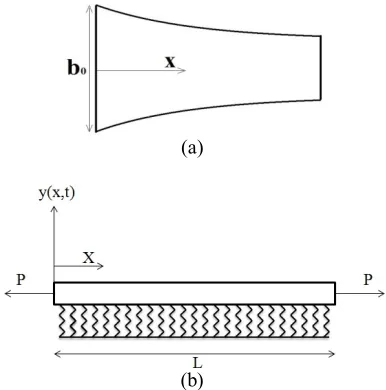
Consider a beam with exponentially varying width and constant height that rests on elastic foundation undergoing transverse vibration under axial tensile force as shown in Figure 1. The width of beam (
b
) varies over length coordinates as follow:x
e b x b = -s
0
)
( , (1)
(a)
(b)
Figure 1.(a) Top view of beam with exponentially varying width and (b) lateral view of beam resting on elastic foundation and under axial tensile force with constant height and non-uniform width.
Here b0 is width in the left end of beam and
s
is the non-uniformity parameter. When width of beam varies over the beam length as Equation (1), then cross-section and moment of inertia varies as follow:x e A x
A( )= 0 -s , (2)
x
e I x
I( )= 0 -s , (3)
0
A and I0arecross-section and moment of inertia in the left end of beam, respectively. Rao [33] governed the equation of motion for an Euler-Bernoulli beam with arbitrary cross-section resting on elastic foundation and under axial tensile force as follows:
L x t
x ky t
t x y x A
x t x y p x x
t x y x EI x
£ £ = +
¶ 
+ ¶ ¶ 
¶ -¶ ¶ 

0 , 0 ) , ( ) , ( ) (
) ) , ( ( ) ) , ( ) ( (
2 2
2 2 2
2
r
(4)
where y(x,t) represents transverse displacement of the beam,
E
is modulus of elasticity, I(x) is moment of inertia,p
is the axial tensile force, A(x) iscross-section of the beam,
k
is elastic coefficient of foundation,L
is the length of the beam andx
is coordinate along the longitudinal axis.The relevant boundary conditions associated with Equation (4) are:
Clamped-clamped (C-C):
, 0 ) ( ) 0 ( ) ( ) 0
( =
¶ ¶ = ¶ ¶ =
= L
x y x y L y
Simply supported –simply supported (S-S): , 0 ) ( ) 0 ( ) ( ) 0 ( 2 2 2 2 = ¶ ¶ = ¶ ¶ = = L x y x y L y y (6) Clamped-free (C-F): , 0 ) ( ) ( ) 0 ( ) 0
( 22 33 =
¶ ¶ = ¶ ¶ = ¶ ¶ = L x y L x y x y y (7)
Assuming that the motion is harmonic we consider
) , (xt
y as follow:
t i e x y t x
y( , )= ( ). W (8)
Substituting Equations (2), (3) and (8) into Equation (4) yields the following equation of motion:
0 2 2 0 2 2 2 2 0 2 3 3 0 4 4 0 = + W r -¶ ¶ -¶ ¶ s + ¶ ¶ s -¶ ¶ s -s -s -s -y k y e A x y p x y e EI x y e EI x y e EI x x x x (9)
Defining a non-dimensional coordinatex=xL, the equation of motion is obtained in non-dimensional form as: 1 0 , 0 ~ ) ( ~ ) ( ~ 2 ~ 2 2 2 2 3 3 4 4 < < = -+ ¶ ¶ -+ ¶ ¶ -¶ ¶ x w x d x d x dx dx y Ke y Pe y y (10)
where other parameters in Equation (10) are:
, ~ L y y= (11) , L s d = , 0 2 EI pL P= , 0 4 EI kL K= . 0 4 2 0 2 EI L AW =r w
Additionally, dimensionless boundary conditions can be written as follows:
Clamped-clamped (C-C): , 0 ) 1 ( ~ ) 0 ( ~ ) 1 ( ~ ) 0 ( ~ = ¶ ¶ = ¶ ¶ = = x x y y y y (12)
Simply supported –simply supported (S-S):
, 0 ) 1 ( ~ ) 0 ( ~ ) 1 ( ~ ) 0 ( ~ 2 2 2 2 = ¶ ¶ = ¶ ¶ = = x x y y y y (13) Clamped-free (C-F): . 0 ) 1 ( ~ ) 1 ( ~ ) 0 ( ~ ) 0 ( ~ 3 3 2 2 = ¶ ¶ = ¶ ¶ = ¶ ¶ = x x x y y y y (14)
3. THE DIFFERENTIAL TRANSFORM METHOD (DTM)
Differential transform method is an efficient semi-analytic approach for solving ordinary and partial differential equation that use the form of polynomials as the approximations to the exact solutions that are sufficiently differentiable. It is different from high-order Taylor series expansions because Taylor series expansions requires symbolic computation of the necessary derivatives of the data functions and is expensive for large orders [14-30].
The conceptual feature of the DTM is to transform the governing differential equations and boundary conditions as well as continuity conditions into a set of algebraic equations using a transformation role. Solving the algebraic equations in the usual way leads to accurate results with fast convergence rate and small computational effort.
A functionx(t), analytical in domain D
,
can be represented by a power series around any arbitrary point in this domain. Differential transform of a function) (t
x is defined as follows:
, ) ( ! 1 ) ( 0 = ú û ù ê ë é = t k k dt t x d k k X (15)
In Equation (15), x(t) is the original function and X(k) is the transformed function. Differential inverse transform of X(k) is defined as:
å
¥ = = 0 , ) ( ) ( k k t k X t x (16)Combining Equation (15) and (16), we obtain the following equation:
å
¥= úû=
ù ê ë é = 0 0 , ) ( ! ) (
k k t
k k dt t x d k t t x (17)
In principal applications, the function x(t) is shown by a finite numbers of terms and Equation (17) can be written as:
å
= úû=
ù ê
ë é = N
k k t
k k dt t x d k t t x 0 0 , ) ( ! ) ( (18)
which implies that:
å
¥+
= úû=
ù ê ë é = 1 0 . ) ( ! ) ( N
k k t
k k dt t x d k t t x (19)
differential equations and boundary conditions are tabulated in Tables 1 and 2, respectively.
3. 1. Solution Procedure with DTM
In the solution
stage, the DTM is applied to the Equation (10) using the transformation rules given in Table 1 and the following recurrence relation is obtained:
0 2 2 2 2 3 3 2 4 4 2 0 0 2 = w -d + -d + + -+ + d + + + d -+ +
å
å
= -= -) n ( Y ! n ] )! l n ( ). l ( Y [ K ! n ] )! l n ( ). l ( Y ! l )! l ( [ P ! n ) n ( Y )! n ( ) n ( Y )! n ( ) n ( Y )! n ( n l l n n l l n (20)In the follow, solution procedure is explained to clamped-clamped beam, similar procedure is followed for the other two boundary conditions; simply supported- simply supported and clamped –free beam.
Applying the DTM rules given in Table 2 to Equation (12), the left end boundary conditions of C-C beam is obtained as:
0 ) 1 ( ) 0
( =
Y
=Y
(21)In the left end of C-C beam, values of bending moment and shear force corresponding to ~(0)
2 2
x

¶ y and
) 0 ( ~ 3 3 x 
¶ y ,
respectively, are unknown. Therefore, the
transformation of these value express as follow: b
Y a
Y(2)= , (3)= (22)
where
a
andb
are unknown parameters.Equation (20) is a recursive equation, that from it for different values of
n
, Y(n) can be determined in terms ofa
,b
,d
,
K
,P
andw
.
The right end of C-C beam corresponds to x =1
,
applying the DTM rules given in Table 2 yields:
å
= = N n n Y 0 0 )( , (23)
å
= = N n n nY 0 0 )( . (24)
Substituting Y(n) into Equations (23) and (24), following matrix expression is obtained:
, 0 0 . ) ( ) ( ) ( ) ( 22 21 12 11 ú û ù ê ë é = ú û ù ê ë é ú û ù ê ë é b a Q Q Q Q w w w w (25)
where
a
andb
are constants and Qj1 and Qj2 (2 , 1
=
j ) are ploynomials of
w
that the coefficients of these polynomials are determined from values of d,
K andP
.
For the non-trivial solutions of Equation (25),it is necessary that the determinant of the coefficient matrix is equal to zero:
. 0 ) ( ) ( ) ( ) ( 22 21 12 11 = w w w w Q Q Q Q (26)
Solving Equation (26), the dimensionless frequencies are calculated. The
j
th estimated dimensionless frequency, (N)j
w corresponds to N and the value of Nis determined by the following convergence criterion:
e w
w( )- (N-1) <
j N
j . (27)
TABLE 1. Basic transformation rules of DTM for equations [30]
Original function Transformed function
) ( . ) (x g x
f =a F(n)=a.G(n)
) ( ) ( )
(x g x hx
f = ± F(n)=G(n)±H(n)
m m dx x g d x
f( )= ( ) ( )
! )! ( )
( G n m
n m n n
F = + +
) ( ) ( )
(x g xh x
f = ( ) () ( )
0 l n H l G n F n l -=
å
= x e x f( )=! 1 ) ( n n F =
TABLE 2. Basic transformation rules of DTM for boundary conditions [17] Original boundary conditions Transformed boundary conditions 0 ) 0 ( =
f F(0)=0
0 ) 0 ( = dx
df F(1)=0
0 ) 0 ( 2 2 = dx f
d F(2)=0
0 ) 0 ( 3 3 = dx f
d F(3)=0
where (N-1)
j
w is the
j
th estimated dimensionless frequency corresponding to N-1 ande
is the tolerance parameter.If Equation (27) is satisfied, the
j
th dimensionless frequency ( (N)j
w ) is obtained. Required CPU time for calculation of dimensionless frequencies is directly dependent on the value of
e
, whene
decreases, the required CPU time increases. Therefore, different values are considered fore
, for results presented in figures e =0.002 and for results presented in tables00001 . 0 =
e .
The explained procedure for C-C beam can be extended to the S-S and C-F beams. For S-S beam boundary conditions at the left end, using DTM rules is transformed as follows:
0 ) 2 ( ) 0
( =Y =
Y , (28)
and for C-F beam is transformed as follows:
0 ) 1 ( ) 0
( =Y =
Y , (29)
Also, applying DTM rules given in Table 2, the boundary conditions at the right end of S-S beam is transformed as follow:
å
=
=
N
n n Y
0
0 )
( , (30)
å
=
=
-N
n
n Y n n
0
0 ) ( ) 1
( , (31)
and for C-F beam, boundary conditions at the right end is transformed as follow:
å
=
=
-N
n
n Y n n
0
0 ) ( ) 1
( , (32)
å
=
=
-N
n
n Y n n n
0
0 ) ( ) 2 )( 1
( . (33)
4. RESULTS AND DISCUSSION
Procedure for determining dimensionless frequencies by DTM has been implemented in computer program using Matlab software. In order to verify accuracy of DTM, comparison between results obtained by DTM and exact solution [5] in the case of non-uniform beam without elastic foundation and axial force has been done in Table 3 for the first five dimensionless frequencies and for three different boundary conditions i.e. C-C, S-S and
C-F. Comparison of results indicates the excellent accuracy of DTM.
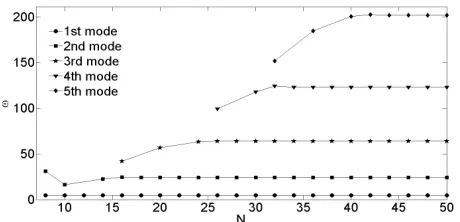
In Figures 2-4, the convergence of first five dimensionless frequencies for P=K=0 and d=1
with respect to the number of terms considered is presented for C-C, S-S and C-F boundary conditions, respectively. It is observed from these figures that the DTM shows rapid convergence and stability in computation without any frequency missing. The accuracy of the method increases dramatically with the number of terms taken into consideration. Rate of convergence for C-F boundary condition is higher than two others kind of boundary conditions.
In Tables 4-9, effect of axial tensile force and elastic foundation coefficients on the first two dimensionless frequencies when
d
is constant has been investigated. The results show, in constant value of thed
,dimensionless frequencies are more sensitive to axial force rather elastic foundation coefficient. First and second dimensionless frequencies in C-C boundary condition have same response to variation of elastic foundation coefficient, but in S-S and C-F boundary conditions first dimensionless frequency has significant sensitivity to elastic coefficient variation rather than second dimensionless frequency.
In Figures 5-7, effect of parameter, corresponding to non-uniformity in cross-section (
d
) on the first three dimensionless frequencies has been investigated for C-C, S-S and C-F boundary conditions, respectively. Three special cases of elastic foundation and axial force values are considered in these figures. In the case A,0
= =P
K , in the case B, K=500,P=10, and in the case C, K=10,P=50, are considered. It is observed from these figures that in the case B, beam with C-F boundary condition has different behaviors in the two first dimensionless frequencies, whereas two other boundary conditions have same behavior when
d
is changed. It is clear, first dimensionless frequency of beam with C-F boundary condition has valuable sensitivity tod
when elastic foundation is greater than axial force.TABLE 3. Comparison of DTM with exact solution in the case of beams without elastic foundation and axial force
d
Present C-C [5] Present S-S [5] Present C-F [5]1
1
w 22.51168 22.51167 9.77291 9.77291 4.73490 4.72298
2
w 61.85969 61.85968 39.57036 39.57036 24.20181 24.20168
3
w 121.10798 121.10799 88.97052 88.97052 63.86449 63.86448
4
w 200.07412 200.07411 158.08418 158.08418 123.09790 123.09790
5
w 298.77615 298.77661 246.92634 246.92650 202.06833 202.06876
2
1
w 22.93772 22.93771 9.48725 9.48725 6.26264 6.25877
2
w 62.42273 62.42272 39.85231 39.85231 26.58359 26.58350
3
w 121.72273 121.72272 89.40520 89.40520 66.37449 66.37449
4
w 200.71859 200.71860 158.59689 158.59689 125.68471 125.68471
5
w 299.43096 299.44012 247.48601 247.48629 204.69504 204.69531
Figure 2. Convergence of dimensionless frequencies for C-C boundary condition (P=K=0,d =1)
Figure 3. Convergence of dimensionless frequencies for S-S boundary condition (P=K=0,d =1)
Figure 4. Convergence of dimensionless frequencies for C-F boundary condition (P=K=0,d =1)
TABLE 4. Effects of elastic foundation and axial force on first dimensionless frequency of C-C beam (d =0.5)
P K=0 K=50 K=100
0 22.4077111 23.8007532 25.1163792
20 28.5432877 29.6478479 30.7125262 40 33.4626373 34.4086608 35.3292263 60 37.673419 38.515488 39.3394305 80 41.4085593 42.1756351 42.9289204
100 44.7975795 45.5072019 46.2058559
TABLE 5. Effects of elastic foundation and axial force on second dimensionless frequency of C-C beam (d =0.5)
P K=0 K=50 K=100
0 61.7195079 62.2408934 62.7579278 20 70.6532331 71.1090426 71.56199
40 78.4967698 78.9070515 79.3152374 60 85.5488499 85.9247423 86.2990022
80 91.932558 92.2797888 92.6256715 100 97.5280812 97.8469308 98.1645879
TABLE 6. Effects of elastic foundation and axial force on first dimensionless frequency of S-S beam (d=0.5)
P K=0 K=50 K=100
0 9.84536167 12.6907833 15.0045044
20 18.7035776 20.3412689 21.8559106 40 24.5383684 25.8067144 27.015169 60 29.226896 30.2987457 31.3336709
TABLE 7. Effects of elastic foundation and axial force on second dimensionless frequency of S-S beam (d=0.5)
P K=0 K=50 K=100
0 39.5013091 40.3139375 41.1109098
20 50.7902139 51.4243339 52.0509159
40 59.9667104 60.5041402 61.0369469
60 67.9000716 68.374686 68.8461006
80 74.9905425 75.4201931 75.8474622
100 81.4633345 81.858839 82.2524848
TABLE 8. Effects of elastic foundation and axial force on first dimensionless frequency of C-F beam (d=0.5)
P
K=0 K=50 K=1000 4.08932796 9.56002449 12.8816721
20 1.95734337 8.98634193 12.5548989
40 1.06982322 8.89674306 12.5352566
60 0.629893134 8.89110061 12.5574896
80 0.390184444 8.90173763 12.5824923
100 0.251046312 8.91426918 12.6038883
TABLE 9. Effects of elastic foundation and axial force on second dimensionless frequency of C-F beam (d=0.5)
P
K=0 K=50 K=1000 39.5013091 40.3139375 41.1109098
20 50.7902139 51.4243339 52.0509159
40 59.9667104 60.5041402 61.0369469
60 67.9000716 68.374686 68.8461006
80 74.9905425 75.4201931 75.8474622
100 81.4633345 81.858839 82.2524848
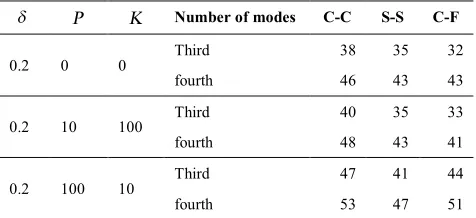
TABLE 10. Required number of terms in DTM to reach
001 . 0
=
e
d P K Number of modes C-C S-S C-F
0.2 0 0 Third 38 35 32
fourth 46 43 43
0.2 10 100 Third 40 35 33
fourth 48 43 41
0.2 100 10 Third 47 41 44
fourth 53 47 51
Figure 5. Effect of
d
on first three dimensionless frequencies of C-C beam. A:K=P=0, B:K=500,P=10 and50 , 10 :K= P=
C
Figure 6. Effect of
d
on first three dimensionless frequencies of S-S beam. A:K=P=0,B:K=500,P=10and50 , 10 :K= P=
C
Figure 7. Effect of
d
on first three dimensionless frequencies of C-F beam. A:K=P =0,B:K=500,P=10 and50 , 10 :K= P=
C
5. CONCLUSION
under axial tensile force was studied by semi-analytical technique, namely differential transform method. The method possesses several benefits such as moderately simple procedure, stability in computations and high accuracy. Exponentially varying width of beam yields variable cross-section. Three boundary conditions are concerned: clamped-clamped, simply supported-simply supported and clamp-free beams. For some special cases comparison has made with exact solution in open literature. Effect of different parameters on dimensionless frequencies has been investigated. The main conclusions are as follows:
1) Although DTM yields rapid convergence but convergence rate depends on boundary conditions. 2) For beams with exponentially varying in width,
clamped –free boundary conditions have different behaviors from other boundary conditions when non-uniformity parameter is changed.
3) Dimensionless frequencies are more sensitive to axial force rather elastic foundation coefficients. 4) When axial forces increase, required number of
terms in DTM increases to achieve the specified accuracy.
6. REFERENCES
1. Cranch, E. and Adler, A. A., "Bending vibrations of variable section beams", Journal of Applied Mechanics, Vol. 23, No. 1, (1956), 103-108.
2. Abrate, S., "Vibration of non-uniform rods and beams", Journal
of Sound and Vibration, Vol. 185, No. 4, (1995), 703-716.
3. Laura, P., Gutierrez, R. and Rossi, R., "Free vibrations of beams of bilinearly varying thickness", Ocean Engineering, Vol. 23, No. 1, (1996), 1-6.
4. Auciello, N., "On the transverse vibrations of non-uniform beams with axial loads and elastically restrained ends",
International Journal of Mechanical Sciences, Vol. 43, No. 1,
(2001), 193-208.
5. Ece, M. C., Aydogdu, M. and Taskin, V., "Vibration of a variable cross-section beam", Mechanics Research
Communications, Vol. 34, No. 1, (2007), 78-84.
6. Firouz-Abadi, R., Haddadpour, H. and Novinzadeh, A., "An asymptotic solution to transverse free vibrations of variable-section beams", Journal of Sound and Vibration, Vol. 304, No. 3, (2007), 530-540.
7. Nikkhah Bahrami, M., Khoshbayani Arani, M. and Rasekh Saleh, N., "Modified wave approach for calculation of natural frequencies and mode shapes in arbitrary non-uniform beams",
Scientia Iranica, Vol. 18, No. 5, (2011), 1088-1094.
8. Chen, W., Lü, C. and Bian, Z., "A mixed method for bending and free vibration of beams resting on a pasternak elastic foundation", Applied Mathematical Modelling, Vol. 28, No. 10, (2004), 877-890.
9. Motaghian, S., Mofid, M. and Alanjari, P., "Exact solution to free vibration of beams partially supported by an elastic foundation", Scientia Iranica, Vol. 18, No. 4, (2011), 861-866.
10. Mardani, E., "The analysis of a beam made of physical nonlinear material on elastic foundation under a harmonic load",
International Journal of Engineering-Transactions B:
Applications, Vol. 26, No. 5, (2013), 509.
11. Ekhteraei Toussi, H., "Frequency analysis for a timoshenko beam located on an elastic foundation", International Journal
of Engineering, Vol. 24, No., (2011).
12. Bodaghi, M. and Saidi, A. R., "Buckling analysis of functionally graded mindlin plates subjected to linearly varying in-plane loading using power series method of frobenius", International
Journal of Engineering-Transactions A: Basics, Vol. 25, No.
1, (2011), 89.
13. Fallah, A., Aghdam, M. and Kargarnovin, M., "Free vibration analysis of moderately thick functionally graded plates on elastic foundation using the extended kantorovich method", Archive of
Applied Mechanics, Vol. 83, No. 2, (2013), 177-191.
14. Zhou, J., Differential transformation and its applications for electrical circuits. 1986, Huazhong University Press, Wuhan, China.
15. Malik, M. and Huy Dang, H., "Vibration analysis of continuous systems by differential transformation", Applied Mathematics
and Computation, Vol. 96, No. 1, (1998), 17-26.
16. Mei, C., "Differential transformation approach for free vibration analysis of a centrifugally stiffened timoshenko beam", Journal
of Vibration and Acoustics, Vol. 128, No. 2, (2006), 170-175.
17. Balkaya, M., Kaya, M. O. and Sağlamer, A., "Analysis of the vibration of an elastic beam supported on elastic soil using the differential transform method", Archive of Applied Mechanics, Vol. 79, No. 2, (2009), 135-146.
18. Yalcin, H. S., Arikoglu, A. and Ozkol, I., "Free vibration analysis of circular plates by differential transformation method", Applied Mathematics and Computation, Vol. 212, No. 2, (2009), 377-386.
19. Arikoglu, A. and Ozkol, I., "Vibration analysis of composite sandwich beams with viscoelastic core by using differential transform method", Composite Structures, Vol. 92, No. 12, (2010), 3031-3039.
20. Shariyat, M. and Alipour, M., "Differential transform vibration and modal stress analyses of circular plates made of two-directional functionally graded materials resting on elastic foundations", Archive of Applied Mechanics, Vol. 81, No. 9, (2011), 1289-1306.
21. Catal, S., "Response of forced euler-bernoulli beams using differential transform method", Structural Engineering and
Mechanics, Vol. 42, (2012), 95-119.
22. Catal, S. and Catal, H. H., "Buckling analysis of partially embedded pile in elastic soil using differential transform method", Structural Engineering and Mechanics, Vol. 24, No. 2, (2006), 247-268.
23. Attarnejad, R., Shahba, A. and Jandaghi Semnani, S., "Application of differential transform in free vibration analysis of timoshenko beams resting on two-parameter elastic foundation", Arabian Journal for Science and Engineering, Vol. 35, (2010), 125-132.
24. Balkaya, M., Kaya, M. O. and Saglamer, A., "Free transverse vibrations of an elastically connected simply supported twin pipe system", Structural Engineering and Mechanics, Vol. 34, No. 5, (2010), 549-561.
25. Kacar, A., Tan, H. T. and Kaya, M. O., "Free vibration analysis of beams on variable winkler elastic foundation by using the differential transform method", Mathematical and
26. Demirdag, O. and Yesilce, Y., "Solution of free vibration equation of elastically supported timoshenko columns with a tip mass by differential transform method", Advances in
Engineering Software, Vol. 42, No. 10, (2011), 860-867.
27. Mao, Q., "Design of shaped piezoelectric modal sensors for cantilever beams with intermediate support by using differential transformation method", Applied Acoustics, Vol. 73, No. 2, (2012), 144-149.
28. Suddoung, K., Charoensuk, J. and Wattanasakulpong, N., "Application of the differential transformation method to vibration analysis of stepped beams with elastically constrained ends", Journal of Vibration and Control, (2012).
29. Rashidi, M. and Erfani, E., "Analytical method for solving steady mhd convective and slip flow due to a rotating disk with
viscous dissipation and ohmic heating", Engineering
Computations, Vol. 29, No. 6, (2012), 562-579.
30. Nourazar, S. and Mirzabeigy, A., "Approximate solution for nonlinear duffing oscillator with damping effect using the modified differential transform method", Scientia Iranica, (2013).
31. Mao, Q. and Pietrzko, S., "Free vibration analysis of a type of tapered beams by using adomian decomposition method",
Applied Mathematics and Computation, (2012).
32. Wang, C., "Exact vibration solution for exponentially tapered cantilever with tip mass", Transactions, Vol. 204, (2012), 204.70.
Semi-analytical Approach for Free Vibration Analysis of Variable Cross-section
Beams Resting on Elastic Foundation and under Axial Force
A. Mirzabeigy
Department of Mechanical Engineering, Amir Kabir University of Technology, Tehran, Iran
P A P E R I N F O
Paper history: Received 30 June 2013
Received in revised form 05 September 2013 Accepted 14 September 2013
Keywords:
Variable Cross-Section Beam Elastic Foundation Axial Force
Differential Transform Method
هﺪﯿﮑﭼ
ﺮﻠﯾواﺮﯿﺗدازآتﺎﺷﺎﻌﺗراﻪﻟﺎﻘﻣﻦﯾارد
-يرﻮﺤﻣﯽﺸﺸﮐرﺎﺑﺮﺛاﺖﺤﺗوﮏﯿﺘﺳﻻاﺮﺘﺴﺑﺮﺑﺮﻘﺘﺴﻣﺮﯿﻐﺘﻣﻊﻄﻘﻣﺢﻄﺳيارادﯽﻟﻮﻧﺮﺑ
دﺮﯿﮔﯽﻣراﺮﻗﯽﺳرﺮﺑدرﻮﻣ
.
ﺪﻨﮐﯽﻣﺮﯿﯿﻐﺗﯽﯾﺎﻤﻧترﻮﺻﻪﺑنآضﺮﻋوهﺪﺷﻪﺘﻓﺮﮔﺮﻈﻧردﺖﺑﺎﺛﺮﯿﺗعﺎﻔﺗرا
.
ﻪﺳياﺮﺑﻞﯿﻠﺤﺗ
رادﺮﯿﮔﺮﺳﮏﯾوﻞﺼﻔﻣﺮﺳود،رادﺮﯿﮔﺮﺳودﻞﻣﺎﺷيزﺮﻣﻂﯾاﺮﺷﻒﻠﺘﺨﻣتﻻﺎﺣ
-ﺖﺳاهﺪﺷمﺎﺠﻧادازآﺮﺳﮏﯾ
.
ﻪﮑﻧآزاﺪﻌﺑ
ﯽﻣﺖﺳدﻪﺑﯽﻠﯿﺴﻧاﺮﻔﯾدﻞﯾﺪﺒﺗشورزاهدﺎﻔﺘﺳاﺎﺑﺪﻌﺑنوﺪﺑيﺎﻫﺲﻧﺎﮐﺮﻓ،ﺪﺷجاﺮﺨﺘﺳاﯽﺳرﺮﺑدرﻮﻣﺮﯿﺗدازآتﺎﺷﺎﻌﺗراﻪﻟدﺎﻌﻣ ﺪﻨﯾآ
.
ﯿﻧشورﮏﯾﯽﻠﯿﺴﻧاﺮﻔﯾدﻞﯾﺪﺒﺗشور
عاﻮﻧاﻞﺣياﺮﺑﺪﻧاﻮﺗﯽﻣﯽﺘﺣارﻪﺑﻪﮐﺪﺷﺎﺑﯽﻣرﻮﻠﯿﺗيﺮﺳﻂﺴﺑﺮﺑﯽﻨﺘﺒﻣﯽﻠﯿﻠﺤﺗﻪﻤ
دوررﺎﮐﻪﺑﯽﺋﺰﺟتﺎﻘﺘﺸﻣوﯽﻟﻮﻤﻌﻣﻞﯿﺴﻧاﺮﻔﯾدتﻻدﺎﻌﻣ
.
ﺎﺑﺮﻇﺎﻨﺘﻣﺮﺘﻣارﺎﭘوﮏﯿﺘﺳﻻا ﺮﺘﺴﺑﺐﯾﺮﺿ،يرﻮﺤﻣيوﺮﯿﻧﺮﯿﺛﺎﺗ
ردﻪﮐيدراﻮﻣردوﺖﺳاهﺪﺷﯽﺳرﺮﺑﺪﻌﺑنوﺪﺑيﺎﻫﺲﻧﺎﮐﺮﻓﺮﺑﻊﻄﻘﻣﺢﻄﺳتاﺮﯿﯿﻐﺗ
ﻪﺘﻓﺮﮔترﻮﺻﯽﻬﺑﺎﺸﻣﻞﯿﻠﺤﺗﻊﺑﺎﻨﻣﺮﯾﺎﺳ
ﺖﺳاهﺪﺷمﺎﺠﻧاﺞﯾﺎﺘﻧﻦﯿﺑﻪﺴﯾﺎﻘﻣ،ﺖﺳا
.
ﻪﺑردﺎﻗوهدﻮﺑﻊﯾﺮﺳﯽﯾاﺮﮕﻤﻫيارادﯽﻠﯿﺴﻧاﺮﻔﯾدﻞﯾﺪﺒﺗشورﺪﻫدﯽﻣنﺎﺸﻧﺞﯾﺎﺘﻧ
دﺮﯾﺬﭘﯽﻣﺮﺛاﯽﻫﺎﮔﻪﯿﮑﺗﻂﯾاﺮﺷزانآﯽﯾاﺮﮕﻤﻫﺖﻋﺮﺳ ﻪﭼﺮﮔاﺪﺷﺎﺑﯽﻣﺎﻫﺲﻧﺎﮐﺮﻓمﺎﻤﺗﻪﺒﺳﺎﺤﻣ
.
نوﺪﺑيﺎﻫﺲﻧﺎﮐﺮﻓﻦﯿﻨﭽﻤﻫ
ﻌﺑ
ﺪﻨﻫدﯽﻣنﺎﺸﻧدﻮﺧزايرﻮﺤﻣيوﺮﯿﻧﻪﺑﺖﺒﺴﻧيﺮﺘﺸﯿﺑﺖﯿﺳﺎﺴﺣﺪ
.
doi:10.5829/idosi.ije.2014.27.03c.05
![TABLE 1. Basic transformation rules of DTM for equations [30]](https://thumb-us.123doks.com/thumbv2/123dok_us/233635.2017981/4.595.306.544.496.753/table-basic-transformation-rules-dtm-equations.webp)