International Journal of Engineering
J o u r n a l H o m e p a g e : w w w . i j e . i rLEBRP- A Lightweight and Energy Balancing Routing Protocol for
Energy-constrained Wireless Ad Hoc Networks
S. R. Taghizadeh*, S. Mohammadi
IT Department, K.N.Toosi University of Technology, Tehran, Iran
P A P E R I N F O
Paper history: Received 30 April 2013
Received in revised form 31 May 2013 Accepted 22 August 2013
Keywords: Ad-hoc Network Routing Protocol Energy Balancing Wireless Network
A B S T R A C T
A wireless ad hoc network typically refers to any set of wireless networks where all devices have equal status on the network and are free to associate with any other wireless ad hoc network devices in their range. Due to their nature, these networks commonly do not have external power supplies, and each node has a limited internal power source. In this paper, we put forward a new routing protocol that is light enough for energy constrained networks, and find routes on the basis of remaining power of each node. Besides, we have also taken some other factors into consideration. These factors include the ratio of remaining power of a node to the distance of the node from next receiving node and the ratio of the remaining power of current node to the average remaining power of the whole network. This protocol puts emphasis on routing in such a way that the network stays heterogeneous in terms of remaining power of nodes. This homogeneity brings on a longer network lifetime. In addition, the presented protocol does not impose a high computational load on the network. Hence, it is lightweight enough to be used in networks with low computational power and constrained power resources.
doi:10.5829/idosi.ije.2014.27.01a.05
1. INTRODUCTION1
Wireless Ad-hoc networks are composed of small self-powered devices which are capable of communicating with each other, and also other wireless devices [1, 2]. These networks are different from other networks in some ways. In these networks each node is configured with the same peer-to-peer networking protocol, thereby allowing a group of nodes to form a self-configuring network. But the biggest and the most important feature to pay attention to, is that they are commonly energy constrained. Considering this constraint, we should search for parts that consume energy in ad-hoc networks. The biggest part of energy consumption is concerned with computation and transmission, in which transmission has higher priority. So, we should think about a mechanism which helps the network to transmit data, using lowest possible amount of energy.
The traditional approach, enshrined in the family of link-state protocols, is to tell everyone [3]. However, as
*Corresponding Author Email: [email protected] (S. R.
Taghizadeh)
a network grows, the requirement of universally communicate and act on each topology change can become problematic, since plenty of network energy would be lost [4-6]. Therefore, we should devise a protocol which does not waste the network energy. The protocol should also consider energy balancing issue, as well as the remaining power of the network. In this paper we have proposed a protocol that considers these factors in addition to some other factors such as homogeneity of the network. The motivation of this study is to devise a low complexity and lightweight routing protocol which increases lifetime of constrained power source networks, and surmount energy management problems of the protocol which only consider remaining power of nodes or are not light enough for energy constrained networks.
2. RELATED WORKS
In the last decade, many energy efficient network routing protocols have been proposed for ad-hoc
networks. Previous routing schemes [7] involve direct communication protocols which facilitate direct communication between the source node and the base station. Therefore, for scenarios where the base station is quite a distance away from the source node, there is excessive usage of energy resources, which ultimately results in a complete drainage of power. Such routing schemes are successful only where nodes are near enough to a base station. The routing protocols proposed require each node to act as a router and route data from the source node to the base station through a set of selected intermediate nodes [8, 9].
These protocols differ from each other in terms of methodology and the algorithm used to select the intermediate nodes which are included in the route between the source and the destination. The main disadvantage of these kinds of protocols is that sometimes nodes which lie near the station are included in the routing path, therefore causing their energy resources to drain off quickly. This inclusion affects the overall power efficiency of the wireless network adversely [5].
Two protocols in the category of ad-hoc networks are proposed for wireless sensor networks which are based on clustering technique and involve dividing the nodes into a set of clusters, then each of them selects a cluster head [10, 11]. Rather than transmitting data directly from the node to the base station, each node transmits the data to the cluster head which, in turn, sends data to the base station. However, as pointed out in [12], the cluster heads need to be selected based on a random rotation to make sure that the energy load is distributed evenly among all nodes. This selection leads to additional overheads [13].
A substantial amount of work has also been done on cross-layer architecture in the last couple of years. A significant portion of such work has focused on cross-layer interaction between the MAC sub-cross-layer and the routing layer. Researchers focused on both power efficiency and scheduling, attempting to solve the problem of power efficiency and Quality of Service (QoS) [8]. Their proposed approach reduces the energy used to transmit and guarantee a certain level of bandwidth for the desired QoS. The main drawback of this approach is that it is a centralized approach where algorithms are executed by central agents having information of the network. Such an approach is more suited to those kinds of wireless networks in which infrastructure support is available to the network. The proposed routing protocol has achieved its security goal, but the main drawback of this protocol is that it is not scalable and does not support data diffusion [14].
The author has presented a cluster base routing protocol which hierarchically forwards data toward the destination [15]. The main disadvantage of this protocol is that it is fairly complex to be implemented in a resource constrained network like WSN.
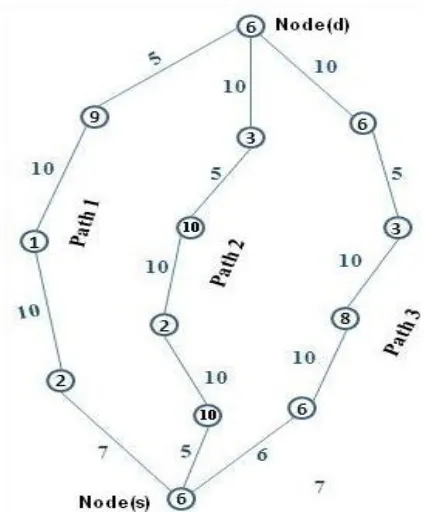
Figure 1. Remaining power of each node, and data transmission cost between nodes
3. PROPOSED METHOD
In our proposed method we use three main factors to select a path. These factors are the cost of energy, the amount of remaining power of the nodes in a route, and the standard deviation of the remaining power in a route. Consideration of these three factors leads to a reasonable judgment about which route to choose. Energy cost factor helps to know about the average amount of energy each route consumes to transfer data. So, less costly routes can be determined as more suitable routes.
The second factor, which is the remaining power of nodes, makes the process of routing more reasonable because of the fact that a less costly route in terms of energy is not always a better route, due to the power problem it may encounter.
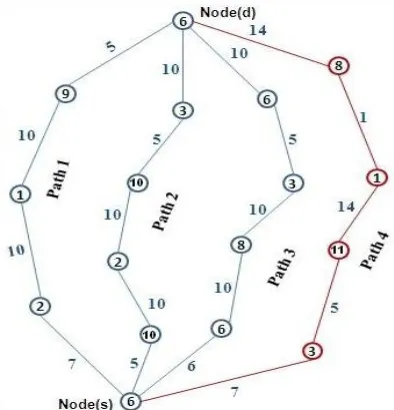
Figure 2. A forth path toward destination with different remaining powers and transmission costs
3. 1. How It Works Energy cost of a path is calculated as follow:
EC#X =∑i,j∈Path XECi,j (1)
in which EC#X represents the total energy cost of pathx,
and Ci,j is the cost of data transmission between nodei
and nodej, while nodei and nodej are two adjacent
nodes. The path cost shows the amount of energy consumed while data transmission in pathx. The second
factor to be taken into the consideration is the level of remaining power. So, we add this factor to formula (i) in such a way that it considers the remaining power as well.
LocC#X =∑ , ∈ ℎ ,
(2)
where LocCi, is the Local cost of using pathX to transmit
data between nodei and nodej. The word local implicates
that the calculated value has not considered the entire network condition which will be discussed later. RPi means the remaining power of nodei. By applying this
formula, lower remaining power brings about higher path cost. The standard deviation of remaining power of each path will be calculated separately.
=
∑ ( − )
where:
=
∑ (3)
We have altered standard deviation formula in a way that it compares each node in a path with the average remaining power of the whole network. To achieve this
goal we use average remaining power of the whole network in the above formula instead of average remaining power of only participating nodes in a path. In the formula [3] , nlocal is the number of nodes in a
path, while Nglobal is the number of nodes in the entire
network. This standard deviation helps determine in which path the power is distributed more evenly in comparison with the entire network. Considering later routings, this metric helps to determine a path which is closer to the network remaining power condition, and hence, helps keep the network homogenous. So, the total cost of a path is calculated as follows:
= × (4)
Selected Path = Min(Set) , where Set is the set
of total costs of all possible paths (5)
The proposed method is compared with a current technique, named as DEARP [16]. The authors have proposed DEARP method which considers only energy cost of data transmission between nodes in a path [16]. Numerical example shows how our proposed method outperforms DEARP, and why LEBRP selected routes are better than those of DEARP.
4. NUMERICAL EXAMPLE
In Figure 1, nodes and noded are two nodes in the
networks with a lot of nodes in between. If nodes wants
to send some information to noded, it should choose one
of three possible paths to noded. the figure also shows
the remaining power of each node, and the energy cost between each pair of nodes.
We apply our routing method on it to see which path is the best one to use. Regarding formula [1], energy cost of each path is calculated as follows:
ECpath 1 = 5 + 10 + 10 + 5 = 30
ECpath 2 = 5 + 10 + 10 + 5 + 10 = 40
ECpath 3 = 6 + 10 + 10 + 5 + 10 = 41
The remaining power of each path is calculated as RP#X
= ∑, ∈ , . So, the remaining power of each
path is as follows:
RPpath1 = 6 + 2 + 1 + 9 = 18
RPpath2 = 6 + 10 + 2 + 10 + 3 = 31
RPpath3 = 6 + 6 + 8 + 3 + 6 = 29
Now, according to formula [2], the LocC of each path is as follows:
LocC path1 = 5/6 + 10/2 + 10/1 + 5/9 = 16.39
LocC path1 = 5/6 + 10/10 + 10/2 + 5/10 + 10/3 = 10.67
TABLE 1. Parameters of different routes in the network
Energy Cost (DEARP) AVG.RP LocC TotC (LEBRP)
Path 1 30 18/4 = 4.5 16.39 √ / = 1.73 25.40
Path 2 40 31/5 = 6.2 10.67 √ ./ = 1.70 16.53
Path 3 41 29/5 = 5.8 7.25 √. ⁄ = 1.14 7.54
TABLE 2. Parameters of Path 4 in comparison with path 3
Energy Cost (DEARP) AVG.RP LocC TotC (LEBRP)
Path 3 41 29/5 = 5.8 7.25 √. ⁄ = 1.14 7.54
Path 4 41 29/5 = 5.8 6.84 √ ./ = 1.76 12.03
Supposing the whole network average power equals 5.5, standard deviation will also be calculated according to formula [3].
SDPath1= ( (6−5.5) + (5.5−2) + (5.5−1) + (9−5.5) )
SDPath2=
( (6−5.5) + (10−5.5) + (10−5.5) + (5.5−5) + (10−5.5) )
SDPath3=
( (6−5.5) + (6−5.5) + (8−5.5) + (5.5−3) + (6−5.5) )
Table 1 summarizes these calculations. AVG.RP means the average remaining power of the path. As it is shown in Table 1, path 3 has a total cost much bigger than path1. So, DEARP chooses path 1 for data transmission, but our proposed protocol, LEBRP, chooses path 3, due to the smaller TotC value. This is logical, since although path 1 has a smaller energy cost, but the third node of the path will soon run out of energy since it has a low amount of remaining energy, but the path cost between it and the next node is very high. So, the path chain will soon tear apart and transmission by DEARP protocol will be interrupted. In other words, the remaining powers of nodes are not proportional to the transmission costs of node pairs. This case happens also for Path 2 in a milder case. Hence, although the remaining power of Path 2 is bigger than that of Path 3, and its energy cost is lower than Path 3, but in our protocol Path 2 has lower priority than Path 3, because there is a better power distribution in accordance with power costs in Path 3. So, LEBRP chooses Path 3 while DEARP chooses Path 2 which results in a heterogeneous network in terms of remaining power of nodes.
It should be mentioned that if there was another fourth path like what is shown in Figure 2, it would lose the competition since it has an inappropriate value,
although its EC and its remaining power is totally equal to Path3 and even its LocC value is smaller than Path3.
This preference is logical, since in a network which the average remaining power is 5.5, it is not advisable to use low power energy nodes such as second and fourth nodes in the path. As it is noticeable, the presented protocol chooses routes in a way that the network will not suffer from sudden drainage of a node in next routings. Consideration of multiple criteria has led to a longer network lifetime.
5. CONCLUSION
network a heterogeneous network in terms of energy. Such a network will never encounter the problem of sudden drainage of a node when the average remaining power of the network is in an acceptable level. Moreover, the presented protocol does not impose a high computational load on the network and is suitable for energy constrained networks.
6. REFERENCE
1. Tarannum, S., Aravinda, B., Nalini, L., Venugopal, K. and Patnaik, L., "Routing protocol for lifetime maximization of wireless sensor networks", in Advanced Computing and Communications, 2006. ADCOM International Conference on, IEEE. (2006), 401-406.
2. Ok, C., Mitra, P., Lee, S. and Kumara, S., "Distributed energy-adaptive routing for wireless sensor networks", in Automation Science and Engineering, CASE, IEEE International Conference on, IEEE. (2007), 905-910.
3. Luo, Y., xu, Y., Huang, l. and Xu, H., A tracking range based ant-colony routing protocol for mobile wireless sensor network, in 4th International Conference on Mobile Ad-hoc and Sensor Networks., IEEE Computer Society. (2008), 116-121.
4. Takahashi, D., Hong, X. and Xiao, Y., "On-demand anonymous routing with distance vector protecting traffic privacy in wireless multi-hop networks", in Mobile Ad-hoc and Sensor Networks, The 4th International Conference on, IEEE. (2008), 145-151. 5. Chilamkurti, N., Zeadally, S., Vasilakos, A. and Sharma, V.,
"Cross-layer support for energy efficient routing in wireless sensor networks", Journal of Sensors, (2009).
6. Chiaraviglio, L., Mellia, M. and Neri, F., "Reducing power consumption in backbone networks", in Communications, 2009. ICC'09. IEEE International Conference on, IEEE. (2009), 1-6.
7. Gelenbe, E. and Silvestri, S., "Reducing power consumption in wired networks", in Computer and Information Sciences, 24th International Symposium on, IEEE. (2009), 292-297.
8. Gelenbe, E. and Mahmoodi, T., "Energy-aware routing in the cognitive packet network", in ENERGY 2011, The First International Conference on Smart Grids, Green Communications and IT Energy-aware Technologies. (2011), 7-12.
9. Gupta, M. and Singh, S., "Greening of the internet", in Proceedings of the 2003 conference on Applications, technologies, architectures, and protocols for computer communications, ACM. (2003), 19-26.
10. Lent, R., "Simulating the power consumption of computer networks", in Computer Aided Modeling, Analysis and Design of Communication Links and Networks (CAMAD), 15th IEEE International Workshop on, IEEE. (2010), 96-100.
11. Nedevschi, S., Popa, L., Iannaccone, G., Ratnasamy, S. and Wetherall, D., "Reducing network energy consumption via sleeping and rate-adaptation", in NSDI. Vol. 8, (2008), 323-336. 12. Gelenbe, E., "Steps toward self-aware networks",
Communications of the ACM, Vol. 52, No. 7, (2009), 66-75.
13. Panarello, C., Lombardo, A., Schembra, G., Chiaraviglio, L. and Mellia, M., "Energy saving and network performance: A trade-off approach", in Proceedings of the 1st International Conference on Energy-Efficient Computing and Networking, ACM. (2010), 41-50.
14. Zhao, H., Li, Y., Shen, J., Zhang, M., Zheng, R., and Wu, Q., "A new secure geographical routing protocol based on location pairwise keys in wireless sensor networks", (2013).
15. Taruna, S. and Tiwari, M. R., "Event driven hierarchical cluster based routing protocol for wireless sensor network",
International Journal, Vol. 3, No. 4, (2013).
16. Chandane, M., Bhirud, S. and Bonde, S., "Distributed energy aware routing protocol for wireless sensor network",
International Journal of Computer Applications, Vol. 34, No.
LEBRP- A Lightweight and Energy Balancing Routing Protocol for
Energy-constrained Wireless Ad Hoc Networks
S. R. Taghizadeh, S. Mohammadi
IT Department, K.N.Toosi University of Technology, Tehran, Iran
P A P E R I N F O
Paper history: Received 30 April 2013
Received in revised form 31 May 2013 Accepted 22 August 2013
Keywords: Ad-hoc Network Routing Protocol Energy Balancing Wireless Network هﺪﯿﮑﭼ ﻪﮑﺒﺷ ﯽﺑ ﻢﯿﺳ كﺎﻫدا ﻪﺑ ﻪﻧﻮﮔ ﯽﺻﺎﺧ زا ﻪﮑﺒﺷ يﺎﻫ ﯽﺑ ﻢﯿﺳ ﻪﺘﻔﮔ ﯽﻣ دﻮﺷ ﻪﮐ رد نآ ﺎﻫ ﻪﻤﻫ هﺮﮔ يﺎﻫ ﻪﮑﺒﺷ ياراد ﻪﻋﻮﻤﺠﻣ ﻤﻧاﻮﺗ ﻨ يﺪ يﺎﻫ نﺎﺴﮑﯾ رد ﻪﮑﺒﺷ ﻪﺑو ترﻮﺻ ﺮﯿﻈﻧ ﻪﺑ ﺮﯿﻈﻧ ﯽﻣ ﺪﻨﺷﺎﺑ . ﻦﯾا هﺮﮔ ﺎﻫ ياراد ناﻮﺗ را ﺗ طﺎﺒ ﺎﺑ ﺮﮕﯾﺪﮕﯾ و ﻦﯿﻨﭽﻤﻫ طﺎﺒﺗرا ﺎﺑ ﺮﯾﺎﺳ ياﺰﺟا ﻪﮑﺒﺷ يﺎﻫ روﺎﺠﻣ ﯽﻣ ﺪﻨﺷﺎﺑ . ﺎﻣا ﻪﭽﻧﺎﻨﭼ ﺖﻌﯿﺒﻃ ﻦﯾا ﻪﻧﻮﮔ ﻪﮑﺒﺷ ﺎﻫ ﺎﻀﺘﻗا ﯽﻣ ﺪﻨﮐ ، ﻪﺑ ﻞﯿﻟد ﯽﯾﺎﻧاﻮﺗ رﺎﯿﺳ ندﻮﺑ ،هﺮﮔ ﻦﯾا ﻪﮑﺒﺷ ﺎﻫ ًﻻﻮﻤﻌﻣ ﻪﺑ ﻊﺒﻨﻣ ﻪﯾﺬﻐﺗ ﯽﺟرﺎﺧ ﻞﺼﺘﻣ هدﻮﺒﻧ و ﺮﻫ هﺮﮔ ياراد ﻊﺒﻨﻣ يژﺮﻧا ﯽﻧورد يدوﺪﺤﻣ ﯽﻣ ﺪﺷﺎﺑ . رد ﻦﯾا ﻪﻟﺎﻘﻣ ﻞﮑﺗوﺮﭘ ﯽﺑﺎﯾﺮﯿﺴﻣ ﯽﮑﺒﺳ ار ياﺮﺑ ﻪﮑﺒﺷ يﺎﻫ ياراد ﺖﯾدوﺪﺤﻣ يژﺮﻧا ﻪﺋارا هدﻮﻤﻧ ﻢﯾا ﻪﮐ ياﺮﺑ ﯽﺑﺎﯾﺮﯿﺴﻣ رد ﻪﮑﺒﺷ يﺎﻫرﻮﺘﮐﺎﻓ يدﺪﻌﺘﻣ نﻮﭽﻤﻫ ناﺰﯿﻣ يژﺮﻧا ﯽﻗﺎﺑ هﺪﻧﺎﻣ هﺮﮔ ﺎﻫ ار رد ﺮﻈﻧ ﯽﻣ دﺮﯿﮔ . ﺑﻪ هوﻼﻋ ﻞﻣﺎﻋ يﺎﻫ يﺮﮕﯾد ﺪﻨﻧﺎﻤﻫ ﺖﺒﺴﻧ يژﺮﻧا ﯽﻗﺎﺑ هﺪﻧﺎﻣ ﮏﯾ هﺮﮔ ﻪﺑ ﻪﻠﺻﺎﻓ نآ هﺮﮔ ﺎﺗ هﺮﮔ يﺪﻌﺑ رد ،ﺮﯿﺴﻣ و ﻦﯿﻨﭽﻤﻫ ﺖﺒﺴﻧ يِژﺮﻧا ﯽﻗﺎﺑ هﺪﻧﺎﻣ ﮏﯾ هﺮﮔ ﻪﺑ ﻂﺳﻮﺘﻣ يژﺮﻧا ﯽﻗﺎﺑ هﺪﻧﺎﻣ رد ﻞﮐ ﻪﮑﺒﺷ ار رد ﻢﯿﻤﺼﺗ يﺮﯿﮔ طﻮﺑﺮﻣ ﻪﺑ ﯽﺑﺎﯾﺮﯿﺴﻣ ﻞﯿﺧد هدﻮﻤﻧ ﻢﯾا . فﺪﻫ ﯽﻠﺻا ﻦﯾا ،ﻞﮑﺗوﺮﭘ ﯽﺑﺎﯾﺮﯿﺴﻣ ﻪﺑ ﻪﻧﻮﮔ يا ﯽﻣ ﺪﺷﺎﺑ ﻪﮐ ﻞﮐ ﻪﮑﺒﺷ زا ظﺎﺤﻟ ناﺰﯿﻣ يژﺮﻧا ﯽﻗﺎﺑ هﺪﻧﺎﻣ ياراد ﮏﯾ ﯽﮕﭼرﺎﭘ و نزاﻮﺗ ﺪﺷﺎﺑ . ﻦﯾا ﮏﯾ ﯽﮕﭼرﺎﭘ و نزاﻮﺗ يژﺮﻧا ًﺎﺘﯾﺎﻬﻧ ﺮﺠﻨﻣ ﻪﺑ ﺶﯾاﺰﻓا ﺮﻤﻋ ﻪﮑﺒﺷ ﺪﻫاﻮﺧ ﺪﺷ . ﺑﻪ هوﻼﻋ ، يورﺮﺑﯽﺗﺎﺒﺳﺎﺤﻣﻦﯿﮕﻨﺳرﺎﺑﻞﯿﻤﺤﺗزاﻞﮑﺗوﺮﭘﻦﯾا
ﻪﮑﺒﺷرد هدﺎﻔﺘﺳاياﺮﺑﻞﯿﻟدﻦﯿﻤﻫﻪﺑوهدﺮﮐيراددﻮﺧﻪﮑﺒﺷ ﺪﯿﻔﻣﯽﺗﺎﺒﺳﺎﺤﻣﺖﯾدوﺪﺤﻣوﻊﺑﺎﻨﻣﻦﯾدوﺪﺤﻣياراد يﺎﻫ