A Monthly Double-Blind Peer Reviewed (Refereed/Juried) Open Access International e-Journal - Included in the International Serial Directories Indexed & Listed at:
VOLUME NO.3(2013),ISSUE NO.10(OCTOBER) ISSN 2231-5756
INTERNATIONAL JOURNAL OF RESEARCH IN COMMERCE, IT & MANAGEMENT
CONTENTS
CONTENTS
CONTENTS
CONTENTS
Sr.
No.
TITLE & NAME OF THE AUTHOR (S)
Page No. 1. MACHINE USAGE BASED ON PRODUCT MIX IN MANUFACTURING CLASSIFICATIONS
DR. SURESH TULSHIRAM SALUNKE & SHWETA SURESH TULSHIRAM SALUNKE
1
2. A STUDY ON THE CHALLENGES FACED BY TIRUPUR GARMENT EXPORTERS
DR. S. SARANANAN & S. MOHANRAJ
5
3. HEALTHCARE AND MEDICAL TOURISM: RETROSPECT AND PROSPECT
R. VEERAPPAN, J. SASIGANTH, FR. ANGELO JOSEPH & A. JOE ROBINSON
8
4. TRADE BETWEEN INDIA AND ASEAN COUNTRIES FOR AGRICULTURAL AND MINERAL PRODUCTS: EXPLORING COMPATIBILITY THROUGH REVEALED COMPARATIVE ADVANTAGE
DR. B. P. SARATH CHANDRAN
11
5. RELEVANCE OF ISLAMIC BANKING TO INDIAN ECONOMY
S. NAYAMATH BASHA & DR. BADIUDDIN AHMED
17
6. AXIOMATIZATION OF THE PREFERENCE CORE IN MULTICRITERIA COOPERATIVE GAMES
A. SUGUMARAN & P. VISHNU PRAKASH
21
7. CORPORATE GOVERNANCE & INFORMATION SECURITY: AN ANALYTICAL STUDY
DR. BADIUDDIN AHMED, SYED HAMID MOHIUDDIN QUADRI & IRFANUDDIN
25
8. RUPEE FALLING: DOLLAR IS ON HORSE RIDE
M. RAMU, M. S. K. VARMA & S.SUDHEER
28
9. AN ANALYSIS OF INDIAN AUTOMOBILE INDUSTRY: SLOWDOWN AS AN OPPORTUNITY FOR NEW DEVELOPMENT
DR. ANKUR KUMAR RASTOGI & NITIN GOPAL GUPTA
36
10. A PROPOSED THEORY OF NEURAL NETWORKS IN KNOWLEDGE MANAGEMENT FOR AN EXPERT SYSTEM
V. SUMALATHA
41
11. THE INFORMATION MANAGEMENT PRACTICES OF BHIRDAR UNIVERSITY
DR. MATEBE TAFERE
45
12. VEBLENIAN SOCIO-PSYCHOLOGICAL MODEL: AN ETHNOGRAPHIC STUDY
DR. K. ABRAHAM & DR. M. RAJASEKHAR
51
13. INNOVATIVE TEACHING AND LEARNING TO ENHANCE CRITICAL THINKING AND REFLECTIVE PRACTICE, FOR QUALITY AND RELEVANCE OF HEALTH EDUCATION
DR. BIRHANU MOGES ALEMU
56
14. A STATISTICAL ANALYSIS OF PHYSICALLY DISABLED POPULATION: DEVELOPMENT IN REHABILITATION SCHEMES
DR. CHINNA ASHAPPA
68
15. USE OF E-JOURNALS IN THE DISCIPLINES OF LIFE SCIENCE IN K.U.K: AN ANALYTICAL STUDY
ANIL KUMAR
72
16. ISLAMIC MICROFINANCE-FINANCING THE POOREST OF THE POOR
DILAWAR AHMAD BHAT
79
17. USE OF CLOUD COMPUTING IN MANUFACTURING COMPANIES
SHEETAL MAHENDHER & SUBASHREE
83
18. CLIMATE CHANGE AND VECTOR BORNE DISEASES: THE ROLE OF GIS & REMOTE SENSING
DIVYA GEORGE & DR. R. RAJKUMAR
88
19. FEASIBILITY STUDY FOR IMPLEMENTATION OF AN ACTIVITY- BASED COSTING SYSTEM (ABCS) IN ALLOY STEEL INDUSTRIES (ASI)
MAJID NILI AHMADABADI & ALI SOLEIMANI
96
20. AN IMPACT OF SERVICE QUALITY ON LOYAL CUSTOMER AND ITS SATISFACTION: A STUDY OF PRIVATE BANKS IN KANPUR CITY (INDIA)
RAVINDRA KUMAR KUSHWAHA, GURPREET SINGH, NEERAJ JOSHI & NEHA PUSHPAK
101
21. A STUDY ON EMPLOYEE PERFORMANCE APPRAISAL IN CEMENT INDUSTRY IN TAMILNADU
DR. M. RAGURAMAN, R. VEERAPPAN, S. ALBERT, M. SUGANYA & S. HEMAVATHY
107
22. DETERMINANTS OF MOBILE BANKING TECHNOLOGY ADOPTION OF COMMERCIAL BANKS IN ETHIOPIA
ZEMENU AYNADIS, TESFAYE ABATE & ABEBE TILAHUN
110
23. EVALUATION OF LIC’S EFFICIENCY IN GENERATING CAPITAL FUNDS UNDER ULIP’S SCHEMES
MANJUSHREE S
117
24. EVALUATION OF COST MANAGEMENT TOOLS: A STUDY ON MULTINATIONAL PHARMACEUTICAL COMPANIES OF BANGLADESH
TAHMINA AHMED
120
25. AN EVALUATION OF NEW ZEALAND’S EXPORT COMPETITIVENESS USING SHIFT-SHARE ANALYSIS
DR. SATYA GONUGUNTLA
126
26. INCREASING INTERNATIONAL COLLABORATIONS IN SCIENCE AND TECHNOLOGY AROUND THE WORLD, AND ITS PATTERNS IN INDIA WITH SPECIAL REFERENCE TO INDO-GERMAN COLLABORATION
MUNEEB HUSSAIN GATTOO & MUJEEB HUSSAIN GATTOO
131
27. A STUDY ON THE ETHICAL INVESTMENT DECISION MAKING IN INDIAN RELIGIOUS ORGANISATIONS
BINCY BABURAJ KALUVILLA
135
28. GREEN MARKETING MIX: A STRATEGY FOR SUSTAINABLE DEVELOPMENT
L. NANDA GOPAL
138
29. CONSIDERING RELATIONSHIP BETWEEN CASH WITH CAPITAL COST AND FINANCIAL FLEXIBILITY
AHMAD GHASEMI & DR. ROYA DARABI
140
30. UNDERSTANDING THE GREEKS AND THEIR USE TO MEASURE RISK
SANJANA JUNEJA
146
CHIEF PATRON
CHIEF PATRON
CHIEF PATRON
CHIEF PATRON
PROF. K. K. AGGARWAL
Chairman, Malaviya National Institute of Technology, Jaipur
(An institute of National Importance & fully funded by Ministry of Human Resource Development, Government of India)
Chancellor, K. R. Mangalam University, Gurgaon
Chancellor, Lingaya’s University, Faridabad
Founder Vice-Chancellor (1998-2008), Guru Gobind Singh Indraprastha University, Delhi
Ex. Pro Vice-Chancellor, Guru Jambheshwar University, Hisar
FOUNDER
FOUNDER
FOUNDER
FOUNDER PATRON
PATRON
PATRON
PATRON
LATE SH. RAM BHAJAN AGGARWAL
Former State Minister for Home & Tourism, Government of Haryana
Former Vice-President, Dadri Education Society, Charkhi Dadri
Former President, Chinar Syntex Ltd. (Textile Mills), Bhiwani
CO
CO
CO
CO----ORDINATOR
ORDINATOR
ORDINATOR
ORDINATOR
AMITA
Faculty, Government M. S., Mohali
ADVISORS
ADVISORS
ADVISORS
ADVISORS
DR. PRIYA RANJAN TRIVEDI
Chancellor, The Global Open University, Nagaland
PROF. M. S. SENAM RAJU
Director A. C. D., School of Management Studies, I.G.N.O.U., New Delhi
PROF. M. N. SHARMA
Chairman, M.B.A., Haryana College of Technology & Management, Kaithal
PROF. S. L. MAHANDRU
Principal (Retd.), Maharaja Agrasen College, Jagadhri
EDITOR
EDITOR
EDITOR
EDITOR
PROF. R. K. SHARMA
Professor, Bharti Vidyapeeth University Institute of Management & Research, New Delhi
CO
CO
CO
CO----EDITOR
EDITOR
EDITOR
EDITOR
DR. BHAVET
Faculty, Shree Ram Institute of Business & Management, Urjani
EDITORIAL ADVISORY BOARD
EDITORIAL ADVISORY BOARD
EDITORIAL ADVISORY BOARD
EDITORIAL ADVISORY BOARD
DR. RAJESH MODI
Faculty, Yanbu Industrial College, Kingdom of Saudi Arabia
PROF. SANJIV MITTAL
University School of Management Studies, Guru Gobind Singh I. P. University, Delhi
PROF. ANIL K. SAINI
VOLUME NO.3(2013),ISSUE NO.10(OCTOBER) ISSN 2231-5756
INTERNATIONAL JOURNAL OF RESEARCH IN COMMERCE, IT & MANAGEMENT
DR. SAMBHAVNA
Faculty, I.I.T.M., Delhi
DR. MOHENDER KUMAR GUPTA
Associate Professor, P. J. L. N. Government College, Faridabad
DR. SHIVAKUMAR DEENE
Asst. Professor, Dept. of Commerce, School of Business Studies, Central University of Karnataka, Gulbarga
ASSOCIATE EDITORS
ASSOCIATE EDITORS
ASSOCIATE EDITORS
ASSOCIATE EDITORS
PROF. NAWAB ALI KHAN
Department of Commerce, Aligarh Muslim University, Aligarh, U.P.
PROF. ABHAY BANSAL
Head, Department of Information Technology, Amity School of Engineering & Technology, Amity
University, Noida
PROF. A. SURYANARAYANA
Department of Business Management, Osmania University, Hyderabad
DR. SAMBHAV GARG
Faculty, Shree Ram Institute of Business & Management, Urjani
PROF. V. SELVAM
SSL, VIT University, Vellore
DR. PARDEEP AHLAWAT
Associate Professor, Institute of Management Studies & Research, Maharshi Dayanand University, Rohtak
DR. S. TABASSUM SULTANA
Associate Professor, Department of Business Management, Matrusri Institute of P.G. Studies, Hyderabad
SURJEET SINGH
Asst. Professor, Department of Computer Science, G. M. N. (P.G.) College, Ambala Cantt.
TECHNICAL ADVISOR
TECHNICAL ADVISOR
TECHNICAL ADVISOR
TECHNICAL ADVISOR
AMITA
Faculty, Government M. S., Mohali
FINANCIAL ADVISORS
FINANCIAL ADVISORS
FINANCIAL ADVISORS
FINANCIAL ADVISORS
DICKIN GOYAL
Advocate & Tax Adviser, Panchkula
NEENA
Investment Consultant, Chambaghat, Solan, Himachal Pradesh
LEGAL ADVISORS
LEGAL ADVISORS
LEGAL ADVISORS
LEGAL ADVISORS
JITENDER S. CHAHAL
Advocate, Punjab & Haryana High Court, Chandigarh U.T.
CHANDER BHUSHAN SHARMA
Advocate & Consultant, District Courts, Yamunanagar at Jagadhri
SUPERINTENDENT
SUPERINTENDENT
SUPERINTENDENT
SUPERINTENDENT
CALL FOR MANUSCRIPTS
CALL FOR MANUSCRIPTS
CALL FOR MANUSCRIPTS
CALL FOR MANUSCRIPTS
We invite unpublished novel, original, empirical and high quality research work pertaining to recent developments & practices in the areas of Computer Science & Applications; Commerce; Business; Finance; Marketing; Human Resource Management; General Management; Banking; Economics; Tourism Administration & Management; Education; Law; Library & Information Science; Defence & Strategic Studies; Electronic Science; Corporate Governance; Industrial Relations; and emerging paradigms in allied subjects like Accounting; Accounting Information Systems; Accounting Theory & Practice; Auditing; Behavioral Accounting; Behavioral Economics; Corporate Finance; Cost Accounting; Econometrics; Economic Development; Economic History; Financial Institutions & Markets; Financial Services; Fiscal Policy; Government & Non Profit Accounting; Industrial Organization; International Economics & Trade; International Finance; Macro Economics; Micro Economics; Rural Economics; Co-operation; Demography: Development Planning; Development Studies; Applied Economics; Development Economics; Business Economics; Monetary Policy; Public Policy Economics; Real Estate; Regional Economics; Political Science; Continuing Education; Labour Welfare; Philosophy; Psychology; Sociology; Tax Accounting; Advertising & Promotion Management; Management Information Systems (MIS); Business Law; Public Responsibility & Ethics; Communication; Direct Marketing; E-Commerce; Global Business; Health Care Administration; Labour Relations & Human Resource Management; Marketing Research; Marketing Theory & Applications; Non-Profit Organizations; Office Administration/Management; Operations Research/Statistics; Organizational Behavior & Theory; Organizational Development; Production/Operations; International Relations; Human Rights & Duties; Public Administration; Population Studies; Purchasing/Materials Management; Retailing; Sales/Selling; Services; Small Business Entrepreneurship; Strategic Management Policy; Technology/Innovation; Tourism & Hospitality; Transportation Distribution; Algorithms; Artificial Intelligence; Compilers & Translation; Computer Aided Design (CAD); Computer Aided Manufacturing; Computer Graphics; Computer Organization & Architecture; Database Structures & Systems; Discrete Structures; Internet; Management Information Systems; Modeling & Simulation; Neural Systems/Neural Networks; Numerical Analysis/Scientific Computing; Object Oriented Programming; Operating Systems; Programming Languages; Robotics; Symbolic & Formal Logic; Web Design and emerging paradigms in allied subjects.
Anybody can submit the soft copy of unpublished novel; original; empirical and high quality research work/manuscriptanytime in M.S. Word format
after preparing the same as per our GUIDELINES FOR SUBMISSION; at our email address i.e. [email protected] or online by clicking the link online submission as given on our website (FOR ONLINE SUBMISSION, CLICK HERE).
GUIDELINES FOR SUBMISSION OF MANUSCRIPT
GUIDELINES FOR SUBMISSION OF MANUSCRIPT
GUIDELINES FOR SUBMISSION OF MANUSCRIPT
GUIDELINES FOR SUBMISSION OF MANUSCRIPT
1. COVERING LETTER FOR SUBMISSION:
DATED: _____________ THE EDITOR
IJRCM
Subject: SUBMISSION OF MANUSCRIPT IN THE AREA OF.
(e.g. Finance/Marketing/HRM/General Management/Economics/Psychology/Law/Computer/IT/Engineering/Mathematics/other, please specify)
DEAR SIR/MADAM
Please find my submission of manuscript entitled ‘___________________________________________’ for possible publication in your journals.
I hereby affirm that the contents of this manuscript are original. Furthermore, it has neither been published elsewhere in any language fully or partly, nor is it under review for publication elsewhere.
I affirm that all the author (s) have seen and agreed to the submitted version of the manuscript and their inclusion of name (s) as co-author (s).
Also, if my/our manuscript is accepted, I/We agree to comply with the formalities as given on the website of the journal & you are free to publish our contribution in any of your journals.
NAME OF CORRESPONDING AUTHOR: Designation:
Affiliation with full address, contact numbers & Pin Code: Residential address with Pin Code:
Mobile Number (s): Landline Number (s): E-mail Address: Alternate E-mail Address:
NOTES:
a) The whole manuscript is required to be in ONE MS WORD FILE only (pdf. version is liable to be rejected without any consideration), which will start from
the covering letter, inside the manuscript.
b) The sender is required to mentionthe following in the SUBJECT COLUMN of the mail:
New Manuscript for Review in the area of (Finance/Marketing/HRM/General Management/Economics/Psychology/Law/Computer/IT/ Engineering/Mathematics/other, please specify)
c) There is no need to give any text in the body of mail, except the cases where the author wishes to give any specific message w.r.t. to the manuscript. d) The total size of the file containing the manuscript is required to be below 500 KB.
e) Abstract alone will not be considered for review, and the author is required to submit the complete manuscript in the first instance.
f) The journal gives acknowledgement w.r.t. the receipt of every email and in case of non-receipt of acknowledgment from the journal, w.r.t. the submission
of manuscript, within two days of submission, the corresponding author is required to demand for the same by sending separate mail to the journal.
2. MANUSCRIPT TITLE: The title of the paper should be in a 12 point Calibri Font. It should be bold typed, centered and fully capitalised.
3. AUTHOR NAME (S) & AFFILIATIONS: The author (s) full name, designation, affiliation (s), address, mobile/landline numbers, and email/alternate email address should be in italic & 11-point Calibri Font. It must be centered underneath the title.
VOLUME NO.3(2013),ISSUE NO.10(OCTOBER) ISSN 2231-5756
INTERNATIONAL JOURNAL OF RESEARCH IN COMMERCE, IT & MANAGEMENT
5. KEYWORDS: Abstract must be followed by a list of keywords, subject to the maximum of five. These should be arranged in alphabetic order separated by commas and full stops at the end.
6. MANUSCRIPT: Manuscript must be in BRITISH ENGLISH prepared on a standard A4 size PORTRAIT SETTING PAPER. It must be prepared on a single space and single column with 1” margin set for top, bottom, left and right. It should be typed in 8 point Calibri Font with page numbers at the bottom and centre of every page. It should be free from grammatical, spelling and punctuation errors and must be thoroughly edited.
7. HEADINGS: All the headings should be in a 10 point Calibri Font. These must be bold-faced, aligned left and fully capitalised. Leave a blank line before each heading.
8. SUB-HEADINGS: All the sub-headings should be in a 8 point Calibri Font. These must be bold-faced, aligned left and fully capitalised.
9. MAIN TEXT: The main text should follow the following sequence:
INTRODUCTION
REVIEW OF LITERATURE
NEED/IMPORTANCE OF THE STUDY
STATEMENT OF THE PROBLEM
OBJECTIVES
HYPOTHESES
RESEARCH METHODOLOGY
RESULTS & DISCUSSION
FINDINGS
RECOMMENDATIONS/SUGGESTIONS
CONCLUSIONS
SCOPE FOR FURTHER RESEARCH
ACKNOWLEDGMENTS
REFERENCES
APPENDIX/ANNEXURE
It should be in a 8 point Calibri Font, single spaced and justified. The manuscript should preferably not exceed 5000 WORDS.
10. FIGURES &TABLES: These should be simple, crystal clear, centered, separately numbered & self explained, and titles must be above the table/figure. Sources of data should be mentioned below the table/figure. It should be ensured that the tables/figures are referred to from the main text.
11. EQUATIONS:These should be consecutively numbered in parentheses, horizontally centered with equation number placed at the right.
12. REFERENCES: The list of all references should be alphabetically arranged. The author (s) should mention only the actually utilised references in the preparation of manuscript and they are supposed to follow Harvard Style of Referencing. The author (s) are supposed to follow the references as per the following:
•
All works cited in the text (including sources for tables and figures) should be listed alphabetically.•
Use (ed.) for one editor, and (ed.s) for multiple editors.•
When listing two or more works by one author, use --- (20xx), such as after Kohl (1997), use --- (2001), etc, in chronologically ascending order.•
Indicate (opening and closing) page numbers for articles in journals and for chapters in books.•
The title of books and journals should be in italics. Double quotation marks are used for titles of journal articles, book chapters, dissertations, reports, workingpapers, unpublished material, etc.
•
For titles in a language other than English, provide an English translation in parentheses.•
The location of endnotes within the text should be indicated by superscript numbers.PLEASE USE THE FOLLOWING FOR STYLE AND PUNCTUATION IN REFERENCES: BOOKS
•
Bowersox, Donald J., Closs, David J., (1996), "Logistical Management." Tata McGraw, Hill, New Delhi.•
Hunker, H.L. and A.J. Wright (1963), "Factors of Industrial Location in Ohio" Ohio State University, Nigeria.CONTRIBUTIONS TO BOOKS
•
Sharma T., Kwatra, G. (2008) Effectiveness of Social Advertising: A Study of Selected Campaigns, Corporate Social Responsibility, Edited by David Crowther &Nicholas Capaldi, Ashgate Research Companion to Corporate Social Responsibility, Chapter 15, pp 287-303.
JOURNAL AND OTHER ARTICLES
•
Schemenner, R.W., Huber, J.C. and Cook, R.L. (1987), "Geographic Differences and the Location of New Manufacturing Facilities," Journal of Urban Economics,Vol. 21, No. 1, pp. 83-104.
CONFERENCE PAPERS
•
Garg, Sambhav (2011): "Business Ethics" Paper presented at the Annual International Conference for the All India Management Association, New Delhi, India,19–22 June.
UNPUBLISHED DISSERTATIONS AND THESES
•
Kumar S. (2011): "Customer Value: A Comparative Study of Rural and Urban Customers," Thesis, Kurukshetra University, Kurukshetra.ONLINE RESOURCES
•
Always indicate the date that the source was accessed, as online resources are frequently updated or removed.WEBSITES
EVALUATION OF LIC’S EFFICIENCY IN GENERATING CAPITAL FUNDS UNDER ULIP’S SCHEMES
MANJUSHREE S
LECTURER
DEPARTMENT OF COMMERCE
KUVEMPU UNIVERSITY
SHANKARAGHATTA
ABSTRACT
Globalization of the financial markets has lead to a manifold increase in the investment. New markets has opened new instruments has developed and new services have been launched. The purpose of financial market is to promote savings, investment and efficient allocation resources among the competing users. One of the principle aims of these markets is to provide crucial infrastructure for corporate to access community savings through a mix of debt and equity instruments. Various investment avenues are available in India but still Insurance is considered as one of the popular investment tool. Insurance is a flourishing industry in India, with several national and international players competing and growing at rapid rates. Thanks to reforms and easing of policy regulations, the Indian insurance sector been allowed to flourish, and as Indians become more familiar with different insurance products, this growth can only increase, with period from 2010 – 2015 projected to be the ‘Golden Age’ for the Indian insurance industry-. Therefore the present paper is an attempt to identify the reasons, why the investors still invest in ULIP’s offered by LIC. The scope of the present study is covered the urban areas as well most of the rural areas of Shivamogga city and Bhadravathi Town. Questionnaires were administered to receive the responses from the target group. Simple Chi-square test and Co-relation test is used for the analysis of the data.
KEYWORDS
Insurance regulatory, net asset value.
INTRODUCTION
ndian insurance companies offer a comprehensive range of insurance plans, a range that is growing as the economy matures and wealth of the middle classes increases. The most common type include: term life policies, joint life policies, endowment policies, whole life policies, loan cover term assurance policies, unit-linked insurance plans, group insurance policies, pension plans, and annuities. General insurance plans are also available to cover motor insurance, home insurance, travel insurance and health insurance. In Insurance industries, Life Insurance Corporation is only public sector and considered as the market with its good will and performance it is also providing above discussed products to the investors of medium, low as well as high level income people.
UNIT LINKED INSURANCE PRODUCTS
Unit linked insurance plan (ULIP) is life insurance solution that provides for the benefits of risk protection and flexibility in investment. A part of the premium paid is utilized to provide insurance cover to the policy holder while the remaining portion is invested in various equity and debt schemes. The money collected by the insurance provider is utilized to form a pool of fund that is used to invest in various markets instruments (debt and equity) in varying proportions just the way it is done for mutual funds.. Policy holders have the option of selecting the type of funds (debt or equity) or a mix of both based on their investment need and appetite. Just the way it is for mutual funds, ULIP policy holders are also allotted units and each unit has a net asset value (NAV) that is declared on a daily basis. The NAV is the value based on which the net rate of returns on ULIPs are determined. The NAV varies from one ULIP to another based on market conditions and the fund’s performance. In a ULIP, the invested amount of the premiums after deducting for all the charges and premium for risk cover under all policies in a particular fund as chosen by the policy holders are pooled together to form a Unit fund. A Unit is the component of the Fund in a Unit Linked Insurance Policy. ULIP play a major role in the Indian life insurance. the strength of the ULIP product that suit the psycho of Indian policyholder because Market linked return, Level of insurance protection, Option of asset diversification Management of fund on professional lines.
STATEMENT OF THE PROBLEM
The Indian life insurance industry has been on a roller-coaster ride in this past year and since financial services in general have been under tremendous pressure, the insurance industry has also witnessed its fair share of downfalls. Deterred due to the regulatory changes, low margins and lack of a policy road map, the life industry today is reeling under the effect of negative growth. The unabated inflation, recessionary trends and fall in industrial production have all had their impact on economy which has lead to the economy growth rate hovering at just about 7 per cent. Throughout the year, the stock markets witnessed violent swings, coupled with reduction in margins on account of new guidelines, which dented the performance of ULIPs. LIC is not except from this. But still when compare to the other private sector players performance of LIC is for better. Therefore the present paper is an attempt to identify the reasons, why the investors still invest in ULIP’s offered by LIC.
OBJECTIVES OF THE STUDY
To study why the investor prefer Life insurance sector especially LIC, to invest their savings and also to analyze the factors considered by the investors preferring the ULIP’s offered by LIC instead of preferring direct investments in stock markets. And to determine the policy reforms to ULIP’s by SEBI.
SCOPE OF THE STUDY
The scope of the present study is covered the urban areas as well most of the rural areas of Shivamogga city and Bhadravathi Town. Moreover in the present study only the various schemes of ULIP’s offered by LIC.
METHODS OF DATA COLLECTION
In order to reach above stated objectives the primary data is collected through questionnaire method and interaction with the respondents. Secondary data is collected through published sources like journals, Books and e-sources.
SAMPLING TECHNIQUE ADOPTED
For this study simple random sampling was is used and respondent groups had employees, housewives, Formers, business men of various income groups and also insurance advisors of LIC were selected randomly. Questionnaires were administered to receive the responses from the target group.
STATISTICAL TOOL USED FOR ANALYSIS
Simple Chi-square test and Co-relation test is used for the analysis of the data.
HYPOTHESIS OF THE STUDY
The researchers tried to identify the respondent’s opinion regarding few vital aspects concerning the stake holders in the studied segment. Hypothesis tested are,
VOLUME NO.3(2013),ISSUE NO.10(OCTOBER) ISSN 2231-5756
INTERNATIONAL JOURNAL OF RESEARCH IN COMMERCE, IT & MANAGEMENT
Ha0 : Income level, Savings, investment pattern of the people are not co-related.
Ha1 : Income level, Savings, investment pattern of the people are co-related.
Hb0 : Investor continue to hold investment in stock market.
Hb1 : Investor prefer to hold investment in capital market through ULIP’s by LIC.
Policy Reforms is another reason for investments in ULIP’s: ULIP’s with less than 10 Years
1. There is 3% cap on charges levied by the insurance companies on ULIP. It means, the total fees collected on ULIP premiums cannot exceed 3%. It is defined as difference between net yield and gross yield should not exceed 3%.
2. In the above 3%, the management fee cannot be more than 1.5%.
3. Gross yield is the yield generated by the ULIP before all charges are deducted. 4. Net yield is the generated by the ULIP after all charges are deducted.
ULIP with greater than 10 years
1. Over all fees cannot be more than 2.25%. 2. Management fees cannot be more than 1.25%.
• Charges here would include allocation charges, administration charges, mortality charges and all such charges by any other name. the total fees would reduce when you opt for the long term investment.
• Unit-linked insurance products (ULIPs) filled after September 30, 2009 will have a lock in five years.
• According to the IRDA, there will be new norms on tightening the commission and fees on ULIP products. It is trying hard to make the investment more attractive for the investors.
• The new norms will have the high life cover; in the existing policies have the high focus on the investment rather than the protection on life. IRDA want to bring more clarity on the life cover and investment portion on the same product. These make investor to clearly understand how much is invested and how much is insured.
• In order to put more money in the hands of investors, IRDA recently said that insurers cannot charge a fee for surrendering the policy even after the completion of the lock-in period.
DATA ANALYSIS AND INTERPRETATION
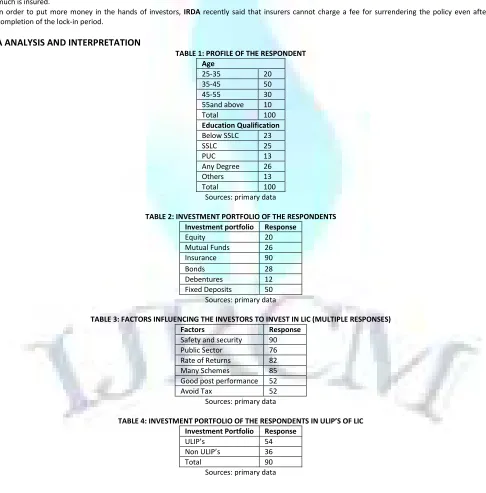
TABLE 1: PROFILE OF THE RESPONDENT Age
25-35 20 35-45 50 45-55 30 55and above 10 Total 100
Education Qualification
Below SSLC 23 SSLC 25 PUC 13 Any Degree 26 Others 13 Total 100
Sources: primary data
TABLE 2: INVESTMENT PORTFOLIO OF THE RESPONDENTS Investment portfolio Response
Equity 20 Mutual Funds 26 Insurance 90 Bonds 28 Debentures 12 Fixed Deposits 50 Sources: primary data
TABLE 3: FACTORS INFLUENCING THE INVESTORS TO INVEST IN LIC (MULTIPLE RESPONSES) Factors Response
Safety and security 90 Public Sector 76 Rate of Returns 82 Many Schemes 85 Good post performance 52 Avoid Tax 52 Sources: primary data
TABLE 4: INVESTMENT PORTFOLIO OF THE RESPONDENTS IN ULIP’S OF LIC Investment Portfolio Response
TABLE 5: RATIONAL BEHIND INVESTMENT IN ULIP’S OFFERED BY LIC (MULTIPLE RESPONSES) Reasons Response
Save Tax 55 Liquidity 42 High Returns 78 Dual Benefits 75 Investment in capital market 80
Sources:primary data
The above five tables clearly shows the demographic factors of the respondents and their income level, savings and their investment preference and also the reasons behind the selection of investment avenues and reason behind investment in LIC and ULIP’s offered by LIC.
TABLE 6: CALCULATION OF CO-EFFICIENT TO KNOW WHETHER SAVINGS AND INVESTMENT, INCOME ARE CO-RELATED C-I X y dx=x-a Dy=x-b dx2 dy2 dxdy
Below 50000 45 43 43 39 1849 1521 1677 50000-150000 33 12 31 08 961 64 248 150000-300000 18 30 16 26 256 676 416 300000-500000 2 11 0 07 0 0 0 Above 500000 2 04 0 0 0 0 0
Total 100 100 90 80 3066 2261 2341 Hao: Income level, Savings, investment pattern of the people are not co-related.
Hal: Income level, Savings, investment pattern of the people are co-related
Let Income will be the class intervals, savings is taken as ‘x’, Investment is taken as ‘y’, calculated co-relation co-efficient value is 0.1974. Therefore it is positive co-relation. Therefore the null hypothesis is rejected and alternative hypothesis is accepted. Here can conclude that income levels, Savings, investment pattern of the people are co-related.
TABLE 7: OPINION OF THE INVESTOR REGARDING HOLDING INVESTMENT
Reasons Safety and Security Direct Transaction Liquidity Dual Benefit Total
ULIPs by LIC 20 0 0 46 66
Stock Markets 0 14 20 0 34
Total 20 14 20 46 100
Sources:primary data
Hbo: Investor continue to hold Investment in Stock market
Hbl: Investor prefer to hold Investment in capital market through ULIP’s by LIC
Chi-square calculated value is 83.96. For 3 degrees of freedom Chi-square tale value for 1% and 5% level of significance is 11.341 and 7.815. The calculated value is more than the tables value therefore the null hypothesis is rejected and alternate hypothesis is accepted. So that we can conclude that, Investor prefers to hold investment in capital market through ULIP’s by LIC. For the reason it is providing dual benefits like coveras well as returns and investment in capital market. At the same time LIC’s good will and market share also made the investor to invest in ULIP’s offered by LIC.
CONCLUSION
ULIP’s are considered as a tool by the investors to invest in capital market. Especially they prefer ULIP’s offered by LIC because they feel that LIC is safer place for investment and also they are getting dual benefits like insurance as well as high returns. But still the risk is more due to the investment made in ULIP’s are directly invested in markets. And investment is depended on the net asset value of the stock in which the fund is invested. Due to economic slowdown the short term investor of ULIP’s are suffered a lot but long term investors are not affected from the downsizing. Therefore the investor must concentrate on these issues while selecting the ULIP products; they must use this as a tool for investment in insurance, but also for investment in stock markets. Moreover the SEBI has been given new policy reforms to the insurance companies in selling the ULIP products which reduces the charges like Initial administration charge, Regular administration charges, Policy administration fee, Investment management charge etc. This helped investors to invest in ULIP’s.
REFERENCES
ARTICLES
1. C.V Nageshwara Rao(2011), “Rough Patch for Life Insurance Industry”, Mon, Dec 26, www.indianexpress.com 2. DK Mehrotrs, MD, LIC(2008), “Catching the ULIP Bus”, Insurance Chronicle May
3. KeithTimini (2010), “The Indian Insurance Industry”, www.economywatch.com. 4. Nani Javeri,(2007), “The World is Moving Towards ULIPs”, Insurance Chronicle January
5. Partha Prathim Sengupta, (2011),” Efficiency Measurement of Indian Life Insurance Industry in Post Reforms Era” , Global Business Review, October, Vol No 12, No.3
WEBSITES
VOLUME NO.3(2013),ISSUE NO.10(OCTOBER) ISSN 2231-5756
INTERNATIONAL JOURNAL OF RESEARCH IN COMMERCE, IT & MANAGEMENT
REQUEST FOR FEEDBACK
Dear Readers
At the very outset, International Journal of Research in Commerce, IT and Management (IJRCM)
acknowledges & appreciates your efforts in showing interest in our present issue under your kind perusal.
I would like to request you to supply your critical comments and suggestions about the material published
in this issue as well as on the journal as a whole, on our E-mail i.e.
for further
improvements in the interest of research.
If you have any queries please feel free to contact us on our E-mail
.
I am sure that your feedback and deliberations would make future issues better – a result of our joint
effort.
Looking forward an appropriate consideration.
With sincere regards
Thanking you profoundly
Academically yours
Sd/-