13th International Conference
ALT-C 2006
5–7 September 2006
Heriot-Watt University, Edinburgh, Scotland, UK
ALT-C 2006: The next generation
Research Proceedings
Edited by Denise Whitelock and Steve Wheeler
Acknowledgement
The editors would like to thank Jamie Shaw for his work in sub-editing and setting these Research Proceedings.
ALT gives permission for authors to reproduce and distribute their own work on the understanding that the origins of the publication are fully acknowledged. Please use the following format for referencing when you distribute it:
Your name (2006). Your paper title. In Whitelock, D. & Wheeler, S. (Eds). The next generation. Research Proceedings of the 13th Association for Learning Technology Conference (ALT-C 2006).
Held 5–7 September 2006, Heriot-Watt University, Scotland, UK.
Published September 2006 by the Association for Learning Technology
© 2006 The Association for Learning Technology
www.alt.ac.uk
ISBN 0-9545870-5-7
Production editing: Rhonda Riachi, ALT
Contents
Index of authors iii
Editorial iv
Part 1: Next Generation Learning
Successful learning or failing premise? A situated evaluation of 1 a virtual learning environment
Mrs Alison Iredale
Mismatched expectations of staff and students towards Blackboard 11
Miss Elisabeth Yaneske, Andrew Bingham
Knowledge construction in online learning 20
Shalni Gulati
L2C: Designing simulation-based learning experiences for collaboration 31 competencies development
Albert Angehrn
Use these tools, your mind will follow. Learning in immersive micromedia and 41 microknowledge environments
Martin Lindner
Blogs, wikis and VOIP in the virtual learning space: the changing landscape 50 of communication in online learning
Ms Rita Kop
Using ICT in education: From pilot to implementation, who is involved? 41
Petra Fisser
Topped by cross-winds, tugged at by sinuous undercurrents: e-learning 70 organisational critical success factors as identified by HE practitioners
Maggie McPherson, Jose Miguel Nunes
Part 2: Next Generation Learners
Are our students digital students? 82
Diana Andone, Jon Dron
Student perspectives of online learning 97
Dr Jo Coldwell, A Craig, A Goold
The modus operandi of the next generation e-learner: an analysis of 108 tracking usage across the disciplines
Dr Judy Hardy, Simon Bates, David McKain, Kirsty Murray, Jessie Paterson, Brendan McGonigle, Lorenzo Vigentini, Andy Jackson
Can computer games help next generation learners? A survey of students’ 121 reasons for playing computer games
Prof Thomas Connolly, Elizabeth Boyle, Mark Stansfield, Thomas Hainey
From lifelong to m-learning 132
ii ALT-C 2006 Research Proceedings
Part 3: Next Generation Technology
The evaluation of next generation learning technologies: the case of 143 mobile learning
John Traxler, Agnes Kukulska-Hulme
Learning objects: seeking simple solutions for students and 153 staff: a New Zealand experience
John Clayton
Leveraging synergies between knowledge management and learning objects 163
Joanne Mowat
The WAFFLE bus: a model for a service-oriented learning architecture 172
Prof Andrew Booth, Dr Brian Clark
Mapping the future: the personal learning environment reference 182 model and emerging technology
Mark Johnson
Part 4: Next Generation Providers
Mapping e-learning: visualising the negotiated social shaping 192 of educational technology
Dr Andrew Whitworth, Dr Angela Benson
Accessing sector e-learning capability with an e-learning maturity model 203
Dr Stephen Marshall, Dr Geoff Mitchell
Part 3 Paper 776: Mapping the Future: The personal learning environment reference model and emerging technology
PAPER 776
Mapping the Future: The personal learning
environment reference model and emerging
technology
Authors Mark Johnson
Oleg Liber Scott Wilson Paul Sharples Colin Milligan Phil Beauvoir
Address for correspondence Mark Johnson University of Bolton Deane Road Bolton BL3 5AB
Abstract
The Personal Learning Environment (PLE) is fast emerging both in practical reality and through the e-learning discourse. As with many new and emerging technologies, there is a divergence of opinion as to what constitutes this new phenomenon, or indeed, if it is a new phenomenon at all. The aim of the PLE project at the University of Bolton has been to bring clarity to this discourse through the production of a reference model together with the creation of some prototypes. Here we present a commentary of our survey of currently emerging projects and technologies in this field and show how the attributes of the reference model may be of use in defining the
relationships between current technologies, the direction of future developments and the implications for learners and educational institutions.
Introduction
The purpose of the Personal Learning Environment (PLE) project at CETIS has been to identify what is perceived by many to be a new phenomenon in learning technology which has acquired the label “Personal Learning Environment”. This is a title which embraces a variety of different interpretations, and this essential ambiguity is reflected in the discourse that has emerged around it. Some, for example, see the PLE as having a significant effect in empowering users of informal learning resources, away from institutions (Attwell, 2006). A related view is to see the PLE as an extension to e-portfolio, helping users to record achievement and set new personal goals (Heibert, 2006; Nicol, 2004). There is also a view that the PLE (and for that matter, other LMS technology) is a superfluous accessory to the technologies of the desktop operating system and the world wide Web (Blackall, 2005). That such variety of interpretation can emerge around the same terminology is indicative of a lack of clarity in defining exactly what a PLE is. The primary goal of the PLE project has been to address this by producing a reference model which maps patterns of emerging practice onto current and emerging technologies.
ALT-C 2006 Research Proceedings 183
Part 3 Paper 776: Mapping the Future: The personal learning environment reference model and emerging technology
1 the strand of current discourse and emerging ‘PLE themes’;
2 the strand of current technological practice;
3 the strand of philosophical grounding which has contributed to the establishment of common terms of reference.
The principle objective has been to identify the nature of the phenomenon of the PLE, the mechanisms that have contributed to its emergence, and the direction of future learning technology developments in the light of these mechanisms.
In this paper, we discuss the technologies we have surveyed as we constructed the reference model, the underlying themes behind those technologies, and the extent to which the model allows us to make sense of the diversity of technological initiatives that are emerging in this space.
Thematisation of the ‘PLE Problem’
In an attempt to thematise the ‘problem’ of the PLE, we can identify particular foci within the discourse reflecting both criticism of current learning technology, together with hopes for future technology. These include:
1 The desire for greater personal ownership of technology (and the criticism that current learning technology doesn’t afford this);
2 The desire for more effective ways of managing technological services;
3 The desire for the integration of technological activity across all aspects of life, not just institution-based learning;
4 The removal of barriers to the use of tools and services;
5 The desire to facilitate peer-based working.
These thematic areas are highly interconnected. For example, the desire for greater personal ownership of technology is related to the removal of barriers to services and to the facilitation of peer-based working. Centrally-owned tools demand user compliance with the procedures of the tool provider (either institutional or commercial). This demand amounts to a barrier which contributes to the difficulty for the user in integrating those tools effectively, which ultimately results in tools and services not being used as effectively by the user as they might otherwise be. It further means that should a user change allegiance from a particular technology provider (e.g. an institution), they lose access to their data within that technology, and have to re-adapt their practices to a new provider. To address the issue of personal ownership is to find ways in which the user may access the services provided by an institutional or commercial provider, but is then at liberty to manipulate and integrate those services in ways which suit them best.
The issue of the effective management of technological services has been further driven by the recent explosion of a variety of ‘specialised’ Web-based services which are attracting
increasingly large communities of users. In this domain, we see the explosion of social
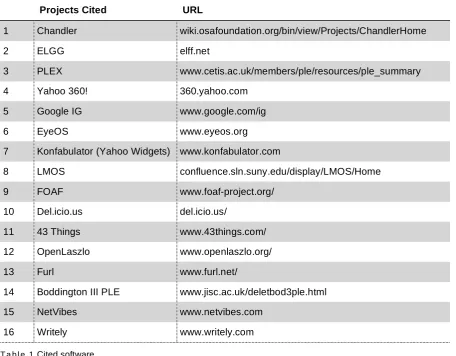
networking (see Kruk, 2006), social bookmarking services like ‘Delicious’ and ‘Furl’ (see Table 1; Hammond, 2006) or personal development resources like ’43 things’, the educational usage of which has been explored by Vuorikari (Vuorikari, 2006). For the communities that use these services, integration with other Web-based activities, whether related to work, leisure or learning, has become a major factor. And into this environment, the institution-controlled VLE, institutional portfolio or library catalogue (for example) present further barriers for integration.
One of these barriers is what might be termed a ‘cognitive burden’. An institution-controlled tool presents the user with a fixed interface of controls (instruments) which the user must learn to use effectively if they are to access the service provided. It is a feature of the current Web
Part 3 Paper 776: Mapping the Future: The personal learning environment reference model and emerging technology
they access. To operate within this environment, the user must manage a number of different dispositions and skills required for different interfaces.
Thematisation of the PLE intervention
The thematisation of the PLE intervention characterises the PLE as an emergent and necessary measure within a technological environment which shares some of the central characteristics of Web2.0 technology (O’Reilly, 2006). In particular, these themes implicate the evolution of Service Oriented Architecture (particularly in the form of Web Services) and the emergence of the read-write Web.
The central insight of the PLE intervention is to see Service Oriented Architecture as a fundamental technological sea-change which permits the separation of what is normally
considered to be a ‘tool’ into a ‘service’ component and an ‘instrument’ component. Rather than being forced to use a particular tool to access a particular service, a PLE user may access a particular service in many different ways, using a ‘Personal Learning Toolkit’ (PLT). The
acquisition of PLT skills will then equip the user/learner with the facility to access a large variety of services, all the time taking ownership of instrumentation and thus overcoming the
instrumental barrier that faces the user on the Web-page.
This apparently simple intervention has some radical implications. Not least amongst which is the redundancy in the need for institutions to provide (and control) instrumentation in order to access their services. Current technology provision is geared towards the maintenance of
instrumentation as well as services. Their inseparability often means that institutions maintain a number of systems which reproduce the same service (for example, the provision of email in a VLE, independent of institutional email). The maintenance of instrumentation also entails a significant investment in training of both learners and staff.
A sub-theme within the PLE intervention is the transition from traditional LMS systems to a PLE service-driven paradigm—a step which is clearly a vital element in the emergence of the PLE. Within the currently emerging technological landscape, we can identify drivers which could play a part in establishing a service-driven paradigm within the institution. For example, the increasing following that service-driven technologies (particularly Web syndication) are acquiring amongst learners will produce growing community pressure which eventually requires such practices to be made more generally available in learning provision. In addition, the increasing interest in the service-driven paradigm from large software houses who seek the flexibility of the service approach, as well as the possibility of new subscription-based models for software licensing, will encourage the adoption of service-oriented thinking within institutions.
The methodological approach behind the
construction of the model
Having thematised the problem domain of the PLE in an informal sense, we require more
methodologically grounded evidence for establishing clear categories for use within the reference model. In particular, we need to identify the sorts of practices currently emerging and to specify services within the model to support these. In pursuance of this, we have used a methodology drawing on Alexander’s (1977) work to create a ‘pattern language’ to describe the underlying factors which contribute to current technological behaviour, and which will serve as a benchmark for the functionality of the Personal Learning Environment.
ALT-C 2006 Research Proceedings 185
Part 3 Paper 776: Mapping the Future: The personal learning environment reference model and emerging technology be used to generate new practices and designs which satisfy the conditions of the underlying problems identified. It is amongst these new generated designs that the PLE intervention situates itself. The ethnographic component of the methodology can be found in the documentation of user experience of technological situations, which is required to begin the process of identifying problems. Extensive use has made use of technology (particularly the wiki) in facilitating a sort of ‘group ethnography’ whereby individuals can contribute their experiences in particular
technological practices, and the underlying problems to which those practices are a solution can be emerged.
Within the PLE reference model project, there is a need to identify the nature of current user practice, and to situate the PLE as an intervention which satisfies the basic elements exposed by the pattern language. It is worth remembering, however, that such a documentation of user experience is ‘tensed’, in that it relates to a particular time and place (indeed, criticism of Alexander’s method might suggest that those ‘problems’ identified are dependent on a range of social and economic factors whose uncovering is excluded by the methodology). Yet, as a snapshot of user experience, the pattern analysis technique can be regarded as useful within the context of the reference model project.
One of the key decisions in the adoption of a survey of current user practice is the choice of technologies to examine. Since the theme of the PLE situates itself around Web2.0 technology, it seems sensible to look at the user behaviour around this technology. For this reason, a sample of technologies has been taken from:
Email and Personal Information Management (e.g. Microsoft Outlook, Chandler) Chat and Instant Messaging
Calendaring and Scheduling software News Aggregation
Weblogging and Personal Publishing
Social Software (e.g. Flickr, 43Things, del.icio.us)
Authoring and other tools for collaborative working (Writely) Integration Tools (NetVibes, EyeOS)
As a result of this analysis, we can take a snapshot of current practice with technologies in a way which allows us to identify key activities, and furthermore (and more importantly for the
construction of the reference model) the services which support these activities. 77 patterns have been uncovered as ‘relevant’ to the model, and these patterns are grouped into 9 categories:
1 Context Patterns
Context involves the general setting-up (and destruction) of relationships—either between a tutor and a student, or a student and other students in a learning relationship. This may take the form of technologies to establish online presence, for example.
2 Conversation Patterns
Mechanisms for maintaining conversations in learning, including support for moderation and collaboration.
3 Network Patterns
Part 3 Paper 776: Mapping the Future: The personal learning environment reference model and emerging technology
4 Resource Patterns
Resource patterns concern the actual content of the data that is transferred and its categorisation into particular forms, and the services which relate to its acquisition, like search. Into this area, we might find concepts like ‘smart folders’ which can be programmed by users to display content dependent on serch criteria.
5 Social Patterns
These patterns relate to the management of personal profiles together with the management of other social contacts and contexts.
6 Team Patterns
We make a distinction between the management of individuals (in the above category) and the management of groups which may be formed from the sharing of practices. Here services allow for (for example) invitation to groups, and distributed communication.
7 Temporal Patterns
This group of patterns relate to the management of personal time through calendaring services, alarms, etc.
8 Workflow Patterns
The organisation of the sequenced activities, which may include technologies to support the management of commitments made by both student and teacher (eg. conversation for action), but which may also include specialised pedagogical sequences as we might find expressed in a Learning Design.
9 Activity Patterns
The nature of the activities which people undertake when learning. Some of these activities have been identified by the recent LADIE project (Conole et al, 2005). Others might include services
to facilitate the shared exploration of resources (‘reading together’), or
common views on documents (‘shared display’).
The reference model
in detail
The patterns identified are
supported by services (for example, Workflow and Activity Management services), and these service
specifications are incorporated within the model. In line with the ‘themes of transformation’ and the PLE interpretation of Service Oriented Architecture, the model makes a distinction between the ‘Service Providers’ and a ‘Personal Learning Toolkit’ (PLT). Diagram 1 shows how these core elements map onto each other. In this
ALT-C 2006 Research Proceedings 187
Part 3 Paper 776: Mapping the Future: The personal learning environment reference model and emerging technology diagram a number of instances of the Toolkit are shown—and these instances may be equated to different learners. Each learner configures their toolkit in different ways to suit their purposes. This configuration involves pointing the toolkit at the services which they wish to consume. A co-ordinating service provides some facilities for the aggregation and co-ordination of data, as well as possibly the management of communication between services.
Within the body of services reside the core services of the reference model. In addition to workflow services, use is made here of services that are already in existence. For example, in supporting social patterns, ‘Friend of a Friend’ (FOAF, Table 1, 9) is ideal (and within both the PLEX and ELGG environments, FOAF connectivity is in-built). For both calendaring and
workflow, a variety of technologies exist, and in the case of workflow, well-developed commercial products could be easily integrated. In addition to pre-existing technologies, we can also see where pre-existing protocols and standards may be integrated into the PLE: for example, the ATOM protocol is ideal for the implementation of conduits, and this compatibility opens up new possibilities for the incorporation of other ATOM-compliant tools and services.
The establishment of the validity of the
PLE reference model
The empirical validity of the model rests on the extent to which the phenomena it predicts resonate with the picture of emerging technological usage and learning. Clearly, this is something which cannot be established with any certainty at such an early stage in the project. However, at the point when such judgements can be made (possibly through using the model to generate and test hypotheses), the ‘reasonableness’ of the predictions of the model with observed technological behaviour will be judged. At this early stage, we argue that an appeal to ‘reasonableness’ may be made through an exploration of the hypothetical implications of the model through the construction of use-case scenarios, and in using the model to situate current technology. The extent to which these studies reflect a reasonable, attainable picture of user behaviour and technological transformation is a useful initial indicator of the robustness of the model.
When examining current technologies, the PLE ‘lens’ affords us two key actions. On the one hand, it allows us to critique current technologies, situating them in terms of what might be characterised as their ‘PLE compliance’. Secondly, it generates a ‘migration path’ to move a current technology from a position of partial PLE-ness to full compliance. These strategies, affecting both existing ‘PLE-like’ technological initiatives and current LMS technology can also be assessed for their ‘reasonableness’ as attainable scenarios.
The use of the model to situate current and
emerging technologies
The PLE reference model proposes a learning environment of interoperable services which may be accessed and organized through a variety of toolkits, where both tools and services may be selected by the learner without prejudice. To facilitate this, there are technical conditions to be met in terms of standards for interoperability and the eventual total separation of services from instruments.
In our review of current and emerging technologies, clearly some technologies are more PLE-compliant than others. In addition, some technologies serve as ‘supporting services’ within a PLE (like delicious, 43things), whilst others attempt to provide a PLE-like ‘organizational environment’ (eg. Chandler).
Part 3 Paper 776: Mapping the Future: The personal learning environment reference model and emerging technology
“the current generation of LMS’s tend to be course-centric rather than student-centric. Student-created content, such as assignments, is submitted to course silos and is only exported to student-controlled portfolios as an afterthought— often with some difficulty” (LMOS, 2006)
To deal with this, LMOS advocates a network of interoperable services which can be accessed flexibly by the learner—clearly a sentiment close to the PLE model. A similar position is
articulated by the Boddington III PLE project (Table 1, 14). ELGG presents itself as an online organization tool for reflective practice and social networking. However, it achieves this through providing mechanisms of interoperation with existing services (for example social networking through FOAF). Again, this is in line with the basic architecture of the model.
Some technologies remain more aloof to the principals of the reference model, although subscribing to a service-driven paradigm. Into this category we may see such developments as Google ig, Yahoo 360! and their Widget Engine (previously Konfabulator), OpenLazlo and Chandler. These technologies offer facilities for social networking, and organization and
integration of e-mail and RSS, but the emphasis is on an integrated environment with some open and some ‘closed’ services which are tied up with the user interface. In some cases (OpenLazlo, Konfabulator) the possibilities for inter-service integration are limited to the simple facility to display them together. Here the model provides an indication of a PLE migration strategy. This strategy would involve the opening-up of closed standards, the incorporation of the facility to use a variety of protocols, and the exposure of the user’s organization data for other (competing) toolkits to use.
For those technologies which are most removed from the reference model (for example, EyeOS—and to a large extent the conventional institutional LMS) the model also provides a migration strategy. The critique of these technologies is that the boundary between service and instrument is insufficiently marked, meaning that the performance of particular activities entails the use of particular tools. The solution is to expose organizational data to other organising tools, to facilitate the integration of services within the tool with those from other tools, etc. Perhaps most importantly from the point of view of institutional migration to a PLE is the opening-up of content services from existing institutional VLEs.
One further ‘situating’ use of the model presents itself in the consideration of the desktop operating system. Here we can consider Blackall’s judgement about the lack of necessity of the PLE and consider the nature of the operating system itself in PLE terms. A desktop operating system typically provides access to tools which do not comply with PLE concepts: in particular, they generally do not provide a separation between ‘instrument’ and ‘service’. Exceptions to this are, however, emerging. The increasing integration of Web syndication into the functionality of the operating system represents a gradual evolution of the operating system into something which is more PLE-like. It may therefore be possible for Blackall to maintain his position whilst at the same time the very concept of the operating system undergoes a ‘PLE transformation’.
The use of the model for constructing pedagogical
scenarios
ALT-C 2006 Research Proceedings 189
Part 3 Paper 776: Mapping the Future: The personal learning environment reference model and emerging technology Bearing the theoretical capabilities as represented by the model of a PLE in mind, we can
consider the following hypothetical learner:
Liam is a ‘traditional’ institution-based leaner, equipped with his own laptop
computer, who makes the most of Web2.0 services (for e-mail, instant messaging, Web-storage, bookmarking, portfolio, etc) co-ordinated via his PLE. This allows him to integrate all aspects of daily communication including calendaring, RSS
aggregation as well as interacting with external services for bookmarking (e.g. ‘delicious’). As a student at University his course information, including resources, assignments, tutor feedback, etc is made available to him via services provided by the institution which interoperate with his PLE. In addition, he has access to further services which support reflective activity and provide a repository for interesting items. Many of these services are provided outside the institution. All of these elements can be integrated and organised in whichever Liam finds useful. Finally, his environment allows him to set up collaborative social groups, and to co-ordinate activity within these groups with other groups to which he is a member.
Within Liam’s daily practice, we find him:
Checking his email and RSS feeds
Tagging interesting items and filing them in bookmarking services
Adding interesting resources to a personal repository
Responding to tutor feedback on assignments through (maybe) a reflective log, and/or setting new personal targets
Checking his calendar to help his time-management
Communicating with friends via Instant Messaging services
Organising collaborative groups for coursework, or participating in pre-existing coursework activities (using wiki services)
To perform all of these activities, Liam has had to master the effective utilisation of his Personal Learning Environment. This was initially a bit tricky, but having got the hang of it, he finds that with a relatively small set of skills (for hooking up with new services, for organising data as he wishes, for creating a few effective ‘smart searches’) his learning environment allows him to negotiate and co-ordinate a large range of different activity. He is mindful of the fact that the performance of such a range of tasks without his PLE would present considerable obstacles for him—not least in simply remembering how to use all the different tools he would have to negotiate. In fact, Liam might go so far to say that his PLE is very much his ‘tool for dealing with life’.
Liam’s hypothetical example provides a useful starting point to examine the experience of using the PLEX Personal Learning Environment. As an embodiment of the principals of the reference model we find that much of the practice listed in Liam’s case-study is possible within PLEX. Liam’s experiences (albeit hypothetical) can be judged against the real experience of using this software. Whilst a deep examination of this user experience is still some way off, we can at this stage comment on the fact that the rich integration of many different areas of practice, together with the circumventing of the numerous ‘instrumental barriers’ are all things which are afforded by the PLEX. Further evaluation of these experiences and their relationship to learning activity will strengthen our grasp on the nature of the relationship between actualized ‘personal learning’ and the reference model.
Conclusion
Part 3 Paper 776: Mapping the Future: The personal learning environment reference model and emerging technology
the emerging field of service-oriented technology. The contribution of each project is on many levels. At one level, the introduction of a service-oriented, user-centred paradigm is an important development: the dissemination of these practices will smooth the way for the next generation of technologies. In addition, many of these projects, whilst perhaps not being complete PLE
implementations, are nevertheless not far from it. In these cases, often it might merely be a case of exposing their own services for consumption by a new breed of Personal Learning Tools, or decoupling themselves from an institutional base, or rationalising their use of services.
The reference model acts as a framework within which these different tools and services may be located. It has helped to clarify the terminology we use in describing these technologies, which in turn should create an environment for constructive discourse. The challenges identified by the Personal Learning Environment project are clear: the effective management of technology, the overcoming of the barriers of instrumentation through personal control, and the effective exploitation of a service driven environment. These same challenges are identified in other projects, and even if not explicitly stated, many of the themes can be detected as drivers for other service-oriented technological developments. The identification of this common direction is important, for it means that whatever the imperfections of individual technological developments, an effective path for their future development can be mapped out. Knowledge of the wider context as it is represented in the PLE model is also useful because it may give current users a degree of confidence and freedom to experiment with the different tools and services that currently exist. Ultimately, the full manifestation of the Personal Learning Environment will present possibilities for teaching and learning which will be free of the restrictions of
instrumentation, allowing learners to be creators of tools, and discoverers of new possibilities in the combination of learning services from a vast range of sources.
Projects Cited URL
1 Chandler wiki.osafoundation.org/bin/view/Projects/ChandlerHome
2 ELGG elff.net
3 PLEX www.cetis.ac.uk/members/ple/resources/ple_summary
4 Yahoo 360! 360.yahoo.com
5 Google IG www.google.com/ig
6 EyeOS www.eyeos.org
7 Konfabulator (Yahoo Widgets) www.konfabulator.com
8 LMOS confluence.sln.suny.edu/display/LMOS/Home
9 FOAF www.foaf-project.org/
10 Del.icio.us del.icio.us/
11 43 Things www.43things.com/
12 OpenLaszlo www.openlaszlo.org/
13 Furl www.furl.net/
14 Boddington III PLE www.jisc.ac.uk/deletbod3ple.html
15 NetVibes www.netvibes.com
16 Writely www.writely.com
ALT-C 2006 Research Proceedings 191
Part 3 Paper 776: Mapping the Future: The personal learning environment reference model and emerging technology
References
Alexander, C (1977) A pattern language : towns, buildings, construction OUP
Arrington, M (2005) Profile—Google RSS reader www.techcrunch.com/2005/07/26/profile-google-rss-reader/ (viewed 10/2/06)
Attwell, G., (2006) Why Personal Learning Environments are important.
81.4.66.124:8080/knownet/writing/weblogs/Graham_Attwell/entries/8463960484 (accessed 24/01/2006) Blackall, L (2005) Die LMS, You Too PLE.
www.knownet.com/writing/weblogs/Graham_Attwell/entries/7498978416
Campbell, A (2005) Weblog Applications for EFL/ESL Classroom Blogging: A Comparative Review writing.berkeley.edu/tesl-ej/ej35/m1.html (viewed 10/2/06)
Conole, G; Littlejohn, A; Falconer, I; Jeffrey, A (2005) Pedagogical review of learning activities and use-cases www.elframework.org/refmodels/ladie/ouputs/LADIE lit review v15.doc (viewed 10/2/06)
Hammond, T; Hannay, T; Lund, B; Scott, J (2006) Social Bookmarking Tools (I) www.dlib.org/dlib/april05/hammond/04hammond.html (viewed 10/2/06)
Hiebert, J., (2006) Your goals are the future headspacej.blogspot.com/2006/01/your-goals-are-future.html (accessed 24/01/2006)
Kruk, S. R. (2006) FOAF-Realm—control your friends' access to resources
www.w3.org/2001/sw/Europe/events/foaf-galway/papers/fp/foaf_realm/ (viewed 10/2/06)
Nicol, D.J. & Macfarlane-Dick, D. (2004). Rethinking formative assessment in HE: a theoretical model and seven principles of good feedback practice. Higher Education Academy
www.heacademy.ac.uk/assessment/ASS051D_SENLEF_model.doc (accessed 24/01/2006)
O’Reilly, T (2006) What is Web2.0 ? www.oreillynet.com/pub/a/oreilly/tim/news/2005/09/30/what-is-web-20.html (accessed 2006)