300
Copyright © 2017. Vandana Publications. All Rights Reserved.
Volume-7, Issue-3, May-June 2017
International Journal of Engineering and Management Research
Page Number: 300-307
Awareness and Attitude of Management Students towards Corporate
Social Responsibility
(A Study of MBA Students in Bhubaneswar City)
Brijlal Mallik1, Dr. Dasarathi Sahu2
1Research Scholar, Department of Business Administration, Utkal University, INDIA 2
Lecturer, Department of Business Administration, Utkal University, INDIA
ABSTRACT
Purpose–This paper is an attempt to explore the awareness and attitude of the management students towards corporate social responsibility (CSR). Students are perceived as future managers of the corporate world and their perception about CSR is deemed important to business organisations. The students can make companies understand their responsibility towards various stakeholders. The paper aims to discuss these issues.
Design/methodology/approach – By doing a review of past literature, an appropriate scale consisting of forty-one items has been developed to measure the dimensions of CSR. Data were collected from 294 students of various business schools situated in Bhubaneswar city (Odisha). The data collected was subjected to exploratory factor analysis to extract the main dimensions that would bring out the attitudes of the students towards CSR.
Findings – Results revealed that the companies should pay attention to accountability towards stakeholders, corporate governance, ethical commitment and humanitarian concerns besides fulfilling other responsibilities as covered under the eight factors identified in the study.
Research limitations/implications – This paper used survey data from small sample of management students in a limited geographic area. Hence, it might be difficult to generalize the results to a larger, more representative population. The research also suggests how corporations can make CSR an integral part of the business organisation.
Practical implications – The dimensions identified in the study if incorporated by the business in its day-to-day operations can make it socially responsible as well as socially acceptable in the true sense.
Originality/value – This research makes an empirical contribution to identify the factors which management students and hence the society at large, expect business enterprises should do to be justified as socially responsible corporate citizens.
Keywords-- Ethics, Corporate social responsibility, Social accountability, Environment protection
Paper type- Research paper
I.
INTRODUCTION
Corporate social responsibility (CSR) is a form of corporate self-regulation integrated into a business model. It is also known by different names such as corporate responsibility, corporate citizenship, sustainable responsible business (SRB), corporate social performance and corporate social opportunity. It is a concept whereby organizations consider the interests of the society by taking responsibility for the impact of their activities on customers, suppliers, employees, shareholders, communities and other stakeholders, as well as the environment. Gray et al. (1996) defined CSR as the “process of communicating the social and environmental effects of organizations’ economic actions to particular interest groups within a society and to society at large”. It encompasses charitable activities in the field of healthcare, different forms of health camps, voluntary blood donation, education of the underprivileged, welfare of the physically challenged, organic farming, livelihood programs, slum rehabilitation, disaster management, etc. and also deals with sensitive issues like child labour, girl child, road safety, women wellness, and minority development.
301
Copyright © 2017. Vandana Publications. All Rights Reserved.
public governance, community members, civil societygroups, other enterprises, etc.) stakeholders (World Bank Group, 2002). CSR is understood to be the way firms integrate social, environmental, and economic concerns into their values, culture, decision making, strategy, and operations in a transparent and accountable manner and thereby establish better practices within the firm, create wealth, and improve society.
II.
RESEARCH OBJECTIVES
. To find out the awareness and attitude of the management students of Bhubaneswar state towards CSR.
. To find out the factors that the management students expects the companies to incorporate in their CSR initiatives.
. To make propositions to the companies with respect to CSR initiatives.
III.
RESEARCH METHODOLOGY
A survey was conducted taking respondents as business school students of Bhubaneswar. Based on previous research in related areas, a questionnaire was designed to measure the attitude of the management students towards the concept of CSR. The required information was collected through the structured questionnaire. The questionnaire consists of 41 statements relevant to the type of information that was to be extracted from the respondents in order to fulfil the objectives of the study.
IV.
SAMPLE AND DATA
COLLECTION
As an exploratory research, judgmental sampling has been used. The universe of this study was Bhubaneswar. The age group of the target population varied from 20 to 25.In order to get the answer on the research questions, 350 questionnaires were randomly distributed to 350 students of various B-schools situated in Bhubaneswar city of Odisha. Out of350 respondents, 64 per cent of respondents were male and rests 36 per cent comprised of female students. Of the 350 questionnaires distributed, 294 filled and completed questionnaires were found suitable for the study, representing a response rate of84 percent.
V.
SURVEY INSTRUMENT
The questionnaire items represent eight categories namely humanitarian concerns, fair business and transparency, accountability towards stakeholders, global standards, social accountability, CG, ethical commitment and environment protection and sustainability. The developed questionnaire included 41 variables where four variables was used to measure humanitarian concerns, four variables to fair business
and transparency, eight variables to accountability towards stakeholders, four variables to global standards, four variables to social accountability, seven variables to CG, seven variables to ethical commitment and four variables to environment protection and sustainability. Respondents were asked to indicate the degrees of agreement with each of the items on five-point Likert scale from (1) strongly disagree to (5) strongly agree.
VI.
DATA ANALYSIS
For the analysis and interpretation of the data, the technique of exploratory factor analysis (EFA) has been used. This technique has been particularly used to extract the minimum number of factors that will explain the maximum amount of variance in the collected data. The data provided were then examined using various statistical tools such as descriptive statistics (mean and standard deviation), Kaiser-Maiyer-Olkin(KMO) and Bartlett’s Spheri city test, reliability statistics using Cronbach’s a and EFA.
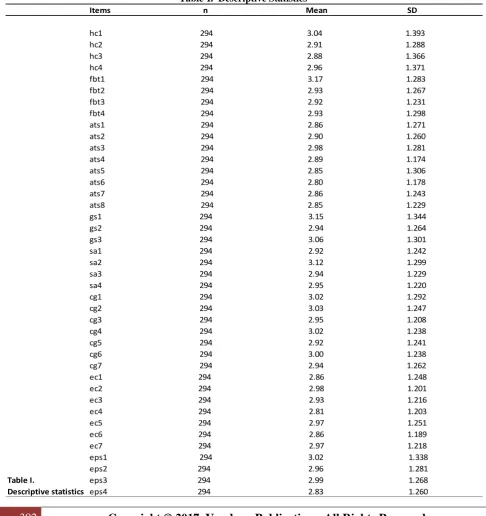
An initial screening was conducted on the data with the help of SPSS 19 statistical software package. The data was found to be normally distributed. Moreover, the descriptive statistics revealed that mean value ranged between 2.80 and 3.17, and the standard deviation ranged between 1.174 and 1.393. This suggested that ratings from the respondents tend to lie on the positive side of the rating scale and relatively high degree of consensus was there among the respondents in their perception of the rating of items in the questionnaire. Descriptive statistics is shown in Table I. To assess there liability of the instruments, the Cronbach’s (1951) a coefficients for the items were calculated (Cronbach’s a ¼ 0.741). As a general rule a coefficient greater than or equal to 0.5 is considered acceptable and a good indication of construct reliability (Nunnally,1978). Hence, the data showed a high internal consistency in terms of reliability.
VII.
RESULTS
302
Copyright © 2017. Vandana Publications. All Rights Reserved.
variable items showed communality value of less than0.5, which was lower than the acceptable limit. The variables showing low communality (hc1, fbt1, ats3, gs2, sa4, cg6, ec3, and ec4) were eliminated from further analysis.
Variable fbt1 was deleted as having low communality. According to the students, the organisations which provided transparency in transactions and were able to serve the customers with quality products at reasonable prices were more important than being corruption prevention machinery. Also among the variables considered in “humanitarian concern” construct hc1 was deleted as the respondents were more focused towards the specific attributes of the construct rather than the general aspects of the factor.
Moreover, ec3 and ec4 were deleted as having low communalities. However, their deletion did not significantly change meaning of “ethical commitment” construct. The students upheld the fact that corporations should follow good governance practices, irrespective of the core value defined in its strategic intent. Hence, cg6 was not considered for further analysis. The deleted variables were not so important from the view point of the management students in the state of Bhubaneswar. This phenomenon was observed with the other deleted variables also which resulted in their lower factor loadings. Hence, these variables were eliminated from the model. However, the deleted variables did not significantly change the content of the construct as it was initially conceptualized.
Table-I. Descriptive Statistics
Items n Mean SD
hc1 294 3.04 1.393 hc2 294 2.91 1.288 hc3 294 2.88 1.366 hc4 294 2.96 1.371 fbt1 294 3.17 1.283 fbt2 294 2.93 1.267 fbt3 294 2.92 1.231 fbt4 294 2.93 1.298 ats1 294 2.86 1.271 ats2 294 2.90 1.260 ats3 294 2.98 1.281 ats4 294 2.89 1.174 ats5 294 2.85 1.306 ats6 294 2.80 1.178 ats7 294 2.86 1.243 ats8 294 2.85 1.229 gs1 294 3.15 1.344 gs2 294 2.94 1.264 gs3 294 3.06 1.301 sa1 294 2.92 1.242 sa2 294 3.12 1.299 sa3 294 2.94 1.229 sa4 294 2.95 1.220 cg1 294 3.02 1.292 cg2 294 3.03 1.247 cg3 294 2.95 1.208 cg4 294 3.02 1.238 cg5 294 2.92 1.241 cg6 294 3.00 1.238 cg7 294 2.94 1.262 ec1 294 2.86 1.248 ec2 294 2.98 1.201 ec3 294 2.93 1.216 ec4 294 2.81 1.203 ec5 294 2.97 1.251 ec6 294 2.86 1.189 ec7 294 2.97 1.218 eps1 294 3.02 1.338 eps2 294 2.96 1.281
Table I. eps3 294 2.99 1.268
303
Copyright © 2017. Vandana Publications. All Rights Reserved.
Once the variable showing low factor loadingswere deleted reliability of the scale was retested. Although the scale reliability (Cronbach’s a ¼ 0.684) dropped marginally, still it showed that the construct reliability was on the higher side. As a next step KMO measure of sampling adequacy and Bartlett’s test of sphere city was conducted on the data. The result of the same is reported in Table II. KMO showed value higher than the cut off (0.50) (Field, 2005). Also Bartlett’s test of sphere city was found to be significant ( p ¼ 0.000). Moreover, determinant value of the correlation matrix was 1.15 x 10 (to the power-005), which indicated nonexistence of multi collinearity in the data set.
The next step in the process is to decide about the number of factors to be derived. The rule of thumb is applied to choose the number of factors for which “Eigen values” with greater than one is taken by using an appropriate data extraction technique (principal component analysis). The component matrix so formed is further rotated orthogonally using vari max rotation algorithm.
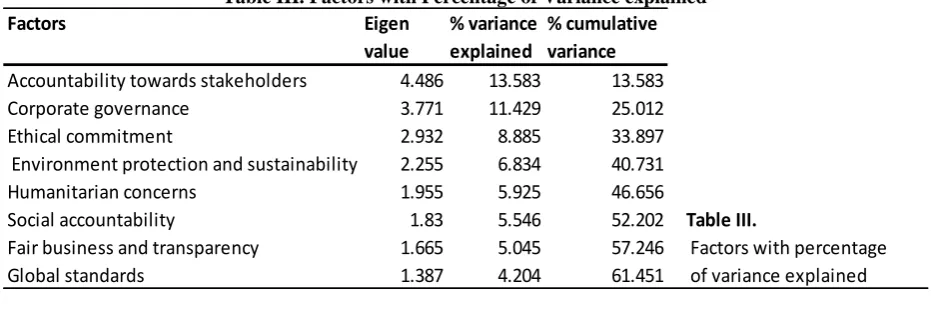
By performing factor analysis 33 variables are reduced into eight component factors (Table III). Each component factor includes some statements which are otherwise called variables. Each variable represents
attitude of student about one particular aspect of CSR and statements under each factor explain the feature of such factor. The eight-attitudinal factors which have Eigen value more than unity alone is taken for consideration. There are separate tables for factor loading of each factor. The eight-attitudinal factors represent around 61 percent of total variance which is very significant and the remaining variance is explained by other factors. The first factor Accountability towards stakeholders accounts for about 13 percent of total variance and other factors accounts for remaining 48 percent of total variance. The list of eight-component factor along with their labels and variables (statements along with loading) are listed in Tables IV-XI.
VIII. ROTATED COMPONENT
(FACTOR) MATRIX
The idea of rotation is to reduce the number factors on which the variables under investigation have high loadings. Rotation does not actually change anything but makes the interpretation of the analysis easier.
Table II. KMO and Batlett’s test
Table III. Factors with Percentage of Variance explained
IX.
FINDINGS
The management students are concerned with the way the companies should consider CSR. For the management students, eight factors matters the most when it comes to following of CSR by the corporate houses in India. The eight factors are: humanitarian concerns (Galbreath, 2010), Fair business and transparency, accountability towards stakeholders
(Carroll, 1991; Freeman et al., 2007), global standards (Dash wood, 2005), social accountability (Donham, 1927), CG (Sternberg, 2004; Aguilera, 2005; Wise and Mahhoob, 2007), ethical commitment and environment protection and sustainability (Ingram, 1978; Abbott, 1979; Hacks ton and Milne, 1996; Deegan and Rankin, 1997;Webb et al., 2009; Waller and Lanis, 2009). These eight factors, if incorporated in CSR, will explain 61.451 percent of variance in the collected data, which means
KMO
measure of sampling adequacy 0.789
Bartlett’s test of sphericity Approx. x 2 3,197.933
df 528
Table II.Sig. 0.000
KMO and Bartlett’s testFactors Eigen % variance % cumulative
value explained variance
Accountability towards stakeholders 4.486 13.583 13.583
Corporate governance 3.771 11.429 25.012
Ethical commitment 2.932 8.885 33.897
Environment protection and sustainability 2.255 6.834 40.731
Humanitarian concerns 1.955 5.925 46.656
Social accountability 1.83 5.546 52.202 Table III.
Fair business and transparency 1.665 5.045 57.246 Factors with percentage
304
Copyright © 2017. Vandana Publications. All Rights Reserved.
that it will fulfil the 61.451 percent expectations of the management students from the business.Table IV. Factor loading for humanitarian concerns
Variables Factor loading Item name Companies should proactively promote public Deleted hc1
Companies should promote health and hygiene 0.624 hc2
Companies should improve quality of life 0.622 hc3
Companies should promote safety 0.660 hc4
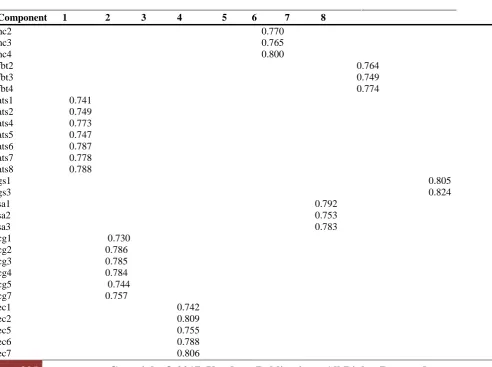
Looking at Table IV, we can see that all the items of variable named humanitarian concerns (i.e. hc2, hc3, and hc4) are substantially loaded under component 5, likewise all the items of variable named fair business and transparency (i.e. fbt2, fbt3, and fbt4) are substantially loaded under component 6 and so on. These
factors can be used as variables for further analysis. The residuals in principal component analysis are computed between observed and reproduced correlations. There are 81 (15.0 percent) non-redundant residuals with absolute values greater than 0.05, which is significant as it is below 50 percent.
Table V. Factor loading for fair business and transparency
---
Variables Factor Loading Item Name
--- --- Companies should prevent corruption (deleted/ dropped) Deleted fbt1
Companies should ensure transparency in transactions 0.601 fbt2 Companies should produce fair products 0.580fbt3
Companies should offer fair price to the customers 0.622fbt4
---
Table VI. Factor loading for accountability towards stakeholders Variables Factor loading Item name
________________________________________________________________________________ Companies should fulfil responsibility towards suppliers0.574ats1
Companies should fulfil responsibility towards creditors 0.591ats2
Companies should fulfil responsibility towards intermediaries (deleted/dropped) ats3 Companies should fulfil responsibility towards employees 0.639ats4
Companies should fulfil responsibility towards competitors 0.573ats5
Companies should fulfil responsibility towards society 0.633 ats6
Companies should fulfil responsibility towards customers 0.635ats7 Companies should fulfil responsibility towards shareholders 0.631ats8
Table VII. Factor loading for global standards
Variables Factor loading Item name
________________________________________________________________________________ Companies should follow international norms 0.670 gs1
Companies should promote community volunteering (deleted/dropped) gs2 Companies should adopt global standards 0.689 gs3
________________________________________________________________________________Table VIII. Factor loading for social accountability
________________________________________________________________________________
Variables Factor loading Item name
Companies should undertake charitable activities 0.648 sa1 Companies should build efforts towards social uplift ment 0.578 sa2
Companies should preserve the heritage 0.637 sa3 Companies should build healthy public relations (deleted/dropped) sa4
________________________________________________________________________________
Table IX. Factor loading for corporate governance
________________________________________________________________________________
305
Copyright © 2017. Vandana Publications. All Rights Reserved.
Companies should ensure corporate sustainability 0.585 cg1Companies should follow corporate behavior 0.627 cg2 Companies should incorporate self-regulations 0.629 cg3 Companies should follow proper business model 0.624 cg4
Companies should adhere to law 0.576 cg5
Companies should follow core values (deleted/ dropped) Deleted cg6
Companies should ensure corporate governance 0.603 cg7
Table X. Factor loading for ethical commitment
Variables Factor loading Item name
Companies should ensure ethical advertising 0.584 ec1 Companies should follow ethical standards 0.658 ec2 Companies should avoid unethical business practices (deleted/dropped) ec3 Companies should provide stable business environment (deleted/dropped) ec4
Companies should prevent insider trading 0.591 ec5 Companies should undertake social accounting 0.629 ec6
Companies should promote social values 0.663 ec7
Table XI. Factor loading for environment protection and sustainability Variables Factor loading Item name
Companies should ensure judicious use of natural resources 0.588 eps1
Companies should ensure sustainable development 0.566 eps2 Companies should ensure environment protection 0.552 eps3 Companies should maintain ecological balance 0.598 eps4
Table XII. Rotated component matrix
____________________________________________________________________________________________ Component 1 2 3 4 5 6 7 8
hc2 0.770
hc3 0.765
hc4 0.800
fbt2 0.764
fbt3 0.749
fbt4 0.774
ats1 0.741
ats2 0.749
ats4 0.773
ats5 0.747
ats6 0.787
ats7 0.778
ats8 0.788
gs1 0.805
gs3 0.824
sa1 0.792
sa2 0.753
sa3 0.783
cg1 0.730
cg2 0.786
cg3 0.785
cg4 0.784
cg5 0.744
cg7 0.757
ec1 0.742
ec2 0.809
ec5 0.755
ec6 0.788
306
Copyright © 2017. Vandana Publications. All Rights Reserved.
eps1 0.758
eps2 0.736
eps3 0.734
eps4 0.757
________________________________________________________________________________
Notes: Extraction method: principal component analysis; rotation method: vari max with Kaisernormalizati on; rotation converged in five iterations
X.
SUGGESTIONS
The findings revealed that the B-school students want Indian organisations to follow international standards with respect to CSR. This perception of the student’s community shows that the domestic business organisations are not so sensitive to societal needs as compared to their foreign counterparts. Hence, the domestic organisations should try to benchmark their CSR initiatives with the global players. Although lack of funds and other contextual differences might be a hindering factor, none the less such benchmarking would form a positive image about the corporations in the mind of the future managers. “Accountability towards stakeholders” has evolved as an important factor in the present study because value chain social impacts are significantly affected by the company’s activities in the ordinary course of business. The respondents perceived that company had a major liability towards the various stakeholders including employees, society, and customers, etc. An organisation might be taking various initiatives in line with their CSR policies, however, those initiatives are not disclosed and hence there is a lack of awareness among the general masses about the various philanthropic activities. A proper disclosure mechanism might be formulated (like publishing of various initiatives in major print/electronic media on a biannual basis) to reach to the masses. This would improve the overall image of the corporation.
In other words, companies should operate in ways that secure long-term economic performance by avoiding short-term behaviour that is socially detrimental or environmentally wasteful. Overall, while formulating a CSR policy, the companies should consider the viewpoint of the future managers. In order to meet the expectations of the management students (future managers) effectively, the companies should try to incorporate the above-mentioned eight factors in their CSR plan. The companies should realize that the youth has become vigilant enough towards CSR and so they cannot afford to show negligence on this count. A critical review of literature (Sharma, 2011) suggests that business houses in India consider CSR as a separate activity altogether. A fixed part of the profit/revenue is being diverted to some sort of philanthropic activities which are justifying the firms’ responsibility towards the society. Thus, CSR is not considered an integral part of the business. This might be because of the lack of clarity of the business houses of their responsibility towards the stakeholders. If the corporations are able to bridge the gap between stakeholder responsibility and CSR initiatives the true meaning of socially responsible
corporate citizenship could be justified. Responsive CSR comprises of two elements: acting as a good corporate citizen, attuned to the evolving social concerns of stakeholders, and mitigating existing or anticipated adverse effects from business activities. Good citizenship is a sine qua non of CSR, and companies need to do it well.
XI.
CONCLUSION
The prevailing approaches to CSR are fragmented and disconnected from business and strategy. Hence, the organisations are not able to obscure many of the opportunities to benefit society. Results of this study provided a new insight into the relationship between business and society that does not treat corporate success and social welfare as a zero-sum game. Rather organisations can analyse their prospects for social responsibility using the strategic intent that guide their core business choices. This would lead to discover that CSR can be more than a cost, a constraint, or a charitable deed and hence it can be a source of opportunity, innovation, and competitive advantage.
This study throws light on the way the future managers expects the companies should conduct their business. Although the primary motive of business is wealth maximisation but public interest should never be discounted. CSR is integral to value creation in business through enhancement of human, natural and social capital complementing their economic and financial growth in order to give the enterprise an enduring future and also to serve a larger goal at all times. It is a charity which ultimately gets translated into profit. The management students, who are the future managers, voice that the companies must pay attention to accountability towards stakeholders, CG, ethical commitment and humanitarian concerns besides fulfilling other responsibilities as covered under the eight factors of the study. A healthy business will help in developing a healthy society and healthy environment, and incorporation of these factors will ensure its long-term sustainability. Hence, the companies should make an effort towards it at the earliest. When looked at strategically, CSR can become a source of tremendous social progress, as the business applies its considerable resources, expertise, and insights to activities that benefit society.
REFERENCES
307
Copyright © 2017. Vandana Publications. All Rights Reserved.
as a method of measuring corporate social involvement”,Academy of Management Journal, Vol. 22 No. 3, pp. 501-515.
[2] Aguilera, R.V. (2005), “Corporate governance and director accountability: an institutional comparative perspective”, British Journal of Management, Vol. 16, pp. 1-15.
[3] Arli, D.I. and Lasmono, H.K. (2010), “Consumers’ perception of corporate social responsibility in a developing country”, International Journal of Consumer Studies, Vol. 34, pp. 46-51. Backman, J. (1975), Social Responsibility and Accountability, New York University Press, New York, NY.
[4] Birch, D. and Glazebrook, M. (Eds) (2000), Doing Business-Doing Culture: Corporate Citizenship, Pluto Press Australia, Annandale.
[5] Capra, F. (1983), The Turning Point: Science, Society and the Rising Culture, Flamingo, London. [6] Carroll, A.B. (1991), “The pyramid of corporate social responsibility: toward the moral management of organizational stakeholders”, Business Horizons, Vol. 34 No. 4, pp. 39-48.
[7] Chowdhury, M.A.A. (2006), Environmental Marketing Strategies in the USA, Friends Publishers, Dhaka.
[8] Cronbach, L.J. (1951), “Coefficient alpha and the internal structure of tests”, Psychometrika, Vol. 22 No. 3, pp. 297-334.
[9] Deegan, C. and Rankin, M. (1997), “The materiality of environmental information to users of annual reports”, Accounting Auditing & Accountability Journal, Vol. 10 No. 4, pp. 562-583.
[10] Dashwood, H. (2005), “Canadian mining companies and the shaping of global norms of corporate social responsibility”, International Journal, Fall, pp. 977-998. [11] Donham, W.B. (1927), “The social significance of business”, Harvard Business Review, Vol. 5 No. 4, pp. 406-419.
[12] Drucker, P. (1999), “Creating community”, Executive Excellence, Vol. 16 No. 5. Field, A. (2005), Discovering Statistics Using SPSS, 2nd ed., Sage, London.
[13] Freeman, R.E., Harrison, J. and Wicks, A.C. (2007), Managing for Stakeholders: Business in the 21st Century, Yale University Press, New Haven, CT. [14] Galbreath, J. (2010), “Drivers of corporate social responsibility: the role of formal strategic planning and firm culture”, British Journal of Management, Vol. 21, pp. 511-525.
[15] Gray, R., Owen, D. and Adams, C.A. (1996), Accounting and Accountability: Changes and Challenges in Corporate Social and Environmental Reporting, Prentice-Hall, London.
[16] Hackston, D. and Milne, M.J. (1996), “Some determinants of social and environmental disclosuresin New Zealand companies”, Accounting Auditing & Accounting Journal, Vol. 9 No. 1, pp. 77-108.
[17] Ingram, R.W. (1978), “An investigation of the information content of (certain) social responsibility
disclosures”, Journal of Accounting Research, Vol. 16 No. 2, pp. 270-285.
[18] Kanjia, G.K. and Choprab, P.K. (2010), “Corporate social responsibility in a global economy”, Total Quality Management, Vol. 21 No. 2, pp. 119-143.
[19] Kavitha, W. and Anita, P. (2011), “Disclosures about CSR practices: a literature review”, The IUPJournal of Corporate Governance, Vol. X No. 1. [20] Kumar, T.N.R. (2008), “Corporate governance and corporate social responsibility: the case of three Indian private companies”, The ICFAI Journal of Corporate Governance, Vol. VIINo. 2.
[21] Maignan, I. and Ferrell, O.C. (2001), “Antecedents and benefits of corporate citizenship: an investigation of French businesses”, Journal of Business Research, Vol. 51, pp. 37-51.
[22] Nolan, J. and Nolan, D. (Eds) (1995), The Path to Social Responsibility, Williams B. Eerdmans Publishing Company, Grand Rapids, MI. Nunnally, J.C. (1978), Psychometric Theory, McGraw-Hill, New York, NY. [23] Prakash, A. (2000), Greening the Firm: The Politics of Corporate Environmentalism, Cambridge University Press, Cambridge.
[24] Ramasamy, B. and Yeung, M. (2009), “Chinese consumers’ perception of corporate social responsibility”, Journal of Business Ethics, Vol. 88, pp. 119-132.
[25] Schwartz, P. (1996), The Art of the Long View, Australian Business Network, St Leonards. Sharma, S. (2011), “Corporate social responsibility in India”, The Indian Journal of Industrial Relations, Vol. 46 No. 4. [26] Shrivastava, P. (1995), “The role of corporations in achieving ecological sustainability”, Academyof Management Review, Vol. 20 No. 4, pp. 936-960. [27] Sternberg, E. (2004), Corporate Governance: Accountability in the Marketplace, 2nd ed., Instituteof Economic Affairs, London.
[28] Tandon, A.K., Mishra, S.K. and Singh, E. (2011), “What discriminates the prospective manager’sattitude towards corporate social responsibility? An insight from psychological variables”,paper presented at the International Conference on the Management of MSME-2011.
[29] Thomas, A.S. and Simerly, R.L. (1995), “Internal determinants of corporate social performance: the role of top managers”, Academy of Management Journal, Special Issue.