Stability of L
4,5
in the R3BP Under the
Combined Effects of Stokes Drag and Finite
Straight Segment
Dinesh Kumar 1, Mamta Jain2, Rajiv Aggarwal3, Satyendra Kumar Satya *4 1
Department of Mathematics, Shyama Prasad Mukherji College (For Women), University of Delhi, New Delhi, India 2
Department of Mathematics, Bhagini Nivedita College, University of Delhi, New Delhi, India 3,4
Department of Mathematics, Sri Aurobindo College, University of Delhi.
Abstract: We have investigated the existence and stability of non-collinear libration points in the restricted three body problem (R3BP) with dissipative force Stokes drag. The bigger primary is taken as spherical and smaller one as a finite straight segment. There exist five libration points, out of which two are non-collinear with the primaries and three are almost collinear with the primaries. The location of libration points for different values of parameters , and l are evaluated numerically and shown graphically. The linear stability of non-collinear libration points is also discussed.
Key Words: Restricted three body problem, Libration points, Straight segment, Linear stability, Dissipative force, Stokes drag.
I. Introduction
In the restricted three body problem the mass of the one of the bodies is considered to be negligibly small, so that the two other bodies (called primaries) can be described by the two body problem and the body with negligible mass moves in the given field of two bodies with given Keplerian motion such that it does not influence the motion of the primaries but is influenced by them. The problem possesses five libration points out of which three are collinear and two are non-collinear. The collinear libration points are unstable for all values of mass parameter µ, while non-collinear libration points are stable for the mass parameter µ ≤ 0.0385…, Szebehely [14]. It is further assumed that the motion of all the three bodies is co-planar (co-planar restricted three body problem) and /or that the orbit of the two massive bodies is circular (circular restricted three body problem). The five Lagrange solutions denoted by L1, L2, L3, L4 and L5
exist in the R3BP. In the circular restricted three body problem the above five configurations remains constant in the reference system co-rotating with the two massive bodies and are known as libration points (equilibrium points or stationary solutions). There are numerous applications of the R3BP in cosmology and stellar dynamics. In fact, the equations of motion of
so many dynamical systems are similar to those of the R3BP. There are many examples of R3BP in space dynamics. One of them is the classical three body problem, namely, the “Sun-Earth-Moon” combination and describing the motion of the Moon. Another example, motion of a Trojan asteroid attracted by the Sun and Jupiter, which has a similarity with the R3BP. A lot of work has been done on R3BP till today. The location and stability of equilibrium points in the planar circular restricted three body problem when the third body is acted on by a variety of drag forces has been investigated by Muray [10]. He found that L4 and L5 are
asymptotically stable. Liou et al. [8] have examined the effects of radiation pressure, Poynting-Robertson drag and Solar wind drag on dust grains trapped in mean motion resonances with the Sun and Jupiter in the R3BP. They concluded that all dust grain orbits are unstable in time when P-R and solar wind drag are included in the Sun-Jupiter-dust system. Shu et al. [13] determined a criterion of linear stability of libration points in the perturbed restricted three body problem and investigated the effect of drag in the linear stability of triangular libration points. Mishra et al. [9] examined the stability of triangular equilibrium points in photogravitational elliptic restricted three body problem with Poynting-Robertson drag by considering the smaller primary as an oblate spheroid and bigger primary as radiating. They concluded that the triangular equilibrium points remain unstable. Jain and Aggarwal [3] determined the existence and stability of libration points in the restricted problem under the effect of Poynting Robertson Light Drag and conclude that both the non-collinear libration points are unstable. Jain and Aggarwal [4] have performed an analysis in the R3BP with Stokes drag effect by taking both primaries as the point masses and found that non-collinear stationary solutions are linearly unstable. Aggarwal et al. [1] discussed the non-linear stability of the triangular libration point L4 of the R3BP under
smaller one as a triaxial body and both are source of radiation. They found that L4 is always unstable.
Furthermore, the motion of a particle under the gravitational field of a massive straight segment has been studied by Riaguas et al. [11]. This model is used as an approximation to the gravitational field of irregular shaped bodies such as asteroids, nuclei and planets moons. Riaguas et al. [12] have studied the non-linear stability of the equilibria in the gravity field of the finite straight segment and determined the orbital stability of the equilibria, for all values of the parameter k. Jain et al. [6] investigated the stationary solutions in the R3BP when the smaller primary is a finite straight segment. They determined that the collinear stationary solutions are unstable for all values of mass parameter µ, whereas the non-collinear stationary solutions are stable for a critical value µc=µ0-0.0073562l2. The equilibrium solutions
and linear stability of m3 and m4 considering one of
the primaries as an oblate spheroid have been examined by Aggarwal and Kaur [2]. They concluded that there are no non-collinear equilibrium solutions of the system. By considering smaller primary as an oblate spheroid, the existence and stability of the non-collinear libration points with Stokes drag effect have been examined by Jain and Aggarwal [5]. They found that the non-collinear libration points are unstable. Kumar et al. [7] studied existence and stability of libration points in the R3BP under the combined effects of finite straight segment and oblateness. They found that, there exist five libration points, out of which three are collinear and two are non-collinear with the primaries. The collinear libration points are unstable for all values of mass parameter µ, and the non-collinear libration points are stable if µ<µc, where µc
=0.038521-0.007356 l2-0.285002 A.
In the present paper, we discuss the linear stability of non-collinear libration points L4 and L5 in the R3BP
by considering the combined effects of Stokes drag and finite straight segment. There are six sections in this paper. In Section II, the equations of motion of the infinitesimal mass m3 are determined. Section III
comprises location of the libration points. In Section IV, we have investigated the stability of the non-collinear libration points. In Section V, the conclusion of this problem is drawn. And in last section, appendix is given.
II. Equations of Motion
Fig.1. The configuration of R3BP with Stokes drag when m1 is a
point mass and m2 is a finite straight segment
Let m1 be a point mass and m2 be the mass of a finite
straight segment (called primaries), are moving with angular velocity n (say) in circular orbits about their common centre of mass O. There is an infinitesimal mass m3 which is moving in the plane of motion of m1 and m2 (m1 ≥ m2). O(XYZ) and O(xyz) are inertial
and synodic coordinate system respectively. The line joining m1 and m2 is taken as X-axis and O their
centre of mass as origin and the line passing through
O and perpendicular to OX and lying in the plane of motion of m1 and m2 is taken as Y-axis. O(xyz)
initially coincident with the inertial coordinate system O(XYZ). The synodic axes are rotating with angular velocity n (say) about Z-axis (the z-axis is coincident with Z-axis) (Fig. 1).
The equations of motion of m3 in the dimensionless
synodic coordinate system are
), ' (
2
), ' (
2
x y
y x
S x y k x
n y
S y x k y
n x
(1)
where
,2 2 log
2 1
2 1
4 3
4 3 1
2 2 2
l r r
l r r l r y x n
,4 2
1
, 1 2
1
2 2 4 3 4 3
4 3 3
1 2
4 3 4 3 3
1 2
l r r r r
r r y r
y y
n
r r r r
x r
x x
n
y x
), 1 ( , ,
2 1
1 2 2
1
2
m m
m m
m
, 22
1
2 2,2 2 2
1 x y r x y
r
1
,, 1
2 2 2
4
2 2 2
3
y l x
r
y l x
r
, 1 ), 1
( 2
2
l l n
l
2 dimensionless length of the straight segment AB,
S Stokes drag Force acting on m3 due to m1 along m1m3.
The components of Stokes drag along the synodic axes are
) '
( y
x k x y S
S and Sy k(yxS'x), where k(0,1) is the dissipative constant depending on several physical parameters like the viscosity of the gas, the radius and mass of the particle.
, )
( '
'S r r3/2
S is the Keplerian angular velocity
at distance r x2y2 from the origin O and ) 1 , 0 (
is the ratio between the gas and Keplerian velocities. rOPxiˆyˆj,nKangular velocity of the axes O(x, y)=constant. The Stokes
drag effect is of the order of
05 . 0 ,
10 5
k (generally k(0,1) and
) 1 , 0 (
as stated above).
III. Libration points
The libration points are the solution of the equations
0,2 3 1 2 1 4 / 7 2 2 4 3 4 3 3 1 2 y y x y k r r r r x r x x n (2)
0.2 3 4 2 1 4 / 7 2 2 2 2 4 3 4 3 4 3 3 1 2 x y x x k l r r r r r r y r y y n (3)
If we take k=0, then it is conformity with Jain et al. [6]. The non-collinear libration points when smaller primary is a finite straight segment are given by Jain et al. [6]
1
. (4)3 24 23 19 2 3 , 1 24 3 2 1 2 0 2 0 l y l x
Now, we assume that the solution of the Eqs. (2) and (3) when k0and y0
. 1 , , ' ,
'x01 yy02 12
x (5)
Putting these values of x',y' in Eqs. (2) and (3) and applying Taylor's series, we get
0, (6) 2 3 ' ' ) 1 ( 2 ' ) 1 )( ( 3 ' ' 2 ' ' ) 1 ( 2 ) 1 ( 1 0 4 / 7 2 0 2 0 0 3 4 3 2 0 0 2 / 5 1 0 0 2 4 3 2 3 4 3 2 2 0 1 1 y y x y k a r r a y x r y x r r a a r r a x a and
0, (7)2 3 ' ' 4 ' ' 2 ' ' 2 ) ' ( ' 2 ' ) ' ( 2 ) 1 ( 1 ' ) ' ( )} 1 ( { 2 ) ' ( ' )} 1 ( { 2 ' ' 4 ' ' 2 ' ) ( 3 ) 1 ( 0 4 / 7 2 0 2 0 0 5 4 3 7 2 2 0 5 4 3 2 5 4 3 7 0 5 2 / 3 4 3 2 2 0 5 4 2 / 3 3 2 2 0 6 2 5 4 2 / 3 3 2 0 0 5 2 / 3 4 3 2 0 0 4 5 4 3 2 2 0 5 4 3 4 0 2 / 5 1 0 0 1 x y x x k a r r a a y a r r a a r r a y a r r a y a r r a y a a r r a l x y a r r a l x y a a r r a y a r r a y r x y where . )} 1 ( { ' , )} 1 ( { ' , ) ( ' 2 0 2 0 4 2 0 2 0 3 2 0 2 0 1 y l x r y l x r y x r , ' ' , ' 1 ' ) ( 3 4 3 2 2 / 3 1 2 / 5 1 2 0
1 a r r
r r
x
a
, ' 1 ' 1 ' ' 1 2 / 1 1 2 / 1 4 4 3 3 r r r r
a
, ' ) 1 ( ' ) 1 ( 3 0 4 0 4 r l x r l x
a
, ' 1 ' 3 ,
4 3/2
1 2 / 5 1 2 0 6 2 2 2 5 r r y a l a
a
. 3 ' ' 0 4 0 7 r y r y
a
Substituting the values of x0 and y0 in Eqs. (6) and
(7), we get
, ) 16 189 ( 3 144 1 ) 60 1 ( 3 48 1 2
1 k kl
. 16 11 27 1 12 5 144 1 2
2 k kl
Thus, the location of non-collinear libration points )
' , ' (
4 x y
, ) 16 189 ( 3 144
1
) 60 1 ( 3 48
1 1
24 3 2
1 '
2 2
l k
k l
x
. 16 11 27
1
12 5 144
1 1
3 24
23 19 2
3 '
2 2
l k
k l
y
L
1
L
2
L
3
L
4
L
5
m
1
m
2
x
y
2 1 0 1 2
2 1 0 1 2
Fig. 2(a) The location of libration points for 0.05, 05
. 0 ,
10 5
l
k and 0.05 (red, gray), 0.10
(green, gray), 0.15 (blue, gray), 0.20 (orange, gray),
L
1L
2L
3L
4L
5m
1m
2x
y
2 1 0 1 2
2 1 0 1 2
Fig. 2(b) The location of libration points for 0.05, 05
. 0 ,
10 5
l
k and 0.02,0.05,0.10,0.15
L
1L
2L
3L
4L
5m
1m
2x
y
2 1 0 1 2
2 1 0 1 2
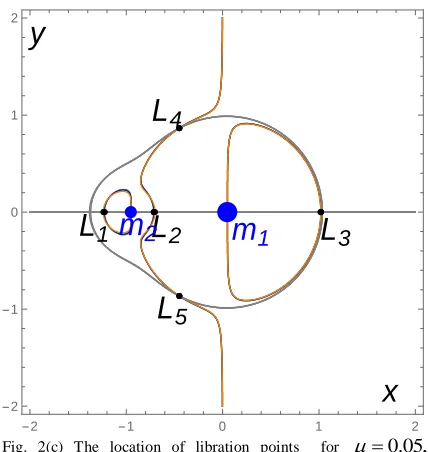
Fig. 2(c) The location of libration points for 0.05, 05
. 0 ,
10 5
k and l0.001,0.01,0.05,0.10. On solving Eqs. (2) and (3) numerically, we get five libration points L1, L2, L3, L4 and L5, out of which L4
and L5 are non-collinear with the primaries and L1, L2, L3 are almost collinear with the primaries. For
fixed values of parameters 0.05, k105, ,
05 . 0
l and 0.05, we get five libration points. In Figure 2(a), the location of libration points for different values of mass parameter are shown. We have taken0.05,k105,l0.05and 0.05, 0.10, 0.15, 0.20. The numerical values of libration points for different values of are given in Table 1. It is observed that as increases, L1 moves away
from m2 along the x-axis. L2 moves towards the
centre of mass O along the x-axis. L3 moves away
from m1 along the x-axis. L4 and L5 moves parallel to x-axis and towards the y-axis.
The location of libration points for different values of
are shown in Fig. 2(b). We have taken 05
. 0 , 10 , 05 .
0 5
l k
and 0.02, 0.05, 0.10,
0.15. The numerical values of libration points for different values ofare given in Table 2. The location of libration points for different values of l
are shown in Fig. 2(c). We have taken 05
. 0 , 10 , 05 .
0 5
k and l0.001, 0.01, 0.05,
L1 L2 L3 L4,5
0.05
(-1.23082, 6.86556106) (-0.71192, 1.70634106) (1.02000, -2.42891104) (-0.45042, 0.86485) 0.10
(-1.26166, 8.40468106) (-0.60647, 1.51175106) (1.04080, -1.20483104) (-0.40040, 0.86489) 0.15
(-1.27191, 9.74215106) (-0.51755, 1.47960106) (1.06150, -7.96326105) (-0.35042, 0.86491) 0.20
(-1.27236, 11.0466106) (-0.43614, 1.60978106) (1.08205, -5.91649105) (-0.30044, 0.86493) Table 1. Libration points, when 0.05,k105,l0.05.
L1 L2 L3 L4,5
0.02
(-1.23082, 6.72144106) (-0.71192, 1.50397106) (1.2000, -2.33360104) (-0.45042,0.86485) 0.05
(-1.23082, 6.86556106) (-0.71192, 1.70634106) (1.2000, -2.42891104) (-0.45042,0.86485) 0.10
(-1.23082, 7.10577106) (-0.71192, 2.04361106) (1.2000, -2.58776104) (-0.45042,0.86485) 0.15
(-1.23082, 7.34598106) (-0.71192, 2.38089106) (1.2000, -2.74662104) (-0.45043,0.86484) Table 2. Libration points, when 0.05,k105,l0.05.
l L1 L2 L3 L4,5
0.001
(-1.22809, 7.15184106) (-0.71522, 1.78288106) (1.02083, -2.43901104) (-0.45008,0.86598) 0.010
(-1.22820, 7.14019106) (-0.71509, 1.77978106) (1.02079, -2.43861104) (-0.45010,0.86594) 0.050
(-1.23082, 6.86556106) (-0.71192, 1.70634106) (1.02000, -2.42891104) (-0.45042,0.86485) 0.100
(-1.23906, 6.09515106) (-0.70201, 1.49801106) (1.01755, -2.39893104) (-0.45142,0.86147) Table 3. Libration points, when 0.05,k105,0.05.
IV. Stability of non-collinear libration points
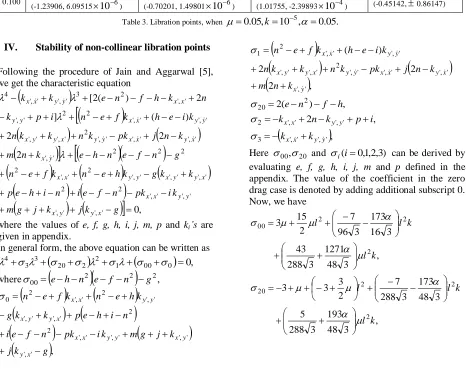
Following the procedure of Jain and Aggarwal [5], we get the characteristic equation
0,2
2 2
) (
]
2 )
( 2 [
' ,' ' ,'
' ,' ' ,' 2 2
' ,' ' ,' ' ,' 2
' ,' 2
2 2 2
' ,'
' ,' '
,' ' ,' 2 ' ,' ' ,'
' ,' '
,' 2
2 '
,'
' ,' 2
3 ' ,' ' ,' 4
g k j k j g m
k i pk n f e i n i h e p
k k g k h e n k f e n
g n f e n h e k
n m
k n j pk k
n k k n
k i e h k f e n i p k
n k
h f n e k
k
x y y x
y y x x
x y y x y y x
x y x
x y x
x y y x y y x
y y x
x y
y
x x y
y x x
where the values of e, f, g, h, i, j, m, p and ki’s are
given in appendix.
In general form, the above equation can be written as
1
00 0
0,2 2 20 3 3
4
where00
ehn2
ef n2
g2,
,' '
,' ,' '
,' ' ,' 2
2 '
,' ' ,'
' ,' 2
' ,' 2
0
g k j
k j g m k i pk n f e i
n i h e p k k g
k h e n k f e n
x y
y x y
y x x x y y x
y y x
x
2
,2 2
) (
' ,'
' ,' '
,' ' ,' 2 ' ,' ' ,'
' ,' '
,' 2
1
y x
x y x
x y y x y y x
y y x
x
k n m
k n j pk k
n k k n
k i e h k f e n
, ) (
2 2
20 en f h
,
2 ,' '
' ,'
2kx x nky y pi
,' ' ,' '
,3kx x ky y
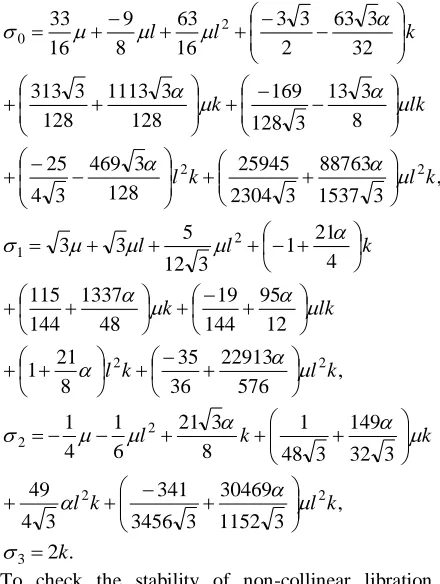
Here 00,20 and i(i0,1,2,3) can be derived by evaluating e, f, g, h, i, j, m and p defined in the appendix. The value of the coefficient in the zero drag case is denoted by adding additional subscript 0. Now, we have
, 3 48 1271 3 288
43
3 16 173 3 96
7 2
15 3
2
2 2
00
k l
k l l
, 3 48 193 3 288
5
3 48 173 3 288
7 2
3 3 3
2
2 2
20
k l
k l l
, 3 1537 88763 3 2304 25945 128 3 469 3 4 25 8 3 13 3 128 169 128 3 1113 128 3 313 32 3 63 2 3 3 16 63 8 9 16 33 2 2 2 0 k l k l lk k k l l , 576 22913 36 35 8 21 1 12 95 144 19 48 1337 144 115 4 21 1 3 12 5 3 3 2 2 2 1 k l k l lk k k l l , 3 1152 30469 3 3456 341 3 4 49 3 32 149 3 48 1 8 3 21 6 1 4 1 2 2 2 2 k l k l k k l . 2
3 k
To check the stability of non-collinear libration points, we have followed the procedure of Jain and Aggarwal [5]. We have found that in our case
k 1
and 32k and therefore, 1 3 and hence, L4,5 is not asymptotically stable. Further, one
of the roots of has positive real root. Hence L4,5 is
not stable. Hence we conclude that L4,5 are linearly
unstable.
V. Conclusion
The existence of the libration points in the restricted three body problem under the combined effects of Stokes drag and straight segment has been investigated. There exist five libration points, out of which two are non-collinear with the primaries and three are almost collinear with the primaries. Using the terminology of Murray [10], we have examined the stability of non-collinear libration points and found that in our case 1k and 32k which proves that L4,5 are linearly unstable.
The location of the libration points for various values of parameters ,and l are shown in Fig. 2. From Fig. 2(a), we observed that as mass parameter increases, L1 moves away from the smaller primary, L2 moves towards the centre of mass O, L3 moves
away from the bigger primary m1, and L4,5 moves
parallel to x-axis and towards the y-axis. It is observed that the effects of and l on the libration points are very negligible. The numerical values of libration points are given in Tables 1, 2 and 3. If we
take k=0 and l=0, our results confirm with the classical restricted three body problem (Szebehely [14]). If l=0 and k0, then the results confirm with Jain and Aggarwal [4]. If we consider k=0 and l0, then the results show the conformity with Jain et al. [6]. VI. Appendix , ' 1 3 1 r
e
' ,' 1 3 2 5 1 y r f
, ' ' ' 1 3 5 1 y r xg
,' ' 1 3 5 1 2 r x
h
, 1 ' ' 2 10 9 2 8 2 4 3
a a
a a a r r i , ' ' 1 ' 1 ' 1 ' ' ' ) 1 ' ( 2 4 3 2 4 2 3 2 4 3 r r r r a r r y x
j
, ' ' ' ' ' 2 2 1 ' ' ' ' ' 2 2 3 12 2 4 11 5 4 3 2 5 2 2 3 12 4 11 5 4 3 r a r a a r r a y a a r a r a a r r y m , 2 1 ' ' ' ' ' ' ' 2 ' 1 ' 1 ' ' ' 2 ' ' 2 5 2 4 3 5 4 3 2 4 2 3 5 4 3 2 2 5 4 3 2 a a r y r y a r r y r r a r r a y a r r a p , ' ) 1 ( ' ' )} 1 ( ' ){ 1 ' ( 3 4 8 r l x r l x x
a
, ' )} 1 ( ' ){ 1 ' ( 2 4 9 r l x x
a
, ' )} 1 ( ' ){ 1 ' ( 2 3 10 r l x x
a
)}, 1 ( ' { )}, 1 ( ' { 12
11 x l a x l
a
' '
' ' , , 4 21 ' ,' 4 / 11 2 2 ',' x y x yk k k
kx x x x
' '
' , 0,4 21 ' ,' 2 4 / 11 2 2 ' ,' y x y
x k x y y k k
k
' '
' , 0,4 21 ' ,' 2 4 / 11 2 2 ' ,' x y x
y k x y x k k
k
' '
' ' , . 4 21 ' ,' 4 / 11 2 2 ',' x y xyk k k
ky y y y
REFERENCES
[1] R. Aggarwal, Z.A. Taqvi and I. Ahmad, “Non-linear stability of L4 in the Restricted Three Body Problem for
Bulletin of Astronomical Society of India, 34, 327-356, 2006.
[2] R. Aggarwal and B. Kaur, “Robe’s restricted problem of 2+2 bodies with one of the primaries an oblate body,”
Astrophys and Space Science, 352(2), 467-479, 2014. [3] M. Jain and R. Aggarwal, “Existence and Stability of
Non-collinear libration points in the restricted problem with Poynting Robertson Light Drag Effect,” Int. J. of Mathematics Trends and Technology, 19, 20-33, 2015. [4] M. Jain and R. Aggarwal, “Restricted three body problem
with Stokes drag effect,” Int. J. Astron. Astrophys., 5, 95-105, 2015.
[5] M. Jain and R. Aggarwal, “A study of non-collinear libration points in the restricted three body problem with Stokes drag effect when smaller primary is an oblate spheroid,” Astrophys and space Science, 358, 51, 2015. [6] D. Kumar, R. Aggarwal and M. Jain, “Combined effects of
finite straight segment and oblateness on the libration points in the restricted three body problem,” Int. J. Tech., 6(2), 185-190, 2016.
[7] M. Khanna and K.B. Bhatnagar,”Existence and stability of libration points in the restricted three body problem when the smaller primary is a triaxial rigid body and the bigger one an oblate spheroid,” Indian J. Pure Appl. Math. 30(7), 721-733, 1999.
[8] J. C. Liou, H. A. Zook and A. A. Jackson, “Radiation pres-sure, Poynting-Robertson drag and solar wind drag in the restricted three body problem,” Icarus, 116, 186-201, 1995b.
[9] V. K. Mishra, J. P. Sharma and B. Ishwar, “Stability of triangular equilibrium points in the Photogravitational elliptic restricted three body problem with Poynting-Robertson drag,” International Journal of Advanced Astronomy, 4(1), 33-38, 2016.
[10] C. D. Muray, “Dynamical effects of drag in the circular restricted three body problems: 1. Location and stability of the Lagrangian equilibrium points,” Icarus, 112, 465-484, 1994.
[11] A. Riaguas, A. Elipe and M. Lara, “Periodic Orbits Around a Massive Straight Segment,” Celestial Mechanics and Dynamical Astronomy, 73(1), 169-178, 1999.
[12] A. Riaguas, A. Elipe, and T. Lopez-Moratalla, “Non-Linear Stability of the equilibria in the gravity field of a finite straight segment,” Celestial Mechanics and Dynamical Astronomy, 81, 235-248, 2001.
[13] R.K. Sharma, “The linear stability of libration points of the photogravitational restricted three body problem when the smaller primary is an oblate spheroid,” Astrophys and Space Science, 135(2), 271-281, 1987.