Chapter 4
American Society of Agronomy
Member Experiences and Perceptions
of the Peer Reviewing-Editing Process
R. E. Sojka
USDA-ARS
Kimberly, Idaho
H. F. Mayland
USDA-ARS
Kimberly, Idaho
E. E. Gbur
Agricultural Statistics Laboratory
University of Arkansas
Fayetteville, Arkansas
ABSTRACT
A membership survey regarding policies and attitudes ger-mane to the peer reviewing and editing practices and policies of the American Society of Agronomy, Crop Science Society of America, and Soil Science Society of America was deemed worthwhile. A second survey queried agricultural experiment station directors on related institutional aspects of the same topic. Briefly, responses indicated good demographic represen-tation of editorial boards with some underrepresenrepresen-tation of non-U.S. addressed members. One-third of the membership has served on the editorial board of some journal, and 1 in 7.4 has served on the editorial board of a Tri-Society journal. Females are used as reviewers one-third as often in proportion to their membership as are males. The publishing membership of the Tri-Societies is essentially those members with Ph.D.'s. Two-thirds of the papers submitted to Tri-Society journals require institutional review before journal submission. There is twice the support among the membership for dual anonymity (author and reviewers) as for reviewer anonymity only (the current policy). Nearly one-half the membership perceived shared responsibility by authors and editors for accuracy of published manuscripts. There was strong concern for seeking qualified reviewers, guaranteeing quality of reviews, admonishing poor reviewers, and instituting training in the Tri-Societies for writ-ing/reviewing/editing. Greater openmindedness was support-ed for publishing "negative" or unusual results where
methodology and analysis were acceptable. Concern was ex-pressed about influence networks undermining the fairness of the review process. Significant support exists for a rapid-publication journal in the Tri-Societies. Two-and-one-half times more authors indicated movement away from Tri-Society jour-nals than to them, with 44% indicating no change. The major reasons for journal migration were gravitation to journals that better reflected some recent shift in research focus, and vari-ous aspects of dissatisfaction with Tri-Society journals. Institu-tional responses indicated a strong raInstitu-tionale for developing and endorsing codes of ethics and limiting Tri-Society responsibili-ty for ethical infractions.
"Publish or perish" is a phrase that has been used since at least 1959 to describe the pressure on academics and researchers to produce scholarly writings (Miller, 1959). Long before then, the published manuscript had already become the universal, if arbitrary, gauge of professional stature. University tenure and advancement systems and the public sponsorship of research have also contributed to the modern focus on published work as a measure of scholarly prowess. Advances in communication have
af-Copyright © 1992 Soil Science Society of America, Crop Science So-ciety of America, and American SoSo-ciety of Agronomy, 677 S. Segoe Rd., Madison, WI 53711, USA. Research Ethics, Manuscript Review, and Journal Quality, ACS Miscellaneous Publication.
36 SOJKA, MAYLAND & GBUR
fected our access to information. Today's abundance of available technical information has made it necessary to limit manuscript publication based on peer assessment of quality.
Yet, this evolution toward refereed journals has proceeded largely as a response to external factors (Burn-ham, 1992). Publishing scientists, or for that matter the readership, have often been substantially insulated from the development of editorial practices and policies, ex-cept in the instances where editorial boards are composed of contributing scientists. Even in these instances the boards, usually composed of mature and recognized scho-lars, do not represent complete cross-sections of their con-tributors or readership. Furthermore, a given board may be substantially influenced by established precedents and may be predisposed to affect policies that derive primar-ily from the editorial point of view. Consequently, they may become somewhat desensitized to the concerns of contributors and readers.
Questions, concerns, and problems regarding the peer-reviewing and editing process are surprisingly universal across disciplines and journals (Lundberg, 1990). The scientific discipline or journal subject matter per se have little direct affect. Although there are marked procedural differences between journals they tend to find their ori-gins in each journal's historical or organizational caprices (Burnham, 1990, 1992; Heichel, 1992).
The performance of journals in providing credible, yet equitable reviews has become a growing concern with the information explosion, the increased emphasis on publi-cation numbers for professional advancement, and the uncovering of numerous publication scandals in the 1980s (Garfield, 1986a,b).
Publication of research results is fundamental to all scientific professions, and is one of the primary functions of the Tri-Societies'. The objective of this paper is to report the perceptions and attitudes of Tri-Society mem-bers regarding this important aspect of their profession-al lives and our societies' service to them. Two questionnaires were compiled to help make this assess-ment. The first polled a sample of the Tri-Society mem-bership on important issues related to the publication of research. The second attempted to define the institutional framework in which the publication process is imple-mented. This paper analyzes and communicates the results of these polls and the perspectives they reflect.
AMERICAN SOCIETY OF AGRONOMY MEMBERSHIP QUESTIONNAIRE
RESULTS AND DISCUSSION
Demographics of Respondents
The authors initially queried the ASA Board about the feasibility of a number of questionnaire formats and dis-tribution/response options. Previous success of question-naires included in
Agronomy News
was very poor (20-30 responses from a mailing in excess of 10 000). Therefore,Table 4-1. Response rates of the membership sample by selected respondent characteristics; overall response was 279 of 516 mailed, or 54.1%.
Member characteristics
Distribution in given population 8940
Members t 516 Sampledt
279 Respondents
Response rate$ Gender
Male 93.6 93.2 94.3 54.7
Female 6.3 6.8 5.7 45.7
Respondent's address§
U.S. 78.6 76.6 83.5 59.0
Non-U.S. 21.4 23.4 16.5 38.0 Highest degree
M.S. 22.8 22.9 17.9 42.4
Ph.D. 77.2 77.1 82.1 57.4
t Entries in these columns differ slightly because of excluded in-dividuals for whom information on other stratification variables was not available.
$ Response rate is defined as the percentage of questionnaires returned by the selected individuals in that category. § Respondent's address was taken as the address from which it
was returned, which occasionally differed from the address to which it was mailed.
a direct mailing was considered to have a greater likeli-hood of response, based on known survey sampling pat-terns. Polling methodology is described in detail in Appendix 4-1.
The response to the questionnaire resulted in the demo-graphics shown in Table 4-1. Not every respondent al-ways answered every question. Therefore the individual question response in many instances is some number less than 279. Notably, overall response was 54.1% (279 respondents) of the selected sample (516 potential respon-dents). The responses were highly reflective of the desired preselected categories identified in the eligible population of 8940 members (Table 4-1). Among the eight strata, male Ph.D.'s with U.S. addresses had the highest response rate (63.8%), and male M.S.'s with non-U.S. addresses had the lowest response rate (23.5%) (Sojka, Mayland, Gbur, 1992, data not shown).
Interpretation of the data requires recognition of sever-al qusever-alifications related to the data. It should be emphat-ically underscored that the responses analyzed and our
interpretations are based on this sample,
and that these statistics, especially where they imply member demo-graphics are related to the respondents andnot the
actu-al complete membership.
In addition, it is implicitly assumed that the nonrespondents' perceptions and atti-tudes do not differ substantially from the respondents (i.e., nonresponse was related to factors other than those addressed in the questionnaire).The responses that reflect attitudes, rather than numer-ical estimates by the respondents, may require somewhat less qualification in relating them to the overall
ETHICS, REVIEW, AND QUALITY 37 Table 4-2. Years of work experience and ASA membership of
respondents by selected respondent characteristics.
Respondent characteristic
Work experience ASA membership
± SE x± SE
yr
Overall 17.5 0.7 15.6 0.6
Gender
Male 18.0 0.7 16.0 0.7
Female 8.6 1.6 7.2 1.3
Address
U.S. 17.1 0.7 16.2 0.7
Non-U.S. 19.4 1.6 12.6 1.4 Highest degree
M.S. 13.6 1.7 10.4 1.1
Ph.D. 18.4 0.7 16.7 0.7
Table 4-3. Cross-tabulation of editorial experience of respondents. Non-ASA editorial
experience
Yes No Row total no., %
ASA editorial
experience Yes 20 (7.3) 17 (6.3) 37 (13.6) No 67 (24.6) 168 (61.8) 235 (86.4) Column total 87 (32.0) 185 (68.0) 272 (100) t ASA editorial experience is different (P < 0.002) from non-ASA
experience.
ship. A further point that should be made, however, is that
other than demographic data, the responses reflect
perceptions. These perceptions may or may not be
reali-ty.
Nonetheless, it is important to understand what the perceptions of the membership on peer reviewing and editing are, and to examine how these perceptions may impact the process. Furthermore, to the extent possible, the Tri-Societies may wish to explore mechanisms to address these perceptions in order to pursue positive goals related to the publication process. A final qualification is that (although assumed otherwise) the respondents may reflect a sample that is more involved or more concerned about the publishing process than the nonrespondents. This could affect the interpretation of certain questions as noted throughout the text.Table 4-2 provides a profile of the work experience and membership tenure of the respondents. Membership tenure in the Tri-Societies is only slightly less than the number of years work experience of respondents. This would suggest that professionals view membership in the Tri-Societies as an integral part of their professional ex-perience. Notably, work experience and membership years of respondents with M.S. degrees are 74 and 62% respectively of the Ph.D. years. This may reflect both a higher dropout rate by M.S. vs. Ph.D. holders from the profession and/or Tri-Society membership, or alterna-tively reflect the movement of M.S. level professionals to the Ph.D. level. In the latter case, years of work and membership are likely counted as Ph.D. level. Responses of the female respondents suggest they make up a younger
Table 4-4. Demographic characteristics of respondents reporting editorial experience.
Respondent
characteristic ASA editors Non-ASA editors no., %
Gender Male Female Address
U.S. Non-U.S.
39 (100) 85 (97.7) 0 (0.0) 2 (2.3) 36 (92.3) 66 (75.9) 3 (7.7) 21 (24.1) work force on average. The reasons for this trend may be related to the rather recent entrance of significant num-bers of females into a largely male-dominated profession, and/or the more rapid exodus of females from the profes-sion because of family or other considerations. Respon-dents from non-U.S. addresses, although having somewhat similar years of work experience, had only 78% as long a membership tenure.
Publication Process Experience
One important aspect of the survey was to estimate the extent of the editorial experience of the membership. An analysis of this result is found in Table 4-3. Among the 14% who had Tri-Society editorial experience over one-half also had experience editing other (i.e., non-ASA) journals. Among the respondents having no Tri-Society editorial experience, 25% did have experience editing other journals. This implies that nearly one-third of the respondents have had some editorial experience and two-thirds had no editorial experience. This would suggest that Tri-Society members can expect to have ample opportu-nity over the course of their careers to serve as editors of a journal in their discipline, although perhaps not for a Tri-Society journal.
edi-38 SOJKA, MAYLAND & GBUR
tors are probably serving the journals based in their home countries. The lower representation of non-U.S. addressed respondents on Tri-Society editorial boards may reflect perceived language difficulties and/or logisti-cal and mailing problems that could impair effective editorial service. The low representation of females on Tri-Society editorial boards may simply reflect the shorter work experience and membership tenure seen in Table 4-1.
The combined journals of the Tri-Societies request some 3000 to 4000 manuscript reviews each year. Table 4-5 analyzes the frequency of selection of respondents to review for Tri-Society vs. non-ASA journals. Forty-two percent reported they were asked to review a mean of 1.6 manuscripts each for ASA journals in 1989, whereas 58 0 reported they reviewed no papers for ASA journals.
Fifty-seven percent reported they reviewed a mean of 3.0 manuscripts each for non-ASA journals. These num-bers of reviews seem inflated, particularly if assuming the reviewer cadre of ASA and non-ASA manuscripts is sub-stantially the same. At 1.6 ASA manuscripts per year x 42% of the 8940 members in the eligible population there would be 6008 reviews for the Tri-Societies performed annually. This is an overestimate of 30 to 50%. An in-flated estimate could also reflect the fact that the 279 questionnaire respondents represent a more responsible or concerned group, by simple virtue of their response to the questionnaire. The fact that 58% said they had per-formed no reviews, however, would seem to negate this argument. Further analysis of the responses shows near-ly one-third (32 07o) indicated they had not reviewed any journal paper in the past year. Similarly 31% noted they had reviewed papers for both ASA and non-ASA jour-nals. However, only 11% had only reviewed manuscripts solely for the Tri-Society journals, and 25% had reviewed only non-ASA manuscripts.
Female respondents indicated a much higher probabil-ity of being requested to review a non-ASA manuscript than an ASA manuscript. Only 15% of female respon-dents had reviewed for a Tri-Society journal in the previ-ous year compared to 43% of male respondents. In contrast, 46% of the female respondents reported provid-ing reviews for non-ASA journals in the previous year, compared to 57% of male respondents. The interpreta-tion of this response must be at least somewhat tempered, however, by the small sample size of female respondents. Numbers of respondents reporting no requests to perform reviews were similar for ASA and non-ASA journals among U.S. addressed respondents; however, non-U.S. respondents reported far more opportunity to review papers for non-ASA journals. Conversely, U.S. addressed respondents were less likely to review papers for non-ASA journals than foreign respondents. Again this may reflect logistical and language-related factors. Perceptions of the peer-reviewing and editing process could be influenced by the individual's own publication frequency. The respondents' self-reported publication
Table 4-5. Numbers of reviews performed by respondents in the preceding year, as related to respondent demographic charac-teristics.
Respondent characteristic
Reviews for ASA journals
Reviews for non-ASA journals .7c ± SE No reviews z ± SE No reviews
%
no. no.
Overall 1.6t 0.2 58 3.0$ 0.4 43 Gender
Male 1.7 0.2 57 3.0 0.4 43 Female 0.5 0.4 85 2.1 1.0 54 Address
U.S. 1.9 0.3 54 2.6 0.4 47 Non-U.S. 0.3 0.1 79 4.6 1.1 28 Highest degree
M.S. 0.1 0.1 93 0.5 0.2 74 Ph.D. 1.9 0.3 50 3.5 0.4 37 t 1.6 ± 0.2 reviews of ASA manuscripts by the 42% doing reviews.
3.0 ± 0.4 reviews of non-ASA manuscripts by the 57% doing reviews.
Table 4-6. Numbers of manuscripts authored or coauthored by respondents in the preceding 2 yr, as related to respondent demo-graphic characteristics.
Respondent characteristic
ASA journal papers Non-ASA journal papers x ± SE No papers z ± SE No papers
% %
no.
no.-Overall 1.0 0.1 62 3.1 0.4 35 Gender
Male 1.0 0.1 62 3.2 0.4 35 Female 0.5 0.3 69 2.3 0.9 31 Address
U.S. 1.0 0.1 61 2.6 0.4 37 Non-U.S. 0.8 0.2 68 5.6 1.8 23 Highest degree
M.S. 0.2 0.1 87 0.6 0.1 59 Ph.D. 1.1 0.1 57 3.7 0.5 30
records for the 2 yr prior to the survey appear in Table 4-6. Essentially one-third of all respondents reported pub-lishing papers in an ASA journal in the previous 2 yr. Approximately two-thirds of the respondents reported publishing papers in non-ASA journals. The publication rate reported for non-ASA journals across all groups in-dicated about three times the publication rate in non-ASA journals. The Ph.D. respondents were far more likely than M.S. respondents to publish in the previous 2 yr, and to publish far more papers, both in ASA journals and in non-ASA journals. Further analysis (Sojka, May-land, Gbur, 1992, data not presented) shows that 26% of the respondents had published no paper in the previ-ous 2 yr. Whereas only 9% had published in only ASA journals, 36% had published in only non-ASA journals. Twenty-nine percent had published in both ASA and non-ASA journals. This analysis did not differ based on gender.
39 ETHICS, REVIEW, AND QUALITY
Table 4-7. Numbers of manuscripts authored or coauthored by respondents in their careers, as related to respondent demograph-ic characteristdemograph-ics.
Respondent characteristic
Senior authorships
Junior authorships
In ASA journals
t
-I- SENo
papers + SE No papers - no. - - no.
Overall 15.4 1.7 10 13.4 1.4 17 33.7 Gender
Male 16.0 1.8 10 13.8 1.5 17 34.3 Female 4.0 L1 23 4.8 2.1 31 21.8 Address
U.S. 14.5 1.9 12 12.8 1.5 19 37.4 Non-U.S. 19.7 3.3 4 15.9 3.6 11 14.4 Highest degree
M.S. 1.9 0.6 47 2.7 0.6 42 24.6 Ph.D. 18.1 2.0 3 15.5 L6 12 35.3
t
Calculated for total of senior and junior authorships.Table 4-8. Distribution of respondents with or without authorship experience as senior author, junior author, or combined ex-perience.
Junior author Respondent Senior
characteristic author Yes No %t
Overall Yes 77.6 12.1
No 5.2 5.2
Males Yes 78.8 11.6
No 4.6 5.0
Females Yes 53.9 23.1
No 15.4 7.7
t
Table entries are percentages based on all respondents having the specified characteristics who answered both questions.influenced the number of reported papers. Males in the sample reported four times the senior authorships and three times the junior authorships as females. This career output difference among males and females contrasts with only twice as great work experience for males. This may reflect a skewing of greater productivity toward later career years, or it may reflect greater genuine impedi-ments to publication by females. These impediimpedi-ments may be related to the publication process, they may relate to conflicting family and social demands outside the work-place, or they may reflect less opportunity to pursue research leading to publication because of other impedi-ments in the workplace.
If extended to differentiate senior and junior author-ships (Table 4-8), additional analysis showed that 5% had no career publications whatsoever. Twelve percent pub-lished only as senior authors whereas 5% pubpub-lished only as junior authors. The remaining 78% had published both as senior and junior authors. Although there was a very small number (13) of female respondents on which to base a comparison, it appears that female authors were more inclined than males to have only published as senior or only as junior authors and that their career opportunity for both experiences was reduced (54 vs. 78%) compared to males. Interestingly the percentages with neither senior
nor junior authorship were practically the same for fe-males as for fe-males.
Non-U.S. residents reported both more senior and junior authorships over their careers than do U.S. resi-dents. This may relate to a slightly longer reported work experience (Table 4-2) or may indicate greater ease of publication in non-ASA journals (or their greater num-bers) that this group reported to patronize more heavily (Table 4-6). Another explanation could be that non-U.S. addressed respondents have a more intense interest in publishing than their U.S. counterparts. While U.S. respondents reported publishing 37% of their career pub-lications in Tri-Society journals, non-U.S. addressees reported publishing only 14% of their papers in them. Whereas 97% of Ph.D.'s reported having at least one senior authored paper, only one-half (53%) of the M.S. respondents reported having ever written a senior authored paper. Similarly, 88% of Ph.D.'s reported hav-ing at least one junior-authored paper, compared to 58% for M.S. respondents. Therefore, it is apparent that a large fraction of the M.S. respondents are not actively involved in the publication process.
If one multiplies the reported overall work experience mean of the respondents (17.5 yr) by the reported annu-al combined senior plus junior authorships of refereed papers (2.05 authorships per year), the product would in-dicate a career production of 36 papers expected. This contrasts with a reported career output mean of 28.8 senior plus junior authorships. Therefore, respondent perceptions of their personal publication prowess may, in fact, be somewhat inflated (by approximately 25%). Alternatively, it may reflect career growth patterns in which later years are generally more productive of pub-lications, either because of program growth or because in later years as one's acceptance rate increases. Yet another possibility is that there is an increasing empha-sis on publish or perish. In any case, the perceptions may be based on more recent performance.
anal-ysis also investigated possible relationships between num-bers of manuscripts published and rejection rate and reported institutional review severity and rejection rate. There was no relationship in either instance.
Internal institutional review practices prior to journal submission may affect author experiences at the journal level. Among the 279 respondents, 19% indicated that no review was required prior to journal submission. Another 19% reported that review was only optional, of these respondents only one-third described the optional internal review as being rigorous. One hundred seventy-three respondents (62%) reported that an internal institu-tional review was required and nearly two-thirds described these reviews as rigorous. These results strongly parallel the information reported by university experiment sta-tions in a separate questionnaire discussed below.
General Review Process
The question of anonymity and identity of parties to the review process causes concern among many authors. When asked who should be anonymous, 70% of the respondents answered that reviewers should remain anonymous and 49% answered that authors should be anonymous. Only 24% replied that both authors and reviewers should be identified, whereas 43% replied that both should be anonymous. Although 44% of the respon-dents said that reviewers could surmise the identity of authors even if attempts were made to preserve anonymi-ty, 57% suggested that dual anonymity would still help improve the fairness of reviews. Only 27% of the respon-dents said that reviewers should be anonymous with authors identified (which is the current practice in all Tri-Society journals). Less than 6% of the respondents said that reviewers should be identified while authors remained anonymous.
Authors are nearly always concerned with the timeli-ness of the review process. Ninety percent of the respon-dents agreed that a reviewer should perform the review of a "typical" paper in not more than 30 d. Despite this strong agreement on punctuality, 71% expressed their un-willingness to see editors accept a paper for publication, by default, merely because the reviewer was tardy. Data presented by Heichel (1992) shows that despite their ex-pressed concern about timeliness of the peer review/editorial process, the single most time-consuming step in manuscript processing in Tri-Society journals is the interval between author receipt of reviews and author return of a revised manuscript.
Although quality is viewed as a major consequence of the review process, identification of dishonesty is not. When asked if it was possible to detect and prevent dis-honesty in the review process, responses were distributed over the range of strongly agree to strongly disagree, with the greatest fraction (36%) of responses being neutral. Nonetheless, the responsibility for quality of a published manuscript was perceived by 75% of the respondents to be shared by both the author and the editorial process.
Accuracy of a published manuscript was perceived by 57% of the respondents to lie with the author, yet 41% said this responsibility was shared by the author and editorial process. Only 2% of the respondents indicated that accuracy or quality was the sole responsibility of the editorial process. It might be argued that the quality con-siderations of agricultural journals could be less stringent than for other disciplines that may have greater immedi-ate consequences associimmedi-ated with use of the information. When asked if agricultural journals should have the same review rigors as, say, medical journals, the responses were 40% strongly agree, 33% agree, 19% neutral, 7% dis-agree, and 1% strongly disagree. Clearly the overwhelm-ing response indicated the need for the highest possible quality of review and would suggest that science demands quality and accuracy, regardless of the discipline.
Reviewer Selection and Performance
A major concern for most authors is whether review-ers have adequate subject matter familiarity to provide a credible review. When asked if a peer reviewer should have minimum credentials established by the journal, 81% agreed. Respondents were nearly equally divided, however, when asked if a peer reviewer should have the same or greater technical expertise as the most recognized author on a paper. Thirty-seven percent agreed, 38% dis-agreed, and the remaining respondents were neutral. It might be argued that the authors themselves are best suited to identify potential credible reviewers. When asked if the author should have the right to select one of the three reviewers only 32% agreed, whereas 47% dis-agreed.
sub-ETHICS, REVIEW, AND QUALITY 41 Table 4-9. Respondent perception of their cumulative experience
with the review process, expressed as an evaluation of quality of reviews received on manuscripts they have written. Table en-tries are percentages for that review characterization.
Percentage frequency of encounterst Review characterization Never <25 25-75 >75 Always
% of responses Accurate, constructive,
concise 0 2.8 42.3 51.6 3.3 Questionable, but
constructive 3.4 43.2 37.7 14.4 1.3 Wrong, but polite, concise 18.9 66.5 11.6 3.0 0 Wrong and hostile 52.1 44.1 3.0 0.4 0.4 Accurate, but hostile 47.6 43.7 7.8 0.4 0.4 Biased by reviewer
self-interest 26.7 50.8 19.5 3.0 0 Personal attacks 76.9 20.1 2.6 0.4 0 Trivial, whether correct
or not 17.2 56.3 20.6 5.9 0 t This question encountered a nonresponse rate that ranged
be-tween 33 and 48 respondents of the 279, and averaged 42.8 non-responses per characterization.
standard reviewer. Only single answer responses were computer coded for analysis. This necessity may have par-tially diluted the strength of the outcry for action to limit the effect of substandard reviewers. The respondents ovewhelmingly agreed (80%) that the Tri-Societies should have a regularly recurring means of educating and im-proving reviewer's skills (e.g., articles in Agronomy
News, seminars at annual meetings, or a chapter in the Publications Handbook and Style Manual).
Contents of Reviews
The respondents were asked a series of questions re-lated to the contents of reviews obtained in the peer-review process. Interestingly, the response rate for near-ly all sections of the questionnaire approached 90%. The response rate of this section, however, was between 52 to 67%. This would suggest that many of the respondents lacked sufficient exposure to the process to formulate strong perceptions about it. One might well ask that if a significant number of authors are only marginally ex-perienced with the review process, how would these authors objectively evaluate reviews they received, as noted above?
Review quality is affected by both technical objectivi-ty and reflections of reviewer behavior. Despite perenni-al concerns about perenni-all aspects of the peer reviewing-editing process, 55% of the respondents (Table 4-9) answered that reviews they had received were "accurate, construc-tive, concise" more than 75% of the time, and less than 3% indicated that this occurred less than 25% of the time. Approximately 67% of the respondents indicated that as many as 1 in 4 comments were technically flawed, but that in these instances the review comments were still po-lite and concise. Likewise, 44% of the respondents indi-cated that as many as one in four comments were not only technically flawed but were hostile. However, 52% of the respondents said that they had never received com-ments that were both wrong and hostile.
Upon receipt of reviews the associate editor may recog-nize certain problems with the review. It may be exces-sively critical, poorly written or simply cursory, or accompanied with harsh and abusive language. Forty-eight percent of the respondents noted that even if the reviewer is prestigious, editors should seek an alternate review in these instances. Thirty-seven percent said the review should be returned to the reviewer for a rewrite, and only 3% of the respondents favored accepting such reviews as written. When a similar question was posed with regard to courtesy, nearly the identical responses oc-curred, 51% favored return for rewrite, 28% favored an alternate review, and 15% would accept as is. The balance in either case (12 and 6%, respectively) would have the editor ignore the poor review.
The favorability of a review is often strongly influenced by a manuscript's manner of presentation, rather than its scientific content. When asked what to do with a manuscript that contained good science, but was poorly written, 50% of the respondents disagreed with the sug-gestion to reject the manuscript. Thirty-three percent fa-vored rejecting the manuscript and 16% were neutral. Other cases can involve manuscripts containing good science that receive poor reviews related to identifiable factors. One common concern is rejection of papers be-cause they report "negative" results. When asked if they believed that negative results get equal treatment with positive results in the review process; 51% said no, 30% said yes, and 19% were neutral. Similarly, many scien-tists express concern about the reception of particularly new or innovative concepts. These people will be pleased to know that 92% of the respondents favored publica-tion where methodology and analysis are acceptable but results are contrary to accepted beliefs. Nearly two-thirds of those strongly favored publication. Respondent con-cern on this point was further underscored by the agree-ment of 54% that the review process restricts publication of innovative ideas by relying too heavily on accepted standard concepts. Nearly 30%, however, were neutral.
Noncontent Related Factors
Many and varied aspects of the publication process are affected by factors having nothing to do with manuscript content, regardless of technical or presentation quality. Many of these considerations have a potent influence on individual attitudes and motivation. When asked if they worked in a publish or perish environment, surprisingly only 51% of the respondents agreed, and 36% disagreed. Interestingly the response was strongly affected by respondent location in or out of the USA, with 54 010 of U.S. addressed respondents agreeing and only 36% of non-U.S. respondents agreeing. Nearly two-thirds of the respondents agreed that the need to publish or perish in the arena of agricultural scholarship has become un-reasonable; only 14% disagreed.
42
However, 56% of the respondents did agree that their publication success was affected by cliques and Good Old Boy systems (influence networks), only 20% disagreed. On a more positive note only 3% agreed that gender af-fected the likelihood of a favorable review and paper ac-ceptance. Furthermore, 78% of the overall respondents and 85% of the female respondents said gender had no effect. Similarly, only 7% of the respondents agreed that nationality, ethnicity, and/or race had affected the likeli-hood of favorable review and paper acceptance; 72% overall and 70% of non-U.S. addressed respondents stat-ed that these factors had no effect. Although the initial inclination is to interpret this as a lack of racial, ethnic, or nationality bias, one must pause to question whether perceived bias by 7% of the membership indicates that, in fact, certain minority groups are adversely affected. When asked specifically if the respondent's career had suffered or was slowed down by poor or unfair reviews of an important paper(s) only 10% agreed, and 78% dis-agreed.
There are numerous political and ethical considerations associated with authorship. When asked about multiple authorships, the respondents were nearly evenly divided on whether or not Tri-Society publications should iden-tify how much and what kind of contribution each author made to a paper. Nonetheless, more than two-thirds agreed that authorships and their order are affected by politics apart from scientific contribution.
American Society of Agronomy, Crop Science Society of America, and Soil Science
Society of America Journals
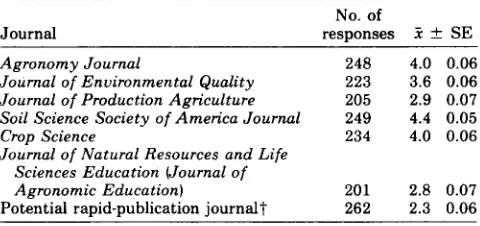
A number of questions evaluated specific aspects of the Tri-Society journals. The first of these questions dealt with the member's perception of the relative prestige of the Tri-Societies' six major journals in the world of scien-tific publication (Table 4-10). Responses were somewhat affected by the respondent's familiarity with a particu-lar journal. With a score of 1 indicating low prestige and 5 indicating high prestige, the weighted mean evaluation of all six journals was a score of 3.7. The results in Table 4-10 (based on respondent perception of journal pres-tige) corresponded well with the citation analysis pre-sented by Garfield (1992).
When further queried, nearly one-half of the respon-dents agreed that there were both journals and topics within journals in which it was more difficult to publish than others. Unfortunately a subsequent question that attempted to identify these divisions in the Tri-Society was poorly understood, and these responses were unin-terpretable. The nature of the difficulty suggested a lack of familiarity and/or identification with Tri-Society divi-sions on the part of the membership.
Despite all of the perils and problems of the publica-tion process less than 3% of the respondents answered that overt dishonesty was a problem in the Tri-Society journals, whereas 74% did not perceive overt dishonesty
Table 4-10. Respondent perception of the prestige of Tri-Society journals in the world of scientific publication, with prestige ranked from low to high on a scale of 1 to 5.
Journal
No. of
responses z ± SE
Agronomy Journal 248 4.0 0.06
Journal of Environmental Quality 223 3.6 0.06 Journal of Production Agriculture 205 2.9 0.07 Soil Science Society of America Journal 249 4.4 0.05
Crop Science 234 4.0 0.06
Journal of Natural Resources and Life Sciences Education (Journal of
Agronomic Education) 201 2.8 0.07
Potential rapid-publication journal[ 262 2.3 0.06 t Respondents were queried in a separate question about the need
for and relative prestige of a new rapid-publication journal with a streamlined review process. The evaluation format was iden-tical to that for the rest of the data presented in Table 4-10. Therefore, results are shown here for comparison.
to be a problem. Even where the problem was described as one of rationalization and misleading presentations of research results, less than 9% agreed that this was a problem in Tri-Society journals, whereas 63% disagreed. The remaining questions in the questionnaire were somewhat focused on possible publication alternatives within the Tri-Societies. Nearly two-thirds of the respon-dents agreed that Tri-Society journals should provide a mechanism for editing the grammar and punctuation of manuscripts accepted for publication.
Some of this occurs now in Tri-Society journals, but it is apparently the perception of the respondents that it would be advantageous to expand this service. Nearly one-half of the respondents (47%) expressed agreement that Tri-Society journals should publish more philosophi-cal, speculative, and socially analytical papers that inter-pret and apply the results of agricultural research to social and governmental concerns. One-third of the respondents disagreed with this concept.
Another evaluation of journal focus dealt with jour-nal treatment of properly conducted studies that were, nonetheless, released, merely because they contained so-called "negative results." That is to say, studies in which controls and alternative treatments do not differ, or in which hypotheses failed to be proven. Given a second op-portunity to respond on the topic, 8 3 07o of the respon-dents agreed that negative results are valuable and should be published in Tri-Society journals; more than one-half of these strongly agreed. A better adherence to this prin-ciple could avoid a substantial repetition of unproduc-tive research by other scientists.
ETHICS, REVIEW, AND QUALITY 43
When asked specifically whether the Tri-Society jour-nals seek enough input from the membership in setting editorial policy, 35% agreed and 25% disagreed. This question was followed by an invitation to identify editori-al policies with which the respondents disagreed. Their responses were extemporaneous, and not prompted by key words or multiple choice statements. The authors of this paper have, of necessity, attempted to summarize their comments into major categories of concern. The major points noted included (number of responses are in parentheses):
1. Liberalize acceptance of: presentation styles, statis-tics, limited audience papers, unconventional ideas, limited but sound speculation, shift some trite papers to notes (23).
2. Limit the possibility of biased or poor reviews; al-low authors to identify potential reviewers (20). 3. Shorten the ASA review process; maybe use a
cadre of appointed reviewers, maybe pay them (20).
4. Provide more guidance/feedback to reviewers to educate them and/or calibrate their review perfor-mance against others, advise authors about which comments to heed (10).
5. Reevaluate the strict adherence to SI units, that are less appropriate than non-SI units in certain cases (9).
6. Conceal author and/or reveal reviewer identity (7). 7. Be more open to international and non-ASA
in-put (5).
8. Seek more member input to improve communica-tion of editorial practices, policies, standards, etc. (5).
9. Select only professionally mature reviewers and as-sociate editors, change editors more frequently (4). 10. Eliminate anonymity, encourage communication
(4).
11. Require access to original data, reject poor gram-mar, tighten up statistics, specify author contribu-tion (3).
12. Standardize review severity among ASA divisions
( 1 ) .
13. Publish more reviews by top scientists (1). Interestingly, the greatest volunteered response had numerous comments implying that enforcement of statistical "requirements" in Tri-Society journals is too rigid and sometimes capricious, especially compared to non-ASA journals. In a recent unrelated survey of C-6 members (J.H. Cherney, 1990, personal communication), with 113 responses to 151 questionnaires mailed, 57.5% of the overall respondents expressed the opinion that Tri-Society journals are too statistically oriented, such that important scientific information is occasionally com-promised. When this question was analyzed with regard to the respondents' editorial experience, the agreement was 44% among those with editorial experience, and 69% among those without editorial experience. It would seem, therefore, that there is considerable sensitivity among the
overall membership on this issue, and that it should not be lightly dismissed. However, in light of the citation analysis presented by Garfield (1992), it should also be noted that Tri-Society journal quality is high compared to non-ASA journals, and the maintenance of high statistical standards is undoubtedly a contributing fac-tor. The question to answer in light of these responses is whether we have exceeded the reasonable need for statistical analysis to uphold the high standards of the journals.
Finally, respondents were asked if, in recent years, they had been more or less likely to publish in ASA journals than in non-ASA journals. Forty-four percent indicated no change, while 40% indicated that they were less like-ly to publish in Tri-Society journals. Onlike-ly 16% indicated that they were more likely to publish in ASA than in non-ASA journals. Respondents again were given an oppor-tunity to discuss their reasons for these preference changes. Some of the major themes that were noted in-cluded:
More Likely to Publish in ASA Journals Because of: 1. ASA journal prestige and wide circulation (13). 2. Change in research focus (3).
3. Journal of Production Agriculture's provision of a more applied forum for my work (1).
4. Good editing and good reviews (1).
Less Likely to Publish in ASA Journals Because of: 1. Other, more specialized, journals in my field (25). 2. Lack of sufficient international scope (14). 3. Dissatisfaction with the ASA review/publication
process (10).
4. Change in research focus (9).
5. Preference for more user-oriented (applied) pub-lications (9).
6. Excessive Tri-Society journal review time (7). 7. High page cost of Tri-Society journals (7). 8. Unreasonable statistical demands (7).
9. Tri-Society journal cliquishness/conservatism (6). 10. SI units (2).
11. Poor photograph reproduction (1).
COLLEGE OF AGRICULTURE QUESTIONNAIRE
Manuscript Review Practices
44 SOJKA, MAYLAND & GBUR a requirement for approval to submit a manuscript to a
journal. Of those 50% who indicated that peer review was a requirement for journal submission, 12 respon-dents, or about one-half in that category, indicated that the author selected the peer reviewer. The remaining 17 respondents indicated that the reviewer was selected at the discretion of an administrator. Most (14) were selected by the department head or his designee. Two respondents indicated that this review was performed by a depart-mental review committee.
Manuscript Editing
Institutional editing included review by a grammarian at 27% of the institutions responding. A similar service was optionally available at another 31% of the respond-ing institutions. A routine inspection of manuscripts for statistical accuracy was indicated by only one respondent. Though this indicates that statistics are not included for-mally in the review or approval process, it does not neces-sarily mean that the review process is devoid of statistical evaluation, or that a statistician is not frequently con-sulted in the course of the research and its evaluation preceding manuscript preparation. The flow and ultimate fate of manuscripts prepared by the staff of 61% of responding institutions is routinely tracked through to publication.
Faculty Requirements
The importance of publication to the performance evaluation of faculty is reflected in the requirement by 93% of the responding institutions for research publica-tions to qualify for tenure. An integral aspect of this ac-tivity is the concomitant requirement by 87% of the responding institutions that faculty are responsible for seeking soft monies to conduct research. These two re-quirements are simultaneously complimentary and an-tagonistic. The monies obtained through the grant process are easier to obtain with a proven record of publication, and also enable further publication. Yet, the time invested in grantsmanship and grant writing can detract from per-forming research and publishing results.
The rigidity of faculty requirements for acknowledg-ment of and adherence to ethical standards is less uni-form. Only 45% of the respondents indicated the existence of a formal code of ethics at their institution. Only one-half of these (20% of all respondents) were obliged to acknowledge the code in writing. The impor-tance of some form of ethical framework is underscored by the response of 30% of the institutions that there had been at least one situation in which an ethical issue had been raised. Only one-third of these (5 respondents) said that the ethical question had resulted in legal action. More than one-half (57%) of the respondents agreed that the existence of a code would not preclude its violation. One in five of the respondents (18%) disagreed, believing that the code itself prevented violations, whereas 9% were
un-sure. Fifty-seven percent also agreed that the existence of a code assisted in the prosecution of an ethical violator.
Student Training/Requirements
Given the importance of scientific writing to career de-velopment and success, several aspects of institutional re-quirements and programs affecting the publication process were queried. None of the respondents indicated that training in technical writing was a requirement for graduation with an advanced degree. In 86% of the responses, however, training was identified as available at the option of the student or student's committee. The degree to which students availed themselves of such train-ing varied widely among respondtrain-ing institutions. Most respondents stated either that technical writing courses were not heavily utilized, or that they were unaware of the extent of their utilization. Where such courses were available, only about one-half of the respondents familiar with the course material said that the courses simulated the writing, reviewing, and revising process for manuscripts in the students' discipline. More than one-half (52%) of the respondents noted that the ethics of scientific research and publication were addressed in stu-dent training through courses, workshops, seminars, or as some other aspect of student training.
Unlike the ubiquitous pressure on faculty to publish research, only 14% of the institutions responding indi-cated that graduate students were required to publish their research in order to obtain their degree. Similarly only 16% responded that college/department requirements dictated that graduate students should be the senior author of papers published from their theses or disserta-tions. One in five of the respondents did indicate, however, that the students' prerogative to senior author the paper did eventually expire. The period varied among respondents, but usually was within 2 yr.
DISCUSSION
The results of these two surveys were voluminous and robust. The analysis performed by the authors has been largely in the context of providing valuable information to the Tri-Societies that may prove useful in analyzing its entire posture with regard to the peer reviewing and editing process. The structure of the data set is such that appropriate scholars could use the data for further anal-ysis related to the philosophy and sociology of science by arrangement with the authors.
ETHICS, REVIEW, AND QUALITY 45
1989), responsibility for accuracy and quality (Hershey, 1989; Stuber, 1989), fraud (Sun, 1989), reviewer qualifi-cation (Glaze, 1988; Leopold, 1988), journal glut (Mad-dox, 1989; Allman, 1988), and bias (Smith, 1988).
Observations and Recommendations
1. Demographic representation on editorial boards is nearly proportional to Tri-Society demographic compo-sition. Some effort to include more females and non-U.S. addressees may be warranted, but there is not a serious underrepresentation of these groups.
2. Demographic representation of reviewers suggests a greater effort is needed to use female reviewers. They are currently utilized about one-third as often in propor-tion to their membership composipropor-tion as are males. Non-U.S. addressed reviewers are also underrepresented, but this is largely a reflection of unavoidable logistical con-siderations.
3. One-half of the M.S. respondents reported never having published either a senior- or junior-authored paper (compared to 3% for Ph.D.'s). Career output of M.S. respondents was usually limited to only a few papers. Many of these authorships, especially junior authorships, may reflect roles as technicians or support staff, or may originate from the respondent's thesis work. The Tri-Society may wish to consider special activities or pro-grams to better address the professional needs of non-Ph.D. members other than the traditional research-report oriented activities aimed at the Ph.D. membership.
4. Thirty-eight percent of the member respondents in-dicated that institutional review prior to journal submis-sion of a manuscript was either not required or was only optional. Similarly about one-half of the institutions polled made the same response. The Tri-Societies should actively promote robust institutional review prior to jour-nal submission among universities and research organi-zations. The result would improve manuscripts, thereby benefiting the author, the institution, and the publica-tion process by elevating quality and accuracy and pos-sibly by discouraging misconduct.
5. Nearly twice the support existed among respondents for dual review anonymity (author and reviewer) than for only reviewer anonymity (that is the current practice in ASA journals). Well over one-half the respondents said dual anonymity would improve review fairness even though author identity would sometimes be surmised any-way. In view of the strong support for dual anonymity it would behoove the editorial boards to at least experi-ment with this approach.
6. Responsibility for quality of manuscripts is over-whelmingly perceived as shared by the author and the edi-tors. Nearly one-half of the respondents perceived shared responsibility for accuracy as well. Although reviewers and editors routinely check manuscripts for quality and obvious flaws, the Tri-Societies may need to proactively cultivate a greater recognition by authors of their primal responsibility for accuracy. Journals or parent societies
may need to go so far as to legally ensure their nonliabil-ity for inaccuracies in published research.
7. There is an overwhelming concern by respondents that reviewers be qualified and that authors have an op-portunity to rate reviewer performance as a regular part of the review process. This sentiment strongly endorses journal efforts to develop lists of qualified voluntary reviewers. When given options concerning how to deal with poor reviewers virtually none were satisfied to ig-nore poor review performance. The greatest majority fa-vored excluding the poor reviewer from future use. Many respondents said that poor reviewers should be informed
of their poor performance. Four-fifths of the respondents
endorsed the institution of recurring means of educating and improving reviewer skills in our Tri-Societies (e.g., articles in Agronomy News and/or seminars at annual meetings, or perhaps by adding a special chapter on reviewing to the Tri-Society Publications Handbook and
Style Manual). These responses underscore the editorial
responsibility to evaluate reviews and revisions, and to react as needed to ensure the adequacy of the review process.
8. Over one-half of the respondents felt that "nega-tive" results are unfairly treated in the review process and that innovative ideas were too heavily judged using ac-cepted standard concepts. Nearly all respondents favored publication where methodology and analysis were accept-able but results were contrary to accepted beliefs. The Tri-Societies' journals should, therefore, be cautioned against excessively conservative disposition of such manuscripts. That attitude risks the inefficiency of redun-dant research and loss of innovation by failure to keep an open mind.
9. Little or no bias in the review and editing process was attributed to gender, nationality, ethnicity or race. The greatest perceived corruption of the review process's integrity was thought to stem from the activity of in-fluence networks (cliques and Good Old Boy networks.. . 56% agreement). Editors bear a particular responsibility to seek reviews from technically knowledgeable review-ers who are free of nontechnical bias.
10. Two-thirds of the respondents agreed that ASA journals should provide a mechanism for editing gram-mar and punctuation. Although the Tri-Societies provide some such service, a greater need was perceived. Greater institutional review (before journal submission) might help alleviate some of this need.
11. Nearly one-half of the respondents agreed there was a need to publish more articles of a philosophical, speculative, and socially analytical nature in Tri 7Society journals. This response endorses the recent trend in this direction, especially as seen in the Journal of Production
Agriculture.
46
13. When asked if respondents were more or less like-ly in recent years to publish in ASA journals, two-and-a-half times as many respondents indicated movement away from ASA journals rather than toward them. One-third indicated no change. This perception suggests the Tri-Society journals could increase service and recogni-tion and benefit financially by making every effort to ac-commodate authors in their efforts to use Tri-Society journals as their primary journals of choice. This might include the need to accommodate new agroscience special-ties into our journals, which are currently forced to seek publication elsewhere, including an increased focus on international agronomy. •
14. Although most institutions offer training in tech-nical writing, only one-half of the offerings simulate the actual writing-reviewing-editing process associated with target journals. Furthermore, no institution indicated such training was required for an advanced degree, despite often requiring graduate students to prepare manuscripts for refereed journals as degree requirements. The Tri-Societies should encourage formal training in writing and communication in formats that more nearly simulate the type that will be required for the graduate's professional duties.
15. Responding institutions have indicated the need for and desirability of establishing codes of scientific ethics. In order to ensure the credibility and to limit the oppor-tunity of adverse liability of our journals, the Tri-Societies should encourage development of ethical codes at all research institutions and within our Tri-Societies. A code for the societies should cover not only the ethics of con-ducting science but the ethics governing conduct of soci-ety professional activities and the peer-reviewing editing process.
APPENDIX 4-1
AMERICAN SOCIETY OF AGRONOMY MEMBERSHIP QUESTIONNAIRE—METHODS
The Questionnaire
The Tri-Society member questionnaire queried many aspects of the peer-reviewing and editing process. Questions and issues were compiled from personal experiences, from concerns com-municated to the authors as associate editors, from reviewers and manuscript authors, and from current literature related to this topic. Three iterations of the questionnaire, each of ap-proximately 50 questions in length, were distributed to 6 to 10 publishing scientists per iteration for review and revision. In-put for the third iteration was also obtained from the Tri-Society headquarters staff. Following the third iteration the question-naire was restructured to group related questions and ensure that the wording and presentation of the questions conformed to standard polling practices. An effort was made to eliminate apparent ambiguities and to ensure that answers could be com-piled according to proper statistical procedures. The question-naire, as mailed, and distribution of responses to the questions appear in Appendix 4-2.
The Sample
The Sample was selected from the Tri-Society membership list as it existed in December 1989. Self-designated students and retired ASA members were excluded from the eligible popula-tion. Members listed as having no graduate degrees were also excluded. The remainder of the membership list was stratified by gender, highest degree earned (M.S., Ph.D.), and region (U.S. address, or non-U.S. address). Within each of the eight strata, a simple random sample with size proportional to the stratum size was selected. The use of this sample design ensured that each group was represented in the selected sample in propor-tion to its size in the eligible populapropor-tion. In particular, small groups, such as female Ph.D.'s with non-U.S. addresses were not missed from the selected sample "by the luck of the draw." They could be underrepresented in the sample analyzed if they chose not to respond to the questionnaire. Estimators of means and proportions from stratified samples are weighted averages of the individual strata means and proportions, respectively. However, under proportional allocation, these stratified esti-mators coincide with simple arithmetic means and proportions (Cochran, 1977, p. 91). This alleviated the need to write special computer programs to tabulate the data.
The overall selected sample of 516 Tri-Society members from an eligible population of 8940 represented approximately 5.8% of the population. There were 279 respondents (51.4% of the selected sample). Although statistics were not explicitly calcu-lated, item nonresponse for the returned questionnaires was low. Several questionnaires were returned completely unanswered with attached explanations that those respondents had no pub-lication experience.
COLLEGE OF AGRICULTURE QUESTIONNAIRE
A second questionnaire was prepared to identify institution-al policies affecting severinstitution-al aspects of writing, reviewing, and editing of technical papers on research conducted in agricul-tural colleges, universities, and experiment stations in the USA. The questions and issues addressed were seen as having an im-pact on the peer reviewing and editing process of manuscripts from these institutions. These issues are also addressed in the section of the paper by Sojka and Moon (1992) that describes the institutional review process in ARS, which is somewhat monolithic in its approach to agency peer review and approval. This survey was developed after sending out the member sur-vey. Because of that experience, there were only two iterations of this survey. The final questionnaire was sent to deans of each state's land grant school plus the University of Puerto Rico (52 surveys mailed). The questionnaire, as mailed, and the distri-bution of responses appear in Appendix 4-3. The survey was mailed to all likely respondents, and therefore no sampling con-siderations were employed per se.
16 263 Female
Extension Industry Consultant Other (specify)
64 67
10 42 19 17 230
49 Ph.D. Gender: Male
Highest degree: M.S.
53 217
U.S. addressed: Non-U.S. addressed
Affiliation: Academic, primarily teaching Academic, primarily research Government action/regulatory agency Government research agency
Geographic region: Northeastern North Central Non-U.S.
Southern Western 28
73 47
17 88 13
59
ETHICS, REVIEW, AND QUALITY 47
APPENDIX 4-2
PEER REVIEW-EDITORIAL PROCESS QUESTIONNAIRE
Data Appear as Means, Actual Counts, or Percentage of Total Counts
Respondent Characteristics
Number of years of: Professional experience
Divisions of the ASA Tri-Societies that are of primary (1), secondary (2), and tertiary (3) interest. Responses were not consistent among repondent's, precluding summarization.
17.5 ASA Membership 15.6
Agronomy
A-1 Resident Education A-la Student Activities A-2 Military Land Use &
Management A-3 Agroclimatology &
Agronomic Modeling A-4 Extension Education A-5 Environmental Quality A-6 International Agronomy A-7 Agricultural Research
Station Management A-8 Soil and Plant Science
Applications (Prov.)
Crop Science
C-1 Crop Breeding, Genetics, & Cytology
C-2 Crop Physiology & Metabolism
C-3 Crop Ecology, Production, & Management
C-4 Seed Physiology, Production, & Technology
C-5 Turfgrass Science
C-6 Crop Quality & Utilization C-7 Cell Biology & Molecular
Genetics
C-8 Plant Genetic Resources (Prov.)
Soil Science
S-1 Soil Physics S-2 Soil Chemistry S-3 Soil Microbiology &
Biochemistry S-4 Soil Fertility & Plant
Nutrition
S-5 Soil Genesis, Morphology, & Classification S-6 Soil & Water Management
& Conservation S-7 Forest & Range Soils S-8 Fertilizer Management &
Technology S-9 Soil Mineralogy
Publication Process Experience
1. Have you had experience as an editor, technical editor, or associate editor for
an ASA journal? Yes 39 No 236
87 185
a non-ASA journal? Yes No
2. How many papers have you reviewed in the last 12 months for an ASA journal?
a non-ASA journal?
1.6 3.0
3. How many refereed papers have you authored or coauthored in the last 24 months in
an ASA journal? 1.0 a non-ASA journal? 3.1
4. How many refereed papers have you published during your career as
senior author? junior author?
15.4 13.4
5. What percentage of the refereed papers published during your career have been in ASA, CSSA, or SSSA journals ?
6. In my career, I have had 1.9 papers rejected, of which
34%
were later accepted in the same journal were later accepted in another refereed journal were later accepted in an unrefereed journal. 35%
45 070 20%
51 31 17 64 102
74 65 117 16
61 6 203
155 5 110 48
Appendix 4-2. Continued.
7. The internal review policy of my employer is best described as no internal review process
internal review is optional and reviews internal review is optional and reviews internal review is required and reviews internal review is required and reviews
are cursory are rigorous are cursory are rigorous.
General Review Process
1. My concept of the ideal review process is best described as: authors identified, reviewers anonymous
authors identified, reviewers identified authors anonymous, reviewers anonymous authors anonymous, reviewers identified.
2. It has been argued that author anonymity can't work in agricultural journals because the topic and methods sections give the reviewer a nearly perfect guess as to the source of the paper.
24 94 71 63 18
Strongly agree Strongly disagree
3. Even if author anonymity were less than perfect in preventing a reviewer from guessing the source of the paper, it would still improve the chance of a fair review.
71 83 50 44 22
Strongly agree Strongly disagree
4. A reviewer who has accepted a request to review a "typical paper" (i.e., has not immediately mailed back a manuscript) should not need more than 30 d to complete the review.
172 74 12 14 0
Strongly agree Strongly disagree
5. If a review is not returned in an allotted time, for example 30 d, the review should be automatically regarded as an acceptance.
25 28 26 62 131
Strongly agree Strongly disagree
6. All reviewer copies of the manuscript should be returned to the author.
163 46 32 21 9
Strongly agree Strongly disagree
7. It is possible to detect and prevent dishonesty in the review process.
24 73 98 64 10
Strongly agree Strongly disagree
8. Where does the responsibility lie for the quality of a published manuscript? with the author(s)
with the editorial process
shared by the author and the editorial process.
9. Where does the responsibility lie for the accuracy of a published manuscript? with the author(s)
with the editorial process
shared by the author and the editorial process.
10. Agricultural journals should have the same review rigors as, say, medical journals.
105 87 51 18 3
Strongly agree Strongly disagree
3 90 154 7
127 34 7 104
89 27 7 8
44 123
110 101 18 1
63 120 46 7
180 47 6 1
41 134 49 14
8 3 0
1 1
1 0 0 0
0 7
102 155 104
.ETHICS, REVIEW, AND QUALITY 49
Appendix 4-2. Continued.
Reviewer Selection and Performance
1. A peer reviewer should have minimum credentials established by the journal.
110 104 26 20 6
Strongly agree Strongly disagree
2. A peer reviewer should have the same or greater technical expertise as the most recognized author on a paper.
33 67 67 76 26
Strongly agree Strongly disagree
3. The author should have the right to select one of the three reviewers.
39 47 59 71 55
Strongly agree Strongly disagree
4. There should be a system that allows authors to rate the quality of the reviews that are received on a manuscript.
64 110 49 35 13
Strongly agree Strongly disagree
5. If an author rating system of reviewers were implemented, good and poor reviewer ratings would simply reflect the harshness of the review.
11 69 65 85 38
Strongly agree Strongly disagree
6. If records of reviewer performance were kept, how should a reviewer who has a reputation for being slow, unresponsive, and for consistently giving poor reviews be treated?
no impact
informed that he/she is producing poor quality reviews not be asked to review manuscripts in the future temporarily banned from publishing in ASA journals.
7. American Society of Agronomy should have a regularly recurring means of educating and improving reviewer's skills (e.g., articles in Agronomy News or seminars at annual meetings).
118 99 26 20 8
Strongly agree Strongly disagree
8. Who is more open-minded to new concepts, innovative ideas, or radical but provocative and valuable ideas? recent graduates
midcareer professionals established professionals
no relationship between open-minedness and "professional age." 47
31 7 178
9. Who provides the fairest reviews? recent graduates midcareer professionals established professionals
no relationship between fairness and "professional age." 9
58 27 170
Contents of Reviews
1. Considering your overall career experience, please rate the contents of reviews of your manuscripts using the following scale: (1) never, (2) less than 25 010 of the time, (3) 25 to 75% of the time, (4) more than 75% of the time, (5) always (actual count).
1 2 3 4 5
Accurate, constructive, concise Questionable, but constructive Wrong, but polite, concise Wrong and hostile Accurate, but hostile
Biased by reviewer self-interest Personal attacks
Trivial, whether correct or not.
50 SOJKA, MAYLAND & GBUR
Appendix 4-2. Continued.
2. If a reviewer rejects a manuscript, but his comments are terse and poorly documented, then, even if the reviewer is pretigious, the editor should
ignore the review
return it to the reviewer for better documentation accept the review as it was written
seek an additional review. 30
97 8 125
3. If a review lacks courtesy, then, even if the reviewer is prestigious, the editor should ignore the review
return it to the reviewer for rephrasing accept the review as it was written seek an additional review. 15
134 39 73
4. If the communication of an idea or research is poor even though the idea or research is sound, then the manuscript should be rejected.
29 64 42 92 43
Strongly agree Strongly disagree
5. Negative experimental results get equal treatment with positive results in the review process.
' 33 48 51 96 40
Strongly agree Strongly disagree
6. If the reported methodology and analysis are good, but the results are contrary to accepted theory, then the manuscript should be published.
158 91 15 4 3
Strongly agree Strongly disagree
7. The review process restricts publication of innovative ideas by relying too heavily on accepted standard concepts.
33 112 77 34 11
Strongly agree
Noncontent Related Factors
I. I work in a publish or perish environment.
Strongly disagree
75 64 34 35 63
Strongly agree Strongly disagree
2. The need to publish or perish in the arena of agricultural scholarship has become unreasonable.
79 93 59 29 8
Strongly agree Strongly disagree
3. The peer review system has proliferated unproductive scientific fads.
35 70 89 56 20
Strongly agree Strongly disagree
4. Publication success is affected by cliques and a Good Old Boy network.
39 111 66 36 18
Strongly agree Strongly disagree
5. My gender has affected the likelihood of favorable review and paper acceptance.
2 7 51 51 156
Strongly agree Strongly disagree
6. My nationality, ethnicity and/or race has affected the likelihood of favorable review and paper acceptance.
2 16 59 42 151
Strongly agree Strongly disagree
ETHICS, REVIEW, AND QUALITY 51
Appendix 4-2. Continued.
7. My career has suffered or has been slowed down by poor or unfair reviews of an important paper(s).
S 22 33 62 145
Strongly agree Strongly disagree
8. Some research groups have reputations for listing many authors on their publications. American Society of Agronomy publica-tions should identify how much and what kind of contribution each author has made to the paper.
41 58 38 69 65
Strongly agree Strongly disagree
9. Authorships and their order are affected by politics apart from scientific contribution.
56 125 49 30 10
Strongly agree Strongly disagree
American Society of Agronomy, Crop Science Society of America, and Soil Science Society of America Journals
1. Please rank each ASA Tri-Society journal as to your perception of its prestige in the world of scientific publications.
Low prestige High prestige
Agronomy Journal 0 16 51 100 81
Journal of Environmental Quality 3 21 80 85 34
Journal of Production Agriculture 19 41 105 31 9
Soil Science Society of America Journal 1 5 25 85 133
Crop Science 2 10 52 72 98
Journal of Agronomic Education 21 41 98 34 7
2. It is more difficult to publish in some Tri-Society journals than in others.
37 87 110 15 6
Strongly agree Strongly disagree
3. Within a Tri-Society journal it is more difficult to publish a paper whose subject matter content relates to certain topics (as defined by the Tri-Society divisions of affiliation on the first page of this questionnaire) than it is for other topics.
29 88 108 19 5
Strongly agree Strongly disagree
4. If the level of difficulty within a journal does vary by topic (society division), then which Tri-Society division (as defined on the first page of this questionnaire) is the
most difficult to publish in? see easiest to publish in? text
5. Overt dishonesty is a problem in ASA Tri-Society journals.
0 6 60 77 112
Strongly agree Strongly disagree
6. Rationalization and misleading presentations of research results are a problem in ASA Tri-Society journals.
1 22 73 105 58
Strongly agree Strongly disagree
7. American Society of Agronomy journals should provide a mechanism for editing the grammar and punctuation of manuscripts accepted for publication.
63 107 34 42 18
Strongly agree Strongly disagree
8. American Society of Agronomy journals should publish more philosophical, speculative, and socially analytical papers that interpret and apply the society's work to social and governmental concerns.
47 80 49 58 34
Strongly agree Strongly disagree