EFFECTS OF FREEZING ON AGGREGATE STABILITY OF SOILS DIFFERING IN TEXTURE, MINERALOGY, AND ORGANIC MATTER CONTENT
by
G. A. Lehrsch, R. E. Sojka, D. L. Carter, and P. M. Jolley 1
INTRODUCTION
Aggregate stability, a measure of a soil aggregate's resistance to breakdown,
influences many soil physical and hydraulic characteristics, such as surface sealing rate,
infiltration rate, and hydraulic conductivity. Thus, because aggregate stability is so important, processes that may increase or decrease it should be studied.
Different soils have been observed to respond differently to the freezing process. Hence, it was hypothesized that soils differing in texture, mineralogy, and organic matter content would be affected differently. A laboratory experiment was designed to test this
hypothesis.
Recently, numerous studies of aggregate response to freezing have been reported. Aggregate stability has usually been inversely proportional to soil water content at the
time of freezing (Bullock et al., 1988; Benoit, 1973; Bryan, 1971; Logsdail and Webber, 1959). Aggregates from poorly aggregated soils, however, are more stable when frozen at intermediate water contents (Mostaghimi et al., 1988; Sillanpaa and Webber, 1961). The number of freeze-thaw cycles to which aggregates have been subjected is important. With increasing freeze-thaw cycles, aggregate stability usually decreases (Logsdail and Webber, 1959; Mostaghimi et al., 1988; Willis, 1955) but may increase for some soils (Mostaghimi et al., 1988; Richardson, 1976).
Aggregates in soil samples constrained from expanding, especially in the horizontal direction, may respond to freezing differently than unconstrained aggregates. The stability of constrained aggregates has decreased more than that of unconstrained aggregates, though affected to an extent by the aggregate's size and water content at freezing (Bullock et al., 1988).
The influence of inorganic bonding agents on aggregate stability has also been widely studied, For example, Al-Ani and Dudes (1988) found that mean weight diameter increased with additions of calcium carbonate from 0 to 41 by weight but thereafter decreased with CaCO3 additions from 4 to 32%. In contrast, Chepil (1954) reported that 3% calcium carbonate had no effect on aggregate stability but that 10% increased it. Others (Kemper and Koch, 1966; Toogood, 1978) found no significant effect due to lime content.
Many of the inconsistencies noted above may be due to different soils being used from experiment to experiment. The current investigation was conducted under a uniform set of conditions with six soils quite different in character, yet having paired soil properties. The experiment was composed of two studies. The objective of Study I was to determine the effects of constrainment, number of freeze-thaw cycles, and water content at freezing on the aggregate stability of six continental U.S. soils differing in texture, mineralogy, and organic matter. In Study II, two potential inorganic bonding agents at two rates were added as additional factors to a subset of the treatments of Study I.
Paper presented at the Frozen Soil Symposium, Spokane, Washington, March 21-22, 1990. 1 Soil Scientists and Biological Technician (Soils), respectively; USDA-Agricultural Research Service, Soil and Water Management Research Unit, 3793 N 3600 E. Kimberly, Idaho 83341.
MATERIALS AND METHODS
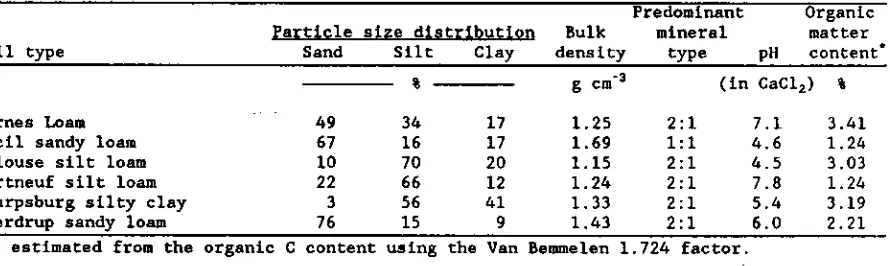
The six soils studied (surface horizons only) were obtained from widely separated locations across the United States. The soils were: a Cecil sandy loam (clayey, kaolinitic, thermic Typic Hapludult) from Watkinsville, GA; a Barnes loam (fine loamy, mixed, Udic Haploboroll) from Morris, MN; a Sverdrup sandy loam (sandy, mixed Udic Haploboroll) from Elbow Lake, MN; a Sharpsburg silty clay (fine, montmorillonitic, mesic Typic Argiudoll) from Lincoln, NE; a Portneuf silt loam (coarse silty, mixed, mesic
Xerollic Calciorthid) from Kimberly, ID; and a Palouse silt loam (fine silty, mixed, mesic pachic Ultic Haploxeroll) from Pullman, WA. Properties of the six soils (Table 1) were determined (Soil Conservation Service Staff, 1984) by the personnel of the National Soil Survey and Soil Mechanics Laboratories, Lincoln, NE.
Table 1. Soil properties.
Predominant Organic Particle size distribution Bulk mineral matter
Soil type Sand Silt Clay density type pH content
.
g cm-3
(in CaC1 2 )%
Barnes Loam
49
34
17
1.25
2:1
7.1
3.41
Cecil sandy loam
67
16
17
1.69
1:1
4.6
1.24
Palouse silt loam
10
70
20
1.15
2:1
4.5
3.03
Portneuf silt loam
22
66
12
1.24
2:1
7.8
1.24
Sharpsburg silty clay
3
56
41
1.33
2:1
5.4
3.19
Sverdrup sandy loam
76
15
9
1.43
2:1
6.0
2.21
• as estimated from the organic C content using the Van Bemmelen 1.724 factor. Study I
A randomized complete block design with three replications and a factorial arrangement of treatments was used. Sources of variation were soils, number of freeze-thaw cycles, constrainment, and water content. Freeze-thaw cycles were either 0, 1, 3, or 5 with the 0 level signifying no freezing. The constrainment factor was at one of two levels, either constrained (in brass cylinders 5 cm high with an inside diameter of 2.75 cm) or
unconstrained (aggregates placed loosely on Al weighing dishes). The water content factor (qualitatively either low, medium, or high) was quantitatively either 0.05, 0.15, or 0.25 g/g for the coarse-textured Sverdrup and Cecil soil or 0.10, 0.20, or 0.30 g/g for the remaining soils. It should be noted that subsequent figures, for the sake of
uniformity, will indicate Sverdrup and Cecil soil samples to have water contents of 0.10, 0.20, or 0.30 g/g. Because some data were missing due to sample mistreatment in the laboratory, statistical analyses were performed using a linear model (SAS Institute, Inc., 1985). Aggregate stability values were reported as least-squares (or marginal) means
(Searle at al., 1980). These least-squares means, estimates of the means that would have been obtained had no data been missing, were separated, utilizing a significance
probability of 5%, using an option available in SAS (SAS Institute, Inc., 1985).
Samples were prepared by sieving field-moist soil (gravimetric water contents ranged from 7 to 22n and averaged 13%) through a 4-mm sieve. Soil was not permitted to air dry between the time it was sampled in the field and analyzed in the laboratory. To prepare constrained samples, the water content of the sieved soil was first adjusted slowly to the desired level, i.e., either lowered by drying in air or raised by misting in a vaporizer (Kemper and Rosenau, 1986). Moist soil was packed by tapping into each brass cylinder until a dry bulk density of 1.15 g/cm
3 was reached. Each packed cylinder was sealed in a
polyethylene bag to both inhibit water loss and prevent water uptake, inserted into a styrofoam tray, and stored at +6°C until the remaining cylinders were packed. The styrofoam, a minimum of 7 cm underneath and 2 cm around each cylinder, served asunconstrained samples. Each dish was sealed in a polyethylene bag, placed on a plastic tray, and stored at +6°C until the remaining unconstrained samples were prepared.
All prepared samples were subjected to either 0, 1, 3, or 5 freeze-thaw cycles. One cycle was completed when prepared soil samples were frozen at -14°C for 24 hours, and subsequently thawed at +6°C for 48 hours. Samples were convectively frozen without access to water. Freezing-induced vertical expansion of the soil in the cylinders was measured. For all samples, a data logger within each enclosure recorded ambient air temperatures. The 0 cycle samples were not frozen but were stored
at
+6°C for a minimum of 48 hours. Before the aggregate stability analysis, all samples were brought to room temperature on a lab bench for 2 hours. Aggregate stability was determined using the procedure of Kemper and Rosenau (1986) modified so that field-moist 1- to 4-mm aggregates were vapor-wetted to 0.30 g/g prior to wet sieving.Study II
The experimental design was the same as for Study I but the sources of variation were different. Factors were soils, number of freeze-thaw cycles, water content, potential bonding agents, and bonding agent addition rates. Freeze-thaw cycles were either 1 or 3. All samples were constrained in brass cylinders. The water content factor was either 0.05 or 0.25 g/g for the coarse-textured Sverdrup and Cecil soil or 0.10 or 0.30 g/g for the remaining soils. Finely ground reagent grade CaCO 3 or CaSO 4 was added as a bonding agent at a rate of either 0.2 or 1.0% by weight of oven-dry soil. The
statistical analysis was
similar to that of Study I. Least-squares means were separated utilizing a significance probability of 5%.Samples were prepared by coating less than 4-mm field-moist soil
with
ground CaCO 3 or CaSO 4 . The desired mass of CaCO 3 or CaSO4 was distributed as evenly as possible over all surfaces of a known mass of sieved soil on plastic sheeting, and thoroughly mixed. Thereafter, in a vaporizer, soil water content was raised to the desired level asdescribed earlier. This moist, coated soil was then packed into a brass cylinder using the procedure of Study I. All packed cylinders were subjected to either 1 or 3
freeze-thaw cycles. After the soil had thawed
the last time, it
waspermitted to
warm to room temperature over a 2-hour period, removed from the cylinder, and analyzed for aggregate stability using the procedure of Study I.RESULTS AND DISCUSSION Study I
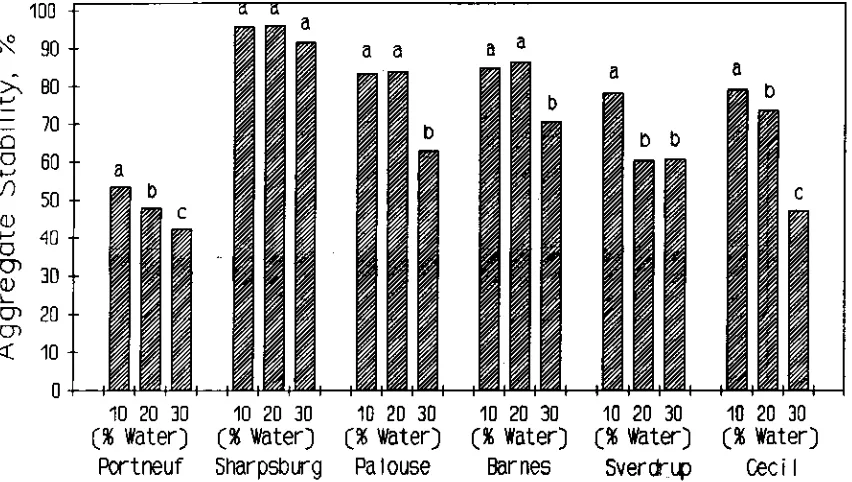
Aggregate stability (averaged over freeze-thaw cycles) is shown as a function of water content in Figure 1 for constrained samples and in Figure 2 for unconstrained samples. Figure 1 reveals that, for each soil, aggregate stability decreased as water contents
increased from 10 to 30%. The stability of the Sharpsburg, Palouse, and Barnes soils (all
medium-textured or finer with organic matter contents of 3% or more) decreased twice asmuch from 20 to 30% than from 10 to 20% water content. The stability of the Portneuf silt loam, with nearly 60% less organic matter (1.24%, Table 1), however, dropped just as much from 20 to 30% as it did from 10 to 20%. Thus, elevated organic matter, known to improve the stability of aggregates with diameters over 0.25 mm (Tisdall and Oades, 1982), was also more effective in stabilizing aggregates frozen at lower than at higher water contents. The coarse-textured Cecil exhibited the greatest drop in aggregate stability from 10 to 20%. Large differences in aggregate stability exist from soil to soil even at
the same water content. For example, Portneuf and Palouse, two silt loans from the
Pacific Northwest,
differ in stability by over 25 percentage points at a 10% watercontent.
Findings for constrained samples (Fig. 1) were similar to those for unconstrained samples (Fig. 2). Some differences were noted, however. In Figure 2, though the
100
V
90
>
7., so
15
70
0 60
1fl
50
a)
4-1
40Cr) 30
LCr) 20
< 10
0
100
so
›; so
70
0 60
-6
40
30
L01 20
< 10
0
10 20 30
10 20 30
10 20 30
10 20 30
10 20 30
10 20 30
(%
Water)
[%
Water]
[% Water]
(% Water)
C% Water)
[%
Water]
Portneuf Sharpsburg
Palouse
Barnes
Sverdrup
Ceci
l
Figure
1. Aggregate stability (averaged over freeze-thaw cycles) as a function of water
content for constrained samples of each soil. Within each soil, means without
a common letter differ significantly at the 0.05 level.
10 20 30
10 20 30
10 20 30
10 20 30
10 20 30
10 20 30
(%
Water)
(%
Water] [% Water]
(%
Water]
(% Water)
(% Water]
Portneuf Sharpsburg
Palouse
Barnes
Sverdrup
Cecil
Figure 2. Aggregate stability
as a
function of water content for unconstrained samples of
each soil. Within each soil, means without a common letter differ
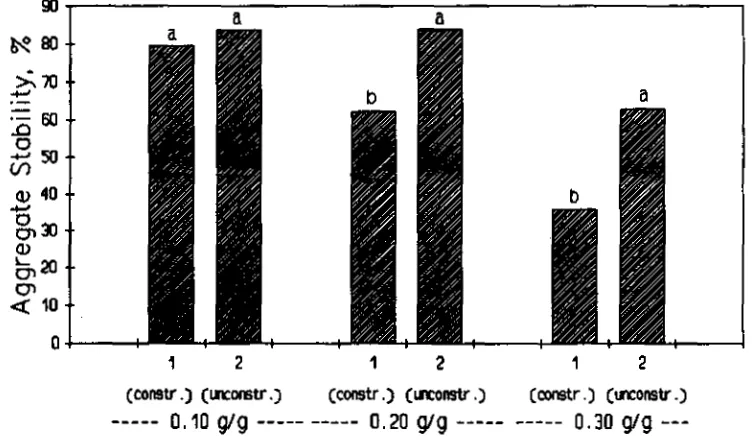
In Figure 3, the data (again averaged over freeze-thaw cycles) for a Palouse silt loam illustrate a typical response to constreinment of aggregates while frozen at different water contents. For every soil, conatrainment decreased the stability of aggregates frozen at higher (20-30%) water contents. Expansion of ice crystals likely caused planes of weakness in the aggregates whose horizontal displacement was limited by the confining pressure of the brass cylinders. These planes of weakness subsequently manifested their presence during the wet sieving process. Figure 3 also indicates that aggregate stability decreased faster with increasing water content when frozen constrained rather than
unconstrained.
90 80
:El 6
°
50 a)
400
0
00 a) 'En 2°Cn < 10
0
1 2
(constr .) (uncorstr .)
0.10 9
/9
1 2
(constr .) (unconstr .)
0.20 gig
1 2
(constr .) (unconstr .)
0.30 gag
Figure 3. Stability of Palouse aggregates as affected by constrainment at each water content. Within each water content, means without a common letter differ significantly at the 0.05 level.
Table 2 lists aggregate stabilities, averaged over water content, of constrained samples of each soil after each freeze-thaw cycle. The Palouse and Barnes soils increased significantly in stability with increasing number of freeze-thaw cycles. Both are medium-textured soils with relatively high organic matter contents.
Table 2. Effect of freeze-thaw cycles on aggregate stability (constrained samples only).
Aggravate
stabilityNumber of freezel thaw cycles
Soil 0 1 3 5
Barnes 53.0 c e 56.3 be 59.6 ab 65.4 a
Cecil 49.5 a 55.1 a 55.8 a 51.5 a
Palouse 43.5 c 60.6 b 71.1 a 62.1 b
Portneuf 38.1 a 38.1 a 36.5 a 38.4 a
Sharpsburg 82.8 a 86.0 a 88.7 a 89.1 a
Sverdrup 45.8 a 46.5 a 50.6 a
When unconstrained, four soils (Fig. 4) increased significantly in aggregate stability with freeze-thaw cycles. In contrast, when constrained, the stability of only two soils increased with freeze-thaw cycles (Table 2). Figure 4 reveals that the coarse-textured Sverdrup and Cecil and, as before, the Palouse and Barnes soils increased in stability. The aggregate stability of Cecil and Palouse increased with each subsequent freeze-thaw cycle, but the response of Sverdrup and Barnes was more variable. The Palouse silt loam was the only soil whose stability increased statistically (and likely practically) from 0 to 1 freeze-thaw cycle. For the remaining three soils, the improvement in stability was minimal, averaging less than nine
percentage points over the
entire range of cycles studied.100
90
90
70
o
60
61 50
40
2 30 CY)
cy) 20
10
CI 1 3 5
0 1 3 5
0 1 3 5
(cycle)
(cycle)
[cycle)
Portneuf Sharpsburg Palouse
Figure 4. Effects of freeze-thaw cycles on the of unconstrained aggregates of each common letter differ significantly a
1 3
50 1 3 5
0 1 3 5
(cycle)
(cycle)
(cycle)
Barnes
Sverdrup
Cecil
stability (averaged over water content) soil. Within each soil, means without a t the 0.05 level.
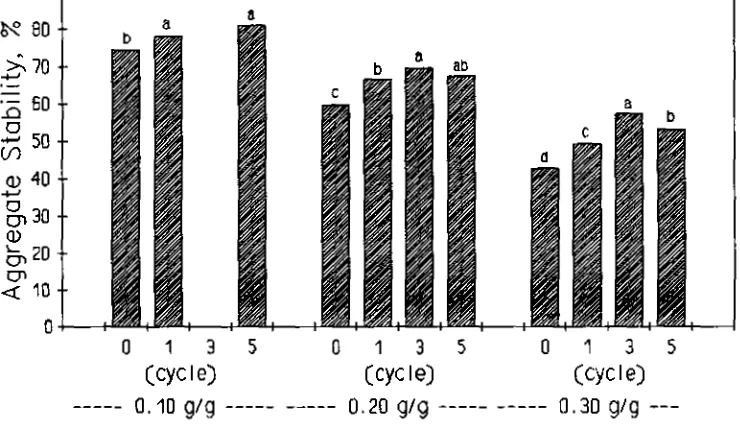
Figure 5 reveals that, within each freeze-thaw cycle, aggregate stability, averaged over all six soils and both constrainment levels, decreased with increasing water content. Also, at least for water contents of 20 and 30%, the stability of aggregates increased when subjected to up to three freeze-thaw cycles
but then decreased when subjected to five
cycles. Thus, for some soils, there seems to be some rather low number of freeze-thaw cycles beyond which aggregates may become less stable with continued freezing and thawing. This suggests that to minimize soil structural damage (and attendant erosion), soil water contents (at least at the surface of the profile) should be as low as possible entering the winter season (Benoit, 1973). Figure 5 also shows that the higher the water content, the greater the increase or decrease caused by freeze-thaw cycles. In other words, freeze-thaw cycles exerted their greatest effect, whether beneficial or detrimental, on aggregate stability at the highest water contents.Study II
Results from Study II confirmed a number of the findings of Study I. First, aggregate stability decreased when water contents increased from 10 to 30%. Second, the decrease in aggregate stability varied from soil to soil, in general being greatest for
go
90
70
E
60
0
50
a) 40
0-1 30
'20
cn
< 10
0
0
1
3
5
(cycle)
0.10 gig
0
1
3
5
(cycle)
0.20 gig
0
1
3
5
(cycle)
0.30 g/g
Figure 5. Aggregate stability (averaged over soils and constrainment levels) as a
function of freeze-thaw cycles at each water content. Within each water content, means without a common letter differ significantly at the 0.05 level.
aggregate stability. The effect of the bonding agents did, however, approach significance at the 10% level. The trend of the response indicated that aggregate stability was higher with the addition of calcium sulfate than calcium carbonate. Moreover, aggregate
stability tended to decrease with increasing rates of the bonding agents. This decrease in stability was greatest when CaCO 3 was added to soil samples at a water content of 30%. Statistical analyses of these data are continuing.
Results
0
light of the objectivegInteractions among the factors examined were the rule rather than the exception in both studies. Constrainment, number of freeze-thaw cycles, and water content at freezing were all found to significantly affect the stability of the six soils, though differently depending upon both the soil in question and the levels of the other factors. In Study I, the effect of constrainment differed depending upon the soil, the water content, and the number of freeze-thaw cycles. When the six soils were taken as a whole, the effect of freeze-thaw cycles on aggregate stability depended upon the water content at freezing. In Study II, the decrease in aggregate stability caused by an increase in water content differed according to the texture of the soil being frozen.
Results in relation to others' findings
freeze-thaw cycles may be the norm rather than the exception (Figs. 4 and 5). The finding of this study that aggregate stability (as an average response for six soils) increases with up to three freeze-thaw cycles but decreases thereafter (Fig. 5) is supported by the results of Mostaghimi et al. (1988) for a Crofton silt loam (fine silty, mixed, mesic Typic Ustorthent). In contrast, the results presented in Figure 4 showing an increase in stability with freeze-thaw cycles for unconstrained samples of four of six soils are at odds with the results presented by Mostaghimi et al. (1988) showing a decrease in stability with freeze-thaw cycles for two of three soils. Such a discrepancy may well result because their soils were air-dried before their experiment was conducted. Air-drying could have strengthened bonds within the aggregates, thus effectively masking the increase in aggregate stability detected for the first few freeze-thaw cycles (Fig. 5). The finding in Study II that CaCO3 added at either 0.2 or 1.01 by weight did not
significantly affect aggregate stability agrees with the results of Chepil (1954), Kemper and Koch (1966), and Toogood (1978) but disagrees with those of Al-Ani and Dudes (1988). There were however, differences in both soils and procedures between the study of Al-Ani and Dudes (1988) and Study II. The soil samples used by Al-Ani and Dudes (1988) were from the BC horizons of two soils with clay contents of 32 or 42% whereas the soil samples used in Study II were from the surface horizons of soils generally of much lower clay content (Table 1). Procedurally, air-dry soil and 4- to 8-mm aggregates were used by Al-Ani and
Dudes (1988) while field-moist soil and 1- to 4-mm aggregates were used in Study /I. A
number of the earlier studies that found CaCO3 to affect aggregate stability used very high calcium carbonate application rates. The rates considered in Study II were more
feasible application rates for agricultural production.
CONCLUSIONS
Constrained aggregates at gravimetric water contents of 20% or more were less stable after freezing than were unconstrained aggregates. For some soils particularly when unconstrained, aggregate stability tended to first increase with increasing number of freeze-thaw cycles and then decrease. The mean response of all six soils showed that the effect of different numbers of freeze-thaw cycles was most pronounced at the highest water content (30%). The one response most consistent throughout the experiment was that aggregate stability decreased with increasing water content at the time of freezing.
ACKNOWLEDGMENT
REFERENCES
Al-Ani, A. N. and M. J. Dudes (1988) Influence of calcium carbonate on mean weight diameter of soil. Soil Tillage Research, Vol. 11, pp. 19-26.
Benoit, G. R. (1973) Effect of freeze-thaw cycles on aggregate stability and hydraulic conductivity of three soil aggregate sizes. Soil Science Society of America
Proceedings, Vol. 37, No. 1, pp. 3-5.
Bryan, R. B. (1971) The influence of frost action on soil aggregate stability. Transactions of the Institute of British Geographers, Vol. 50, pp. 71-88.
Bullock, M. S., W. D. Kemper and S. D. Nelson (1988) Soil cohesion as affected by freezing, water content, time and tillage. Soil Science Society of America Journal, Vol. 52, No. 3, pp. 770-776.
Chepil, W. S. (1954) Factors that influence.clod structure and erodibility of soil by wind. III. Calcium carbonate and decomposed organic matter. Soil Science, Vol. 77, No. 6, pp. 473-480.
Kemper, W. D. and E. J. Koch (1966) Aggregate stability of soils from western United States and Canada. U.S. Department of Agriculture Technical Bulletin 1355. U.S. Government Printing Office, Washington, D.C. 52 pp.
Kemper, W. D. and R. C. Rosenau (1986) Aggregate stability and size distribution, pp. 425-442. In A. Klute (Editor), Methods of soil analysis, Part 1. Agronomy Monograph, No. 9
Logsdail, D. E. and L. R. Webber (1959) Effect of frost action on structure of Haldimand clay. Canadian Journal of Soil Science, Vol. 39, pp. 103-106.
Mostaghimi, S., R. A. Young, A. R. Wilts and A. L. Kenimer (1988) Effects of frost action on soil aggregate stability. Transactions of the ASAE, Vol. 31, No. 2, pp. 435-439.
Richardson, S. J. (1976) Effect of artificial weathering cycles on the structural
stability of a dispersed silt soil. Journal of Soil Science, Vol. 27, No. 3, pp. 287-294.
SAS Institute, Inc. (1985) SAS/STAT guide for personal computers. 6th ed. SAS Institute, Inc., Cary, North Carolina. 378 pp.
Searle, S. R., F. M. Speed and G. A. Milliken (1980) Populations marginal means in the linear model: An alternative to least squares means. American Statistician, Vol. 34,
pp. 216-221.
Sillanpaa, M. and L. R. Webber (1961) The effect of freezing-thawing and wetting-drying cycles on soil aggregation. Canadian Journal of Soil Science, Vol. 41, pp. 182-187. Soil Conservation Service Staff (1984) Procedures for collecting soil samples and methods
of analysis for soil survey. USDA-SCS Soil Survey Invest. Rep. No. 1. U.S. Government Printing Office, Washington, D.C. 68 pp.
Tisdall, J. M. and J. M. Oades (1982) Organic matter and water-stable aggregates in soils. Journal of Soil Science, Vol. 33, No. 2, pp. 141-163.
Toogood, J. A. (1978) Relation of aggregate stability to properties of Alberta soils, pp. 211-214. In W. W. Emerson, R. D. Bond and A. R. Dexter (Editors), Modification of Soil Structure. John Wiley and Sons, Inc., Chichester.
FREEZE THAW EFFECTSION SOIL STRENGTH by
Hans Kok and Donald K. McCool l INTRODUCTION
Erosion occurs on the 4 million hectares of non-irrigated cropland in the Pacific Northwest at rates much higher than tolerable to sustain long-term productive agriculture. For example, ten percent of the Palouse river basin of eastern Washington and northern Idaho has already lost all of its topsoil (USDA, 1978) and current annual erosion rates for cropland average from 5 to 50 ton per hectare (Papendick at al., 1983). Rates as high as 224 ton per hectare have been reported (McCool et al., 1976a). Intensive tillage practices associated with common crop rotations, that frequently contain summer fallow, leave the soils pulverized and very vulnerable to erosion. The long and steep slopes in loessial soils of the region combined with the many freeze-thaw cycles (up to 120 per year) during the winter season result in extremely erodible conditions. Soils accumulate moisture prior to the freezing cycles and often freeze wet with resultant low infiltration capacities (McCool and Molnau, 1974). The majority of the precipitation occurs as low intensity rain or snow during the winter months when soils are bare and unprotected
(McCool at al., 1982). Runoff detachment and transport are the dominant erosion processes (McCool et al., 1976a; 1987). Mare than 50 percent of the soil erosion in the Palouse region is related to rain or snowmelt on frozen or thawing ground, often accelerated by warm, moist Pacific air masses (McCool et al., 1976b; Yoo and Molnau, 1982; Zuzel et al., 1982), yet one of the least understood aspects of the physical erosion process is the effect of freeze and thaw.
This report will briefly summarize research conducted at Pullman, Washington pertaining to the effects of freeze-thaw cycles on soil properties.
FIELD RESFARCI-1
Field research has been conducted since 1931 at the Palouse Conservation Field Station (PCFS). A series of runoff plots have been installed since 1978 that are
subjected to tillages and crop rotations common to the area. Results have been primarily used to adapt the Universal Soil Loss Equation to the Pacific Northwest (McCool and George, 1983, McCo y l et al., 1976a, McCool at al., 1982). On tillage weakened soils, 60 to 70 percent of the annual runoff and about 55 percent of the yearly soil loss was related to rainfall and snowmelt on frozen ground.
During the 1987-88 and 1988-89 erosion seasons, soil strength was monitored on a Palouse silt loam on a 21 percent slope at the PCFS (Kok, 1989, Kok and McCool, 1989). Several instruments were used; fall-cone, pocket penetrometer and Torvane ,a device with vertical vanes radiating from a central point. Satisfactory results were obtained only with a metal Torvane apparatus. Torvane soil strength varied drastically over the period of field testing, from virtually zero while thawing to 14 kPa under dry soil conditions in early spring.
An example of observations as obtained with the Torvane apparatus for early 1988 is
shown in Figure 1, together with soil water content observations for this period. The soil had been tilled with a Lely Roterra (a tiller with vertical teeth rotating around
a
The mention of trade or brand names in this publication does not constitute endorsement or recommendation for use by the authors and is provided for the reader's information only.
Paper presented at the Frozen Soil Symposium, Spokane, Washington, March 21-22, 1990 1 Research Associate, Washington State University, Pullman, WA, and Agricultural Engineer,