The Thirty-Third AAAI Conference on Artificial Intelligence (AAAI-19)
Densely Supervised Grasp Detector (DSGD)
Umar Asif
IBM Research Australia [email protected]
Jianbin Tang
IBM Research Australia [email protected]
Stefan Harrer
IBM Research Australia [email protected]
Abstract
This paper presents Densely Supervised Grasp Detector (DSGD), a deep learning framework which combines CNN structures with layer-wise feature fusion and produces grasps and their confidence scores at different levels of the image hi-erarchy (i.e., global-, region-, and pixel-levels). Specifically, at the global-level, DSGD uses the entire image information to predict a grasp. At the region-level, DSGD uses a region proposal network to identify salient regions in the image and uses a grasp prediction network to generate segmentations and their corresponding grasp poses of the salient regions. At the pixel-level, DSGD uses a fully convolutional network and predicts a grasp and its confidence at every pixel. Dur-ing inference, DSGD selects the most confident grasp as the output. This selection from hierarchically generated grasp candidates overcomes limitations of the individual models. DSGD outperforms state-of-the-art methods on the Cornell grasp dataset in terms of grasp accuracy. Evaluation on a multi-object dataset and real-world robotic grasping experi-ments show that DSGD produces highly stable grasps on a set of unseen objects in new environments. It achieves 97% grasp detection accuracy and 90% robotic grasping success rate with real-time inference speed.
Introduction
Grasp detection is a crucial task in robotic grasping be-cause errors in this stage affect grasp planning and execu-tion. A major challenge in grasp detection is generalization to unseen objects in the real-world. Recent advancements in deep learning have produced Convolutional Neural Network (CNN) based grasp detection methods which achieve higher grasp detection accuracy compared to hand-crafted features. Methods such as (Lenz, Lee, and Saxena 2015; Redmon and Angelova 2015; Asif, Bennamoun, and Sohel 2017b; Asif, Tang, and Harrer 2018a) focused on learning grasps in a global-context (i.e., the model predicts one grasp con-sidering the whole input image), through regression-based approaches (which directly regress the grasp parameters de-fined by the location, width, height, and orientation of a 2D rectangle in image space). Other methods such as (Pinto and Gupta 2016) focused on learning grasps at patch-level by extracting patches (of different sizes) from the image and
Copyright c2019, Association for the Advancement of Artificial Intelligence (www.aaai.org). All rights reserved.
predicting a grasp for each patch. Recently, methods such as (Morrison, Corke, and Leitner 2018; Zeng et al. 2017) used auto-encoders to learn grasp parameters at each pixel in the image. They showed that one-to-one mapping (of image data to ground truth grasps) at the pixel-level can effectively be learnt using small CNN structures to achieve fast inference speed. These studies show that grasp detection performance is strongly influenced by three main factors:i) The choice of the CNN structure used for feature learning,ii)the objec-tive function used to learn grasp representations, andiii)the image hierarchical context at which grasps are learnt (e.g., global or local). In this work, we explore the advantages of combining multiple global and local grasp detectors and a mechanism to select the best grasp out of the ensemble. We also explore the benefits of learning grasp parameters us-ing a combination of regression and classification objective functions. Finally, we explore different CNN structures as base networks to identify the best performing architecture in terms of grasp detection accuracy. The main contributions of this paper are summarized below:
1) We present Densely Supervised Grasp Detector (DSGD), an ensemble of multiple CNN structures which generate grasps and their confidence scores at different levels of image hierarchy (i.e., global-level, region-level, and pixel-level).
2) We propose a region-based grasp network, which learns to segment salient parts (e.g., handles or extrusions) from the input image, and uses the information about these parts to learn class-specific grasps (i.e., each grasp is associated with a probability with respect to a gras-pable class and a non-grasgras-pable class).
3) We perform an ablation study of our DSGD by varying its critical parameters and present a grasp detector that achieves real-time speed and high grasp accuracy.
Related Work
In the context of deep learning based grasp detection, methods such as (Saxena, Driemeyer, and Ng 2008; Jiang, Moseson, and Saxena 2011; Lenz, Lee, and Saxena 2015) trained sliding window based grasp detectors. However, their high inference times limit their application for real-time systems. Other methods such as (Mahler et al. 2016; 2017; Johns, Leutenegger, and Davison 2016) reduced in-ference time by processing a discrete set of grasp candi-dates, but these methods ignore some potential grasps. Al-ternatively, methods such as (Redmon and Angelova 2015; Kumra and Kanan 2017; Guo et al. 2017) proposed end-to-end CNN-based approaches which regress a single grasp for an input image. However, these methods tend to produce av-erage grasps which are invalid for certain symmetric objects (Redmon and Angelova 2015). Recently, multi-grasp detec-tors based on auto-encoders (Morrison, Corke, and Leitner 2018; Zeng et al. 2017; 2018; Myers et al. 2015; Varley et al. 2015) and Faster-RCNN (Ren et al. 2015) based grasp detector (Chu, Xu, and Vela 2018) demonstrated higher grasp accuracy compared to the global methods. Another stream of work focused on learning mapping between im-ages of objects and robot motion parameters using reinforce-ment learning, where the robot iteratively refines grasp poses through real-world experiments (Pinto and Gupta 2016; Levine et al. 2016). In this paper, we present a grasp de-tector which has several key differences from the current grasp detection methods.First, our detector generates mul-tiple global and local grasp candidates and selects the grasp with the highest quality. This allows our detector to effec-tively recover from the errors of the individual global or lo-cal models.Second, we introduce a region-based grasp net-work which uses segmentation information of salient parts of objects (e.g., handles, extrusions) to learn grasp poses, and produces more accurate grasp predictions compared to global (Kumra and Kanan 2017) or local detectors (Pinto and Gupta 2016). Finally, we use layer-wise dense fea-ture fusion (Huang et al. 2017) within the CNN strucfea-tures. This maximizes variation in the information flow across the networks and produces better image-to-grasp mappings compared to the models of (Redmon and Angelova 2015; Morrison, Corke, and Leitner 2018).
Problem Formulation
Given an image of an object as input, the goal is to gener-ate grasps at different image hierarchical levels (i.e., global-, region- and pixel-levels), and select the most confident grasp as the output. We define the global grasp by a 2D oriented rectangle on the target object in the image space. It is given by:
Gg= [xg, yg, wg, hg, θg, ρg], (1)
wherexgandygrepresent the centroid of the rectangle. The termswg andhg represent the width and the height of the rectangle. The termθgrepresents the angle of the rectangle with respect to x-axis. The termρgisgrasp confidenceand represents the quality of a grasp. Our region-level grasp is defined by a class-specific representation, where the param-eters of the rectangle are associated withnclasses (a
gras-pable class:n= 1, and a non-graspable class:n= 0). It is given by:
Gr= [xnr, y n r, w
n r, h
n r, θ
n r, ρ
n
r], n∈[0,1]. (2) Our pixel-level grasp is defined as:
Gp= [Mxy,Mw,Mh,Mθ]∈Rs×W×H, (3)
where Mxy, Mw, Mh, and Mθ represent
Rs×W×H−dimensional heatmaps1, which encode the
position, width, height, and orientation of grasps at every pixel of the image, respectively. The terms W and H
represent the width and the height of the input image respectively. We learn the grasp representations (Gg, Gr, andGp) using joint regression-classification based objective functions. Specifically, we learn the position, width, and the height parameters using a Mean Squared Loss, and learn the orientation parameter using a Cross Entropy Loss with respect toNθ= 20classes (angular-bins).
The Proposed DSGD (Fig. 1)
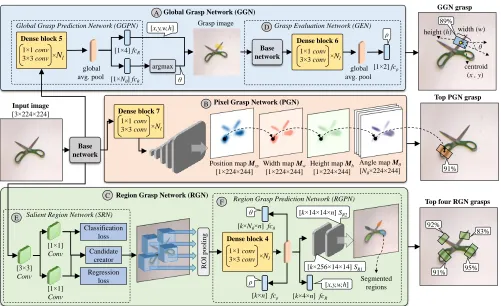
Our DSGD is composed of four main modules as shown in Fig. 1: a base network for feature extraction, a Global Grasp Network (GGN) for producing a grasp at the image-level, a Region Grasp Network (RGN) for producing grasps using salient parts of the image, and a Pixel Grasp Network (PGN) for generating grasps at each image pixel. In the following, we describe in detail the various modules of DSGD.
Base Network
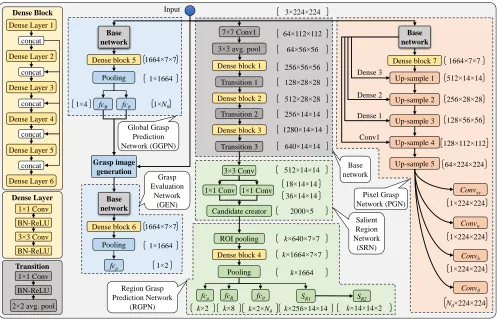
The purpose of the base network is to act as a feature ex-tractor. We extract features from the intermediate layers of a CNN such as DenseNets (Huang et al. 2017), and use the features to learn grasp representations at different hierarchi-cal levels. The basic building block of DenseNets (Huang et al. 2017) is aDense block: bottleneck convolutions inter-connected through dense connections. Specifically, a dense block consists ofNlnumber of layers termedDense Layers which share information from all the preceding layers con-nected to the current layer through skip connections (Huang et al. 2017). Fig. 3 shows the structure of a dense block with
Nl= 6dense layers. Each dense layer consists of1×1and 3×3convolutions followed by Batch Normalization (Ioffe and Szegedy 2015) and a Rectified Linear Unit (ReLU). The output of the lthdense layer (X
l) in a dense block can be written as:
Xl= [X0, ...,Xl−1], (4)
where[···]represents concatenation of the features produced by the layers0, ..., l−1.
Global Grasp Network (GGN)
Our GGN structure is composed of two sub-networks as shown in Fig. 1-A: a Global Grasp Prediction Network (GGPN) for generating grasp pose ([xg, yg, wg, hg, θg]) and a Grasp Evaluation Network (GEN) for predict-ing grasp confidence (ρg). The GGPN structure is com-posed of a dense block, an averaging operation, a
1
Region Grasp Network (RGN)
Pixel Grasp Network (PGN) Global Grasp Network (GGN)
Dense block 5
1×1 conv
3×3 conv×Nl
global avg. pool
[1×4] fcR
[1×Nθ] fcθ θ
Position mapMxy [1×224×244]
[k×Nθ×n] fcθ
[k×n] fcρ
Base network
Dense block 4
1×1 conv
3×3 conv ×Nl [x,y,w,h]
Salient Region Network (SRN)
Classification loss
Regression loss [3×3]
Conv
[1×1]
Conv
[1×1]
Conv
A
C
ROI
pooling
Input image
[3×224×224]
GGN grasp
89% width (w)
centroid (x , y)
θ
height (h)
Global Grasp Prediction Network (GGPN) Grasp Evaluation Network (GEN)
Region Grasp Prediction Network (RGPN)
[1×2] fcρ
92%
83%
91%
Top four RGN grasps
95% 91%
Top PGN grasp
Width map Mw [1×224×244]
Height map Mh [1×224×244] Grasp image
[k×4×n] fcR
Dense block 6
1×1 conv
3×3 conv ×Nl
Base network
B
Dense block 7
1×1 conv
3×3 conv ×Nl argmax
D
E
[x,y,w,h]
θ
ρ
ρ
global avg. pool
Candidate creator
F
Segmented regions [k×14×14×n] SR2
[k×256×14×14] SR1
Angle map Mθ [Nθ×224×244]
Figure 1: Overview of our DSGD architecture. Given an image as input, DSGD uses a base network to extract features which are fed into a Global Grasp Network (A), a Pixel Grasp Network (B), and a Region Grasp network (C), to produce grasp candidates. The global model produces a single grasp per image and uses an independent Grasp Evaluation Network (D) to produce grasp confidence. The pixel-level model uses a fully convolutional network and produces grasps at every pixel. The region-level model uses a Salient Region Network (E) to generate region proposals which are fed into a Region Grasp Prediction Network (F) to produce salient region segmentations and their corresponding grasp poses. During inference, DSGD switches between the GGN, the PGN, and the RGN models based on their confidence scores.
Input image
Rectangle image
0
0 1
1 Grasp
image
Training samples
Figure 2: Left: A grasp image is generated by replacing the blue channel of the input image with a binary rectangle im-age produced from a grasp pose. Right: Our Grasp Evalua-tion Network is trained using grasp images labelled in terms of valid (1) and invalid (0) grasp rectangles.
4−dimensional fully connected layer for predicting the pa-rameters[xg, yg, wg, hg], and aNθ−dimensional fully con-nected layer for predictingθg. The GEN structure is simi-lar to GGPN except that GEN has a single2−dimensional fully connected layer for predictingρg. The input to GEN is a grasp image which is produced by replacing theBlue
channel of the input image with a binary rectangle image generated from the output of GGPN as shown in Fig. 2. Let
Rgi = [xgi, ygi, wgi, hgi],θgi andρgi denote the predicted values of a global grasp for theithimage. We define the loss of the GGPN and the GEN models overKimages as:
Lggpn=
X
i∈K
(1−λ1)Lreg(Rgi, R
∗
gi) +λ1Lcls(θgi, θ
∗ gi)
, (5)
Lgen=
X
i∈K
Lcls(ρgi, ρ
∗
gi), (6)
where Rg∗i, θ∗gi, and ρ∗gi represent the ground-truths. The termLregis a regression loss defined as:
Lreg(R, R∗) =||R−R∗||/||R∗||2. (7)
The termLclsis a classification loss defined as:
Lcls(x, c) =− Nθ X
c=1
Yx,clog(px,c), (8)
3×3 Conv
1×1 Conv 1×1 Conv
Candidate creator
ROI pooling
Dense block 4
Pooling fcθ fcR fcρ k×1664×7×7 k×1664
k×2 k×8 k×2×Nθ
k×640×7×7 2000×5 36×14×14 18×14×14 512×14×14 3×224×224 Base network Input Dense Block
Dense Layer 1
Dense Layer 2
Dense Layer 3
Dense Layer 4
Dense Layer 5
Dense Layer 6
Region Grasp Prediction Network (RGPN) concat concat concat concat concat Grasp Evaluation Network (GEN)
Dense block 6
Pooling fcρ 1664×7×7 1×1664 1×2 Base network
Dense block 5
Pooling
fcR fcθ
1×4 1×Nθ
Base network Global Grasp Prediction Network (GGPN) 1664×7×7 1×1664 Salient Region Network (SRN) Grasp image generation Base network Up-sample 1 Up-sample 2 Up-sample 3 Up-sample 4 Up-sample 5 Convw Convh Convθ Convxy
Nθ×224×224 1×224×224 1×224×224 1×224×224 64×224×224 128×112×112 128×56×56 256×28×28 512×14×14 Dense 3 Dense 2 Dense 1 Conv1 Pixel Grasp Network (PGN)
Dense block 7 1664×7×7 7×7 Conv1 64×112×112
3×3 avg. pool
Dense block 1
Transition 1
Dense block 2
Transition 2
Dense block 3
Transition 3 64×56×56 256×56×56 128×28×28 512×28×28 256×14×14 1280×14×14 640×14×14 Dense Layer 1×1 Conv BN-ReLU 3×3 Conv BN-ReLU Transition 1×1 Conv BN-ReLU
2×2 avg. pool
SR2
k×14×14×2
SR1
k×256×14×14
Figure 3: Detailed architecture of our DSGD with a DenseNet (Huang et al. 2017) as its base network.
Region Grasp Network (RGN)
The RGN structure is composed of two sub-networks as shown in Fig. 1-C: a Salient Region Network (SRN) for pro-ducing salient region proposals, and a region grasp predic-tion network (RGPN) for producing salient region segmen-tations and their corresponding grasp poses.
Salient Region Network (SRN): Here, we use the fea-tures extracted from the base network to generate propos-als defined by the location (xsr, ysr), width (wsr), height (hsr), and confidence (ρsr) of non-oriented rectangles which encompass salient parts of the image (e.g., handles, extru-sions). For this, we first generate a fixed number of rectan-gles using the Region of Interest (ROI) method of (He et al. 2017). Next, we use the features from the base network and optimize a Mean Squared Loss on the rectangle coordi-nates and a Cross Entropy Loss on the rectangle confidence scores. LetTi = [xsr, ysr, wsr, hsr]denote the parameters of theithpredicted rectangle, andρsridenote its probability whether it belongs to a graspable region or a non-graspable region. The loss of SRN overIproposals is given by:
Lsrn=
X
i∈I
(1−λ2)Lreg(Ti, Ti∗) +λ2Lcls(ρsri, ρ
∗
sri)
,
(9)
whereρ∗
sri= 0for a non-graspable region andρ
∗
sri = 1for a graspable region. The termTi∗represents the ground truth candidate corresponding toρ∗sr
i.
Region Grasp Prediction Network (RGPN): Here, we
produce salient region segmentations and their correspond-ing grasp poses uscorrespond-ing the proposals predicted by SRN (k= 50in our implementation). For this, we crop features from the output feature maps of the base network using the Re-gion of Interest (ROI) pooling method of (He et al. 2017). The cropped features are then fed toDense block 4which produces feature maps of k×1664×7×7−dimensions as shown in Fig. 3. These feature maps are then squeezed to
k×1664−dimensions through a global average pooling, and fed to a segmentation branch (with two up-sampling layers
SR1∈Rk×256×14×14andSR2∈Rk×14×14×n), which
pro-duces a segmentation mask for each salient region as shown in Fig. 1-F. The squeezed features are also fed to three fully connected layers f cR ∈ Rk×4×n, f cθ ∈ Rk×Nθ×n, and
f cρ ∈ Rk×2 which produce class-specific grasps for the
segmented regions. LetRri = [xri, yri, wri, hri],θri, and
ρri denote the predicted values of a region-level grasp for theithsalient region, andS
i ∈ R14×14×ndenotes the
model is defined overIsalient regions as:
Lrgpn=
X
i∈I
(Lreg(Rri, R
∗
ri) +λ3Lcls(θri, θ
∗
ri)+
λ3Lcls(ρri, ρ
∗
ri) +Lseg(Si,S
∗
i)),
(10)
whereR∗,θ∗,ρ∗, andS∗represent the ground truths. The
term ρ∗ri = 0 for a non-graspable region and ρ
∗
ri = 1 for a graspable region. The term Lseg represents a pixel-wise binary cross-entropy loss used to learn segmentations of salient regions. It is given by:
Lseg=− 1
|Si|
X
j∈Si
(yjlog(ˆyj)+(1−yj) log(1−yˆj)), (11)
where,yj represents the ground truth value andyˆj denotes the predicted value for a pixelj ∈ Si. Learning segmenta-tion based grasp poses enables the model to produce grasp confidence maps where the confidence scores follow Gaus-sian distributions with the highest confidence at the center of the segmented region. This produces region-centred grasps and therefore better localization results. The total loss of our RGN model is given by:
Lrgn=Lsrn+Lrgpn. (12)
The termsλ1,λ2, andλ3in Eq. 5, Eq. 9, and Eq. 10 control
the relative influence of classification over regression on the combined objective functions2.
Pixel Grasp network (PGN)
Here, we feed the features extracted from the base network intoDense block 7followed by a group of upsampling layers which increase the spatial resolution of the features and pro-duce feature maps of the size of the input image. These fea-ture maps encode the parameters of the grasp pose at every pixel of the image. LetMxyi,Mwi,Mhi, andMθi denote the predicted feature maps of theithimage, respectively. We define the loss of the PGN model overKimages as:
Lpgn=
X
i∈K
(Lreg(Mxyi,M
∗
xyi) +Lreg(Mwi,M
∗
wi)+
Lreg(Mhi,M
∗
hi) +Lcls(Mθi,M
∗
θi)),
(13) whereMxy∗i, M
∗
wi,M
∗
hi, andM
∗
θi represent the ground-truths.
Training and Implementation
For the global model, we trained the GGPN and the GEN sub-networks independently. For the region-based and the pixel-based models, we trained the networks in an end-to-end manner. Specifically, we initialized the weights of the base network with the weights pre-trained on ImageNet. For theDense blocks (4-7), the fully connected layers of GGPN, GEN, SRN, and RGPN, and the fully convolutional layers of PGN, we initialized the weights from zero-mean Gaus-sian distributions (standard deviation set to 0.01, biases set to 0), and trained the networks using the loss functions in
2
For experiments, we set the parametersλ1,λ2, andλ3to 0.4.
Eq. 5, Eq. 6, Eq. 9, Eq. 12, and Eq. 13, respectively for 150 epochs. The starting learning rate was set to 0.01 and di-vided by 10 at 50% and 75% of the total number of epochs. The parameter decay was set to 0.0005 on the weights and biases. Our implementation is based on the framework of Torch library (Paszke et al. 2017). Training was performed using ADAM optimizer and data parallelism on four Nvidia Tesla K80 GPU devices. For grasp selection during infer-ence, DSGD selects the most confident region-level grasp if its confidence score is greater than a confidence thresh-old (δrgn), otherwise DSGD switches to the PGN branch and selects the most confident pixel-level grasp. If the most confident pixel-level grasp has a confidence score less than
δpgn, DSGD switches to the GGN branch and selects the global grasp as the output. Experimentally, we found that
δrgn = 0.95andδpgn = 0.90produced the best grasp de-tection results.
Experiments
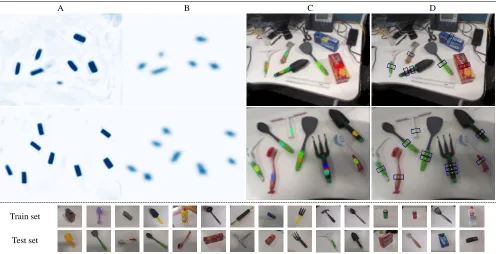
We evaluated DSGD for grasp detection on the popular Cor-nell grasp dataset (Lenz, Lee, and Saxena 2015), which contains 885 RGB-D images of 240 objects. The ground-truth is available in the form of grasp-rectangles. We also evaluated DSGD for multi-object grasp detection in new environments. For this, we used the multi-object dataset of (Asif, Tang, and Harrer 2018b) which consists of 6896 RGB-D images of indoor scenes containing multiple objects placed in different locations and orientations. The dataset was generated using an extended version of the scene la-beling framework of (Asif, Bennamoun, and Sohel 2017a) and (Asif, Bennamoun, and Sohel 2016). For evaluation, we used the object-wise splitting criteria (Lenz, Lee, and Sax-ena 2015) for both the Cornell grasp dataset and our multi-object dataset. The multi-object-wise splitting splits the multi-object in-stances randomly into train and test subsets (i.e., the training set and the test set do not share any images from the same object). This strategy evaluates how well the model gener-alizes to unseen objects. For comparison purposes, we fol-lowed the procedure of (Redmon and Angelova 2015) and substituted the blue channel with the depth image, where the depth values are normalized between 0 and 255. We also performed data augmentation through random rotations. For grasp evaluation, we used the “rectangle-metric” proposed in (Jiang, Moseson, and Saxena 2011). A grasp is consid-ered to be correct if:i)the difference between the predicted grasp angle and the ground-truth is less than30◦, andii)the Jaccard index of the predicted grasp and the ground-truth is higher than 25%. The Jaccard index for a predicted rectangle Rand a ground-truth rectangleR∗is defined as:
J(R∗,R) = |R
∗∩R|
|R∗∪R|. (14)
Single-Object Grasp Detection
confi-B A
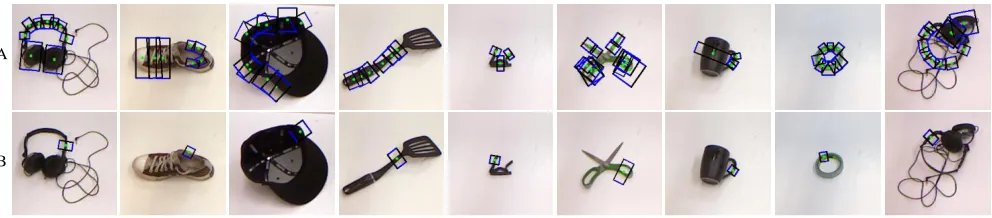
Figure 4: Grasp detection results of our DSGD (B) on some challenging objects of the Cornell grasp dataset. Ground truths are shown in A.
Table 1: Grasp evaluation on the Cornell grasp dataset in terms of average grasp detection accuracy.
Method Accuracy (%)
(Jianget. al.2011) Fast search 58.3 (Lenzet. al.2015) Deep learning 75.6 (Redmonet. al.2015) MultiGrasp 87.1 (Kumraet. al.2017) ResNets 88.9 (Guoet. al.2017) Hybrid-Net 89.1 (Asifet. al.2018) GraspNet 90.2 (Chuet. al.2018) Multi-grasp 96.1
(this work) DSGD 97.7
Table 2: Comparison of the individual networks of the pro-posed DSGD in terms of grasp accuracy (%) on the Cornell grasp dataset.
Base Global model Local models
DSGD
network GGN PGN RGN
ResNet50 86.8 94.1 96.3 96.7
DenseNet 88.9 95.4 97.0 97.7
dence scores from both global and local contexts. This en-ables DSGD to effectively recover from the errors of the global (Kumra and Kanan 2017) or local methods (Guo et al. 2017). Second, the use of dense feature fusion en-ables the networks to learn more discriminative features compared to the models used in (Kumra and Kanan 2017; Guo et al. 2017). Fig. 4 shows grasps produced by our DSGD on some images of the Cornell grasp dataset.
Significance of Combining Global and Local Models:
Table 2 shows a quantitative comparison of the individual models of our DSGD in terms of grasp accuracy on the Cor-nell grasp dataset, for different CNN structures as the base network. The base networks we tested include: ResNets (He et al. 2016) and DenseNets (Huang et al. 2017). Table 2 shows that on average the local models (PGN and RGN) pro-duced higher grasp accuracy compared to the global model (GGN). The global and the local models have their own pros and cons. The global model uses the entire image informa-tion and learns an average of the ground-truth grasps. Al-though, the global-grasps are accurate for most of the ob-jects, the grasps tend to lie in the middle of circular
sym-metric objects resulting in localization errors as highlighted in red in Fig. 5-B. The PGN model on the other hand op-erates at the pixel-level and produces correct grasp local-izations for these challenging objects as shown in Fig. 5-C. However, pixel-based model is susceptible to outliers in the position prediction maps which result in localization errors as highlighted in red in Fig. 5-D. Our RGN model works at a semi-global level while maintaining large receptive fields. It predicts grasps using segmentation information of salient parts of the image which highly likely encode graspable parts of an object as shown in Fig. 5-F. Consequently, RGN is less susceptible to pixel-level outliers (see Fig 6-B and Fig 6-C) and does not suffer global averaging errors as shown in Fig. 5-G. Furthermore, the grasp confidences produced by the RGN model follow Gaussian distributions where the confidence scores are the highest at the center of the seg-mented salient regions (see Fig. 6-E). This results in grasps which are more stable compared to the PGN model, where the predicted grasp confidences follow uniform distributions along the surfaces of the objects resulting in several unstable grasps as shown in Fig. 6-D. Our DSGD takes advantage of both the global context and local predictions and produces highly accurate grasps as shown in Fig. 5-H.
Ablative Study of the Proposed DSGD: The growth rate parameterWrefers to the number of output feature maps of each dense layer and therefore controls the depth of the net-work. Table 3 shows that a large growth rate and wider dense blocks (i.e., more number of layers in the dense blocks) in-crease the average accuracy from 96.9% to 97.7% at the ex-pense of low runtime speed due to the overhead from addi-tional channels. Table 3 also shows that aliteversion of our detector (DSGD-lite) can run at 6fpsmaking it suitable for real-time applications.
Multi-Object Grasp Detection
A: Ground Truth B: GGN output
H: DSGD output C: PGN
localization
D: PGN top predictions
E: RGN localization
F: RGN segmented regions
G: RGN top predictions
Figure 5: Qualitative comparison of grasps produced by the proposed GGN, PGN, RGN, and DSGD models. The results show that our DSGD effectively recovers from the errors of the individual models. Incorrect predictions are highlighted in red.
C: RGN predictions B: PGN predictions
A: Scene D: PGN predictions (zoomed) E: RGN predictions (zoomed)
Figure 6: Comparison of PGN and RGN predictions. The intensity of the prediction maps represent grasp confidences. The RGN predictions (C) are less prone to pixel-level outliers (e.g., due to noise) compared to the PGN predictions (B). Furthermore, the RGN predictions follow Gaussian distributions where the confidence values are the highest at the center of the segmented salient regions (E) producing more stable grasps compared to the PGN predictions where confidence values follow uniform distributions along the surfaces of the objects (D).
Table 3: Ablation study of our DSGD (with DenseNet as the base network) on the Cornell grasp dataset in terms of the growth rate (W) and the number of dense layers (Nl) of the GGN, PGN, and RGN sub-networks.
Model W RGN PGN GGN Accuracy Speed
Nl1 Nl2 Nl3 Nl5 W Nl1 Nl2 Nl3 Nl7 W Nl1 Nl2 Nl3 Nl4 (%) (f ps)
DSGD-lite 32 6 12 24 16 32 6 12 24 16 32 6 12 24 16 96.9 6
DSGD-A 32 6 12 32 32 32 6 12 32 32 32 6 12 24 16 97.1 5
DSGD-B 48 6 12 36 24 32 6 12 32 32 32 6 12 24 16 97.3 4
DSGD-C 48 6 12 36 24 32 6 12 48 32 32 6 12 24 16 97.5 4
DSGD-D 48 6 12 36 24 32 6 12 24 16 32 6 12 24 16 97.7 4
DSGD-E 48 6 12 36 24 48 6 12 36 24 32 6 12 24 16 97.4 3
network and the proposed pixel-level network learn to as-sociate grasp poses to salient regions and salient pixels in the image data, respectively. These salient regions and pix-els encode object graspable parts (e.g., boundaries, corners, handles, extrusions) which are generic (i.e., have similar ap-pearance and structural characteristics) across a large variety of objects generally found in indoor environments. Conse-quently, the proposed hierarchical mappings learned by our models successfully generalize to new object instances dur-ing testdur-ing. This justifies the practicality of our DSGD for real-world robotic grasping.
Robotic Grasping
Our robotic grasping setup consists of a Kinect for image acquisition and a 7 degrees of freedom robotic arm which is
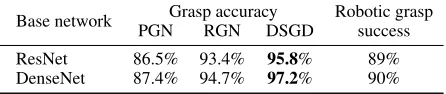
Table 4: Grasp evaluation on our multi-object dataset.
Base network Grasp accuracy Robotic grasp
PGN RGN DSGD success
ResNet 86.5% 93.4% 95.8% 89%
DenseNet 87.4% 94.7% 97.2% 90%
grip-A B C
Train set
Test set
D
Figure 7: Grasp evaluation on our multi-object dataset. The localization outputs of our pixel-level (PGN) and region-level (RGN) grasp models are shown in (A) and (B), respectively. The intensity of the prediction maps A and B represent grasp confidences. The segmented regions produced by our RGN model are shown in (C). Note that we only show grasps with confidence scores higher than 90% in (D). Our grasp detection results on Kinect video streams are available at: https://youtu. be/tA2qgtbTT98
Robot view Pixel-level localization outputs Region-level localization outputs Kinect view
Figure 8: Experimental setting for real-world robotic grasping. See video of our experiments at: https://youtu.be/Bn dQ8vcNzs
per), holds it in air for 3 seconds and takes it away from the robot workspace. The objects are placed in random positions and orientations to remove bias related to the object pose. Table 4 shows the success rates computed over 200 grasp-ing trials. The results show that we achieved grasp success
Conclusion and Future Work
We presentedDensely Supervised Grasp Detector(DSGD), which generates grasps and their confidence scores at dif-ferent image hierarchical levels (i.e., global-, region-, and pixel-levels). Experiments show that our proposed hierarchi-cal grasp generation produces superior grasp accuracy com-pared to the state-of-the-art on the Cornell grasp dataset. Our evaluations on videos from Kinect and robotic grasping ex-periments show the capability of our DSGD for producing stable grasps for unseen objects in new environments. In future, we plan to reduce the computational burden of our DSGD through parameter-pruning for low-powered GPU devices.
References
Asif, U.; Bennamoun, M.; and Sohel, F. 2016. Simultaneous dense scene reconstruction and object labeling. In ICRA, 2255–2262. IEEE.
Asif, U.; Bennamoun, M.; and Sohel, F. 2017a. A multi-modal, discriminative and spatially invariant cnn for rgb-d object labeling. IEEE Transactions on Pattern Analysis and Machine Intelligence.
Asif, U.; Bennamoun, M.; and Sohel, F. A. 2017b. Rgb-d object recognition anRgb-d grasp Rgb-detection using hierarchical cascaded forests. IEEE Transactions on Robotics.
Asif, U.; Tang, J.; and Harrer, S. 2018a. Ensemblenet: Improving grasp detection using an ensemble of convolu-tional neural networks. InBritish Machine Vision Confer-ence (BMVC).
Asif, U.; Tang, J.; and Harrer, S. 2018b. Graspnet: An effi-cient convolutional neural network for real-time grasp detec-tion for low-powered devices. InProceedings of the Twenty-Seventh International Joint Conference on Artificial Intelli-gence, IJCAI-18, 4875–4882.
Chu, F.-J.; Xu, R.; and Vela, P. A. 2018. Real-world multi-object, multigrasp detection.IEEE Robotics and Automation Letters3(4):3355–3362.
Guo, D.; Sun, F.; Liu, H.; Kong, T.; Fang, B.; and Xi, N. 2017. A hybrid deep architecture for robotic grasp detection. InICRA, 1609–1614. IEEE.
He, K.; Zhang, X.; Ren, S.; and Sun, J. 2016. Deep residual learning for image recognition. InCVPR, 770–778. He, K.; Gkioxari, G.; Doll´ar, P.; and Girshick, R. 2017. Mask r-cnn. InICCV, 2980–2988. IEEE.
Huang, G.; Liu, Z.; Weinberger, K. Q.; and van der Maaten, L. 2017. Densely connected convolutional networks. In CVPR, volume 1, 3.
Ioffe, S., and Szegedy, C. 2015. Batch normalization: Accel-erating deep network training by reducing internal covariate shift. InICML, 448–456.
Jiang, Y.; Moseson, S.; and Saxena, A. 2011. Efficient grasp-ing from rgbd images: Learngrasp-ing usgrasp-ing a new rectangle rep-resentation. InICRA, 3304–3311. IEEE.
Johns, E.; Leutenegger, S.; and Davison, A. J. 2016. Deep learning a grasp function for grasping under gripper pose uncertainty. InIROS, 4461–4468. IEEE.
Kumra, S., and Kanan, C. 2017. Robotic grasp detection using deep convolutional neural networks. InIROS. IEEE. Lenz, I.; Lee, H.; and Saxena, A. 2015. Deep learning for detecting robotic grasps.IJRR34(4-5):705–724.
Levine, S.; Pastor, P.; Krizhevsky, A.; Ibarz, J.; and Quillen, D. 2016. Learning hand-eye coordination for robotic grasp-ing with deep learngrasp-ing and large-scale data collection.IJRR 0278364917710318.
Mahler, J.; Pokorny, F. T.; Hou, B.; Roderick, M.; Laskey, M.; Aubry, M.; Kohlhoff, K.; Kr¨oger, T.; Kuffner, J.; and Goldberg, K. 2016. Dex-net 1.0: A cloud-based network of 3d objects for robust grasp planning using a multi-armed bandit model with correlated rewards. InICRA, 1957–1964. IEEE.
Mahler, J.; Liang, J.; Niyaz, S.; Laskey, M.; Doan, R.; Liu, X.; Ojea, J. A.; and Goldberg, K. 2017. Dex-net 2.0: Deep learning to plan robust grasps with synthetic point clouds and analytic grasp metrics. Robotics: Science and Systems (RSS).
Morrison, D.; Corke, P.; and Leitner, J. 2018. Closing the loop for robotic grasping: A real-time, generative grasp syn-thesis approach. arXiv preprint arXiv:1804.05172.
Myers, A.; Teo, C. L.; Ferm¨uller, C.; and Aloimonos, Y. 2015. Affordance detection of tool parts from geometric features. InICRA, 1374–1381.
Paszke, A.; Gross, S.; Chintala, S.; Chanan, G.; Yang, E.; DeVito, Z.; Lin, Z.; Desmaison, A.; Antiga, L.; and Lerer, A. 2017. Automatic differentiation in pytorch.
Pinto, L., and Gupta, A. 2016. Supersizing self-supervision: Learning to grasp from 50k tries and 700 robot hours. In ICRA, 3406–3413. IEEE.
Redmon, J., and Angelova, A. 2015. Real-time grasp detec-tion using convoludetec-tional neural networks. InICRA, 1316– 1322. IEEE.
Ren, S.; He, K.; Girshick, R.; and Sun, J. 2015. Faster r-cnn: Towards real-time object detection with region proposal networks. InNIPS, 91–99.
Saxena, A.; Driemeyer, J.; and Ng, A. Y. 2008. Robotic grasping of novel objects using vision.IJRR27(2):157–173. Varley, J.; Weisz, J.; Weiss, J.; and Allen, P. 2015. Generat-ing multi-fGenerat-ingered robotic grasps via deep learnGenerat-ing. InIROS, 4415–4420. IEEE.
Zeng, A.; Song, S.; Yu, K.-T.; Donlon, E.; Hogan, F. R.; Bauza, M.; Ma, D.; Taylor, O.; Liu, M.; Romo, E.; et al. 2017. Robotic pick-and-place of novel objects in clutter with multi-affordance grasping and cross-domain image match-ing.arXiv preprint arXiv:1710.01330.