The Thirty-Third AAAI Conference on Artificial Intelligence (AAAI-19)
Insufficient Data Can Also Rock! Learning to
Converse Using Smaller Data with Augmentation
Juntao Li,
1,2,∗Lisong Qiu,
1,2,∗Bo Tang,
3Dongmin Chen,
1Dongyan Zhao,
1,2Rui Yan
1,2† 1Center for Data Science, Academy forAdvanced Interdisciplinary Studies, Peking University, Beijing, China
2Institute of Computer Science and Technology, Peking University, Beijing, China
3Department of Computer Science and Engineering, Southern University of Science and Technology {lijuntao,qiuls,dongminchen,zhaody,ruiyan}@pku.edu.cn
Abstract
Recent successes of open-domain dialogue generation mainly rely on the advances of deep neural networks. The effective-ness of deep neural network models depends on the amount of training data. As it is laboursome and expensive to acquire a huge amount of data in most scenarios, how to effectively utilize existing data is the crux of this issue. In this paper, we use data augmentation techniques to improve the perfor-mance of neural dialogue models on the condition of insuffi-cient data. Specifically, we propose a novel generative model to augment existing data, where the conditional variational autoencoder (CVAE) is employed as the generator to output more training data with diversified expressions. To improve the correlation of each augmented training pair, we design a discriminator with adversarial training to supervise the aug-mentation process. Moreover, we thoroughly investigate var-ious data augmentation schemes for neural dialogue system with generative models, both GAN and CVAE. Experimental results on two open corpora, Weibo and Twitter, demonstrate the superiority of our proposed data augmentation model.
Introduction
Open-domain dialogue generation is becoming a research hotspot in the community of natural language processing due to their penitential applications. Along with the flour-ishing development of neural networks, plenty systems have been proposed to improve the quality of generated dia-logues from many aspects such as diversity (Li et al. 2015; Zhao, Zhao, and Eskenazi 2017), topic (Xing et al. 2017), persona modeling (Zhang et al. 2018) and emotion con-trolling (Zhou et al. 2017). Generally, in the paradigm of deep neural networks, a large quantity of training data is re-quired for facilitating the convergence of these models. For instance, Li et al. (2016) collected over 24 millions of query-response training pairs for building personalized dialogue generation systems. Hence, the crucial point of building di-alogue systems depends on whether exists proper dataset with sufficient training pairs. In other words, current dia-logue generation models mainly focused on using effective model frameworks, e.g. CVAE (Shen et al. 2017), and model
∗
Equal contribution
†
Corresponding author: Rui Yan ([email protected]) Copyright c2019, Association for the Advancement of Artificial Intelligence (www.aaai.org). All rights reserved.
training, e.g. adversarial and reinforcement learning (Li et al. 2017) to achieve improvement on an existing dataset.
As progress on dialogue generation is restricted by the size of training datasets, we investigate to move the fron-tier of dialogue generation forward from a different angle, i.e. training dialogue system on smaller data through using data augmentation techniques. To augment existing dialogue training data, there are two main issues to be addressed. The first one is how to get sufficient alternative expressions of the raw query response pairs since small data will result in the over-fitting problem and make conversation system vulnera-ble to unseen data (Hou et al. 2018). In real-world chit-chats, there are many proper responses for one specific query and there are also alternative responses with different syntacti-cal structure but same semantic information. Another chal-lenge is how to control the quality of augmented query re-sponse training pairs. It is expected that the data augmenta-tion method can generate more valid training data that can supplement the expressions of original data and further im-prove the performance of trained dialogue systems. To ob-tain more valid training data and limit negative noise, an ef-fective data augmentation model is required to generate each query-response pair with high relevance, and meanwhile re-duce repetitions between augmented query-response pairs.
While important, there are only a few studies presented for addressing the aforementioned challenges in dialogue data augmentation. To improve the performance of task-oriented dialogue system, Kurata et al. (2016) introduced an auto-encoder with random noise to produce more differ-ent utterances. Beyond that, another data augmdiffer-entation ap-proach for dialogue language understanding was presented through combing sequence-to-sequence and diversity rank to generate more diverse utterances (Hou et al. 2018). Al-though these methods have achieved performance improve-ment on specific tasks, there is still noticeable gap between these models and the aforementioned requirements. For one thing, they suffer from data sparsity as there are a few proper transformations only considering the lexical-level alterna-tive expressions. For another, integrating random noise to generate more data without supervision and feedback about the feasibility of the augmented utterances is risky.
au-toencoder (CVAE) model for generating sufficient alterna-tive expressions with diversified words by introducing a la-tent variable. To improve the relevance of each augmented query-response pair, we combine the CVAE model with a discriminator. The whole model is trained in an adversar-ial fashion to feed loss information from the discriminator to train the CVAE part, which allows generating more valid training pairs. Moreover, we introduce a distillation strategy to filter repetition query-response pairs in augmented data.
For evaluating the performance of our proposed data aug-mentation model, we conduct experiments on two open datasets, Weibo and Twitter. Automatic metrics and human evaluations indicate that our model can generate more valid training pairs with diversified expressions and good rele-vance within each augmented pair. Furthermore, we uti-lize sequence to sequence (Sutskever, Vinyals, and Le 2014; Klein et al. 2017) as the conversation generation model to evaluate whether the augmented dataset can achieve im-provement over the original one. Both quantitative and qualitative analysis confirm that after augmentation, the sequence-to-sequence model can generate better responses.
Problem Formulation
In this paper, our goal is to enrich training data under low-source condition. To formulate this task, the dialogue gen-eration and data augmentation processes are described with necessary notations, show as follows.
Following previous work (Li et al. 2015), open-domain dialogue generation involves automatically generating a re-sponse R = (r0, . . . , rj, . . . , rm) for a user-issued query Q = (q0, . . . , qk, . . . , qm0), where rj refers to the embed-ding representation ofi-th word in a response andqkdenotes thek-th word’s embedding of query.mandm0are the length of a response and a query, respectively. The entire dialogue system is trained underD, i.e. maximizing theP(Ri|Qi), whereD = {(Qi, Ri)}Ni=0 is the dataset and N refers to
the number of training query-reply pairs. For the data aug-mentation task, the original datasetDis increased toD0 =
{(Qi, Ri)}nNi=0, where n is the magnification of
augmen-tation. Correspondingly, the response generation changes fromargmaxRP(R|Q, D)toargmaxRP(R|Q, D
0
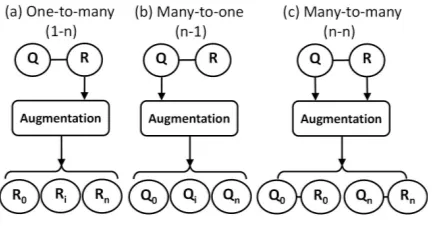
). Recall that dialogues are diversified, e.g. one specific query can match many proper responses and vice versa. In-spired by this, we design three different schemes for en-hancingDtoD0, which is shown in Figure 1. The first one is to construct n queries conditioned on each single query-response pair, as a result of which each query refers to n proper responses, named one-to-many (1-n). Similarly, we refer the second one to generating n queries based on each single query-response pair, defined as many-to-one (n-1). Another one is named many-to-many (n-n) which represents mapping each query-response pair to n pairs, where the gen-eration process is accomplished in an paired fashion, i.e. both queries and replies are different with the original one.
The Approach
In this section, we will elaborate the details of data augmen-tation model, augmenting process and dialogue modeling.
Figure 1: Three different paradigms of data augmentation for open-domain dialogue generation.
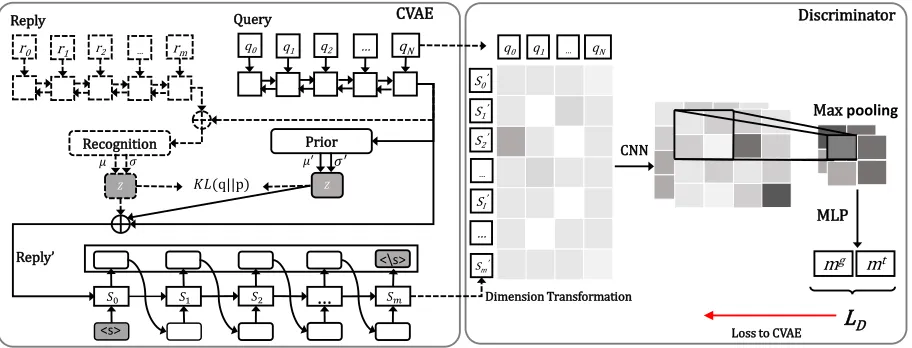
As demonstrated in Figure 2, our proposed data augmenta-tion model comprises two parts: CVAE and a discriminator.
CVAE
To generate diversified query-response pairs, we employ CVAE as the core of our data augmentation model. On the whole, the CVAE part consists of an encoder and a decoder. The encoder is a bidirectional RNN (Schuster and Paliwal 1997) with gated recurrent units (GRU) (Sutskever, Vinyals, and Le 2014), where inputxis mapped to a latent variable z under given condition c, i.e.(x, c) 7→ z. In details, the encoder computes a posterior distributionqθ(z|x, c)given the input xand condition c. Note that inputx can be ei-ther query or response depending on which augmentation scheme mentioned above is used, so doesc. For instance,x refers to response whilecrefers to query for the one-to-many setting. Hereinafter, we take the one-to-many setting as ex-ample to describe the augmentation process of our proposed model while other settings will be elaborated in the follow-ing subsection. Durfollow-ing encodfollow-ing, a query and a response are represented by the concatenation of forward and backward vectors, i.e.hq = [
− →
hq,
←−
hq]andhr= [
− →
hr,
←− hr].
The decoder is a one-layer RNN with GRU cell, which takes[z, c]as input to construct the inputx, i.e.(z, c)7→x. Specifically, the decoding process is formulated as comput-ingpθ(x|z, c), wherezfollows a prior distributionpθ(z|c), e.g, a standard Gaussian distribution. θ denotes the pa-rameters of both encoder and decoder. Since the integral of the marginal likelihood pθ(x|c) is intractable for large datasets (Kingma and Welling 2014), the true posterior is re-placed by its variational approximationqφ(z|x, c).φrefers to parameters ofq.
For training the CVAE part, the objective is to maximize the log-likelihood pθ(x|c) over inputxconditioned on c. Through pushing up the variational lower bound of the ob-jective, written by
L(θ, φ;x, c) =−KL(qφ(z|x, c)kpθ(z|c))
+Eqφ(z|x,c)[logpθ(x|z, c)]
(1)
CVAE
𝜇 𝜎 𝜇′ 𝜎′
rm
r1 …
r0
Reply
r2 q0 q1 q2 … qN
Query
Recognition
𝑆0 𝑆1 𝑆2
…
𝑆𝑚𝑍 𝑍
Prior
𝐾𝐿(q||p)
<\s> Reply’
<s>
q0 q1 … qN
Sm’ … SI’ … S2’ S1’ S0’
Dimension Transformation
Maxpooling
CNN
Discriminator
mg mt
L
DMLP
Loss to CVAE
Figure 2: The architecture of our proposed data augmentation model, where the left is the CVAE and the right depicts the discriminator. The operations labeled by red color refers to the loss signal from the discriminator. Notice that the discriminator and objects with dashed lines are only used during training while other parts are used during both training and testing process.
the approximated posterior qφ(z|x, c). Following previous work, (Kingma and Welling 2014; Zhao, Zhao, and Eskenazi 2017), we hypothesize the approximated posterior follows a multivariate Gaussian N, i.e qφ(z|x, c) = N(µ, σ2I), whereµandσ2represents the mean and variance ofN and
Ihas a diagonal structure. Thus modeling the apprximiated posterior is converted to learnµandσ, computed by
µ
log σ2
=Wq
x c
+bq (2)
where Wq and bq are trainable parameters. In the same vein, the prior pθ(z|c) is another multivariate Gaussian
N(µ0, σ02I). The key parameters µ0 and σ02 are learned
by a single-layer fully-connected network (MLP) with the tanh(·)activation function, formulated as:
µ0
log σ02
= MLPp(c) (3)
Both the encoder and decoder are used during the training process while only part with solid lines in Figure 2 are used during prediction. It is worth noticing that the hidden states of the decoder,(s0, . . . , si, . . . , sm), and the word embed-ding representation of a query, (q0, . . . , qk, . . . , qm0), will be passed to the discriminator as inputs.
The Discriminator
The discriminator in our model is to evaluate whether the generated responses are feasible for a given query. The loss signal from the discriminator is back-propagated to the CVAE part for enhancing its training process. In this study, we utilize the implementation that contains two steps. We first calculate the interaction (or matching) matrix between the generated responseR0 and the queryQ, whereR0 refers to the constructed result of the originalR. We then use a convolutional neural network (CNN) to extract features from
the interaction matrix and output a score for calibrating the matching degree between R0 and the given query. As the training is conducted in an adversarial fashion, we treatR0 as the negative instance whileRas positive one.
Specifically, R0 is represented by (s0, . . . , si, . . . , sm) andQis(q0, . . . , qk, . . . , qm0), which are from the CVAE part. A dimension transformation is first conducted onR0to align it withQ, formulated as:
s0i=ReLU(Wdsi+bd) (4) where ReLU is activation function and Wd and bd are trainable parameters. In this way, the dimension of s0i is same as word embedding. With generated response R0d = (s00, . . . , s
0
i, . . . , s
0
m), the interaction matrix between the re-constructed response and queryQis formulated as below:
Mg=R0d·Q (5)
whereMg ∈R(m+1)×(m
0
+1);“·”refers to the matrix
mul-tiplication operation.
In the second step, a feature matrix is learned by F =
CN N(Mg), which corresponds to extracting features from the interaction matrix using a CNN network. Once this is done, a max-overtime pooling strategy (Collobert et al. 2011) is used for filtering features inF. Then, a one-layer fully-connected neural network with a sigmoid activation function is utilized to flatten the feature matrix, resulting in the final matching score mg ∈ (0,1). Apart frommg, the matching scoremtbetween the positive instanceRand query Qis also calculated as the above-mentioned proce-dure, except the dimension transformation operation. Note thatRis represented by(r0, . . . , rj, . . . , rm), whererjhas the same dimension with word embedding.
the discriminator is to maximize the matching score of pos-itive instances and meanwhile minimize the matching score of negative ones, formulated as:
LD= log(mt) + log(1−mg) (6)
Finally, the overall objective of our proposed data aug-mentation model can be formulated as the following one:
LCVAE-D=LCV AE−λLD (7)
which is maximized for updating the parameters of the CVAE, where LCV AE is the objective of CVAE, i.e.
LCV AE =L(θ, φ;x, c). For training the discriminator, this objective is minimized such thatLD is maximized, which corresponds to encourage better distinction between posi-tive and negaposi-tive instances.λis a balancing parameter. The CVAE and the discriminator is trained alternatively in a two-step adversarial fashion (Zhang, Barzilay, and Jaakkola 2017). This training process is repeated until the whole ob-jectiveLCVAE-Dis converged.
Data Augmentation
Recall that we investigate to utilize three different aug-mentation schemes for generating query-response pairs, i.e., many, many-to-one, many-to-many. For the one-to-many (1-n) scheme, we are targeting at generatingn corre-sponding responses according to each query-response pair, wherenis the magaification. In this setting, the aforemen-tioned conditioncof CVAE refers to the query andxrefers to the response. In the test, the trained CVAE-GAN model generatesnresponses conditioned oncandx, i.e. the orig-inal query-response pair. As to many-to-one (n-1), the aug-mentation process is conduced in a similar fashion, where the reply is presented ascwhile the query refers tox. The setting of many-to-many (n-n) refers to iteratively using the trained models in one-to-many and many-to-one settings, i.e., generating a response conditioned a query and then outputting a query according to the generated response at each iteration. After niterations, a query-response pair is enhanced to n pairs. As there could exist alike or irrele-vant instances, we propose a distillation strategy to filter the augmented results. Specifically, we use the Jaccard distance to depict the word-level semantic similarity between utter-ances, where highly similar utterances will be removed.
Dialogue Generation
As a most popular dialogue generation model, the sequence to sequence model with attention (S2S) is adopted as the benchmark to verify the efficiency of our proposed ap-proach. In S2S, given a queryQ= (q1, ..., qk, ..., qm0)and a replyR = (r0, . . . , rj, . . . , rm),Qis encoded by apply-inghe
t = RN Nenc(xt|het−1)and the final hidden statehk is fed into the decoderRN Ndec as the initial statehd0. At
each timestep of decoding, the hidden state of decoder is computed assi =RN Ndec(ri−1, si−1, ci), whereciis cal-culated through the attention mechanism (Luong, Pham, and Manning 2015) and the probability distribution of candidate words is computed through softmax. The objective function
Rela. Does the query-response pair correlate well?
Divt. Does the utterance narrate with diversified words?
Red. Is the utterance grammatically formed?
Ovr. The average score of the above three criteria.
Table 1: Criteria of human evaluation.
is to minimize the negative log probability:
LS2S=
N
X
j=1
−logP(Rj|Qj) (8)
whereP(Rj|Qj)is calculated by the chain rule.
Experiment Setup
Datasets
To evaluate the effect of data augmentation, we conduct ex-periments on two open dialogue corpora in different lan-guages, the Weibo (Wang et al. 2013) and Twitter (Rit-ter, Cherry, and Dolan 2010). Concretely, the Weibo dataset consists of short-text online chit-chat dialogues in Chinese, which is crawled from Sina Weibo1. The Twitter dataset is
in English, which is collected from the microblogging ser-vice, Twitter2. Totally, there are 0.6 million query-response
pairs in the Weibo corpus and 1.3 million pairs in the Twitter dataset. In our experiments, we randomly extract [20k, 50k, 100k, 200k, 300k, 500k] utterance pairs from both datasets for training to simulate the scenario of data augmentation. In addition to the training sets, we also collect 10k and 20k pairs for validation and testing, respectively. For preprocess-ing, we follow the conventional settings (Ritter, Cherry, and Dolan 2010; Wang et al. 2013).
Baselines
Our model is compared with several highly related and strong baselines, including:
Sequence to sequence (S2S), the vanilla RNN-based sequence-to-sequence dialogue system (Klein et al. 2017).
Noising Autoencoder (NAE), the conventional RNNs encoder-decoder with random perturbations added to the en-coded vectors (Kurata, Xiang, and Zhou 2016).
DAGAN,a basic implementation of DAGAN (Antoniou, Storkey, and Edwards 2017) for text generation task, which is the combination of our introduced discriminator and the NVE model.
CVAE, the conventional CVAE model (Zhao, Zhao, and Eskenazi 2017; Shen et al. 2017), which is used for investi-gating the performance of CVAE for data augmentation.
Model Settings
All models are trained with the following hyper-parameters: both encoder and decoder are set to one layer with GRU cells, where the hidden state size of GRU is 500; the ut-terance length is limited to 50, and the vocabulary size is
1
https://www.weibo.com/ 2
40,000; word embedding size is 500; all trainable parame-ters are initialized from a uniform distribution [-0.08, 0.08]; we employ the Adam (Kingma and Ba 2014) for optimiza-tion with a mini-batch size 64; the gradient clipping strat-egy is utilized to avoid gradient explosion, where the gra-dient clipping value is set to be 5. We stop training the dialogue model S2S if the perplexity keeps increasing in two successive epochs. During decoding, we use the beam search strategy, with the beam size set to 5. In addition to the shared hyper-parameters, we have the following settings for CVAE, DAGAN, and CVAE-GAN. The dimension of the latent variablezin CVAE and CVAE-GAN is set to 300 and the layer size ofM LPpis 400. For the discriminator in DA-GAN and CVAE-DA-GAN, the kernel size of CNN is (5, 5) with the stride sizekset to 2. Following the conventional setting (Hu et al. 2017), we set the balancing parameterλto 0.1. For data augmentation, the magnificationnis 10. For each original query-response pair, its corresponding augmented utterances that have Jaccard distances larger than 0.8 with others are filtered during the distillation process, where the threshold value is set empirically.
Evaluation Metrics
To comprehensively evaluate the quality of augmented query-response pairs and their influence to dialogue genera-tion system, we utilize the following metrics:
BLEU:In dialogue generation, BLEU is widely used in previous studies (Zhao, Zhao, and Eskenazi 2017; Lei et al. 2018). We follow their settings in this paper.
Distinctness:To distinguish safe and common responses, the distinctness score (Li et al. 2015) is designed to measure word diversity by counting the distinctive [1,4]-grams with the final distinctness values normalized to [0, 100].
Human Evaluation: For assessing the quality of aug-mented query-response pairs, we utilize the criteria in previ-ous work (Tao et al. 2018; Shang et al. 2018), i.e. relevance (Rela.), diversity (Divt.), Readability (Red.). Details of the criteria are given in Table 1, where each criterion is scored from{1, 2, 3}, denoting bad, normal, good, respectively. To evaluate the performance of dialogue generation model, we conduct human preference judges (Fan, Lewis, and Dauphin 2018) on generated utterances, i.e. choosing the better one from two competing utterances. For both settings, we ran-domly sample 200 generated utterances for each model, where each utterance is ranked by 5 well-educated annota-tors. The whole evaluation is conducted in a blind fashion.
Results and Analysis
Recall that we conduct experiments on different raw data sizes to investigate the effects of data augmentation on di-alogue generation. Table 2 presents the results of human judges and Table 3 illustrates the results of automatic evalu-ation. We analyze these results from the following aspects.
Ablation Study
This section is to investigate how each part of the data aug-mentation model affects the generated query-response pairs and the resulting performance of dialogue generation. There
Datasets Models Rela. Divt. Red. Ovr.
NAE 1.87 2.02 2.22 2.04
DAGAN 1.96 1.97 2.27 2.07
CVAE 2.20 2.41 2.35 2.32
CVAE-GAN 2.38 2.35 2.45 2.39
NAE 1.67 1.89 1.98 1.85
DAGAN 1.79 1.92 2.04 1.92
CVAE 1.84 2.21 2.10 2.05
CVAE-GAN 2.04 2.23 2.22 2.16
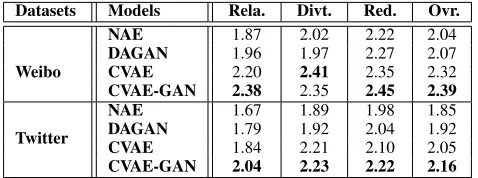
Table 2: Results of human evaluations on augmented query-response pairs (p<0.01), whereRela.,Divt.,Red.,Ovr. rep-resent relevance, diversity, readability, overall, respectively.
are two groups of ablation observations, i.e. the effects of the CVAE and the influence of the introduced discriminator. To investigate whether using a latent variable and vari-ational inference can improve the diversity of augmented query-response pairs, we summarize two groups comparison of human evaluation results in Table 2, i.e, NAEv.s.CVAE, DAGANv.s.CVAE-GAN. The results show that CVAE out-performs all baselines in terms of diversity score on two datasets, which means the CVAE part can generate query-response pairs with diversified expressions. With diversified expressions in the augmented data, CVAE also achieves a better user experience, which is confirmed by the overall score in human evaluation. These results confirm that CVAE is effective for supplementing the original training data with proper query-response pairs in diversified words. Though ef-fective for improving the diversity, the CVAE model yields substandard correlations between augmented queries and their corresponded responses. As the variational latent vari-able introduces randomness into the augmentation process, query-response pairs from CVAE model have weaker corre-lation than those from CVAE-GAN, which is proven by the relevance score in Table 2.
To study the influence of augmented training data from CVAE, we analyze the results of dialogue generation in Ta-ble 3. It can be seen that the dialogue model enhanced with augmented data from CVAE outputs responses with better distinct scores than other baseline settings, which confirms that dataset augmented by CVAE can substantially improve the diversity of dialogue generation. We also observe that training dialogue systems with the augmented data from CVAE improves the performance in terms of BLEU scores.
The discriminator is introduced for supervising data aug-mentation process so as to generate query-response pairs correlated well with each other. We conduct two groups of comparisons to study the effectiveness of the discrim-inator, i.e., DAGAN v.s. NAE, CVAE v.s. CVAE-GAN. We observe that the discriminator is effective for improving the correlations between generated query-response pairs. As presented by the relevance score in Table 2, the CVAE and NAE model can generate correlated query-response pairs with the enhancement of the discriminator. Meanwhile, the introduced discriminator does not result in inferior perfor-mance in readability and diversity.
dis-Metrics
S2S
NAE
DAGAN
CVAE
CVAE-GAN
1-n
n-1
n-n
1-n
n-1
n-n
1-n
n-1
n-n
1-n
n-1
n-n
BLEU-1
9.42
9.79
9.78
9.54
10.1
9.46
9.15
10.1
9.19
9.22
10.9
9.18
9.71
BLEU-2
1.44
1.28
1.46
1.40
1.30
1.47
1.37
1.51
1.50
1.55
1.62
1.60
1.72
BLEU-3
0.58
0.47
0.74
0.69
0.47
0.73
0.71
0.62
0.79
0.79
0.57
0.85
0.95
BLEU-4
0.34
0.29
0.58
0.52
0.28
0.58
0.54
0.39
0.64
0.60
0.32
0.68
0.76
Dist-1
5.00
4.94
5.50
7.49
4.16
7.34
6.77
8.29
8.41
8.20
8.87
8.68
8.62
Dist-2
25.9
24.1
24.2
31.1
20.2
32.4
31.0
36.6
35.5
34.8
35.8
37.5
36.2
Dist-3
51.0
51.6
47.7
56.3
43.7
57.5
56.4
66.5
61.3
60.9
63.7
63.0
63.2
Dist-4
69.7
73.9
66.9
73.9
65.0
74.7
73.4
84.4
77.5
77.5
82.0
68.8
80.0
Table 3: Results of automatic evaluation for dialogue systems with distillation under the setting of 100k raw Weibo training data.BLEU-nrefers to BLEU scores on n-gram;Dist-ndenotes the distinctness ofn-gram, withn = 1to4;1-n,n-1,n-n
represent augmenting responses (one-to-many), queries (many-to-one), query-response pairs (many-to-many), respectively.
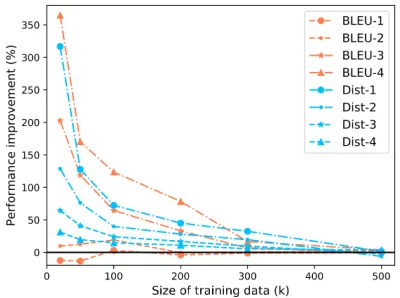
Figure 3: The performance improvements with different raw training data sizes, where augmentation is done by the CVAE-GAN model under the many-to-many (n-n) setting.
criminator boosts the dialogue generation model with a sub-stantial improvement in terms of BLEU scores, which rep-resents more overlappings with the expected conversations. Moreover, the discriminator does not introduce negative ef-fects to the S2S dialogue generation model, which is con-firmed in Table 3 that CVAE-GAN and DAGAN achieves comparable results from other aspects, e.g. diversity.
For our CVAE-GAN model, it outperforms all baselines in human evaluations for dialogue data augmentation. As il-lustrated in Table 2, training pairs augmented from CVAE-GAN are better than other baselines from three aspects, i.e. relevance, diversity, and readability. We also observe that the CVAE-GAN model further improves the quality of dialogue generation model trained on the augmented data pairs, which is confirmed by the significant improvement of BLEU and distinct scores. These results indicate that the CVAE-GAN data augmentation model is effective for enhancing the S2S dialogue generation model, especially improving diversity.
The Effect of Data Augmentation
As illustrated in Table 3, each data augmentation models have three different schemes for enhancing the raw data, i.e.
Model S2S S2S+DA Weibo 38.4% 61.6%
Twitter 43.2% 56.8%
Table 4: Results of human perference judges on the dialogue systems, whereDArefers to data augmentation.
one-to-many (1-n), many-to-one (n-1), and many-to-many (n-n). Through analyzing these results, we have the follow-ing three main observations: under the settfollow-ing of 1-n, the augmented data set achieves the best results of diversity while obtaining relatively low BLEU scores; for the n-1 set-ting, the augmented data set yields higher BLEU scores and shows competitive diversity; as for n-n setting, it achieves a balance between the above-mentioned two settings. To show the superiority of our proposed data augmentation scheme, we also conduct human preference judges on the results of S2S dialogue system. Table 4 shows the results of training the S2S model with augmented data from CVAE-GAN un-der the many-to-many setting (n-n). The results indicate that the CVAE-GAN data augmentation model substantially im-proves user experience of the final trained dialogue system.
Scheme Query Have a look at these various mistakes. Response The one in the kitchen is so funny, hahaha.
1-n
Response1 How can the last expression be so funny!
Response2 The last one is really funny. So cute!
Response3 Sure enough, it’s hilariously funny, hahaha.
Response4 Ah, impressive! This is so funny.
n-1
Query1 What do you think of it?
Query2 Have a look at these brilliant replies.
Query3 Find the highlight, especially in those comments.
Query4 What’s going on? Can you share it?
n-n
Query1 This is the right way to be funny.
Response1 o o hahaha, it’s so cute. We laugh our heads off.
Query2 There are various funny mistakes. Have a look!
Response2 Wow, the kid is so funny, hahaha.
Query3 Take a look at these various mistakes as you wish.
Response3 LoL, it’s awesome, hahaha.
Query4 It cracks me up.
Response4 This is really cute, hahaha.
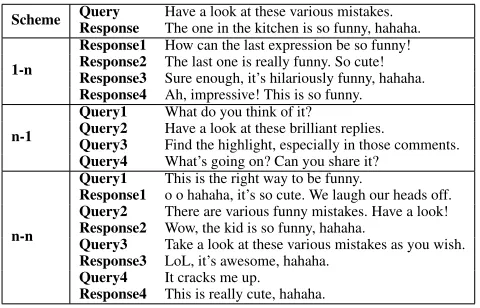
Figure 4: Example pairs augmented by CVAE-GAN model.
Case Study
In addition to quantitative results, we also launch case study to illustrate the superiority of our proposed data augmenta-tion approach. Figure 4 presents some examples produced by the CVAE-GAN model on the Weibo corpus where the Chinese utterances are translated into English. We can ob-serve that in all three settings, our data augmentation model can generate query-pairs correlated well with the original ones while limiting repetitions. Figure 5 gives some cases which illustrate the influence of augmented data to dialogue generation, where case 1, 2 are obtained from the dialogue model trained on Weibo dataset while the others refer to the Twitter corpus. These results confirm that dialogue system trained with augmented data can produce utterances with di-verse expressions that are proper and feasiable.
Related Work
Deep Generative Models
This work can be seen as the extension of deep generative models (Bengio et al. 2014) in natural language generation. Conventionally, generative models, inluding VAEs (Kingma and Welling 2014) and GANs (Goodfellow et al. 2014), are mainly used for image generation (Sohn, Yan, and Lee 2015; Yan et al. 2016). In the field of natural language process-ing (NLP), owprocess-ing to the discrete nature of text (Yu et al. 2017), previous success for text generation with genera-tive models concentrates on using VAE (Bowman et al. 2016) and CVAE (Serban et al. 2017; Shen et al. 2017; Zhao, Zhao, and Eskenazi 2017). As the GAN framework facilitates training the generator, Larsen et.al. (2016) pro-pose to integrate VAE and GAN, where VAE is treated as the generator. Hu et.al. (2017) first combine VAE and GAN for text generation. To the best of our knowledge, we are the first to combine CVAE-GAN (Li et al. 2018) for data aug-mentation.
Data Augmentation
In the paradigm of deep learning, data augmentation is an effective way to boost the performance of neural models. Previous success of data augmentation is mainly observed in
Case 1
Query The new photography of the twenty-four solar terms is so overwhelming.
Response I love this so much that I can’t be thin to settle.
S2S I am grieved to watch the game.
S2S+DA I like it so much, and I’ve already collected it.
Case 2
Query In Tibet, you can see such starry sky as you look up. Do you like it?
Response I wanna to go to Tibet.
S2S I just want to ask where you are.
S2S+DA I wanna go to the place of Tibet.
Case 3
Query It was nice. I had my nieces 2nd birthday get together and it was nice hanging with children.
Response Awwww, was she all happy ?
S2S It was nice. I thought it was fun today.
S2S+DA Glad she had a wonderful birthday !
Figure 5: Case study of utterances generated by dialogue systems. DA denotes augmentation with the CVAE-GAN model under the many-to-many (n-n) scheme.
computer vision while there are only a few works designed for tasks in natural language processing. A denosiong au-toencoder is utilized for generating more utterances through introducing noise to the decoding process (Kurata, Xiang, and Zhou 2016). Besides, Hou et.al. (2018) combined se-quence to sese-quence model with a diversity rank to produce alternatives of utterances for language understanding.
Conclusion
In this paper, we propose an effective model that com-bines CVAE and GAN for augmenting dialogue data. Con-cretely, we utilized CVAE to improve the diversity of aug-mented query-response pairs. A discriminator is used with adversarial training for enhancing the relevance of gener-ated training pairs. Moreover, we designed three data aug-mentation schemes for query-response pair generation, i.e. one-to-many, many-to-one and many-to-many. Experimen-tal results on two open corpora, Weibo and Twitter, indicate that through combing CVAE with the discriminator, notable improvement has been achieved on the quality of augmented training data over those generated by existing models. With the augmented training data, the dialogue generation model also gains a substantial performance improvement.
Acknowledgments
We would like to thank the anonymous reviewers for their constructive comments. This work was supported by the Na-tional Key Research and Development Program of China (No. 2017YFC0804001), the National Science Foundation of China (NSFC No. 61672058; NSFC No. 61876196). Rui Yan was sponsored by CCF-Tencent Open Research Fund, Alibaba Innovative Research (AIR) fund, and Microsoft Re-search Asia (MSRA) Collaborative ReRe-search Program. Bo Tang was supported by Guangdong Natural Science Founda-tion (Grant No. 2018A030310129) and the NaFounda-tional Science Foundation of China (NSFC No. 61802163).
References
Bengio, Y.; Thibodeau-Laufer, E.; Alain, G.; and Yosinski, J. 2014. Deep Generative Stochastic Networks Trainable by Backprop. InICML, 226–234.
Bowman, S. R.; Vilnis, L.; Vinyals, O.; Dai, A.; Jozefow-icz, R.; and Bengio, S. 2016. Generating Sentences from a Continuous Space. InSIGNLL, 10–21.
Collobert, R.; Weston, J.; Bottou, L.; Karlen, M.; Kavukcuoglu, K.; and Kuksa, P. 2011. Natural Language Processing (Almost) from Scratch. Journal of Machine Learning Research12(Aug):2493–2537.
Fan, A.; Lewis, M.; and Dauphin, Y. 2018. Hierarchical Neural Story Generation.arXiv preprint arXiv:1805.04833. Goodfellow, I.; Pouget-Abadie, J.; Mirza, M.; Xu, B.; Warde-Farley, D.; Ozair, S.; Courville, A.; and Bengio, Y. 2014. Generative Adversarial Nets. InNIPS, 2672–2680.
Hou, Y.; Liu, Y.; Che, W.; and Liu, T. 2018. Sequence-to-Sequence Data Augmentation for Dialogue Language Un-derstanding. arXiv preprint arXiv:1807.01554.
Hu, Z.; Yang, Z.; Liang, X.; Salakhutdinov, R.; and Xing, E. P. 2017. Toward controlled generation of text. arXiv preprint arXiv:1703.00955.
Kingma, D. P., and Ba, J. 2014. Adam: A method for stochastic optimization.arXiv preprint arXiv:1412.6980. Kingma, D. P., and Welling, M. 2014. Auto-Encoding Vari-ational Bayes.stat1050:10.
Klein, G.; Kim, Y.; Deng, Y.; Senellart, J.; and Rush, A. M. 2017. OpenNMT: Open-source toolkit for neural machine translation. InProc. ACL.
Kurata, G.; Xiang, B.; and Zhou, B. 2016. Labeled Data Generation with Encoder-Decoder LSTM for Semantic Slot Filling.INTERSPEECH.
Larsen, A. B. L.; Sønderby, S. K.; Larochelle, H.; and Winther, O. 2016. Autoencoding Beyond Pixels Using a Learned Similarity Metric. InICML, 1558–1566.
Lei, W.; Jin, X.; Kan, M.-Y.; Ren, Z.; He, X.; and Yin, D. 2018. Sequicity: Simplifying task-oriented dialogue systems with single sequence-to-sequence architectures. In ACL, volume 1, 1437–1447.
Li, J.; Galley, M.; Brockett, C.; Gao, J.; and Dolan, B. 2015. A diversity-promoting objective function for neural conver-sation models. arXiv preprint arXiv:1510.03055.
Li, J.; Galley, M.; Brockett, C.; Spithourakis, G.; Gao, J.; and Dolan, B. 2016. A persona-based neural conversation model. InACL, volume 1, 994–1003.
Li, J.; Monroe, W.; Shi, T.; Jean, S.; Ritter, A.; and Jurafsky, D. 2017. Adversarial learning for neural dialogue genera-tion. InEMNLP, 2157–2169.
Li, J.; Song, Y.; Zhang, H.; Chen, D.; Shi, S.; Zhao, D.; and Yan, R. 2018. Generating classical chinese poems via con-ditional variational autoencoder and adversarial training. In EMNLP, 3890–3900.
Luong, M.-T.; Pham, H.; and Manning, C. D. 2015. Effec-tive approaches to attention-based neural machine transla-tion.arXiv preprint arXiv:1508.04025.
Ritter, A.; Cherry, C.; and Dolan, B. 2010. Unsupervised modeling of twitter conversations. InNAACL, 172–180. Schuster, M., and Paliwal, K. K. 1997. Bidirectional Recur-rent Neural Networks. IEEE Transactions on Signal Pro-cessing45(11):2673–2681.
Serban, I. V.; Sordoni, A.; Lowe, R.; Charlin, L.; Pineau, J.; Courville, A. C.; and Bengio, Y. 2017. A Hierarchical Latent Variable Encoder-Decoder Model for Generating Dialogues. InAAAI, 3295–3301.
Shang, M.; Fu, Z.; Peng, N.; Feng, Y.; Zhao, D.; and Yan, R. 2018. Learning to converse with noisy data: Generation with calibration. InIJCAI, 4338–4344.
Shen, X.; Su, H.; Li, Y.; Li, W.; Niu, S.; Zhao, Y.; Aizawa, A.; and Long, G. 2017. A Conditional Variational Frame-work for Dialog Generation. InACL, volume 2, 504–509. Sohn, K.; Yan, X.; and Lee, H. 2015. Learning Structured Output Representation using Deep Conditional Generative Models. InNIPS, 3483–3491.
Sutskever, I.; Vinyals, O.; and Le, Q. V. 2014. Sequence to sequence learning with neural networks. InNIPS, 3104– 3112.
Tao, C.; Gao, S.; Shang, M.; Wu, W.; Zhao, D.; and Yan, R. 2018. Get the point of my utterance! learning towards effective responses with multi-head attention mechanism. In IJCAI, 4418–4424.
Wang, H.; Lu, Z.; Li, H.; and Chen, E. 2013. A dataset for research on short-text conversations. InEMNLP, 935–945. Xing, C.; Wu, W.; Wu, Y.; Liu, J.; Huang, Y.; Zhou, M.; and Ma, W.-Y. 2017. Topic Aware Neural Response Generation. InAAAI, volume 17, 3351–3357.
Yan, X.; Yang, J.; Sohn, K.; and Lee, H. 2016. At-tribute2image: Conditional Image Generation from Visual Attributes. In ECCV, 776–791. Amsterdam, Netherlands: Springer.
Yu, L.; Zhang, W.; Wang, J.; and Yu, Y. 2017. Seqgan: Sequence generative adversarial nets with policy gradient. AAAI.
Zhang, Y.; Barzilay, R.; and Jaakkola, T. 2017. Aspect-augmented Adversarial Networks for Domain Adaptation. TACL5(1):515–528.
Zhang, S.; Dinan, E.; Urbanek, J.; Szlam, A.; Kiela, D.; and Weston, J. 2018. Personalizing Dialogue Agents: I have a dog, do you have pets too?ACL.
Zhao, T.; Zhao, R.; and Eskenazi, M. 2017. Learning Discourse-level Diversity for Neural Dialog Models using Conditional Variational Autoencoders. InACL, volume 1, 654–664.