The Thirty-Third AAAI Conference on Artificial Intelligence (AAAI-19)
Learning Personalized End-to-End Goal-Oriented Dialog
Liangchen Luo,
†,∗Wenhao Huang,
‡Qi Zeng,
†Zaiqing Nie,
§Xu Sun
††MOE Key Lab of Computational Linguistics, School of EECS, Peking University, Beijing, China
‡Shanghai Discovering Investment, Shanghai, China§Alibaba AI Labs, Beijing, China
†{luolc,pkuzengqi,xusun}@pku.edu.cn
‡[email protected]§[email protected]
Abstract
Most existing works on dialog systems only consider conver-sation content while neglecting the personality of the user the bot is interacting with, which begets several unsolved issues. In this paper, we present a personalized end-to-end model in an attempt to leverage personalization in goal-oriented di-alogs. We first introduce a PROFILEMODELwhich encodes user profiles into distributed embeddings and refers to conver-sation history from other similar users. Then a PREFERENCE
MODELcaptures user preferences over knowledge base enti-ties to handle the ambiguity in user requests. The two mod-els are combined into the PERSONALIZED MEMN2N. Ex-periments show that the proposed model achieves qualitative performance improvements over state-of-the-art methods. As for human evaluation, it also outperforms other approaches in terms of task completion rate and user satisfaction.
1
Introduction
There has been growing research interest in training dia-log systems with end-to-end models (Vinyals and Le 2015; Sordoni et al. 2015; Sukhbaatar et al. 2015) in recent years. These models are directly trained on past dialogs, without assumptions on the domain or dialog state structure (Bor-des, Boureau, and Weston 2017). One of their limitations is that they select responses only according to the content of the conversation and are thus incapable of adapting to users with different personalities. Specifically, common is-sues with such content-based models include: (i) the inabil-ity toadjust language style flexibly (Herzig et al. 2017); (ii) the lack of adynamic conversation policybased on the interlocutor’s profile (Joshi, Mi, and Faltings 2017); and (iii) the incapability ofhandling ambiguitiesin user requests.
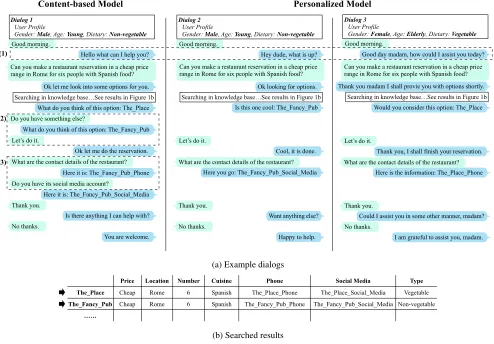
Figure 1 illustrates these problems with an example. The conversation happens in a restaurant reservation scenario. First, the responses from the content-based model are plain and boring, and not able to adjust appellations and language styles like the personalized model. Second, in the recom-mendation phase, the content-based model can only provide candidates in a random order, while a personalized model
∗
This work was done when the first author was on an intern-ship and the second author was a full-time employee researcher at Microsoft Research Asia.
Copyright c2019, Association for the Advancement of Artificial Intelligence (www.aaai.org). All rights reserved.
can change recommendation policy dynamically, and in this case, match the user dietary. Third, the word “contact” can be interpreted into “phone” or “social media” contact infor-mation in the knowledge base. Instead of choosing one ran-domly, the personalized model handles this ambiguity based on the learned fact that young people prefer social media account while the elders prefer phone number.
Psychologists have proven that during a dialog humans tend to adapt to their interlocutor to facilitate understand-ing, which enhances conversational efficiency (Brown 1965; 1987; Kroger and Wood 1992). To improve agent intelli-gence, we may polish our model to learn such human behav-iors in conversations. A big challenge in building personal-ized dialog systems is how to utilize the user profile and gen-erate personalized responses correspondingly. To overcome it, existing works (Qian et al. 2017; Herzig et al. 2017) often conduct extra procedures to incorporate personalization in training, such as intermediate supervision and pre-training of user profiles, which are complex and time-consuming. In contrast, our work is totally end-to-end.
In this paper, we propose a PROFILE MODEL and a
PREFERENCEMODELto leverage user profiles and
prefer-ences. The PROFILE MODELlearns user personalities with
distributed profile representation, and uses a global memory to store conversation context from other users with similar profiles. In this way, it can choose a proper language style and change recommendation policy based on the user pro-file. To address the problem of ambiguity, the PREFERENCE
MODEL learns user preferences among ambiguous
candi-dates by building a connection between the user profile and the knowledge base. Since these two models are both under the MEMN2N framework and make contributions to per-sonalization in different aspects, we combine them into the
PERSONALIZEDMEMN2N.
Our experiments on a goal-oriented dialog corpus, the personalized bAbI dialog dataset, show that leveraging per-sonal information can significantly improve the performance
of dialog systems. The PERSONALIZEDMEMN2N
Good morning.
Hey dude, what is up?
Can you make a restaurant reservation in a cheap price range in Rome for six people with Spanish food?
Ok looking for options.
Is this one cool: The_Fancy_Pub
Let’s do it.
Cool, it is done.
What are the contact details of the restaurant? Here you go: The_Fancy_Pub_Social_Media
Thank you.
Want anything else? No thanks.
Happy to help. Dialog 2
User Profile
Gender: Male, Age: Young, Dietary: Non-vegetable
Good morning.
Good day madam, how could I assist you today?
Can you make a restaurant reservation in a cheap price range in Rome for six people with Spanish food?
Thank you madam I shall provie you with options shortly.
Would you consider this option: The_Place
Let’s do it.
Thank you, I shall finish your reservation. What are the contact details of the restaurant?
Here is the information: The_Place_Phone
Thank you.
Could I assist you in some other manner, madam? No thanks.
I am grateful to assist you, madam. Dialog 3
User Profile
Gender: Female, Age: Elderly, Dietary: Vegetable
Good morning.
Hello what can I help you?
Can you make a restaurant reservation in a cheap price range in Rome for six people with Spanish food?
Ok let me look into some options for you. Searching in knowledge base…See results in Figure 1b
What do you think of this option: The_Place
Let’s do it.
Ok let me do the reservation. What are the contact details of the restaurant?
Here it is: The_Fancy_Pub_Social_Media
Thank you.
Is there anything I can help with? No thanks.
You are welcome. Dialog 1
User Profile
Gender: Male, Age: Young, Dietary: Non-vegetable
Do you have something else?
What do you think of this option: The_Fancy_Pub
Here it is: The_Fancy_Pub_Phone Do you have its social media account?
Content-based Model Personalized Model
Searching in knowledge base…See results in Figure 1b Searching in knowledge base…See results in Figure 1b
(1)
(2)
(3)
(a) Example dialogs
Price Location Number Cuisine Phone Social Media Type
The_Place Cheap Rome 6 Spanish The_Place_Phone The_Place_Social_Media Vegetable The_Fancy_Pub Cheap Rome 6 Spanish The_Fancy_Pub_Phone The_Fancy_Pub_Social_Media Non-vegetable
……
(b) Searched results
Figure 1: Examples to show the common issues with content-based models. We can see that the content-based model (1) is incapable of adjusting appellations and language styles, (2) fails to provide the best candidate, and (3) fails to choose the correct answer when facing ambiguities. (a) Three dialogs are chosen from the personalized bAbI dialog dataset. Personalized
and content-based responses are generated by the PERSONALIZEDMEMN2N and a standard memory network, respectively.
(b) Examples of valid candidates from a knowledge base that match the user request.
2
Related Work
End-to-end neural approaches to building dialog systems have attracted increasing research interest. It is well ac-cepted that conversation agents include goal-oriented dialog systems and non goal-oriented (chit-chat) bots.
Generative recurrent models like SEQ2SEQhave showed
promising performance in non goal-orientedchit-chat
(Rit-ter, Cherry, and Dolan 2011; Lowe et al. 2015; Luo et al. 2018). More recently, retrieval-based models using a mem-ory network framework have shown their potential in goal-oriented systems (Sukhbaatar et al. 2015; Bordes, Boureau, and Weston 2017). Although steady progress has been made, there are still issues to be addressed: most existing mod-els are content-based, which are not aware of the interlocu-tor profile, and thus are not capable of adapting to different kinds of users. Considerable research efforts have been de-voted so far to make conversational agents smarter by incor-porating user profile.
Personalized Chit-ChatThe first attempt to model per-sona is Li et al. (2016), which proposes an approach to
as-sign specific personality and conversation style to agents based on learned persona embeddings. Luan et al. (2017) describe an interesting approach that uses multi-task learn-ing with personalized text data. There are some researchers attempting to introduce personalized information to dialogs by transfer learning (Yang et al. 2017; Zhang et al. 2017).
Since there is usually no explicit personalized information in conversation context, existing models (Qian et al. 2017; Herzig et al. 2017) often require extra procedures to incor-porate personalization in training. Qian et al. (2017) add in-termediate supervision to learn when to employ the user pro-file. Herzig et al. (2017) pre-train the user profile with exter-nal service. This work, in contrast, is totally end-to-end.
attention to the user persona and aims to make agents more adaptive to different kinds of interlocutors.
Personalized Goal-Oriented Dialog As most previous works (Li et al. 2016; Liu et al. 2018; Qian et al. 2017) focus on chit-chat, the combination of personalization and goal-oriented dialog remains unexplored. Recently a new dataset has been released that enriches research resources for per-sonalization in chit-chat (Zhang et al. 2018). However, no open dataset allows researchers to train goal-oriented dialog with personalized information, until the personalized bAbI dialog corpus released by Joshi, Mi, and Faltings (2017).
Our work is in the vein of the memory network models for goal-oriented dialog from Sukhbaatar et al. (2015) and Bor-des, Boureau, and Weston (2017). We enrich these models by incorporating the profile vector and using conversation context from users with similar attributes as global memory.
3
End-to-End Memory Network
Since we construct our model based on the MEMN2N by Bordes, Boureau, and Weston (2017), we first briefly recall its structure to facilitate the delivery of our models.
The MEMN2N consists of two components: context memory and next response prediction. As the model con-ducts a conversation with the user, utterance (from the user) and response (from the model) are in turn appended to the memory. At any given time steptthere arecu
1,· · ·cut user
ut-terances andcr1,· · ·crt−1model responses. The aim at time
tis to retrieve the next responsecr t.
Memory RepresentationFollowing Dodge et al. (2015), we represent each utterance as a bag-of-words using the
em-bedding matrixA, and the context memorymis represented
as a vector of utterances as:
m= (AΦ(cu1),AΦ(cr1),AΦ(cu2),AΦ(cr2), · · ·,AΦ(cut−1),AΦ(crt−1)) (1)
whereΦ(·)maps the utterance to a bag of dimensionV (the vocabulary size), andAis ad×V matrix in whichdis the embedding dimension.
So far, information of which speaker spoke an utterance, and at what time during the conversation, are not included in the contents of memory. We therefore encode those pieces of
information in the mappingΦby extending the vocabulary
to containT= 1000extra “time features” which encode the
indexiof an utterance into the bag-of-words, and two more features (#u, #r) encoding whether the speaker is the user or the bot.
The last user utterancecu
t is encoded intoq =AΦ(cut),
which also denotes the initial query at timet, using the same matrixA.
Memory OperationThe model first reads the memory to find relevant parts of the previous conversation for
re-sponses selection. The match between q and the memory
slots is computed by taking the inner product followed by a softmax: αi = Softmax(q>mi), which yields a vector
of attention weights. Subsequently, the output vector is
con-structed byo = RP
iαimi whereR is ad×dsquare
matrix. In a multi-layer MEMN2N framework, the query is
then updated withq2=q+o. Therefore, the memory can
be iteratively reread to look for additional pertinent informa-tion using the updated queryq2instead ofq, and in general
usingqkon iterationk, with a fixed number of iterationsN
(termedN hops).
Letri =WΦ(yi), whereW ∈ Rd×V is another word
embedding matrix, and y is a (large) set of candidate
re-sponses which includes all possible bot utterances and API calls. The final predicted response distribution is then de-fined as:
ˆ
r= Softmax(qN+1>r1,· · · ,qN+1>rC) (2)
where there areCcandidate responses iny.
4
Personalized Dialog System
We first propose two personalized models. The PROFILE MODELintroduces the personality of the interlocutor explic-itly (using profile embedding) and implicexplic-itly (using global
memory). The PREFERENCE MODEL models user
prefer-ences over knowledge base entities.
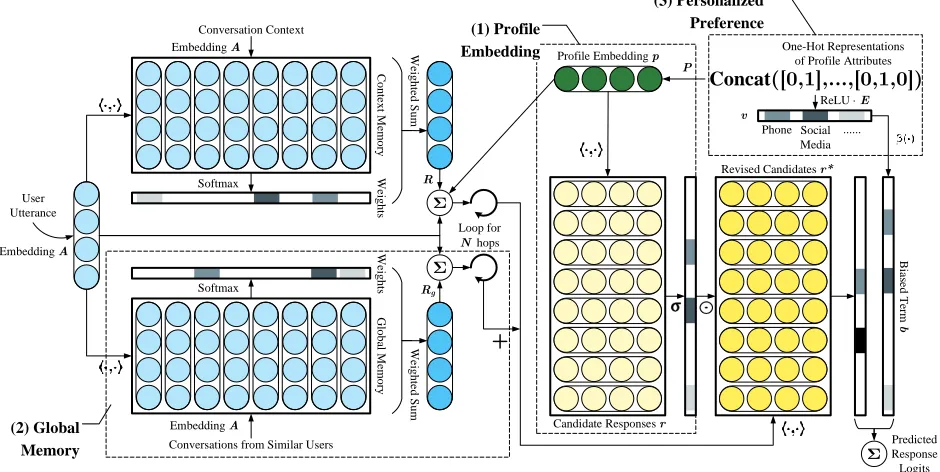
The two models are independent to each other and we also explore their combination as the PERSONALIZED MEMN2N. Figure 2 shows the structure of combined model. The different components are labeled with dashed boxes separately.
4.1
Notation
The user profile representation is defined as follows. Each interlocutor has a user profile represented by n attributes
{(ki, vi)}in=1, whereki andvi denote the key and value of
thei-th attribute, respectively. Take the user in the first dia-log in Figure 1 as an example, the representation should be
{(Gender,Male),(Age,Young),(Dietary,Non-vegetable)}. Thei-th profile attribute is represented as a one-hot vector ai∈Rdi, where there aredipossible values for keyki. We
define the user profileˆa∈Rd (p)
as the concatenation of one-hot representations of attributes:ˆa= Concat(a1,· · ·,an),
whered(p)=Pn
i di. The notations of the memory network
are the same as introduced in Section 3.
4.2
Profile Model
Our first model is the PROFILEMODEL, which aims to
in-tegrate personalized information into the query and ranking part of the MEMN2N. The model consists of two different components: profile embedding and global memory.
Profile EmbeddingIn the MEMN2N, the queryqplays a key role in both reading memory and choosing the response, while it contains no information about the user. We expect to add a personalized information term toqat each iteration of the query. Then, the model can be aware of the user pro-file in the steps of searching relevant utterances in the mem-ory and selecting the final response from the candidates. We thus obtain a distributed profile representation p ∈ Rd by
applying a linear transformation with the one-hot user pro-file:p=Pˆa, whereP ∈Rd×d
(p)
. Note that this distributed profile representation shares the same embedding dimension
dwith the bag-of-words. The query update equation can be
changed as:
User Utterance
Embedding A
W
e
ight
e
d
S
um
R
W
e
ight
s
Conversation Context
Embedding A
Cont
e
xt
M
em
ory
Softmax
W
e
ight
e
d
S
um
G
loba
l M
em
ory
W
e
ight
s
Conversations from Similar Users Softmax
Embedding A
Rg
One-Hot Representations of Profile Attributes
Loop for
N hops
Phone Social Media
...
Concat([0,1],...,[0,1,0])
P
Profile Embedding p
ReLU · E
Candidate Responses r
Predicted Response Logits
+
(2) Global Memory
(1) Profile Embedding
(3) Personalized Preference
Revised Candidates r*
Bi
a
se
d T
erm
b
v
Figure 2: PERSONALIZED MEMN2N architecture. The incoming user utterance is embedded into a query vector. The model
first reads the memory (at top-left) to find relevant history and produce attention weights. Then it generates an output vector by taking the weighted sum followed by a linear transformation. Part (1) isProfile Embedding: the profile vectorpis added to the query at each iteration, and is also used to revise the candidate responsesr. Part (2) isGlobal Memory: this component (at bottom-left) has an identical structure as the original MEMN2N, but it contains history utterances from other similar users. Part (3) isPersonalized Preference: the bias term is obtained based on the user preference and added to the prediction logits.
whereqi andoi are the query and output at thei-th hop,
respectively.
Also, the likelihood of a candidate being selected should be affected directly by the user profile, no matter what the query is. Therefore, we obtain tendency weights by
comput-ing the inner product betweenpand candidates followed by
a sigmoid, and revise the candidates accordingly:
r∗i =σ(p>ri)·ri, (4)
whereσis a sigmoid. The predictionˆris then computed by Equation (2) usingr∗instead ofr.
Global MemoryUsers with similar profiles may expect the same or a similar response for a certain request. There-fore, instead of using the profile directly, we also implicitly integrate personalized information of an interlocutor by uti-lizing the conversation history from similar users as a global memory. The definition of similarity varies with task do-mains. In this paper, we regard those with the same profile as similar users.
As shown in Figure 2, the global memory component has an identical structure as the original MEMN2N. The differ-ence is that the contents in the memory are history utterances from other similar users, instead of the current conversation. Similarly, we construct the attention weights, output vector,
and iteration equation by
α(ig)= Softmax(q>m(ig)) (5) o(g)=Rg
X
i
α(ig)m(ig) (6)
qi(+1g) =qi(g)+o(ig), (7)
wherem(g)denotes the global memory,α(g)is the attention
weight over the global memory,Rgis ad×dsquare matrix,
o(g)is the intermediate output vector andq(g)
i+1is the result
at thei-th iteration. Lastly, we useq+=q+q(g)instead of
qto make the following computation.
4.3
Preference Model
The PROFILE MODELhas not yet solved the challenge of
handling the ambiguity among KB entities, such as the choice between “phone” and “social media” in Figure 1. The ambiguity refers to the user preference when more than one valid entities are available for a specific request. We propose inferring such preference by taking the relation between user profile and knowledge base into account.
Assuming we have a knowledge base that describes the details of several items, where each row denotes an item and each column denotes one of their corresponding properties. The entityei,jat rowiand columnjis the value of thej-th
The PREFERENCEMODELoperates as follows.
Given a user profile and a knowledge base with K
columns, we predict the user’s preference on different
columns. We first model the user preferencev∈RKas:
v= ReLU(Ea)ˆ (8)
whereE ∈ RK×d
(p)
. Note that we assume the bot cannot provide more than one option in a single response, so a can-didate can only contains one entity at most. The probability of choosing a candidate response should be affected by this preference if the response mentions one of the KB entities.
We add a bias termb= β(v,r,m) ∈ RC to revise the
logits in Equation (2). The bias fork-th candidatebkis
con-structed as the following steps. If thek-th candidate contains no entity, thenbk = 0; if the candidate contains an entity ei,j, which belongs to itemi, thenbk=λ(i, j), where given
the current conversation contextctx,
λ(i, j) =
vj, if itemiis mentioned inctx;
0, otherwise. (9)
For example, the candidate “Here is the information:
The Place Phone” contains a KB entity “The Place Phone”
which belongs to restaurant “The Place” and column
“Phone”. If “The Place” has been mentioned in the conver-sation, the bias term for this response should bevP hone.
We update the Equation (2) to
ˆ
r= Softmax(qN+1>r1+b1,· · ·,qN+1>rC+bC). (10)
4.4
Combined Model
As discussed previously, the PROFILE MODEL and the
PREFERENCE MODEL make contributions to
personaliza-tion in different aspects. The PROFILEMODELenables the
MEMN2N to change the response policy based on the user profile, but fails to establish a clear connection between the user and the knowledge base. On the other hand, the
PREF-ERENCEMODELbridges this gap by learning the user
pref-erences over the KB entities.
To take advantages of both models, we construct a
gen-eral PERSONALIZEDMEMN2N model by combining them
together, as shown in Algorithm 1. All these models are trained to minimize a standard cross-entropy loss between
ˆ
rand the true labelrtrue.
5
Experiments
5.1
Dataset
The personalized bAbI dialog dataset (Joshi, Mi, and Falt-ings 2017) is a multi-turn dialog corpus extended from the bAbI dialog dataset (Bordes, Boureau, and Weston 2017). It introduces an additional user profile associated with each dialog and updates the utterances and KB entities to inte-grate personalized style. Five separate tasks in a restaurant reservation scenario are introduced along with the dataset. Here we briefly introduce them for better understanding of our experiments. More details on the dataset can be found in the work by Joshi, Mi, and Faltings (2017).
Algorithm 1 Response Prediction by PERSONALIZED MEMN2N
Input:User utteranceq, Context memorym, global mem-orym(g), candidatesrand user profileˆa
Output:The indexyof the next response
1: procedurePREDICT(q,m,m(g),r,ˆa)
2: p←Paˆ .Profile embedding
3: q(g)←q
4: forNhopsdo
5: α←Softmax(q>m)
6: q←q+p+RP iαimi
7: α(g)←Softmax((q(g))>m(g))
8: q(g)←q(g)+RgPiα
(g)
i m
(g)
i
9: end for
10: v= ReLU(Eˆa)
11: b=β(v,r,m) .Bias term
12: q+=q+q(g) .Final query
13: r∗=σ(p>r)r .Revised candidates
14: rˆi←Softmax((q+)>ri∗+bi)
15: y←arg maxirˆi
16: end procedure
Task 1: Issuing API CallsUsers make queries that con-tain several blanks to fill in. The bot must ask proper ques-tions to fill the missing fields and make the correct API calls.
Task 2: Updating API CallsUsers may update their re-quest and the bot must change the API call accordingly.
Task 3: Displaying OptionsGiven a user request, the KB is queried and the returning facts are added to the dialog history. The bot is supposed to sort the options based on how much users like the restaurant. The bot must be conscious of the user profile and change the sorting strategy accordingly to accomplish this task.
Task 4: Providing InformationUsers ask for some in-formation about a restaurant, and more than one answer may meet the requirement (i.e., contact with-respect-to so-cial media account and phone number). The bot must infer which answer the user prefers based on the user profile.
Task 5: Full DialogThis task conducts full dialog com-bining all the aspects of Tasks 1 to 4.
The difficulties of personalization in these tasks are not incremental. In Tasks 1 and 2, the bot is only required to se-lect responses with appropriate meaning and language style. In Tasks 3 and 4, the knowledge base is supposed to be searched, which makes personalization harder. In these two tasks, apart from capturing shallow personalized features in the utterances such as language style, the bot also has to learn different searching or sorting strategies for different user profiles. In Task 5 we expect an average performance (utterance-wise) since it combines the other four tasks.
There are two variations of dataset provided for each task: a full set with around6000dialogs and a small set with only 1000dialogs to create realistic learning conditions. We get the dataset released on ParlAI.1
1
T1: Issuing T2: Updating T3: Displaying T4: Providing T5: Full
Models API Calls API Calls Options Information Dialog
1. Supervised Embeddings 84.37 12.07 9.21 4.76 51.60
2. MemN2N 99.83 (98.87) 99.99(99.93) 58.94 (58.71) 57.17 (57.17) 85.10 (77.74)
3. Split MemN2N 85.66 (82.44) 93.42 (91.27) 68.60 (68.56) 57.17 (57.11) 87.28 (78.10)
4. Profile Embedding 99.96 (99.98) 99.96 (99.94) 71.00 (70.95) 57.18 (57.18) 93.83 (81.32)
5. Global Memory 99.76 (98.96) 99.93 (99.74) 71.01 (71.11) 57.18 (57.18) 91.70 (81.43)
6. Profile Model 99.93 (99.96) 99.94 (99.94) 71.12 (70.78) 57.18 (57.18) 93.91 (82.57)
7. Preference Model 99.80 (99.95) 99.97 (99.97) 68.90 (68.34) 81.38 (80.30) 94.97 (86.56)
8. Personalized MemN2N 99.91 (99.93) 99.94 (99.95) 71.43 (71.52) 81.56 (80.79) 95.33 (88.07)
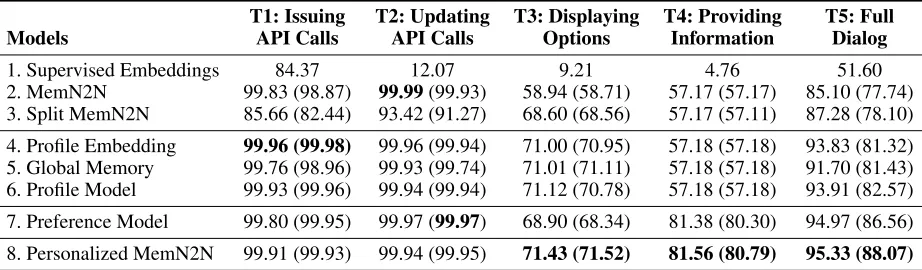
Table 1: Evaluation results of the PRESONALIZEDMEMN2N on the personalized bAbI dialog dataset. Rows 1 to 3 are baseline
models. Rows 4 to 6 are the PROFILEMODELwith profile embedding, global memory and both of them, respectively. In each
cell, the first number represents the per-response accuracy on the full set, and the number in parenthesis represents the accuracy on a smaller set with 1000 dialogs.
5.2
Baselines
We consider the following baselines:
Supervised Embedding Model: a strong baseline for both chit-chat and goal-oriented dialog (Dodge et al. 2015; Bordes, Boureau, and Weston 2017).
Memory Network: the MEMN2N by Bordes, Boureau, and Weston (2017), which has been described in detail in Section 3. We add the profile information as an utterance said by the user at the beginning of each dialog. In this way the standard MEMN2N may capture the user persona to some extent.
Split Memory Network: the model proposed by Joshi, Mi, and Faltings (2017) that splits the memory into two parts: profile attributes and conversation history. The various attributes are stored as separate entries in the profile mem-ory before the dialog starts, and the conversation memmem-ory operates the same as the MEMN2N.
5.3
Experiment Settings
The parameters are updated by Nesterov accelerated gradi-ent algorithm (Nesterov 1983) and initialized by Xavier ini-tializer. We try different combinations of hyperparameters and find the best settings as follows. The learning rate is 0.001, and the parameter of momentumγis0.9. Gradients are clipped to avoid gradient explosion with a threshold of 10. We employ early-stopping as a regularization strategy. Models are trained in mini-batches with a batch size of64.
The dimensionality of word/profile embeddings is128. We
set the maximum context memory and global memory size (i.e. number of utterances) as250and1000, separately. We pad zeros if the number of utterances in a memory is less than250or1000, otherwise we keep the last250utterances
for the context memory, or randomly choose1000valid
ut-terances for the global memory.
5.4
Results
Following Joshi, Mi, and Faltings (2017), we report response accuracy across all models and tasks on the
per-sonalized bAbI dataset in Table 1. The per-response accu-racy counts the percentage of correctly chosen candidates.
Profile Model Rows 4 to 6 of Table 1 show the evaluation
results of the PROFILEMODEL.
As reported in Joshi, Mi, and Faltings (2017), their per-sonalized dialogs model might be too complex for some sim-ple tasks (such as Tasks 1 and 2, which do not rely on KB facts) and tends to overfit the training data. It is reflected in the failure of the split memory model on Tasks 1 and 2. Al-though it outperforms the standard MEMN2N in some com-plicated tasks, the latter one is good enough to capture the profile information given in a simple raw text format, and defeats the split memory model in simpler tasks.
To overcome such a challenge, we avoid using exces-sively complex structures to model the personality. Instead, we only represent the profile as an embedding vector or implicitly. As expected, both profile embedding and global memory approach accomplish Tasks 1 and 2 with a very high accuracy and also notably outperform the baselines in Task 3, which requires utilizing KB facts along with the pro-file information. Also, the performance of combining the two components together, as shown in row 6, is slightly bet-ter than using them independently. The result suggests that we can take advantages of using profile information in an explicit and implicit way in the meantime.
Preference Model Since the PROFILE MODEL does not build a clear connection between the user and the knowl-edge base, as discussed in Section 4, it may not solve ambi-guities among the KB columns. The experiment results are consistent with this inference: the performance of the
PRO-FILEMODELon Task 4, which requires user request
disam-biguation, is particularly close to the baselines.
Row 7 shows the evaluation results of the PREFERENCE MODEL, which is proposed to handle the above mentioned challenge. The model achieves significant improvements on Task 4 by introducing the bias term derived from the learned user preference.
In-tuitively, different properties of the restaurants are weighted differently, and the user preference over the KB columns can be considered as scoring weights which is useful for task-solving. As a result, the model also improves the per-formance in Task 3 compared to the standard MEMN2N.
Personalized MemN2N We test the performance of the
combined PERSONALIZEDMEMN2N as well. As we have
analyzed in Section 4, the PROFILEMODELand the
PREF-ERENCE MODEL make contributions to personalization in
different aspects and their combination has the potential to take advantages of both models. Experiment results confirm our hypothesis that the combined model achieves the best performance with over 7% (and 9% on small sets) improve-ment over the best baseline for the full dialog task (Task 5).
6
Analysis
As the proposed PERSONALIZEDMEMN2N achieves better
performance than previous approaches, we conduct an anal-ysis to gain further insight on how the integration of profile and preference helps the response retrieval.
6.1
Analysis of Profile Embeddings
Since we use the learned profile embeddings to obtain ten-dency weights for candidates selection, as is illustrated in Equation (4), we expect to observe larger weights on can-didates that correctly match the profile. For instance, given
a profile “Gender: Male, Age: Young”, we can generate a
weight for each response candidate. Due to the fact that can-didates are collected from dialogs with different users, they can be divided based on the user profile. Those candidates
in the group ofyoung maleshould have larger weights than
others.
male,y oung
female,y oung
male,middle-agedfemale,middle-agedmale,elderlyfemale,elderly
Profiles
male,young
female,young
male,middle-aged
female,middle-aged
male,elderly
female,elderly
Candidates
Group
ed
by
This
Profile
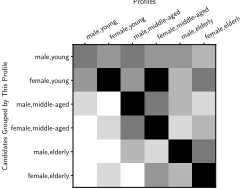
Figure 3: Confusion matrix for profiles and generated ten-dency weights. Darker cell means larger weight value.
We group the candidates by their corresponding user pro-file. For each profile, we generate tendency weights and col-lect the average value for each group. Figure 3 visualizes the results by a confusion matrix. The weights on the diagonal are significantly larger than others, which demonstrates the contribution of profile embeddings in candidate selection.
6.2
Analysis of Global Memory
To better illustrate how much the global memory impacts the performance of the proposed model, we conduct a control experiment. Specifically, we build a model with the same global memory component as described in Section 4.2, but
Models T5: Full Dialog
Global Memory (similar users) 91.70 (81.43)
Global Memory (random users) 87.17 (78.02)
Table 2: Evaluation results of the control experiment on Task 5: Full Dialog.
young middle-aged elderly
0.2 0.4 0.6 0.8 1.0 1.2
Preference
over
KB
Columns
Social Media Phone
(a) Task 4
young middle-aged elderly
0.2 0.4 0.6 0.8 1.0 1.2
Preference
over
KB
Columns
Social Media Phone
(b) Task 5
Figure 4: The preference arguments learned from Task 4: Providing Information, and Task 5: Full Dialog. The
prefer-ence score is computed by an L2 normalization fromv.
the utterances in the memory are from randomly chosen users rather than similar users. We report the results of the control experiment on Task 5 in Table 2. The numbers indi-cate that the global memory does help improve the perfor-mance.
6.3
Analysis of Preference
Remember that we use a preference vectorvto represent the user’s preference over the columns in the knowledge base. Therefore, we investigate the learned arguments grouped by profile attributes. As seen in Figure 4, the model successfully learns the fact that young people prefer social media as their contact information, while middle-aged and elderly people prefer phone number. The result shows great potential and advantage of end-to-end models. They are capable of learn-ing meanlearn-ingful intermediate arguments while belearn-ing much simpler than existing reinforcement learning methods and pipeline models for the task of personalization in dialogs.
6.4
Human Evaluation
To demonstrate the effectiveness of the personalization ap-proach over standard models more convincingly, we build an interactive system based on the proposed model and base-lines, and conduct a human evaluation. Since it is impractical to find testers with all profiles we need, we randomly build 20profiles with different genders, ages and preferences, and ask three judges to act as the given roles. They talk to the system and score the conversations in terms of task com-pletion rate and satisfaction. Task comcom-pletion rate stands for how much the system accomplish the users’ goal. Satisfac-tion refers to whether the responses are appropriate to the user profile. The scores are averaged and range from0to1
(0 is the worst and1is perfect). We find that
PERSONAL-IZED MEMN2N wins the MEMN2N baseline with27.6%
7
Conclusion and Future Work
We introduce a novel end-to-end model for personalization in goal-oriented dialog. Experiment results on open datasets and further analysis show that the model is capable of over-coming some existing issues in dialog systems. The model improves the effectiveness of the bot responses with per-sonalized information, and thus greatly outperforms state-of-the-art methods.
In future work, more representations of personalities apart from the profile attribute can be introduced into goal-oriented dialogs models. Besides, we may explore on learn-ing profile representations for non-domain-specific tasks and consider KB with more complex format such as ontologies.
Acknowledgements
We thank all reviewers for providing the constructive sug-gestions. Also thanks to Danni Liu, Haoyan Liu and Yuan-hao Xiong for the helpful discussion and proofreading. Xu Sun is the corresponding author of this paper.
References
Bordes, A.; Boureau, Y.-L.; and Weston, J. 2017. Learning
end-to-end goal-oriented dialog. In the 5th sInternational
Conference on Learning Representations (ICLR). Brown, R. 1965. Social psychology.
Brown, R. 1987. Theory of politeness: An exemplary case. Inmeeting of the Society of Experimental Social Psycholo-gists, Charlottesville, VA.
Dodge, J.; Gane, A.; Zhang, X.; Bordes, A.; Chopra, S.; Miller, A. H.; Szlam, A.; and Weston, J. 2015. Evaluat-ing prerequisite qualities for learnEvaluat-ing end-to-end dialog
sys-tems.CoRRabs/1511.06931.
Ficler, J., and Goldberg, Y. 2017. Controlling linguistic style
aspects in neural language generation. InProceedings of
the Workshop on Stylistic Variation, 94–104. Copenhagen, Denmark: Association for Computational Linguistics. Herzig, J.; Shmueli-Scheuer, M.; Sandbank, T.; and Konop-nicki, D. 2017. Neural response generation for customer ser-vice based on personality traits. InProceedings of the 10th International Conference on Natural Language Generation, 252–256. Santiago de Compostela, Spain: Association for Computational Linguistics.
Joshi, C. K.; Mi, F.; and Faltings, B. 2017. Personalization
in goal-oriented dialog.CoRRabs/1706.07503.
Kroger, R. O., and Wood, L. A. 1992. Are the rules of ad-dress universal? iv: Comparison of chinese, korean, greek,
and german usage. Journal of cross-cultural psychology
23(2):148–162.
Li, J.; Galley, M.; Brockett, C.; Spithourakis, G.; Gao, J.; and Dolan, B. 2016. A persona-based neural conversation
model. InProceedings of the 54th Annual Meeting of the
Association for Computational Linguistics (Volume 1: Long Papers), 994–1003. Berlin, Germany: Association for Com-putational Linguistics.
Liu, B.; Xu, Z.; Sun, C.; Wang, B.; Wang, X.; Wong, D. F.;
and Zhang, M. 2018. Content-oriented user modeling
for personalized response ranking in chatbots. IEEE/ACM
Transactions on Audio, Speech, and Language Processing 26(1):122–133.
Lowe, R.; Pow, N.; Serban, I.; and Pineau, J. 2015.
The ubuntu dialogue corpus: A large dataset for
re-search in unstructured multi-turn dialogue systems. CoRR
abs/1506.08909.
Luan, Y.; Brockett, C.; Dolan, B.; Gao, J.; and Galley, M. 2017. Multi-task learning for speaker-role adaptation in
neu-ral conversation models.CoRRabs/1710.07388.
Luo, L.; Xu, J.; Lin, J.; Zeng, Q.; and Sun, X. 2018.
An Auto-Encoder Matching Model for Learning
Utterance-Level Semantic Dependency in Dialogue Generation. In
Proceedings of the 2018 Conference on Empirical Methods in Natural Language Processing, 702–707. Brussels, Bel-gium: Association for Computational Linguistics.
Nesterov, Y. 1983. A method for unconstrained convex min-imization problem with the rate of convergence o (1/kˆ 2). In Doklady AN USSR, volume 269, 543–547.
Qian, Q.; Huang, M.; Zhao, H.; Xu, J.; and Zhu, X. 2017. Assigning personality/identity to a chatting machine for
co-herent conversation generation. CoRRabs/1706.02861.
Ritter, A.; Cherry, C.; and Dolan, W. B. 2011. Data-driven
response generation in social media. InProceedings of the
2011 Conference on Empirical Methods in Natural Lan-guage Processing, 583–593. Edinburgh, Scotland, UK.: As-sociation for Computational Linguistics.
Sordoni, A.; Galley, M.; Auli, M.; Brockett, C.; Ji, Y.; Mitchell, M.; Nie, J.-Y.; Gao, J.; and Dolan, B. 2015. A neural network approach to context-sensitive generation of
conversational responses. InProceedings of the 2015
Con-ference of the North American Chapter of the Association for Computational Linguistics: Human Language
Technolo-gies, 196–205. Denver, Colorado: Association for
Compu-tational Linguistics.
Sukhbaatar, S.; szlam, a.; Weston, J.; and Fergus, R. 2015.
End-to-end memory networks. In Cortes, C.; Lawrence,
N. D.; Lee, D. D.; Sugiyama, M.; and Garnett, R., eds., Ad-vances in Neural Information Processing Systems 28. Cur-ran Associates, Inc. 2440–2448.
Vinyals, O., and Le, Q. V. 2015. A neural conversational
model. CoRRabs/1506.05869.
Yang, M.; Zhao, Z.; Zhao, W.; Chen, X.; Zhu, J.; Zhou, L.; and Cao, Z. 2017. Personalized response generation via domain adaptation. InProceedings of the 40th International ACM SIGIR Conference on Research and Development in Information Retrieval, SIGIR ’17, 1021–1024. New York, NY, USA: ACM.
Zhang, W.; Liu, T.; Wang, Y.; and Zhu, Q. 2017. Neural
per-sonalized response generation as domain adaptation. CoRR
abs/1701.02073.
Zhang, S.; Dinan, E.; Urbanek, J.; Szlam, A.; Kiela, D.; and Weston, J. 2018. Personalizing dialogue agents: I have a