Volume 2, Issue 1, January 2013
Page 16
A
BSTRACTNiO thin films have been prepared on suitably cleaned quartz substrates by rapid thermal oxidation method for different oxidation time and 850 oC oxidation temperature. The structural properties of NiO thin films have been investigated. Polycrystalline nature of the material was confirmed by X-ray diffraction technique and various structural parameters were calculated. All the films show most preferred orientation along (111), (200) and (220) planes. The grain size of prepared NiO films is small and is within the range of 49 to 63 nm.
Keywords: NiO thin films, structure properties, rapid thermal oxidation.
1. I
NTRODUCTIONAmong functional metal oxide materials, nickel oxide (NiO) has attracted considerable attentions for technological applications. Nanosized nickel oxide has demonstrated excellent properties that are suitable for practical applications ranging from catalysts 1, organic light emitting diodes 2, fuel cell electrodes 3, magnetoresistance sensors 4, gas sensors 5, transparent conducting films 6, optical and electrochemical sensors 7. Furthermore, Nickel oxide undergoes electrochromic property involving a colourless reduced state and a dark brown oxidized form. Due to this distinguished property, NiO is also one of the most often used materials in electrochromicrelated technologies 8. NiO films can be prepared by several method such as thermal evaporation 9, pulsed laser deposition 10, etc. Nickel oxide (NiO) is an attractive material due to its excellent chemical stability, as well as optical, electrical and magnetic properties.
Furthermore, it is considered to be a model semiconductor with p-type conductivity films due to its wide band-gap energy range from 3.6 to 4.0 eV 11.
The most useful starting point in understanding the structure of a metal oxide is to understand the ionic model. Nickel oxide (NiO) has a six-fold octahedral coordination, the so called rock salt structure. This is the most common metal ion geometry in the oxides.
The rock salt crystal structure is the simplest oxide structure not only from the standpoint of the bulk arrangement of the atoms, but also because the surface energy, is far lower for the (100) surface than for any other. The principal valence atomic orbitals of the transition-metal cations are of d symmetry. Electron configurations are generally assigned on the basis of a formal ionic charge, which may not of course, give a realistic indication of the actual charge distribution. Covalent bonding interactions transform the O 2p and the metal d orbitals into bonding and antibonding orbitals of mixed atomic character. The‘d-electron’ configuration really represents the number of electrons remaining when all the metal-oxygen- bonding levels are filled. This is an essential concept in understanding the electronic properties of transition-metal oxides 12.
In this work NiO thin films were made using rapid thermal oxidation method. The structure properties of NiO thin films are investigated.
2. EXPERIMENT
WORK
Vacuum thermal evaporation system type (Edwards Speedvac Unit) has been used to evaporate high purity 150 nm thickness of nickel on quartz substrate at room temperature under low pressure (about10-6torr). Test quartz slides, cleaned by alcohol with ultrasonic waves in order to remove the impurities and residuals from their surfaces. NiO film was obtained with aid of rapid thermal oxidation system with halogen lamp as oxidation source. The oxidation condition used to form NiO film was 850 oC and different oxidation time (30, 60) sec.
The X-ray diffraction (XRD) spectrum of the film recorded with X-ray diffractometer operates with 1.54056 Å monochromatized CuKα radiation with Ni filter. Fourier Transform-Infrared Spectroscopy (FTIR) probes the molecular vibrations of molecules. Light of different energies (or frequency, represented by wavenumbers in the spectrum above)
Structural and morphological studies of NiO
thin films prepared by Rapid thermal oxidation
method
Arwaa Fadil Saleh
Volume 2, Issue 1, January 2013
Page 17
is directed through a sample. When a particular energy (or frequency) of light matches a vibrational frequency of the molecule, the molecule absorbs the light and vibrates. Peaks in an infrared spectrum are upside-down compared to other forms of spectroscopy to convey that the peak is a decreased intensity, or absorbance of light. The (SHIMADZU- 8400S) Scan of the FTIR measurements are performed over the range between (400-4000) cm-1 for the prepared sample.3. RESULTS
ANDDISCUSSION
3.1 Structural properties
The crystal material structure was studied by measuring the XRD. The crystalline structure of a prepared film at oxidation temperature 850 °C with different oxidation time is illustrated in Fig. 1. From XRD patterns, the observable
peak position at 2θ=37.2354°, 43.1334° and 62.7522° show (111), (200) and (220) orientation planes assigned to the crystal plane of cubic structure of NiO 13. Table (1) shows the effect of oxidation time on the XRD characteristics evaluated from the diffrograms.
Fig. 1 X-Ray diffraction patterns for NiO thin films: (a) t = 30 sec, (b) t= 60 sec
Table 1: XRD patterns characteristics of NiO thin films at different oxidation time and 850 oC oxidation temperature.
d (Å) ASTM I/I1
ASTM (2Ө)°
ASTM (h k l)
d (Å) XRD I/I1
XRD (2Ө)°
XRD Deposition
Conductions
2.4100 91
37.280 111
2.4128 80
37.2354 t=30 sec
2.0880 100
43.297 200
2.0592 30
43.1334
2.4100 91
37.280 111
2.4105 100
37.2271
t=60 sec
2.0880 100
43.297 200
2.0661 48
43.276
1.4760 57
62.916 220
1.4944 21
62.7522
3.1.1 Parameters Calculation
Normally XRD is used to calculate different parameters which could be used to clarify the studies of the prepared films which are shows in table (1).
Volume 2, Issue 1, January 2013
Page 18
a=d [h2 + k2 +l2]1/2………. (1)A. Full Width at Half Maximum (FWHM) (β)
The FWHM of the preferred orientation (peak) could be measured, since it is equal to the width of the line profile (in degrees) at the half of the maximum intensity. Table (2) listed the results obtained from XRD illustration which shows that the FWHM of NiO thin films are reduce with increasing of the oxidation time, that means the grain size and crystallite of the films are increased.
B. Average Grain Size (Dg)
The grain size Dg was calculated by Scherer equation 15:
cos
k
D
g
……….. (2)The Dg values in Table 2 shows the FWHM of the XRD and gives the value of the estimated grain size for the prepared films at different growth conditions. It appears clearly from the results that these are an enhancement in the film morphology and smoothness with increasing the oxidation time up to (60 sec, 850 oC). Here, it is recognized that the reduction in the FWHM, reflected in the grain size.
Where K= 0.94 , λ is the wave length of incident X-ray radiation , β is the intrinsic full width at Half Maximum of the peak , and θ is the Bragg's diffraction angle of the respective XRD peak .
Assumes the world Warren that the mathematical representation of curves resulting from the X-ray diffraction (XRD) depends primarily on the amount of similarity between these curves and functions of each of the Cauchy and Gauss, In the case considered curve X-ray diffraction is similar to function Cauchy and take the form of (1+k2x2)-1, the correction is given by the following relationship, which was called (Scherer's correction):-
βcs = βm-βi………..……….…… (3)
Compensation equation (3) in the relationship (2) we get:
Dg= K λ / [(βm-βi) cos (θ)]………….…………. (4)
In the case considered X-ray diffraction curve similar to the function Gauss which takes the form exp (-k2x2) the accuracy to be higher because of the great similarity between this function and the diffraction curves; it was suggested (Warren) correction form:
βcs2 = βm2- βi2……….. (5)
This correction called (Warren's Correction)
Compensation equation (5) in the relationship (2) we get:
Dg= K λ / [(βm2- βi2) ½ cos (θ)]………..…... (6)
Since the output line shape does not resemble the Gauss curve and Cauchy curve completely, so these relations have limited operation values. If the intensity curve does not sharp may be used (Scherer's correction) or (Warren's Correction) former because the difference between the values given by relations (4) and (6) is not large, which means
that the decrease of the curve breadth (an increase of sharpness) means that the effect of the amount )βi) is significant,
since the width of the curve in the half intensity (FWHM) is inversely proportional with grain size according to equation (2), the decrease in (FWHM) leads to increase in the grain size, which means that few crystal defects are present in the sample.
Moreover, Warren was suggested a relationship takes into account the geometric meaning which is 16, 17:
βcs = [(βm - βi) (βm2 -βi2)1/2]1/2 ……… (7)
Volume 2, Issue 1, January 2013
Page 19
Dg= K λ/ [[(βm - βi) (βm2 -βi2)1/2]1/2 cosθ]….….... (8)
Table 2: Grain size for NiO Samples at 850o C oxidation temperature and different oxidation time.
Grain size (nm) eq.(8) Grain size (nm) eq.(6) Grain size (nm) eq.(4) Grain size (nm) eq.(2) hkl Deposition Conductions 49.2091 38.8832 62.2307 34.9307 111 t=30 sec 54.4008 42.3549 69.8785 37.5415 200 52.0801 40.7339 66.5723 36.2609 111
t=60 sec 200 41.4249 84.6236 48.1809 63.8582 31.1503 26.8225
36.1724 25.6643
220
C. Number of Layers (N
ℓ )
For the thin films the microstructural factor like film texture may be considered as the powerful means that control electrical properties of polycrystalline film materials 18. The number of crystallite layer (N
ℓ) which could be calculated
due to the percolation theory, and it depends on the film thickness (t) as the relation:
t = Dg * N
ℓ……….……… (9)
Where: Dg is a mean crystallite size or grain size 19. D. Micro Strains (ε)
The micro strains are caused during the growth of thin films, and will be raised from stretching or compression in the lattice. So the strain broadening is caused by varying displacements of the atoms with respect to their reference lattice position 20.This strain can be calculated from the formula 21:
ε= (λ/D sinθ)-(β/tanθ)……….………….. (10) E. Dislocation density
A dislocation is an imperfection within the crystal associated with the misregistry of the lattice in one part of the crystal with that in another part. Unlike vacancies and interstitial atoms, dislocations are not equilibrium imperfections, i.e. thermodynamic considerations are insufficient to account for involving dislocation as a matter of importance. The dislocation density (δ) has been calculated by using the following formula for NiO thin films 14:
δ=1/Dg……… (11)
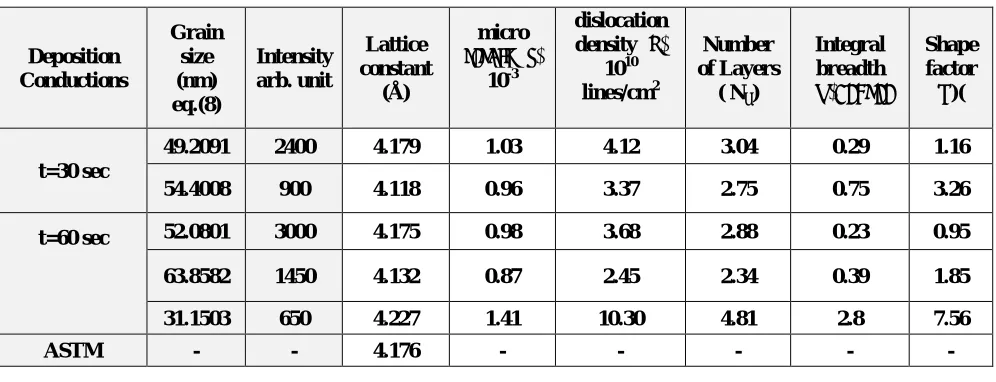
Table 3: Main parameters for XRD results at different oxidation time
Shape factor φ)( Integral breadth (Δ)degree Number of Layers
( Nℓ )
dislocation density (δ)
Volume 2, Issue 1, January 2013
Page 20
F-Integral Breadth (Δ):
There are two branches of line profile analysis:
i. broadening .
ii. shape of diffraction line.
The first one is caused by non ideal optics of the instrument , wavelength , dispersion and structural imperfections of the specimen , also this branch is subdivided into size broadening (which is caused by the finite size of domains ), and strain broadening ( which is caused by varying displacements of the atoms with respect to their reference –lattice
positions) . The second is frequently characterized by means of one or two breadth measures FWHM, and β which is
given by 22:
Δ=Area/Imax ………. (12)
Where: Area = area under peak. I
max = maximum intensity.
The shape factor of the line profile resulting from the XRD patterns could be calculated from the relation 22: φ = Δ / β ……...…….…...…………...… (13)
All these parameters are calculated and presented in Table 3.
3.2- Surface Morphology
Surface morphology was studied by means of reflection microscope. Fig.4 shows the influence of oxidation temperature and oxidation time on the homogeneity and smoothness of the NiO films.
Fig.2 (a), give the optical micrographs of 150 nm Ni film thickness deposited on quartz substrate at room temperature. The optical micrographs at an oxidation time of 60 sec and oxidation temperature of 850 oC is shown in fig.2 (b), also recognized changes in the prepared film and morphology changes to become more transparent may be due to transmission of microscope light through the prepared film. The colour of the samples also showed that pure nickel oxide at an oxidation time 60 sec has a grey colour, where Ni metal film totally transform to its NiO film. It can clearly be noticed that the film color is the same as the physical color of the NiO thin film.
Fig.2 Surface morphology of Ni samples prepared on quartz substrate (a) room temperature (b) (850 oC) oxidation temperature and (60 sec) oxidation time
3.3 FTIR measurements
Fourier transformation-Infrared spectroscopic results give information about phase composition and the way in which oxygen is bound to metal ions.
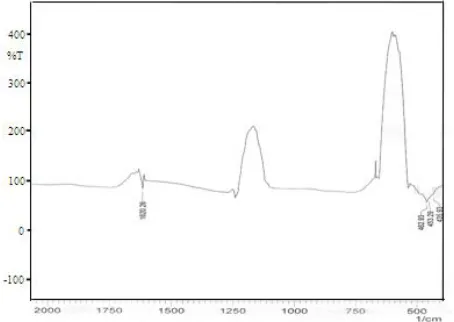
The FTIR spectra of NiO thin films prepared at 850 oC oxidation temperature and 60 sec oxidation time as shown in fig.3. The band at ~ 1600 cm-1 is attributed to the bending vibration of water due to absorbed moisture. The band that appears below 500 cm-1 corresponds to a stretching vibration of the Ni-O bond of nickel oxide. For the case of the nickel oxide formation, the mean kinetic energy of the Ni atoms decreases through collision with oxygen, formation of (O+2) ions (through energetic change reaction of Ni with O2 molecules). So, chemical bonding like (Ni-O) vibrational
Volume 2, Issue 1, January 2013
Page 21
Fig. 3 FTIR spectrum of NiO thin film prepared at t=60 sec oxidation time and (850 oC) oxidation temperature.
4. CONCLUSIONS
NiO thin films were prepared onto quartz substrate by rapid thermal oxidation technique at different oxidation times. The structures of the films consist of fine (49–36 nm average size) highly oriented grains with cubic (111) planes. The grain size increases when the oxidation time increases. All the films prepared at different oxidation times show cubic structure.
R
EFERENCES[1] N.M. Deraz, M.M. Selim and M. Ramadan. (2009). Mat. Chem. and Phys. 113, 269. [2] S.W. Park, J.M. Choi, E. Kim and S. Im. (2005). Appl. Surf. Sci. 244, 439.
[3] S. G. Kim, S. P. Yoon, J. H., S. W. Nam, T. H. Lim, I. H. Oh and S. A. Hong. (2004). Elec. Act. 49, 3081. [4] A. Gaur and G.D. Varma. (2006). Sol. Com. 139, 310.
[5] P. Elumalai and N. Miura. (2005). Sol. Ion. 176, 2517.
[6] U.S. Joshi, Y. Matsumoto, K. Itaka, M. Sumiya and H. Koinuma. (2006). Appl. Surf. Sci. 252, 2524.
[7] E. D. Gaspera, D. Buso, M. Guglielmi, A. Martucci, V. Bello, G. Mattei, M. L. Post, C. Cantalini, S. Agnoli, G. Granozzi, A. Z. Sadek, K. Kalantar-zadeh and W. Wlodarski. (2010). Sen.and Act. B. 143, 567.
[8] E. O. Zayim, I. Turhan, F.Z. Tepehan and N. Ozer. (2008). Sol. Energ. Mat. Sol. C. 92, 164. [9] I. Porqueras and E. Bertran. (2001). Thi. Sol. Film. 398 –399, 41.
[10] Y. Makimura, A. Rougier and J. M. Tarascon. (2006). App. Surf. Sci. 252, 4593. [11] H. Sato, T. Minami, S. Takata, T. Yamada. (1993). Thin Solid Films. 23, 27.
[12] Marko Nieuwenhuizen (project leader), Jaap Bastiaansen (treasurer), Brian Pauw, Xin Wang, Karen Scholz (tutor), Jetse Reijenga (coordinator). June 23, (2004). The versatility of nickel oxide, from rechargeable batteries to smart windows and electrocatalysts, Interfacultary Project Marko.
[13] A.A. Al-Ghamdi, Waleed E. Mahmoud, S.J. Yaghmour and F.M. Al-Marzouki. (2009). J. Alloys and Comp. 486, 9.
[14] K. Girlja, S. Thirumalalrajan, S. M. Mohan, J. Chandrasekaran. August (2009). Chalcogenide Letters. 6, 8, 351 – 357.
[15] M. Elahi, N. Ghobadi.(2008). Iranian Physical Journal, 2-1, 27-31. [16] L.V. Azarooff. (1968). Mc Graw-Hill Book Company. 552-556. [17] Th.H.DE.Keijser. (1982). J. Appl. Cryst., 15, 308-314.
[18] A. Efros. (1976). Physics State, Sol. (b), 76, 475.
[19] A. Ivashchenko and I. Kerner, Moldavian. (2003). J. Phys. Sci., 2, 1.
[20] J. G. Van Berkum , J. G. M. , A. C. Varmcuch , R. Delhen , Th. H. Dinkeijser , and E. J. Hemeijer. (1994). J. Appl. Crys. , 27, 345-357.