The Thirty-Third AAAI Conference on Artificial Intelligence (AAAI-19)
Semantic Adversarial Network with
Multi-Scale Pyramid Attention for Video Classification
De Xie,
1Cheng Deng,
1∗Hao Wang,
1Chao Li,
1Dapeng Tao
21School of Electronic Engineering, Xidian University, Xi’an 710071, China
2School of Information Science and Engineering, Yunnan University, Kunming 650091, China
{xiede.xd, chdeng.xd, haowang.xidian,}@gmail.com, li [email protected], [email protected]
Abstract
Two-stream architecture have shown strong performance in video classification task. The key idea is to learn spatio-temporal features by fusing convolutional networks spatially and temporally. However, there are some problems within such architecture. First, it relies on optical flow to model tem-poral information, which are often expensive to compute and store. Second, it has limited ability to capture details and lo-cal context information for video data. Third, it lacks explicit semantic guidance that greatly decrease the classification per-formance. In this paper, we proposed a new two-stream based deep framework for video classification to discover spatial and temporal information only from RGB frames, moreover, the multi-scale pyramid attention (MPA) layer and the seman-tic adversarial learning (SAL) module is introduced and inte-grated in our framework. The MPA enables the network cap-turing global and local feature to generate a comprehensive representation for video, and the SAL can make this repre-sentation gradually approximate to the real video semantics in an adversarial manner. Experimental results on two pub-lic benchmarks demonstrate our proposed methods achieves state-of-the-art results on standard video datasets.
Introduction
Video classification is a fundamental task in computer vision community, and it serves as an important basis for high-level tasks, such as video caption (Wang et al. 2018), action de-tection (Ren´e and Hager 2017), and video tracking (Li et al. 2018b). Significant progress on video classification has been made by deep learning on account of the powerful model-ing capability of deep convolutional neural networks that obtain superior performance than those hand-crafted repre-sentation based methods. However, compared with other vi-sual tasks (Li et al. 2018a; Fan et al. 2018; Deng et al. 2018; Yang et al. 2018), video classification should consider not only static spatial information in each frame but also dy-namic temporal information between frames. Although deep convolutional neural networks can model spatial informa-tion well, it is limited ability to capture temporal informainforma-tion only from frame sequence. Therefore, how to model spa-tial and temporal information effectively with deep learning framework is still a challenging problem.
∗
Corresponding author.
Copyright c2019, Association for the Advancement of Artificial Intelligence (www.aaai.org). All rights reserved.
(a) (b) (c)
Figure 1: Modeling temporal information with images. (a) input frames; (b) The optical flows between these frames, (c) The differential images between multiple video frames.
The third category is based on 3DCNN (Tran et al. 2015; Ji et al. 2013), which employs 3D convolutions and 3D pooling operations to directly learn spatio-temporal features from stacked RGB volumes. Such methods seem to having ability solve the problem of spatio-temporal modeling but the performance is still worse than two-steam CNN based methods. Meanwhile, 3DCNN based methods also suffer from a large number of parameters and huge computation burden. More important, all three categories methods ignore utilizing the semantic information embodied in video, which leads to limited generalization performance. In fact, RGB frames contain abundant of semantic information, which can greatly improve classification performance. In addition, In-spired by prior work (Wang et al. 2016), we find the RGB differential image between multiple video frames have suf-ficient ability to model temporal information, which is less computational cost than optical flows. As shown in Figure 1, the RGB differential images are sensitive to the part of the motion in the video, which means that the details of RGB differential images have ability to model the temporal infor-mation.
In this paper, we propose a new two-stream based archi-tecture to address all mentioned problems. Specially, we
de-sign aSpatial Networkto model spatial information which
takes RGB frames as input and a Temporal Network to
model temporal information which exploits differential im-ages as input. In order to obtain more discriminative repre-sentation, we design a multi-scale pyramid attention (MPA) layer to capture multi-scale features from different stage of
Spatial NetworkandTemporal Network, and then combine these multi-scale information into new representation. In ad-dition, we devise semantic adversarial learning (SAL)
mod-ule aiming to guideSpatial NetworkandTemporal Network
to learn more discriminative and semantic video representa-tion. Overall, the main contribution of the proposed method can be summarized as follows:
• We propose a new deep architecture for video
classifica-tion, which containsSpatial NetworkandTemporal
Net-work only taking RGB frames as input, which
signifi-cantly reduced computational complexity without sacri-ficed.
• We devise a multi-scale pyramid attention (MPA) layer
that conducts attention-driven multi-scale features extrac-tion and it is pluggable that can be easily embedded to other CNNs based architecture.
• We introduce a semantic adversarial learning (SAL)
mod-ule, which can make fully use of video semantic informa-tion and guide video representainforma-tion learning in adversarial manner.
• Experimental results on two public benchmarks for action
recognition, HMDB51 and UCF101, highlight the advan-tages of our method and obtain improved performance compared to state-of-the-art methods.
Related Work
Video classification has received sustained attention in re-cent years, and has spawned lots of excellent works(Yang et
al. 2017a; 2017b; 2016). Traditional methods rely on hand-craft visual features such as Motion Boundary Histogram (MBH) (Dalal, Triggs, and Schmid 2006) and improved Dense Trajectory (iDT) (Wang and Schmid 2013) which lack the discriminative capacity to classify complex videos. Deeply learned features is proved more powerful than hand-craft features which can achieve superior performance.
There are many works have been trying to design effec-tive deep architecture for video classification. For
exam-ple, Karpathyet al.(Karpathy et al. 2014) showed the first
large-scale experiment on training deep convolutional neu-ral networks from a large video dataset, Sports-1M. Two-Stream (Simonyan and Zisserman 2014), as a significant breakthrough method, containing spatial and temporal nets to model appearance and motion information respectively. Wanget al.(Wang et al. 2016) designed temporal segment network to perform sparse sampling and temporal fusion,
which aims to learn from the entire video. Wanget al.(Wang
et al. 2017) further improved this architecture by integrat-ing appearance information, short-term and long-term mo-tion informamo-tion, which achieve outstanding classificamo-tion performance. However, these methods used optical flows to caption motion which is time consuming. In order to cap-ture the motion information directly from RGB frames, a set of methods have been proposed to use 3DCNN (Tran et al. 2015), containing 3D convolution filters and 3D pooling layers, to model spatial and temporal information simulta-neously. Although it is intuitive, but in fact, spatial informa-tion and temporal informainforma-tion may interfere with each other during the modeling process. So, it is still unclear whether this pattern could efficiently model spatial and temporal re-lation. To explicitly modeling spatial and temporal informa-tion, CNN-LSTM (Shi et al. 2017) based methods is pro-posed to model spatial and temporal information in different stage. They use CNN to extract Spatial features firstly and then model temporal information by using Long Shot-Term Memory(LSTM) as an encoder to encode the relationship between the sequence-illustrating spatial features. The main problem of these methods is the neglecting of local temporal relationship.
As a solution to the above problems, our method uses only RGB frames as input and can obtain hybrid features from different level through the multi-scale pyramid attention layer. Moreover, our proposed semantic adversarial learn-ing module can take fully use the video semantic informa-tion. which can guide the whole framework to learn more discriminative and semantic video representations.
Proposed Method
In this section, we give detailed description about our method for video classification. Specifically, we first intro-duce the structure of our method as a whole. Then, we study the multi-scale pyramid attention layer for multiple level features fusion. Finally, we present the semantic adversar-ial learning module in detail.
Overall Architecture
We design a unified convolutional network that can be
Spatial CNN Block
Temporal CNN Block
Spatial Feature map
Temporal Feature map
Multi-scale Pyramid Attention
Down Sampling
Wor
d
E
m
b
e
d
d
in
g
Se
m
an
tic
Feat
u
re
s
Sp
atial
M
u
lti
-scale
Fu
si
o
n
Tem
p
o
ral
M
u
lti
-scale
Fu
si
o
n
D
Class Score
Class Score
Action: “Punch”
D
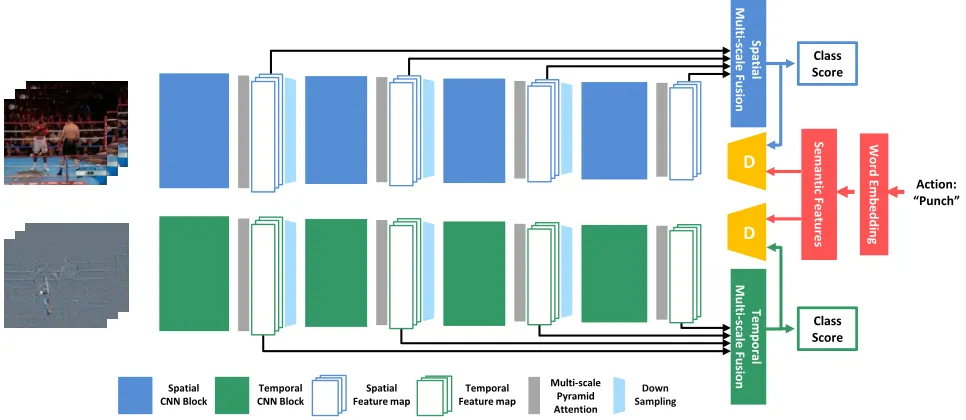
Figure 2: Our proposed framework. It can be divided into three components. The top branch isSpatial Network, which can
model spatial information. The middle branch isSemantic encoder, which provides video semantic features. The bottom branch
is Temporal Network, which can model temporal information. The multi-scale pyramid attention and semantic adversarial learning is introduced in our framework to learn discriminative and semantically rich representation from videos.
Network and semantic autoencoder. Figure 2 shows the overall architecture of our method. Specifically, we divide a
deep convolutional neural network into fourstages. The
out-put of each stage represents multi-scale features of different visual levels. Then we insert multi-scale pyramid attention (MPA) layer at each stage in order to obtain refined
multi-scale features. Given a video clip in the form ofnframes
sequence{θ1, θ2, . . . , θn}, we can obtain four different
lev-els of features{Vi
1, V2i, . . . , Vni},i∈ {1,2,3,4}, after MPA
layer of each stage.Vjican be rewritten as:
Vji= Attn(θj :Wi), (1)
whereAttn(θj :Wi)is a function representing MPA layer
after thei-th stage with its parametersWioperating on the
frameθj. The multi-scale features can be formulated as:
¯
V =
4
X
i=1
αi·G(V1i, V i 2, . . . , V
i
n), (2)
whereGis the frames consensus function, which is able to
combine the features from multiple frames to obtain a
con-sensus of representations among them. Theαi is a weight
parameter about ofi-th level, which can be learned
automat-ically. In order to obtain video semantics, we design
seman-tic autoencoder, taking video labels as input. Then semantic adversarial learning module is adopted to guide the architec-ture to learn semantic representations. We can formulize the adversarial loss as:
Ladv(S,V¯) = Adv( ¯V , S), (3)
whereSis video semantic extracted fromsemantic
autoen-coder. After that, the proposed framework can thus
gener-ate semantically rich representationVe. We note thatVfk is
the representation of thek-th video, and the class scoreCk
is the output of classification layer withfVk as input.
Com-bining with standard categorical cross-entropy loss, the final loss function is formed as:
Lcls(y, C) =−
K
X
i=1
yi(Ci−log K
X
j=1
expCj), (4)
where K is the number of video classes and yi is the
groundtruth label concerning classi. Finally, by combining
Eq. 3 and Eq. 4, we can get the final loss function as:
L=Lcls(y, C) +Ladv(S,V¯). (5)
By minimizingL, the objective of video classification can
be achieved. Next, we will illustrate the proposed multi-scale pyramid attention layer and semantic adversarial learn-ing module in detail.
Multi-Scale Pyramid Attention
The deep convolutional neural network extraction feature is a process from low-level visual features to high-level se-mantic features. Although the higher network layer is able to extract the global information , it will inevitably lose the details. Therefore, we intend to collect different levels fea-tures from a unified convolutional neural network. Specif-ically, we divide a network (such as ResNet101) into four
⋮
c
Ratio 1
Ratio n
c
Multi-scaleSampling
Conv Block 1x1
Concatenation
multiplication
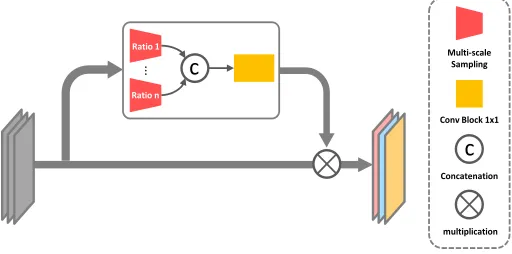
Figure 3: Multi-scale pyramid attention unit. We first put feature maps to multi-scale sampling branch to obtain multi-scale
information. Then we concatenate them and feed them into a1×1convolutional layer to merge the information as well as
generate the attention weights of feature maps. Finally we obtain the refined video representation.
task and may degrade the performance. So it is necessary to refine them for classification, and meanwhile, maintaining the multi-scale properties. Motivated by recent progress on residual learning, we introduce a novel multi-scale pyramid attention (MPA) layer that enables the network to consider the importance of each stage feature maps comprehensively with the informations of different receptive fields, so as to obtain reasonable attention weights. The structure of MPA is shown in Figure 3. It is a pluggable architecture and we put it to the end of each stage, as the Figure 2 shows.
Considering the importance of each stage feature maps
fromTscales, the attention weightshiof thei-th stage
fea-ture mapsfican be formulated as:
hi=τ( T
X
t=1
βtlt(fi:Wattt )), (6)
whereτ is the function corresponding to the1×1
convo-lutional layer.βtis a weight that can be learned
automati-cally.ltrepresents the extractor of thet-th scale andWattt is
its parameters. Therefore, the function of MPA layer can be rewritten as:
¯
V =
4
P
i=1
αi·G(V1i, V2i, . . . , Vni)
= 4
P
i=1
αi·G(Attn(θ1:Wi), . . . ,Attn(θn:Wi))
= 4
P
i=1
αi·G(hi1·f1i, . . . , hin·fni).
(7) Then we can easily obtain the video representation with hy-brid multi-scale information.
Semantic Adversarial Learning
Although multi-scale features have the ability to model video information, it still requires the guidance of explicit semantics. So, it is necessary to explore the exact semantic
of videos. To this end, the semantic autoencoder is
intro-duced in the proposed method. The structure ofsemantic
au-toencodercontains three fully connected layers supervised by video labels. After training, we freeze trained encoder
to generate exact semantic information. Specifically, the
se-manticSof videos can be written as:
S= encoder(y), (8)
whereyis the groundtruth label of videos.
In order to eliminate the difference of “real” semantic
S and “fake” semanticV¯, we design a semantic
adversar-ial learning module because of its excellent ability of per-fectly model the data distribution (Goodfellow et al. 2014; Li et al. 2018a). The adversarial loss function is used to
en-courageV¯ close toSion the manifold to preserves
seman-tics, by ”fooling” a discriminator networkDthat outputs the
probabilities to ensureV¯ is as ”real” asS. The adversarial
loss function is formulated as:
Ladv(S,V¯) = Adv( ¯V , S)
=ES(logD(S)) +EV¯(log[1−D( ¯V)]),
(9)
whereV¯ can be regarded as a transformationGof frames
sequenceθ. So the loss function can be rewritten as:
Ladv(S,V¯) =ES(logD(S)) +Eθ(log[1−D(G(θ))]),
(10)
where G tries to minimize Ladv against D that tries
to maximize it, i.e., D∗ = argminGmaxDLadv(S,V¯)
For better gradient of learning G, we actually
mini-mizeEθ(log[−D(G(θ))])instead ofEθ(log[1−D(G(θ))]).
Therefore, the final adversarial loss function is defined as:
Ladv(S,V¯) =ES(logD(S)) +Eθ(log[−D(G(θ))]), (11)
Combining with Eq. (5), we can obtain the optimization of
our proposed method. ForSpatial Network, the whole
net-work can be divided into three parts: semantic generator G, classification layer C and semantic discriminator D. We adopt an alternating optimization to train all three parts men-tioned above to avoid gradient vanishing problem caused by the minmax loss.
Firstly, semantic discriminator D is trained by minimizing Eq. (5). Update the parameters of D with G and C fixed:
D∗= argmin
Algorithm 1The optimization algorithm of SAL
Input: video datasetV ={(θk, yk), k= 1, . . . , K}
Output: semantic representationV¯, class scoreC
1: Initialized D, G, C; pretrained senmantic encoder
2: repeat
3: ExtractSby Eq. 8.
4: Fixing parameters of G and D
5: Update D by minimizing Eq. 5. (S→1,V¯ →0)
6: Fixing parameters of G and D
7: Update G, C by minimizing Eq. 5. (V¯ →1)
8: ExtractV¯ andC
9: untilconvergence
Then, semantic generator G and classification layer C are trained by minimizing Eq. (5). Update the parameters of G and C with D fixed:
G∗, C∗= argmin
G,CL. (13)
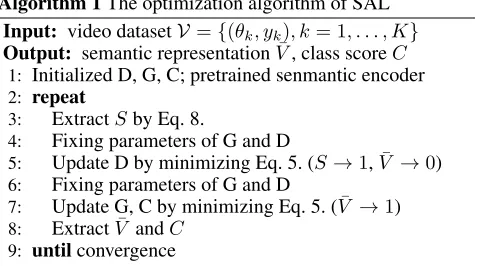
The whole semantic adversarial learning module (SAL) is
summarized in Algorithm 1. TheTemporal Networkhas the
same setting asSpatial Network.
Experimental Evaluations
In this section, evaluation datasets and implementation de-tails used in experiments will be first introduced. Then we will study different aspects of our proposed modal to ver-ify the effectiveness, respectively. Finally, we will make a comparison between our model with other RGB based state-of-the-art methods and provide a visualization of our exper-imental results.
Datasets and Implementation Details
Evaluation Datasets. In order to evaluate our proposed model, we conduct action recognition experiments on two popular video benchmark datasets: UCF101 (Soomro, Za-mir, and Shah 2012) and HMDB51 (Kuehne et al. 2011). The UCF101 dataset are collected from the Internet, con-taining 13,320 videos which are divided into 101 classes. While the HMDB51 dataset are collected from the realistic videos, including movies and web videos, containing 6,766 videos which are divided into 51 action categories. We fol-low the officially offered scheme which divides dataset into 3 training and testing splits and finally report the average
accuracy over the three splits. ForSpatial network, we
di-rectly utilize RGB frames extracted from videos. For
Tempo-ral Network, the difference between adjacent frames is used to model temporal information of videos.
Implementation details. In generation procedure, we use
stochastic gradient descent algorithm to train our Spatial
NetworkandTemporal Network. The mini-batch size is set to 64 and the momentum is set to 0.9. The initial learning
rate is set to 0.001 forSpatial NetworkandTemporal
Net-workand decreases by 0.1 every 40 epochs.
For adversarial training procedure, we use adaptive mo-ment estimation algorithm to train D Network and the initial
learning rate is set to 0.0001. The training procedure of
Spa-tial Network andTemporal Networkstops after 80 epochs
Table 1: Performance comparison on HMDB51 split 1.
Method Spatial Temporal Combine
TSN 52.0% 57.1% 62.5%
Ours 54.4% 57.8% 63.7%
Table 2: Performance comparison on UCF101 split 1.
Method Spatial Temporal Combine
TSN 84.5% 85.4% 89.9%
Ours 86.1% 86.8% 91.2%
Table 3: Ablation study of our proposed method.
Dataset Method Network Accuracy
HMDB51
Baseline Spatial 52.0%
MPA Spatial 54.0%
MPA + SAL Spatial 54.4%
UCF101
Baseline Spatial 84.5%
MPA Spatial 85.2%
MPA + SAL Spatial 86.1%
and 120 epochs respectively. We use gradient clipping of 20 and 40 for Spatial and Temporal training procedure to avoid gradient explosion. We train our model with 4 NVIDIA TI-TAN X GPUs and all the experiments are implemented un-der the Pytorch.
Results and Ablation Study
In this subsection, we will investigate the performance of our proposed method. The analysis for the performance of single and multiple modalities. All the results are trained with the same network backbone and strategies illustrated in previous sections for fair comparison.
We first evaluate the effectiveness of our proposed method. In this section, we compare the performance be-tween ours and TSN (Wang et al. 2016) with the same experimental condition. The experiment is performed on HMDB51 split 1 and UCF101 split 1, the results are sum-marized in Table 1 and Table 2. As is shown in them, our method is superior than TSN both in spatial and temporal branch. In spatial branch, our method has about 2% im-provement in performance compared to TSN, which proves the effectiveness of proposed MPA and SAL. but in tempo-ral branch, it is a limited improvement because differential image has less visual elements than RGB.
In order to justify the effectiveness of our proposed MPA and SAL, we conduct an ablation study for them. All exper-iments in this ablation study are performed on the split 1 of
HMDB51 and UCF101 bySpatial Network. The results are
shown in Table 3. Thebaselinemeans the original network
without multi-scale pyramid attention and semantic
adver-sarial learning module. The MPA means add multi-scale
pyramid attention layer tobaseline. It has about 1%-2%
im-provement in performance compared tobaseline, which can
prove the effectiveness of proposed MPA. The MPA+SAL
Table 4: Comparison with state-of-the-art methods on the UCF101 and HMDB51 datasets. The accuracy is reported as average over three splits. For fair comparison, we consider methods that use only RGB input. It can be seen our method obtains the best performance.
Method Pre-train UCF101 HMDB51
HOG(Wang and Schmid 2013) None 72.4% 40.2%
ConvNet+LSTM(Donahue et al. 2015) ImageNet 68.2%
-Two Stream Spatial Network(Simonyan and Zisserman 2014) ImageNet 73.0% 40.5%
Conv Pooling Spatial Network(Feichtenhofer and Zisserman 2016) ImageNet 82.6%
-Spatial Stream ResNet ImageNet 82.3% 43.4%
Spatial TDD(Wang, Qiao, and Tang 2015) ImageNet 82.8% 50.0%
TSN Spatial Network(Wang et al. 2016) ImageNet 86.4% 53.7%
TSN (RGB+RGB-Diff)(Wang et al. 2016) ImageNet 91.0%
-RGB-I3D(Carreira and Zisserman 2017) ImageNet 84.5% 49.8%
CoViAR(Wu et al. 2018) ImageNet 90.4% 59.1%
DCD(Zhao, Xiong, and Lin 2018) ImageNet 91.8%
-LTC(Varol, Laptev, and Schmid 2018) Sports-1M 82.4% 48.7%
C3D(Tran et al. 2015) Sports-1M 85.8% 54.9%
Pseudo-3D Resnet(Qiu, Yao, and Mei 2017) ImageNet+Sports-1M 88.6%
-C3D(Tran et al. 2015) Kinetics 89.8% 62.1%
Ours ImageNet 92.7% 66.3%
TSN TSN TSN TSN
Ours Ours Ours Ours
BalanceBeam FieldHockeyPenalty HighJump LongJump
ParallelBars
CricketBowling PizzaTossing PoleVault BalanceBeam
HammerThrow
FieldHockeyPenalty Shotput
CricketBowling ThrowDiscus
JavelinThrow
ThrowDiscus Fencing PoleVault HighJump
Shotput
LongJump ParallelBars BodyWeightSquats Lunges
BlanceBeam
PommelHorse ParallelBars Diving UnevenBars
FieldHockeyPenalty
CricketShot HammerThrow ThrowDiscus BaseballPitch
HighJump
LongJump PoleVault SkateBoarding JavelinThrow
LongJump
Lunges BandMarchin
HandstandWalking Shotput
Figure 4: A comparison of top-5 predictions between TSN and our proposed method on UCF101 split 1. The tags on the top is the groundtruth labels. The yellow bars indicate correct classifications and the blue stand for incorrect cases. The length of each bar shows its confidence.
in performance compared toMPA, that can prove the
effec-tiveness of the proposed SAL.
Comparison with the State-of-the-Arts
In this subsection we compare the classification performance of our approach with other state-of-the-art methods that take RGB frames as input. The experiment is conducted on two popular video action recognition benchmarks: UCF101 and HMDB51. The results are shown in Table 4, where we com-pare our method with traditional approach HOG and a series of deep learning based methods such as 3D convolutional
network, trajectory-pooled deep convolutional descriptors, temporal segment network and compressed video action recognition. It can be seen that our model achieves best re-sults than other methods on these benchmark datasets, which can demonstrates the advantage of our proposed method and the effectiveness of multi-scale feature semantic modeling.
Visualization
brush_hair cartwheel catch chew clap climb climb_stairs dive draw_sword dribble drink eat fall_floor fencing flic_flac golf handstand hit hug jump kick_ball kick kiss laugh pick pour pullup punch push pushup ride_bike ride_horse run shake_hands shoot_ball shoot_bow shoot_gun sit situp smile smoke somersault stand swing_baseball sword_exercise sword talk throw turn walk wave brush_hair cartwheel catch chew clap climb climb_stairs dive draw_sword dribble drink eat fall_floor fencing flic_flac golf handstand hit hug jump kick_ball kick kiss laugh pick pour pullup punch push pushup ride_bike ride_horse run shake_hands shoot_ball shoot_bow shoot_gun sit situp smile smoke somersault stand swing_baseball sword_exercise sword talk throw turn walk wave 0.0 0.2 0.4 0.6 0.8 1.0
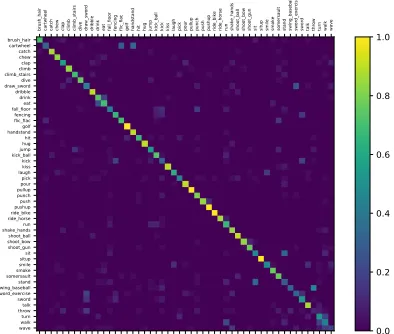
Figure 5: Confusion matrix for HMDB51 dataset.
ApplyEyeMakeup ApplyLipstick Archery BabyCrawling BalanceBeam BandMarching BaseballPitch Basketball BasketballDunk BenchPress Biking Billiards BlowDryHair BlowingCandles BodyWeightSquats Bowling BoxingPunchingBag BoxingSpeedBag BreastStroke BrushingTeeth CleanAndJerk CliffDiving CricketBowling CricketShot CuttingInKitchen Diving Drumming Fencing FieldHockeyPenalty FloorGymnastics FrisbeeCatch FrontCrawl GolfSwing Haircut Hammering HammerThrow HandstandPushups HandstandWalking HeadMassage HighJump HorseRace HorseRiding HulaHoop IceDancing JavelinThrow JugglingBalls JumpingJack JumpRope Kayaking Knitting LongJump Lunges MilitaryParade Mixing MoppingFloor Nunchucks ParallelBars PizzaTossing PlayingCello PlayingDaf PlayingDhol PlayingFlute PlayingGuitar PlayingPiano PlayingSitar PlayingTabla PlayingViolin PoleVault PommelHorse PullUps Punch PushUps Rafting RockClimbingIndoor RopeClimbing Rowing SalsaSpin ShavingBeard Shotput SkateBoarding Skiing Skijet SkyDiving SoccerJuggling SoccerPenalty StillRings SumoWrestling Surfing Swing TableTennisShot TaiChi TennisSwing ThrowDiscus TrampolineJumping Typing UnevenBars VolleyballSpiking WalkingWithDog WallPushups WritingOnBoard YoYo
ApplyEyeMakeupBabyCrawlingApplyLipstickArchery BalanceBeam BandMarchingBaseballPitchBasketball BasketballDunkBlowDryHairBenchPressBilliardsBiking BlowingCandles BodyWeightSquatsBowling BoxingPunchingBagBoxingSpeedBag BreastStroke BrushingTeethCleanAndJerkCliffDiving CricketBowling CricketShot CuttingInKitchenDrummingFencingDiving FieldHockeyPenaltyFloorGymnasticsFrisbeeCatchFrontCrawlGolfSwing Haircut Hammering HammerThrow HandstandPushups HandstandWalking HeadMassageHorseRidingHorseRaceHighJump HulaHoop IceDancing JavelinThrow JugglingBallsJumpingJack JumpRopeKayakingLongJumpKnittingLunges MilitaryParadeMoppingFloorParallelBarsNunchucksMixing PizzaTossingPlayingCelloPlayingDholPlayingFlutePlayingDaf PlayingGuitar PlayingPianoPlayingSitar PlayingTabla PlayingViolin PoleVault PommelHorsePushUpsPullUpsPunch Rafting RockClimbingIndoorRopeClimbingRowing SalsaSpin ShavingBeardShotput SkateBoardingSkiing Skijet SkyDiving SoccerJugglingSoccerPenaltyStillRings SumoWrestlingSurfingSwing TableTennisShotTaiChi TennisSwing ThrowDiscus TrampolineJumpingUnevenBarsTyping
VolleyballSpikingWalkingWithDogWritingOnBoardWallPushupsYoYo 0.0 0.2 0.4 0.6 0.8 1.0
Figure 6: Confusion matrix for UCF101 dataset.
The results show that the original two-stream based methods (such as TSN) are easily fooled by common background. For instance, it regards BalanceBeam as ParallelBars, since the similar backgroud of gym and equipments. The reasons is that those methods fail to capture details and local context information effectively. The results base on our method can classify this actions will, which demonstrate the effective-ness of proposed MPA and SAL module. Figure 5 and Fig-ure 6 show the confusion matrix for HMDB51 and UCF101, respectively. All the results can demonstrate the superior performance of our method.
Conclusion
In this paper, we proposed a new deep network architecture for video classification. The proposed architecture can only need RGB frames as input to model spatial information and temporal information for videos, which greatly reduce the computational cost compared with those methods using op-tical flow. In order to obtain more discriminative video repre-sentation, we design multi-scale pyramid attention (MPA) to
refine and merge different level features. Then we introduce semantic adversarial learning (SAL) module to guide learn-ing procedure and to generate more discriminative seman-tic representation. Comprehensive experiment results on two popular benchmark datasets show that our method yields state-of-the-art performance in video classification tasks.
Acknowledgments
Our work was supported in part by the National Natural Science Foundation of China under Grant 61572388 and 61703327, in part by the Key R&D Program-The Key Indus-try Innovation Chain of Shaanxi under Grant 2017ZDCXL-GY-05-04-02, 2017ZDCXL-GY-05-02 and 2018ZDXM-GY-176, and in part by the National Key R&D Program of China under Grant 2017YFE0104100.
References
Carreira, J., and Zisserman, A. 2017. Quo vadis, action
recognition? a new model and the kinetics dataset. In
Com-puter Vision and Pattern Recognition (CVPR), 2017 IEEE Conference on, 4724–4733. IEEE.
Dalal, N.; Triggs, B.; and Schmid, C. 2006. Human
detection using oriented histograms of flow and
appear-ance. InEuropean conference on computer vision, 428–441.
Springer.
Deng, C.; Chen, Z.; Liu, X.; Gao, X.; and Tao, D.
2018. Triplet-based deep hashing network for
cross-modal retrieval. IEEE Transactions on Image Processing
27(8):3893–3903.
Donahue, J.; Anne Hendricks, L.; Guadarrama, S.; Rohrbach, M.; Venugopalan, S.; Saenko, K.; and Darrell, T. 2015. Long-term recurrent convolutional networks for
visual recognition and description. In Proceedings of the
IEEE conference on computer vision and pattern
recogni-tion, 2625–2634.
Fan, X.; Yang, Y.; Deng, C.; Xu, J.; and Gao, X. 2018. Com-pressed multi-scale feature fusion network for single image
super-resolution.Signal Processing146:50–60.
Feichtenhofer, A., and Zisserman, A. 2016. Convolutional two-stream network fusion for video action recognition. In
Proceedings of the IEEE Conference on Computer Vision and Pattern Recognition, 1933–1941.
Goodfellow, I.; Pouget-Abadie, J.; Mirza, M.; Xu, B.; Warde-Farley, D.; Ozair, S.; Courville, A.; and Bengio, Y.
2014. Generative adversarial nets. InAdvances in neural
information processing systems, 2672–2680.
Ji, S.; Xu, W.; Yang, M.; and Yu, K. 2013. 3d
convolu-tional neural networks for human action recognition. IEEE
transactions on pattern analysis and machine intelligence
35(1):221–231.
Karpathy, A.; Toderici, G.; Shetty, S.; Leung, T.; Suk-thankar, R.; and Fei-Fei, L. 2014. Large-scale video
clas-sification with convolutional neural networks. In
Kuehne, H.; Jhuang, H.; Garrote, E.; Poggio, T.; and Serre, T. 2011. Hmdb: a large video database for human motion
recognition. InComputer Vision (ICCV), 2011 IEEE
Inter-national Conference on, 2556–2563. IEEE.
Li, C.; Deng, C.; Li, N.; Liu, W.; Gao, X.; and Tao, D.
2018a. Self-supervised adversarial hashing networks for
cross-modal retrieval. InThe IEEE Conference on Computer
Vision and Pattern Recognition (CVPR).
Li, F.; Tian, C.; Zuo, W.; Zhang, L.; and Yang, M.-H. 2018b. Learning spatial-temporal regularized correlation filters for
visual tracking. InThe IEEE Conference on Computer
Vi-sion and Pattern Recognition (CVPR).
Qiu, Z.; Yao, T.; and Mei, T. 2017. Learning spatio-temporal
representation with pseudo-3d residual networks. In2017
IEEE International Conference on Computer Vision (ICCV), 5534–5542. IEEE.
Ren´e, C. L. M. D. F., and Hager, V. A. R. G. D. 2017. Tem-poral convolutional networks for action segmentation and
detection. InIEEE International Conference on Computer
Vision (ICCV).
Shi, Y.; Tian, Y.; Wang, Y.; Zeng, W.; and Huang, T. 2017. Learning long-term dependencies for action
recogni-tion with a biologically-inspired deep network. In
Proceed-ings of the International Conference on Computer Vision, 716–725.
Simonyan, K., and Zisserman, A. 2014. Two-stream
con-volutional networks for action recognition in videos. In
Ad-vances in neural information processing systems, 568–576. Soomro, K.; Zamir, A. R.; and Shah, M. 2012. Ucf101: A dataset of 101 human actions classes from videos in the
wild. arXiv preprint arXiv:1212.0402.
Tran, D.; Bourdev, L.; Fergus, R.; Torresani, L.; and Paluri, M. 2015. Learning spatiotemporal features with 3d
convo-lutional networks. InProceedings of the IEEE international
conference on computer vision, 4489–4497.
Varol, G.; Laptev, I.; and Schmid, C. 2018. Long-term
tem-poral convolutions for action recognition.IEEE transactions
on pattern analysis and machine intelligence 40(6):1510– 1517.
Wang, H., and Schmid, C. 2013. Action recognition with
improved trajectories. InProceedings of the IEEE
interna-tional conference on computer vision, 3551–3558.
Wang, L.; Xiong, Y.; Wang, Z.; Qiao, Y.; Lin, D.; Tang, X.; and Van Gool, L. 2016. Temporal segment networks:
To-wards good practices for deep action recognition. In
Euro-pean Conference on Computer Vision, 20–36. Springer. Wang, H.; Yang, Y.; Yang, E.; and Deng, C. 2017. Explor-ing hybrid spatio-temporal convolutional networks for
hu-man action recognition.Multimedia Tools and Applications
76(13):15065–15081.
Wang, J.; Jiang, W.; Ma, L.; Liu, W.; and Xu, Y. 2018. Bidi-rectional attentive fusion with context gating for dense video
captioning. In The IEEE Conference on Computer Vision
and Pattern Recognition (CVPR).
Wang, L.; Qiao, Y.; and Tang, X. 2015. Action recogni-tion with trajectory-pooled deep-convolurecogni-tional descriptors.
InProceedings of the IEEE conference on computer vision and pattern recognition, 4305–4314.
Wu, C.-Y.; Zaheer, M.; Hu, H.; Manmatha, R.; Smola, A. J.; and Kr¨ahenb¨uhl, P. 2018. Compressed video action
recog-nition. InProceedings of the IEEE Conference on Computer
Vision and Pattern Recognition, 6026–6035.
Yang, Y.; Liu, R.; Deng, C.; and Gao, X. 2016. Multi-task
human action recognition via exploring super-category.
Sig-nal Processing124:36–44.
Yang, Y.; Deng, C.; Gao, S.; Liu, W.; Tao, D.; and Gao, X. 2017a. Discriminative multi-instance multitask learning for
3d action recognition. IEEE Transactions on Multimedia
19(3):519–529.
Yang, Y.; Deng, C.; Tao, D.; Zhang, S.; Liu, W.; and Gao,
X. 2017b. Latent max-margin multitask learning with
skelets for 3-d action recognition. IEEE Trans.
Cybernet-ics47(2):439–448.
Yang, E.; Deng, C.; Li, C.; Liu, W.; Li, J.; and Tao, D.
2018. Shared predictive cross-modal deep quantization.
IEEE Transactions on Neural Networks and Learning
Sys-tems(99):1–12.
Yue-Hei Ng, J.; Hausknecht, M.; Vijayanarasimhan, S.; Vinyals, O.; Monga, R.; and Toderici, G. 2015. Beyond short snippets: Deep networks for video classification. In
Proceedings of the IEEE conference on computer vision and pattern recognition, 4694–4702.
Zhao, Y.; Xiong, Y.; and Lin, D. 2018. Recognize actions
by disentangling components of dynamics. InProceedings