Selection of Air Lines by the Fuzzy Analytic
Hierarchy Process
Rajshri Gupta #1,O.K. Chaudhari *2 and Nita Dhawade #3
# 1
Assistant Professor, G. H. R. College of Engineering, Nagpur, India
* 2
Professor, G. H. R. College of Engineering, Nagpur, India
# 3
Associate Professor, Arts, Comm. & Science College, Koradi, Nagpur
Abstract
Air lines users are constantly in search of regular, on time service, reasonable cost, high safety with physical and psychological comfort. This study and the presented evaluation method for the analysis of the current situation along with the comparison of the airlines can help to improvise their services. The data have been analyzed by using Fuzzy Analytic Hierarchy Process, which was proposed by Saaty. The Analytic Hierarchy Process (AHP) is one of the Fuzzy Multiple Criteria Decision Making methods for complicated and unstructured problems. Fuzzy decision making is observed to be a very significant tool. AHP methodology with the Fuzzy Linear Programming Model is found to make complex decisions with ease. Fuzziness and vagueness involved in the problem may contribute to poor judgment in AHP, but AHP-FLP model allows decision makers to consider the uncertain conditions. Thus AHP-FLP model is more relevant than AHP method for the selection of Airlines.
Keywords — Fuzzy Analytic Hierarchy Process, Multiple Criteria Decision Making method, unstructured problems.
I. INTRODUCTION
Air lines Passengers are in search of regular, on time services, reasonable costs, high safety with physical and psychological comfort. This paper seeks to provide air lines passengers with a logical and scientific tool to support the decisions made in hope of achieving a higher quality services.
Analytic Hierarchy Process i.e. AHP is one of the most convenient methodology in order to evaluate transportation issues. Basically AHP, which was proposed by proposed by Saaty in 1985 [5] is a method of breaking down a complex, unstructured situation into its components parts, arranging these parts, or variables into a hierarchic order and to synthesize the judgments to determine which variables have the highest priority. This paper is comprised of two main parts. First part is consists of the literature survey regarding the AHP and its application areas. Second part is mainly focused on a sample application of AHP technique. The process of multi-level hierarchical structure uses both the linguistic assessments and numerical values for the alternative selection problem. It uses the concepts of fuzzy set theory and hierarchical structure analysis for the selection of the most appropriate alternative among a set of feasible alternatives. It is easy and useful methodology to be able to provide pair wise comparisons in each area of expertise. The aim of this paper is, how to select the better air transportation according to passengers‟ expectations.
A. Overview of Multi-Criteria Decision Making
Selection
Criteria1
Criteria 2
Criteria 3
SubCriteria2
Sub Criteria3
SubCriteria4
Sub Criteria1
Object 1
Object 2
Criteria 4
Object 2
Figure 1: Hierarchical Structure of Selection Criteria
to deal with multi objective planning problems, when a theoretically infinite number of continuous alternatives are defined by a set of constraints on a vector of decision variables (Mendoza, Martins, 2006) [3].
B. Multi-Attribute Decision Making (MADM)
MADM methods provide a simple and intuitive tools for making decisions on problems that involve uncertain and subjective information [Cheng, Y.K] [1]. These methods have the advantage that they can assess a variety of options according to a variety of criteria that have different units. This is a very important advantage over traditional decision aiding methods where all criteria need to be converted to the same unit. Another significant advantage of MADM methods is that they have the capacity to analyze both quantitative and qualitative evaluation criteria together. MADM describes each alternative by using multiple attributes. For a given set of alternatives, MADM models try to choose the best alternative among them, rank the alternatives from the best to the worst or classify them into classes. Although the MADM methods are generally used to solve discrete problems, some of them can also be used within the context of continuous decision problems (Doumpos and Zopounidis, 2002) [2].
To resolve this difficulty, fuzzy set theory, first introduced by Zadeh, L. A., 1965 [9], has been used and is adopted herein. Fuzzy set theory attempts to select, prioritize or rank a finite number of courses of action by evaluating a group of predetermined criteria. Solving this problem thus requires constructing an evaluation procedure to rate and rank, in order of preference, the set of alternatives. Among the MADM methods developed in the literature, AHP, multi-attribute utility theory and outranking methods are more frequently applied to discrete decision problems than all other methods.
C. Analytic Hierarchy Process
The analytic hierarchy process (AHP) is a structured technique for organizing and analyzing complex decisions, based on mathematics and psychology. It was developed by Thomas L. Saaty in the 1970s and has been extensively studied and refined since then.
Once the hierarchy is built, the decision makers systematically evaluate its various elements by comparing them to each other two at a time, with respect to their impact on an element above them in the hierarchy. In making the comparisons, the decision makers can use concrete data about the elements, but they typically use their judgments about the elements' relative meaning and importance. It is the essence of the AHP that human judgments, and not just the underlying information, can be used in performing the evaluations. Wikipedia [8]
The AHP converts these evaluations to numerical values that can be processed and compared over the entire range of the problem. A numerical weight or priority is derived for each element of the hierarchy, allowing diverse and often incommensurable elements to be compared to one another in a rational and consistent way. This capability distinguishes the AHP from other decision making techniques.
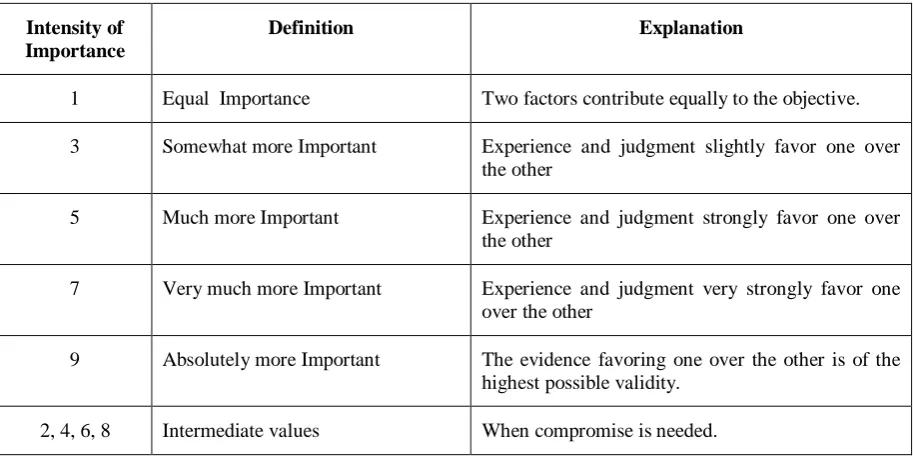
In the final step of the process, numerical priorities are calculated for each of the decision alternatives. These numbers represent the alternatives' relative ability to achieve the decision goal, so they allow a straight forward consideration of the various courses of action. The pair wise comparisons using fuzzy scale was given by Satty in the Table I.
Table I: The Pair Wise Comparisons Using Fuzzy Scale
Intensity of Importance
Definition Explanation
1 Equal Importance Two factors contribute equally to the objective.
3 Somewhat more Important Experience and judgment slightly favor one over the other
5 Much more Important Experience and judgment strongly favor one over the other
7 Very much more Important Experience and judgment very strongly favor one over the other
9 Absolutely more Important The evidence favoring one over the other is of the highest possible validity.
2, 4, 6, 8 Intermediate values When compromise is needed.
Through this comparison matrix of the elements is formed and then consistency ratio (CR) is calculated to check the consistency of responses. The reliability of responses is maintained if CR is less or equal to 0.10. This CR is given by CR=CI/RI where CI is consistency index and RI is random index. If CR is greater than 0.10 then judgment in the matrix would be considered as inconsistent and in that case we shall have to revise the matrix. There is computer software to assist in using the process.
II. APPLICATION
A. Analytic Hierarchy Process for selection of Airlines
Air lines users are constantly in search of regular, on time service, reasonable cost, high safety with physical and psychological comfort. We made an attempt to use AHP-FLP model in the selection of airline which should be match perfect according to our need.
prefer to have a comfortable journey, hence this is one of the important criteria. Customer services plays a very important role in the selection of airlines. Hence the criteria and sub criteria are decided as given in Table II.
Table II: Criteria and Sub Criteria for Selection of Airlines
S. No. Criteria Sub criteria
1 Time (TI)
Check in Start (CIS) Check in Closed (CIC) Luggage Pickup Time (LPT) Arrival on Time (AT)
2 Pricing (PR)
Price (PR)
Discount/Group Booking (DIS/GB) Negotiation/Seat Preference (NE/SP) Cancellation /Date Change (CAN/RS)
3 Comfort (CO)
Hospitality (HO) Catering Services (CS) Delay/Flight Cancelled (D/FC)
4 Customer Care (CC)
Luggage Allowed (LA) Luggage Handling (LH) Insurance Protection (IP)
Figure 2: Criteria and Sub Criteria for Selection of Airline
D-Airways Selection
C1-Timing
C2-Pricing
C3-Comfort
C4-Customer Care
C11-CIS
C14-AT C13-LPT C12-CIC
C21-PR
C24-CAN/RS C22-DIS/GB
C23-NE/SP
C33-D/FC C31-HO
C32-CS
C43-IP C41-LA
C42-LH
A1
A2
B. Calculation of weights of the criteria
In this paper, three airlines are compared on various criteria and sub-criteria for the selection of proper airline to travel with comfort as per the passengers need. For this pairwise comparison of main selection criteria, comparison of criteria over sub-criteria comparison of sub-criteria over alternatives for selection of airline have been done to know the weights of each airline using Satty‟s scale.
Pairwise comparison of main selection criteria is given in Table III.
Table III: Inter Comparison of Main Criteria
Criteria TI PR CO CC Priority TI 1 3 1/5 2 0.2305 PR 1/3 1 1 3 0.2079 CO 5 1 1 7 0.4932 CC 1/2 1/3 1/7 1 0.0684 CI: 0.2428 CR: 0.2754 Sum: 1
Table IV to Table VII show pair wise comparison of criteria over sub-criteria for the selection of airline
Table IV: Inter Comparison of Sub-Criteria with Respect to Main Criteria TI
TI CIS CIC LPT AT Priority CIS 1 1/3 2 1/5 0.1087 CIC 3 1 3 1/7 0.1994 LPT 1/2 1/3 1 1/2 0.1107 AT 5 7 2 1 0.5812 CI: 0.239086 CR: 0.271227 Sum: 1
Table V: Inter Comparison of Sub-Criteria with Respect to Main Criteria PR
PR PR DIS/GB NE/SP CAN/RS Priority PR 1 3 2 1 0.32369 DIS/GB 1/3 1 1/5 1/2 0.09727 NE/SP 1/2 5 1 1/3 0.226013 CAN/RS 1 2 3 1 0.353026 CI: 0.12954 CR: 0.146954 Sum: 1
Table VI: Inter Comparison of Sub-Criteria with Respect to Main Criteria CO
Table VII: Inter Comparison of Sub-Criteria with Respect to Main Criteria CC
CC LA LH IP Priority
LA 1 7 1/3 0.37309 LH 1/7 1 1/2 0.116582 IP 3 2 1 0.510328 CI: 0.323216 CR: 0.616237 1
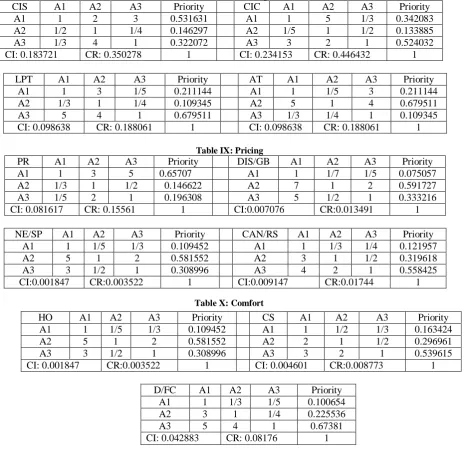
Table VIII to Table XI show pair wise comparison of sub-criteria with respect to alternatives for the selection of airline
Table VIII: Timing
CIS A1 A2 A3 Priority CIC A1 A2 A3 Priority A1 1 2 3 0.531631 A1 1 5 1/3 0.342083 A2 1/2 1 1/4 0.146297 A2 1/5 1 1/2 0.133885 A3 1/3 4 1 0.322072 A3 3 2 1 0.524032 CI: 0.183721 CR: 0.350278 1 CI: 0.234153 CR: 0.446432 1
LPT A1 A2 A3 Priority AT A1 A2 A3 Priority A1 1 3 1/5 0.211144 A1 1 1/5 3 0.211144 A2 1/3 1 1/4 0.109345 A2 5 1 4 0.679511 A3 5 4 1 0.679511 A3 1/3 1/4 1 0.109345 CI: 0.098638 CR: 0.188061 1 CI: 0.098638 CR: 0.188061 1
Table IX: Pricing
PR A1 A2 A3 Priority DIS/GB A1 A2 A3 Priority A1 1 3 5 0.65707 A1 1 1/7 1/5 0.075057 A2 1/3 1 1/2 0.146622 A2 7 1 2 0.591727 A3 1/5 2 1 0.196308 A3 5 1/2 1 0.333216 CI: 0.081617 CR: 0.15561 1 CI:0.007076 CR:0.013491 1
NE/SP A1 A2 A3 Priority CAN/RS A1 A2 A3 Priority A1 1 1/5 1/3 0.109452 A1 1 1/3 1/4 0.121957 A2 5 1 2 0.581552 A2 3 1 1/2 0.319618 A3 3 1/2 1 0.308996 A3 4 2 1 0.558425 CI:0.001847 CR:0.003522 1 CI:0.009147 CR:0.01744 1
Table X: Comfort
D/FC A1 A2 A3 Priority A1 1 1/3 1/5 0.100654 A2 3 1 1/4 0.225536 A3 5 4 1 0.67381 CI: 0.042883 CR: 0.08176 1
Table XI: Customer Care
LA A1 A2 A3 Priority LH A1 A2 A3 Priority A1 1 2 1/7 0.149899 A1 1 1/4 1/5 0.093616 A2 1/2 1 1/5 0.105638 A2 4 1 1/3 0.279688
A3 7 5 1 0.744463 A3 5 3 1 0.626696
CI:0.059476 CR:0.113395 1 CI:0.042883 CR:0.08176 1
IP A1 A2 A3 Priority A1 1 1/2 1/3 0.163424 A2 2 1 1/2 0.296961 A3 3 2 1 0.539615 CI: 0.004601 CR:0.008773 1
Pairwise comparison of airlines with criteria and sub-criteria has been done to find out the weights of airlines and given in Table XII
Table XII: Pairwise Comparison of Airlines with Criteria and Sub-Criteria
Sub-criteria Weight Wt of A1 Wt of A2 Wt of A3
CIS 0.1087 0.53163 0.14630 0.32207 CIC 0.1994 0.34208 0.13388 0.52403 LPT 0.1107 0.21114 0.10934 0.67951 AT 0.5812 0.21114 0.67951 0.10934 PR 0.32369 0.65707 0.14662 0.19631 DIS/GB 0.09727 0.07506 0.59173 0.33322 NE/SP 0.226013 0.10945 0.58155 0.30900 CAN/RS 0.353026 0.12196 0.31962 0.55842 HO 0.220582 0.10945 0.58155 0.30900 CS 0.099867 0.16342 0.29696 0.53961 D/FC 0.679551 0.10065 0.22554 0.67381 LA 0.37309 0.14990 0.10564 0.74446 LH 0.116582 0.09362 0.27969 0.62670 IP 0.510328 0.16342 0.29696 0.53961
According to the main selection criteria, Time (TI), Pricing (PR), Comfort (CO) and Customer Care (CC) the final weights of each of the airlines to select the best one is given in Table XIII.
Table XIII: Final Weights of Airlines
Criteria Weight Wt of A1 Wt of A2 Wt of A3
TI 0.23 0.272 0.450 0.278 PR 0.21 0.288 0.349 0.363 CO 0.49 0.109 0.311 0.580 CC 0.07 0.150 0.224 0.626 FINAL WEIGHT 0.187 0.345 0.468
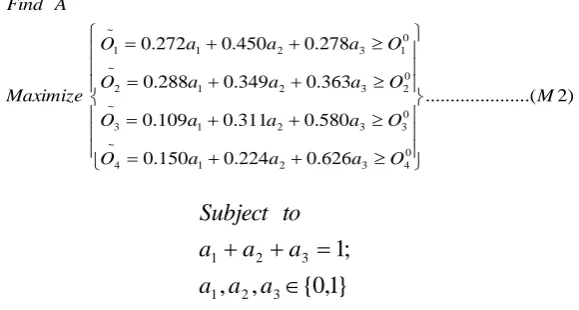
C. Multi-objective Linear Programming Problem
) 1 ...( ... 626 . 0 224 . 0 150 . 0 580 . 0 311 . 0 109 . 0 363 . 0 349 . 0 288 . 0 278 . 0 450 . 0 272 . 0 3 2 1 4 3 2 1 3 3 2 1 2 3 2 1 1 M a a a O a a a O a a a O a a a O Maximize
D. Limitations of main criteria
Table 14 gives limitations for each of the main criteria i.e. bounds for them. Minimum value *
K
O
& maximum valueO
K0 for each of the main criteria are given in the Table XIV. Table XIV: Upper & Lower Bounds for Each CriterionBounds
1
O
O
2O
3O
4*
K
O
(Min) 0.272 0.288 0.109 0.150 0K
O
(Max) 0.450 0.363 0.580 0.626E. Fuzzy Multi-objective Linear Programming Problem
From M1, the fuzzy multi-objective linear programming problem for the selection of airline is given below -
) 2 .( ... ... 626 . 0 224 . 0 150 . 0 580 . 0 311 . 0 109 . 0 363 . 0 349 . 0 288 . 0 278 . 0 450 . 0 272 . 0 0 4 3 2 1 ~ 4 0 3 3 2 1 ~ 3 0 2 3 2 1 ~ 2 0 1 3 2 1 ~ 1 M O a a a O O a a a O O a a a O O a a a O Maximize A Find
}
1
,
0
{
,
,
;
1
3 2 1 3 2 1
a
a
a
a
a
a
to
Subject
For above four objective functions, membership functions can be written as follows:
) 3 ( ... ... 272 . 0 ) ( ; 0 450 . 0 ) ( 0.272 ; 272 . 0 450 . 0 ) ( 450 . 0 450 . 0 ) ( ; 1 ) ( 1 1 1 1 1 M A O A O A O A O A O ) 4 ( ... ... 288 . 0 ) ( ; 0 363 . 0 ) ( 288 . 0 ; 288 . 0 363 . 0 ) ( 363 . 0 363 . 0 ) ( ; 1 ) ( 2 2 2 2 2 M A O A O A O A O A O ) 5 ...( ... ... 109 . 0 ) ( ; 0 580 . 0 ) ( 109 . 0 ; 109 . 0 580 . 0 ) ( 580 . 0 580 . 0 ) ( ; 1 )
( 3 3
) 6 .( ... ... 0.150 ) ( ; 0 626 . 0 ) ( 0.150 ; 0.150 626 . 0 ) ( 626 . 0 626 . 0 ) ( ; 1 ) ( 4 4 4 4 4 M A O A O A O A O A O
F. AHP-FLP model construction
From M2, we can write crisp single objective programming model equivalent to Fuzzy multi-objective models M7 for the selection of airline.
} 1 , 0 { , , ; 1 ] 1 , 0 [ , , , 150 . 0 626 . 0 ) 626 . 0 224 . 0 150 .. 0 ( 626 . 0 ) 7 ...( ... 109 . 0 580 . 0 ) 580 . 0 311 . 0 109 .. 0 ( 580 . 0 288 . 0 363 . 0 ) 363 . 0 349 . 0 288 .. 0 ( 363 . 0 272 . 0 450 . 0 ) 278 . 0 450 . 0 272 .. 0 ( 450 . 0 07 . 0 49 . 0 21 . 0 23 . 0 3 2 1 3 2 1 4 3 2 1 3 2 1 4 3 2 1 3 3 2 1 2 3 2 1 1 4 3 2 1 a a a a a a w w w w a a a w M a a a w a a a w a a a w to Subject w w w w Maximize
It is important to note that weights taken with all
w
K, k = 1, 2, 3, 4 are taken as weights ofeach of the main criteria calculated using AHP in comparison matrix.
Model M7 is solved to get optimal solution for the selection of airline.
We get, a1= 0, a2= 1, a3= 0 which indicates that airline A2 is the best selection for the satisfaction of the passenger on the basis of criteria & sub criteria considered. Hence the values of objective functions and membership functions from this preference can be as follows
O1= 0.450, O2= 0.349, O3= 0.311, O4=0.224
0
)
(
1
A
O
,(
)
0
.
19
2
A
O
,(
)
0
.
57
3
A
O
,(
)
0
.
85
4
A
O
From this we can say that the achievement levels of the O3 & O4 are better than the achievement levels of O1 & O2
III. RESULTSANDDISCUSSION
Table XV shows comparison of AHP and AHP-FLP results for the selection of airlines. It shows that through AHP-FLP approach, airline A2 is the best choice for the selection of airline with score of one as compare to the AHP approach which suggests that the airline A3 is the best choice with overall score of 0.468. So, the sensitivity of AHP-FLP method is analyzed by considering various criterion and sub criterions used in the model. According to the views of experts and passengers, travelling frequently through air, the comfort and the customer care are considered as the most important as compared to the other two factors namely timing and pricing, for the selection of the suitable airline.
Table XV: Comparison of AHP and AHP-FLP for Selection of Airline
Approach A1 A2 A3
AHP 0.187 0.345 0.468
This hybrid model „AHP-FLP‟ is applied in an integrated approach of Analytic Hierarchy Process and Fuzzy Linear Programming for selection of airline of suitable choice.
IV. CONCLUSION
Selection of airlines with complex expectations of the decision maker has become very tough due to the overwhelming competition amongst the airlines. Fuzzy decision making is observed to be a very significant tool. AHP methodology with the Fuzzy Linear Programming Model is found to make complex decisions with ease.
Fuzziness and vagueness involved in the problem may contribute to poor judgment in AHP, but AHP-FLP model allows decision makers to consider the uncertain conditions. Thus AHP-FLP model is more relevant than AHP method for the selection of Airlines.
REFERENCES
[1] Cheng, Y.K., (2000), “Development of a Fuzzy Multi-Criteria Decision Support System for Municipal Solid Waste Management”, Regina, Saskatchewan, Thesis pp 1-181.
[2] Doumpos and Zopounidis, (2002), “Multicriteria Decision Aid Classification Methods” ,Kluwer Academic Publishers,Book, pp 1-255.
[3] Mendoza, G.A., Martins, H., (2006), “Multi-criteria Decision Analysis in Natural Resource Management: A Critical Review of Methods and New Modeling Paradigms”, Forest Ecology and Management, 230 (1-3), pp. 1 – 22 [4] Mollaghasemi, M., (1997), IEEE, “Making Multiple-Objective Decisions”, California
[5] Satty T.L.(1980): Analytic hierarchy process, McGraw- Hill, New York
[6] Senay OGUZTIMUR ,(2011), “Why Fuzzy Analytic Hierarchy Process Approach for transportation problems?”51st Congress of the European Regional Science Association: "New Challenges for European Regions and Urban Areas in a Globalised World", Barcelona, Spain.
[7] The London School of Economics and Political Science,(2007),“Multi-criteria Decision Analysis”
http://www.lse.ac.uk/collections/summerSchool/courseoutlines/management/Multicriteria%20analysis%20manual.ht m
[8] Wikipedia