Volume: 03, Issue: 02
(MARCH
–
APRIL, 2017)
51
Efficient Image Retrieval Using Integrated Features
Extraction in Binary Domain
Jyoti Sharma
1, Prof. Ratnesh Kumar Dubey
2, Dr. Vineet Richhariya
1M.Tech. Scholar, 2Research Guide, 3HOD
Department of Computer Science and Engineering, LNCT, Bhopal
Abstract - The recent advancement in technology providing the distribution of information at extremely rapid speed such as audio, video and images. The allocation of such data also increased as the social networking sites become popular among young generation. Now the online databases of images is so huge having millions of images, and the searching of images we need is crucial task. For such applications various image retrieval methodologies is proposed. In this paper we are proposing very efficient image retrieval technique based on integrated feature extraction in binary domain. From the simulation results we have found that from Wangs 1000 images database having 100 images of each category, by using proposed algorithm takes only 0.068 seconds to retrieve results. The precision and recall values shows the significant performance over base paper results. Keywords - Image Retrieval, Precision, Recall, Color Features, Binary Domain Features, Retrieval Speed.
I. INTRODUCTION
Points in an image where brightness changes abruptly are called edges or edge points. There are different types of sharp changing points in an image. Edges can be created by shadows, texture, geometry, and so forth. Edges can also be defined as discontinuities in the image intensity due to changes in image structure. These discontinuities originate from different features in an image. Edge points are to be associated with the boundaries of objects and other kinds of changes. Edges within an image generally occur at various resolutions or scales and represent transitions of different degree, or gradient levels.
Edge detection refers to the process of identifying and locating sharp discontinuities in an image. There are many ways to perform edge detection. However, most of them may be grouped into two categories, namely, gradient based edge detection and Laplacian-based edge detection. In the gradient based edge detection, we calculate an estimate of the gradient magnitude using the smoothing filter and use the calculated estimate to determine the position of the edges. In other words the gradient method detects the edges by looking for the maximum and minimum in the first derivative of the image. In the Laplacian method we calculate the second derivative of the signal and the derivative magnitude is maximum when second derivative is zero. In short, Laplacian method searches for zero crossings in the second derivative of the image to find edges.
Digital image processing is an ever expanding and dynamic area with applications reaching out into our everyday life such as in medicine, space exploration, surveillance, authentication, automated industry inspection and in many more areas. Applications such as these involve different processes like image enhancement, and object detection. Implementing such applications on a generable purpose computer can be easier but not very efficient in terms of speed. The reason being the additional constraints put on memory and other peripheral device management. Application specific hardware offers much greater speed than a software implementation.
Content-based image retrieval system design highly depends on the image domain in use. In the range of images under consideration, there is a gradual distinction between narrow and broad image domains. In a narrow domain, one finds a limited variability of the content of the images. Usually, the recording circumstances are also very similar over the whole domain. An example of a narrow domain is a set of frontal views of faces recorded against a clear background. Although each face is unique and has large variability in the visual details, there are obvious geometrical, physical, and color-related constraints governing the domain. Another good example of a narrow domain would be a collection of fingerprint images. In broad domains, images are polysemic and their semantics are described only partially. It might be the case that there are conspicuous objects in the scene for which the object class is unknown or even that the interpretation of the scene is not unique. The broadest class available to date is the set of all images available on the internet. Many problems of practical interest have an image domain in between these extreme ends of the spectrum. The notions of broad and narrow domains are helpful in characterizing patterns of use, in selecting features, and in designing systems. For this thesis, the image collection used is museum images, which can be classified as a medium to broad domain.
II. CBIR SYSTEM MODEL
Volume: 03, Issue: 02
(MARCH
–
APRIL, 2017)
52 information needed to support CBIR. Finally the text annotation database contains the keywords and free-text descriptions of the images.
Figure 2.1 Image retrieval architecture.
The text-based retrieval is included in the system because, as mentioned earlier, only the integration of the two methods can result in satisfactory retrieval performance. However the concern of this thesis is only towards the left-hand side of Figure 2.1, i.e. the CBIR, since content-based image retrieval is still new and offers more room for improvement. In general there are two important phases in a CBIR system, which are feature extraction and feature indexing.
A. Feature Extraction
Feature extraction is the basis of content-based image retrieval, and features can be classified as general or domain-specific. General features are suitable for most applications and include colour, texture, shape, colour layout and shape layout features. Domain-specific features are only suitable for a narrow image domain, which is application dependent, and therefore is not of interest in the context of this thesis. Colour, texture and shape are the most used features in content-based image retrieval. Many different approaches for multidimensional indexing can be found, such as the many branches of the famous tree-based algorithms. Clustering and neural nets, widely used in pattern recognition, are also promising indexing techniques.
B. Multidimensional Indexing
Multidimensional indexing is needed in content-based image retrieval in order to make the system truly scalable to large size image collections. It is an important issue for multimedia systems since such systems needs to handle a vast amount of multimedia data which normally involves high dimension. Similarity retrieval on multiple attributes (as opposed to exact matching) is also an important issue
for multimedia systems, as most of the queries are searching for the nearest matches rather than exact matches.
There are two main types of multidimensional indexing method: Point Access Methods and Spatial Access Methods. The Point Access Method is only for multidimensional data points whereas the Spatial Access Methods are designed for data not only represented by points but also as multidimensional spatial regions. In general, the performance of multidimensional access
methods degrades dramatically with increasing
dimensionality. The lower dimensional features (such as Fourier series and multidimensional scaling approaches) are then indexed by a fast multidimensional method.
III. PROPOSED METHODOLOGY
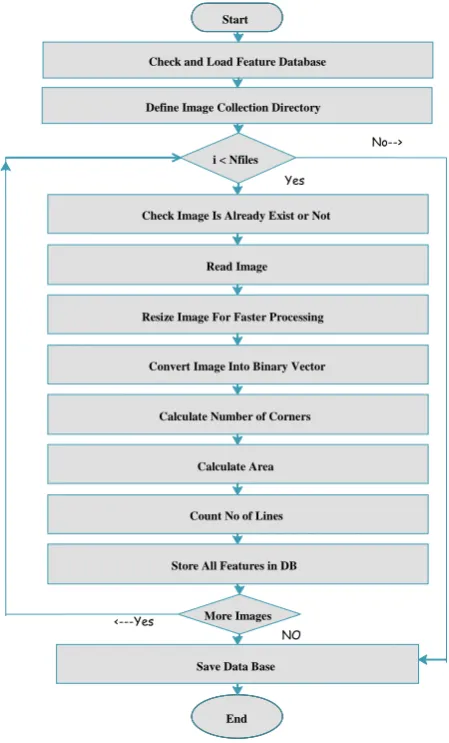
The Proposed system for image retrieval demonstrated in figure. the scheme has start to work with preparation of data base . Figure 3.1 demonstrate the step involve in the preparation of data base with help of flow diagram
Figure 3.1 Data base Preparation.
(1) Data Base Preparation:
With start of the execution of the program first it checks and load the feature data base define the image collection
Check and Load Feature Database
Define Image Collection Directory
i < Nfiles
Check Image Is Already Exist or Not
Read Image
Resize Image For Faster Processing
Convert Image Into Binary Vector
Calculate Number of Corners
Calculate Area
Count No of Lines
Store All Features in DB
More Images
Save Data Base
End Start
<---Yes
NO Yes
Volume: 03, Issue: 02
(MARCH
–
APRIL, 2017)
53 directory. if value of “i” is less than the Nfiles check whether image already exist in data base or not if yes read image and resize for faster processing than convert it in binary vector calculate number of corners calculate area count number of lines and store all feature in data base if more image repeat the whole process again if “i” is not less than Nfiles directly save inage in data base .
Figure 3.2 Data base Preparation.
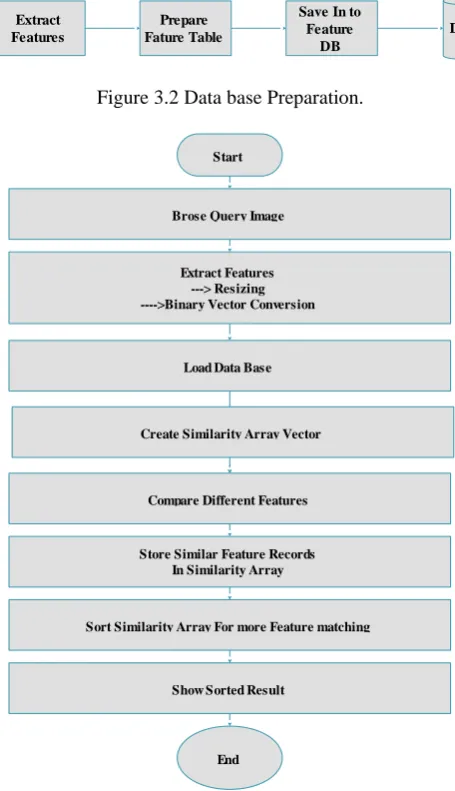
Figure 3.3 Flow chart of Retrieval of Image.
Figure 3.2 Demonstrate the block diagram of database preparation first extract image which is to be retrieve prepare feature table for it save it in to feature data base
(2) Image Retrieval
The flow chart of the image retrieval system is demonstrated in figure 3.3 described below
(a) Brose Query image: Browse the image which is asked to retrieve.
(b) Extract Feature: extract feature from the data base and resize it and convert it in binary vector.
(c) Load the Data base.
(d) Create Similarity array vector.
(e) Compare deferent features like dose it already exist or not.
(f) Store similar feature records in similarity array.
(g) Sort similarity array for more feature matching.
(f) Show result stored in data base.
Block Diagram of retrieval of image is shown below
Figure 3.4 Retrieval of Image.
Preprocess input image compare its features to data base prepare similarity table for image short image for max. Similarity display sorted result.
IV. SIMULATION RESULTS
The simulation of the proposed algorithm is performed on the MATLAB tool. The MATLAB provides the image processing toolbox to make image processing easier and also gives freedom to develop new algorithms to facilitates the modern era of research. The simulation is performed on the Wang image database having 1000 images and having 100 images of each set. Among those this work experimented for 5 test images 382.jpg, 510.jpg, 602.jpg, 788.jpg and 984.jpg.
Figure 4.1 Retrieval results for query image 382.jpg.
Extract Features
Prepare Fature Table
Save In to Feature
DB
DB
Brose Query Image
Extract Features ---> Resizing ---->Binary Vector Conversion
Load Data Base
Compare Different Features
Store Similar Feature Records In Similarity Array
Sort Similarity Array For more Feature matching
Show Sorted Result
End Start
Create Similarity Array Vector
Pre-Process Of Image
Compare Features
Prepare Similarity TAble
Sort For Max. Similarity
Data Base I/P
Image
Sorted Result s
Volume: 03, Issue: 02
(MARCH
–
APRIL, 2017)
54 Figure 4.2 Retrieval results for query image 510.jpg.
Figure 4.3 Retrieval results for query image 602.jpg.
Figure 4.4 Retrieval results for query image 788.jpg.
Figure 4.5 Retrieval results for query image 984.jpg.
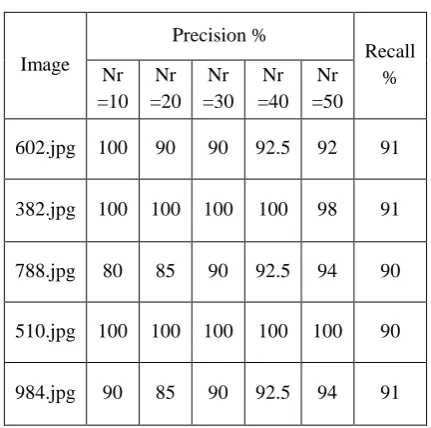
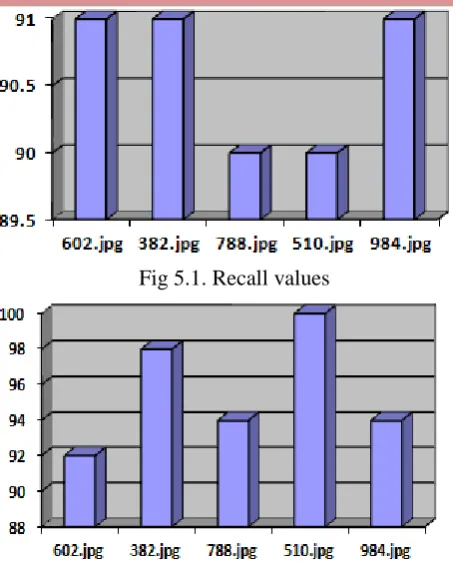
The below figure shows the retrieval results of all the test images given previous. Fig. 4.1 to 4.5 shows the retrieval results of respective test image and the precision and recall values also shown in the table 1.
The calculations of the precision and recall is shown below:
Precision = A A + B
Recall = A C
Where, A = Relevant Images Retrieved
B = Total Irrelevant Images Retrieved
C = Total No. of Relevant Images
Table 1 shows the percentage precision and recall values for respective test images.
Table 1: Precision And Recall
Image
Precision %
Recall % Nr
=10 Nr =20
Nr =30
Nr =40
Nr =50
602.jpg 100 90 90 92.5 92 91
382.jpg 100 100 100 100 98 91
788.jpg 80 85 90 92.5 94 90
510.jpg 100 100 100 100 100 90
Volume: 03, Issue: 02
(MARCH
–
APRIL, 2017)
55
Fig 5.1. Recall values
Fig. 5.2 Precision values ( No. of retrieved
images=50)
V. CONCLUSION AND FUTURE SCOPE
Image retrieval is growing and in demand technique
used in wide area of application like search engines,
social networking sites, surveillance systems etc. The
need of image searching is either colour based or
shapes. In the proposed methodology of this work we
have adopted method for integrated feature extraction
in binary domain and precision recall table also shows
the robustness and reliability of the searching
algorithm. The proposed algorithm has better
searching speed also which is approximately 0.068
seconds to get results. In the future searching
algorithms hybrid form of multiple techniques like
color and texture and shape features will be the added
functionality which will definitely improve the
accuracy of the algorithm and save searching and
retrieval time also.
REFERENCES
[1] N. Mariam and Rejiram R, "A modified approach in CBIR based on combined edge detection, color and discrete Wavelet Transform," 2015 International Conference on Advances in Computing, Communications and Informatics (ICACCI), Kochi, 2015, pp. 2201-2205.
[2] G. Rafiee, S. S. Dlay and W. L. Woo, "A review of content-based image retrieval," 2010 7th International Symposium on Communication Systems, Networks & Digital Signal Processing (CSNDSP 2010), Newcastle upon Tyne, 2010, pp. 775-779.
[3] B. L. Deekshatulu, "Learning Semantics in Content Based Image Retrieval (CBIR) - A Brief Review," 2010 Second Vaagdevi International Conference on Information Technology for Real World Problems, Warangal, 2010, pp. 76-78.
[4] A. Mumtaz, S. A. M. Gilani and T. Jameel, "A Novel Texture Image Retrieval System Based On Dual Tree Complex Wavelet Transform and Support Vector Machines," 2006 International Conference on Emerging Technologies, Peshawar, 2006, pp. 108-114.
[5] B. Xue and L. Wanjun, "Research of Image Retrieval Based on Color," 2009 International Forum on Computer Science-Technology and Applications, Chongqing, 2009, pp. 283-286.
[6] Wu Siqing; Xiong Gang; Wang Geng; Zhang Guoping,
”Digital-image retrieval based on shape-feature and MPEG-7
standard,” International Conference on Consumer Electronics,
Communications and Networks (CECNet), 2011 , vol., no., pp.3095,3097, 16-18 April 2011.
[7] Castellano, G.; Castiello, C.; Fanelli, A.M., ”Content-based
image retrieval by shape matching,” Annual meeting of the North
American Fuzzy Information Processing Society, (NAFIPS) 2006.,vol.,no., pp.114,119, 3- 6 June 2006
[8] Hongyan Sun; Shuxue Tian, ”Image retrieval based on blocked
histogram and Sobel edge detection algorithm,” International Conference onComputer Science and Service System (CSSS), 2011, vol., no., pp.3277,3281, 27-29 June 2011 .
[9] Ramamurthy, K. R. Chandran, ”Content Based Image Retrieval
for Medical Images Using canny Edge Detection Algorithm”, International Journal of Computer Applications (0975-8887), Vol. 17, No. 6, Marcb 2012
[10] Lamard, M.; Cazuguel, G.; Quellec, G.; Bekri, L.; Roux, C.;
Cochener, B., ”Content Based Image Retrieval based on Wavelet
Transform coefficients distribution,” Engineering in Medicine and Biology Society, 2007. EMBS 2007. 29th Annual International Conference of the IEEE , vol., no., pp.4532,4535, 22-26 Aug. 2007
[11] Agarwal, S.; Verma, A.K.; Singh, P., ”Content Based Image
Retrieval using Discrete Wavelet Transform and Edge Histogram
Descriptor,” International Conference on Information Systems and
Computer Networks (ISCON), 2013 , vol., no., pp.19,23, 9-10 March 2013
[12] Agarwal, S.; Verma, A.K.; Dixit, N., ”Content Based Image
Retrieval using Color Edge Detection and Discrete Wavelet
Transform,” International Conference on Issues and Challenges in
Intelligent Computing Techniques (ICICT), 2014 , vol., no., pp.368,372, 7-8 Feb. 201
[13] Ashok Kumar, J. Estber, ”Comparative Study on CBIR based