R E S E A R C H
Open Access
MHD Carreau fluid slip flow over a porous
stretching sheet with viscous dissipation
and variable thermal conductivity
Rehan Ali Shah
1*, Tariq Abbas
2, Muhammad Idrees
2and Murad Ullah
2*Correspondence:
1Department of Basic Sciences and
Islamiat, University of Engineering and Technology Peshawar, Khyber Pakhtoon Khwa, Pakistan Full list of author information is available at the end of the article
Abstract
The aim of this article is to investigate MHD Carreau fluid slip flow with viscous dissipation and heat transfer by taking the effect of thermal radiation over a
stretching sheet embedded in a porous medium with variable thickness and variable thermal conductivity. Thermal conductivity of the fluid is assumed to vary linearly with temperature. The constitutive equations of Carreau fluid are modeled in the form of partial differential equations (PDEs). Concerning boundary conditions available, the PDEs are converted to ordinary differential equations (ODEs) by means of similarity transformation. The homotopy analysis method (HAM) is used for solution of the system of nonlinear problems. The effects of various parameters such as Weissenberg numberWe2, magnetic parameterM2, power law indexn, porosity parameterD, wall thickness parameter
α
, power index parameterm, slip parameterλ
, thermal conductivity parameterε
, radiation parameterRand Prandtl number on velocity and temperature profiles are analyzed and studied graphically.Keywords: magnetohydrodynamics (MHD); Carreau fluid flow; stretching sheet; slip flow; variable thickness; variable thermal conductivity; thermal radiation
1 Introduction
The study of heat transfer and boundary layer flow over a stretching sheet has received a great deal of attention from many researchers due to its importance in many engineering and industrial applications, such as paper production, glass-fiber production, solidifica-tion of liquid crystals, petroleum producsolidifica-tion, exotic lubricants, suspension solusolidifica-tions, wire drawing, continuous cooling and fibers spinning, manufacturing plastic films and extrac-tion of polymer sheet. Crane [] was the first person who studied the boundary layer flow past a stretching sheet. He concluded that velocity is proportional to the distance from the slit. Gupta and Gupta [] discussed the problem of the continuous moving surface with constant temperature. The constant surface velocity case with a power law temperature variation was studied by Soundalgekar et al. []. Elbashbeshy [] examined the heat trans-fer over a stretching surface with variable heat flux and uniform surface heat flux. Grubka et al. [] studied the stretching flow problem with a variable surface temperature. Hayat et al. [] obtained the series solutions for stretching sheet problem with mixed convection by using the homotopy analysis method (HAM). In the presence of a transverse magnetic field, Chaim [] studied boundary layer flow due to a plate stretching with a power law
velocity. Effect of variable thermal conductivity and heat source/sink on flow near a stag-nation point on a nonconducting stretching sheet was studied by Sharma et al. [].
Georgiou [] investigated time-dependent Poiseuille flow of Carreau fluid in the pres-ence of slip effect and concluded that the wavelength and amplitude of oscillations in radial direction decrease with an increase in the slip effect. The peristaltic flow characteristics of Carreau fluid in a uniform tube and the heat transfer characteristics of Carreau fluid were discussed by El Hakeem []. Malik et al. [] studied the pressure-dependent viscosity in Carreau fluid through a porous medium. The effect of transpiration on magnetohydrody-namic stagnation-point flow of Carreau nanofluid toward a stretching/shrinking sheet in the presence of thermophoresis and Brownian motion was numerically investigated by Su-lochana et al. []. Akbar et al. [] investigated numerically the flow of peristaltic Carreau nanofluid past an asymmetric channel and found that increasing values of magnetic pa-rameter encourage the velocity profiles. Ali and Hayat [] presented the analytic solution of mathematical modeling for the flow of incompressible Carreau fluid in an asymmet-ric channel with sinusoidal wall variations. Suneetha et al. [] investigated the effect of thermal radiation on a two-dimensional stagnation point flow of an incompressible MHD Carreau fluid towards a shrinking surface in the presence of convective boundary condi-tions. The unsteady peristaltic flow of an incompressible Carreau fluid in eccentric cylin-ders was investigated by Nadeem et al. []. The boundary layer flow and heat transfer to a Carreau model over a nonlinear stretching surface was discussed by Khan et al. []. Masood et al. [] investigated the effect of magnetic field on the stagnation point flow of a generalized Newtonian Carreau fluid.
by Gnaneswara et al. []. Groza et al. [] presented a Newton interpolating series for approximate solutions of the entire functions of multipoint boundary value problems for differential equations. Marin [] extended the concept of domain of influence, proposed by Cowin and Nunziato, in order to cover the elasticity of micro stretch materials. Ghita et al. [] formulated some problems modeling the local hardening behavior of a plastic material following a Prandtl-Reuss law. Directional linear hardening, which is similar to Bauschinger’s effect in metals, is characterized by an anisotropic factor. The magnetohy-drodynamic (MHD) flow of non-Newtonian nanofluid in a pipe was studied by Ellahi []. Ellahi et al. [] theoretically investigated the problem of the peristaltic flow of Jeffrey fluid in a non-uniform rectangular duct under the effects of Hall and ion slip. Marin et al. [] considered a right cylinder composed of a physically micropolar thermoelastic material for which one plane end is subjected to an excitation harmonic in time.
The aim of the present work is to model and analyze the steady boundary layer flow of MHD Carreau fluid slip flow with viscous dissipation and heat transfer by taking the effects of thermal radiation over a stretching sheet embedded in a porous medium with variable thickness and variable thermal conductivity. The system of nonlinear partial differential equations is transformed into a system of ordinary differential equations using appropriate similarity transformations. A model system of equations is solved analytically by means of the homotopy analysis method (HAM).
2 Mathematical formulation
2.1 Description of the problem
Consider two-dimensional steady boundary layer flow of MHD Carreau fluid slip flow over a stretching sheet embedded in a porous medium. The origin is located at the slit, through the sheet is drawn in the fluid medium. Thex-axis is taken in the direction of sheet motion, and they-axis is normal to it. The sheet is stretched with velocityUw=U(x+b)m, whereUis the reference velocity. Assume that the sheet is not flat, which is specified as
y=A(x+b)–m, where the coefficientAis chosen small for the sheet to be sufficiently thin,
andmis the velocity power index. The problem is valid form= because form= , the problem reduces to a flat sheet.
2.2 Governing equations and boundary conditions
The basic governing equations of continuity, boundary layer flow and heat transfer are
∂u
∂x +
∂v
∂y= , ()
u∂u
∂x+v
∂u
∂y=ν
∂u
∂y – μ ρku+ ν
(n– )
∂u
∂y
∂u
∂y – σJ
ρ u, ()
ρcp
u∂T
∂x +v
∂T
∂y
= ∂
∂y
κ∂T ∂y
–∂qr
∂y +μ
∂u
∂y
, ()
The radiative heat fluxqris employed according to Rosseland approximation [] such that
qr= σ∗
k∗
∂T
∂y , ()
whereσ∗= .·–W mK–is the Stefan-Boltzmann constant andk∗is the mean absorption coefficient. Following Rapits [], we assume that the temperature differences within flow are sufficiently small such thatTmay be expressed as a linear function of the temperature. ExpandingTin a Taylor series aboutT
∞and neglecting higher order terms, we have
T∼= T∞T– T∞. ()
The physical and mathematical advantage of the Rosseland formula () consists in the fact that it can be combined with Fourier’s second law of conduction to an effective conduction-radiation fluxqeffin the form
qeff= –
κ+σ ∗T
∞ k∗
∂T
∂y = –κeff
∂T
∂y, ()
whereκeff= (κ+σ
∗T
∞
k∗ ) is the effective thermal conductivity. So, the steady energy balance equation, including the net contribution of the radiation emitted from the hot wall and observed in the colder fluid, takes the form
ρcp
u∂T
∂x +v
∂T ∂y = ∂ ∂y κeff ∂T ∂y +μ ∂u ∂y . ()
To obtain the similarity solutions, it is assumed that the permeability of the porous mediumk(x) is of the formk(x) =k(x+b)–m, wherekis the permeability parameter.
The corresponding equations are subjected to the boundary conditions
u(x,y) =U(x+b)m+λ
∂u
∂y
, v(x,y) = ,
T(x,y) =Tw aty=A(x+b)
–m
,
()
u(x,y) = , T(x,y) = aty→ ∞, ()
whereλ is the slip coefficient having dimension of length. For similarity solutions, it is assumed that the slip coefficientλis of the formλ= (x+b)
–m
.
The mathematical analysis of the problem is simplified by introducing the following dimensionless coordinates:
η=y
U
m+
(x+b)m–
ν ,
ψ(x,y) =
νU
m+
(x+b)m+F(η),
(η) = T–T∞
Tw–T∞,
whereηis the similarity variable,ψis the stream function defined asu=∂ψ∂y andv= –∂ψ∂x and(η) is the dimensionless temperature.
In this study, the equation for the dimensionless thermal conductivityκis generalized for temperature dependence as follows:
κ=κ∞( +ξ ), ()
whereκ∞is the ambient thermal conductivity andξis the thermal conductivity parameter. Using these variables, the boundary layer governing equations ()-() can be written in a non-dimensional form as follows:
F+FF–DF+
(n– )(m+ )We
FF–MF– m
m+ F
= , ()
+R
Pr
( +ξ )+ξ +F+EcF= , ()
whereWe=
U (x+b)m–
ν is the Weissenberg number,D=
ν
kU(m+)is the porosity
param-eter,M=σJ
ρU is the magnetic parameter,Pr=
μcp
κ∞ is the Prandtl number,Ec=
Uw
cp(Tw–T∞) is the Eckert number andR=σk∗∗κT∞∞ is the radiation parameter.
Boundary conditions ()-() will be transformed
F(α) =α
–m
+m
+λF(α), F(α) = +λF(α), (α) = , ()
F(∞) = , (∞) = , ()
where λ= √
U√(m+)
ν is the slip velocity parameter,α=A
U(m+)
ν is the parameter
re-lated to the sheet thickness, and η=α=A U(m+)
ν indicates the plate surface. In
or-der to facilitate the computation, we introduce the function f(ζ) =f(η–α) =F(η) and θ(ζ) =θ(η–α) =(η). The similarity equations ()-() for f(ζ) and the associated boundary conditions ()-() become, respectively,
f+ff–Df+
(n– )(m+ )We
ff–Mf– m
m+ f
= , ()
+R
Pr
( +ξ θ)θ+ξ θ+fθ+Ecf= , ()
f() =α
–m
+m
+λf(), f() = +λf(), θ() = , ()
f(∞) = , θ(∞) = , ()
where the prime denotes differentiation with respect toζ. Based on the variable transfor-mation, the solution’s domain will be fixed from to∞.
The physical quantity of interest in this study is the skin friction coefficientCf and the local Nusselt numberNux, which are defined as
Cf= –
m+
Re
–
x f(), Nu= –
m+
Re
xθ(), ()
3 Solution by the homotopy analysis method
In this section we apply the HAM to obtain approximate analytical solutions of the MHD Carreau fluid slip flow with viscous dissipation and heat transfer by taking the effect of thermal radiation over a stretching sheet embedded in a porous medium with variable thickness and variable thermal conductivity. We select initial guesses and the linear oper-ator for equations () and () as
f(z) =
–e–z( –ez+m–mez–αez+mαez)
( +m)( +λ) , θ(z) =e
–z, ()
Lf =
∂f
∂z+ ∂f
∂z, Lθ= ∂θ ∂z +
∂θ
∂z, ()
the above auxiliary linear operators have the following properties:
Lf
c+cz+ce–z
= ,
Lθ
c+ce–z
= ,
()
whereci(i= -) are arbitrary constants. The zeroth order deformation problems can be obtained as
( –q)Lff(z;q) –f(z)
=qhfNff(z;q)
, ()
( –q)Lθθ(z;q) –θ(z)
=qhθNθf(z;q),θ(z;q)
, ()
Nff(z;q),θ(z;q)
=∂ f(z;q)
∂z +f(z;q)
∂f(z;q) ∂z –
m m+
∂f(z;q) ∂z
+(n– )(m+ )
We
∂f(z;q) ∂z
∂f(z;q) ∂z
–M
∂f(z;q) ∂z
–D
∂f(z;q) ∂z
, ()
Nθθ(z;q)
= ( +R) +ξθ(z;q)∂ θ(z;q)
∂z +ξ
∂θ(z;q) ∂z
+Prf(z;q)∂θ(z;q) ∂z +PrEc
∂f(z;q) ∂z
, ()
whereqis an embedding parameter,hf andhθare the non-zero auxiliary parameters and
Nf,Nθare nonlinear operators.
Forq= andq= , we have
f(z; ) =f(z), f(z; ) =f(z),
θ(z; ) =θ(z), θ(z; ) =θ(z).
()
Taylor’s series expansion of these functions yields
f(z;q) =f(z) + ∞
k=
fk(z)qk,
θ(z;q) =θ(z) + ∞
k= θk(z)qk,
()
where
fk=
k!
∂kf(z;q) ∂zk
q= ,
θk=
k!
∂kθ(z;q)
∂zk
q= .
()
Keep in mind that the above series depends onhfandhθ. On the assumption that the
non-zero auxiliary parameters are chosen so that equations () converge atq= , we have
f(z) =f(z) + ∞
k=
fk(z),
θ(z) =θ(z) + ∞
k= θk(z).
()
Differentiatingk-times the zeroth order deformation of Eqs. () and () one has thekth order deformation equations as
Lf
fk(z) –χkfk–(z)
=hfRf,k(z), ()
Lθ
θk(z) –χkθk–(z)
=hθRθ,k(z), ()
where the boundary conditions () and () take the form
fk() =fk() =fk(∞) = ,
θk() =θk(∞) = ,
()
Rf,k(z) =
∂fk–(z) ∂z +
k–
j=
fk––j(z)
∂fj(z)
∂z –
M+D∂fk–(z)
∂z
– m
m+ k–
j=
∂fk––j(z)
∂z
∂fk(z)
∂z
+(n– )(m+ )
We k– j=
∂fk––j(z)
∂z ∂f
k(z)
∂z
∂f
k–(z)
∂z +χk, ()
Rθ,k(z) = ( +R)
+ξ θk(z)
∂θk–(z) ∂z +ξ
k–
j=
∂θk––j(z)
∂z
∂θk(z)
∂z +Pr k– j=
fk––j(z)
∂θk(z)
∂z +PrEc
k–
j=
∂f
k––j(z)
∂z
∂fk(z)
∂z
χk= ⎧ ⎨ ⎩
, k> ,
, k= . ()
Finally, the general solution may be written as follows:
fk(z) =fk∗+c+cz+ce–z,
θk(z) =θk∗+c+ce–z,
()
wherefk∗andθk∗are the special solutions.
4 Error analysis
Before starting analysis of the problem, we first analyze the accuracy of the HAM on this specific problem. For this purpose Figures - are drawn and Tables and are con-structed. Error profiles off forλ= . and . are plotted in Figures and versus the order of approximations. It is observed that error is continuously reducing by increas-ing the order of approximation, and satisfactory error is achieved at the th order. The error for temperature distribution is shown in Figures and forλ= . and ., respec-tively. From here one can observe that accuracy up to –is achieved on the th order approximation. The optimal values of convergence control parameter as well as the mini-mum values of total averaged squared residual error for various order of approximations is shown in the table. Notice that the table is made to observe the error for velocity and tem-perature fields for different orders of approximations. One can notice that error in velocity componentf and in temperatureθ decreases as we increase the order of approximations.
Figure 1 Error profile off, takingλ= 0.2,
n= 0.5,We= 0.03,M= 0.05,Pr= 0.7,m= 0.001,
α= 0.2,D= 0.5,R= 0.05,Ec= 0.02 andξ= 0.01.
Figure 2 Error profile ofθ, takingλ= 0.2,
n= 0.5,We= 0.03,M= 0.05,Pr= 0.7,m= 0.001,
Figure 3 Error profile off, takingλ= 0.25,
n= 0.5,We= 0.03,M= 0.05,Pr= 0.7,m= 0.001,
α= 0.2,D= 0.5,R= 0.05,Ec= 0.02 andξ= 0.01.
Figure 4 Error profile ofθ, takingλ= 0.25,
n= 0.5,We= 0.03,M= 0.05,Pr= 0.7,m= 0.001,
α= 0.2,D= 0.5,R= 0.05,Ec= 0.02 andξ= 0.01.
Table 1 Optimal value of convergence control parameters for different orders of approximations
Order of approximation f θ εtm
2 –1.50039 –0.52479 7.16404×10⁻⁴
3 –1.14981 –0.42060 6.90592×10⁻⁴
4 –1.19560 –1.16693 5.15041×10⁻⁴
5 –1.24825 –0.30060 5.55759×10⁻⁴
6 –1.31412 –1.28875 5.01547×10⁻⁴
7 –1.35632 –1.31419 4.05433×10⁻⁴
8 –1.38483 –1.36406 2.18914×10⁻⁴
Table 2 Individual averaged squared residual errors using optimal values of auxiliary parameters
m εf
m εθm
2 3.28588×10⁻⁵ 4.15975×10⁻⁴
4 2.10586×10⁻⁵ 6.47816×10⁻⁵
6 1.97175×10⁻⁵ 3.97772×10⁻⁵
8 1.92867×10⁻⁵ 2.39297×10⁻⁵
10 1.91356×10⁻⁵ 1.47931×10⁻⁵
12 1.90796×10⁻⁵ 9.87921×10⁻⁶
14 1.90562×10⁻⁵ 7.34606×10⁻⁶
16 1.90439×10⁻⁵ 6.07003×10⁻⁶
18 1.90350×10⁻⁵ 5.42235×10⁻⁶
20 1.90271×10⁻⁵ 5.07083×10⁻⁶
5 Results and discussion
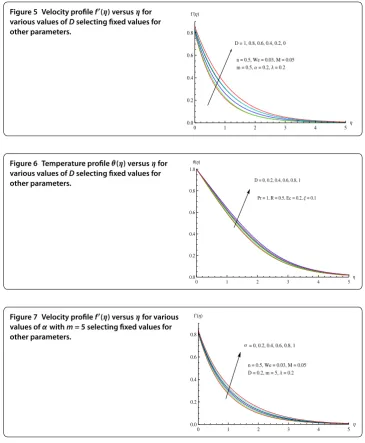
ther-Figure 5 Velocity profilef(η) versusηfor various values ofDselecting fixed values for other parameters.
Figure 6 Temperature profileθ(η) versusηfor various values ofDselecting fixed values for other parameters.
Figure 7 Velocity profilef(η) versusηfor various values ofαwithm= 5 selecting fixed values for other parameters.
mal conductivity. The system of nonlinear ordinary differential equations ()-() with boundary conditions () and () is solved analytically by HAM. The effects of Weis-senberg number, power law index, magnetic parameter, velocity power index parameter, porous parameter, wall thickness parameter, slip velocity parameter, thermal conductivity parameter, radiation parameter, Eckert number and Prandtl number on the velocity and temperature fields are analyzed with the help of graphical aids and numerical results.
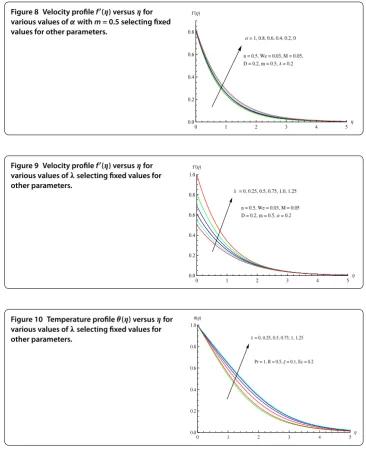
Figure 8 Velocity profilef(η) versusηfor various values ofαwithm= 0.5 selecting fixed values for other parameters.
Figure 9 Velocity profilef(η) versusηfor various values ofλselecting fixed values for other parameters.
Figure 10 Temperature profileθ(η) versusηfor various values ofλselecting fixed values for other parameters.
is true form< . It is clear from figures that the thickness of the boundary layer becomes thicker for higher values ofαwhenm> and becomes thinner for higher values ofαwhen
m< .
The effect of the slip parameterλon the velocity profile is shown in Figure . It is clear that the velocity profile decreases quickly throughout the fluid with the increase in the slip parameterλ. Boundary layer thickness decreases due to the effect of increasing the slip parameterλwhile keeping other parameters fixed. The behavior of temperature dis-tribution for the variation of the slip parameterλis shown in Figure . It is obvious that the temperature profile increases with an increase in the slip parameterλ, while the other parameters are fixed.
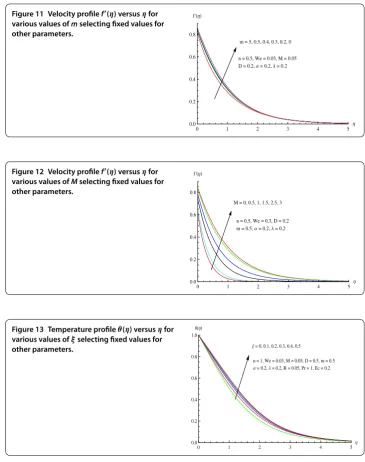
Figure 11 Velocity profilef(η) versusηfor various values ofmselecting fixed values for other parameters.
Figure 12 Velocity profilef(η) versusηfor various values ofMselecting fixed values for other parameters.
Figure 13 Temperature profileθ(η) versusηfor various values ofξselecting fixed values for other parameters.
keeping the values of all other parameters fixed. Figure depicts the velocity distribution for different values ofM. As the magnetic parameter increases, the velocity distribution gets decreased. Further the boundary layer thickness is decreased due to the influence of magnetic parameterMwhile keeping other parameters fixed.
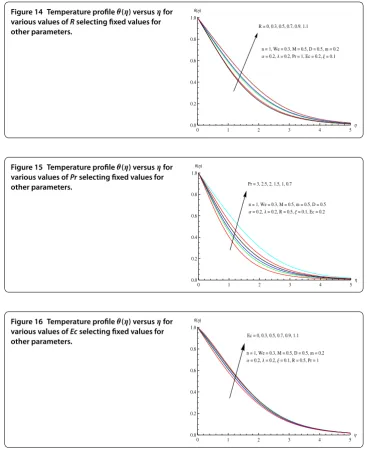
Figure 14 Temperature profileθ(η) versusηfor various values ofRselecting fixed values for other parameters.
Figure 15 Temperature profileθ(η) versusηfor various values ofPrselecting fixed values for other parameters.
Figure 16 Temperature profileθ(η) versusηfor various values ofEcselecting fixed values for other parameters.
Ecis plotted in Figure . It is that the temperature distributionθ(η) increases with the increase in the value of Eckert numberEckeeping the other parameters fixed.
In order to investigate the accuracy of (HAM), we compared the values of skin friction –f() with those given in Eid et al. [] and Fang et al. [] for the caseα= .,α= . whenWe= ,M= ,λ= ,n= . andD= , respectively, for different values of velocity power indexm.
Table 3 Values of –f(0) for different values ofmwhenn= 0.5,We= 0,λ= 0,M= 0,D= 0 and
α= 0.5
m Present value Eid et al. [28] Fang et al. [22]
9.0 1.05992 1.0590 1.0589
7.0 1.05606 1.0551 1.0550
5.0 1.04963 1.0487 1.0486
3.0 1.03685 1.0359 1.0359
2.0 1.02422 1.0234 1.0234
1.0 1.00000 1.0000 1.0000
0.5 0.97665 0.9798 0.9799
0.0 0.95050 0.9575 0.9576
–1/3 0.99301 1.0000 1.0000
–0.50 1.15585 1.1668 1.1667
Table 4 Values of –f(0) for different values ofmwhenn= 0.5,We= 0,λ= 0,M= 0,D= 0 and
α= 0.25
m Present value Eid et al. [28] Fang et al. [22]
10.0 1.14419 1.1434 1.1433
9.0 1.14126 1.1404 1.1404
7.0 1.13314 1.1324 1.1323
5.0 1.11992 1.1185 1.1186
3.0 1.09168 1.0904 1.0905
1.0 1.00000 1.0000 1.0000
0.5 0.93225 0.9339 0.9338
0.0 0.77766 0.7842 0.7843
–1/3 0.46962 0.5000 0.5000
–0.50 0.13856 0.0834 0.0833
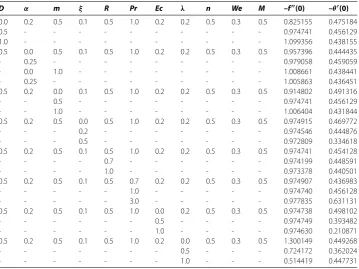
Table 5 Values of –f(0) and –θ(0) for various values ofm,D,α,λ,ξ,R,Ec,Pr
D α m ξ R Pr Ec λ n We M –f(0) –θ(0)
0.0 0.2 0.5 0.1 0.5 1.0 0.2 0.2 0.5 0.3 0.5 0.825155 0.475184
0.5 - - - 0.974741 0.456129
1.0 - - - 1.099356 0.438155
0.5 0.0 0.5 0.1 0.5 1.0 0.2 0.2 0.5 0.3 0.5 0.957396 0.444435
- 0.25 - - - 0.979058 0.459059
- 0.0 1.0 - - - 1.008661 0.438441
- 0.25 - - - 1.005863 0.436451
0.5 0.2 0.0 0.1 0.5 1.0 0.2 0.2 0.5 0.3 0.5 0.914802 0.491316
- - 0.5 - - - 0.974741 0.456129
- - 1.0 - - - 1.006404 0.431844
0.5 0.2 0.5 0.0 0.5 1.0 0.2 0.2 0.5 0.3 0.5 0.974915 0.469772
- - - 0.2 - - - 0.974546 0.444876
- - - 0.5 - - - 0.972809 0.334618
0.5 0.2 0.5 0.1 0.5 1.0 0.2 0.2 0.5 0.3 0.5 0.974741 0.454128
- - - - 0.7 - - - 0.974199 0.448591
- - - - 1.0 - - - 0.973378 0.440501
0.5 0.2 0.5 0.1 0.5 0.7 0.2 0.2 0.5 0.3 0.5 0.974907 0.436983
- - - 1.0 - - - 0.974740 0.456128
- - - 3.0 - - - 0.977835 0.631131
0.5 0.2 0.5 0.1 0.5 1.0 0.0 0.2 0.5 0.3 0.5 0.974738 0.498102
- - - 0.5 - - - - 0.974749 0.393482
- - - 1.0 - - - - 0.974630 0.210871
0.5 0.2 0.5 0.1 0.5 1.0 0.2 0.0 0.5 0.3 0.5 1.300149 0.449268
- - - 0.5 - - - 0.724172 0.362024
- - - 1.0 - - - 0.514419 0.447731
power index parameter. Skin friction coefficient increases with an increase in the wall thickness parameter form= . and . The local Nusselt number increases with an in-crease in the Prandtl number. Moreover, it is clear that the local Nusselt number dein-creases with an increase in the Eckert number, the thermal conductivity parameter and the radi-ation parameter. The effect of slip parameter is to decrease the skin friction coefficient.
6 Conclusion
In this article, similarity solution of the steady boundary layer flow of MHD Carreau fluid slip flow with viscous dissipation and heat transfer is analyzed by taking the effects of ther-mal radiation over a stretching sheet embedded in a porous medium with variable thick-ness and variable thermal conductivity. The characteristics of velocity and temperature profiles are studied graphically. The main conclusion can be summarized as follows:
• The increase in porosity parameterD, wall thickness parameterα, slip parameterλ
and magnetic parameterMleads to the decrease in velocity; on the other hand, velocity increases with an increase in velocity power index parameter.
• The increase in porous parameterDand Prandtl numberPrleads to the decrease in
heat transfer.
• The increase in slip parameterλ, velocity power index parameterm, magnetic parameterM, thermal conductivity parameterεradiation parameterRand Eckert
numberEcleads to the increase in heat transfer.
• The increase in porosity parameterD, wall thickness parameterαand velocity power index parametermleads to the increase in skin friction, while the skin friction coefficient decreases with an increase in slip parameter.
• The increase in Prandtl numberPrleads to the increase in local Nusselt number. The increase in porosity parameterD, velocity power indexm, radiation parameterR, thermal conductivity parameterεand Eckert numberEcleads to the decrease in local Nusselt number.
Acknowledgements
The authors would like to thank the reviewers for their constructive comments and valuable suggestions to improve the quality of the paper. This paper is self supported by authors in respect of funding and technically supported by Islamia Collogue University, KP, Peshawar, Pakistan.
Nomenclature
P: pressure (N·m–2);μ: viscosity (m2·s–1);ν: kinematic viscosity (m2·s–1);ρ: fluid density (kg·m–3);: the time
constant;u,v:xandycomponents of velocity (m·s–1);U
w: stretching surface velocity (m·s–1);x,y: spatial Cartesian coordinates (m);n: power law index;σ: electrical conductivity (m–2·s);c
p: specific heat (J/Kelvin);κ: thermal diffusivity (W·m–1·K–1);Pr: Prandtl number (ν/k);J: magnetic field (k·g1/2·m–1/2·s–1);S: suction parameter;T: fluid temperature (Kelvin);TW: wall temperature (Kelvin);Nux: local Nusselt number;η: similarity variable;qr: radiative heat flux (W/m2);K: permeability of the porous medium;σ∗: Stefan-Boltzmann constant (W·m–2·K–4);k∗: mean absorption coefficient;k0:
permeability parameter;λ1: slip coefficient;U0: reference velocity (m·s–1);λ: slip velocity parameter;ξ: thermal
conductivity parameter;: dimensionless temperature;We2: Weissenberg number;D: porosity parameter;Ec: Eckert number;R: radiation parameter;α: wall thickness parameter;T∞: fluid ambient temperature (Kelvin);Cf: skin friction coefficient;Re(x): local Reynolds number;ψ: stream function.
Competing interests
The authors declare that they have no conflict of interests.
Authors’ contributions
All authors participated in the analysis of the results and manuscript coordination. All authors read and approved the final manuscript.
Author details
1Department of Basic Sciences and Islamiat, University of Engineering and Technology Peshawar, Khyber Pakhtoon Khwa,
Publisher’s Note
Springer Nature remains neutral with regard to jurisdictional claims in published maps and institutional affiliations.
Received: 4 January 2017 Accepted: 26 May 2017
References
1. Crane, LJ: Flow past a stretching Plate. Z. Angew. Math. Phys.21, 645-647 (1970)
2. Gupta, PS, Gupta, AS: Heat and mass transfer on a stretching sheet with suction or blowing. Can. J. Chem. Eng.55, 744-746 (1979)
3. Soundalgekar, VM, Ramana, TV: Heat past a continuous moving plate with variable temperature. Warme-und Stoffubertragung14, 91-93 (1980)
4. Elbashbeshy, EMA: Heat transfer over a stretching surface with variable surface heat flux. J. Phys. D, Appl. Phys.31, 1951-1954 (1998)
5. Grubka, LJ, Bobba, KM: Heat transfer characteristics of a continuous stretching surface with variable temperature. J. Heat Transf.107, 248-250 (1985)
6. Hayat, T, Abbas, Z, Javed, T: Mixed convection flow of a micropolar fluid over a non-linearly stretching sheet. Phys. Lett. A372, 637-647 (2008)
7. Chaim, TC: Hydromegnetic flow over a surface stretching with a power-law velocity. Int. J. Eng. Sci.33, 429-435 (1995) 8. Sharma, PR, Singh, G: Effects of variable thermal conductivity and heat source/sink on MHD flow near a stagnation
point on a linearly stretching sheet. J. Appl. Fluid Mech.2, 13-21 (2009)
9. Georgiou, GC: The time-dependent, compressible Poiseuille and extrudate-swell flows of a Carreau fluid with slip at the wall. J. Non-Newton. Fluid Mech.109, 93-114 (2003)
10. El Hakeem, A, El Naby, A, El Misery, AEM: Separation in the flow through peristaltic motion of a Carreau fluid in uniform tube. Physica A343, 1-14 (2004)
11. Malik, MY, Zehra, I, Nadeem, S: Flows of carreau fluid with pressure dependent viscosity in a variable porous medium: application of polymer melt. Alex. Eng. J.53, 427-435 (2014)
12. Sulochana, C, Ashwinkumar, GP, Sandeep, N: Transpiration effect on stagnation-point flow of a Carreau nanofluid in the presence of thermophoresis and Brownian motion. Alex. Eng. J.55, 1-7 (2016)
13. Akbar, NS, Nadeem, S, Khan, ZH: Numerical simulation of peristaltic flow of a Carreau nanofluid in an asymmetric channel. Alex. Eng. J.53, 191-197 (2014)
14. Ali, N, Hayat, T: Peristaltic motion of a Carreau fluid in an asymmetric channel. Appl. Math. Comput.193, 535-552 (2007)
15. Suneetha, S, Gangadhar, K: Thermal radiation effect on MHD stagnation point flow of a Carreau fluid with convective boundary conditions. Appl. Math. Comput.3, 121-127 (2014)
16. Nadeem, S, Riaz, A, Akbar, NS, Elahi, R: Series solution of unsteady peristaltic flow of a Carreau fluid in eccentric cylinders. Ain Shams Eng. J.5, 293-304 (2013)
17. Khan, M, Hashim: Boundary layer flow and heat transfer to Carreau fluid over a nonlinear stretching sheet. AIP Advances5, 107203 (2015). doi:10.1063/1.4932627
18. Khan, M, Hashim, Alshomrani, AS: MHD stagnation-point flow of a Carreau fluid and heat transfer in the presence of convective boundary conditions. PLoS ONE11, e0157180 (2016)
19. Cheng, P, Minkowyez, WJ: Free convection about a vertical flat plate embedded in a porous medium with application to heat transfer from a dike. J. Geophys. Res.82, 2040-2044 (1977)
20. Elbashbeshy, EMA, Bazid, MAA: Heat transfer in a porous medium over a stretching surface with internal heat generation and suction or blowing. Appl. Math. Comput.158, 799-804 (2004)
21. Hayat, T, Abbas, Z, Pop, I, Asghar, S: Effects of radiation and magnetic field on the mixed convection stagnation point flow over a vertical stretching sheet in a porous medium. Int. J. Heat Mass Transf.53, 466-474 (2010)
22. Fang, T, Zhang, J, Zonng, Y: Boundary layer flow over a stretching sheet with variable thickness. Appl. Math. Comput.
218, 7241-7252 (2012)
23. Subhashini, SV, Sumathi, R, Popb, I: Dual solutions in a thermal diffusive flow over a stretching sheet with variable thickness. Int. Commun. Heat Mass Transf.48, 61-66 (2013)
24. Khader, MM, Megahed, AM: Numerical simulation using the finite difference method for the flow and heat transfer in a thin liquid film over an unsteady stretching sheet in a saturated porous medium in the presence of thermal radiation. J. King Saud Univ., Eng. Sci.25, 29-34 (2013)
25. Mostafa, AAM, Megahed, AM: MHD flow and heat transfer in a non-Newtonian liquid film over an unsteady stretching sheet with variable fluid properties. Can. J. Phys.87, 1065-1071 (2009)
26. Anjali Devi, SP, Prakash, M: Steady nonlinear hydromagnetic flow over a stretching sheet with variable thickness and variable surface temperature. J. Korean Soc. Ind. Appl. Math.18, 245-256 (2014)
27. Khader, MM, Megahed, AM: Numerical solution for boundary layer flow due to a nonlinearly stretching sheet with variable thickness and slip velocity. Eur. Phys. J. Plus 100-128 (2013)
28. Eid, A, Khader, MM: Numerical studies using finite different method for viscous dissipation and thermal radiation effects on the slip flow and heat transfer due to a stretching sheet embedded in a porous medium with variable thickness and variable thermal conductivity. NTMSCI4, 38-50 (2016)
29. Gnaneswara, RM, Sandeep, N: Heat and mass transfer in radiative MHD Carreau fluid with cross diffusion. Ain Shams Eng. J. 1-16 (2016)
30. Groza, G, Khan, SM, Pop, N: Approximate solutions of boundary value problems for ODEs using Newton interpolating series. Carpath. J. Math.25(1), 73-81 (2009)
31. Marin, M: A domain of influence theorem for microstretch elastic materials. Nonlinear Anal., Real World Appl.11(5), 3446-3452 (2010)
32. Ghita, C, Pop, N, Cioban, H: Quasi-static behavior as a limit process of a dynamical one for an anisotropic hardening material. Comput. Mater. Sci.52(1), 217-225 (2012)
34. Ellahi, R, Bhatti, MM, Pop, I: Effect of Hall and Ion Slip on MHD Peristaltic of Jeffrey fluid in a nonuniform rectangular duct. Inter. J. for Num. Met. Heat and Fluid Flow26(2016)
35. Marin, M, Lupu, M: On harmonic vibrations in thermoelasticity of micropolar bodies. J. Vib. Control4, 507-518 (1998) 36. Rapits, A: Flow of a micropolar fluid past a continuously moving plate by the presence of radiation. Int. J. Heat Mass
Transf.41, 2865-2866 (1998)