Arch. Anim. Breed., 62, 565–570, 2019 https://doi.org/10.5194/aab-62-565-2019 © Author(s) 2019. This work is distributed under the Creative Commons Attribution 4.0 License.
Open Access Archives Animal Breeding
iginal
study
Identification of mutations in
BMP15
and
GDF9
genes
associated with prolificacy of Markhoz goats
Hourad Ghoreishi1, Sadegh Fathi-Yosefabad2, Jalal Shayegh2, and Abolfazl Barzegari3 1Department of Animal Sciences, Tabriz Branch, Islamic Azad University, Tabriz, Iran 2Department of Veterinary Medicine, Shabestar Branch, Islamic Azad University, Shabestar, Iran
3School of Advanced Medical Sciences, Research Center for Pharmaceutical Nanotechnology,
Tabriz University of Medical Sciences, Tabriz, Iran
Correspondence:Jalal Shayegh ([email protected])
Received: 9 September 2018 – Revised: 5 August 2019 – Accepted: 21 August 2019 – Published: 14 October 2019
Abstract. The Markhoz is a local goat breed in the Kurdistan region of Iran. The mohair obtained from these animals plays an important cultural role and is used for making local clothes in the Kurdistan region. This breed is a low-fecundity local goat, and searching for genes associated with fertility of these goats is important for their breeding. Moreover, this research is complementary to prior studies of candidate genes associated with fertility. The growth differentiation factor 9 (GDF9) and bone morphogenetic protein 15 (BMP15) are attractive candidates expressed by the oocyte and are associated with increased ovulation rate in sheep. However, there are no reports on single nucleotide polymorphisms associated with fertility of Markhoz goats. Hence, we studied these candidate genes and found two novel mutations (g.233C>A and g.755T>G) in GDF9 exon I and in
BMP15exon II, respectively. Furthermore, we investigated their association with prolificacy. These nucleotide changes are detectable with the PCR-RFLP method and can be used in the screening for highly fecund goats. Both of the mutations significantly increased litter size in heterozygote form forBMP15and homozygote form forGDF9in this goat breed. Homozygote females for theBMP15mutation were not identified in the Markhoz breed, which is similar to the situation found in Belclare sheep, small-tailed Han sheep, and Jining Grey goats.
1 Introduction
Markhoz (Iranian Angora) goats are raised in the Kurdis-tan region of Iran, and the mohair obtained from these goats has an essential cultural value and is used for making local clothes in Kurdistan, Iran. These small ruminants are effort-less and withstand harsh conditions (Farshad et al., 2008). The Markhoz goats live in various arid and semi-arid areas, where they are handled as beneficial animals for the produc-tion of milk, meat, hair, and hide. It is a low-fecundity local goat breed. Therefore, it is advantageous to find any genes that can be used in breeding and thus increasing the fecun-dity.
On the other hand, GDF9 andBMP15 genes have been proved to be effective in increasing the number of twin births in the sheep (Abdoli et al., 2013; Barzegari et al., 2010; Lian-dris et al., 2012; Eghbalsaied et al., 2012); hence, the muta-tions associated with fecundity in goats should be confirmed
(Ahlawat et al., 2013; Pramod et al., 2013). The influence of these genes on fertility in mammals and even in humans may appear progressively. Various candidate genes such as
KiSS-1,TSHB,POU1F1,GPR54, and BMPR-IBhave been reported for litter size in goats (Cao et al., 2010, 2011; Chu et al., 2007a; Feng et al., 2012; Huang et al., 2015). How-ever, evidence shows the high influence ofBMP15andGDF9
genes on the fecundity (Chu et al., 2010; Feng et al., 2012).
in specifying ovulation rate and litter size (Galloway et al., 2000; Hanrahan et al., 2004).
Several mutations in these growth factors likely contribute to the high prolificacy such as high ovulation rate or litter size and hence are necessary for ewe reproductivity (Hanrahan et al., 2004). These changes are required for follicular growth, and in addition both of these oocyte-derived growth factors influence ovulation rate in sheep (Hanrahan et al., 2004). Juengel et al. (2004) hypothesized that, in the regulation of ovulation rate in sheep, either BMP15 andGDF9 homod-imers have essential but similar roles, that BMP15/GDF9
heterodimers have crucial roles, or both. This suggests that bothGDF9andBMP15may play critical roles in not only regulating ovulation rate but in oocyte health together with the establishment of pregnancy (Hanrahan et al., 2004). The equal outcomes are observed in ewes, heterozygous for the Inverdale gene, in which ovulation rate increases lead to a predictable increase in litter size (Yan et al., 2001). The phys-iological relevance of the synergistic effects ofBMP15and
GDF9mutations is emphasized by the observation that ewes, the compound heterozygotes for bothBMP15andGDF9 mu-tations, have significantly higher ovulation rates than het-erozygous carriers of a mutation in only one of them.
In this study, SNP of BMP15 and GDF9 genes, which plays a very important role in the regulation of folliculogen-esis as well as the control of ovulation rate, was detected in a low-fecundity Markhoz (Iranian Angora) goat breed. The as-sociation between these genes and prolificacy in these goats were also analyzed.
2 Materials and methods
2.1 Experimental animals and DNA extraction
Approximately 10 mL of blood was drawn aseptically from the jugular vein of 70 Markhoz does, using EDTA as an anticoagulant. Genomic DNA was extracted from whole blood by the phenol-chloroform method, then dissolved in TE buffer (10 mmol=L Tris HCl and 1 mmol=L EDTA, pH 8.0), and kept at−20◦C.
For the 70 Markhoz does, kidded in 2010–2012, there are data on litter size at the first, second, third, or fourth parity, and the does were chosen randomly from Sanandaj Markhoz Goat Breeding Station, Kurdistan region of Iran. No selection on litter size or other fertility traits was made in the flock over previous years. The average age and litter size of the does were 38.7 months and 1.25, respectively. These animals were under the full supervision of the Kurdistan Agricultural Jihad Organization and under the standard conditions of manage-ment, health, and nutrition.
2.2 Amplification ofBMP15andGDF9genes and sequencing
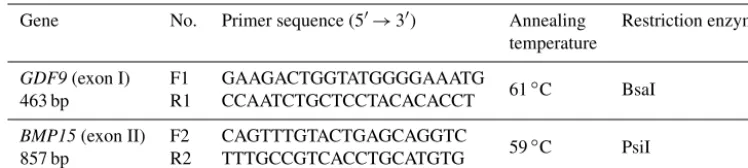
The primers were designed using Oligo-7 software for exon I of the GDF9 and exon II of the BMP15 genes from goat genomicBMP15andGDF9sequences that were recorded in NCBI GenBank (BMP15, EU743938.1;GDF9, EU883989.1). PCR amplification was performed using a 25 µL reaction mixture, containing 1 U Taq DNA polymerase (CinnaGen Co. nos. 2 and 7, Iran), 0.2 µM of each primer, and 40 ng of caprine genomic DNA. The cycling program was set as follows: initial denaturation at 94◦C for 4 min, followed by 35 cycles of denaturation at 94◦C for 50 s; an-nealing at 61◦C forGDF9 and 59◦C forBMP15for 40 s; extension at 72◦C for 25 s, and a final extension at 72◦C for 10 min. The sequences of primers, restriction enzymes, and PCR reaction conditions are described in Table 1. In order to distinguish any possible mutations in exons of these two genes, the PCR products from the samples of prolific and non-prolific females were randomly sequenced. Then, PCR-RFLP was used to confirm the mutations that appeared in gene sequencing.
2.3 PCR-RFLP analysis
The exon I of theGDF9and exon II of the BMP15genes, from some sequenced samples, had mutations in nucleotide no. 233 with C>A type and in nucleotide no. 755 with T>G type and contained XmiI (AccI) and BpuJI restriction sites, respectively. The PCR products were digested with 0.5 µL of Eco31I (BsaI) enzyme forGDF9exon I and AanI (PsiI) en-zyme forBMP15exon II (Fermentase Co.) overnight at 37◦C and the resulting products were separated by 2 % agarose gel electrophoresis. Although both mutations were silent, statis-tical analysis was performed to find out whether or not they affect prolificacy in this breed.
2.4 Statistical analyses
Analysis of variance of litter size data undergoing the least square procedures was conducted forGDF9, BMP15, and their combined genotypes. Therefore, the following model was fitted to compare differences in litter size among differ-ent genotypes:
y=µ+KS+P+G1+G2+G1G2+s+e, (1)
wherey is the litter size phenotypic value;µ is the popu-lation mean; KS is the fixed kidding season effect;P is the fixed parity effect; G1 is the fixed effect for GDF9
geno-types;G2 is the fixed effect forBMP15 genotypes;G1G2
Table 1.Primers and PCR conditions of the genes and restriction enzymes.
Gene No. Primer sequence (50→30) Annealing Restriction enzyme temperature
GDF9(exon I) F1 GAAGACTGGTATGGGGAAATG
61◦C BsaI
463 bp R1 CCAATCTGCTCCTACACACCT
BMP15(exon II) F2 CAGTTTGTACTGAGCAGGTC
59◦C PsiI
857 bp R2 TTTGCCGTCACCTGCATGTG
Table 2.The novel single nucleotide polymorphism inBMP15and GDF9within the Markhoz.
Gene Base Coding Coding Amino acid change change base residue
(bp) (aa)
BMP15 T-G 1083 361 Unchanged Pro (P) GDF9 C-A 183 61 Unchanged Leu (L)
(GLM) procedure of SAS (Ver. 8.1) (SAS Institute Inc., Cary, NC, USA). Mean separation procedures were performed us-ing the least significant difference test.
3 Results
3.1 Sequence results and novel SNP detection
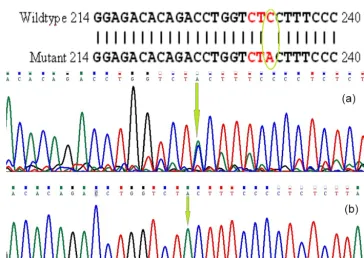
The PCR products were electrophoresed in 1 % agarose gel for BMP15 andGDF9 genes. The products were then se-quenced by Macrogen Inc. (South Korea). Afterward, us-ing BLAST software (http://blast.ncbi.nlm.nih.gov/Blast.cgi, last access: 15 January 2010), the determined sequences were aligned with theCapra hircusnucleotide database in NCBI GenBank. They were submitted with accession numbers of GU732196.1 and GU784823.2 for BMP15 andGDF9, re-spectively. The loci of the mutations are shown in Figs. 1 and 2.
3.2 Determination of PCR-RFLP and statistical analyses
PCR-RFLP products are displayed in Fig. 3. Three geno-types of GG (234 bp/229 bp), Gg (234 bp/229 bp/463 bp), and gg (463 bp/463 bp) were detected for GDF9 gene, while only two genotypes, BB (757 bp/100 bp) and Bb (857 bp/757 bp/100 bp), were identified for BMP15 gene (Fig. 3). These mutations result in no change in the amino acid codes that are Leucine and Proline for GDF9 and
BMP15, respectively (Table 2). Allelic and genotypic fre-quencies of the mutations of GDF9 andBMP15genes are presented in Table 3.
For the GDF9 gene, frequencies of genotypes GG, Gg, and gg were 0.28, 0.52, and 0.2, respectively. While for the
Table 3.Allele and genotype frequencies of theGDF9gene and BMP15gene.
No. of does Allele frequency Genotype frequency
70 G g GG Gg gg
0.54 0.46 0.280 0.520 0.200
B b BB Bb bb
0.847 0.153 0.693 0.307 0.0
Table 4.Combined genotypic frequencies ofGDF9and BMP15 genes.
No. of does Genotype frequency
70 GGBB GGBb GgBB GgBb ggBB ggBb
0.227 0.053 0.373 0.147 0.093 0.107
BMP15gene, frequencies of genotypes BB, Bb, and bb were 0.69, 0.31, and 0.00, respectively. Combined genotypic fre-quencies of GDF9 andBMP15mutations are presented in Table 4. The highest and the lowest frequencies for combined genotypes were 0.37 and 0.05 for GgBB and GGBb, respec-tively.
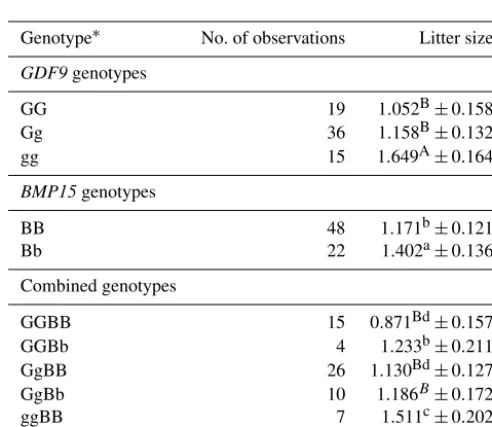
Litter size in Markhoz goats was significantly influenced byGDF9(P =0.029) andBMP15(P =0.0307) genotypes. No significant interaction was detected among GDF9 and
BMP15 genotypes. Moreover, the least square means and standard error for litter size of differentGDF9andBMP15
and their combined genotypes in Markhoz goats are given in Table 5. Does with the heterozygote mutant Bb genotype had 0.231 (P <0.05) more kids than those with the wild type BB genotype. The Markhoz does with homozygote mutant gg genotype had 0.597 (P <0.01) and 0.491 (P <0.01) more kids than those with wild type GG and heterozygote mu-tant Gg genotypes, respectively. Does with mutations in both
GDF9and BMP15genes had greater litter size than those with each mutation alone. Similarly, the effect of theGDF9
Figure 1.Partial sequence ofBMP15(exon II) and T to G transition in heterozygote goat.
Figure 2.Nucleotide change inGDF9(exon I):(a)heterozygote goat,(b)homozygote goat.
4 Discussion
Some mutations have been demonstrated to be involved in twin births along with fecundity increase in twoGDF9and
BMP15genes in sheep (Barzegari et al., 2010; Galloway et al., 2000; Hanrahan et al., 2004; Javanmard et al., 2011). The reported mutations in sheep remain dissociated with the fe-cundity in goats (Godara et al., 2012); however, the mutations in other positions in two genes of goats imply the prominent influence of these two genes on fecundity of mammals.
This article constitutes introductory research concerning the possible prolific mechanisms in goats. The present study
reports two new nucleotide polymorphisms in the goatGDF9
Figure 3.Genotypes ofBMP15gene, BB (757 bp/100 bp), and Bb (857 bp/757 bp/100 bp) (UC−uncut). Genotypes ofGDF9gene, GG (234 bp/229 bp), Gg (463 bp/234 bp/229 bp), and gg (463 bp).
Table 5.Least square means and SE for litter size of differentGDF9 andBMP15genotypes.
Genotype∗ No. of observations Litter size
GDF9genotypes
GG 19 1.052B±0.158
Gg 36 1.158B±0.132
gg 15 1.649A±0.164
BMP15genotypes
BB 48 1.171b±0.121
Bb 22 1.402a±0.136
Combined genotypes
GGBB 15 0.871Bd±0.157
GGBb 4 1.233b±0.211
GgBB 26 1.130Bd±0.127
GgBb 10 1.186B±0.172
ggBB 7 1.511c±0.202
ggBb 8 1.788Aa±0.180
A–BLeast square means with different letters within each of the three sets (GDF9,
BMP15, or combined genotypes) different atP <0.01.a–dLeast square means with
different letters within each of the three sets (GDF9,BMP15, or combined genotypes) different atP <0.05.∗g−GDF9mutation; b−BMP15mutation; G and B−wild type.
Does carrying one copy ofBMP15mutation had more kids than those with the wild type genotype. No homozygote mu-tant genotype was detected forBMP15gene. A potential rea-son is that the mutation is an inactivating mutation in ho-mozygote form; hence females carrying two copies of this inactivating mutation are sterile and are likely removed from the flock. There have been no substantial reports on infertility among Markhoz does until now. Seemingly, no bb genotype
females live in the Markhoz breed, similar to the situation that was obtained for Belclare sheep, small-tailed Han sheep, and Jining Grey goats (as a hypothesis) (Chu et al., 2007b; Hanrahan et al., 2004). Controlled breeding of Bb genotype bucks and does and large-scale research, studying the effect of bucks on litter size and investigating more breeds, are re-quired to confirm this hypothesis.
The Markhoz does with two copies of theGDF9mutation had more kids than those with the wild type and those car-rying mutations in one copy of the mutation. There was no significant difference between does with heterozygote muta-tion ofGDF9and does with wild type genotype. Does with mutations in bothGDF9andBMP15genes had greater litter size than those with one copy of each of the mutations. Sim-ilarly, the effect of theGDF9gene mutation was greater than that of the mutation of theBMP15gene on litter size in the combined genotypes of Markhoz does.
Ethical issues
No animal or human studies were carried out by the authors.
Data availability. The data that support the findings of this study are available from the Kurdistan Agricultural Jihad Organization, but restrictions apply to the availability of these data, which were used under license for the current study, so they are not publicly available. Data are however available from the authors upon reason-able request and with permission from the Kurdistan Agricultural Jihad Organization.
Competing interests. The authors declare that they have no con-flict of interest.
Acknowledgements. Authors would like to acknowledge Sanan-daj Markhoz Goat Breeding Station for the samples.
Review statement. This paper was edited by Steffen Maak and reviewed by two anonymous referees.
References
Abdoli, R., Zamani, P., Deljou, A., and Rezvan, H.: Asso-ciation of BMPR-1B and GDF9 genes polymorphisms and secondary protein structure changes with repro-duction traits in Mehraban ewes Gene, 524, 296–303, https://doi.org/10.1016/j.gene.2013.03.133, 2013.
Ahlawat, S., Sharma, R., and Maitra, A.: Screening of indigenous goats for prolificacy associated DNA markers of sheep, Gene, 517, 128–131, https://doi.org/10.1016/j.gene.2012.12.015, 2013. Barzegari, A., Atashpaz, S., Ghabili, K., Nemati, Z., Rustaei, M., and Azarbaijani, R.: Polymorphisms in GDF9 and BMP15 associated with fertility and ovulation rate in Moghani and Ghezel sheep in Iran, Reprod. Domest. Anim., 45, 666–669, https://doi.org/10.1111/j.1439-0531.2008.01327.x, 2010. Cao, G. L., Chu, M. X., Fang, L., Di, R., Feng, T., and Li, N.:
Analysis on the DNA sequence of KiSS-1 gene and its associ-ation with litter size in goats, Mol. Biol. Rep., 37, 3921–3929, https://doi.org/10.1007/s11033-010-0049-7, 2010.
Cao, G. L., Chu, M. X., Fang, L., Feng, T., Di, R., and Li, N.: Analysis on the DNA sequence of GPR54 gene and its associ-ation with litter size in goats, Mol. Biol. Rep., 38, 3839–3848, https://doi.org/10.1007/s11033-010-0499-y, 2011.
Chu, M. X., Jiao, C. L., He, Y. Q., Wang, J. Y., Liu, Z. H., and Chen, G. H.: Association Between PCR-SSCP of bone morpho-genetic protein 15 Gene and Prolificacy in Jining Grey Goats, Anim. Biotechnol., 18, 263–274, 2007a.
Chu, M. X., Liu, Z. H., Jiao, C. L., He, Y. Q., Fang, L., Ye, S. C., Chen, G. H., and Wang, J. Y.: Mutations in BMPR-IB and BMP-15 genes are associated with litter size in Small Tailed Han sheep (Ovis Aries), J. Anim. Sci., 85, 598–603, https://doi.org/10.2527/jas.2006-324, 2007b.
Chu, M. X., Zhao, X. H., Zhang, Y. J., Jin, M., Wang, J. Y., Di, R., Cao, G. L., Feng, T., Fang, L., Ma, Y. H., and Li, K.: Polymor-phisms of the BMPR-IB gene and their relationship with litter size in goats, 37, 4033–4039, 2010.
Eghbalsaied, S., Ghaedi, K., Shahmoradi, S., Pirestani, A., Amini, H., Saiedi, T., Nicol, L., and McNeilly, A.: Presence of SNPs in GDF9 mRNA of Iranian Afshari Sheep, Int. J. Fertil. Steril., 5, 225–230, 2012.
Farshad, A., Akhondzadeh, S., Zamiri, M. J., and Sadeghi, G. H.: The Estrous Cycle of the Markhoz Goat in Iran, Asian Austral. J. Anim., 21, 1411–1415, https://doi.org/10.5713/ajas.2008.70707, 2008.
Feng, T., Chu, M. X., Cao, G. L., Tang, Q. Q., Di, R., Fang, L., and Li, N.: Polymorphisms of caprine POU1F1 gene and their
asso-ciation with litter size in Jining Grey goats, Mol. Biol. Rep., 39, 4029–4038, https://doi.org/10.1007/s11033-011-1184-5, 2012. Galloway, S. M., McNatty, K. P., Cambridge, L. M., Laitinen,
M. P., Juengel, J. L., Jokiranta, T. S., McLaren, R. J., Luiro, K., Dodds, K. G., Montgomery, G. W., Beattie, A. E., Davis, G. H., and Ritvos, O.: Mutations in an oocyte-derived growth factor gene (BMP15) cause increased ovulation rate and infer-tility in a dosage-sensitive manner, Nat. Genet., 25, 279–283, https://doi.org/10.1038/77033, 2000.
Godara, A., Gahlot, G. C., Ashraf, M., and Ghorui, S. K.: Polymor-phism of growth hormone BMP-15 gene in Marwari goat, Indian Journal of Small Ruminants, 18, 32–36, 2012.
Hanrahan, J. P., Gregan, S. M., Mulsant, P., Mullen, M., Davis, G. H., Powell, R., and Galloway, S. M.: Mutations in the genes for oocyte-derived growth factors GDF9 and BMP15 are associated with both increased ovulation rate and sterility in Cambridge and Belclare sheep (Ovis Aries), Biol. Reprod., 70, 900–909, https://doi.org/10.1095/biolreprod.103.023093, 2004.
Huang, H. Y., Liang, Z., Li, S. F., Li, C. M., Zhao, Z. H., and Wang, Q. B.: Polymorphism identification in BMP15 and GDF9 genes and their association with egg production in chickens, Br. Poult. Sci., 56, 277–283, https://doi.org/10.1080/00071668.2015.1019829, 2015. Javanmard, A., Azadzadeh, N., and Esmailizadeh, A. K.:
Muta-tions in bone morphogenetic protein 15 and growth differen-tiation factor 9 genes are associated with increased litter size in fat-tailed sheep breeds, Vet. Res. Commun., 35, 157–167, https://doi.org/10.1007/s11259-011-9467-9, 2011.
Juengel, J. L., Hudson, N. L., Whiting, L., and McNatty, K. P.: Effects of immunization against bone morphogenetic protein 15 and growth differentiation factor 9 on ovulation rate, fer-tilization, and pregnancy in ewes, Biol. Reprod., 70, 557–561, https://doi.org/10.1095/biolreprod.103.023333, 2004.
Knight, P. G. and Glister, C.: TGF-β superfamily members and ovarian follicle development, Reproduction, 132, 191–206, 2006. Liandris, E., Kominakis, A., Andreadou, M., Kapeoldassi, K., Chadio, S., Tsiligianni, T., Gazouli, M., and Ikonomopou-los, I.: Associations between single nucleotide polymorphisms of GDF9 and BMP15 genes and litter size in two dairy sheep breeds of Greece, Small Ruminant Res., 107, 16–21, https://doi.org/10.1016/j.smallrumres.2012.04.004, 2012. Paulini, F. and Melo, E. O.: The role of oocyte-secreted
factors GDF9 and BMP15 in follicular development and oogenesis, Reprod. Domest. Anim., 46, 354–361, https://doi.org/10.1111/j.1439-0531.2010.01739.x, 2011. Pramod, R. K., Sharma, S. K., Singhi, A., Pan, S., and
Mi-tra, A.: Differential ovarian morphometry and follicular ex-pression of BMP15, GDF9 and BMPR1B influence the prolificacy in goat, Reprod. Domest. Anim., 48, 803–809, https://doi.org/10.1111/rda.12165, 2013.