Design, implementation, and evaluation of principles of writing
biomedical research paper course
ALI AKBAR NEKOOEIAN
Cardiovascular Pharmacology Research Lab, Department of Pharmacology, Medical School, Shiraz University of Medial Sciences, Shiraz, Iran
Introduction: Graduate (PhD) students in medical sciences, who will form future faculties and investigators in Iran’s Universities of Medical Sciences, are not trained on scientific writing during their training. The present study describes the design, implementation, and evaluation of Principles of Writing Biomedical Research Paper course.
Methods: The course, prepared based on an extensive search of the literature and books on writing biomedical research papers, was offered as an elective course to PhD students at Shiraz University of Medical Sciences in the second semester of 2011-2012 academic year. The structure and function of various sections of a paper and publication ethics were discussed in lecture and practical sessions over a period of 12 weeks. The course was then evaluated using a self-designed questionnaire.
Results: The majority of students gave the highest score (20) to the content and implementation of all sessions of the course. Moreover, most of them believed that the allotted time to the course was not enough, and suggested that it should be increased to 32 hours (equal to two credits). Also, almost all the participants believed that overall the materials lectured were comprehensive, the practical sessions were important in learning the lectured materials, and the course was useful in advancing their abilities and skills to write papers.
Conclusion: The evaluation of the present course showed that it was able to increase the participants’ knowledge of the structure of scientific papers, and enhanced their abilities and skills to write papers. The evaluation was used as a basis to modify the course.
Design, Evaluation, Biomedical, Principles of writing
Keywords:
Corresponding author:
Ali Akbar Nekooeian,
Address: Department of Pharmacology, Medical School, Shiraz University of Medical Sciences, Zand Street,
Phone & Fax: +98-711-2307591, Email: [email protected]
Please cite this paper as:
Nekooeian AA. Design, Implementation, and Evaluation of Principles of Writing Biomedical Research Paper Course. J. Adv Med&Prof. 2013;1(4):113-118.
Received : 25 June 2013 Accepted : 24 August 2013
Introduction
P
ublication of research findings is the final stage of a research effort, and without it research process is futile and others would not know whether or not a piece of research has been done. In fact, there is no difference between not doing the research, and doing the research and not publishing it. Publication of research findings contributes to the dissemination of research findings and expansion ofknowledge in every field. Moreover, it has been taken as a criterion for scientific advancement of countries (1). Publication of scientific paper advances the fame and prestige of the universities (2, 3). It also helps the authors to find jobs, and advance their promotion, profile, research ability as well as national and internationalrecognition (2-4).
their rate of publication (11-13), their understanding of the structure of scientific articles (12) and their abilities to choose a journal (12), and simplified the submission and publication process (11).
In Iran, graduate (PhD) students, who will are to be university faculties and investigators, are not trained how to write a paper at anytime in their training. Moreover, according to national guidelines of Iran’s Ministry of Health for Graduate Studies, PhD student must publish two papers, one in an ISI journal, before being allowed to defend their thesis. In addition, publication of scientific papers by graduate students is priceless in helping them to get a faculty position at a university after graduation.
Considering the importance of abilities and skills of writing papers for graduate students, a course entitled as Principles of Writing Biomedical Research Paper
was designed, implemented and evaluated at Shiraz University of Medical Sciences. Herein, I will describe the process of design, implementation and evaluation of that course.
Methods
DesignThe idea of design and presentation of a course on writing a scientific paper started from 2006 to mid 2010 when used to work at the Center for Development of Clinical Research, Nemazee Hospital, and Shiraz University of Medical Sciences as a consultant for writing biomedical papers. I used to help authors, who were faculties, residents and graduate students, to revise and improve their papers in various fields of biomedical sciences including Basic Sciences, Clinical Medicine, Dentistry, and Nursing etc. During that period, I realized that one of the main reasons for authors’ lack of competence was insufficient knowledge in regards to the role of each section of a paper including title, abstract, introduction, materials and methods, results, discussion, acknowledgement and references, and an standard way of writing each
section. I was thinking of ways to help authors that the design and presentation of a course of writing biomedical research papers came to my mind. Therefore, I started to look for the content of the course using various data bases including Pubmed and Springer databases, and Google search engine using key words such as scientific writing course, biomedical writing course, and medical writing course and workshop. Unfortunately, the Web was silent on possible existence of courses on writing medical papers. One of a few courses that looked particularly useful was “Biomedical Writing Course”, which was sponsored by China Medical Board (14-16). I also consulted a number of books on writing and publishing papers in biomedical sciences (3, 12, 17-26).
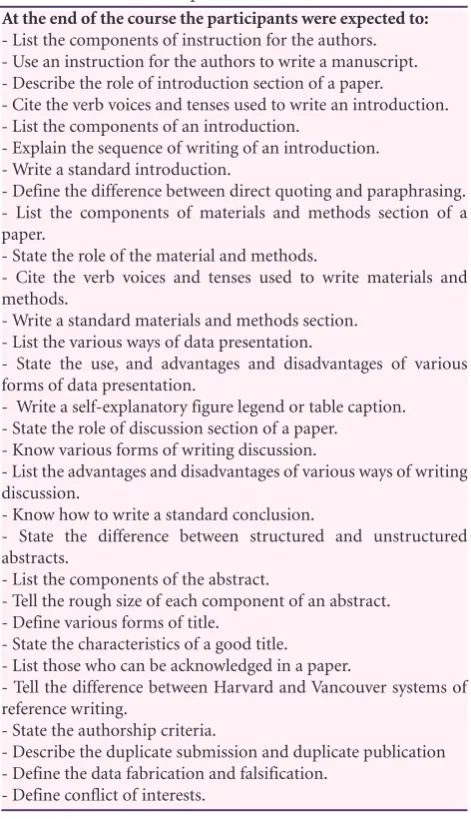
After collecting adequate information, I wrote a plan for the course comprising of a weekly schedule (Table 1), learning objectives (table 2), and methods of instruction and evaluation. I did present the course plan to Educational Council, which oversights the University’s educational activities. After approval by the Council, I was authorized to present the course in the second semester of 90-91 academic years. The course was announced through a formal letter to the departments that were running PhD programs. The letter mentioned that the course was an elective credit one, and students could register for the course based on their motivations and interests.
Implementation
A total of 27 students did register for the course. They were divided into two sections (section one; n= 15 and section two; n=12), which were scheduled for Sundays and Tuesdays, respectively for the next 12 weeks using the schedule presented in Table 1.
I used various teaching methods including heavily interactive lecturing and intensive discussions with enormous question and answers between the instructor and students, and students themselves.
Table 1. Weekly schedule of principles of writing biomedical research paper course
Session Session topics Duration of the session (h)
1 Instruction for the authors (lecture) 2
2 Introduction (lecture) 2
3 Introduction (practical) 2
4 Materials and methods (lecture) 2
5 Materials and methods (practical) 2
6 Results (lecture) 2
7 Results (practical) 2
8 Discussion and conclusion (lecture) 2
9 Discussion and conclusion (practical) 2
10 Title and abstract (lecture and practical) 2
11 Publication ethics (lecture) 2
As mentioned in Table 1, some of the sessions were lectures, which were heavily interactive. The lecture materials were prepared from a number of books on writing biomedical research papers (3, 12, 17-26) and a significant number of published scientific papers. In lectures on various sections of a paper, characteristics, role, verb tenses used, verb voiced used, size, and the way of writing each section were discussed. Moreover, the points that reviewers take into account in reviewing each section were presented. In the session on medical papers, the characteristics, use, and the way of writing each type of paper were discussed. In the lectures on publication ethics, areas liable to ethical violation including authorship, duplicate submission, duplicate publication, data falsification and fabrication, and conflict of interest were explained.
Practical sessions varied. In the case of practical session on introduction section, the students were given some pieces of data on a general subject, and were asked to write an introduction of a putative paper based on those results. For the rest of the practical session, they were asked to write each section
of a paper based on the findings of their own ongoing research, or bring a published paper from their previous investigations. Since the students were PhD candidates, they had something to present from one of these sources. In practical sessions, the students were presenting PDF or Microsoft Word files of their assignments, and the rest of them were reading and commenting on the assignments using the principles determined by the instructor in lecture sessions. The assessment of the students’ learning was based on class attendance and participation in class discussions (%50), and a summative exam at the end of the course (%50).
Evaluation
At the end of the course, it was evaluated using a self-designed questionnaire comprising 14 statements (Table 3). The face and content validity of the questionnaire was established by asking a number of colleagues to comment on the statements and their scoring methods. The students completed the questionnaire anonymously.
At the end of the course the participants were expected to: - List the components of instruction for the authors. - Use an instruction for the authors to write a manuscript. - Describe the role of introduction section of a paper. - Cite the verb voices and tenses used to write an introduction. - List the components of an introduction.
- Explain the sequence of writing of an introduction. - Write a standard introduction.
- Define the difference between direct quoting and paraphrasing. - List the components of materials and methods section of a paper.
- State the role of the material and methods.
- Cite the verb voices and tenses used to write materials and methods.
- Write a standard materials and methods section. - List the various ways of data presentation.
- State the use, and advantages and disadvantages of various forms of data presentation.
- Write a self-explanatory figure legend or table caption. - State the role of discussion section of a paper.
- Know various forms of writing discussion.
- List the advantages and disadvantages of various ways of writing discussion.
- Know how to write a standard conclusion.
- State the difference between structured and unstructured abstracts.
- List the components of the abstract.
- Tell the rough size of each component of an abstract. - Define various forms of title.
- State the characteristics of a good title. - List those who can be acknowledged in a paper.
- Tell the difference between Harvard and Vancouver systems of reference writing.
- State the authorship criteria.
- Describe the duplicate submission and duplicate publication - Define the data fabrication and falsification.
- Define conflict of interests.
Table 2. The learning objectives of Principles of Writing
Biomedical Research Paper course Table 3. Writing Biomedical Research Paper courseThe questionnaire used to evaluate Principles of
A. Please score the statements 1-8 by choosing one of the scores presented.
1- Instruction for the authors 12 14 16 18 20
2- Title 12 14 16 18 20
3- Abstract 12 14 16 18 20
4- Introduction 12 14 16 18 20 5- Materials and Methods 12 14 16 18 20
6- Results 12 14 16 18 20
7- Discussion 12 14 16 18 20
8- Types of papers in medical sciences 12 14 16 18 20
B- Please answer question 1-9 by selecting one of the choices.
9- Was the allotted time (22 hours) to the course enough?
Yes No Somehow
10- If the time was not enough, can you suggest an appropriate one?
11- Overall the lectured materials were comprehensive.
Yes No Somehow
12- The practical sessions were important in enforcing the learning of lectured materials.
Yes No Somehow
13- The course was useful to advance PhD students’ abilities and skills to write papers.
Yes No Somehow
14- In the PhD program, when do you think is the right time for the course to be offered?
Results
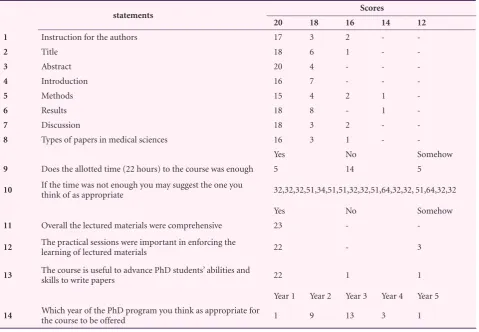
The results of the course evaluation are presented in Table 4. The number of students who gave the highest score (20) to the materials and implementation of the sessions on instructions for the authors, title and abstract, introduction, materials and methods, results, discussion, and types of medical papers were 18.24 , 20.24, 16.23, 16.23, 15.24, 18.23, 15.21, respectively (Table 4). Moreover, the majority (14.25) of the participants believed that the allotted time to the course was not enough, and the majority of them (9 out of 17) suggested that the course duration was better to increase to 32 hours. Almost all the participants believed that overall the materials lectured were comprehensive, the practical sessions were important in learning the lectured materials, and the course was useful in advancing their abilities and skills to write papers.
Discussion
The results of the evaluation of the present course indicate that based on the participants’ scores, the course was able to increase their knowledge of the structure and the role of various sections of papers in medical sciences, and increased their ability and skills to write papers. They also show that the majority
of the students believed that the duration of the course was not enough, and suggested that it should be increased to 32 hours (equal to two credits per semester). Moreover, the results showed that the best time for offering the course was the third year of PhD programs.
A scientific research, no matter how extraordinary the findings are, is completed only when it is published. Writing is the cornerstone of scientific research, and good writing is essential to publishing and disseminating scientific findings, whereas bad writing can and often prevents or delay the publication of good sciences (3). Graduate student worldwide are mainly educated and trained in their fields of study, and are rarely trained in writing scientific papers. They usually learn writing by imitating the prose and style of previous authors. Considering the significance of teaching graduate students to write scientific papers, it is regrettable to realize that there are few courses on scientific writing offered worldwide.
One of the first challenges in the design of the course was the selection of its content, which was based on the areas in which I believed the graduate students were in need of improvement. Previous studies have shown that an understanding of the structure of scientific article was essential in empowering various Table 4. The results of evaluation of Principles of Writing Biomedical Research Paper course
statements Scores
20 18 16 14 12
1 Instruction for the authors 17 3 2 -
-2 Title 18 6 1 -
-3 Abstract 20 4 - -
-4 Introduction 16 7 - -
-5 Methods 15 4 2 1
-6 Results 18 8 - 1
-7 Discussion 18 3 2 -
-8 Types of papers in medical sciences 16 3 1 -
-Yes No Somehow
9 Does the allotted time (22 hours) to the course was enough 5 14 5
10 If the time was not enough you may suggest the one you think of as appropriate 32,32,32,51,34,51,51,32,32,51,64,32,32, 51,64,32,32
Yes No Somehow
11 Overall the lectured materials were comprehensive 23 -
-12 The practical sessions were important in enforcing the learning of lectured materials 22 - 3
13 The course is useful to advance PhD students’ abilities and skills to write papers 22 1 1
Year 1 Year 2 Year 3 Year 4 Year 5
14 Which year of the PhD program you think as appropriate for the course to be offered 1 9 13 3 1
learners to write scientific papers (12).Therefore, I used around 11 books (17-27)to select the content of the lecture materials, which provided information of the structure of each section of scientific papers.
The evaluation showed that almost all of the respondents (22 out of 24) stated that the mentioned course was useful in advancing their abilities and skills to write papers. Considering the electiveness of the course, lack of obligation to taking the course, and anonymity of the evaluation, the students’ views may somehow be a true reflection of their improvement during the course. Previous studies have shown that educational intervention in the form of workshops or courses did result in increased publication rate (28-30). Moreover, previous studies have shown that lack of knowledge about writing scholarly publication (31) and understanding of basic principles of scientific writing and data presentation (8) were two of the main barriers to scientific writing. Considering the course content and practical activities, which were mainly to teach structure and principles of writing scientific papers, it may not be unreasonable to conclude that the course would be able to advance the abilities and skills of the participants in practice. Learning to structure an article, how to write and abstract/title, and how to synthesize argument, which are among the main objectives of the present course were the most cited aspects of a course on scientific writing (32). It would be interesting to examine if the course is able to improve the students’ abilities and skills to write papers in practice, and help increase the publication rate of the participants.
The course was an elective credit one and students took part voluntarily. The nature of voluntariness of the course led to the registration of motivated students. Moreover, students were from a diverse background including pharmacology, physiology, anatomical sciences, pharmaceutical biotechnology, epidemiology and physiotherapy. Variation in the field of studies of the participants, not only did not hinder their participation in class discussion, but also enhanced it. In class discussions, attention was paid to the nature of journalism and arts of scientific writing, and not the science aspect of the papers. For example, when a participants’ assignment on introduction was being discussed, the way that the introduction was written, the sequence of introduction writing, the verb tenses, way of writing literature review, research question or hypothesis, and research objective were criticized. In fact, the heterogeneity of the participants’ background proved beneficial in providing feedback on each others’ writing.
Based on the results of the student’s evaluation, the present course was modified and the number of hours for the course was increased to 32 (equal to 2 credits).
As a result of the revision performed, a new session on manuscript submission and editorial process, a practical session on result, and two practical sessions on discussion were added to the course.
In conclusion, the evaluation of the present course showed that it was able to increase the participants’ knowledge about the structure of scientific papers, and enhance their abilities and skills to write papers. The evaluation was used as a basis to modify the course.
Acknowledgement
I sincerely thank Dr. Imanieh, President of Shiraz University of Medical Sciences, Dr Sagheb, the University Vice-President for Education, and members of the University Educational Council for their support and advice.
References
1. King DA. The scientific impact of nations. Nature. 2004 Jul 15;430(6997):311-6. PubMed PMID: 15254529. 2. Baldwin C, Chandler GE. Improving faculty publication
output: the role of a writing coach. J Prof Nurs. 2002 Jan-Feb;18(1):8-15. PubMed PMID: 11859488. 3. Rosenfeldt FL, Dowling JT, Pepe S, Fullerton MJ. How
to write a paper for publication. Heart Lung Circ. 2000 Oct;9(2):82-7. PubMed PMID: 16352000.
4. Taylor J, Lyon P, Harris J. Writing for publication: a new skill for nurses? Nurse Educ Pract. 2005 Mar; 5(2):91-6. PubMed PMID: 19038185.
5. Sprague S, Bhandari M, Devereaux PJ, Swiontkowski MF, Tornetta P, 3rd, Cook DJ, et al. Barriers to full-text publication following presentation of abstracts at annual orthopaedic meetings. J Bone Joint Surg Am. 2003 Jan;85-A(1):158-63. PubMed PMID: 12533587. 6. Weber EJ, Callaham ML, Wears RL, Barton C, Young
G. Unpublished research from a medical specialty meeting: why investigators fail to publish. JAMA. 1998 Jul 15;280(3):257-9. PubMed PMID: 9676674.
7. Hicks C. A survey of midwives’ attitudes to, and involvement in, research: the first stage in identifying needs for a staff development programme. Midwifery. 1993 Jun;9(2):51-62. PubMed PMID: 8332092. 8. Marusic A, Marusic M. Teaching students how to read
and write science: a mandatory course on scientific research and communication in medicine. Acad Med. 2003 Dec;78(12):1235-9. PubMed PMID: 14660423. 9. Marusic A, Marusic M. What can medical journal
editors do in war? Lancet. 2002 Dec;360 Suppl:s59-60. PubMed PMID: 12504508.
10. Keen A. Writing for publication: pressures, barriers and support strategies. Nurse Educ Today. 2007 Jul;27(5):382-8. PubMed PMID: 16904796.
11. Sommers PS, Muller JH, Bailiff PJ, Stephens GG. Writing for publication: a workshop to prepare faculty as medical writers. Fam Med. 1996 Oct;28(9):650-4. PubMed PMID: 8909969.
12. Bydder S, Packer D, Semmens J. The value of a scientific writing training workshop for radiologists and radiation oncologists. Australas Radiol. 2006 Feb;50(1):29-32. PubMed PMID: 16499724.
faculty publication productivity. Fam Med. 1995 Apr;27(4):255-9. PubMed PMID: 7797004.
14. Dong Zh GB. Biomedical writing course1998: Available from: http://www.authoraid.info/resource-library/ china-medical-board-program-resources/cmb-lessons-in-scientific-writing/Intro%20Material.pdf. 15. Dong Zh GB. Biomedical writing course. 1998:
Available from: http://www.authoraid.info/resource-library/china-medical-board-program-resources/ cmb-lessons-in-scientific-writing/Sci%20Papers-%20 Part%201.pdf.
16. Dong Zh GB. Biomedical writing course.1998: Available from: http://www.authoraid.info/resource-library/ china-medical-board-program-resources/cmb-lessons-in-scientific-writing/Other%20Writing.pdf. 17. Cargil M, O’Connor P. Writing Scientific Research
Articles, Strategy and Steps; 2009.
18. Fraser J. How to publish in biomedicine, 500 tips for success. Abingdon UK: Radcliffe Medical Press; 2004. 19. Hall GM. How to write a paper. London: BMJ publishing
groups; 2003.
20. Hartley J. Academic writing and publishing. London: Routledge; 2008.
21. Huth EJ. Writing and publishing in medicine. Baltimore USA: Williams & Wilkins; 1999.
22. Katz MJ. From research to manuscript, a guide to scientific writing: Springer Science + Business Media B.V; 2009.
23. KÖrner AM. Guide to publishing a scientific paper.
London: Routledge; 2008.
24. Lang TA. How to write, publish & present in the health Sciences, a guide for clinicians & laboratory researchers. Philadelphia, USA: American College of Physicians; 2010.
25. Yang JT. An outline of Scientific writing. Singapore: World Scientific; 1999.
26. Zeiger M. Essentials of writing biomedical research papers.: McGraw-Hill; 2000.
27. BjörnGustavii. How to write and illustrate a scientific paper: Cambridge University Press, Cambridge; 2008. 28. Henninger DE, Nolan MT. A comparative evaluation of
two educational strategies to promote publication by nurses. J Contin Educ Nurs. 1998 Mar-Apr;29(2):79-84. PubMed PMID: 9582776.
29. Lawrence MM, Folcik MA. Writing for publication. J Nurs Staff Dev. 1996 Nov-Dec;12(6):289-93.
30. Murray R, Newton M. Facilitating writing for publication. Physiotherapy 2008; 94(1):29-34. doi: 10.1016/j.physio.2007.06.004.
31. Pololi L, Knight S, Dunn K. Facilitating scholarly writing in academic medicine. J Gen Intern Med. 2004 Jan;19(1):64-8. PubMed PMID: 14748862.