Available Online at www.ijergs.in
Volume - 4, Issue - 6, November - December - 2018, Page No. 34 - 39
Corresponding Author: Bhavesh Jain, Volume - 4, Issue - 6, November – December 2018, Page No. 34 - 39
Pag
e
34
A Review on Basic Database Concepts
1
Bhavesh Jain, 2Pradeep Jha, 3Sameeksha Sharma, 4Prapti Pandey
Department of Computer Science, Arya College of Engineering and Research Centre Jaipur, India,
E-Mail: [email protected], [email protected], [email protected] ,
4
Abstract
Database management system is a set of interdisciplinary data and a set of applications and procedures to provide
mechanisms to store, access and manage data in a secure manner. In this paper Provides an overview of database
management system such as its components, data models such as ER graph. This paper presents the basic
fundamentals of Database System and the conversion of ER diagram into the data base tables.
Keywords: Data, Data Abstraction, DDL,DML, DCL, TCL, ER Diagram.
Introduction
Database Management System (DBMS) is primarily a setup of programs that enable the user to enable, modify and
display data, which facilitates the design, maintenance and access to the database. The DBMS system exempts the
user from really knowing how to store data and manipulate the Complex algorithm is used to execute operations in
the database. It only focuses on how much operations are done to contain data from the database. The DBMS is
responsible for access, security, storage and a host of other Database system features. It does this by a selection of
computer programs. This allows you to manage a large number of structured data, which forms a database and
provides access to many simultaneous users in saving data integrity. [1] [2]
Applications of DBMS
a) Railway Reservation System:- The database is required to reserve a reservation of reservation, distance status
and train connection. Also, if trains are permanently, people come to know them by updating the database.
b) Library Management System:- There are thousands of books in the library so it's easier to keep a record of
all books in a copy or record. Therefore, the database management system (DBMS) was used to keep all
information about the publication date of the book, the name of the book, the author and the availability of the
book.
c) Banking:- We do thousands of transactions over banks everyday and we can do without the bank. So, it is
very easy to sit in the house by sending money or receiving by banks. Everything can only be done because
DBMS manages all bank transactions.
d) Universities and colleges:- Online exams today apply today and colleges and colleges are all supported by the
DBMS. Student introduction details, results, courses and grades are stored in the database.
e)Credit card transactions:- To purchase credit cards, all other transactions can only be reached by a DBMS
© IJERGS, All Rights Reserved.
Pag
e
35
Pag
e
35
Pag
e
35
Pag
e
35
Pag
e
35
Pag
e
35
Pag
e
35
Pag
e
35
Pag
e
35
Pag
e
35
Pag
e
35
Pag
e
35
Pag
e
35
Pag
e
35
Pag
e
35
Pag
e
35
Pag
e
35
Pag
e
35
Pag
e
35
Pag
e
35
Pag
e
35
f) Telecom:- There is a database for tracking information about made calls, network usage, customer details, and
so on. Without a database system, it is difficult to maintain this huge amount of data that is updated every
millisecond.
View of data
A database system is a set of shared data and a set of programs that allow users to access and access data
simultaneously. One of the main tasks of the database system is to provide abstract data to users. This system
describes specific details on how to save and save data.
Data Abstraction
To make the system more user-friendly, the data should be efficiently recovered. The need for an efficient design
results in the use of complex structural data to store data in the database. Since many users of the database system are
not being downloaded on the computer, developers develop the complexity of users through different levels of
abstraction to simplify interaction with the system:
Physical level:- It tells us how the data is stored in the system memory, that is, in which the data structure is
located. Since these data are actually stored, they are not visible to external users and not to programmers. For
example, the data may be in the form of units of bits, bytes and words. In the same way, it also informs us
about the path, that is, the location data in the memory.
Logical level :- The next top level (also known as the conceptual level) determines the type of data and the
relationship between the data. It also reports on the limitations associated with the data. For example, in a
university management system, an important entity is the student. The student can have a name of the type of
yarn and its signs of the type of buoy and DOB of the type of date and the age of the correct type.
View level:- The level of observation that is also called external level is the higher level of abstraction. It tells
us how the data looks to the external user. There may be several different views, which means that different
external users may only be interested in the data related to them. For example, in a university, the accountant
will only deal with the data related to the Accounts section. In the same way, students will be able to see data
related to them, such as their marks and their individual status in the drawings.
© IJERGS, All Rights Reserved.
Pag
e
36
Pag
e
36
Pag
e
36
Pag
e
36
Pag
e
36
Pag
e
36
Pag
e
36
Pag
e
36
Pag
e
36
Pag
e
36
Pag
e
36
Pag
e
36
Pag
e
36
Pag
e
36
Pag
e
36
Pag
e
36
Pag
e
36
Pag
e
36
Pag
e
36
Pag
e
36
Pag
e
36
Purpose of Database Management system
DBMS has been developed to handle all faults of typical file systems supported by traditional operating systems.
Some of the DBMS's endeavors are data replay and inconsistency, data problems, data isolation, integrity issues,
subsequent updates, simultaneous access to multiple users and security issues.
Drawbacks of using file systems to store data:
Data redundancy and Inconsistency: Multiple file formats, duplicate information in different files. Difficulty in accessing data: You need to write a new program to perform any new task.
Data isolation : multiple files and formats
Integrity problems: Limiting integrity (for example account balance> 0) is part of the program code. It is
difficult to add new restrictions or to change existing restrictions
Atomicity of updates: If the database does not remain in an inconsistent, there may be temporary updates. For
example, the transfer of funds from one account to another must be complete or not even come
Concurrent access by multiple users: Synchronous access required for performance. Unchecked access at
the same time can lead to inconsistencies.
Disadvantages of DBMS
The database system has the following disadvantages:-
Cost:- Data Base Management System requires high initial investments for hardware, software and trained
staff. A large investment depends on the size and the organization process if necessary. The Organization will
also pay annual maintenance expenses.
Complexity:- DBMS systems meet many requirements and solve many database problems. But all these
functions made the DBMS a very complex program. The developer, the designer, the DBA and the end user
must have the complete skills database if they want to use them correctly. If you do not understand this
complex system, it can cause the loss of data or the failure of the database.
Database Failure:- As you know, in DBMS all files are stored in a database, so the database is more likely to
fail. Any random accident in a component can lead to loss of valuable data. This is a big question for big
companies.
Extra Cost of Hardware:- A DBMS system requires disk storage for data, and sometimes you need to buy
extra space to save your data. Sometimes you need to have a device to work better for the database. These
devices and storage space increase the hardware costs.
Database Administrator
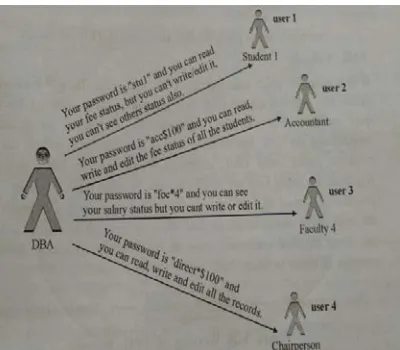
The database administrator or DBA is the person who supervises and controls the database. The DBA is ultimately
responsible for determining access levels (read, read, write, read, write and modify) to a specific person in the
organization. The responsibilities that come under the DBA are:
a) Schema definition- The DBA must define the structure of the database by writing queries in some query language. In
the same way, the "restrictions applied" through codes are also made by the DBA.
© IJERGS, All Rights Reserved.
Pag
e
37
Pag
e
37
Pag
e
37
Pag
e
37
Pag
e
37
Pag
e
37
Pag
e
37
Pag
e
37
Pag
e
37
Pag
e
37
Pag
e
37
Pag
e
37
Pag
e
37
Pag
e
37
Pag
e
37
Pag
e
37
Pag
e
37
Pag
e
37
Pag
e
37
Pag
e
37
Pag
e
37
different people. Not everyone can access the administrator's account. A very similar example of this task is to create an
account in the computer system. Often, when we use the system, we realize: the administrator and the user, and we need
to enter the password to enter the system through a particular account.
The concept of authorization is Shown in figure which is given below:-
Figure 2 : DBA is giving the authorization to different users that “What an upto which level” they can
access the data .
1 Modification of logical level and physical level schema- When necessary, the DBA must modify the structure of the
database by executing queries. To improve performance, you can sometimes modify the physical level chart.
2 Routine Maintenance- The activities are called at regular intervals or at specified intervals. Disk storage is
sufficiently provided and data is blocked by unauthorized persons also during routine maintenance.
DBMS Languages
The DBMS should provide the appropriate languages and interfaces for each class of users to provide queries and
updates in the database. The database language is used to create and maintain a database. There are many database
languages, such as Oracle, MySQL, MS Access, dBase, FoxPro, and so on. SQL operators, commonly used in
Oracle and MS Access, can be used as a Data Definition Language (DDL), a DCL Data Management Language
(DML), and Data Processing Language (DML) [2]
Data Definition Language (DDL) :- It is the language that enables users to identify their communication
with other types of data. He is mainly used to create files, databases, dictionary data, and tables in databases.
Also, to determine the structure of each table, a set of values associated with each ITB, internalization
restrictions, information security and permissions for each table, and the physical structure of storing each
table on the disk are used.
Data Manipulation Language (DML) : It is a language that provides a set of processes for supporting the
processing of initial data in data in databases. It allows users to import, update, delete and retrieve data from
the database. A part of the DML language that contains recovery data is called in the query language.
Data Control Language(DCL):-DCL declarations control access to data and the database using statements
© IJERGS, All Rights Reserved.
Pag
e
38
Pag
e
38
Pag
e
38
Pag
e
38
Pag
e
38
Pag
e
38
Pag
e
38
Pag
e
38
Pag
e
38
Pag
e
38
Pag
e
38
Pag
e
38
Pag
e
38
Pag
e
38
Pag
e
38
Pag
e
38
Pag
e
38
Pag
e
38
Pag
e
38
Pag
e
38
Pag
e
38
can be SELECT, ALTER, DELETE, EXECUTE, INSERT, INDEX, etc. In addition to granting privileges,
you can also revoke them (recover them) with the REVOKE command.
Transaction Control (TCL): The data is used to limit changes made by DML statements. Donation
Collection provides logical transactions. Requirements - Save jobs. SAVEPOINT: Stakes a point in a
transaction that can later recover. ROLLBACK: Unless the last meeting again shows the database to the father.
Authentication Process: Change the transaction files, such as the level of isolation and some accounting party.
E-R DIAGRAM
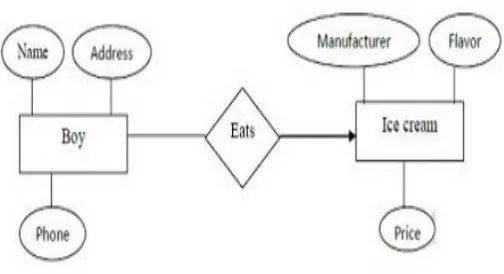
A relationship diagram of an institution is also called an E-R model. It is also a graphic representation of institutions
and relationships between individuals.
Conversion of ER Diagram into table
The example of the ER Diagram is given below-
Conversion of the above ER Diagram into the table is given below-
© IJERGS, All Rights Reserved.
Pag
e
39
Pag
e
39
Pag
e
39
Pag
e
39
Pag
e
39
Pag
e
39
Pag
e
39
Pag
e
39
Pag
e
39
Pag
e
39
Pag
e
39
Pag
e
39
Pag
e
39
Pag
e
39
Pag
e
39
Pag
e
39
Pag
e
39
Pag
e
39
Pag
e
39
Pag
e
39
Pag
e
39
Table 2 : Ice Cream
Conclusion
At the end we conclude that the database management system has advantages and disadvantages. Database
Management System (DBMS) is a software application for efficient and efficient storage, access and updating of
major content. The DBMS system can use the utility drama dramatically. In addition, it makes it easier for users to
check their database.
The DBMS is a fully-operated system designed to allow you to quickly and accurately determine the DBMS system
with user-friendly and user-friendly features in your subscription schedule. For example, if you want to run a system
that is running DBMS, the user will be able to log in the replication and isolation of data. It is also used to recover
data effectively. This means that the DBMS will delete some duplicate data.
Although this duplicate data is not completely eliminated, you must control the amounts of repetition data. Without
DBMS, the programmer or person who performs the database will have a lot of work to organize data when entering
data in the database. We also convert the ER scheme to the database table.
Reference
1. Er. Anshuman Sharma, Mr. Anurag Gupta and Jagmohan Mago, “Fundamentals of DBMS”, Lakhanpal
Publishers, fourth edition, 2011.
2. Database - Definition of database by Merriam- Webster.
3. A. B. Silberschatz, H. F. Korth, and S. Sudarshan, “Database System Concepts”, McGraw-Hill, sixth edition,
2011.
4. Soror Sahri, “Design of a Scalable Distributed Database System: SD-SQL Server", IEEE,2006.
5. Alessandro Artale, Francesca Cesarini, and Giovanni Soda, " Describing Database Objects in a Concept
Language Environment", IEEE TRANSACTIONS ON KNOWLEDGE AND DATA ENGINEERING, VOL. 8,
NO. 2, pp - 345-351 , APRIL 1996.
6. Elisa Bertino and Ravi Sandhu, " Database Security—Concepts, Approaches, and Challenges", IEEE
TRANSACTIONS ON DEPENDABLEANDSECURECOMPUTING, VOL.2, NO.1, JANUARY-MARCH,