IJRTSM
INTERNATIONAL JOURNAL OF RECENT TECHNOLOGY SCIENCES & MANAGEMENT
Wear Analysis of Clutch Material by Using Pin-on-Disk Method
Sandeep Badlani
1, Ajay Bhargava
2,
Amardeep Kumar
3,Nitesh more
4Acropolis Technical Campus, Indore
Mail. Id-
[email protected]
ABSTRACT
When applying sliding force on a rotating friction surfaces heat will be generated and the surface temperature will increase this change in temperature will change the properties of the material too. Due to friction between mating part some part of friction material get wear out. The objectives of this research work were to investigate the effect of loads on friction and wear behavior of different clutch material discs under dry operating conditions and also to predict the nature of various clutch materials. We have conducted wear and friction analysis on the basis of load applied by using PIN-ON-DISK TEST METHOD. And wear rate can be used as a quantitative comparative value for wear resistance. The results showed that the Carbon Carbon clutch material is one of the best, with excellent gripping and less wear, as compared to other clutch material under test.
KEYWORDS: . clutch materials, Tribology, Pin-on-disk test method
I.
I
NTRODUCTIONClutch is very significant element of machine which plays a vital role in the transmission of power from one part (the driving a part of the machine) to a different (the driven part). A well-known use for the clutch is in automobile wherever it’s used to connect the engine & the gearbox.
Clutch Materials like Asbestos, Semi metallic, sintered metal, Carbon Carbon and Mild Steel have been widely used. In order to subjecting the material into action, it is essential to look into their characteristics property which includes friction and wear. Hence it has become objective of the present work. Based on trials on the variation of load the properties like
friction and wear.
II.
.
METHODOLOGY
In our research work we are using Wear and Friction Monitor – ED 201 machine. The Ducom Wear and Friction Monitor – ED 201 consists of a rotating disc against which tests pin or ball is pressed with a known force. A provision for measurement of compound wear and frictional force is provided. This machine represents a considerable advance in terms of simplicity and convenience of operation. This
machine is intended to use medium loads (0-30N) than the conventional machines and is intended for only dry condition. This machine facilitates analysis of friction and wear characteristics in sliding contacts under desired condition. Sliding occur between the stationary pin on a rotating disc. Normal load and wear track diameter can be varied to suit the test conditions. Tangential friction force and wear are monitored with electric sensors and displayed on the front panel.
http: // www.ijrtsm.com© International Journal of Recent Technology Science & Management
individual nature and compare both properties by plotting on same graph. The graph between Experimental data and theoretical one was somehow similar this indicated that our procedure to obtaining the results were right.
For the second phase specimen of desired shape were required. For the same the raw material of Asbestos, Semi Metallic, Sintered Metals and Carbon were chosen.
This method is based on following principle:
1. Archard’s equation: The Archard wear equation is a simple model used to describe sliding wear and is based around the theory of asperity contact. It concludes that the volume of the removed debris due to wear is proportional to the work done by friction forces.
Q = Where:
Q is the total volume of wear debris produced K is a dimensionless constant
W is the total normal load L is the sliding distance
H is the hardness of the softest contacting surfaces
WL is proportional to the work done by the friction forces as described by Reye's hypothesis.
2. Amontons' First Law: The force of friction is directly proportional to the applied load.
FF α N
Where N is Normal load
3. Amontons' Second Law: The force of friction is independent of the apparent area of contact
4. Coulomb's Law of Friction: Kinetic friction is free from the sliding velocity.
Euler’s law: the buckling of pin is said to what proportion axial load is applied:
Axial force on pin causing the pin to buckle = (Pin material modulus of elasticity * Pin Dia.4 ) / Pin Length2
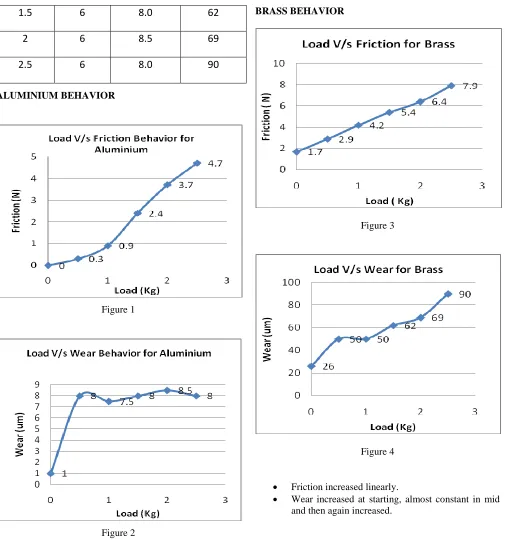
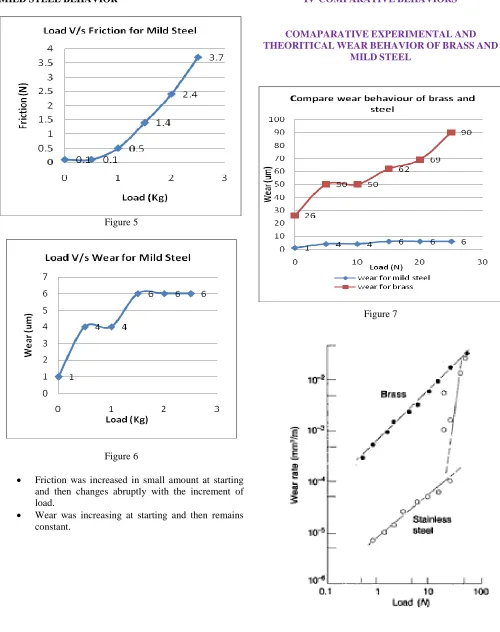
It has been noticed that when we increase the load the friction was found to be increase. In case of Aluminium, friction increases in small amount at starting after that the rate was increased. In Brass the increasing rate of friction was constant and in Mild Steel the friction was increasing at starting and then shows the small change in friction with the increment of load. Also, in Mild Steel the change in friction was minimum as compare to others specimen, Bright bar shows little bit more friction.
The value of coefficient of friction with relevance to time, load and velocity for all materials in numerous values and graphical value for comparative study of all materials for choosing better of them. Carbon-carbon is that the best material for clutch as a result of clutch material ought to face up to with high thermal impact and high speed and carbon carbon is most up-to-date development during this field and ready to with stand at warm temperature and high speed than others.
III.RESULTSOFWEAR
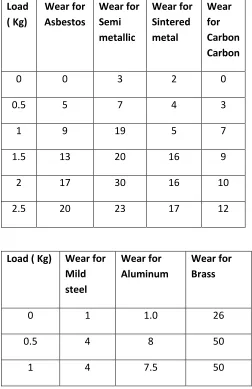
It has been noticed that when we increase the load the wear was found to be increased. In case of Aluminium, wear increases at starting and then retarded. In Brass, the wear was increasing linearly and in Mild Steel the wear was increasing at starting and then remains constant with the increment of load. Asbestos shows the wear amount of 20 micrometer hen it was subjected to testing conditions..Semi Metallic indicated the wear amount of 23 micrometer. Sintered metal clutch showed the wear amount of 17 micrometer. Carbon Carbon shows the less wear amount of 12 micrometer.
Table 1 Result of Load V/s Wear
Load
( Kg)
Wear for
Asbestos
Wear for
Semi
metallic
Wear for
Sintered
metal
Wear
for
Carbon
Carbon
0
0
3
2
0
0.5
5
7
4
3
1
9
19
5
7
1.5
13
20
16
9
2
17
30
16
10
2.5
20
23
17
12
Load ( Kg) Wear for
Mild
steel
Wear for
Aluminum
Wear for
Brass
0
1
1.0
26
0.5
4
8
50
1.5
6
8.0
62
2
6
8.5
69
2.5
6
8.0
90
ALUMINIUM BEHAVIOR
Figure 1
Figure 2
Friction increased in small amount at starting after that the rate was increased.
Wear increased at starting and then retarded.
BRASS BEHAVIOR
Figure 3
Figure 4
Friction increased linearly.
http: // www.ijrtsm.com© International Journal of Recent Technology Science & Management MILD STEEL BEHAVIOR
Figure 5
Figure 6
Friction was increased in small amount at starting and then changes abruptly with the increment of load.
Wear was increasing at starting and then remains constant.
IVCOMPARATIVEBEHAVIORS
COMAPARATIVEEXPERIMENTALAND
THEORITICALWEARBEHAVIOROFBRASSAND MILDSTEEL
Figure 7
on lists actually distracts a person from the immediacy of each encounter.
One cannot change one’s face but facial expression can be changed . Though, some emotional stages can be judged easily and their meaning are simple and similar in every culture and tradition as anger, love, hatred, sadness, worry, nervousness, anxiety, pity, ego, etc. But there may be different ways to communicate such emotions . So “how” to show these emotions and thoughts may vary from culture to culture. In basic term it is called etiquette and manners and officially it is called protocol.
When using dimensions of culture – time control, status, individualism, etc. – we understand that these dimensions point to probabilities about cultures that are worth paying attention to – and the word probability is key. The same is true when we observe non-verbal behaviour and attempt to decipher its meaning.
The most important thing to keep in mind about non-verbal behaviors is that they do not translate across cultures easily
COMAPARATIVEEXPERIMENTALAND THEORITICALWEARBEHAVIOROFALUMINIUM
Figure 9 Table 2
Load
( Kg)
Wear for
Asbestos
Wear for
Semi
metallic
Wear for
Sintered
metal
Wear
for
Carbon
Carbon
0.5
5
7
4
3
1
9
19
5
7
1.5
13
20
16
9
2
17
30
16
10
2.5
20
23
17
12
Load ( Kg)
Wear
for Mild
steel
Wear for
Aluminum
Wear
for
Brass
0.5
4
8
50
1
4
7.5
50
1.5
6
8.0
62
2
6
8.5
69
2.5
6
8.0
90
V.CONCLUSION
Clutch Materials like Asbestos, Semi metallic, sintered metal, Carbon Carbon and Mild Steel have been widely used. In order to subjecting the material into action, it is essential to look into their characteristics property which includes friction and wear. Hence it has become objective of the present work. Based on trials on the variation of load the properties like friction and wear vary, the following conclusions are made,
1. As per the experimental work performed, Brass shows the higher wear rate with
respect to Aluminium and mild steel. 2. Carbon Carbon showed the best results.
3. With the help of results obtained describing the nature of Asbestos, Semi-Metallic, Sintered metal ,Carbon Carbon and Mild Steel, we can predict the nature which is helpful to understand the behavior of material at different conditions. After studying the Mechanical friction and wear properties of organic, semi metallic, sintered metal, Carbon Carbon and Mild Steel sample under the different loading conditions, the following works are suggested to be carried out in the future. 1. The similar studies can be made for other types of widely used materials etc.
2. The studies on friction and wear properties of sample can also be performed by variable speed.
3. The studies can be further extended for considering the effect of change in microstructure of the material with or without heat treatment.
R
EFERENCES[1]Prepared by Benjamin Mell &m Guillaume Begin, Wear Rate Analysis Using Tribology &3D Metrology,Today’s standard for tommorrow’s materials, 2010 NANOVEA [2]Pradnya Kobse, B.Chittranjan More, Performance
Characteristics of a Disc Brake Friction Material, Performance Characteristics of a Disc Brake Friction Material, Institute of Technology, Nirma University, Ahemdabad-Dec-2010
[3]Wenyi Yan, Noel P. O’Dowd , Esteban P. Busso, Numerical study of sliding wear caused by a loaded pin on a rotating disc.
[4]Rikard Maki, Wet Clutch Tribology, Lulea University of Technology Department of Applied Physics and Mechanical Engineering Division of Machine Element, Doctoral Thesis, 2005.
[5]Totten, G., E. Howes, and M. A.H, Steel Heat Treatment Handbook. 1997, Marcel Dekker, Inc. p. 157.
[6]W. Ost, P. De Baets and J. Degrieck. The tribological behaviour of paper friction plates for wet clutch application investigated on SAE II and pin-on disk test rigs. 2001.