Turkish Journal of Fisheries and Aquatic Sciences 13: 657-663 (2013)
www.trjfas.org ISSN 1303-2712 DOI: 10.4194/1303-2712-v13_4_11
© Published by Central Fisheries Research Institute (CFRI) Trabzon, Turkey in cooperation with Japan International Cooperation Agency (JICA), Japan
Effects of Illumination Intensity on Growth Parameters and Swim Bladder
Development in Common dentex (
Dentex dentex
, L.) Larvae
Introduction
Common dentex (Dentex dentex) is a highly economic species which is distributed the Mediterranean, the Atlantic from the Bay of Biscay to Madeira and, rarely, the Black Sea (Bauchot and
Hureau, 1986; Koumoundouros et al., 1999). This species is considered to promising candidate species for Mediterranean aquaculture due to a higher growth rate than gilthead sea bream Sparus aurata, possesses the ability to spawn spontaneously and current production technology may be applied to its culture
Şükrü Yıldırım
1,*,
Cüneyt Suzer
1, Deniz Çoban
2, H. Okan Kamacı
1, Kürşat Fırat
1, Şahin Saka
11
Ege University, Faculty of Fisheries, Aquaculture Department, 35100 Bornova, Izmir, Turkey.
2
Adnan Menderes University, Faculty of Agriculture, Department of Aquatic Biosciences, 09010 Aydın, Turkey.
* Corresponding Author: Tel.: +90.232 3115211; Fax: +90.232 3883685; E-mail: [email protected]
Received 2 May 2013 Accepted 11 October 2013
Abstract
The influences of three different light intensities were investigated on growth of common dentex (Dentex dentex) during
larval period (0-35 day). Three different illumination levels were compared that 10 lx as group A, 30 lx described group B and 100 lx named group C in triplicates, respectively. Larvae were cultured in a recirculating aquaculture system using a green water technique. The longest total length and the heaviest weight were found as 18.43±1.9 mm and 38.48±5.1 mg in group B with 30 lx light intensity. Same parameters were 18.03±2.5 mm and 36.72±4.8 mg for group C with 100 lx light intensity; 16.23±1.7 mm and 28.53±4.2 mg for group A with 10 lx light intensity. In terms of total length and weight, there were significant differences in group A (P<0.05), however, differences were not detected between B and C groups (P>0.05). Also, swim bladder inflation rates were calculated as 88.3±2.7, 92.1±1.6 and 91.4±1.3% for groups A, B and C, respectively and did not presented significant differences among groups (P>0.05). In addition, survival rates were 8.8±3.1, 23.5±2.5 and 19.9±2.8%, respectively. While not significant differences were found between group B and C (P>0.05), but group A presented significantly difference compared to other groups (P<0.05). As a result, it is thought that illumination effected
husbandry parameters were more affirmative with 30 lx light intensity in Dentex dentex under culture conditions.
Keywords: Illumination, larval growth, swim bladder, survival rate, common dentex, Dentex dentex.
Işık Yoğunluğunun Sinarit (Dentex dentex, L.) Larvalarında Büyüme Parametreleri ve Hava Kesesi
Gelişimine Olan Etkileri
Özet
Bu çalışmada 3 farklı ışık yoğunluğunun üretim periyodu boyunca (0-35 gün) sinarit (Dentex dentex) larvalarının
büyümesine olan etkileri incelenmiştir. 3 tekrarlı yürütülen denemede 3 farklı ışık yoğunluğu karşılaştırılmış ve sırasıyla 10 lux A grubu, 30 lux B grubu ve 100 lux C grubu olarak tanımlanmıştır. Larvalar yeşil su tekniği kullanılarak akışkanlı sistemde üretilmiştir. En yüksek total boy 18,43±1,9 mm ve 38,48±5,1 mg ağırlık değerleri olarak 30 lux uygulanan B grubunda bulunmuştur. Aynı parametreler 100 lux denenen C grubunda 18,03±2,5 mm ve 36,72±4,8 mg, 10 lux uygulanan A grubunda ise 16,23±1,7 mm ve 28,53±4,2 mg olarak ölçülmüştür. Boyca büyüme ve ağırlık artışı açısından, A grubu farklı bulunmuş (P<0,05), ancak B ve C grubu arasında önemli farklılıklar tespit edilmemiştir (P>0,05). Bunun yanında, hava kesesi gelişim oranları A, B ve C grupları için sırasıyla %88.3±2,7, 92,1±1.6 ve 91.,4±1,3 olarak hesaplanmış, ancak gruplar arasında önemli bir farklılık göstermemiştir (P>0,05). Ek olarak, yaşama oranları gruplara göre sırasıyla %8,8±3,1, 23,5±2,5 ve 19,9±2,8 olarak hesaplanmıştır. B ve C grubu arasında önemli farklılık tespit edilmez iken (P>0.05) A grubu diğer deneme
gruplarına göre farklı bulunmuştur (P<0,05). Sonuç olarak, kültür koşulları altında farklı ışık yoğunlukları sinarit Dentex
dentex larvalarının büyüme parametrelerini etkilemiş, 30 lux ışık yoğunluğunda daha olumlu sonuçlar tespit edilmiştir.
658
(Glamuzina et al., 1989; Efthimiou et al., 1994; Loir
et al., 2001). During the past decade, culture of common dentex relatively increased and reached a considerable level of development in certain Mediterranean countries (Abellan, 2000; Rueda and Martinez, 2001; Loir et al., 2001). Also, common dentex has attracted wide interest therefore, more studies have been focused on its reproduction and physiology (Pavlidis et al., 2000; Saka et al., 2004), larval rearing (Glamuzina, et al., 1989; Pastor et al., 1995), nutrition (Tibaldi et al., 1996; Mourente et al., 1999), morphological and osteological ontogeny (Koumoundouros et al., 1999; 2004). It is important species for diversification of Mediterranean aquaculture industry due to faster growth rate and economical gain than the Sparid species.
More than past decades, due to over saturation of aquaculture by two species, European sea bass (Dicentrarchus labrax) and gilthead seabream (Sparus aurata), culture of promising candidate species that would diversity to expand the market for aquacultured species. Scientific and technical interests have focused on native species and their biological cycle can be reproduced using currently available breeding techniques. Therefore, common dentex could be accepted as a credible candidate for marine culture (Abellan, 2000; Rueda and Martinez, 2001; Loir et al., 2001). Studies on this species in its natural environment are scarce, and mostly have focused on finding its distribution, determining the timing of gonadal maturation under natural conditions or describing its early life history, morphology, nutritional ontogeny, physiology and production (Santamaria et al., 2004; Koumoundouros et al., 2004; Fırat et al., 2003, 2005; Pérez-Jiménez et al., 2009; Gisbert et al., 2009). Over the last decades, however, a considerable number of scientific reports have been published concerning the biology and culture techniques of common dentex in captivity (Morales-Nin and Moranta, 1997; Suzer et al., 2006; Giménez and Estevez, 2008a,b). Common dentex is normally found in the Mediterranean basin and in recent years it has been successfully produced in Greece, Italy and Spain, where its market price is similar to that of other marine farmed species.
Among the numerous abiotical factors affecting the activity of fish larvae, light and light intensity have an important crucial role under culture conditions which must be reared in a specific light ranges, depending on the developmental stage and the species (Chatain and Ounais-Guschemann, 1991; Boeuf and Le Bail, 1999). Especially, in order to enhance swim bladder inflation and promote the larval growth, illumination is the main crucial criteria under culture conditions. Besides, lack of functional swim bladder is caused to malnutrition, lack of movement, spinal deformities and delay of development (Chatain, 1986; Chatain and Ounais-Guschemann, 1991). In this study, effects of different illumination levels, which are the common light
intensities for larval rearing period in Mediterranean aquaculture on growth parameters and swim bladder inflation of common dentex (Dentex dentex) are studied.
Materials and Methods
Broodstock and Egg Incubation
Common dentex broodstock, 8 females (3.4 kg mean weight) and 8 males (2.6 kg mean weight), were selected from wild broodstocks and maintained in 16 m3 cylindrical tank during the natural spawning season between April and May. In order to enhance of spawning, no hormonal treatment was administered for breeders. After spawning, egg collectors on the broodstock tank were monitored and eggs were immediately taken from collectors. Following fertilization, the viable buoyant eggs were separated from the dead sinking eggs from the same batch. Eggs were incubated in 50 litre cylindrical conical incubators with 3000 eggs.L-1 density in seawater at 16.00.5C. Oxygen saturation was over 85%, salinity was 37 ppt and pH was 7.650.23. Ammonia and nitrite components were always below 0.012 mg.L-1.
Larval Rearing
Larvae of common dentex were cultured in recirculating aquaculture system using a green water technique and also larval rearing parameters and protocols were carried out according to Firat et al.
(2005).
On day 3, the mouth opened and also from this date until 18 DAH, larvae were fed at density of 10– 15 individuals.ml-1 with two strains of rotifers (Brachionus plicatilis but mainly with Brachionus rotundiformis) enriched with algae and enrichment media (DHA Protein Selco, Artemia Systems SA, Ghent, Belgium). In similar with rotifer, two grade of
Artemia nauplii (between 9 and 17 DAH at 4–6 individuals.ml-1, AF480 INVE Aquaculture) and
Artemia metanauplii (from 15 to 35 DAH at 2-4 individuals.ml-1, EG, Artemia Systems SA, Ghent, Belgium), both enriched with Protein Selco (Artemia Systems SA, Ghent, Belgium).
Experimental Design and Sampling
659
(Model YFE-YF1065).
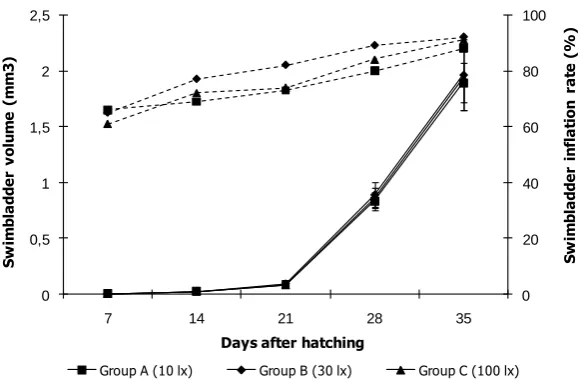
In order to measure of growth rate, larvae were sampled from each group per week (30 larvae sample group−1). At the end of the experiment, larval survival was determined by manually counted larvae remaining in the larval tanks. Swim bladder volume was calculated by following formulae (Ré et al., 1985). V= 4/3*π*a*b2 where a is the half of
maximum swim bladder length and b is the half of maximum swim bladder width.
Statistical Analysis
All measurements were conducted in triplicate. Data were presented as mean±SD. Levene test was used for determination of the variance homogeneity while Fischer’s chi-square test was performed to examine of survival data. All data were compared by one-way ANOVA, whereas followed by Newman-Keul’s multiple range test with a significance level of 5% and performed by SPSS 15.0 software.
Results
Larvae hatched out between 52-57 h after fertilization and hatching rate varied between 87 and 94%. Diameters of eggs and oil globules were 1004.31±17.02 µm and 232.84±5.59 µm, respectively and egg parameters were not significantly different (P>0.05).
In all groups, water temperature was between 16 and 20C, as average was 18.6±0.4°C and also mouth opening was observed at 3 DAH.
In group A with 10 lx, initial total length was 3.12±0.01 mm while it was measured as 4.04±0.2 mm at 7 DAH. It was 4.62±0.2 mm, 8.05±0. 5 mm, 12.12±1.4 mm, and 16.23±1.7 mm for 14, 21, 28, and 35 DAH respectively. In terms of weight development of larvae in group A, it was 0.945±0.01 mg on day 7 while it was 0.603±0.01 mg at 0 DAH. It was 3.04±0.8 mg, 15.11±1.1 mg, 19.18±2.1 mg, and 28.53±4.2 mg for 14, 21, 28, and 35 DAH, respectively (Fig.1).
In group B with 30 lx, total length development was measured as 4.07±0.1 mm and 3.12±0.01 mm at 0 and 7 DAH, respectively. It was 4.76±0.2 mm, 8.65±0.6 mm, 14.31±1.8 mm, and 18.43±1.9 mm for 14, 21, 28, and 35 DAH, respectively. In terms of weight development of larvae in group B, it was 0.922±0.11 mg on day 7 while it was 0.603±0.01 mg at 0 DAH. It was 3.21±0.9 mg, 16.22±1.4 mg, 23.07±3.5 mg, and 38.48±5.1 mg for 14, 21, 28, and 35 DAH, respectively (Figure 1).
In group C treated with 100 lx, total length development was estimated as 3.12±0.01 mm and 3.77±0.2 mm on day 0 and 7. Then, it was 4.63±0.1 mm, 8.11±0.8 mm, 13.72±1,7 mm, and 18.03±2.5 mm for 14, 21, 28, and 35 DAH, respectively. In terms of weight development of larvae in group C, it was 0.863±0.12 mg on day 7 while it was 0.603±0.01
mg at the beginning of the experiment. Then it was 3.12±0.9 mg, 15.53±1.18 mg, 21.27±1.06 mg, and 36.72±4.8 mg for 14, 21, 28, and 35 DAH, respectively (Figure 1).
Among groups, the longest larval length was found in group B treated with 30 lx. However, no significant differences were found between group B and C (P>0.05), while there were significant differences between group A and other experimental groups (P<0.05). Similarly, the heaviest weight was observed in group B. Although, there were no significant differences between group B and C (P>0.05), significant differences were recorded between group A and other experimental groups (P<0.05). Total length and weight development in groups are shown in Figure 1.
At the end of the experiment, survival rates were 8.8±3.1, 23.5±2.5 and 19.9±2.8% for groups A, B and C, respectively. In similar, no significant differences were noted between group B and C were (P>0.05), whereas group A was analyzed significantly different than the other experimental groups (P<0.05).
Initiation of swim bladder inflation percentages were observed from 5-7 DAH. The first inflation rate was determined on day 5 (Replicates A: 37.3, 39.7 and 34.6%; B: 42.2, 44.1 and 38.5%; C: 36.4, 33.8 and 29.2%) for the first time in all groups and also inflation rate exponentially increased by larval age at 6 (Replicates A: 56.1, 52.4 and 57.3%; B: 58.2, 61.4 and 54.9%; C: 54.6, 57.7 and 59.8%) and 7 DAH (Replicates A: 66.3, 62.2 and 68.7%; B: 65.4, 63.2 and 71.8%; C: 61.9, 55.1 and 63.5%). Finally, these rates reached to 88.3±2.7, 92.1±1.6 and 91.4±1.3% for group A, B and C, respectively at the end of the experiments. No significant differences were found among experimental groups (P>0.05).
In addition, on day 7, swim bladder volume was 0.055±0.006 mm3, 0.059±0.007 mm3 and
0.057±0.006 mm3 for groups A, B and C, respectively
(Figure 2). No statistical differences were found among groups (P>0.05). After this date, swim bladder volumes increased in all groups depending on larval age and size. Metamorphosis of swim bladder was observed between 15 and 20 days and about 3-5 fold increases were observed in swim bladder volumes. However, swim bladder hypertrophy was observed as 15, 11 and 18% for groups A, B and C, respectively. Increase of hypertrophic swim bladder volume was about 8-9 fold. Additionally, swim bladder metamorphosis was calculated more than these rates and also about from 14.6 to 18.4% swim bladder hypertrophy was observed between 23 and 29 DAH due to metamorphosis. At the end of the experiment, swim bladder volumes were 1.77±0.17 mm3,
1.94±0.31 mm3 and 1.86±0.28 mm3 for groups A, B
660
group A, B and C, respectively but all experimental groups did not presented significant differences (P>0.05). Swim bladder inflation and development in all groups are shown in figure 2.
Discussion
Light has an important role in the preparation of survival functions in all organisms (Boeuf and Le Bail, 1999). In aquaculture studies, light intensity and period as an abiotical factor, are very important, but have not been studied enough in culture conditions yet for many cultured fish species. These factors play a vital role in periods from incubation of eggs to forming larval pigmentation and from absorption of endogenous food reserves to formation of deformation. Many studies on larval development and
light have focused on the most cultured, gilthead sea bream Sparus aurata, European sea bass
Dicentrarchus labrax and candidate species, Atlantic halibut Hippoglossus hippoglossus and rainbow trout
Oncorhynchus mykiss, (Bolla et al., 1988; Saka et al., 2001; Weppe and Joassard, 1986; Fırat et al., 2003). In this study, influences of three different light intensities on swim bladder development and inflation and larval survival rate of common dentex (Dentex dentex) during larval development (between 0-35 DAH) was studied.
Growth was satisfactory in all groups except group A treated with 10 lx. The highest total length and weight development was observed in group B with 30 lx (18.43±1.9 mm and 38.48±5.1 mg, respectively). For groups A and C, these parameters were 16.23±1.7 mm, 28.53±4.2 mg and 18.03±2.5
0 10 20 30 40 50
0 5 10 15 20 25
0 7 14 21 28 35
W
ei
ght
(m
g)
To
tal
le
ngth
(
mm)
Days after hatching
T. Length A T. Length B T. Length C Weight A Weight B Weight C
Figure 1. Growth of Dentex dentex larvae in experimental groups during the experiment: total length (histogram) and weight (solid line). Each mean ±SD represents a pool of 30 larvae.
0 20 40 60 80 100
0 0,5 1 1,5 2 2,5
7 14 21 28 35
S
w
im
b
la
d
d
e
r
in
fl
a
ti
on
r
a
te
(
%
)
S
w
im
b
la
d
d
e
r
v
ol
u
m
e
(
m
m
3
)
Days after hatching
Group A (10 lx) Group B (30 lx) Group C (100 lx)
661
mm, 36.72±4.8 mg, respectively.
Similar results were recorded in the other cultured Sparid species under the same experimental design. In both common pandora (Pagellus erythrinus) and red porgy (Pagrus pagrus), two recent candidate species, the highest growth were observed in larvae exposed to 30 lx illumination, while poor growth parameters were recorded in the 10 lx conditions (Suzer and Kamacı, 2004; 2005). On the other hand, Fırat et al. (2005) and Çoban et al. (2009) estimated the total length of cultured common dentex larvae at 35 DAH around 15-16 mm under 80-100 lx conditions. It is considered that the between our results and authors’ results, are derived from breeders, egg and larvae quality, culture conditions, and/or larval feed (rotifera and Artemia). Moreover, in this study survival rates were 8.8±3.1, 23.5±2.5 and 19.9±2.8% for groups A, B and C, respectively. According to obtained results, relatively lower illumination (10 lx) resulted in poor growth parameters and survival. Critical change in growth parameters were recorded especially after 20 DAH. This could be related to lower light intensities not satisfying of biological requirement of dentex larvae during the metamorphosis stage and also relatively lower illumination levels caused to malnutrition due to dark zone in deeper side of experimental tanks. Similar pattern for survival rates were observed for both common pandora (Pagellus erythrinus) and red porgy (Pagrus pagrus) for all illumination levels in the same experimental conditions (Suzer and Kamacı, 2004; 2005). On the other hand, it was treated different photoperiod and light intensities during the larval rearing of this species, also the authors reported that the best conditions for illumination for this species were reported as 24 h L:0 h D photoperiod and at least 3.4 μmol m−2 s−1 illumination under culture conditions (Giménez and Estevez, 2008a).
It is well reported that swim bladder is a crucial hydrostatic organ which manage the vertical distribution and changing of buoyancy of larval fishes. Besides, it is claimed that the most critical stage generally observed after finishing of yolk sac reserves during the initial inflation of swim bladder (Chatain, 1986; Chatain, 1994; Kitajima et al., 1994). Larval swim bladder becomes functional by gulping air at the water surface during the dark stage of photoperiod (Chatain, 1986; Chatain, 1994; Kitajima
et al., 1994). Additionally, there are several factors effecting initial inflation and development of swim bladder such as water temperature, salinity, aeration, illumination, physico-chemical parameters of sea water, and tank shape and hydrodynamics (Chatain, 1986; Chatain, 1994; Kitajima et al., 1994). In this study, initial swim bladder inflation was observed between 5 and 7 DAH around 4.0-4.5 mm in all groups. As expected, the ratio of swim bladder to its volume increased significantly during the experiment depending on the larval age. Besides, it is reported that first swim bladder inflations was observed in
3.5-4.0 mm total length and between 5-10 days in Dentex dentex (Fırat et al., 2005; Çoban et al., 2009). As is the case for other sparids, the success of swim bladder inflation depends to a large extent on the photoperiod. Some studies by Abellán et al. (2000) stated that an 18:6 (L:D) photoperiod provides the best results both in terms of swim bladder inflation and larval survival (Rueda and Martinez, 2001). Similarly, in sea bream
(Sparus aurata) and sharpsnout sea bream (Diplodus puntazzo) larvae, this phemenon was determined 4.0-5.0 mm total length and between 5-9 days (Chatain, 1986; Marangos, 1995). Additionally, similar finding were recorded for both common pandora (Pagellus erythrinus) and red porgy (Pagrus pagrus) for all illumination levels in the same experimental conditions (Suzer and Kamacı, 2004; 2005).
Swim bladder hypertrophy was firstly identified as a stress syndrome in sea bass (D. labrax) larvae by Johnson and Katavic (1984). They observed that this syndrome could be described by failure of the larvae to inflate their swim bladder and/or hyperinflation of swim bladder due to sudden changes of abiotical factors such as temperature, salinity, aeration, illumination, and other physical-chemical parameters of culture conditions. This syndrome mostly caused vertebra deformities in fish larvae due to hyperinflation of swim bladder and higher pressure to larval notochord. In this study, several hypertrophic swim bladder were observed in all experimental groups. Similarly, a few common dentex larvae presented hyperinflation swim bladder between 25-35 DAH, which might be due to internal stress factors such as malnutrition and some organogenetic changes during the metamorphosis in this species. Besides, it is reported that lack of functional swim bladder and/or swim bladder hypertrophy could be caused to vertebral deformities in this species and marine fish larvae during early ontogeny (Chatain, 1986; Koumoundouros et al., 2004).
In conclusion, this study investigates relationships between illumination and growth parameters in D. dentex larvae during early ontogeny. It is thought that illumination effected husbandry parameters and also larval development, swim bladder inflation and survival rate were more affirmative with 30 lx light intensity in Dentex dentex culture, which is easily applicable in culture conditions.
References
Abellán, E. 2000. Culture of common dentex (Dentex
dentex L.): Present knowledge, problems and
perspectives. Cah. Options Méditerr., 47: 157–168. Bauchot, M.L. and Hureau, J.C. 1986. Sparidae In:
Whitehead, P.J.P., Bauchot, M.L., Hureau, J.C., Nielsen, J., Tortonese, E., (Eds.), Fishes of the North-Eastern Atlantic and Mediterranean. UNESCO, Paris: 883–907.
662
Bolla, S. and Holmefjord, I. 1988. Effect of temperature and light on development of Atlantic halibut larvae. Aquaculture, 74: 355–358. doi: 10.1016/0044-8486(88)90379-1
Chatain, B. 1986. La vessie natatoire chez Dicentrarchus
labrax et Sparus auratus. 1. Aspects Morphologiques
du developpement. Aquaculture, 53: 303-311. doi: 10.1016/0044-8486(86)90361-3.
Chatain, B. and Ounais-Guschemann, N. 1991. The
relationships between light and larvae of Sparus
aurata. Larvi ’91 Fish & Crustacean Larviculture
Symposium, 310-313 pp.
Chatain, B. 1994. Abnormal swim bladder development and
lordosis in sea bass (Dicentrarchus labrax) and sea
bream (Sparus auratus). Aquaculture, 119: 371–379.
doi: 10.1016/0044-8486(94)90301-8
Çoban, D., Suzer, C., Kamacı, H.O., Saka, Ş. and Fırat, K. 2009. Morphometric and allometric growth of
cultured common dentex (Dentex dentex). Journal of
FisheriesSciences.com, 3(1): 40-50. doi: 10.3153/jfscom.2009007
Efthimiou, S., Divanach, P. and Rosenthal, H. 1994. Growth, food conversion and agonistic behaviour in
common dentex Dentex dentex juveniles fed on
pelleted moist and dried diets. Aquat. Living Resour., 7: 267–275. doi: 10.1051/alr:1994029
Fırat, F., Saka, Ş. and Çoban, D. 2003. The effect of light intensity on early life development of gilthead
common dentex Dentex dentex (L. 1758) larvae.
Aquaculture Research, 34: 727–732. doi: 10.1046/j.1365-2109.2003.00875.x
Fırat, K., Saka, Ş. and Çoban, D. 2005. Early life history of
cultured common dentex, Dentex dentex (L. 1758).
Turk J. Vet. Anim. Sci., 29: 1–7.
Giménez, G. and Estévez, A. 2008a. Effect of larval and prey density, prey dose and light conditions on first
feeding common dentex (Dentex dentex L.) larvae.
Aquaculture Research, 39: 77–84. doi: 10.1111/j.1365-2109.2007.01875.x
Giménez, G. and Estévez, A. 2008b. Effects of two culturing techniques on the growth, survival and
larval quality of Dentex dentex Linnaeus, 1758.
Aquaculture Research, 39: 354–361. doi: 10.1111/j.1365-2109.2007.01726.x
Gisbert, E., Gimenéz, G., Fernández, I., Kotzamanis, Y. and Estevéz, A. 2009. Development of digestive enzymes
in common dentex Dentex dentex during early
ontogeny. Aquaculture, 287: 381–387. doi: 10.1016/j.aquaculture.2008.10.039
Glamuzina, B., Jug-Dujakovic, J. and Katavic, I. 1989. Preliminary studies on reproduction and larval rearing
of common dentex, Dentex dentex (Linnaeus 1758).
Aquaculture, 77: 75–84. doi:
10.1016/0044-8486(89)90023-9
Johnson, D.V. and Katavic, I. 1984. Mortality, growth and swim bladder stress syndrome of sea bass
(Dicentrarchus labrax) larvae under varied
environmental conditions. Aquaculture, 38: 67-78. doi: 10.1016/0044-8486(84)90138-8
Kitajima, C., Watanabe, T., Tsukashima, Y. and Fujita, S.
1994. Lordotic Deformation and Abnormal
Development of Swim Bladders in Some Hatchery-Bred Marine Physoclistous Fish in Japan. Journal of
World Aquaculture Society, 25: 64-77. doi:
10.1111/j.1749-7345.1994.tb00806.x
Koumoundouros, G., Divanach, P. and Kentouri, M. 1999.
Ontogeny and allometric plasticity of Dentex dentex
(Osteichthyes: Sparidae) in rearing conditions. Marine Biology, 135: 561–572. doi: 10.1007/s002270050657 Koumoundouros, G., Carrillo, J., Divanach, P. and
Kentouri, M. 2004. The rearing of common dentex
Dentex dentex (L.) During the hatchery and on–
growing phases. Aquaculture, 240: 165–173. doi: 10.1016/j.aquaculture.2004.01.038
Loir, M., Le Gac, F., Somarakis, S., Pavlidis, M. 2001. Sexuality and gonadal cycle of the common dentex
(Dentex dentex) in intensive culture. Aquaculture,
194: 363–381. doi: 10.1016/S0044-8486(00)00514-7 Marangos, C. 1995. Larviculture of the sheepshead bream,
Puntazzo puntazzo Gmelin 1789 Pisces. Sparidae. A
Workshop on Diversification in Aquaculture, Cyprus. Cah. Options Mediterr., 16: 41–46.
Morales-Nin, B. and Moranta, J. 1997. Life history and
fishery of the common dentex (Dentex dentex) in
Mallorca (Balearic Islands in Western
Mediterranean). Fisheries Research, 30: 67–76. doi: 10.1016/S0165-7836(96)00560-7
Mourente, G., Rodrýguez, A., Grau, A., Pastor, E. 1999.
Utilization of lipids by Dentex dentex L.
(Osteichthyes. Sparidae) larvae during lecitotrophia
and subsequent starvation. Fish Physiology and
Biochemistry, 21: 45–58. doi: 10.1023/A:1007789908409
Pastor, E., Riera, F.J., Pou, S., Greu, A., Pittman, K., Batty, R. and Verreth, J. 1995. Summary of investigations on reproduction and larval rearing of common dentex
(Dentex dentex L.). ICES Mar. Sci. Symp., 201: 148–
152.
Pavlidis, M., Greenwood, L., Mourot, B., Kokkari, C., Le Menn, F., Divanach, P. and Scott, A.P. 2000. Seasonal variations and maturity stages in relation to differences in serum levels of gonadal steroids, vitellogenin, and thyroid hormones in the common
dentex (Dentex dentex). Gen. Comp. Endocrinol, 118:
14–25. doi: 10.1006/gcen.1999.7440
Pérez-Jiménez, A., Cardenete, G., Morales, A.E., García-Alcázar, A., Abellán, E. and Hidalgo, C.M. 2009.
Digestive enzymatic profile of Dentex dentex and
response to different dietary formulations.
Comparative Biochemistry and Physiology, 154A: 157–164. doi: 10.1016/j.cbpa.2009.05.126
Ré, P., Rosa, H. C. and Dinis, M.T. 1985. Diel Rhytms in
Dicentrarchus labrax Larvae under Controlled
Conditions: Swimbladder Inflation, Feeding and Otolith Growth. Insev. Pesquera 49 (3): 411 - 418. Rueda, F.M. and Martínez, F.J. 2001. A review on the
Biology and Potential Aquaculture of Dentex dentex.
Reviews in Fish Biology and Fisheries, 11: 57-70. doi: 10.1023/A:1014276700138
Saka, Ş., Fırat, K. and Çoban, D. 2004. Development of
common dentex, Dentex dentex (L. 1758) eggs in
relation to temperature. Aquaculture Research, 35: 224-231. doi: 10.1111/j.1365-2109.2004.00986.x Saka, Ş., Fırat, K. and Suzer, C. 2001. The effect of light
intensity on early life development of gilthead sea
bream larvae, Sparus aurata. Israeli Journal of
Aquaculture–Bamidgeh, 53: 139–146.
Santamaría, C.A., Marin de Mateo, M., Traveset, R., Sala, R., Grau, A., Pastor, E., Sarasquete, C. and Crespo, S.
2004. Larval organogenesis in common dentex Dentex
dentex L. (Sparidae): histological and histochemical
aspects. Aquaculture, 237: 207–228. doi:
10.1016/j.aquaculture.2004.03.020
663
on larval development in common pandora (Pagellus
erythrinus, L. 1758) larvae. E.U. Journal of Fisheries
and Aquatic Science, 21(3–4): 319–323.
Suzer, C. and Kamacı, H.O. 2005. Effects of light intensity
on the larval development of the red porgy (Pagrus
pagrus, L. 1758) larvae. Science and Eng. J. of Fırat
Univ., 17(4): 613–620.
Suzer, C., Çoban, D., Kamacı, H.O., Saka, Ş. and Fırat, K. 2006a. Culture techniques used in larviculture of
common dentex (Dentex dentex, L.). Ege University,
Journal of Fisheries and Aquatic Sciences, 23: 31–35.
Tibaldi, E., Beraldo, P., Volpelli, L.A. and Pinosa, M. 1996.
Growth response of juvenile dentex (Dentex dentex.
L.) to varying protein level and protein to lipid ratio in practical diets. Aquaculture, 139: 91–99. doi: 10.1016/0044-8486(95)01150-1
Weppe, M. and Joassard, L. 1986. Preliminary study: effects of light on swim-bladder’s inflation of cultured
sea bass (Dicentrarchus labrax) larvae. In: C.P.