Katarzyna Zabłocka-Słowińska
1, A–D, Ewelina Dzielska
1, B–D,
Iwona Gryszkin
2, B, Halina Grajeta
1, E, FDietary Supplementation During Diabetes Therapy
and the Potential Risk of Interactions
1 Department of Food Science and Nutrition, Wroclaw Medical University, Poland 2 Nutrition and Dietetics Clinic, North Public Health Care Institution, Wrocław, Poland
A – research concept and design; B – collection and/or assembly of data; C – data analysis and interpretation;
D – writing the article; E – critical revision of the article; F – final approval of article; G – other
Abstract
Background. The classification of dietary supplements as foodstuffs promotes widespread access to them and increases the possibility of patients using them without being monitored. Unreasonable or excessive consumption of these preparations poses risks to type-2 diabetes mellitus (T2DM) patients (among others) because it may induce disturbances in glycemic control. The aim of this study was to assess the frequency of dietary supplementation among patients using anti-diabetic drugs and such patients’ nutrient intake in order to evaluate the potential risk of interactions.
Material and Methods. The study participants were 150 diabetic patients who were asked about the type of phar-macotherapy and dietary supplementation they used. The intake of minerals, vitamins, dietary fiber and long-chain polyunsaturated fatty acids (LC-PUFAs) from the patients’ diets were also assessed, using the 24-h dietary recall method.
Results. The highest percentage of patients taking individual anti-diabetic drugs used supplements containing magnesium and herbs. They also often took antioxidant vitamins, B-group vitamins and omega-3 fatty acids. In the majority of patients (both those using supplements and those not), the dietary recall showed insufficient intake of potassium, calcium and magnesium, as well as of vitamin E, folic acid, vitamin D and LC-PUFAs. In addition, their diets provided high median amounts of iron, copper, vitamin A and β-carotene.
Conclusions. The levelof dietary supplementation and the ill-balanced diets reported by the majority of the recruited T2DM patients indicate a high possible risk of interactions with the anti-diabetic drugs. Therefore, patients should always consult their physicians regarding dietary supplementation, and medically trained staff should routinely assess dietary intake to avoid hazardous changes in the activity of drugs (Adv Clin Exp Med 2014, 23, 6, 939–946).
Key words: dietary supplements, nutrients, anti-diabetic drugs, interactions.
Adv Clin Exp Med 2014, 23, 6, 939–946 ISSN 1899–5276
ORIGINAL PAPERS
© Copyright by Wroclaw Medical University
Complete treatment of type 2 diabetes melli-tus (T2DM) includes pharmacotherapy and com-plementary actions such as a well-balanced diet, physical activity and generally leading a healthy lifestyle. Numerous data confirm that patients suf-fering from T2DM tend to make dietary mistakes, especially insufficient micronutrient intake [1–4]. A low intake of minerals and vitamins is very haz-ardous due to increasing disturbances in carbohy-drate metabolism which can influence the phar-macological control of glycemia [5, 6]. Increasing public awareness of the role of nutrition in the prophylaxis and dietary therapy of many diseases,
including T2DM, can lead patients to take dietary supplements, which are very often incorrectly con-sidered substitutes for a well-balanced diet.
the potential risk of interactions with anti-diabet-ic drugs [8]. Polypharmacy is frequently observed among T2DM patients and is the key problem in giving good guidance to patients. In addition, a poorly-balanced diet and excessive supplemen-tation may contribute to disturbances in glycemic control. The purpose of this study was therefore to assess the frequency of dietary supplementation among patients using anti-diabetic drugs and such patients’ nutrient intake, in order to evaluate the potential risk of interactions.
Material and Methods
The study participants were 150 patients (100 women and 50 men) with diagnosed T2DM. All the patients were interviewed by trained staff using a questionnaire constructed by the au-thors, which consisted of questions concerning the use of anti-diabetic drugs and dietary supplements. The patients were also asked about the time inter-val between drug and dietary supplement admin-istration and about their awareness of the potential interactions between them.
Nutrient Intake
All the participants’ intakes of minerals, vita-mins, dietary fiber and long-chain polyunsaturat-ed fatty acids (LC-PUFAs) were assesspolyunsaturat-ed to com-pare the nutrient intake and (among those taking dietary supplements) the relevance of dietary sup-plementation. The 24-h dietary recall method was used to collect diet-related data. Nutrient intake was calculated with DIETA 5.0 software (IŻŻ Na-tional Food and Nutrition Institute, Warsaw, Po-land) and compared with the Estimated Average Requirements (EAR) [9]. Intake of β-carotene was compared with the upper level (UL), whereas in-take of Na, K, Mn and dietary fiber was compared with adequate intake (AI) [9, 10]. The EAR (UL or AI) cut-offs were used to assess the prevalence of insufficient dietary intake of vitamins, minerals, dietary fiber and LC-PUFAs.
Statistical Analysis
The data were analyzed using STATISTICA v. 10.0 software (StatSoft, Tulsa, OK, USA). Dif-ferences in dietary nutrient intake between the pa-tients using supplements and those not using them were evaluated with the U Mann Whitney test for nonparametric data. Differences in the percentage of supplemented and non-supplemented patients whose intake of nutrients was below the cut-off points were evaluated with the c2 test. A p value
less than 0.05 was considered statistically signifi-cant. All parameters are presented as median and range.
Results
The Participants’ Characteristics
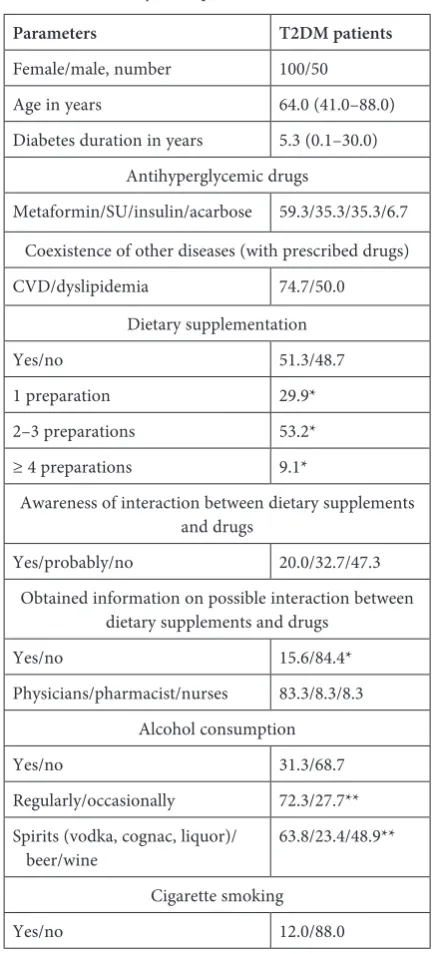
The baseline characteristics of the T2DM pa-tients who participated in the study are present-ed in Table 1. The mpresent-edian age of the patients and
Table 1. Characteristics of T2DM patients (n = 150) enrolled in the study (% of patients)
Parameters T2DM patients
Female/male, number 100/50 Age in years 64.0 (41.0–88.0) Diabetes duration in years 5.3 (0.1–30.0)
Antihyperglycemic drugs
Metaformin/SU/insulin/acarbose 59.3/35.3/35.3/6.7 Coexistence of other diseases (with prescribed drugs) CVD/dyslipidemia 74.7/50.0
Dietary supplementation
Yes/no 51.3/48.7
1 preparation 29.9* 2–3 preparations 53.2* ≥ 4 preparations 9.1*
Awareness of interaction between dietary supplements and drugs
Yes/probably/no 20.0/32.7/47.3 Obtained information on possible interaction between
dietary supplements and drugs
Yes/no 15.6/84.4*
Physicians/pharmacist/nurses 83.3/8.3/8.3 Alcohol consumption
Yes/no 31.3/68.7
Regularly/occasionally 72.3/27.7** Spirits (vodka, cognac, liquor)/
beer/wine 63.8/23.4/48.9** Cigarette smoking
Yes/no 12.0/88.0
median diabetes duration were 64.0 years and 5.3 years, respectively. The highest percentage of patients took metformin, followed by sulfonylou-rea, insulin and acarbose. About half of the re-cruited patients declared that they took dietary supplements. Most of them reported taking 2 or 3 supplements, and a 10th of them reported
ing 4 or more. Only about 16% of the patients tak-ing dietary supplements had received information about possible interactions between those prepa-rations and drugs. Out of those, the highest per-centage had received that information from phy-sicians. Most of the patients declared that they did not drink alcohol and did not smoke. Among the patients who reported drinking alcohol, the major-ity declared regular consumption (minimum once a week).
Dietary Supplementation
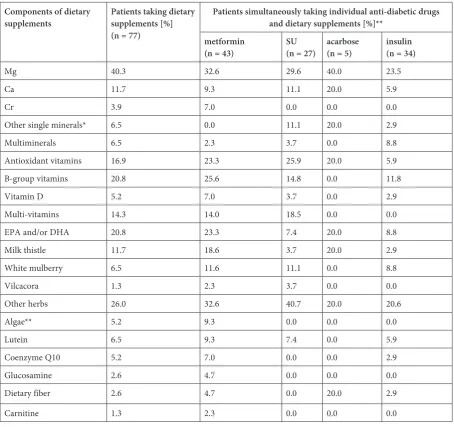
The frequency of simultaneous use of dietary supplementation and anti-diabetic drugs is pre-sented in Table 2.
Magnesium was the most popular dietary sup-plement among the study participants, followed by various herbs, B-group vitamins and EPA/DHA. A very small percentage of the patients supple-mented their diets with dietary fiber, white mul-berry and chromium.
The highest percentage of the metformin pa-tient group used supplements containing magne-sium, herbs, B-group vitamins, antioxidant vita-mins and omega-3 fatty acids. An unexpectedly small percentage of this group took dietary fiber.
In the sulfonylourea (SU) patient group, the highest percentage took herbs as dietary
Table 2. The frequency of simultaneous use of individual anti-diabetic drugs and dietary supplements (% of patients)
Components of dietary
supplements Patients taking dietary supplements [%] (n = 77)
Patients simultaneously taking individual anti-diabetic drugs and dietary supplements [%]**
metformin
(n = 43) SU(n = 27) acarbose(n = 5) insulin (n = 34)
Mg 40.3 32.6 29.6 40.0 23.5
Ca 11.7 9.3 11.1 20.0 5.9
Cr 3.9 7.0 0.0 0.0 0.0
Other single minerals* 6.5 0.0 11.1 20.0 2.9
Multiminerals 6.5 2.3 3.7 0.0 8.8
Antioxidant vitamins 16.9 23.3 25.9 20.0 5.9
B-group vitamins 20.8 25.6 14.8 0.0 11.8
Vitamin D 5.2 7.0 3.7 0.0 2.9
Multi-vitamins 14.3 14.0 18.5 0.0 0.0
EPA and/or DHA 20.8 23.3 7.4 20.0 8.8
Milk thistle 11.7 18.6 3.7 20.0 2.9
White mulberry 6.5 11.6 11.1 0.0 8.8
Vilcacora 1.3 2.3 3.7 0.0 0.0
Other herbs 26.0 32.6 40.7 20.0 20.6
Algae** 5.2 9.3 0.0 0.0 0.0
Lutein 6.5 9.3 7.4 0.0 5.9
Coenzyme Q10 5.2 7.0 0.0 0.0 2.9
Glucosamine 2.6 4.7 0.0 0.0 0.0
Dietary fiber 2.6 4.7 0.0 20.0 2.9
Carnitine 1.3 2.3 0.0 0.0 0.0
supplementation. About one third of the SU pa-tient group took dietary supplements with mag-nesium. Every fourth SU patient took antioxidant vitamins. None of them took coenzyme Q10, glu-cosamine, algae, dietary fiber or L-carnitine as di-etary supplements.
In the insulin patient group, magnesium was the most popular dietary supplement. Herbal di-etary supplements were used by 20.6% of these patients. Other dietary supplements used in this group were B-group vitamins, multi-minerals, white mulberry and omega-3 fatty acids.
Several patients taking acarbose used di-etary supplements containing magnesium, calci-um, other single minerals (selenicalci-um, zinc, potassi-um, iron), antioxidant vitamins, milk thistle, other herbs, omega-3 fatty acids and dietary fiber.
Nutrient Intake
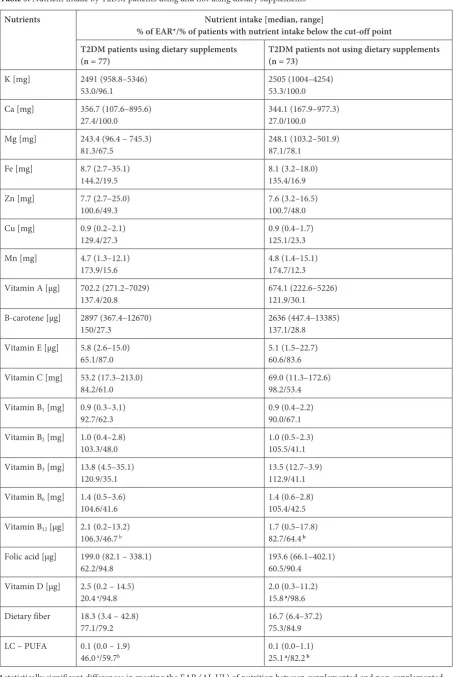
Nutrient intake was evaluated to assess whether the participants’ dietary supplementation was really needed, and if there were any differences in nutri-ent intake from diets between the participants tak-ing supplements and those who did not (Table 3).
The majority of the patients taking supple-ments had insufficient amounts of the following minerals in their diets: potassium (about 96% of the patients), calcium (all the patients) and magne-sium (67.5% of patients). Surprisingly, the intake of these minerals in the non-supplemented pa-tients was even more inadequate: in this group all the patients had inadequate dietary potassium and calcium, and 78% had inadequate dietary mane-sium. The median daily intake of trace minerals was very similar in the supplemented and the non- -supplemented T2DM patients, and there were no statistically significant differences between them. In almost half of the participants (both the sup-plemented and the non-supsup-plemented groups), the intake of zinc from their diets was insufficient.
Antioxidant vitamins (A, E, C and β-carotene) were provided by the participants’ diets in very different amounts. The median intake of vitamin A from diets was 702.2 µg/d (137.4% of the EAR) in the supplemented group and 674.1 µg/d (121.9% of the EAR) in the non-supplemented group. The diets of both the supplemented and non-supple-mented groups provided a high median amount of β-carotene, which met the upper level (UL) in 150% and 137.1%, respectively. The majority of the supplemented and non-supplemented groups reported an insufficient intake of vitamin E (87% and 83.6%) and vitamin C (61.0% and 53.4%) from their diets. Inadequate intake of B1, B6 and B12
vita-mins were noted respectively for 62.3%, 41.6% and 46.7% of the supplemented group and for 67.1%,
42.5% and 64.4% of the non-supplemented group. Compared to the supplemented patients, a statisti-cally significant higher percentage of the non-sup-plemented patients reported an inadequate intake of vitamin B12 from their diet (p = 0.02). A very
high percentage of supplemented and non-supple-mented patients (exceeding 90%) consumed insuf-ficient amounts of folic acid. The mean intake of vitamin D by both the supplemented and non-sup-plemented participants was very low, reaching the EAR in only 20.4% and 15.8%, respectively; how-ever, the difference between these two groups’ vita-min D intake was statistically significant (p = 0.02). About 60% of the supplemented patients showed an insufficient intake of LC-PUFA, and an even higher percentage of non-supplemented patients (exceeding 80%) consumed LC-PUFAs at a lev-el blev-elow the EAR; the difference between the two groups in meeting the EAR for LC-PUFAs was sta-tistically significant (p < 0.01).
Discussion
This study focused on the frequency of dietary supplementation among T2DM patients in con-nection with the potential hazards of such sup-plementation. The mechanisms of interaction be-tween the components of dietary supplements and oral anti-diabetic agents have not been explicitly described in the literature. The possible mecha-nisms of hypoglycemic action have been summa-rized for many dietary supplements, which makes it possible to hypothesize that drug-dietary supple-ment interaction may indeed occur [11–14]. In this study, almost half the T2DM patients took dietary supplements, which could indicate a high potential risk of interactions with drugs or nutrients.
Taking magnesium as a dietary supplement by a high percentage of the participants was rather positive in light of the dietary magnesium deficien-cy reported by both the supplemented and the non- -supplemented groups of patients. Magnesium is an essential co-factor for the enzymes involved in glucose metabolism, and it improves the suscepti-bility of peripheral tissues to insulin[15]. T2DM patients are usually characterized by a lower serum concentration of this mineral compared to nor-mal subjects, as a result of an inadequate supply of magnesium from food and/or increased elimina-tion from the body [16]. A proper supply of this nutrient from food or supplementation may have a beneficial effect on glycemic control in T2DM patients [17].
Table 3. Nutrient intake by T2DM patients using and not using dietary supplements
Nutrients Nutrient intake [median, range]
% of EAR*/% of patients with nutrient intake below the cut-off point T2DM patients using dietary supplements
(n = 77) T2DM patients not using dietary supplements (n = 73)
K [mg] 2491 (958.8–5346)
53.0/96.1 2505 (1004–4254)53.3/100.0 Ca [mg] 356.7 (107.6–895.6)
27.4/100.0 344.1 (167.9–977.3)27.0/100.0 Mg [mg] 243.4 (96.4 – 745.3)
81.3/67.5 248.1 (103.2–501.9)87.1/78.1 Fe [mg] 8.7 (2.7–35.1)
144.2/19.5 8.1 (3.2–18.0)135.4/16.9 Zn [mg] 7.7 (2.7–25.0)
100.6/49.3 7.6 (3.2–16.5)100.7/48.0 Cu [mg] 0.9 (0.2–2.1)
129.4/27.3 0.9 (0.4–1.7)125.1/23.3 Mn [mg] 4.7 (1.3–12.1)
173.9/15.6 4.8 (1.4–15.1)174.7/12.3 Vitamin A [µg] 702.2 (271.2–7029)
137.4/20.8 674.1 (222.6–5226)121.9/30.1 Β-carotene [µg] 2897 (367.4–12670)
150/27.3 2636 (447.4–13385)137.1/28.8 Vitamin E [µg] 5.8 (2.6–15.0)
65.1/87.0 5.1 (1.5–22.7)60.6/83.6 Vitamin C [mg] 53.2 (17.3–213.0)
84.2/61.0 69.0 (11.3–172.6)98.2/53.4 Vitamin B1 [mg] 0.9 (0.3–3.1)
92.7/62.3 0.9 (0.4–2.2)90.0/67.1 Vitamin B2 [mg] 1.0 (0.4–2.8)
103.3/48.0 1.0 (0.5–2.3)105.5/41.1 Vitamin B3 [mg] 13.8 (4.5–35.1)
120.9/35.1 13.5 (12.7–3.9)112.9/41.1 Vitamin B6 [mg] 1.4 (0.5–3.6)
104.6/41.6 1.4 (0.6–2.8)105.4/42.5 Vitamin B12 [µg] 2.1 (0.2–13.2)
106.3/46.7 b 1.7 (0.5–17.8)82.7/64.4b
Folic acid [µg] 199.0 (82.1 – 338.1)
62.2/94.8 193.6 (66.1–402.1)60.5/90.4 Vitamin D [µg] 2.5 (0.2 – 14.5)
20.4 a/94.8
2.0 (0.3–11.2) 15.8 a/98.6
Dietary fiber 18.3 (3.4 – 42.8)
77.1/79.2 16.7 (6.4–37.2)75.3/84.9 LC – PUFA 0.1 (0.0 – 1.9)
46.0 a/59.7b
0.1 (0.0–1.1) 25.1 a/82.2b
a statistically significant differences in meeting the EAR (AI, UL) of nutrition between supplemented and non-supplemented
patients (U Mann Whitney; p < 0.05); bstatistically significant differences in percentage of supplemented and
only a very small percentage of the recruited pa-tients used supplements containing it. Chromium supplementation can be beneficial for fasting se-rum glucose, total cholesterol and triglyceride con-centrations and the percentage of HbA1c, as well as body weight and insulin sensitivity in T2DM pa-tients [18–20]. On the other hand, it was not pos-sible to evaluate chromium intake from the partic-ipants’ diets, so it is unknown whether there was any necessity to supplement their diets with this trace mineral.
Fewer than 20% of the participants used an-tioxidant vitamins as dietary supplements. Anti-oxidants can reduce hyperglycemia-induced tis-sue damage and may be effective in preventing the progression of the chronic complications of diabe-tes [15]. Chen et al. [21]demonstrated the synergis-tic action of retinoids and insulin in the induction of glucokinase gene expression due to the activation of the retinoic acid receptor and retinoid X recep-tor, which may help in glucose homeostasis. In turn, vitamin E supplementation by T2DM patients can help to reduce the risk of developing cardiovascular disease by preventing the oxidation of low-densi-ty lipoproteins [15].Shinde et al. [22] demonstrat-ed a rdemonstrat-eduction in oxidative stress and an improve-ment in antioxidant enzyme activity and vascular endothelial function in T2DM patients treated with anti-diabetic agents supplemented with vitamin E, as compared with patients treated only with glucose- -lowering drugs. However, the pro-oxidative action of vitamin E, which depends on the dose, the du-ration of supplementation and the dudu-ration of dia-betes, may alter the expected effect of supplemen-tation [22]. In the present study, the participants’ dietary intake of vitamin E and C were rather inad-equate, therefore supplementation with these anti-oxidants would be probably favorable.
It was also advisable for the patients’ diets to be supplemented with B-group vitamins (mainly B6) because of insufficient vitamin B intake from
their diets. Dietary supplementation with B-group vitamins, as used by 20.8% of the supplemented patients in this study, may be helpful in the pre-vention and treatment of chronic complications of the cardiovascular and nervous systems of T2DM patients [23]. It can also prevent vitamin B12
de-ficiencies, which are common among T2DM pa-tients treated with metformin [24]. It has also been shown that vitamin B12 status can be improved by
calcium supplementation [25], which was reported by only about 10% of the patients treated with met-formin; this is unfortunate, given their very poor dietary calcium intake.
Only a small percentage of the patients in the present study took vitamin D as a dietary supple-ment. Considering the dietary deficiencies of this
vitamin shown in almost all the patients from both the supplemented and non-supplemented groups, it would be desirable for them to supplement their diets with this vitamin. Vitamin D plays an impor-tant role in the proper secretion and activity of insu-lin. Specific receptors for vitamin D are located on the surface of islet β cells,and binding vitamin D to them may enhance insulin secretion. Vitamin D is also known to be involved in maintaining the prop-er extracellular concentration of calcium ions and their flow into the pancreatic β cells. An increased concentration of calcium ions in the cytosol of β cells promotes the release of insulin [26]. Sulfony-lourea (SU) has a similar mechanism for enhanced insulin secretion [26]. In the current study, only some of the patients taking SU used vitamin D as a dietary supplement. The intake of vitamin D and calcium from these patients’ diets was insufficient to enhance the pharmacological effect of SU.
Dietary supplementation with EPA/DHA is recommended for individuals with determined di-etary deficiencies in LC-PUFAs. LC-PUFAs affect lipid-carbohydrate metabolism and exhibit insuli-notropic and anti-inflammatory activity through membrane receptors [27].They also inhibit the ex-pression and activity of pro-inflammatory cytok-ines and decrease the activity of the pro-inflamma-tory nuclear factor β (NF-β), which promotes the expression and increases the activity of many pro-inflammatory genes and molecules, e.g. cytokines and chemokines that induce insulin resistance [28]. An increased intake of LC-PUFAs (EPA, DHA) al-so elicits an increase in skeletal muscle membrane fluidity, the number of insulin receptors and insu-lin action [29]. Sankar et al.[30] also demonstrat-ed the synergistic activity of sesame oil, consisting of 43% PUFA, with glibenclamide. Patients simul-taneously taking this anti-diabetic drug and sesa-me oil had significantly better biochemical results of carbohydrate metabolism than those who used only glibenclamide or only sesame oil.
Among the T2DM patients recruited for the present study, many took dietary supplements con-taining herbal ingredients that can interact with an-ti-diabetic drugs. For example, SU is metabolized primarily in the liver, in particular by CYP2C9 and to a lesser extent by CYP3A4. Inhibitors and in-ducers of CYP2C9 and CYP3A4 9 (e.g. herbs) may alter the pharmacokinetics of sulfonylourea, which may affect its final therapeutic effect [31].
antihyperglycemic properties, according to the lit-erature [14]. The probable mechanisms of spiruli-na action are stimulation of pancreatic islet β cells to secrete insulin and/or to increase the transport of glucose into the peripheral tissue[14]; this sig-nificantly increases the probability of SU-spirulina interaction. In this study, only a low percentage of patients (5.2%) took the spirulina as a dietary sup-plement, therefore the potential risk of overlap-ping hypoglycemic activities was very low.
The study assessed the participants’ nutrient intake and compared the results from the supple-mented and non-supplesupple-mented patient groups. It turned out to be very similar in both groups. Sur-prisingly, the supplemented patients had some nu-trients in their diets in higher median amounts than the non-supplemented patients did (vitamins A, E, D, B3, B12, β-carotene, and LC-PUFA), but no
statistically significant differences were observed between these 2 groups except for K, vitamin D, vitamin B12 and LC-PUFAs intake. It seems that
the patients’ decisions to take dietary supplements were rather haphazard and did not result from a preliminary assessment of their nutrient intake.
The authors also found that the participants’ diets showed high deficiencies of some nutrients that are critical in the dietary care of diabetic pa-tients, including vitamin E, vitamin C, folic acid and vitamin D, as well as potassium, calcium, mag-nesium and LC-PUFAs. In the light of these re-sults, dietary supplementation could improve the nutritional status of T2DM patients. On the oth-er hand, the first step to enhance nutritional status would involve changes in incorrect dietary habits.
The authors concluded that proper compre-hensive care for T2DM patients entails pharma-cotherapy and many complementary factors, such as appropriate nutritional status and use of di-etary supplements. The potential risk of interac-tions among the nutritional components of food, dietary supplements and anti-diabetic drugs may change the expected results of pharmacotherapy due to the supplements’ impact on the pharmaco-kinetic or (more frequently) the pharmacodynam-ic properties of the drug. Dietary supplementation with hypoglycemic effects and an ill-balanced diet were reported in a high percentage of the T2DM patients recruited for this study, which indicates a very possible risk of interaction with the anti-di-abetic drugs they used. In view of the above, pa-tients should always consult physicians regard-ing dietary supplementation, and trained medical staff should routinely assess T2DM patients’ di-etary intake to avoid hazardous changes in the ac-tivity of drugs.
This study has several limitations and un-certainties. Although data was collected on co-existing cardiovascular disease and dyslipidemia, the patients were not asked about drugs used in these and other diseases. Multi-treatment is a very strong risk factor for interaction and may interfere with glycemic control, certainly more than dietary supplementation and/or an ill-balanced diet. Ad-ditionally no information was obtained regarding the surveyed patients’ adherence to medication. As Cramer et al. [32] pointed out, poor adher-ence to anti-diabetic drugs results in poor glyce-mic control.
Acknowledgements. The authors gratefully thank the director of Dobrzyńska Medical Center, Maciej Sokołowski MD, and the medical staff there for the opportunity to conduct interviews with diabetic patients.
References
[1] Yoshimura Y, Kamada C, Takahashi K, Kaimoto T, Satoshi I, Ohashi Y, Araki A, Umegaki H, Sakurai T, Ito H: The Japanese Elderly Diabetes Intervention Trial Study Group: Relations of nutritional intake to age, sex and body mass index in Japanese elderly patients with type 2 diabetes: the Japanese Elderly Diabetes Intervention Trial. Geriatr Gerontol Int 2012, 12, 29–40.
[2] Ahn H J, Min KW, Cho YO: Assessment of vitamin B6 status in Korean patients with newly diagnosed type 2 diabetes. Nutr Res Pract 2011, 5, 34–39.
[3] Oh HM, Yoon JY, Cho SH, Yoon JS: Vitamin A and vitamin E status of diabetic patients and normal adults in Korea. Korean J Nutr 2009, 42, 318–326.
[4] Bleich SN, Wang YC: Consumption of sugar-sweetened beverages among adults with type 2 diabetes. Diabetes care 2011, 34, 551–555.
[5] Chaudhary DP, Sharma R, Bansal DD: Implications of magnesium deficiency in type 2 diabetes: a review. Biol Trace Elem Res 2010, 134, 119–129.
[6] Walker AF: Potential micronutrient deficiency lacks recognition in diabetes. Br J Gen Pract 2007, 57, 3–4.
[7] Ustawa o bezpieczeństwie żywności i żywienia z dnia 29 czerwca 2010 r. Dz. U. 2010 r. Nr 136, poz. 914 z późn. zm.
[8] Suliburska J, Bogdański P: Ocena sposobu żywienia, stanu odżywienia oraz ryzyka występowania interakcji leków z żywnością u pacjentów z cukrzycą typu 2. Farm Współ 2011, 4, 3–8.
[9] Jarosz M: Normy żywienia dla populacji polskiej – nowelizacja. Wyd. IŻŻ, Warszawa 2012.
[11] Mudra M, Ercan-Fang N, Zhong L, Furne J, Levitt M: Influence of mulberry leaf extract on the blood glucose and breath hydrogen response to ingestion of 75 g sucrose by type 2 diabetic and control subjects. Diabetes Care 2007, 30, 1272–1274.
[12] Sheng X, Zhang Y, Gong Z, Huang C, Zang YQ: Improved insulin resistance and lipid metabolism by cinnamon extract through activation of peroxisome proliferator – activated receptors. PPAR Res 2008, 1–9.
[13] Horvath EM, Tackett L, McCarthy AM, Raman P, Brozinick JT, Elmendorf JS: Antidiabetogenic effects of chro-mium mitigate hyperinsulinemia – induced cellular insulin resistance via correction of plasma membrane choles-terol imbalance. Mol Endocrinol 2008, 22, 937–950.
[14] Layam A, Reddy CLK: Antidiabetic property of spirulina. Diabet Croat 2006, 35, 29–33.
[15] Guerrero-Romero F, Rodgiguez-Moran M: Complementary therapies for diabetes: the case for chromium, mag-nesium and antioxidants. Arch Med Res 2005, 36, 250–257.
[16] Wälti MK, Zimmermann MB, Spinas GA, Hurrell RF: Low plasma magnesium in type 2 diabetes. Swiss Med Wkly 2003, 133, 289–292.
[17] Dong J, Xun P, He K, Qin L: Magnesium intake and risk of type 2 diabetes. Diabetes Care 2011, 34, 2116–2122.
[18] Rabinowitz H, Friedensohn A, Leibovitz A, Gabay G, Rocas C, Habot B: Effect of chromium supplementa-tion on blood glucose and lipid levels in type 2 diabetes mellitus elderly patients. Int. J Vitam Nutr Res 2004, 74, 178–182.
[19] Martin J, Wang ZQ, Zhang XH, Wachtel D, Volaufova J, Matthews DE, Cefalu, WT: Chromium picolinate supplementation attenuates body weight gain and increases insulin sensitivity in subjects with type 2 diabetes. Diabetes Care 2006, 29, 1826–1832.
[20] Broadhurst CL, Domenico P: Clinical studies on chromium picolinate supplementation in diabetes mellitus – a review. Diab Technol Ther 2006, 8, 677–687.
[21] Chen G, Zhang Y, Lu D, Li N, Ross AC: Retinoids synergize with insulin to induce hepatic Gck expression. Biochem J 2009, 419, 645–653.
[22] Shinde SN, Dhadke VN, Suryakar AN: Evaluation of oxidative stress in type 2 diabetes mellitus and follow-up along with vitamin E supplementation. Ind J Clin Biochem 2011, 26, 74–77.
[23] Martini LA, Catania AS, Ferreira SRG: Role of vitamins and minerals in prevention and management of type 2 diabetes mellitus. Nutr Rev 2010, 68, 341–354.
[24] Liu KW, Dai DLK., Ho W, Lau E, Woo J: Metformin – associated vitamin B12 deficiency in the elderly. Asian J Gerontol Geriatr 2011, 6, 82–87.
[25] Bauman WA, Shaw S, Jayatilleke E, Spungen AM, Herbert V: Increased intake of calcium reverses vitamin B12 malabsorption induced by metformin. Diabetes Care 2000, 23, 1227–1231.
[26] Pittas AG, Lau J, Hu FB, Dawson-Hughes B: The role of vitamin D and calcium in type 2 diabetes. A systematic review and meta-analysis. J Clin Endocrinol Metab 2007, 92, 2017–2029.
[27] Flash P, Rossmeisl M, Bryhn M, Kopecky J: Cellular and molecular effects of n-3 polyunsaturated fatty acids on adipose tissue biology and metabolism. Clin Sci 2009, 116, 1–16.
[28] Singer P, Shapiro H, Theilla M, Anbar R, Singer J, Cohen J: Anti-inflammatory properties of omega-3 fatty acids in critical illness: novel mechanisms and an integrative perspective. Int Care Med 2008, 34, 1580–1592.
[29] Martín de Santa Olalla L, Sánchez Muniz FJ, Vaquero MP: n-3 fatty acids in glucose metabolism and insulin sensitivity. Nutr Hospital 2009, 24, 113–127.
[30] Sankar D, Ali A, Sambandam G, Rao R: Sesame oil exhibits synergistic effect with anti-diabetic medication in patients with type 2 diabetes mellitus. Clin Nutr 2011, 30, 351–358.
[31] Holstein A, Beil W: Oral antidiabetic drug metabolism: pharmacogenomics and drug interactions. Expert Opin Drug Metab Toxicol 2009, 5, 225–241.
[32] Cramer JA: A systematic review of adherence with medication for diabetes. Diabetes Care 2004, 27, 1218–1224.
Address for correspondence:
Katarzyna Zabłocka-Słowińska
Department of Food Science and Nutrition Wroclaw Medical University
Borowska 211 50-556 Wroclaw Poland
Tel: + 48 71 784 05 10
E-mail: [email protected]
Conflict of interest: None declared